Structure of the Digestive System
Note: The focus of the AQA specification is on the mechanisms of digestion and absorption — it doesn’t require knowledge of the structure of the digestive system. However, it’s hard to visualise how digestion and absorption work without a picture of where they occur, so this is included for context.
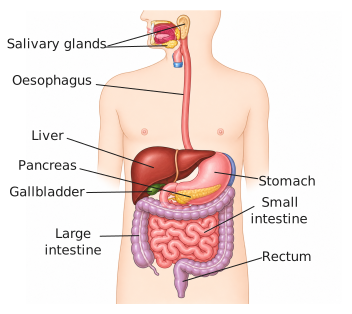
- Salivary glands — secretions contain amylase, which hydrolyses starch into maltose
- Mouth — physical breakdown of food by teeth, which forms a bolus of food so it can travel down the oesophagus
- Oesophagus — moves food from mouth to stomach by peristalsis
- Stomach — muscular sac with an inner lining containing glands that secrete enzymes (e.g. pepsin) and hydrochloric acid; stores food and digests proteins (protease enzymes)
- Pancreas — produces pancreatic juice containing proteases, lipase and amylase (alkaline).
- The pancreas has both exocrine (digestive enzymes — relevant to this topic) and endocrine functions (see Control of Blood Glucose)
- Small intestine (duodenum and ileum) — main site of digestion and absorption.
- Large intestine — absorbs water from undigested food
- Rectum — stores faeces before egestion
What is Digestion?
What you need to know (based on the AQA specification)
What you need to know (based on the AQA specification)
During digestion, large biological molecules are hydrolysed to smaller molecules that can be absorbed across cell membranes.
During digestion, large biological molecules are hydrolysed to smaller molecules that can be absorbed across cell membranes into the bloodstream.
You need to know about the digestion of:
- Carbohydrates — by amylases and membrane-bound disaccharidases
- Lipids — by lipase (with the action of bile)
- Proteins — by endopeptidases, exopeptidases and membrane-bound dipeptidases
All of these reactions are hydrolysis reactions (water is added to break the bond). Each enzyme works at a different optimal pH, which is why digestion happens in different parts of the body (e.g. proteases in the stomach at low pH; lipase in the small intestine at higher pH).
Digestion of Carbohydrates
What you need to know (based on the AQA specification)
What you need to know (based on the AQA specification)
Digestion of carbohydrates by amylases and membrane-bound disaccharidases.
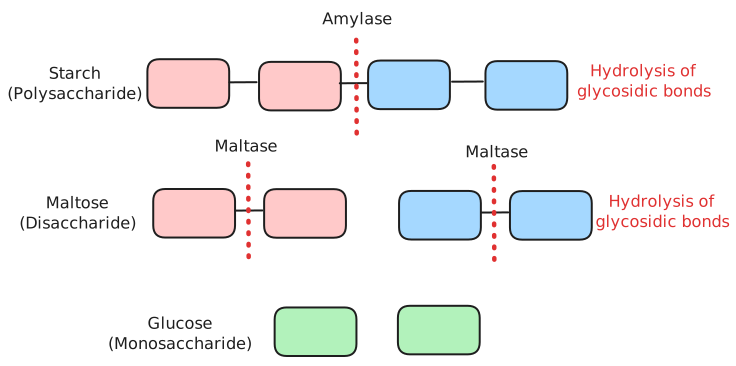
Step 1: Polysaccharides → Disaccharides
Starch is hydrolysed to maltose by amylases, which break the glycosidic bonds.
- Mouth (salivary amylase) — hydrolyses starch to maltose
- Small intestine (pancreatic amylase) — continues hydrolysing starch to maltose
Do you think starch is broken down in the stomach? Why/why not?
Do you think starch is broken down in the stomach? Why/why not?
No — the stomach is too acidic for salivary amylase, which becomes denatured. So no further hydrolysis of starch happens here. Starch digestion resumes in the small intestine when pancreatic amylase is added.
Step 2: Disaccharides → Monosaccharides
Membrane-bound disaccharidases hydrolyse disaccharides → monosaccharides.
- Disaccharidases are embedded in the cell-surface membrane of epithelial cells
- Each disaccharidase hydrolyses the single glycosidic bond in its disaccharide
- The monosaccharide products are then absorbed into the bloodstream (see Absorption)
| Disaccharide | Disaccharidase | Monosaccharide products |
|---|---|---|
| Maltose | Maltase | Glucose + Glucose |
| Sucrose | Sucrase | Glucose + Fructose |
| Lactose | Lactase | Glucose + Galactose |
Digestion of Lipids
What you need to know (based on the AQA specification)
What you need to know (based on the AQA specification)
Digestion of lipids by lipase, including the action of bile salts.
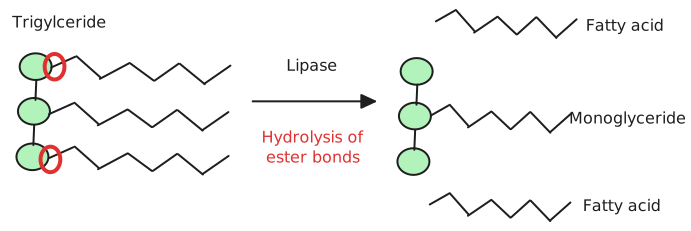
Lipids are hydrolysed by enzymes called lipases, which are produced in the pancreas.
- Lipase hydrolyses the ester bonds in triglycerides, forming fatty acids and monoglycerides
- A monoglyceride is a molecule of glycerol with one fatty acid attached
Role of Bile Salts
- Bile is produced in the liver and stored in the gallbladder
- Bile is released from the gallbladder via the bile duct into the small intestine
- Bile emulsifies lipids, breaking them up into smaller droplets
- This increases the surface area available for lipase to act on, speeding up the rate of lipid hydrolysis
- Bile is alkaline, so it also neutralises stomach acid, providing the optimum pH for the enzymes
Micelles
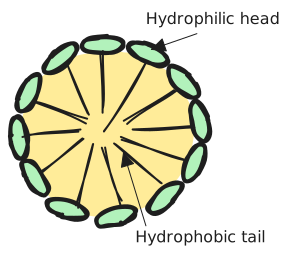
After digestion in the duodenum, monoglycerides and fatty acids remain associated with bile salts, forming micelles.
Micelles are important because they:
- Transport the monoglycerides and fatty acids to the epithelial cells of the ileum (where they can be absorbed)
- Are soluble in water, so can move easily through the aqueous environment of the small intestine to the epithelial cells lining the ileum
Digestion of Proteins
What you need to know (based on the AQA specification)
What you need to know (based on the AQA specification)
Digestion of proteins by endopeptidases, exopeptidases and membrane-bound dipeptidases.
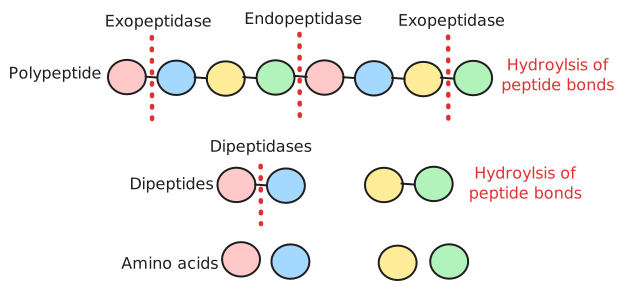
Digestion of protein involves breaking long polypeptide chains into amino acids and dipeptides that can be absorbed into the blood.
1. Endopeptidases Hydrolyse peptide bonds between amino acids in the internal region of a polypeptide chain.
2. Exopeptidases Hydrolyse peptide bonds between amino acids at the terminal (ends) of polypeptide chains.
The combined action of endopeptidases (middle of chain) and exopeptidases (ends of chain) increases the rate of protein digestion.
Why does the combined action increase the rate of protein digestion?
Why does the combined action increase the rate of protein digestion?
Endopeptidases cut the polypeptide internally, creating more ends for exopeptidases to work on. This increases the surface area available for exopeptidases, speeding up digestion.
3. Membrane-bound dipeptidases Dipeptidases are embedded in the epithelial cell membrane and hydrolyse dipeptides into single amino acids, which are then absorbed into the bloodstream.
Why do dipeptides and disaccharides need to be broken down into amino acids and monosaccharides?
Why do dipeptides and disaccharides need to be broken down into amino acids and monosaccharides?
Smaller molecules (amino acids and monosaccharides) can cross the cell membranes of the epithelial cells lining the ileum. Larger molecules like dipeptides and disaccharides cannot.
Absorption
Absorption allows smaller molecules to pass across cell membranes and into the bloodstream, where they can be transported around the body. It’s important that larger molecules are first broken down into smaller molecules so they can pass across the cell membranes.
Ileum Structure & Adaptations for Absorption
Absorption takes place in the epithelial cells lining the ileum (in the small intestine).
- Folded with finger-like projections (villi)
- Each epithelial cell has a further folded surface (microvilli) — sometimes called a “highly folded cell membrane”
- Microvilli increase surface area to accelerate the rate of absorption
- Thin walls (only a single layer of epithelial cells) — short diffusion pathway
- Rich network of blood capillaries — maintains a steep concentration gradient
- Co-transport / carrier proteins — required for co-transport of glucose and sodium ions (see mechanism below)
- High number of mitochondria — produce ATP used in active transport
Absorption: Monosaccharides & Amino Acids
Epithelial cells of the ileum absorb glucose (and other monosaccharides and amino acids) via active transport and co-transport.
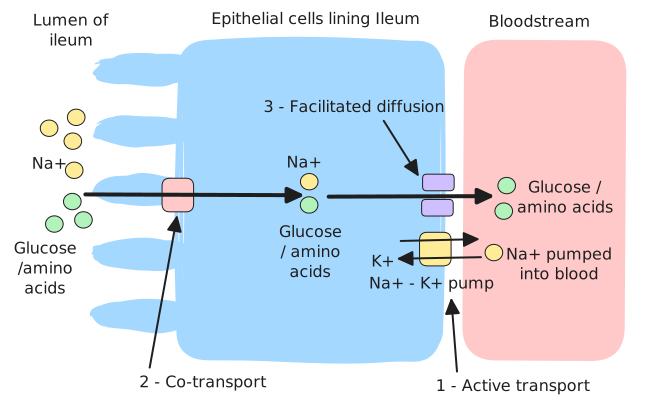
1. Active transport (Na⁺ ions)
The sodium–potassium pump actively transports Na⁺ ions out of the ileum epithelial cells into the blood.
This creates a concentration gradient:
- Low Na⁺ concentration in the epithelial cells
- High Na⁺ concentration in the lumen of the ileum
What is needed for the sodium–potassium pump?
What is needed for the sodium–potassium pump?
ATP — active transport requires energy from ATP hydrolysis.
2. Co-transport
Sodium ions diffuse from the lumen of the ileum into the epithelial cell down their concentration gradient, via a co-transport protein. This carrier carries glucose (or amino acids) along with it.
3. Facilitated diffusion
Now the concentration of glucose/amino acids is higher inside the epithelial cells than in the blood, so they diffuse into the bloodstream down their concentration gradient by facilitated diffusion.
What is the difference between facilitated diffusion and simple diffusion?
What is the difference between facilitated diffusion and simple diffusion?
- Simple diffusion — molecules diffuse directly across the phospholipid bilayer (no protein needed). Only works for small, non-polar molecules (e.g. O₂, CO₂).
- Facilitated diffusion — molecules diffuse through a channel or carrier protein in the membrane. Used for larger or polar molecules (e.g. glucose, amino acids) that can’t cross the bilayer directly.
Both are passive (no ATP required) and move molecules down their concentration gradient.
Absorption: Monoglycerides & Fatty Acids
- Micelle formation — monoglycerides and fatty acids combine with bile salts, making them soluble in water
- Micelles travel through the aqueous environment to the epithelial cells lining the villi of the ileum
- Micelles break down close to the epithelial cells, releasing monoglycerides and fatty acids
- Monoglycerides and fatty acids diffuse through the membrane into the epithelial cells
Why are monoglycerides and fatty acids able to move through the membrane?
Why are monoglycerides and fatty acids able to move through the membrane?
They are non-polar (lipid-soluble), so they can diffuse directly through the phospholipid bilayer by simple diffusion. No protein is needed.
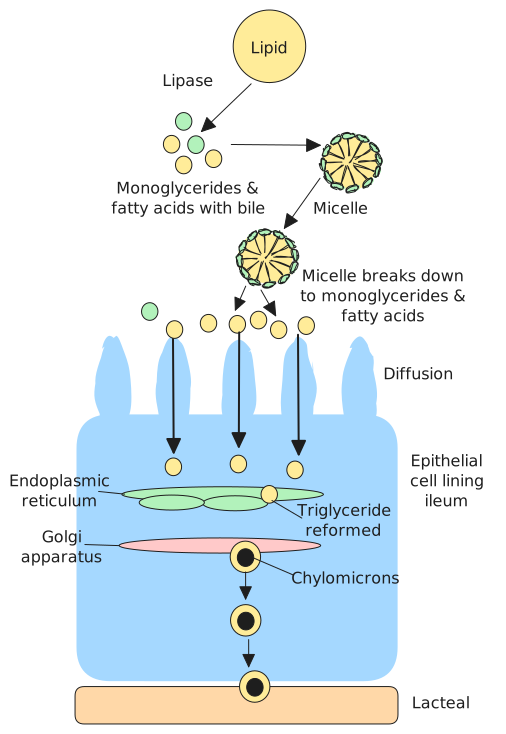
Once inside the epithelial cells:
- Transported to the smooth ER → reassembled into triglycerides
- Triglycerides + cholesterol + proteins → packaged into chylomicrons (in the Golgi apparatus)
- Chylomicrons leave by exocytosis → enter lacteals (lymphatic capillaries in villi) → lymphatic system → bloodstream
Important — read the question carefully
Read questions carefully when they ask about lipid absorption. If a question asks about the role of micelles in lipid absorption, it’s asking about transporting fatty acids/monoglycerides to the epithelial cells (steps before they enter the cell) — not what happens inside the cell (smooth ER, chylomicrons, lacteals).
Summary Table
Test yourself — click any button to reveal that column.
| Substance | Enzyme(s) | Bond broken | Final products |
|---|---|---|---|
| Carbohydrates (starch) | Amylase, then membrane-bound disaccharidases | Glycosidic | Monosaccharides (e.g. glucose) |
| Proteins | Endopeptidases, exopeptidases, membrane-bound dipeptidases | Peptide | Amino acids |
| Lipids (triglycerides) | Lipase (with bile salts) | Ester | Fatty acids + monoglycerides |
Exam Questions
Describe the complete digestion of starch by a mammal.
(4 marks)Hint
Starch is digested in two stages — first to a disaccharide, then to a monosaccharide. Name the bond broken, the type of reaction, and the enzymes involved at each stage.
Mark Scheme
- Hydrolysis (1 mark)
- Of glycosidic bonds (1 mark)
- Starch → maltose by amylase (1 mark)
- Maltose → glucose by disaccharidase/maltase (1 mark)
- Membrane-bound disaccharidase/maltase (1 mark)
Tips from examiner reports
- Starch is digested in two stages: first to maltose (a disaccharide), then maltose to glucose — not straight to glucose
- Say “maltose” not just “disaccharide” when naming the product of starch digestion
- Mention hydrolysis of glycosidic bonds
- Don’t describe bile salt action or co-transport in the context of starch digestion
- Membrane-bound enzymes (e.g. maltase) on the epithelial cell surface are often overlooked
Describe how the anti-toxin antibody would be digested.
(3 marks)Hint
Antibodies are proteins. What happens to proteins in the digestive system? Name the enzymes and what they do to peptide bonds.
Mark Scheme
- Peptide bonds hydrolysed (1 mark)
- Endopeptidase(s) break internal (peptide) bonds (1 mark)
- Exopeptidase(s) break terminal (peptide) bonds (1 mark)
- (Membrane-bound) dipeptidase(s) break dipeptides to amino acids (1 mark)
Comments from mark scheme
- Ignore named structures in the digestive system
- For point 2: accept “bonds within” OR “bonds in middle” for internal
- For point 3: accept “external bonds” OR “bonds at ends” OR “penultimate bonds” for terminal
- For points 2, 3 and 4: accept “act on”, “affect”, or “hydrolyse” for “break”
- For point 4: accept “between 2 amino acids” for dipeptides
- Ignore stomach acid
Tips from examiner reports
- Recognise that antibodies are proteins and would be digested by proteases if taken orally
- Endopeptidases break bonds within the polypeptide; exopeptidases break bonds at the ends — don’t confuse them
- Say enzymes hydrolyse peptide bonds between amino acids, not “hydrolyse amino acids”
- Don’t just list enzyme names — explain what they do to the antibody protein
Vitamin D is a fat-soluble substance. Micelles are involved in the process of vitamin D absorption.
Describe the process of vitamin D absorption into cells lining the ileum.
(3 marks)Hint
This is about absorption of an intact fat-soluble vitamin. Think about how micelles help transport it to the membrane and what happens when it reaches the cell.
Mark Scheme
- Combine/mix/join with bile salts (1 mark)
- Make (more) soluble in water (1 mark)
- (Micelles) breakdown close to cells OR maintain high(er) concentration at cell-surface membrane OR transport to cells/lining (1 mark)
- Diffuses (into cells/ileum) (1 mark)
Comments from mark scheme
- Max 2 marks if context is related to digestion of vitamin D to phospholipids, monoglycerides or fatty acids
- Ignore emulsification of vitamin D
- For point 3: accept “fuse with” for “breakdown close to”
- For point 4: ignore “facilitated”; ignore “micelles are absorbed”
Tips from examiner reports
- Micelles form when lipids associate with bile salts — emulsification is a separate process
- Focus on how intact vitamin D molecules are absorbed, not on lipid digestion
- Micelles don’t diffuse across membranes as a whole unit
- Don’t bring in co-transport or sodium ion pumps where they aren’t relevant
Describe and explain two features you would expect to find in a cell specialised for absorption (this is related to digestion).
(2 marks)Hint
Think about cells lining the ileum. Each “feature” needs both a description AND an explanation of how it helps absorption.
Mark Scheme
Any two of the following (each worth 1 mark for description + explanation):
- Folded membrane / microvilli → large surface area (for absorption) (1 mark)
- Large number of co-transport / carrier / channel proteins → fast rate of absorption OR for active transport (1 mark)
- Large number of mitochondria → produce (more) ATP (by respiration) for active transport (1 mark)
- Membrane-bound (digestive) enzymes → maintains concentration gradient (for fast absorption) (1 mark)
Comments from mark scheme
- For point 1: reject references to “villi”; accept “brush border” for “microvilli”
- For point 4: accept named examples of digestive enzymes
Tips from examiner reports
- Distinguish between villi (folds of the ileum wall) and microvilli (folds on individual cell membranes) — these are not the same
- Each feature must be described AND explained — just stating “large surface area” or “protein carriers in the membrane” is not enough
- “Thin membranes/walls” is a misconception that should not appear at A-level
Comments from mark scheme