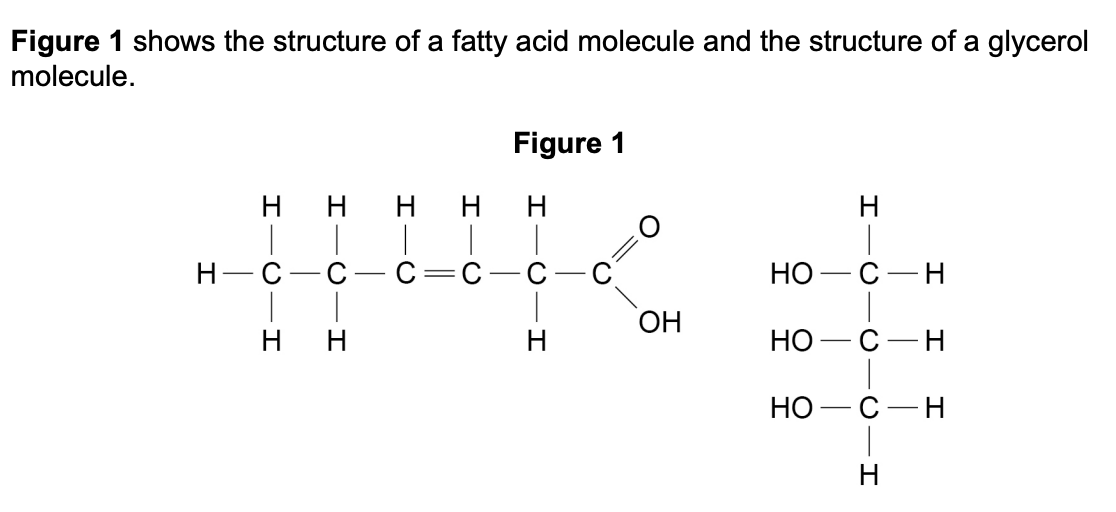
On Figure 1, draw a circle around the part of the fatty acid molecule and the part of the glycerol molecule that is removed to form a bond in a triglyceride molecule.
Name the bond formed between a fatty acid and glycerol in a triglyceride molecule.
Name the reaction involved in forming a bond between a fatty acid and glycerol in a triglyceride molecule.
- Bond =
- Reaction =
Hint
Think about what molecule is released when bonds form between monomers. Which specific atoms from each molecule combine to form that released molecule?
Answer
Mark Scheme
- Circle(s)/shape(s) drawn around H in one of the HO groups of the glycerol and the OH group of the fatty acid (1 mark)
- Ester (bond) (1 mark)
- Condensation (reaction) (1 mark)
Tips from examiner reports
- Don’t confuse ester bonds with glycosidic bonds in triglycerides
- When showing condensation, make sure the circled groups on glycerol and fatty acid combine to release water — don’t circle an OH from both molecules
- The OH removed comes from the carboxylic acid group of the fatty acid and the H from the hydroxyl group of glycerol
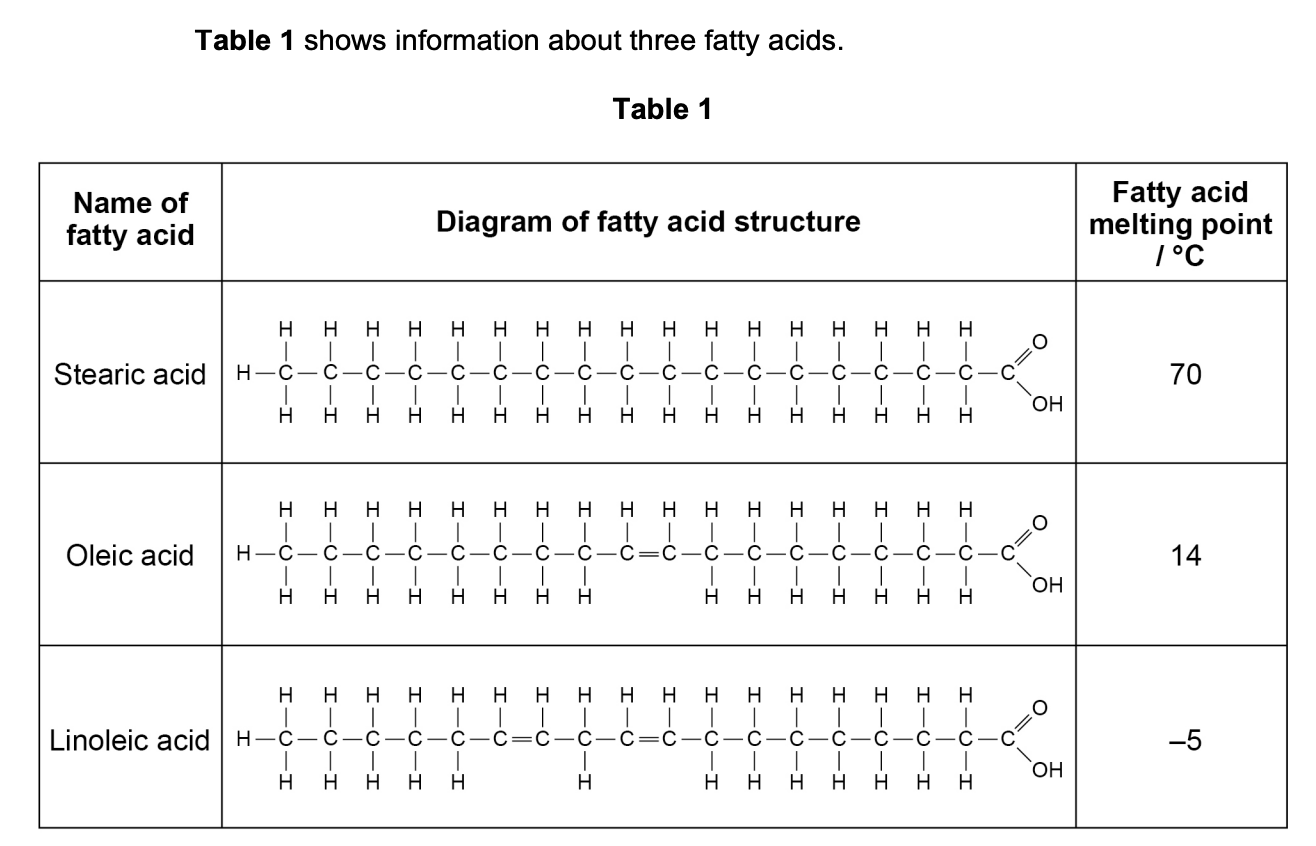
Name the fatty acid shown in Table 1 that is a saturated fatty acid.
Hint
Look at the molecular structure - what feature tells you a fatty acid is saturated vs unsaturated?
Answer
Mark Scheme
- Stearic (acid) (1 mark)
Tips from examiner reports
- Straightforward identification — know the difference between saturated and unsaturated fatty acids
The melting point is the temperature at which a solid changes state to be a liquid.
Use Table 1 to describe the relationship between fatty acid structure and fatty acid melting point
(1 marks)Hint
Consider how the presence of double bonds affects the shape of fatty acid chains and how they pack together.
Answer
Mark Scheme
- As (number of C) double bonds increases, melting point decreases OR As unsaturation increases, melting point decreases OR As saturation increases, melting point increases (1 mark)
Comments from mark scheme
Tips from examiner reports
- Refer to carbon-carbon double bonds when comparing saturated and unsaturated fatty acids
- Say hydrogen atoms, not hydrogen molecules, when discussing hydrogenation
- Read the question carefully — if it says melting point, don’t write about boiling point
The ratio of saturated to unsaturated fatty acids in a cell-surface membrane determines the extent of the membrane’s fluidity.
Scientists provided a cell culture of mouse phagocytes with liquid broth rich in unsaturated fatty acids.
The scientists observed:
- an increase in the proportion of phospholipids in the phagocytes containing unsaturated fatty acids
- more phagocytosis.
Suggest and explain why there was more phagocytosis.
(3 marks)Hint
Think about what physical property of the membrane would help a cell wrap around and engulf a pathogen. How does fatty acid composition affect this property?
Answer
Mark Scheme
- More unsaturated fatty acids increases fluidity (in (cell-surface membrane) (1 mark)
- (Making cell-surface) membrane more fluid/ flexible (1 mark)
- Easy to engulf (1 mark)
Comments from mark scheme
Accept for 2 marks, more unsaturated fatty acids increases membrane fluidity 3. Accept endocytosis for engulf 3. Accept more/easier for phagosomes to form
Tips from examiner reports
- Link your knowledge to the context — don’t just describe phagocytosis in general
- Fatty acids in food are not antigens — don’t describe an immune response to them
- Explain how unsaturated fatty acids in the membrane increase fluidity, and how this helps engulfing
- Refer specifically to the cell-surface membrane, not just the ‘bilayer’
Describe the processes of facilitated diffusion and active transport.
-
Facilitated diffusion
-
Active transport
Hint
Consider: What types of molecules need help crossing? What direction relative to the gradient? What provides the energy (if any)? What type of protein is involved in each?
Answer
Mark Scheme
- (Movement of) polar/charged molecules (1 mark)
- (Facilitated diffusion) movement down a concentration gradient via carrier/channel protein (1 mark)
- (Active transport) movement against a concentration gradient via carrier protein using ATP (1 mark)
Comments from mark scheme
- Accept ions OR non-lipid soluble for polar
- Accept named polar molecule, eg glucose OR amino acids OR nucleotides
- Reject if ATP used
- Ignore along OR with for down
- Ignore diffusion gradient
- Reject channel protein
Tips from examiner reports
- Give enough detail — basic definitions alone may not score full marks
- For active transport, mention carrier proteins specifically (not just ‘proteins’ or channel proteins)
- For facilitated diffusion, specify channel or carrier proteins — ‘transport proteins’ is too vague
- Facilitated diffusion is a passive process — don’t say it requires ATP
- Remember that charged molecules (ions) can also move by these processes
What are microvilli?
(1 marks)Hint
Focus on what microvilli ARE structurally at the cellular level, not what they DO. Think about what part of a single cell they are made from.
Answer
Mark Scheme
- (Highly) folded cell(-surface) membrane (1 mark)
Comments from mark scheme
Accept invaginated OR projections OR extensions for folded Reject hairs Ignore brush border
Tips from examiner reports
- Microvilli are folds of the cell membrane — don’t confuse them with villi (which are multicellular structures)
- Increased surface area is a function of microvilli, not a structural feature
- Don’t confuse microvilli with cilia or place them in lung tissue
Vitamin A is a fat-soluble substance.
Micelles are involved in the process of vitamin A absorption.
Describe the process of vitamin A absorption into cells lining the ileum
(3 marks)Hint
The question asks about absorption of an intact fat-soluble vitamin. Think about how micelles help transport it to the membrane and what happens when it reaches the cell.
Answer
Mark Scheme
- Combine/mix/join with bile salts (1 mark)
- Make (more) soluble (in water) (1 mark)
- (Micelles) breakdown close to cells OR Maintain high(er) concentration at cell(-surface membrane) OR Transport to cells/lining (1 mark)
- Diffuses (into cells/ileum) (1 mark)
Comments from mark scheme
Max 2 if context is related to digestion of vitamin A to phospholipids OR monoglycerides OR fatty acids Ignore emulsification of vitamin A 3. Accept ‘fuse with’ for ‘breakdown close to’ 4. Ignore facilitated 4. Ignore micelles are absorbed
Tips from examiner reports
- Micelles form when lipids associate with bile salts — emulsification is a separate process
- Focus on how intact vitamin A molecules are absorbed, not on lipid digestion
- Micelles don’t diffuse across membranes as a whole unit
- Don’t bring in co-transport or sodium ion pumps where they aren’t relevant
Describe how we breathe in.
(3 marks)Hint
Think about which muscles contract and what movement each causes. How do these movements change the space available for the lungs?
Answer
Mark Scheme
- Diaphragm (muscle) contracts pulling diaphragm down (1 mark)
- External intercostal muscles contract pulling/moving ribs upwards/outwards (1 mark)
- (Causes) volume increase and pressure decrease in thoracic cavity (1 mark)
Comments from mark scheme
- Accept flattening OR moves down for ‘pulling diaphragm down’
- Accept ribs lifted for ‘pulling ribs upwards’
- Accept thorax OR lung(s) for thoracic cavity
Tips from examiner reports
- Link external intercostal muscle contraction to rib cage movement — don’t just mention one without the other
- Use the term ‘thoracic cavity’ rather than ‘chest’ or ‘chest cavity’
- Don’t say muscles ‘pull the diaphragm down’ — the diaphragm contracts and flattens independently
- Don’t just describe the route air takes (trachea → bronchi → alveoli) — explain the mechanism of pressure change
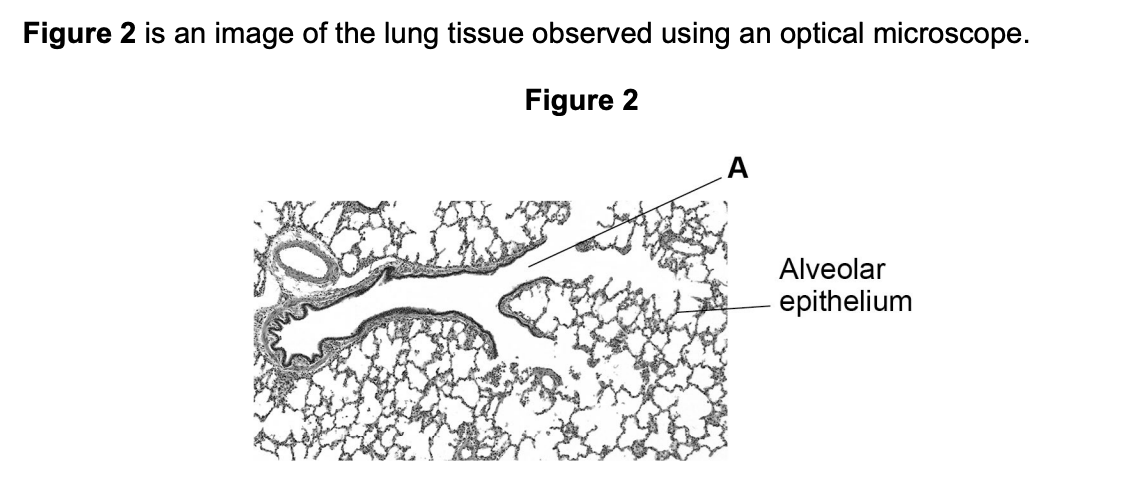
A scientist prepared alveolar tissue to view using an optical microscope. The scientist cut very thin slices of the alveolar tissue.
Explain why the scientist used very thin slices of alveolar tissue with the optical microscope.
Hint
Consider what happens to light when it hits thick tissue vs thin tissue. What does an optical microscope need to form an image?
Answer
Mark Scheme
- (Create a) single/few layer(s) of cells/tissue (1 mark)
- (So) light can pass through (1 mark)
Comments from mark scheme
- Accept to avoid overlapping cells
Tips from examiner reports
- Explain why thin slices are needed — they contain few layers of cells so light can pass through
- Don’t just repeat the question by saying ‘light passes through because it’s thin’
- Thin slices don’t improve resolving power or magnification of the microscope
- Practical details like flat coverslips or not touching the lens are not relevant here
Identify the tube labelled A.
(1 marks)Hint
Consider the size and position in the respiratory system. What comes between the larger airways and the gas exchange surfaces?
Answer
Mark Scheme
- Bronchiole(s) (1 mark)
Tips from examiner reports
- Know the difference between bronchiole, bronchus, trachea and alveolus from diagrams
- A bronchiole is a small airway with no cartilage rings
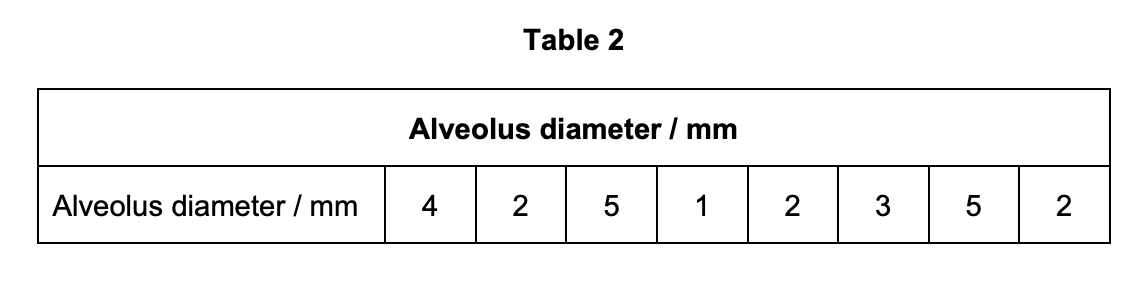
The scientist used a ruler to measure the diameter of some of the alveoli.
Table 2 shows the scientist’s results.
The magnification of the image in Figure 2 is × 40.
Use this information and Table 2 to calculate the mean diameter, in μm, of the alveoli.
Show your working (Answer in μm)
Hint
Write out the magnification formula first. Which values do you know? Rearrange to find what you need. Check your unit conversions.
Answer
Mark Scheme
- Correct answer for 2 marks, 75 (μm) (1 mark)
- Accept for 1 mark, evidence of Real/actual = Image Mag(nification) (correct rearranged magnitude word equation) OR ÷ 40 (correct denominator from equation) OR 3000 (µm) (correct mean diameter) (1 mark)
Tips from examiner reports
- Know the magnification formula and be able to rearrange it
- Practise converting between mm and µm (1 mm = 1000 µm)
Give the uncertainty associated with taking a measurement using a ruler with 1 mm graduations.
Calculate the percentage error for a measurement using the ruler of 4 mm
Give the:
- Uncertainty ± (mm)
- Percentage error
Hint
When measuring with a ruler, you read two positions (start and end). How does this affect the total uncertainty?
Answer
Mark Scheme
- (Uncertainty ±) 1 (mm) (1 mark)
- (Percentage error) 25 (%) (1 mark)
Comments from mark scheme
- Accept, if incorrect uncertainty ÷ 4 and multiplied by 100 OR – for example 50% (if uncertainty is 2) OR 12.5% (if uncertainty is 0.5) OR 2.5% (if uncertainty is 0.1)
Tips from examiner reports
- When measuring with a ruler, uncertainty applies to both ends of the measurement, so it’s ±1 mm (not ±0.5 mm) for a 1 mm scale
- The uncertainty is half the smallest division × 2 (for two points)
- Use the correct formula: percentage error = (uncertainty / measured value) × 100
Molasses is a solution obtained from sugar beet plants.
The sugars present in molasses are sucrose, glucose and fructose.
Give the number of different types of monosaccharides present in molasses.
(1 marks)Hint
Remember the difference between monosaccharides and disaccharides. Which sugars listed are single units?
Answer
Mark Scheme
- 2 (1 mark)
Comments from mark scheme
Accept glucose and fructose
Tips from examiner reports
- Read the data carefully to identify the number of different monosaccharide types present
A student used the biochemical test for reducing sugars on a clear sample of molasses.
Describe the biochemical test for a reducing sugar.
Explain the result expected from the test on the sample of molasses
Include:
- Description of biochemical test
- Explanation of expected result
Hint
What reagent is used? What conditions are needed? What colour indicates a positive result? Which sugars in the sample would actually react?
Answer
Mark Scheme
- Heat with Benedict’s (solution/reagent) (1 mark)
- Red (colour/precipitate) (1 mark)
- (Because) glucose/fructose is/are reducing sugars OR (Because) glucose/fructose is/are detected (1 mark)
Comments from mark scheme
- Ignore water bath unqualified
- Ignore warm
- Accept Fehling’s for Benedict’s
- Reject if heat with acid
- Accept green OR orange OR brown OR yellow
- Ignore emulsion
- Reject if sucrose is detected
Tips from examiner reports
- For the reducing sugar test: add Benedict’s reagent, heat in a water bath — mention both steps
- A positive result is a colour change to red/orange/yellow (don’t list multiple end colours as if they’re all expected)
- Explain why the result is positive — glucose and fructose are reducing sugars; sucrose is not
- Don’t describe the non-reducing sugar test procedure when asked about reducing sugars
‘Free sugar’ is the sugar in food and drinks released when food is crushed or when sugar is added to food at home or by manufacturers.
Scientists recommend that no more than 5% of the energy consumed per day should come from ‘free sugar’.
The mean daily energy requirement for a 10-year-old child is 8100 kJ. The ‘free sugar’ in one tablespoon of molasses contains 250 kJ of energy.
Calculate the number of tablespoons of molasses required for a 10-year-old child to reach the recommendation for energy consumed in ‘free sugar’ per day.
Answer in number of tablespoons per day
(1 marks)Hint
The question asks about ‘free sugar’ energy only - what percentage is that? Calculate that amount first, then work out how many tablespoons provide it.
Answer
Mark Scheme
- 1.6 / 1.62 (1 mark)
Comments from mark scheme
Accept 2
Tips from examiner reports
- Read carefully whether the question asks for total energy or just free sugar energy
- Don’t round down when the question asks for the amount needed to ‘reach’ a requirement — round up to meet it
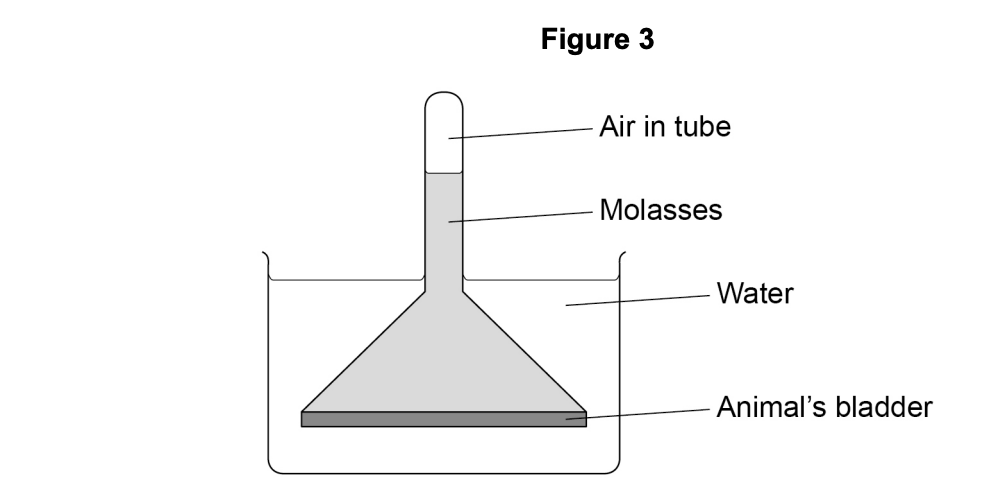
A scientist used the apparatus in Figure 3 to investigate osmosis.
Use your understanding of osmosis to explain why the air pressure in the tube increased.
Hint
Compare the water potential of the two solutions. What type of membrane separates them? Where will water move and what effect will this have on the volume inside?
Answer
Mark Scheme
- Molasses/solution has a lower water potential OR Water (in beaker) has higher water potential (1 mark)
- Water moves in (across) partially/selectively permeable bladder (1 mark)
- Increased (molasses/solution) volume OR Decreased air volume (1 mark)
Comments from mark scheme
- Accept more negative for lower OR less negative for higher
- Accept for water potential
- Accept semi-permeable
Tips from examiner reports
- Use the term water potential, not water concentration, when explaining osmosis
- Apply osmosis principles to the specific context — don’t just write a generic definition
- Be clear about whether it’s the air or the solution that changed in volume
- Identify the partially permeable membrane and state the direction of water movement
The scientist repeated the investigation, but made one change to the molasses. The scientist did not change the volume of molasses at the start of the investigation.
The scientist observed that the air pressure inside the tube increased by 160 kPa compared with 800 kPa in the first investigation.
Suggest the change the scientist made to the molasses to cause this smaller increase in air pressure.
Use the air pressure figures in a calculation to support your answer.
(2 marks)Hint
The question says the change was made to the molasses. Use the pressure values to calculate the ratio of change - what does this tell you about the concentration change?
Answer
Mark Scheme
- Suggested change 1. Diluted (molasses) OR Decreased (molasses) concentration OR Increased (molasses) water potential OR Decreased water potential gradient (1 mark)
-
- (Reduction by) 80% / 5 times OR (Reduction to) 20% OR (Used) 1 in 5 molasses to water OR (Used) 1 : 4 molasses to water (1 mark)
Comments from mark scheme
Ignore reduced temperature
- Accept less negative for increased
- Accept for water potential
- Accept description of 1 : 4 ratio, eg 20 (cm³ ) molasses (added) to 80 (cm³ ) water OR
- Accept fivefold OR factor of 5 for 5 times dilution
Tips from examiner reports
- Analyse the numerical data — calculate ratios or percentage changes where possible
- A decrease in pressure could indicate a reduced water potential gradient due to dilution of the solution
- Make changes to the correct variable — if the question asks about changing the solution, don’t suggest changing the water or apparatus
Describe the appearance and behaviour of chromosomes during prophase and during anaphase of mitosis.
Prophase
Anaphase
(4 marks)Hint
For each stage, think about what is happening to: the chromosomes’ appearance, spindle fibres, and centromeres. What key event triggers chromatid separation?
Answer
Mark Scheme
- Max two marks for prophase (In prophase) 1. Chromosomes/chromatids (continue to) condense (1 mark)
-
- Chromosomes/chromatids (become/are) visible (1 mark)
-
- Chromosomes attach to spindle (fibres) OR Chromatids attach to spindle (fibres) OR Centromeres attach to spindle (fibres) (1 mark)
- (In anaphase) 4. Centromeres divide/split (1 mark)
-
- Chromosomes/chromatids moved/pulled to opposite poles/sides/ends (1 mark)
Comments from mark scheme
- Accept chromatin for chromosomes
- Accept shorten OR thicken OR coils OR a description of condensing for condense
- Accept appear OR form OR present OR distinct for visible
- Reject homologous chromosomes moved to opposite sides
Tips from examiner reports
- Know the stages of mitosis: chromosomes condense in prophase, spindle fibres attach at metaphase, centromeres split in anaphase
- Spindle fibres attach during metaphase, not just at other stages
- Don’t confuse mitosis with meiosis — separation of homologous chromosomes and crossing over are meiosis events
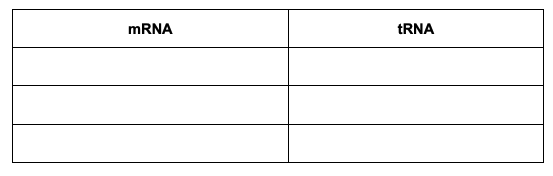
Give three structural differences between an mRNA molecule and a tRNA molecule
Hint
Think about the overall shape, relative length, and special features each type has for its function. Make sure you compare like with like.
Answer
Mark Scheme
- Answer as image (1 mark)
Comments from mark scheme
Must be comparisons 3. Accept description of binding site, eg amino acid only bound to tRNA 3. Accept mRNA cannot carry an amino acid, tRNA can
Tips from examiner reports
- Both mRNA and tRNA contain uracil — don’t say tRNA has thymine
- tRNA has a cloverleaf shape; mRNA is linear/straight — make this the comparison
- mRNA is not ‘single-stranded’ vs tRNA ‘double-stranded’ — tRNA is single-stranded with internal base pairing
- Say tRNA has an amino acid binding site, not just ‘has an amino acid’
- tRNA is shorter than mRNA, not the other way around
- Make sure comparisons are on the same row of the table — compare like with like
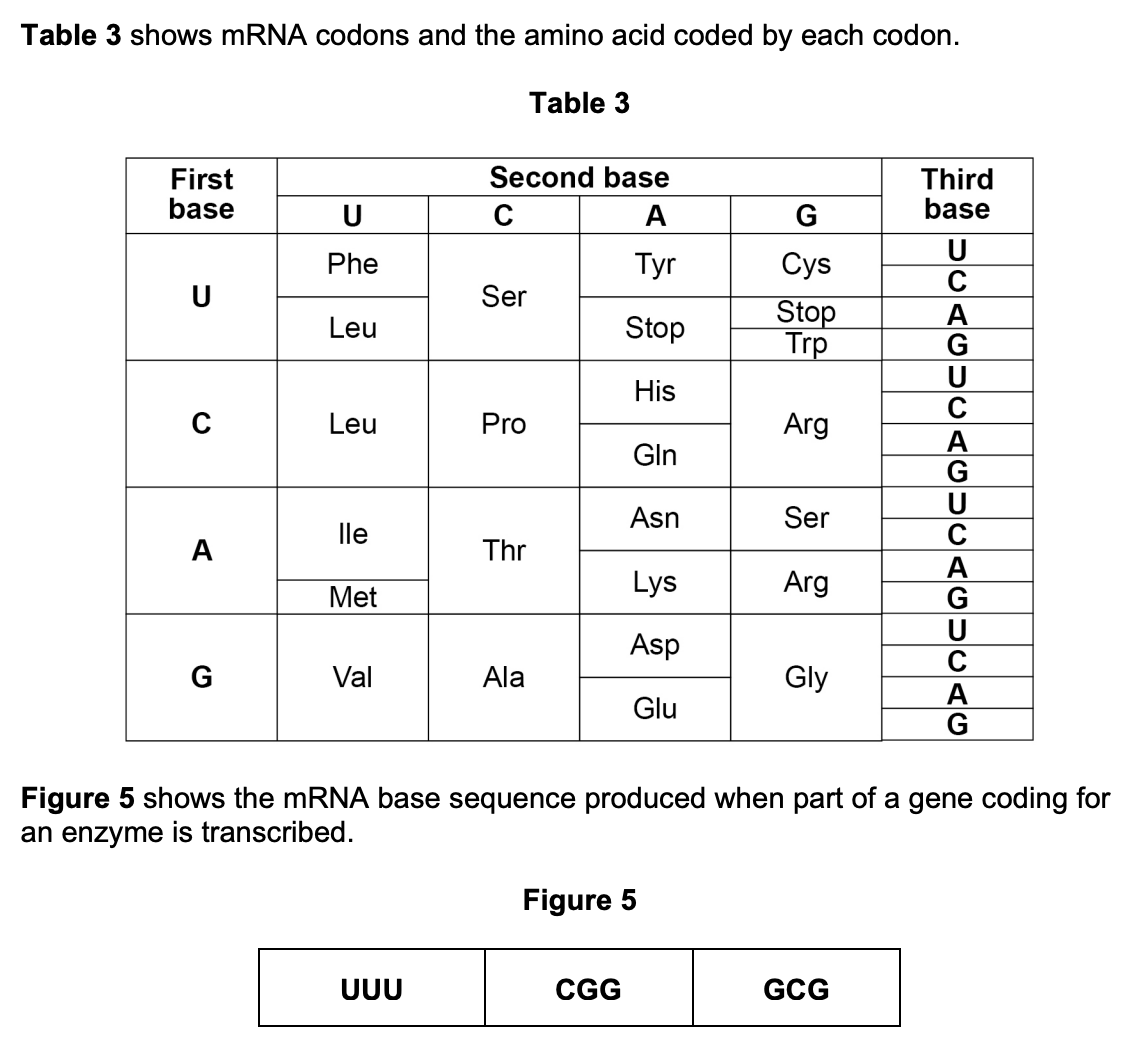
Table 3 shows mRNA codons and the amino acid coded by each codon.
Figure 5 shows the mRNA base sequence produced when part of a gene coding for an enzyme is transcribed.
Use Table 3 to give the amino acids coded by the mRNA base sequence in Figure 5
Hint
Use the mRNA codons directly with the table - don’t convert to anything else first. Read each three-base sequence carefully.
Answer
Mark Scheme
- Phe, Arg, Ala (1 mark)
Comments from mark scheme
Reject if order is different
Tips from examiner reports
- Use the codon table carefully — read codons from mRNA, not from the complementary DNA strand
- Check for mutations in the sequence before determining the amino acid
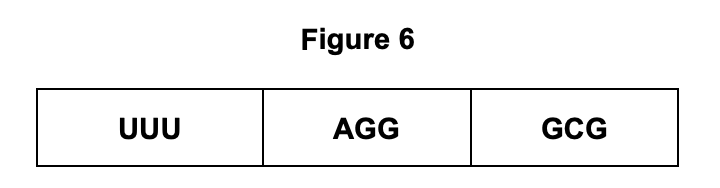
A mutation occurred in the part of the gene transcribed in Question 06.2. Figure 6 shows the mRNA base sequence produced when the identical part in the mutated gene is transcribed.
The amino acids coded by this mRNA base sequence form part of the enzyme’s active site.
Use all the information in this question to:
- name the type of mutation that occurred to produce the mutated gene
- give the change in DNA caused by this mutation
- explain the effect this mutation will have on the function of the enzyme.
Hint
Identify what changed at the DNA level. Check what amino acid the new codon codes for. What feature of the genetic code explains this outcome?
Answer
Mark Scheme
- (Name of mutation) 1. (Single base) substitution (1 mark)
- (Change in DNA) 2. Guanine to thymine OR G to T OR GCC to TCC (1 mark)
- (Explanation) 3. (So) Arg (still) present OR No change in amino acid (1 mark)
-
- (So) no change in primary structure OR (So) no change in tertiary structure OR (So) no change in active site (shape) (1 mark)
Comments from mark scheme
Marks can be achieved in any section 2. Reject thiamine 3. Reject amino acids are formed
Tips from examiner reports
- Identify the type of mutation first (substitution, deletion, etc.)
- Then follow through the consequences: changed codon → changed amino acid → effect on protein
- Don’t ignore the specific details given in the question about the mutation
A student investigated the activity of the enzyme polyphenol oxidase (PPO) in apple tissue.
When apple tissue is exposed to air, PPO catalyses a reaction between colourless phenol compounds in apple tissue and oxygen. Figure 7 shows the reaction.
Figure 7
PPO phenol compounds + oxygen → brown pigment
The student measured the time taken for the brown pigment to appear in two apple varieties (D and E).
Method
- Cut a 1 cm cube of apple tissue from variety D.
- Put the cube on a plate and leave the plate at 30 °C
- Measure the time for the brown pigment to appear.
- Repeat steps 1 to 3 two more times.
- Repeat steps 1 to 4 with apple tissue from variety E.
The student obtained the results shown below, but did not record the data in a results table.
Variety D = 15 min 50 s, 18 min, 14 min 30 s Variety E = 6 min 30 s, 8 min, 7 min
Design a suitable results table.
- Enter the student’s results into the table.
- Calculate the mean results and include these in the table.
- Use 1 decimal place for both mean results.
Hint
What should go in the left column? What needs to be in the heading for measured values? Are all your values in the same unit? How many decimal places are required?
Answer
Mark Scheme
- Variety and D and E in left column (1 mark)
- Time and ‘/ min’ and Mean (time) ‘/ min’ in column heading only (1 mark)
- Correctly calculated times and means calculated to one decimal place; Examples achieving 3 marks (1 mark)
Comments from mark scheme
Accept if no table lines are shown, figures clearly written in rows and columns Accept tables where mean is given in middle column and time is given in right column
- Accept type OR apple for variety
- Accept D and E in either order
- Accept mean values shown in rows rather than in columns
- Accept brackets OR “in” for solidus
- Ignore average for mean
- Accept min OR mins for minutes
- Accept seconds OR secs OR sec for seconds
- Reject mixed units eg “/ minutes and seconds”
- Accept correct times and correct means however presented
Tips from examiner reports
- Draw tables with ruled lines, clear labels, and correct units
- Show your calculations clearly
- A labelled table with the right structure can still earn marks even if presentation is untidy
Suggest and explain why the results for variety D are different from the results for variety E.
(2 marks)Hint
Which variety showed the faster reaction (shorter time)? What could explain why one variety reacts faster than the other? Think about enzyme kinetics.
Answer
Mark Scheme
- More phenol/substrate in E OR More PPO/enzyme in E OR Higher PPO/enzyme activity in E (1 mark)
- (So) more enzyme-substrate/E-S complexes (form) (1 mark)
Comments from mark scheme
- and 2. Accept the converse for D
- Ignore oxygen
- Ignore ESC
Tips from examiner reports
- Link enzyme activity to the results — longer reaction times suggest lower enzyme activity
- Don’t confuse which variety showed which result
- Make sure you relate the data to the conclusion
The student repeated the investigation but made one change to the method used to prepare the apple tissue.
The student then observed shorter times for the brown pigment to appear in both apple varieties.
Suggest the change the student made to the method of preparing the apple tissue.
Explain why the brown pigment appeared in a shorter time.
Do not suggest using a different volume or mass of apple.
Include:
- Change to method
- Explanation
Hint
What factors affect enzyme reaction rates? Pick one that could be changed in tissue preparation. Explain the chain of effects leading to faster browning.
Answer
Mark Scheme
- Use (enzyme’s) higher/optimum temperature (1 mark)
- More kinetic energy OR (So) more active enzyme (1 mark)
- (Causing) increased rate of reaction OR (Causing) more enzyme-substrate complexes/collisions; OR (1 mark)
- Use (enzyme’s) lower/optimum temperature OR Use (enzyme’s) optimum pH (1 mark)
- Less denaturation; OR (So) more active enzyme (1 mark)
- (Causing) increased rate of reaction OR (Causing) more enzyme-substrate complexes/collisions; OR (1 mark)
- Crush/grind/blend/chop the apple (tissue); 8 (So) more PPO/phenol/substrate in contact with oxygen/air (1 mark)
- (Causing) increased rate of reaction OR (Causing) more enzyme-substrate complexes/collisions (1 mark)
Comments from mark scheme
Mark in groups, 1, 2 and 3. OR 4, 5 and 6 OR 7, 8 and 9 3. 6. and 9. Accept ES complexes for enzyme-substrate complexes 3. 6. and 9. Accept a description of increased rate, eg ‘speeds up reaction’
Tips from examiner reports
- A shorter time for colour change means a faster reaction, not a slower one
- Read the context carefully before interpreting the data
The student wants to change the procedure to obtain a measure of PPO activity either in terms of how much substrate is used or how much product is produced.
Which change in procedure will provide a successful measure of PPO activity for the student?
(1 marks)Hint
Consider what each method actually measures and whether it would work practically with a solid cube of apple tissue.
Answer
Mark Scheme
- Measure the intensity of brown colour by comparing apple tissue with a colour chart showing a range of apple tissues of known pigment concentration. (1 mark)
Tips from examiner reports
- Read the question carefully to understand what variable is being tested
- Think about what the practical procedure is actually measuring before choosing an answer
Give two structural features of an aorta wall and explain how they are related to the function of an aorta.
(2 marks)Hint
Name a tissue in the artery wall, then explain what it does during each heartbeat cycle. Think about what happens when blood surges through.
Answer
Mark Scheme
- (Smooth) muscle absorbs/resists/withstands high (blood) pressure (1 mark)
- Elastic (tissue/layer) stretches and recoils maintains/smooths blood pressure (1 mark)
- (Smooth) endothelium reduces friction (1 mark)
- Protein (coat) prevents (artery) wall splitting OR Protein (coat) absorbs/resists/withstands high (blood) pressure (1 mark)
Comments from mark scheme
- Ignore contraction
- Ignore maintains pressure
- Reject contracts/ relaxes for recoils
- Accept dilate OR expand for stretch
- Accept fibrous OR collagen for protein
Tips from examiner reports
- Muscles in artery walls don’t pump blood — that’s a common misconception
- Elastic tissue stretches when blood surges and recoils to smooth/maintain blood pressure — mention both stretch and recoil
- Vasoconstriction occurs in arterioles, not in the aorta
- The endothelium is smooth to reduce friction — don’t confuse endothelium with epithelium
Small tears may occur in the layers of tissue in an aorta wall. These tears weaken the wall without bursting the aorta.
Scientists:
- measured the aorta diameter (d) in a large population of people over 60 years of age
- calculated the risk of an aorta wall developing a tear.
Table 4 shows their results
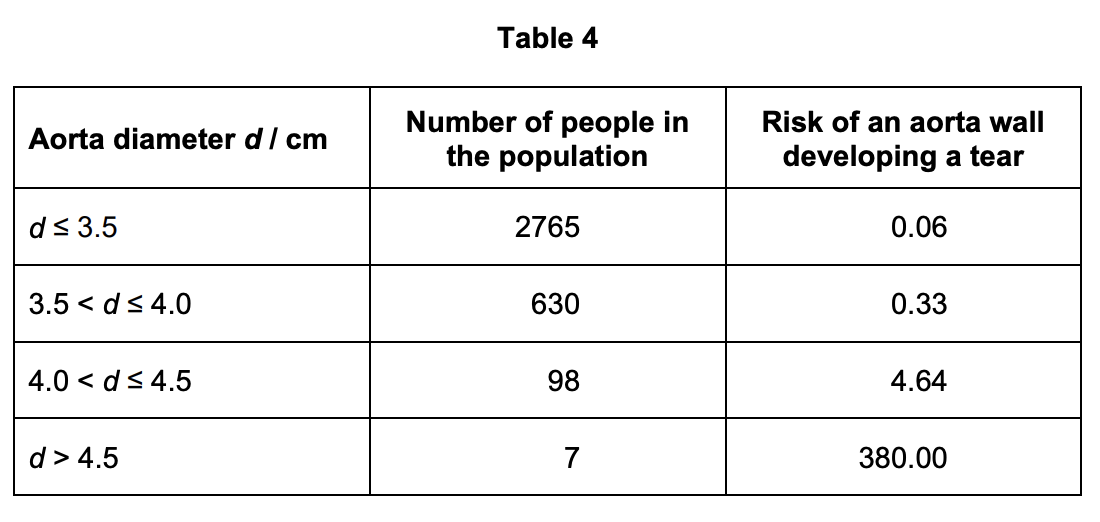
Blood may push through the tears in the aorta wall. This produces a balloon-like swelling called an aneurysm and increases the aorta diameter. Aneurysms can cause the aorta to burst.
Using all the information, what can you conclude about aorta diameter and the risk of developing an aneurysm?
- measured the aorta diameter (d) in a large population of people over 60 years of age
- calculated the risk of an aorta wall developing a tear.
Hint
Link the data about tears to the formation of aneurysms. What does the data show about both risk level AND how many people are affected?
Answer
Mark Scheme
- Small diameters are low risk of tears so unlikely to/do not have aneurysms OR As diameter increases, risk of tears increases and (risk of developing) aneurysms increase (1 mark)
- Few people have/at high risk of tear OR Few people have/at high risk of aneurysms (1 mark)
- Diameters > / above 4.5 (cm) at high risk (of tears) so may have aneurysms (1 mark)
- (High risk of) tear does not mean aneurysm will/has occurred (1 mark)
Comments from mark scheme
- Accept the converse
- Accept ≤ 4.5 for small
- Accept the converse, eg most people at low risk of tear/aneurysm
- Accept 7/98/105 for few
- Accept ‘increases significantly
Tips from examiner reports
- Don’t just describe data trends — link them to the context (e.g. risk of aneurysms, not just ‘risk of tears’)
- Note the ‘>’ symbol in data tables — it affects interpretation
- A small number of people in a category doesn’t mean it’s a small sample if the overall cohort is large
A scientist investigated changes in a diseased heart and changes in a healthy heart during cardiac cycles.
For each heart, the scientist obtained a value for: • the mean blood volume in a full ventricle just before the ventricle contracts (BVB) • the mean ejection fraction (EF).
- The EF is the proportion of blood pumped out of a full ventricle in one heartbeat.
- The EF is calculated using this formula:
EF = Blood volume pumped out of a full ventricle in one heartbeat (stroke volume) / BVB
Table 5 shows the scientist’s results.
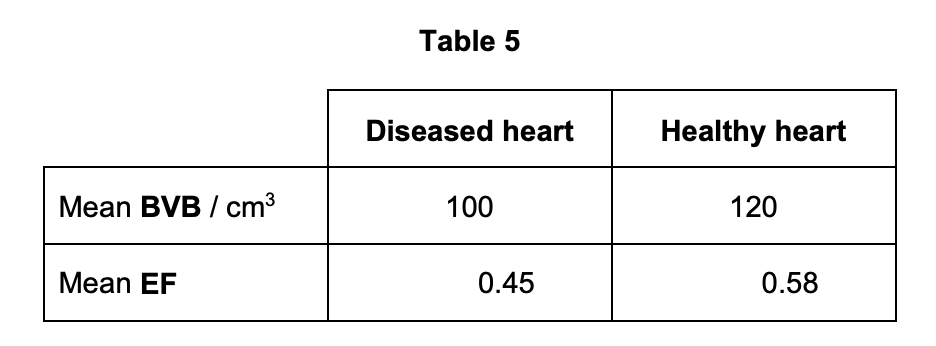
Using Table 5, a student calculated that the percentage change in the stroke volume of the diseased heart compared with the stroke volume of a healthy heart is –30%.
The student’s answer is wrong because the final step of the calculation was performed incorrectly. Using the equation and Table 5, calculate the correct percentage change in the stroke volume of the diseased heart compared with the stroke volume of the healthy heart.
Identify the mathematical error in the final step of the student’s calculation
Include
- Correct answer (%)
- Mathematical error
Hint
Rearrange the equation to find stroke volume. For percentage change, which value should be the denominator - the original or the new value?
Answer
Mark Scheme
- and 2. Correct answer of 35 / 35.1 / 35.3 / 35.7 / 36 / 40(%) = 2 marks;; Accept for 1 mark, incorrect answer but shows: Evidence of 45 (correct stroke volume for diseased heart) OR Evidence of 69.6 OR 70 (correct stroke volume for healthy heart) OR Evidence of 24.6 OR 25 (correct difference between stroke volumes) OR Evidence of 48.6 to 50 (correct calculated volume change, not percentage change) (1 mark)
- (Mathematical error) incorrect rounding (1 mark)
Comments from mark scheme
Accept positive or negative values
Tips from examiner reports
- When calculating percentage change, always divide by the original value (not the new value)
- Be careful with rounding — don’t round intermediate steps
- Check your arithmetic: multiply carefully before finding the difference
- Percentage change = (difference / original) × 100
Courtship behaviour in the frog species, Xenopus laevis box, involves male frogs calling to:
- attract sexually active females - these are advertisement calls
- start and continue mating – these are mating calls
- signal when a male is not sexually active – these are rasping calls.
Scientists investigated frog courtship behaviour by feeding a population of sexually active male frogs a diet containing the hormone EE2. The scientists also fed a separate control population of sexually active male frogs a diet without EE2.
They determined the percentage of males making advertisement calls or rasping calls in each population.
Table 6 shows their results
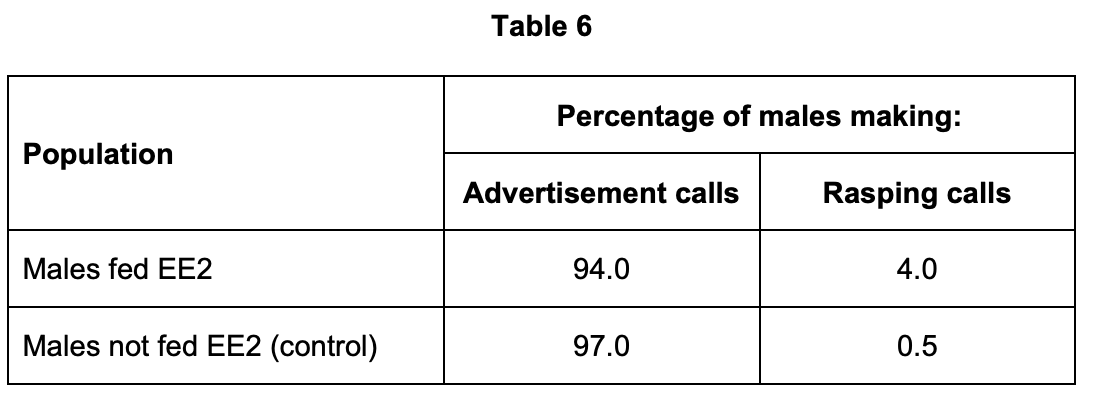
There were 800 males in the control population.
Each male made one type of call.
Use this information and Table 6 to calculate the number of males making mating calls in the control population.
(1 marks)Hint
Read all the call categories carefully. Make sure you include all relevant types in your calculation.
Answer
Mark Scheme
- 20 (1 mark)
Tips from examiner reports
- Read data tables carefully — make sure you include all relevant categories
- Don’t confuse percentages with actual numbers
Suggest one change the scientists could make to both frog populations to increase the number of mating calls.
(1 marks)Hint
Think about what triggers males to make mating calls. What would increase competition or opportunity for mating?
Answer
Mark Scheme
- Add (sexually active) female(s) (1 mark)
Tips from examiner reports
- Think about what would increase the dependent variable — adding sexually active females would increase mating calls
- Don’t suggest changes that aren’t biologically relevant to the investigation
The scientists also investigated the effect on female frog courtship behaviour of feeding EE2 to male frogs.
Table 7 shows their results.
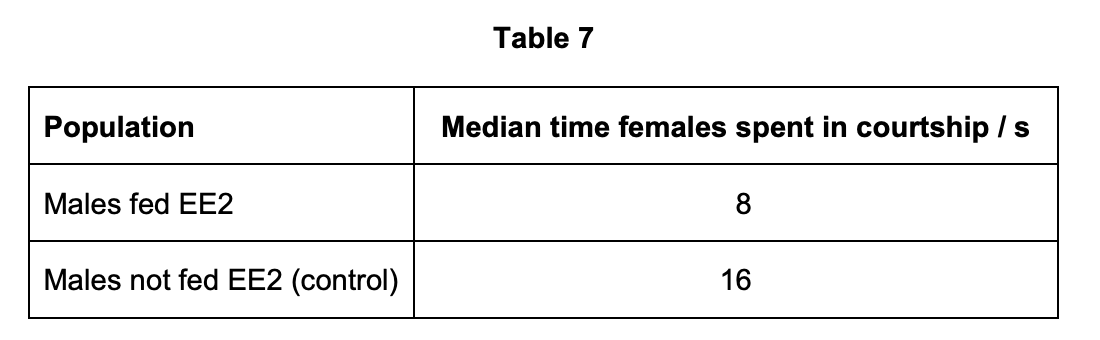
EE2 is contained in human contraceptive pills. Some EE2 is released in human urine and collects in sewage. Untreated sewage pollutes the water in frog habitats.
Suggest and explain the effect EE2 pollution in frog habitats will have on frog breeding.
Use information from Table 6 and Table 7 in your answer.
Include:
- Effect on frog breeding
- Explanation
Hint
Use BOTH tables. For each call type change, think about its function - what consequence does changing that call have for breeding success?
Answer
Mark Scheme
- (Effect on breeding) 1. Less mating/breeding OR Fewer offspring (1 mark)
- (Explanation) 2. Fewer advertisement calls, so females not attracted OR Fewer advertisement calls, so males not located (1 mark)
-
- Fewer mating calls as males less (sexually) active (1 mark)
-
- More rasping calls as (more) males not (sexually) active (1 mark)
-
- Less time spent in courtship (1 mark)
Comments from mark scheme
Maximum 3 marks for MP2 to MP5 4. Accept mature for active
Tips from examiner reports
- Use data from all the tables provided, not just one
- Don’t just quote figures — explain what they mean in context
- Link changes in call types to their biological effect (e.g. fewer advertisement calls → fewer females attracted)
- Say ‘less time in courtship’ not ‘fewer females’ if the data shows time, not numbers
- Don’t ignore data that contradicts your conclusion
Describe and explain how you would use cell fractionation and ultracentrifugation to obtain a sample of nuclei from muscle tissue.
(6 marks)Hint
Think about why each property of the solution matters (cold, isotonic, buffered). For centrifugation, which organelles settle first and why?
Answer
Mark Scheme
- Homogenise (tissue) to break open cells OR Homogenise (tissue) to release organelles/nuclei (1 mark)
- Filter to remove (intact) tissue/cells/debris (1 mark)
- Cold (solution) to prevent enzyme activity (1 mark)
- (Solution with) equivalent water potential to prevent osmosis OR (Solution with) equivalent water potential to prevent organelles bursting/shrinking (1 mark)
- Buffered (solution) to stop enzymes/protein denaturing (1 mark)
- Centrifuge/spin at low(er) speed so nuclei in pellet/move to bottom OR Centrifuge at low(er) speed and supernatant/solution discarded (1 mark)
Comments from mark scheme
- Accept blend OR grind OR chop for homogenise
- Accept ‘slow down’ for prevent
- Accept isotonic for ‘equivalent water potential’
- Reject if reference is made to cells
- Accept up to 1000 revolutions min⁻¹ OR 1000 × gravity for identified slow spin speed
Tips from examiner reports
- Homogenisation breaks open cells; filtration removes debris — know the difference from cell fractionation
- Explain why the solution is cold (reduces enzyme activity), isotonic (prevents damage to organelles, not cells), and buffered (maintains pH so enzymes aren’t denatured)
- In differential centrifugation, use a low spin speed first to pellet the heaviest organelles (nuclei) — don’t describe increasing speeds for nuclei
- Dense structures move to the pellet, not away from it
Describe the role of organelles in the production and release of enzymes by animal cells. Do not include details of transcription in your answer.
(5 marks)Hint
Follow the pathway from gene to secreted enzyme. Which organelle is involved at each step? Don’t forget energy requirements.
Answer
Mark Scheme
- DNA in nucleus codes for enzyme/protein (production) (1 mark)
- Ribosomes/rough endoplasmic reticulum produce enzyme/protein OR Translation on ribosomes/rough endoplasmic reticulum (1 mark)
- Rough endoplasmic reticulum transports/modifies/processes enzymes/protein (1 mark)
- Mitochondria produce ATP (1 mark)
- Golgi apparatus modify/process/ package/transport enzymes/protein OR Golgi apparatus make/transport glycoprotein OR Golgi apparatus forms/releases vesicles (1 mark)
- Vesicles move (protein) to cell(-surface) membrane OR Vesicles fuse with cell(-surface) membrane (1 mark)
Comments from mark scheme
- Accept genetic material/code OR gene for DNA Accept polypeptide for protein/enzyme
- Ignore rER/RER only once
- Reject produce energy
- Accept body for apparatus 5 Accept ‘adds lipid/carbohydrate to’ for modify
- Accept lipoprotein for glycoprotein 5 and 6 Accept lysosome for vesicle
- Accept exocytosis for ‘fuse with cell membrane’
Tips from examiner reports
- Focus on organelle roles, not a general description of translation or protein structure
- Key organelles: ribosomes (protein synthesis), rough ER (transport), Golgi (processing/packaging), vesicles (exocytosis), mitochondria (ATP production)
- Be specific — say vesicles fuse with the cell membrane for exocytosis, not just ‘transport enzymes where needed’
- Don’t write about phagocytosis or DNA replication if the question asks about enzyme production and secretion
Describe the structure of ATP.
Outline how named enzymes break down and resynthesise ATP.
(4 marks)Hint
What three components make up ATP? What happens to water in the reactions that make and break ATP?
Answer
Mark Scheme
- Ribose, Adenine and 3 phosphates (1 mark)
- ATP to ADP + Pi by ATP hydrolase in hydrolysis (reaction) (1 mark)
- ADP + Pi to ATP by ATP synthase (1 mark)
- (In) condensation (reaction) (1 mark)
Comments from mark scheme
- Accept a labelled diagram showing ribose, adenine and 3 phosphates
- Accept adenosine and 3 phosphates
- Reject Adenosine and 3 phosphates if ribose/pentose is also mentioned
- Ignore pentose sugar
- Accept ATPase for ATP hydrolase
- Accept hydrolayse
- Accept synthayse
Tips from examiner reports
- ATP structure = adenosine (adenine + ribose) + 3 phosphate groups — don’t just say ‘ADP + Pi’
- Say ribose specifically, not just ‘pentose sugar’
- Hydrolysis of ATP uses water and is catalysed by ATP hydrolase — don’t confuse hydrolysis with condensation
- Don’t waste time describing ATP as an ‘immediate energy source’ if the question asks about structure and reactions
Give the three structural features found in all virus particles and describe the function of one of these features.
(2 marks)Hint
Think about which structures are found in ALL viruses, not just some. Consider: what contains the genetic material? What surrounds it? What helps the virus attach to host cells?
Answer
Mark Scheme
- Genetic material, capsid and attachment protein (1 mark)
- Genetic material codes for (viral) protein OR Capsid protects the genetic material/RNA/DNA OR Attachment protein binds to receptors (on cell); Accept ‘DNA or RNA’ OR nucleic acid OR genome for genetic material. Accept glycoprotein for attachment protein. Ignore genetic information (1 mark)
Comments from mark scheme
- Accept have no organelles/cytoplasm Ignore ‘do not contain membrane-bound organelles’
- Accept ‘do not have cell structure(s)’
- Accept correct named metabolic reaction
- Accept reproduce for replicate
Tips from examiner reports
- All viruses have a nucleic acid (DNA or RNA — not all have the same one), a protein coat (capsid), and attachment proteins
- Don’t include structures only found in some viruses (e.g. lipid envelope, reverse transcriptase)
- Viruses don’t have bacterial structures like capsules, plasmids, or flagella
- For attachment proteins, mention they bind to receptors on host cells
Explain why viruses are described as acellular and non-living.
(2 marks)Hint
Acellular means ‘not made of cells’. What would a cell have that a virus lacks? Think about organelles and cytoplasm.
Answer
Mark Scheme
- (Acellular) no cell(-surface) membrane OR Not made of cells (1 mark)
- (Non-living) have no metabolism/metabolic reactions; OR Cannot independently move, respire, replicate or excrete. (1 mark)
Comments from mark scheme
- Accept have no organelles/cytoplasm Ignore ‘do not contain membrane-bound organelles’
- Accept ‘do not have cell structure(s)’
- Accept correct named metabolic reaction
- Accept reproduce for replicate
Tips from examiner reports
- Acellular means having no cell structure — explain this as ‘no organelles’ or ‘no cytoplasm’
- Don’t define acellular as ‘non-living’ — that’s a separate concept
- For non-living characteristics, say viruses cannot replicate without a host cell or cannot carry out metabolic reactions
Give one reason why antibiotics are not effective against viruses.
(1 marks)Hint
Antibiotics target specific bacterial structures. What structures do bacteria have that viruses lack?
Answer
Mark Scheme
- Do not have bacterial structures/enzymes OR metabolic processes OR cell wall/murein. (1 mark)
Comments from mark scheme
Accept ‘do not have ribosomes’ Ignore 70S OR 80S
Tips from examiner reports
- Antibiotics target bacterial structures (e.g. cell walls, ribosomes) that viruses don’t have
- Don’t just say viruses ‘hide inside cells’ — explain what structures antibiotics target and why viruses lack them
- Don’t confuse antibiotics with antibodies
Chitin is a polysaccharide. The chitin monomer is a β-glucose molecule with one OH group replaced by an NHCOCH3 group. NHCOCH3 can be represented by N(Ac). Figure 1 shows the monomer that forms chitin and the chitin polymer
Chitin has a similar structure to cellulose.
Use Figure 1 to describe three ways the structure of chitin is similar to the structure of cellulose.
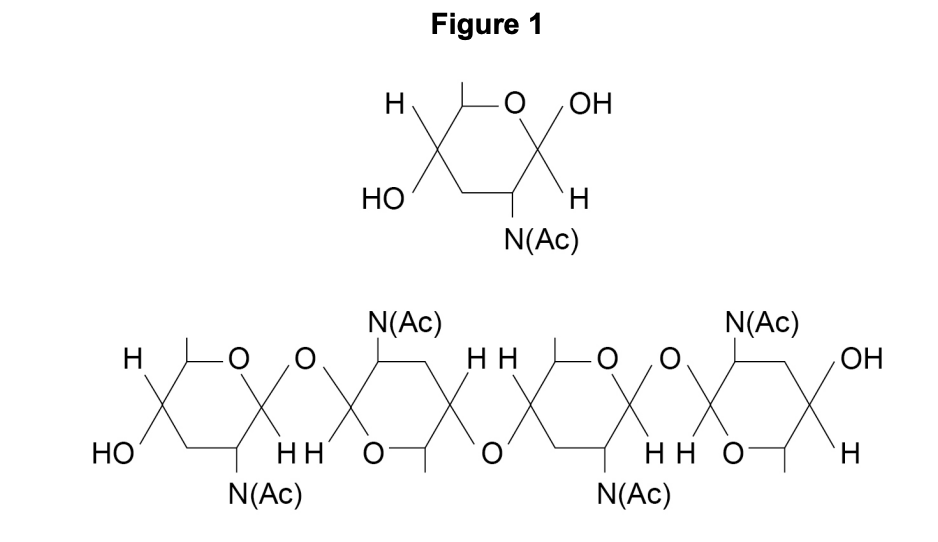
Hint
Focus on structural features shown in the diagram. What type of glucose? What type of bond? What is the arrangement of monomers?
Answer
Mark Scheme
- (Alternate) monomers/glucoses are flipped/upside down/rotated (by 180o) (1 mark)
- (Joined by) glycosidic bonds (1 mark)
- (Forms) straight/linear/unbranched (chains/ molecules) (1 mark)
Comments from mark scheme
Ignore they are both polysaccharides 4. Accept as an additional mark point, ‘contains 1-4 linkages/bonds’ 4. Reject if reference made to 1-6 5. Accept as an additional mark point, ‘have β glucose’ Ignore both contain C, H and O
Tips from examiner reports
- Cellulose is made of β-glucose monomers joined by 1,4-glycosidic bonds in unbranched chains
- Alternate monomers are rotated (flipped) — this is a key structural feature
- Use ‘monomer’ not ‘molecule’ when describing the repeating unit
- Don’t mention 1,6 bonds — those are found in starch (amylopectin), not cellulose
Chitin keeps the tracheae open in the tracheal system of gas exchange in an insect. Gas exchange does not occur in the tracheae.
Explain the importance of one adaptation of the gas exchange surface in the tracheal system of an insect.
(2 marks)Hint
Focus on adaptations AT the gas exchange surface (tracheoles), not the whole system. Link structure to function - how does it increase diffusion rate?
Answer
Mark Scheme
- EITHER 1. Tracheole (wall) thin/one cell thick (1 mark)
-
- (So) rapid diffusion (into cells) OR (So) short diffusion pathway/distance (1 mark)
- OR 3. Tracheoles enter/supply tissues/muscle fibres (1 mark)
-
- (So) diffusion direct into cells OR (So) short diffusion pathway/distance OR (So) rapid diffusion (into cells) (1 mark)
- OR 5. Tracheoles are highly branched (1 mark)
-
- (So) short diffusion distance/pathway OR (So) large surface area for (rapid) diffusion (1 mark)
Comments from mark scheme
Mark as pairs, 1 and 2 OR 3 and 4 OR 5 and 6 Ignore ‘liquid in tracheoles’
Tips from examiner reports
- Focus on adaptations at the gas exchange surface itself (e.g. highly branched tracheoles increasing surface area)
- Don’t just describe spiracles — they are entry points, not the gas exchange surface
- Say ‘increased rate of diffusion’ not ‘increased gas exchange’ when explaining why large surface area helps
Lignin is a polymer found in the walls of xylem vessels in plants. Lignin keeps the xylem vessel open as a continuous tube.
Explain the importance of the xylem being kept open as a continuous tube.
(3 marks)Hint
This is about water transport in xylem, not sugar transport. How does water form a continuous column? What creates the pulling force?
Answer
Mark Scheme
- Allows unbroken water column (1 mark)
- Cohesion from H bonds between (all) water (molecules) (1 mark)
- Evaporation/transpiration creates tension (in column) (1 mark)
Comments from mark scheme
- Accept idea of continuous flow OR stream of water
- Ignore chain of water molecules If 1, 2 or 3 are not awarded accept a principle mark for correct reference to cohesion-tension causing water movement
Tips from examiner reports
- Water moves up xylem by cohesion-tension: transpiration creates tension, water molecules cohere via hydrogen bonds forming a continuous column
- Don’t confuse transpiration in xylem with translocation in phloem
- Don’t mention ‘source and sink’ — that relates to translocation of sugars
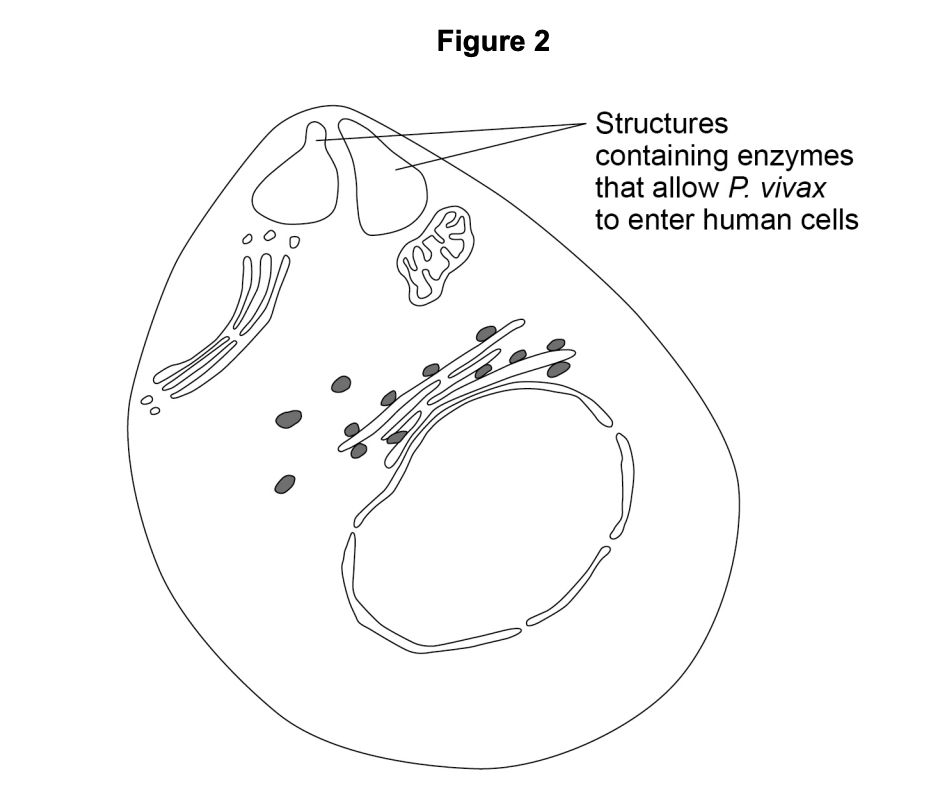
The human disease, malaria, is caused by infection with a single-celled eukaryotic organism.
Figure 2 shows a diagram of Plasmodium vivax, one of the species that can cause malaria.
Other than the Golgi apparatus, name one structure in Figure 2 which shows that P. vivax is a eukaryote.
Hint
Identify structures that would be found in a eukaryotic cell. Consider what the diagram shows - membrane-bound organelles.
Answer
Mark Scheme
- Membrane-bound organelle(s) OR Mitochondrion/mitochondria OR Vesicle(s)/lysosomes OR (Rough) endoplasmic reticulum OR Nucleus/(double) nuclear membrane/pore(s)/ nuclear envelope (1 mark)
Tips from examiner reports
- Know the structures visible in eukaryotic cells: mitochondria, rough ER, nucleus, Golgi, etc.
- Don’t suggest plant-only or bacterial structures (vacuole, cell wall, plasmid) for animal cells
Describe two functions of the Golgi apparatus in a eukaryotic cell.
(2 marks)Hint
Give two DIFFERENT functions. Processing and packaging are related - consider what else the Golgi does.
Answer
Mark Scheme
- Modify/package proteins or lipids (1 mark)
- Form vesicles/lysosomes. (1 mark)
Tips from examiner reports
- Give two different functions of the Golgi apparatus, not two aspects of the same function
- Processing proteins and producing glycoproteins count as one function, not two
- Good answers: packaging proteins into vesicles, producing lysosomes, forming glycoproteins/glycolipids
- Ribosomes are not made by the Golgi apparatus
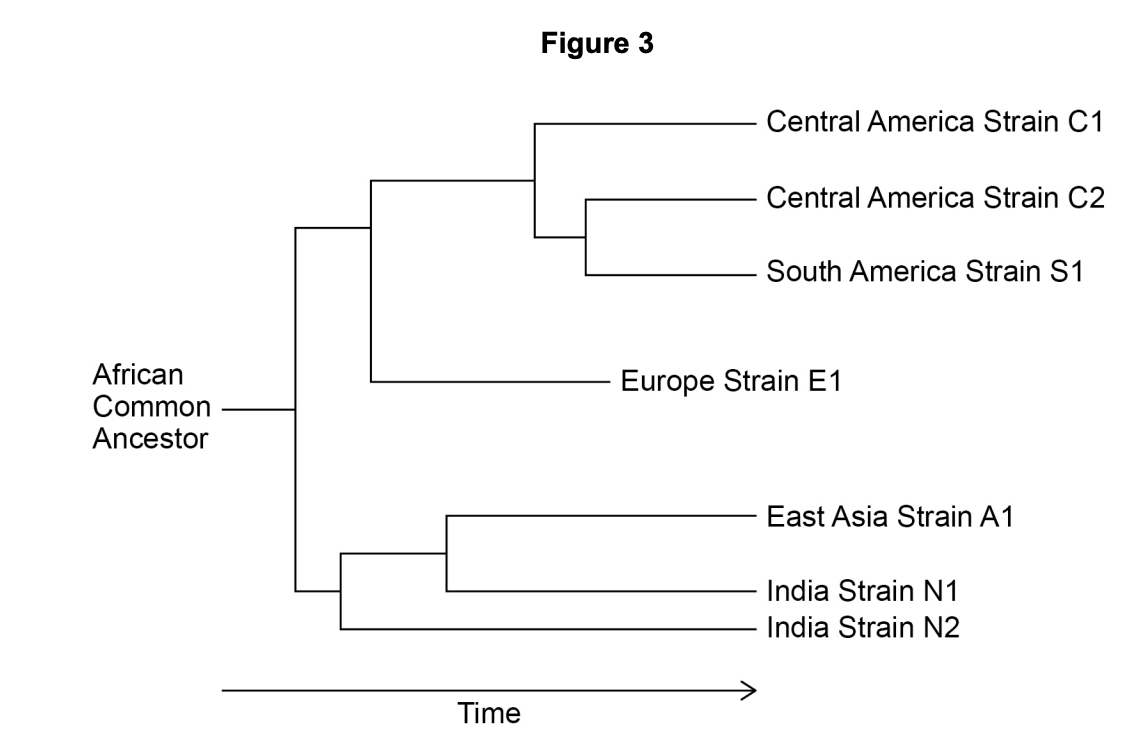
P. vivax box evolved from a common ancestor in Africa. As humans migrated around the world, new strains of P. vivax evolved.
P. vivax is now extremely rare in Africa but there are several different strains of P. vivax in other parts of the world.
Figure 3 shows a phylogenetic diagram of the evolution of these different strains
What does Figure 3 suggest is the order of human migration out of Africa?
Tick () one box.
Hint
Apply your knowledge of cell structures and their functions.
Answer
Mark Scheme
- Answer key: India, Europe, East Asia, Central America, South America (1 mark)
Tips from examiner reports
- Straightforward recall question — revise the topic thoroughly
There are an estimated 229 million cases of human malaria worldwide per year.
94% of these cases are found in Africa, but are not caused by P. vivax.
P. vivax does cause 61% of the cases of human malaria outside Africa.
Use this information to calculate the number of cases worldwide caused by P. vivax each year.
Answer in cases of malaria
(1 marks)Hint
Break the calculation into steps: first find cases outside Africa, then find the proportion caused by P. vivax.
Answer
Mark Scheme
- Correct answer of 8.3814 million/8 381 400/8.3814 x 106 OR 8.4 million/8400000/8.4 x 106 (1 mark)
Tips from examiner reports
- Show your working clearly in multi-step calculations
- Make sure you apply percentages to the correct figures
- Check whether you need to find a percentage of a subset, not the whole
In Africa today, most of the human population are resistant to malaria caused by P. vivax.
Use your knowledge of natural selection to explain why this resistance is so common in Africa.
(4 marks)Hint
Apply natural selection to the specific context of malaria resistance. What causes the variation? What is selected for? Be precise with terminology.
Answer
Mark Scheme
- Mutation produced allele (1 mark)
- Those with allele/resistance less likely to/do not get malaria/P vivax OR Those with allele/resistance survive malaria/P vivax (1 mark)
- (So more likely to) reproduce and pass on the allele (1 mark)
- (Over generations) allele frequency increase (1 mark)
Comments from mark scheme
Reject gene for allele only once
- Reject ‘mutation caused by infection/exposure to P. vivax’.
- Accept converse; eg ‘people lacking the allele die from malaria’
- Accept description of increasing frequency of allele eg ‘higher proportion’, ‘more common’ but ‘ignore increase in number of allele’
Tips from examiner reports
- Apply natural selection to the specific context — don’t just write generic stock phrases
- A mutation produces a new allele of a gene — say ‘allele’ not ‘gene’ when discussing inheritance
- Mention what the selection pressure is (e.g. malaria) and how resistance provides a survival advantage
- The sequence: mutation → new allele → survival advantage → increased reproduction → allele frequency increases
Some hospital patients suffer from diarrhoea caused by infection with the bacterium Clostridium difficile. The C. difficile bacteria release toxins. These toxins cause the diarrhoea.
The toxins damage the cells lining the ileum, causing them to lose their microvilli. The damage to the cells reduces the absorption of the products of digestion and reduces the absorption of water, resulting in diarrhoea.
Explain why the damage to the cells lining the ileum reduces absorption of the products of digestion and why this reduces absorption of water.
(3 marks)Hint
Water moves by OSMOSIS, not diffusion. Think about water potential - where is it higher and lower?
Answer
Mark Scheme
- Reduced surface area OR Fewer co-transport/carrier/channel proteins (1 mark)
- Decreases water potential in ileum/lumen OR Increases water potential in cells (1 mark)
- (So) water moves out of cells/into ileum by osmosis OR (So) less/no water moves into cells/out of ileum by osmosis (1 mark)
Comments from mark scheme
- Ignore references to diffusion OR facilitated diffusion OR active transport
- Ignore SA Accept gut for ileum
- Accept Ψ for water potential
- Ignore WP
- Accept reduces water potential gradient
- Accept lumen for ileum
- Accept absorbed for moves
Tips from examiner reports
- Water is absorbed in the ileum by osmosis, not diffusion — make sure you name the correct process
- Mention water potential and state the direction of the gradient clearly
- Look for hints in the question — if it mentions water absorption, think osmosis
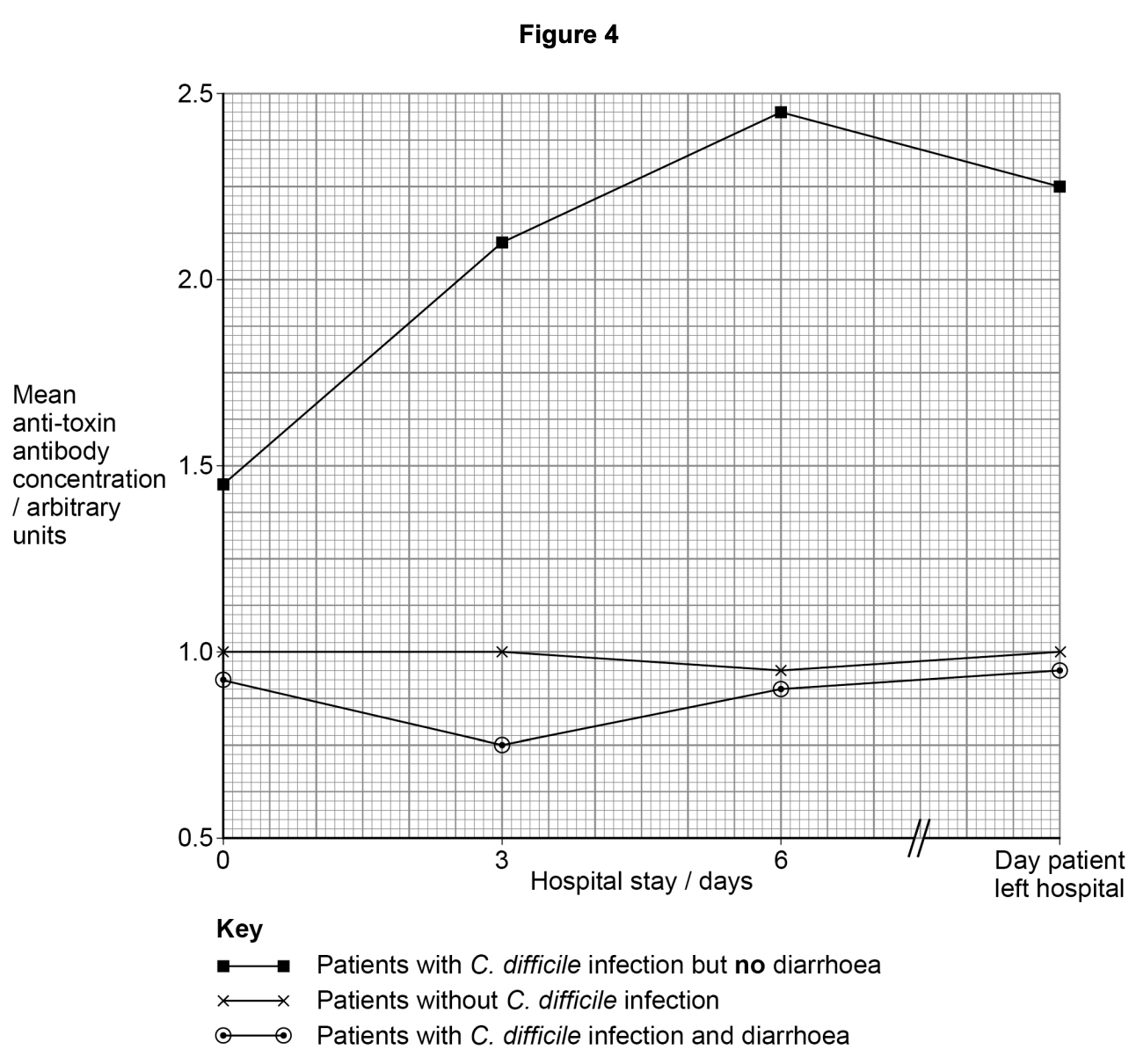
Not all patients in hospital with C. difficile develop diarrhoea. box Scientists measured the anti-toxin antibody concentration in hospital patients with and without C. difficile infection. They measured the anti-toxin antibody concentration four times:
- on admission to hospital (day 0)
- on day 3
- on day 6
- on the day the patient left the hospital.
Figure 4 shows the scientists’ results.
The scientists suggest that the anti-toxin antibody could be given to some patients as a form of passive immunity.
Use Figure 4 to suggest how this passive immunity would work and which patients should be offered this anti-toxin antibody.
Hint
This is about PASSIVE immunity and TOXINS, not active immunity or pathogens. How do antibodies neutralise toxins?
Answer
Mark Scheme
- Anti-toxins/antibodies cause phagocytosis/ destruction/agglutination/neutralisation (of toxin) (1 mark)
- Anti-toxin/antibody prevents/reduces (chance of) diarrhoea OR (C difficile) patients with no diarrhoea have high(est) (concentration of) anti-toxin/antibody OR (C difficile) patients with diarrhoea have low(est) (concentration of) anti-toxin/antibody (1 mark)
- (Offered to C. difficile) patients with diarrhoea OR (Offered to) patients with low (concentrations of) anti-toxin/antibody (1 mark)
Comments from mark scheme
- For ‘neutralised’, accept idea of preventing toxin binding/damaging cells lining the ileum.
- and 3 Accept people for patients
- Ignore symptoms for diarrhoea
- Accept ‘passive immunity offered’ for ‘antibody offered’
Tips from examiner reports
- Passive immunity involves antibodies given directly, not produced by the body’s own immune system
- Antibodies neutralise toxins — don’t say they ‘destroy the pathogen’ when the question is about anti-toxin
- Don’t write a general description of active immunity if the question asks about passive immunity
- Link your answer to the data provided
To be used as passive immunity treatment, the anti-toxin antibody would be injected. If it was given by mouth, it would be digested.
Describe how the anti-toxin antibody would be digested.
(3 marks)Hint
Antibodies are proteins. What happens to proteins in the digestive system? Name the enzymes and what they do to peptide bonds.
Answer
Mark Scheme
- Peptide bonds hydrolysed (1 mark)
- Endopeptidase(s) break internal (peptide) bonds (1 mark)
- Exopeptidase(s) break terminal (peptide) bonds (1 mark)
- (Membrane-bound) dipeptidase(s) break dipeptides to amino a (1 mark)
Comments from mark scheme
Ignore named structures in the digestive system 2. Accept ‘bonds within’ OR ‘bonds in middle’ for internal 3. Accept ‘external bonds’ OR ‘bonds at ends’ OR ‘penultimate bonds’ for terminal 2., 3. and 4. Accept ‘act on’ OR ‘affect’ OR ‘hydrolyse’ for break 4. Accept between 2 amino acids for dipeptides Ignore stomach acid
Tips from examiner reports
- Recognise that antibodies are proteins and would be digested by proteases if taken orally
- Endopeptidases break bonds within the polypeptide; exopeptidases break bonds at the ends — don’t confuse them
- Say enzymes hydrolyse peptide bonds between amino acids, not ‘hydrolyse amino acids’
- Don’t just list enzyme names — explain what they do to the antibody protein
A student investigated the use of cinnamon oil as box an antimicrobial substance. She investigated the effect of cinnamon oil on the growth of five different bacterial cultures grown on agar plates.
The student added 100 mm³ of each bacterial culture from its glass bottle onto a separate agar plate. She spread each bacterial culture evenly over the agar using a spreader.
Describe the aseptic techniques the student should use
(3 marks)Hint
Describe steps that reduce contamination. What surfaces need to be cleaned? How are equipment items sterilised?
Answer
Mark Scheme
- Wash hands with soap OR Disinfect surfaces (1 mark)
- Use sterile pipette/syringe (to transfer bacteria) (1 mark)
- (Remove bottle lid and) flame neck of bottle (1 mark)
- Lift lid of (agar) plate at an angle (1 mark)
- Work close to upward air movement (1 mark)
- Use sterile spreader (1 mark)
- Place pipette/spreader into disinfectant (immediately after use) (1 mark)
Tips from examiner reports
- For aseptic technique: disinfect the work surface, flame the bottle neck, use a sterilised spreader, and work near a Bunsen flame
- Make sure practical steps are logical — don’t describe steps you haven’t actually done
- You don’t flame the agar plate or the lid
- Upward air currents from a Bunsen don’t ‘kill bacteria’ — they carry microbes away from the plate
On each agar plate, the student cut a well (a hole) in the agar. The well had a diameter of 6 mm. The student added 50 mm³ of cinnamon oil into the well.
Calculate the minimum depth of the well to allow the addition of 50 mm³ of cinnamon oil.
Use the following equation in your calculation: Volume of a cylinder = πr² × l Use 3.14 as the value for π. Show your working.
(2 marks)Hint
Rearrange the equation first. Make sure you use radius, not diameter.
Answer
Mark Scheme
- Correct answer ~1.77 mm using πr²l formula with r = 3 mm. (1 mark)
Tips from examiner reports
- Know how to rearrange unfamiliar equations
- Use the radius, not the diameter, in area calculations (πr²)
- Show your working clearly for each step
The student kept the plates at 25 °C for 24 hours.
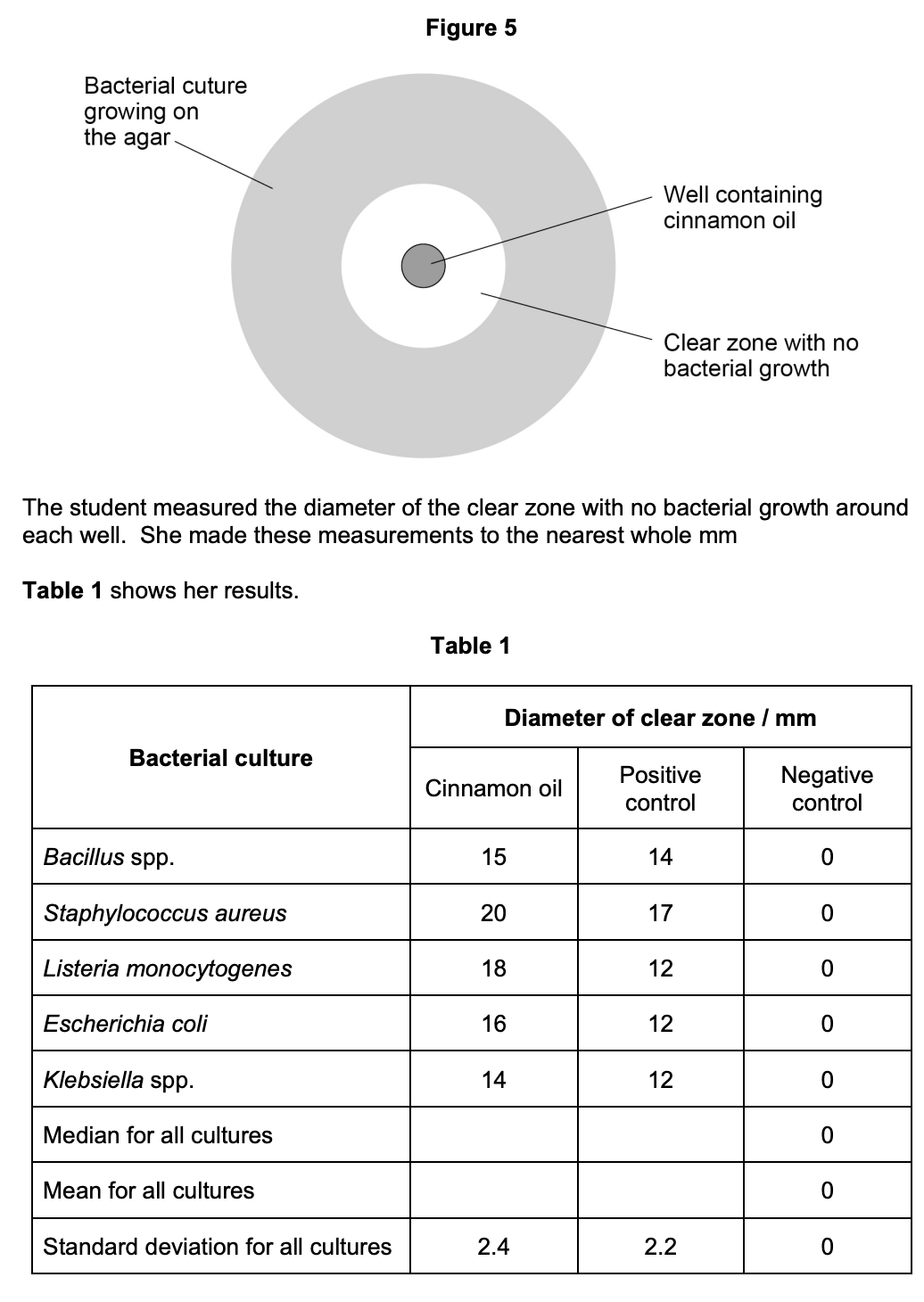
Figure 5 shows what one of her plates looked like after 24 hours.
Suggest exactly what the student added to the wells to get the positive control and negative control results.
Hint
A positive control should give a known positive result. A negative control should give a known negative result. What would you add to each?
Answer
Mark Scheme
- (Positive control) 1. Antimicrobial/ antibacterial (solution) OR Antibiotic OR Antiseptic/disinfectant (1 mark)
- (Negative control) 2. (Sterile) water OR Oil (without cinnamon) (1 mark)
Tips from examiner reports
- A negative control should show what happens without the antimicrobial agent — not ‘doing nothing to the well’
- A positive control uses a known effective antimicrobial to confirm the method works
- Don’t confuse positive and negative controls
Complete Table 1 to show the median and mean diameters.
(1 marks)Hint
Calculate the mean for each treatment. Keep the same number of significant figures as the original data.
Answer
Mark Scheme
- Median: 16 and 12 (1 mark)
- Mean: 17 and 13. Accept 16.6 and 13.4 as mean values. (1 mark)
Tips from examiner reports
- Calculate the median carefully — check the positive control value against the data
- Match the number of significant figures to those used in the data table
The mean ± 2 standard deviations includes over 95% of the data. Use this information to consider whether the standard deviations suggest the differences in means are likely to be due to chance.
Explain your answer, including at least one calculation.
(2 marks)Hint
For 95% confidence, you need 2 standard deviations. What does overlap/no overlap of these ranges tell you about significance of DIFFERENCES?
Answer
Mark Scheme
- (Mean ± 2SD) ranges overlap (e.g., 12.2 to 21.8 and 8.6 to 17.4) (1 mark)
- Overlap suggests difference is likely due to chance OR not significant. Reject: results are due to chance OR results are significant (without justification). (1 mark)
Tips from examiner reports
- For 95% confidence, use 2 × standard deviation (not just 1 SD) when calculating overlap or significance
- Say ‘the difference is/isn’t significant’ or ‘the difference is/isn’t due to chance’ — not ‘the results are due to chance’
Define genome and proteome.
(2 marks)Hint
Be precise with definitions. Genome relates to genes/DNA. Proteome relates to proteins that CAN be produced.
Answer
Mark Scheme
- Genome: Complete set of genes/alleles/genetic material in a cell. (1 mark)
- Proteome: Full range of proteins a cell can produce or coded for by DNA/genome. (1 mark)
Tips from examiner reports
- Genome = all the DNA (or all the genes) of an organism — don’t say ‘genetic information’, ‘genetic code’, or ‘genetic constitution’
- Proteome = all the proteins produced by the genome/cell — be precise and link it to DNA or the genome
- Don’t say ‘all the proteins a cell codes for’ — say ‘all the proteins produced by the genome’
The classification system used in the early 20th century grouped different species of bacteria according to the position and shape of flagella on bacterial cells and by the number of flagella per cell. These were observed using an optical microscope.
Each species of bacterium has a characteristic cell shape and arrangement of flagella.
These characteristics may be shared with other species within a genus.
Flagella are fragile, difficult to stain and may extend from the cell at any angle.
Consider the accuracy and limitations of the early classification of bacteria using the arrangement of flagella.
(3 marks)Hint
Consider limitations of the method. What could go wrong or cause inaccurate results when using flagella for classification?
Answer
Mark Scheme
- Cannot distinguish species accurately (1 mark)
- Microscope resolution is low (1 mark)
- Flagella are fragile/damaged/not visible or mistaken due to artifacts (1 mark)
- Difficult to stain; 5. At angle; 6. Not all bacteria have flagella. (1 mark)
Tips from examiner reports
- When asked to evaluate a classification method, consider its limitations (e.g. low resolution microscopy, broken structures, staining difficulties)
- Think about why separate species might appear identical under certain techniques
Suggest why several bacterial species have been renamed in recent years.
(1 marks)Hint
What new molecular techniques allow more accurate classification? Be specific about what is being compared.
Answer
Mark Scheme
- DNA/RNA base sequencing OR amino acid sequencing OR electron microscopy with higher resolution. (1 mark)
Tips from examiner reports
- Reclassification of species is due to new evidence from molecular techniques like DNA/RNA base sequence comparisons
- Don’t say organisms ‘evolved into new species’ or ‘mutated so needed renaming’
- Say ‘DNA base sequence’ not just ‘DNA sequencing’ — include the word ‘base’
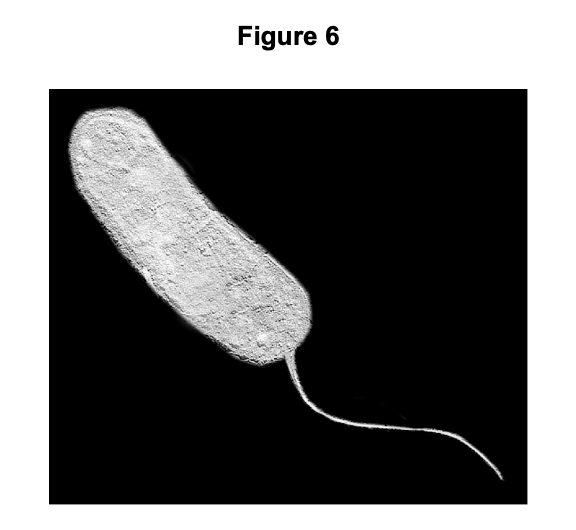
Figure 6 shows an image from an optical microscope of a single bacterial cell.
This bacterial cell is 2.3 μm long (excluding the flagellum).
Calculate the magnification of this image. Show your working.
Hint
Use the magnification formula. Be very careful with unit conversions between mm and µm.
Answer
Mark Scheme
- Correct answer of 19 565 (from measurement of 45mm) OR 20 000 (from measurement of 46mm) OR 20 435 (from measurement of 47mm) (1 mark)
Tips from examiner reports
- Know how to calculate magnification: magnification = image size / actual size
- Convert units carefully: 1 mm = 1000 µm (not 100 µm)
- Measure the image size accurately from the figure
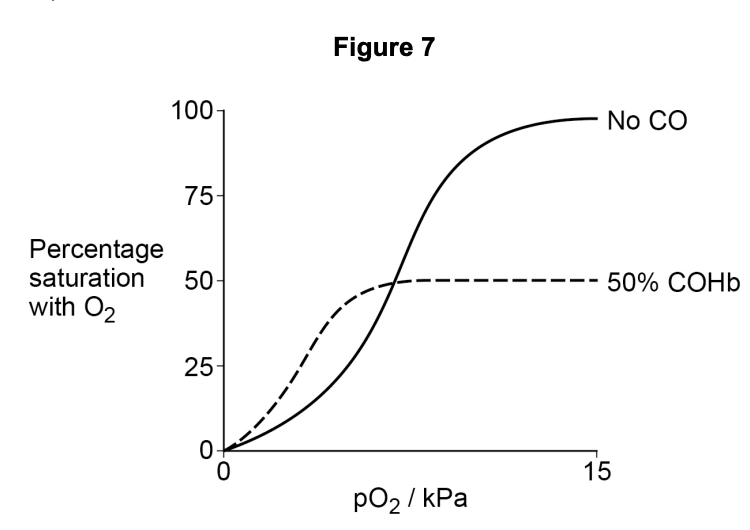
Carbon monoxide (CO) is released during incomplete combustion of fossil fuels. Figure 7 shows the dissociation curve for oxyhaemoglobin when:
- not exposed to CO
- exposed to CO such that 50% of the oxygen binding sites are occupied by CO (50% COHb)
Using Figure 7, what can you conclude about how exposure to CO affects the loading and unloading of oxygen by haemoglobin?
Explain your answer
Hint
Apply knowledge specifically to carboxyhaemoglobin (COHb). How does CO affect oxygen loading AND unloading? Don’t just recall general dissociation curve knowledge.
Answer
Mark Scheme
- Less (oxygen) loaded at high pO₂ (compared with no CO) OR Maximum Hb saturation is 50% (oxygen) (1 mark)
- (At low pO₂) Hb has higher affinity (for oxygen) (1 mark)
- Hb has more oxygen at low pO₂ OR Hb unloads less oxygen at low pO₂ (1 mark)
Comments from mark scheme
Ignore references to ‘binding sites occupied by CO’
- Accept ‘in lungs’ for ‘high pO₂’
- Accept ‘levels (off)’ OR ‘plateau at 50%’ for maximum 1 Accept ‘only 50%’ for ‘maximum (of) 50%’
- Accept ‘in (respiring) cells/tissues’ for ‘low pO₂/cells’
- Ignore ‘more loading of oxygen at low pO₂’
- Accept ‘less readily’ for less
Tips from examiner reports
- Apply oxygen dissociation curve knowledge to the specific context — don’t just describe a normal curve
- Carbon monoxide binds to haemoglobin and prevents oxygen loading — don’t say COHb ‘loads more readily’
- The Bohr shift and pH changes are not relevant to carbon monoxide poisoning
The World Health Organisation (WHO) suggests that to avoid long-term health effects, COHb concentrations should be kept below 2.5%. WHO recommends that people should not be exposed to:
- air with > 10 mg m⁻³ CO for more than 8 hours
- air with > 30 mg m⁻³ CO for more than 1 hour.
Scientists have used a mathematical model to calculate the exposure to carbon monoxide that would result in 2.5% COHb in both adults and children. Table 2 shows the scientists’ results.
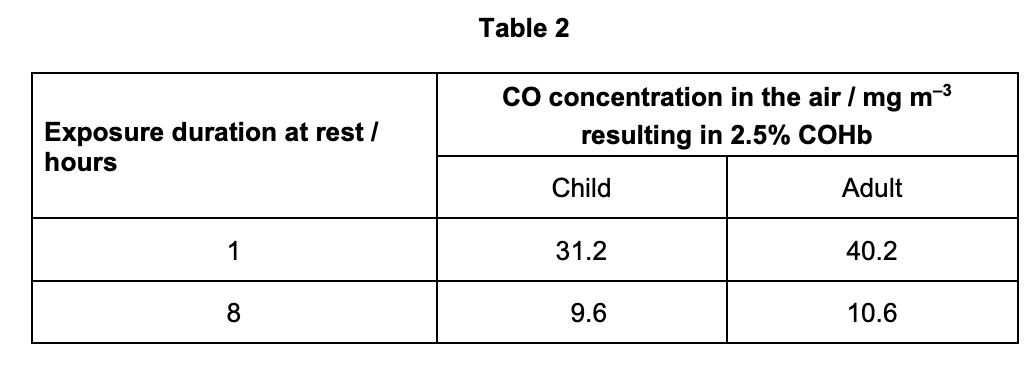 The scientists suggest that the WHO recommendations for carbon monoxide concentrations resulting in 2.5% COHb should be reduced.
Evaluate the scientists’ conclusion
(3 marks)Hint
State clearly if you agree or disagree with the conclusion, then use the data to support your judgement. Consider limitations of the study design.
Answer
Mark Scheme
- (For scientists’ suggestion) 1. Children exposed (to CO) for 8 hours (1 mark)
- (Against scientists’ suggestion) 2. Children exposed (to CO) for 1 hour OR Adults exposed (to CO) for 1 hour and 8 hours (1 mark)
- (But) 3. Maths model may not be accurate OR Maths model did not use people (1 mark)
-
- (Recommendation for people) only at rest OR Unknown effects of exercise (on CO uptake) (1 mark)
-
- (People vary in) size/age/ethnicity OR Different sex (1 mark)
-
- No statistical test to show if differences are significant (1 mark)
-
- Unknown effects on CO exposure for people with respiratory disease OR Unknown effects on CO exposure for smokers (1 mark)
-
- Might not be able to reduce CO (concentration) in air below 10(mg m⁻³) (1 mark)
Comments from mark scheme
Award 3 max only if answer contains MP1 OR MP2 3. Accept ‘(based on) invalid assumptions’ for ‘may not be accurate’ 3. Accept test OR experiment OR investigation for ‘maths model’ 5. Accept gender 6. Accept no SDs to show if differences are significant 7. Accept any named respiratory disorder; eg asthma OR coronary heart disease
Tips from examiner reports
- When evaluating a conclusion, clearly state whether you think it’s supported or not, then use data as evidence
- Note whether data comes from a mathematical model (theory) or real observations
- Check whether statistical tests have been done before accepting conclusions
- Don’t make vague comments like ‘correlation does not mean causation’ without specific context
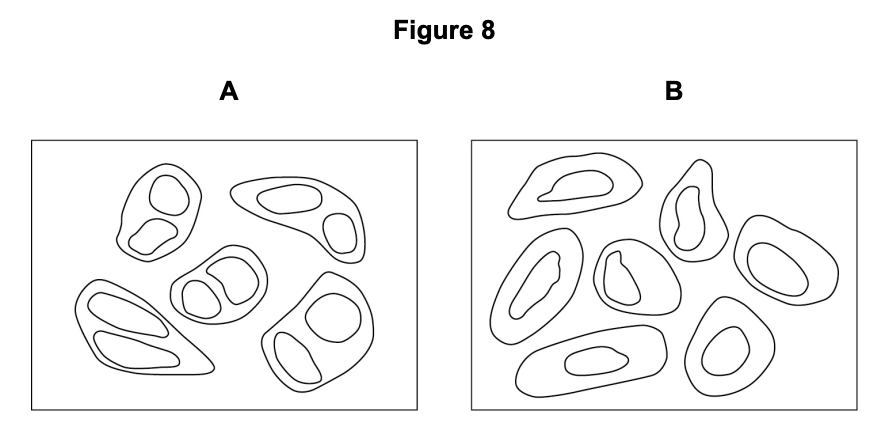
Scientists investigated a drug called MiTMAB as a treatment for cancer. MiTMAB inhibits cytokinesis. Figure 8 shows drawings of cancer cells seen with an optical microscope from a:
- sample treated with MiTMAB
- control sample
The cells in drawing A can be identified as those treated with MiTMAB. Explain why
Hint
Look at the diagram carefully. How many nuclei are in one cell? What stage of mitosis shows this arrangement? What process has been inhibited?
Answer
Mark Scheme
- 2 nuclei (in cells) OR Cells (stopped) at telophase (1 mark)
- Cytokinesis prevented OR Stopped (new) cell membrane forming OR Stopped cytoplasm dividing (1 mark)
Comments from mark scheme
- Accept cell membrane not dividing/splitting/ pinching (in the cell)
Tips from examiner reports
- If a cell has two nuclei, consider that mitosis occurred but cytokinesis was inhibited
- Identify which stage of mitosis the cell reached (e.g. telophase if two nuclei have formed)
- Two nuclei in one cell doesn’t mean they are separate cells
MiTMAB acts as a non-competitive inhibitor of an enzyme called dynamin.
Suggest how MiTMAB can cause dynamin to become inactive.
(3 marks)Hint
Where does a non-competitive inhibitor bind? How does this affect the active site? What happens to enzyme-substrate binding?
Answer
Mark Scheme
- (MiTMAB) binds (to dynamin) other than the active site (1 mark)
- Changes the shape of (dynamin) active site OR Changes the tertiary structure (of dynamin/ enzyme) (1 mark)
- Not complementary so substrate does not bind (to active site) OR Not complementary so no/fewer enzymesubstrate complexes (form) (1 mark)
Comments from mark scheme
- Accept (MiTMAB) binds to dynamin at an allosteric OR inhibitor site
- Accept denature for ‘change in shape’
- Accept ES complex in this instance
- Ignore ESC
- Accept fit OR
Tips from examiner reports
- Non-competitive inhibitors bind at a site other than the active site (an allosteric site)
- This changes the tertiary structure/shape of the active site so the substrate is no longer complementary and cannot bind
- Don’t describe the inhibitor as binding to the substrate
- Don’t call this competitive inhibition
When active, dynamin has two functions:
- it stimulates cytokinesis
- it inhibits cell death.
The scientists treated actively growing cultures of cancer cells with MiTMAB. They incubated:
- one sample of 2500 cells without MiTMAB as a control
- eight samples, each with 2500 cells and a different concentration of MiTMAB.
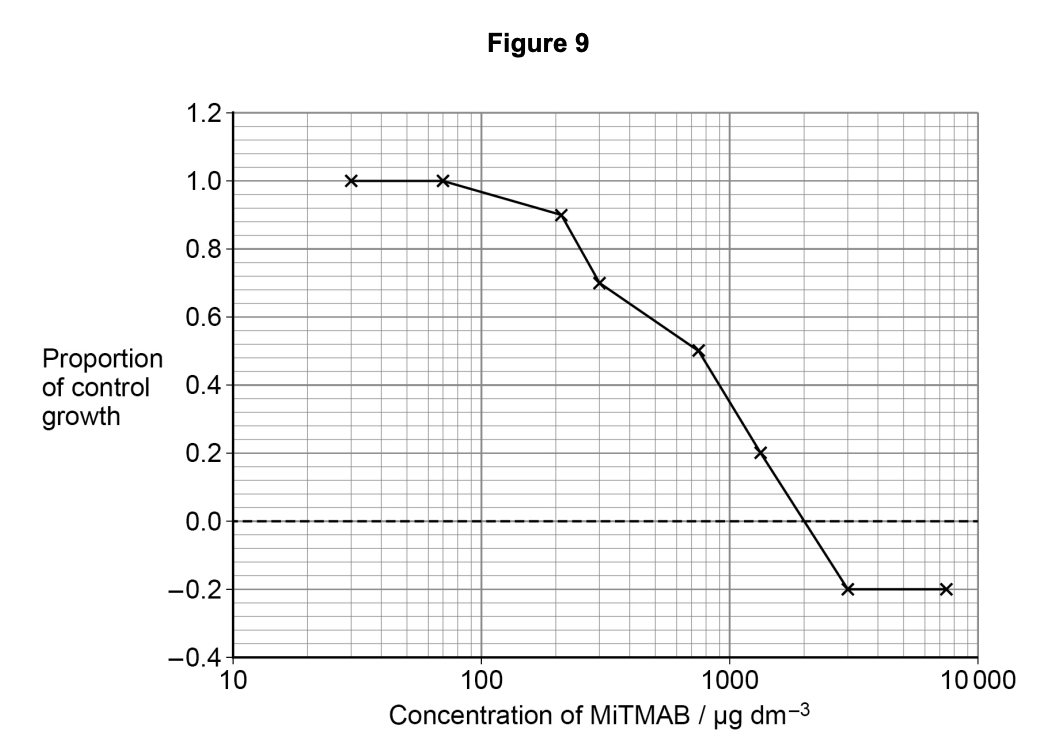
After 72 hours, the scientists measured the number of cells in each sample. Figure 9 shows the scientists’ results. A negative value for proportion of control growth means that fewer than 2500 cells were counted after 72 hours.
Use all the information given to explain the results shown in Figure 9.
Hint
Read values carefully from the logarithmic scale. Describe the trend using data from the figure.
Answer
Mark Scheme
- (At) lowest concentrations (all) dynamin is not inhibited OR (At) lowest concentrations (MiTMAB) does not cause cell death/inhibit cytokinesis (1 mark)
- (As MiTMAB) concentration increases more dynamin is inhibited/inactive OR (As MiTMAB) concentration increases cell death increases OR (As MiTMAB) concentration increases cytokinesis decreases OR No change in cell number at 2000 (µg dm⁻³) OR No change in cell number at 0.0 (on y axis) (1 mark)
- (At) highest (MiTMAB) concentrations all dynamin is inhibited OR (At) highest concentrations (MiTMAB) causes cell death OR (At) highest concentrations (MiTMAB) inhibits cytokinesis (1 mark)
Comments from mark scheme
- Accept graph readings in range 30 to 70 for lowest;
- Accept ‘has no effect’ for ‘cause cell death/inhibit cytokinesis’
- and 3. Accept ‘prevents inhibition of cell death’ for ‘causes cell death’ 1, 2 and 3. Accept ‘cell replication’ OR mitosis for cytokinesis
- Accept graph readings >2000 to 8000 for highest
Tips from examiner reports
- Describe data trends precisely — say ‘as concentration increases, more enzymes are inhibited’ rather than just ‘increased drug caused cell death’
- Read logarithmic scales carefully — the intervals are not evenly spaced
- Quote specific values from the graph to support your answer
0.01 dm³ of MiTMAB solution was added to the treated cells.
Calculate the increase in mass of MiTMAB (in μg) added to the cells to reduce the cell growth from equal to the control to 0.0 of the control. Show your working Answer (μg)
(2 marks)Hint
Read values carefully from the logarithmic scale. Calculate the fold increase using the concentrations that cause effects.
Answer
Mark Scheme
- Correct answer in range 19.3 to 19.7 = 2 marks (1 mark)
- Accept for 1 mark evidence of 70 and 2000 (correct readings from the graph) / 30 and 2000 (correct readings from the graph) OR 1930 (correct increase in MiTMAB, 70 to 2000) / 1970 (correct increase in MiTMAB, 30 to 2000) OR Division by 100/multiplication by 0.01 (correct conversion to mass in 0.01 dm³) (1 mark)
Comments from mark scheme
Correct answer 19.3 (is obtained from 70 and 2000) 19.7 (is obtained from 30 and 2000) Accept for 1 mark, any value in range 30 to 70 and 2000 Accept for 1 mark, any value in the range 1930 to 1970
Tips from examiner reports
- Practise reading logarithmic scales — the intervals between values are not equal
- Show your working clearly when extracting and using values from graphs
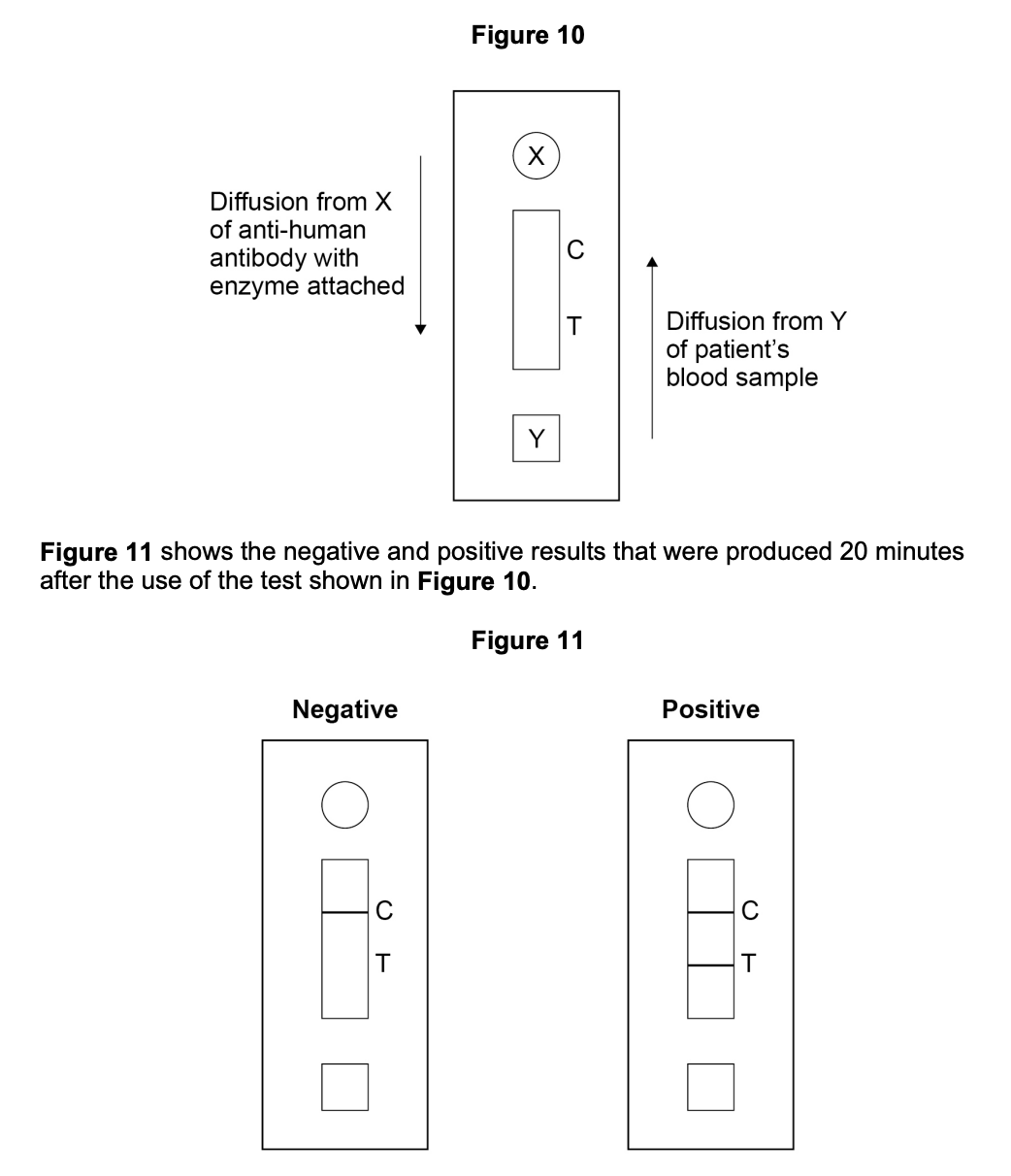
Dengue box fever is a human disease caused by the dengue virus. Scientists designed an ELISA test to detect antibodies to the dengue virus in a patient’s blood sample. Figure 10 shows a diagram of this test and some information about how it works.
Suggest what is on the test at line T and explain what causes the line to appear in a positive test.
Hint
Read the question carefully - what is being detected? Antibodies or antigens? Describe how the ELISA technique produces a visible result.
Answer
Mark Scheme
- Antigen (at T and substrate) (1 mark)
- Enzyme-substrate complex (produces a line/colour change) OR Enzyme (binds) with substrate (produces line/colour change) (1 mark)
Comments from mark scheme
- Reject antigen in blood
- Accept colourless dye for substrate
- Accept ES complex in this instance
Tips from examiner reports
- In an ELISA-based test, the test detects antibodies (not viruses or antigens) in the blood sample
- Read the question carefully to identify exactly what the test is detecting
- Include the full sequence: antibody binds → enzyme catalyses reaction with substrate → colour change
A line at C shows that the test has worked.
Suggest one reason why a line at C shows the test has worked.
(1 marks)Hint
What does the control line tell you about whether the test has worked properly?
Answer
Mark Scheme
- Blood/sample has moved/diffused (above T in the test) (1 mark)
Comments from mark scheme
Accept Blood/sample and anti-human antibody have moved (in the test)
Tips from examiner reports
- The control line confirms the sample has flowed through the test properly — it validates that the result at the test line is reliable
- Don’t focus on why a colour appears at the control line — focus on what it proves about sample flow
Figure 12 shows a flowchart of how the anti-human antibodies with enzyme attached are produced.
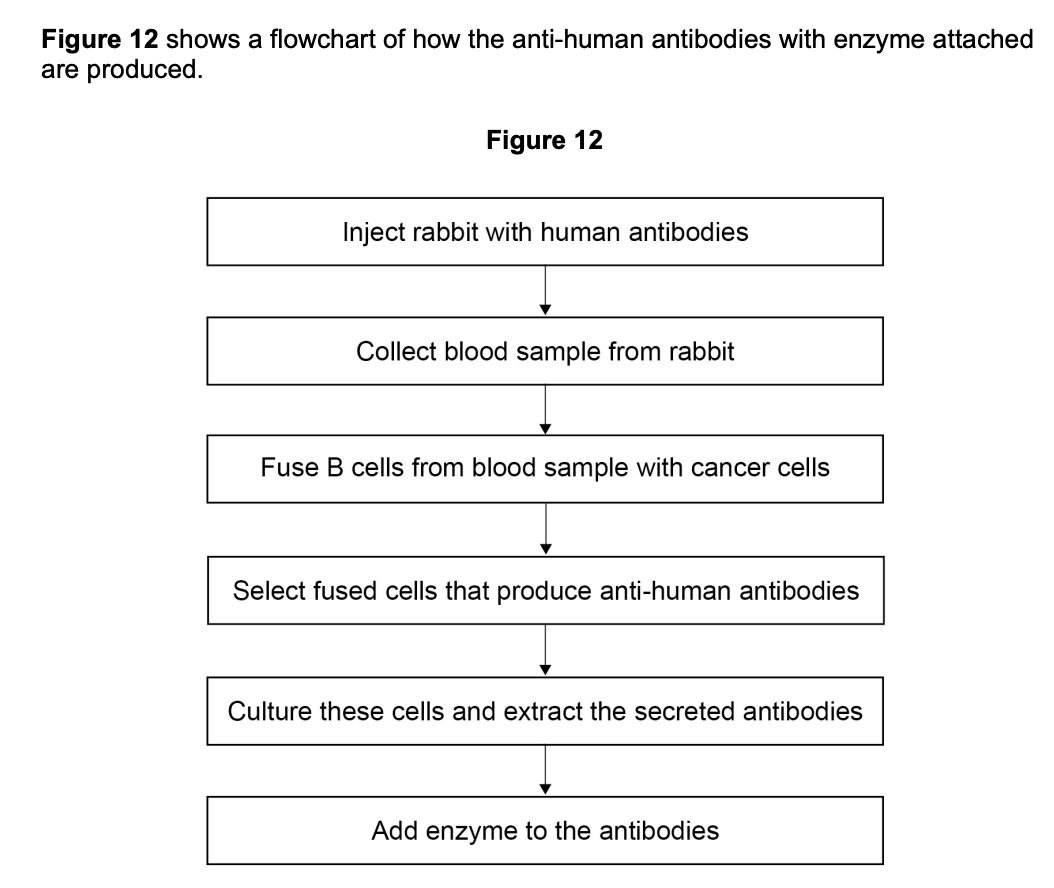 Suggest why the fused cells allow continuous production of monoclonal antibodies.
Hint
Hybridomas are made by fusing two cell types. What does each contribute? Why are they useful for antibody production?
Answer
Mark Scheme
- Fused cells divide uncontrollably (cancerous) (1 mark)
- B cells produce antibodies (from immune response). Accept hybridoma for fused cells. (1 mark)
Comments from mark scheme
- Accept mitosis OR reproduce for divide
- Accept hybridoma for ‘fused cell’
- Accept ‘plasma cells’ OR ‘memory cells’ for ‘B cells’
- Accept secrete OR make for produce
Tips from examiner reports
- Hybridoma cells combine the rapid division of cancer cells with antibody production from B cells/plasma cells
- Make sure you mention both properties: unlimited cell division AND antibody production
Evaluate the ethics of the production process shown in Figure 12.
Hint
Evaluate means give both sides - benefits AND drawbacks. Consider medical benefits as well as ethical concerns.
Answer
Mark Scheme
- Harmful to animals but provides useful treatment OR Not harmful but animals injected. Must include both positive and negative ethical considerations. (1 mark)
Comments from mark scheme
Must have idea ‘for’ and idea ‘against’ Accept stressed OR exploited OR mistreated OR abused for harmed Accept illness OR infection OR death for suffering
Tips from examiner reports
- When asked to ‘evaluate’, present both sides of the argument — not just one
- Consider both the ethical concerns and the potential benefits
Early identification of dengue fever can be difficult as many other diseases produce box the same symptoms. Early identification is important because people suffering with dengue fever can become ill very quickly and may need hospital treatment.
Scientists compared the effectiveness of three diagnostic tests for dengue fever.
- Laboratory-based test – a patient’s blood sample is sent from the doctor’s clinic to a laboratory for testing.
- Current test used in the doctor’s clinic.
- New test to be used in the doctor’s clinic – the ELISA test shown in Figures 10 and 11 (on page 24).
The scientists’ results are shown in Table 3.
A blood sample from each patient with confirmed dengue fever at each time after onset of symptoms was tested with all three diagnostic tests.
The scientists recommend that the new test is used for the identification of dengue fever in all countries around the world.
Discuss this recommendation. Use all the information given
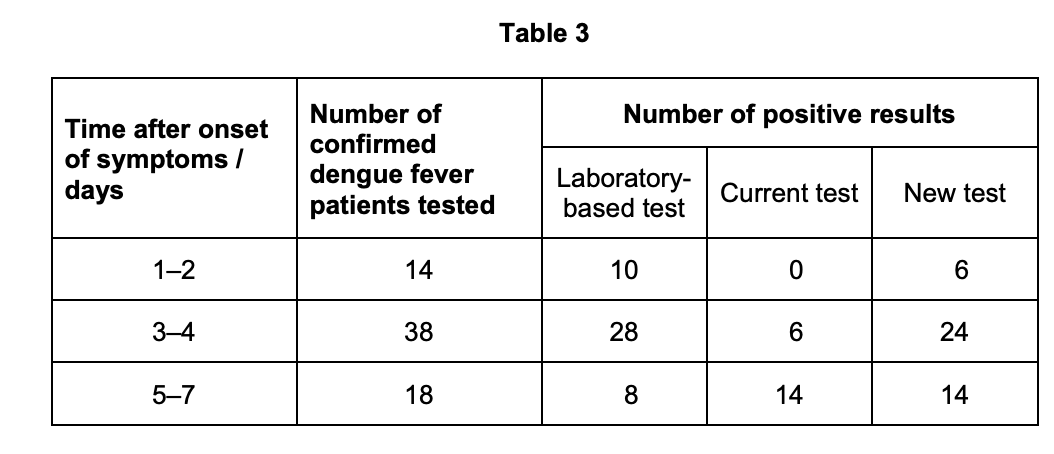
Hint
Compare the tests using the data provided. Calculate totals or percentages if it helps your comparison. Consider reliability and practical factors.
Answer
Mark Scheme
- Better than current at detecting early but not as good as lab-based (1 mark)
-
- New/current test better than lab-based from 5 days OR New test as good as current from 5 days (1 mark)
-
- New test and lab-based better total (of) positives than current OR New test total (of) positives not (quite) as good as lab-based (1 mark)
-
- New test (likely to be) quicker (1 mark)
-
- New test (likely to be) cheaper (1 mark)
-
- Limited/inaccessible labs OR Limited training of people to use labs (1 mark)
Comments from mark scheme
Max 2 from 4, 5 and 6 Accept ELISA test for new test 1, 2 and 3 Accept correct comparative figures from Table 3 OR calculations (some examples in table below)
- and 2. Accept higher proportion for better
- Accept reference to day(s) in range of 1 to 4 days for early
- Accept identifies OR finds OR spots for detects
- and 2. Accept ‘more accurate’ OR ‘identifies more’ OR ‘finds more’ OR ‘detects more’ O ‘is more successful’ OR ‘is more effective’ for “better than” and the converse of these statements for “not as good as”
- Accept after 4 days
- Accept ‘more efficient’ for quicker
Tips from examiner reports
- When asked to ‘discuss’ data, describe trends AND evaluate the investigation design
- Calculate totals or percentages from the data to strengthen your analysis
- Make logical comparisons between different conditions or tests
The dengue virus causes damage to capillaries so that blood proteins move out of the capillaries into the tissue fluid.
Explain how damage to capillaries would affect the return of tissue fluid into the capillaries.
(2 marks)Hint
What happens when protein leaks out of capillaries? How does this affect water potential in tissue fluid and the direction of water movement?
Answer
Mark Scheme
- Increases water potential of blood/capillary OR Decreases water potential of tissue fluid (1 mark)
- (So) less water returns to blood/capillaries (by osmosis) OR (So) more water leaves blood/capillaries (by osmosis) (1 mark)
Comments from mark scheme
- Accept Ψ for water potential 1 Ignore WP
- Accept reduces water potential gradient
- Ignore tissue fluid
- Accept ‘no’ for less
Tips from examiner reports
- It’s water that moves by osmosis, not tissue fluid — be precise with terminology
- If protein leaks out of capillaries, water potential of tissue fluid decreases (becomes more negative), not increases
- State clearly where the water potential changes and the direction of water movement
Describe how a quaternary protein is formed from its monomers. Do not include translation.
(5 marks)Hint
Describe each level of protein structure and the bonds involved. Primary is about sequence and peptide bonds.
Answer
Mark Scheme
- Amino acids joined by peptide bond(s) (1 mark)
- (By) condensation reaction(s) (1 mark)
- Secondary structure is formed by hydrogen bonding (1 mark)
- Tertiary structure formed by interactions (between R groups) (1 mark)
- Quaternary structure contains >1 polypeptide OR Quaternary structure formed by interactions/bonds between polypeptides (1 mark)
Comments from mark scheme
- Accept alpha helix OR β-pleated sheet for ‘secondary structure’
- Accept 3o for tertiary
- and 5. Accept for ‘interactions’, hydrogen bonds OR disulfide bridges OR ionic bonds OR hydrophobic OR hydrophilic interactions
- Ignore peptide
Tips from examiner reports
- Cover all levels of protein structure: primary (amino acids joined by peptide bonds via condensation), secondary, tertiary, quaternary
- Quaternary structure doesn’t always mean four polypeptides — it means multiple polypeptide chains
- Don’t forget to mention condensation reactions and peptide bonds for primary structure
Describe the structure of DNA and the structure of a chromosome.
(6 marks)Hint
Describe DNA structure in detail - nucleotide components, how they join, base pairing rules, overall structure.
Answer
Mark Scheme
- Polymer of nucleotides (1 mark)
- (Nucleotide) consists of deoxyribose, phosphate and an organic/nitrogenous base (1 mark)
- Phosphodiester bonds (between nucleotides) (1 mark)
- DNA double helix held by H bonds OR 2 strands held by H bonds (1 mark)
- (Hydrogen bonds/pairing) between adenine, thymine and cytosine, guanine (1 mark)
- DNA is associated with histones/proteins (1 mark)
- (During mitosis/when visible) chromosome consists of two chromatids joined at a centromere (1 mark)
Comments from mark scheme
- Accept ‘polynucleotide’
- Accept ‘phosphoric acid’ for phosphate
- Ignore bases identified with letters (A, T, G, C)
- Reject adenosine and cysteine Accept correctly annotated diagram(s) for equivalent marking points
Tips from examiner reports
- DNA is a polymer of nucleotides — state this clearly
- Write out full base names (adenine, thymine, cytosine, guanine) — single letters alone won’t score marks
- Phosphodiester bonds link nucleotides together — state where they are located
- Mention hydrogen bonds between complementary base pairs hold the two strands together
Mutation can result in an increase in genetic variation within a species. Describe and explain the other processes (apart from mutation) that result in increases in genetic variation.
(4 marks)Hint
Focus on meiosis (crossing over, independent segregation) and fertilisation. How do these create NEW COMBINATIONS of alleles?
Answer
Mark Scheme
- Independent segregation of homologous Chromosomes/pairs (1 mark)
- Crossing over between homologous chromosomes/pairs (1 mark)
- Random fertilisation of gametes (1 mark)
- (Produces) new combinations of alleles (1 mark)
Comments from mark scheme
If no marks awarded accept one principle mark ‘Meiosis producing cells that are genetically different (from one another)’
- For ‘independent’ accept ‘random’
- For ‘segregation’ accept ‘assortment’
- Accept ‘within bivalent’ for ‘between homologous pair’
- Ignore ‘random mating’
- Accept ‘random fusion’ for ‘random fertilisation’ Accept as an additional mark point
- (Produces) new combinations of maternal and paternal chromosomes Ignore reference to epigenetics
Tips from examiner reports
- For genetic variation in meiosis, include: crossing over during prophase I (between homologous chromosomes), independent assortment/segregation, and random fertilisation
- Don’t forget to mention homologous chromosome pairing before describing crossing over
- Random fertilisation involves gametes — say so explicitly
- Migration introduces new alleles but doesn’t create new allele combinations — only meiosis and fertilisation do that
Describe the structure and function of the nucleus.
(4 marks)Answer
Mark Scheme
- Structure 1. Nuclear envelope and pores OR Double membrane and pores (1 mark)
-
- Chromosomes/chromatin OR DNA with histones (1 mark)
-
- Nucleolus/nucleoli (1 mark)
- Function 4. (Holds/stores) genetic information/material for polypeptides (production) OR (Is) code for polypeptides (1 mark)
-
- DNA replication (occurs) (1 mark)
-
- Production of mRNA/tRNA OR Transcription (occurs) (1 mark)
-
- Production of rRNA/ribosomes (1 mark)
Comments from mark scheme
Max 2 for structure or function
- Ignore porous for pores 2 Ignore genetic material/information
- Accept nucleoplasm
- Ignore promoter regions OR genes OR alleles Accept regulation of gene expression
- Accept protein OR amino acid sequences OR primary structure for polypeptides 6 Ignore mRNA leaves nucleus
Tips from examiner reports
- Give more than one function of the nucleus — don’t stop at just one
- Explain that DNA codes for polypeptides/proteins — saying ‘controls cell activities’ is too vague
- The nucleolus doesn’t contain all the cell’s DNA — it’s involved in ribosome production
Name the main polymer that forms the following cell walls.
- Plant cell wall
- Fungal cell wall
Answer
Mark Scheme
- Cellulose (plants) and Chitin (fungi) (1 mark)
Tips from examiner reports
- Fungal cell walls contain chitin, not murein/peptidoglycan (which is found in bacteria)
- Don’t confuse fungal and bacterial cell wall composition
Scientists investigated the effect of the number of fungal species in soil on the diversity of plant species.
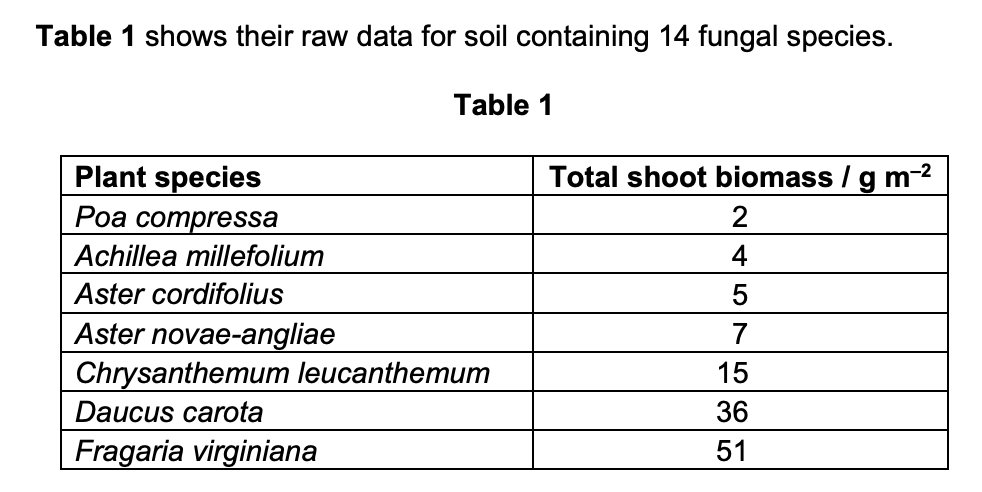 Suggest one reason the scientists used biomass instead of the number of individuals of each plant species when collecting data to measure diversity.
Answer
Mark Scheme
- Individual organisms could not be identified/separated OR Too small/numerous to count individuals OR Too time consuming (1 mark)
Comments from mark scheme
Ignore too difficult to identify/distinguish different species Ignore too difficult to count unless qualified Accept reference to fungi for plants
Tips from examiner reports
- Biomass is used to measure the abundance of a species more objectively when organisms are very small or numerous, making counting subjective
- Don’t confuse biomass measurement with energy flow or pyramids of biomass
- This isn’t about excluding water — it’s about getting a reliable measure of abundance
The scientists used this equation to calculate the plant species index of diversity.
d = 1 − Σ(n/N)²
where n = shoot biomass of each plant species and N = total shoot biomass of all plant species
Use this equation to calculate the index of diversity for the data in Table 1.
(2 marks)Answer
Mark Scheme
- Correct answer for 2 marks, 0.7– 0.71 (1 mark)
- Accept for 1 mark, 0.29 – 0.3 (correct calculation not subtracted from 1) OR 120 (correct total shoot biomass) (1 mark)
Tips from examiner reports
- Use the formula given in the question, not a different one you’ve memorised from the specification
- Read the table carefully and calculate totals accurately before applying the formula
Clostridium difficile is a bacterial species that causes disease in humans. Antibiotic-resistant strains of C. difficile have become a common cause of infection acquired when in hospital.
Explain how the use of antibiotics has led to antibiotic-resistant strains of bacteria becoming a common cause of infection acquired when in hospital.
(3 marks)Answer
Mark Scheme
- (Some bacteria have) alleles for resistance (1 mark)
- (Exposure to) antibiotics is the selection pressure OR Non-resistant bacteria die OR Resistant bacteria survive/reproduce (1 mark)
- More antibiotics used in hospital (compared with elsewhere) OR Patients have weakened immune systems OR (So) high frequency of resistance allele (in bacterial population) (1 mark)
Comments from mark scheme
1 and 2 Reject reference to immunity only once
- and 3. Accept gene for allele
- Reject if antibiotics cause production of resistance gene/allele
- Accept strain for bacteria
- Ignore antibiotics prescribed when not needed OR antibiotic course is not finished
- Ignore defence system, for immune system
- Accept proportion/percentage for frequency
Tips from examiner reports
- Antibiotic resistance in bacteria arises from natural selection, not from antibiotics causing mutations
- Don’t say bacteria develop an ‘immune response’ to antibiotics or involve white blood cells/antibodies
- In hospitals, resistance is selected for by high antibiotic use and patients with weakened immune systems
- The sequence: random mutation → resistant allele → survival advantage with antibiotics → reproduction → allele frequency increases
Scientists suggested that factors, other than antibiotic use, led to the increase in antibiotic-resistant C. difficile infections. One suggested factor is people eating more trehalose in their diet. Trehalose is a disaccharide formed from two glucose molecules.
Name another disaccharide formed from two glucose molecules.
(1 marks)Answer
Mark Scheme
- Maltose (1 mark)
Tips from examiner reports
- Straightforward recall — make sure you know this topic
Scientists investigated the effect of trehalose on the growth rate of C. difficile. They grew populations of non-resistant and antibiotic-resistant C. difficile on separate agar plates with:
- no carbohydrate added
- trehalose added.
They measured the growth rate of the C. difficile.
Describe how the scientists could use aseptic techniques to transfer 0.3 cm³ of C. difficile in liquid culture from a bottle onto an agar plate.
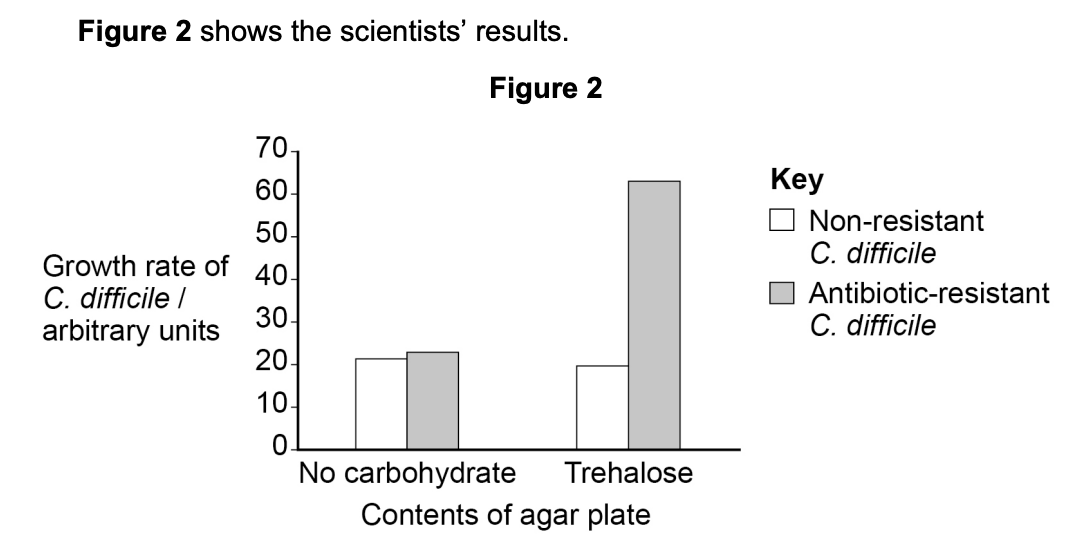
Answer
Mark Scheme
- Wash hands with soap OR Disinfect surfaces (1 mark)
- Use sterile pipette/syringe (to transfer bacteria) (1 mark)
- (Remove bottle lid and) flame neck of bottle (1 mark)
- Lift lid of (agar) plate at an angle (1 mark)
- Work close to upward air movement (1 mark)
- Use sterile spreader (1 mark)
- Place pipette/spreader into disinfectant (immediately after use) (1 mark)
Comments from mark scheme
- Ignore sterilise hands OR surfaces
- Accept sanitise for disinfect
- Accept antiseptic /antimicrobial/alcohol (wipes)
- and 7 Accept a named type of disinfectant
- Reject loop
- Accept use unopened pipette/syringe for sterile
- Accept lift lid slightly OR keep lid over plate
- Ignore work quickly with lid off 5 Reject air movements sterilise air 5 Accept convection current for air movement
- Accept loop for spreader
- Examples of sterilising technique eg, flame OR dip in alcohol and flame OR dip in disinfectant and rinse (in sterile water)
Tips from examiner reports
- For aseptic technique, be specific: hold the lid at an angle (don’t just say ‘reduce time lid is off’)
- Working near a lit Bunsen creates upward convection currents that carry airborne microbes away
- Use appropriate techniques for the context — don’t describe tweezers or loops if they’re not suitable
Use Figure 2 to evaluate whether more trehalose in the diet could be a factor in the increased number of antibiotic-resistant C. difficile infections.
(3 marks)Answer
Mark Scheme
- For 1. Resistant bacteria grow faster with trehalose (1 mark)
-
- (So) resistant bacteria (likely to) increase in frequency in the population/people (1 mark)
-
- Resistant bacteria (likely to) outcompete non-resistant bacteria (1 mark)
- Against 4. In laboratory not in people (1 mark)
-
- Other disaccharides (in the diet) might affect bacteria (1 mark)
-
- Other bacterial species (in the body) might affect bacteria (1 mark)
-
- No stats test to see if difference/increase is significant (1 mark)
-
- No data for both resistant and non-resistant bacteria growing together (1 mark)
-
- No data for different concentrations of trehalose (1 mark)
Comments from mark scheme
Max 2 if only ‘For’ or only ‘Against’ marks 1, 2, 3 ,4 and 5 Accept C. difficile/strain for bacteria 2. Accept ‘percentage/ proportion’ for ‘frequency’ 5. Accept carbohydrate OR polysaccharide OR sugar, for disaccharide 7. Accept ‘is not due to chance’ for ‘is significant’ 7. Ignore standard deviation/SD (as not a stats test) 7 Reject ‘to see if results are significant
Tips from examiner reports
- Faster bacterial growth means more cells are produced in a given time — don’t just say ‘more bacteria’
- When evaluating, mention specific limitations: only one concentration tested, lab conditions vs real-life application, no statistical tests
- Avoid generic statements like ‘correlation doesn’t mean causation’ without linking them to the specific data
Give two features of all prokaryotic cells that are not features of eukaryotic cells.
(1 marks)Answer
Mark Scheme
- For 1 mark, accept any two from Prokaryotes have No membrane-bound organelles/correct example OR (Single,) circular/loop DNA (in cytoplasm) OR DNA free in cytoplasm OR DNA not associated with proteins/histones OR 1 (AO1) Murein/peptidoglycan (in) cell wall (1 mark)
Comments from mark scheme
Accept (prokaryotes) only have smaller ribosomes /60S/70S Accept mesosome Accept no introns Accept nucleoid for single, circular DNA Reject nucleosome Reject plasmid Reject (bacterial) chromosome Reject capsule/slime layer Reject flagellum
Tips from examiner reports
- The question asks for structures found in ALL prokaryotes — don’t list structures only in some (plasmids, capsules, flagella)
- 70S ribosomes are found in both prokaryotes AND eukaryotic organelles, so they’re not unique to prokaryotes
- Read the question carefully — ‘structures in all prokaryotes’ is different from ‘differences between prokaryotes and eukaryotes’
This AP has a secondary structure in a helical shape.
Tick the box to show which type of bond maintains the helical structure of the polypeptide.
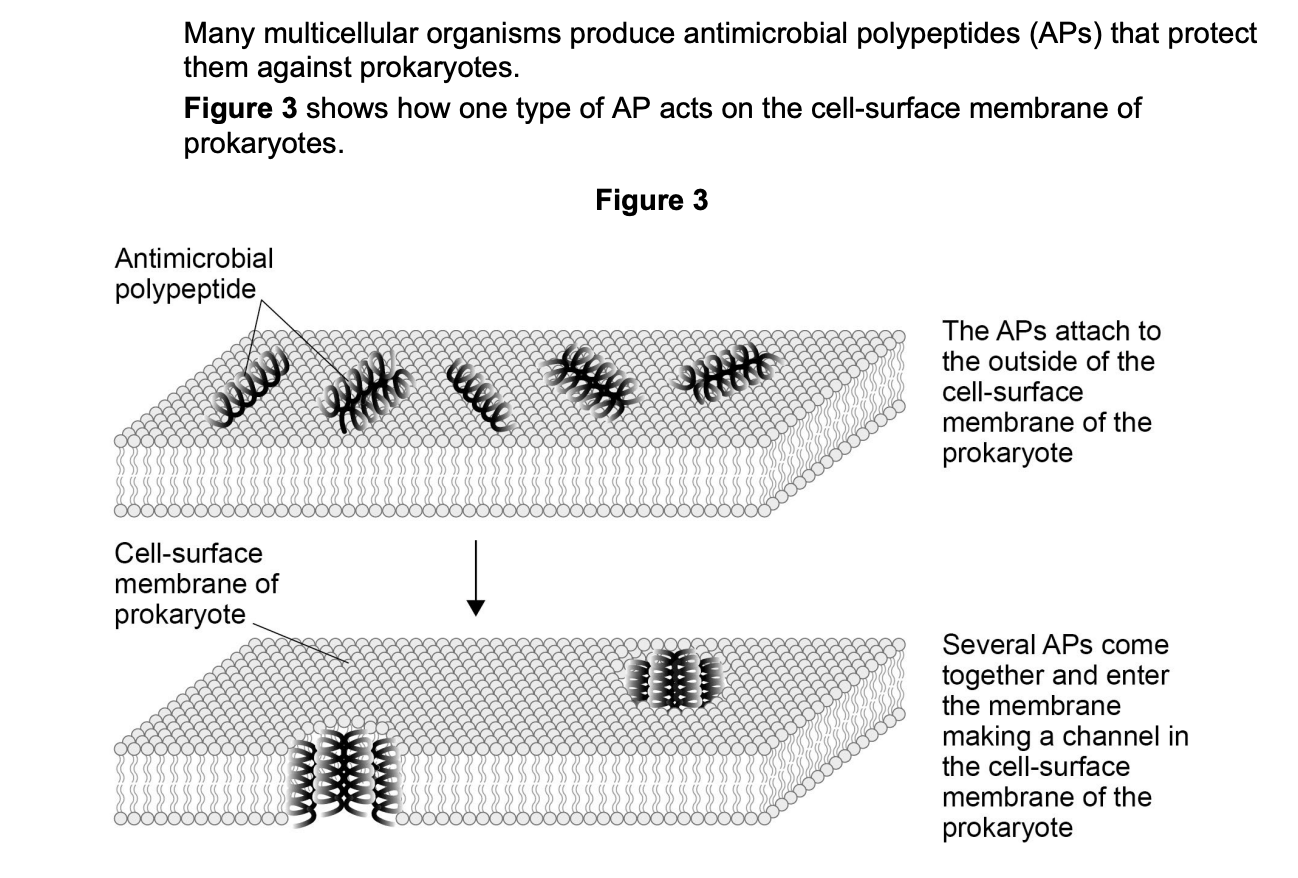
Answer
Mark Scheme
- Hydrogen (1 mark)
Tips from examiner reports
- Straightforward recall — make sure you know this topic
The amino acids on one side of each AP helix have hydrophobic properties. The amino acids on the opposite side of each helix have hydrophilic properties. Figure 4 shows this.
Suggest how these properties of the APs allow them to become positioned across the membrane (as shown in Figure 3) and make a channel through which ions can pass.
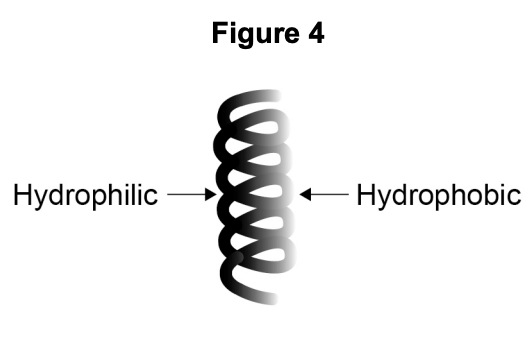
Answer
Mark Scheme
- Hydrophobic side next to/in/face fatty acids/tails OR Hydrophobic side next to/in/face hydrophobic (part of) phospholipid/bilayer (1 mark)
- Hydrophilic sides allow ion movement through membrane OR Hydrophilic sides form a channel (1 mark)
Comments from mark scheme
1 and 2 Accept ‘part/region/bit/half’ for side 2. Accept water OR charged/polar molecules/substances OR water-soluble substances for ions
Tips from examiner reports
- Don’t confuse hydrophilic with hydrophobic — know which parts of a protein interact with the aqueous environment and which sit within the bilayer
- Describe how a transmembrane protein sits across the membrane with hydrophobic regions in the lipid bilayer and hydrophilic regions exposed
- This creates a hydrophilic channel through the membrane
Figure 5 shows further information about a channel formed in the cell-surface membrane by the APs.
Use Figure 5 to calculate the cross-sectional area of the channel through which ions can pass. Assume the cross-sectional area is circular. Use π = 3.14 in your calculation.
Give your answer in nm² and to 1 decimal place
Answer in nm²
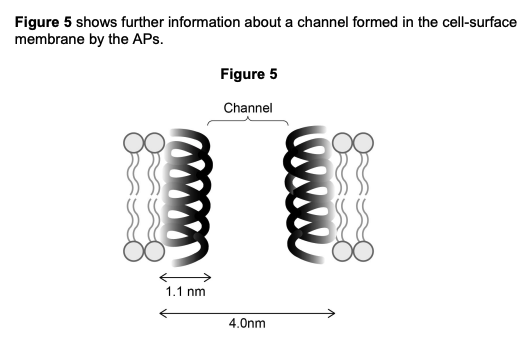
Answer
Mark Scheme
- Correct answer for 2 marks, 2.5 (1 mark)
- Accept for 1 mark, 2.5434 (Correct answer but 2 or more decimal places) OR 10.2 (correct area calculation using diameter, to 1 decimal place) OR 6.6 (correct calculation using radius (4 – 1.1) ÷ 2, to 1 decimal place) OR 26.4 (correct calculation using diameter, 4 – 1.1, to 1 decimal place) (1 mark)
Tips from examiner reports
- Use the radius (not diameter) in the area formula πr²
- Measure dimensions carefully from figures and round appropriately
The APs damage prokaryotic cells but do not damage the eukaryotic cells in the organisms that produce them. Prokaryotic cell membranes do not contain cholesterol.
Assess why the APs do not damage the eukaryotic cells of the organisms that produce them.
(2 marks)Answer
Mark Scheme
- Cholesterol stabilises (the membrane) OR Cholesterol restricts the movement of molecules/phospholipids/fatty acid (tails) (making up the membrane) (1 mark)
- (So) APs do not make channels in (eukaryotic) membranes OR (So) APs cannot enter the (eukaryotic) membrane (1 mark)
Comments from mark scheme
- Accept makes (membrane) less flexible OR less fluid OR stiffer OR rigid OR gives structural support for stabilises
- Ignore strength
- Accept holds together for restricts movement
- Accept fewer for do not
- Accept cannot fit OR be positioned OR sit in OR form in OR embed OR disrupt for enter
Tips from examiner reports
- Cholesterol in eukaryotic membranes reduces membrane fluidity and helps maintain structural integrity
- Be specific about how pore-forming proteins damage membranes — don’t just say ‘they damage membranes’
- Cholesterol doesn’t ‘strengthen’ membranes or resist turgidity pressure
Scientists observed these APs on prokaryotes using a transmission electron microscope. They stained the APs using a monoclonal antibody with gold attached to it.
Suggest how these techniques allowed observation of APs on prokaryotes.
(3 marks)Answer
Mark Scheme
- Antibody binds to AP OR Gold (present) where AP located (1 mark)
- (As antibody/tertiary structure is) complementary (to AP) (1 mark)
- Gold interacts with electrons (in TEM) (1 mark)
- (T)EM (used as it) has a high resolution (1 mark)
Comments from mark scheme
- Accept attaches OR forms antibody-AP OR antibody-antigen complex, for binds
- Reject reference to active site
- For ‘interact’ accept scattered/deflected/reflected OR blocked/absorbed/ bounced/ interrupted OR a description of these
Tips from examiner reports
- Monoclonal antibodies bind specifically to target proteins due to their complementary shape
- TEM provides high resolution to visualise where antibodies have bound
- Don’t say antibodies have an ‘active site’ — they have a binding site
- Don’t describe ELISA unless the question asks for it
Describe viral replication.
(3 marks)Answer
Mark Scheme
- Attachment proteins attach to receptors (1 mark)
- (Viral) nucleic acid enters cell (1 mark)
- Nucleic acid replicated in cell OR Reverse transcriptase makes DNA from RNA (1 mark)
- Cell produces (viral) protein/capsid/enzymes (1 mark)
- Virus assembled and released (from cell) (1 mark)
Comments from mark scheme
- For ‘attachment protein’ accept gp41/gp120/ glycoprotein but ignore ‘receptor protein’ (on virus)
- Accept bind for attach
- Accept references to engulfment OR injection for enters Ignore references to virus DNA/RNA incorporated into cell genome/nucleus/ chromosomes
- and 3. Accept RNA/DNA/genetic material for ‘nucleic acid’.
- Accept capsomeres OR reverse transcriptase for protein
- Accept lysis OR burst OR bud off OR emerge for released
Tips from examiner reports
- Viruses replicate by: attachment proteins bind to host cell receptors → genetic material enters the cell → host cell machinery makes viral components → new viruses are assembled → released from the cell
- Viruses don’t replicate by binary fission or mitosis
- mRNA is not injected into cells — viral nucleic acid is
- Include viral assembly before release — don’t skip this step
Complete Table 2 by putting a tick () where the feature is part of a cell cycle involving mitosis or a cell cycle involving binary fission.
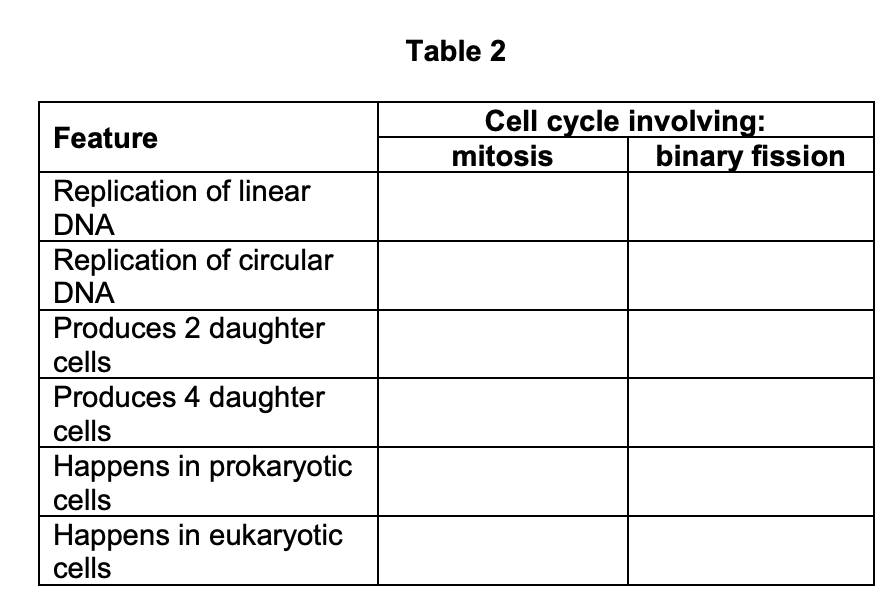
Answer
Mark Scheme
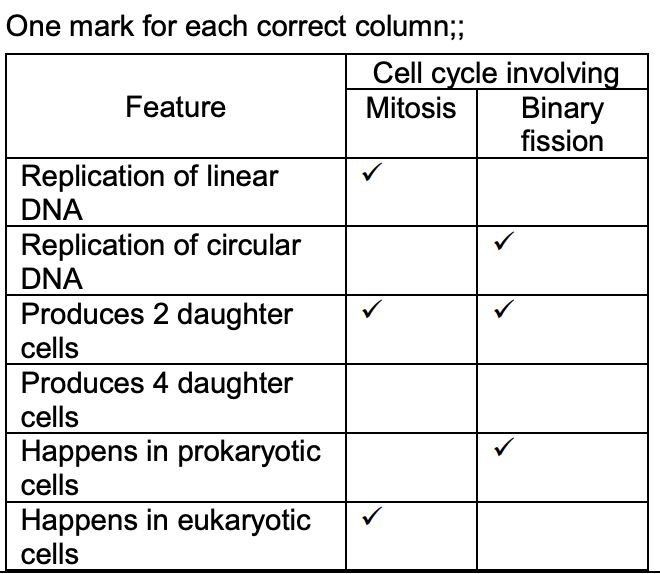
Tips from examiner reports
- Straightforward recall of cell division — revise mitosis and meiosis thoroughly
Complete Figure 6 to show the chromosomes inside the daughter cells formed after the second meiotic division.
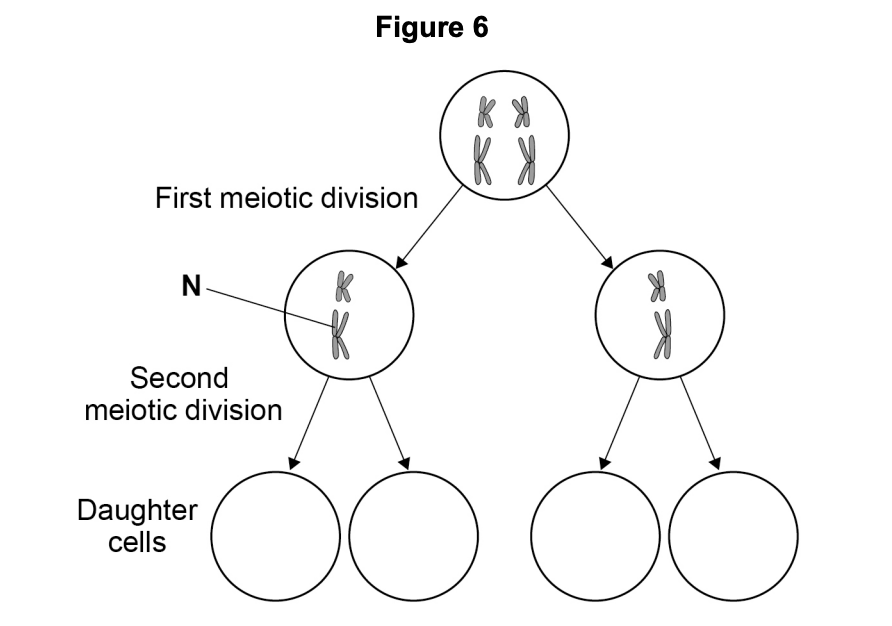
Answer
Mark Scheme
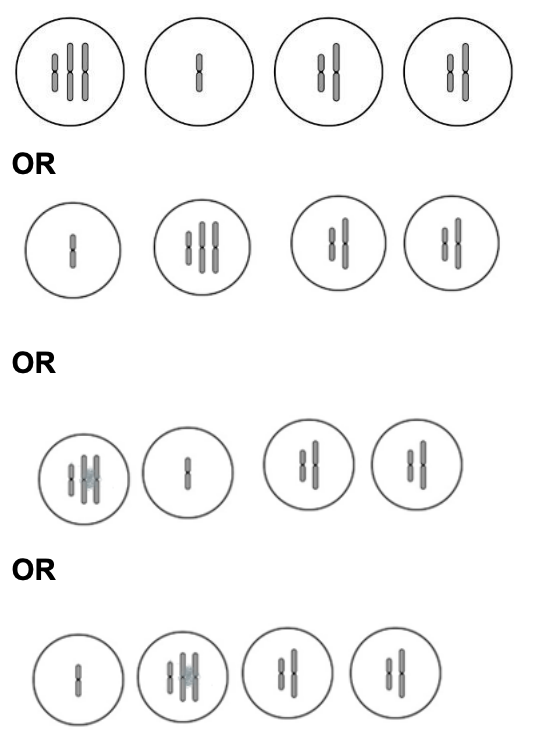
- 2 cells on left correct, ignore differences in chromosome length in drawn cells (1 mark)
- 2 cells on right correct, ignore differences in chromosome length in drawn cells (1 mark)
Tips from examiner reports
- In non-disjunction, chromosomes or chromatids fail to separate properly during meiosis
- Draw chromatids clearly — show the difference between long and short chromosomes
- Non-disjunction of one pair doesn’t leave a cell with zero chromosomes — only one pair is affected
A student concluded that there were more mothers of age ˃37 with MM2 errors than with MM1 errors. Using Figure 7 and suitable calculations show why this conclusion is not valid.
(2 marks)Answer
Mark Scheme
- (Conclusion not valid because) 1. (MM1) 197/197.1 (1 mark)
- and 2. (MM2) 83/82.8 (1 mark)
Tips from examiner reports
- Read data from graphs/figures carefully — don’t misread 0.01 as 0.1
- Include all categories when calculating totals
- Round correctly — 82.8 rounds to 83, not 82
- Use the correct population size in your calculations
Two enzymes, P and Q, are proteins with quaternary structure which catalyse the same reaction, but they have different amino acid sequences.
Define the quaternary structure of a protein.
(1 marks)Answer
Mark Scheme
- More than 1 polypeptide (1 mark)
Comments from mark scheme
Ignore prosthetic group OR named interactions between chains, eg disulfide bridge
Tips from examiner reports
- Quaternary structure = two or more polypeptide chains joined together — know this definition
Explain how two enzymes with different amino acid sequences can catalyse the same reaction.
(2 marks)Answer
Mark Scheme
- (Both) active sites have similar/identical tertiary structures OR (Both) active sites have identical amino acid sequences (1 mark)
- (So) form enzyme-substrate complexes (with the same substrate) (1 mark)
Comments from mark scheme
- Ignore shape for tertiary structure
- Accept (both) have active sites that are complementary to different parts of the substrate;
- Accept attach/bind for complementary 2 Accept E-S for enzyme-substrate
Tips from examiner reports
- Different amino acid sequences fold into different tertiary structures, giving different active site shapes — this is why different enzymes have different specificities
- Don’t say the amino acid sequence is a ‘degenerate code’ or that it determines the order of bases
- Answer the actual question asked — don’t describe how different enzymes are produced if that’s not what’s being asked
- Use ‘tertiary structure’ not ‘3o’ — write it out in full
- Say the substrate fits into the enzyme’s active site, not that the substrate is the active site
Scientists investigated the effect of pH 8.4 and pH 7.5 on the activity of enzymes P and Q. Figure 8 shows their results.
Describe what the scientists should place in the control tubes in this investigation.
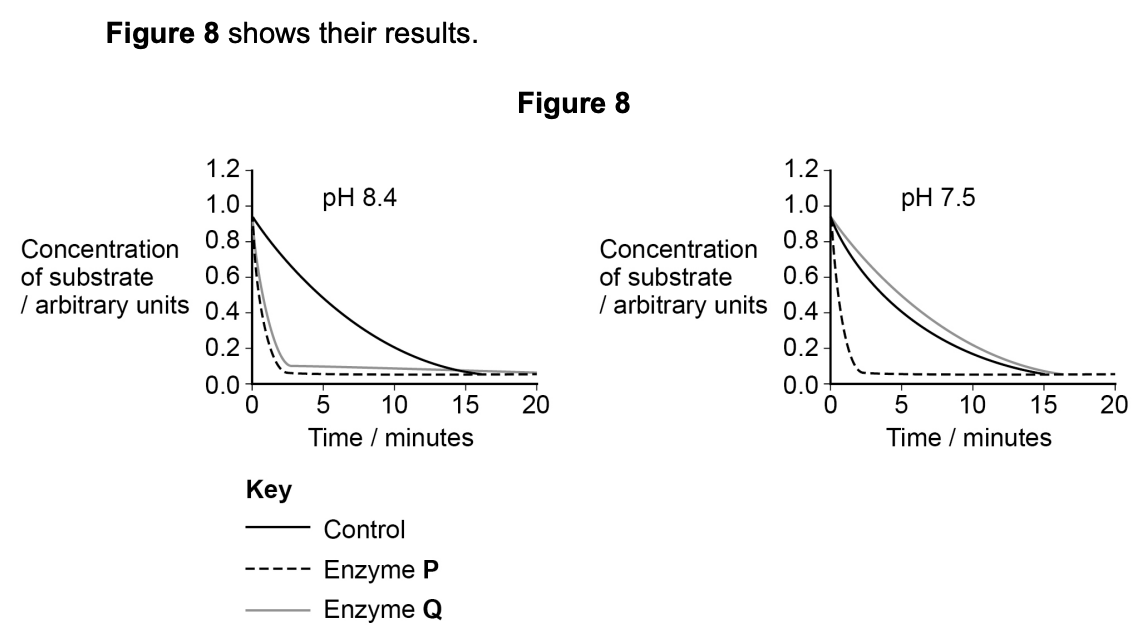
Answer
Mark Scheme
- Same volume of (each) buffer/pH solution (1 mark)
- Same concentration/mass of substrate (at start) (1 mark)
- Same concentration/mass of denatured enzyme (1 mark)
Comments from mark scheme
Ignore temperature Ignore amount for volume, concentration OR mass Accept pH solution for buffer 3. Accept description of denatured, eg boiled
Tips from examiner reports
- A control experiment keeps everything the same except the independent variable to show what happens without the treatment
- Use a denatured enzyme (e.g. boiled) as a negative control — not a different enzyme, different pH, or different temperature
- Say ‘buffer’ or ‘solution of known pH’ rather than just ‘same pH’
- Don’t change the independent variable in a control — that defeats the purpose
Give three conclusions you can make from Figure 8.
(3 marks)Answer
Mark Scheme
- 1.Both/P and Q (are) active at pH 8.4 (1 mark)
- 2.P is (equally/most) active at both pHs 3. Q is denatured/not active at pH 7.5 4. Reaction occurs without enzyme(s) 5. All (reactions) reach same end (point) (substate not used up) (1 mark)
Comments from mark scheme
Accept catalyse OR breakdown (substrate) OR hydrolyse (substrate) OR digest (substrate) OR cause reaction for active/reaction Ignore works better for active/reaction Ignore reference to optimum 3. Accept description of denatured 5. Accept broken down OR catalysed OR digested OR hydrolysed for used (up) 5. Accept does not reach zero for not used up
Tips from examiner reports
- A decrease in substrate concentration indicates the enzyme is active and the reaction is occurring
- If substrate concentration doesn’t change, the enzyme may be denatured or inactive
- Don’t say an enzyme ‘works well’ — describe its activity in terms of substrate use or product formation
Mangrove trees grow near the sea. Sea water surrounds the lower parts of the trees at high tide. Scientists investigated the rate of transpiration in a mangrove tree. Figure 9 shows the scientists’ results.
Explain the rate of transpiration between 5 am and midday shown in Figure 9.
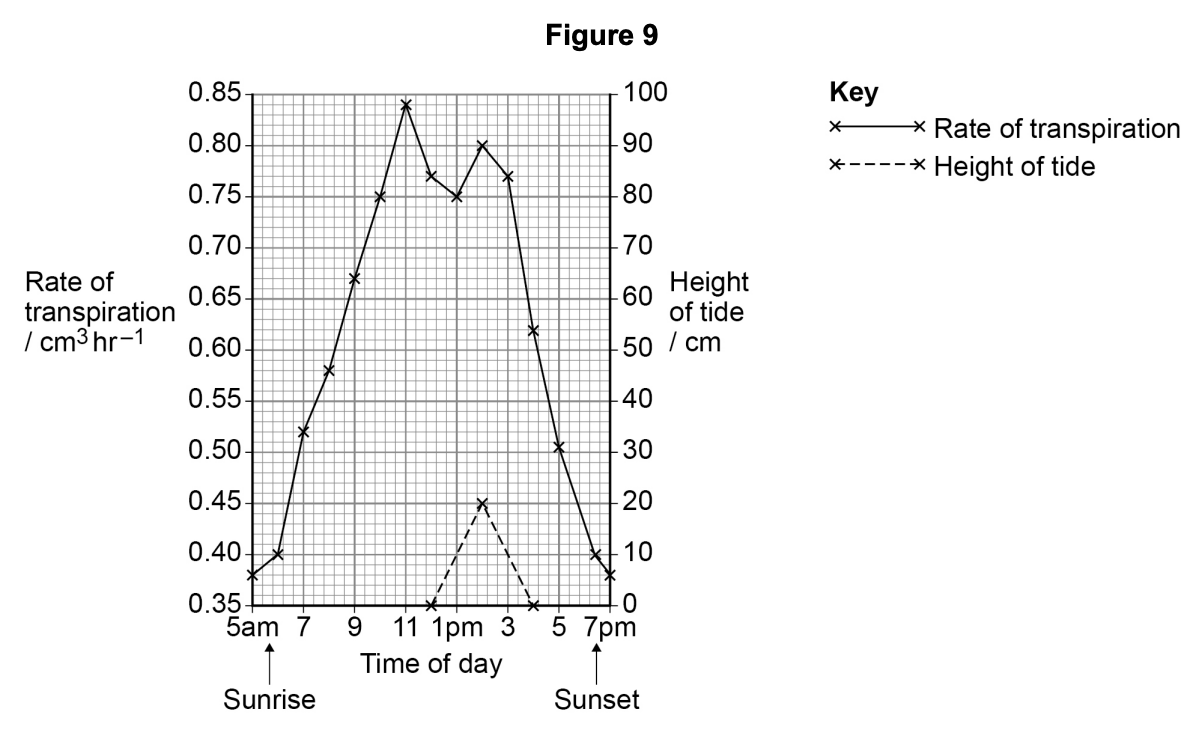
Answer
Mark Scheme
- (Rate of) transpiration/evaporation increases due to increased temperature (1 mark)
- (So) increased kinetic energy (causing more water loss) (1 mark)
- Stomata open (at sunrise/after 5 am) allowing gas exchange (1 mark)
- (Some) stomata close at midday/after 11 am (reducing transpiration) (1 mark)
Comments from mark scheme
Ignore reference to tide 1 and 2 Reject tide affecting transpiration/ water potential/ humidity 1 and 2 Correct link needed between factor affecting transpiration and the explanation 4 Accept at 11 am as the time when stomata close
Tips from examiner reports
- Explain the biological reason behind the data pattern — don’t just describe the trend
- Be precise: say ‘increased light intensity’ or ‘increased temperature’ rather than ‘the sun’
- Stomata open for gas exchange, and water loss is a consequence — not the other way around
- Changes in photosynthesis rate don’t directly explain changes in transpiration rate
- Annotating figures with lines to mark relevant time periods can help structure your answer
Use Figure 9 to calculate the percentage increase in the rate of transpiration from 1 pm to 2 pm.
Percentage increase in rate of transpiration % =
(2 marks)Answer
Mark Scheme
- Correct answer for 2 marks, 6.6̇, 6.67 – 7 (%) (1 mark)
Tips from examiner reports
- For percentage change: (new value - original value) / original value × 100
- Use the correct denominator — the original value, not the new value
- Read values from figures carefully
The higher rate of transpiration at high tide shows that the mangrove tree is absorbing water from the sea water surrounding its roots.
Describe an experiment that you could do to investigate whether the mangrove root cells have a lower water potential than sea water. You are given:
- a piece of fresh mangrove root
- sea water
- access to laboratory equipment.
Answer
Mark Scheme
- Mark in groups, either 1 to 4 OR 5 to 8 1. Record mass/length before and after (1 mark)
-
- Place in sea water for (specified/equal) time (1 mark)
-
- Method to remove surface water (1 mark)
-
- Increase in mass/length shows water has been absorbed by osmosis OR Increase in mass/length shows cells have lower water potential (1 mark)
- OR 5. Put tissue/cells on (microscope/glass) slide (1 mark)
-
- Add seawater (and leave) 7. Observe under (optical) microscope (1 mark)
-
- If cells become flaccid they do not have a lower water potential than seawater OR (If cells become) turgid cells show water is absorbed by osmosis OR (If cells become) turgid cells show cells have a lower water potential OR (If cells are) not flaccid/plasmolysis cells show water is not lost by osmosis OR (Determine) percentage plasmolysis (1 mark)
Comments from mark scheme
Accept ‘weight’ for ‘mass’. Accept ‘diameter’ for ‘length’. 2. Ignore period of time 2. Accept seawater in a dilution series Ignore blot dry before initial mass measurement Reject ‘size’ once then allow ECF. 3. Accept eg use tissue paper to dry OR blot dry 4. Accept root/mangrove for cells 8. Accept description of turgid (cells)
Tips from examiner reports
- Describe how to investigate water potential: place tissue samples in solutions, measure mass change
- Include a method to dry tissue before weighing to get accurate measurements
- Say ‘movement of water by osmosis’ not ‘movement of seawater by osmosis’
- A potometer measures transpiration rate, not osmotic changes in cells — don’t suggest using one here
Complete Table 3 to give three differences between DNA molecules and tRNA molecules.
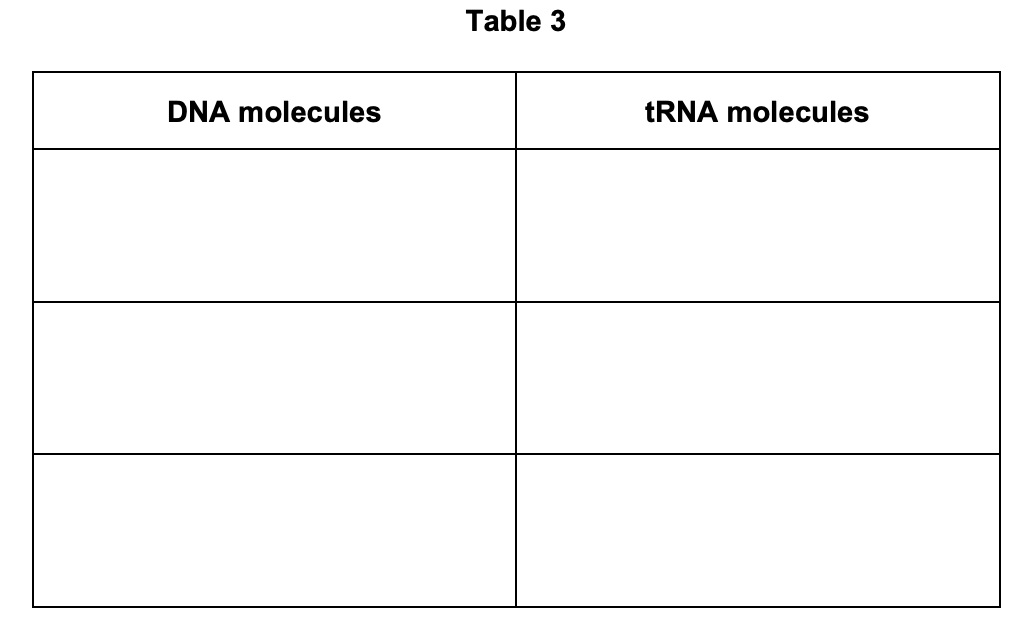
Answer
Mark Scheme
- DNA v tRNA 1. Deoxyribose v ribose (1 mark)
-
- Double-stranded v single-stranded (1 mark)
-
- Many nucleotides v few (1 mark)
-
- Thymine v uracil (1 mark)
-
- Linear v clover leaf (structure) OR Double helix v clover (leaf structure) (1 mark)
-
- Does not bind to amino acid v does bind to amino acid (1 mark)
-
- No exposed bases v anticodon (1 mark)
Comments from mark scheme
- Accept double helix for double stranded 3 Accept longer v shorter
- Ignore T and U
- Accept description of clover leaf structure.
- Accept straight for linear
- Accept attach/carry/have binding site for ‘bind to’
Tips from examiner reports
- Write out full base names (thymine, uracil) — don’t just use single letters T and U
- Say ‘double helix’ not just ‘helix’ when describing DNA structure
- If you mention anticodons on tRNA, also note that DNA has no exposed/unpaired bases in the same way
- Use a table format for comparisons — make sure each row compares one feature across both molecules
The scientists broke open the cells to produce a suspension of cell contents.
Describe how the scientists would remove large organelles from this suspension of cell contents.
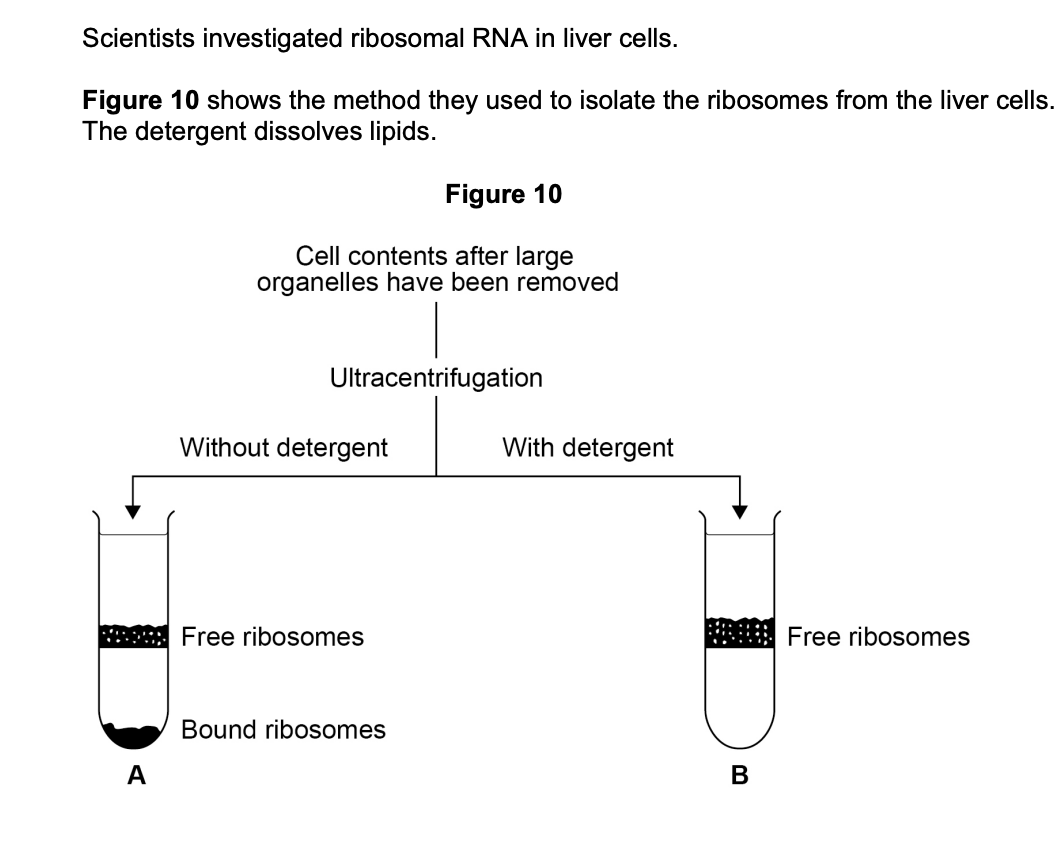
Answer
Mark Scheme
- Use centrifuge/centrifugation at slow/low/increasing (sequence of) speed(s) (1 mark)
- Large/dense organelles (removed) in (first/early) pellet OR Less dense organelles (removed) in supernatant OR Small organelles (removed) in supernatant (1 mark)
Comments from mark scheme
Ignore homogenate OR filtering Ignore cold, isotonic, buffered 2. Accept descriptions of supernatant and pellet, eg liquid and sediment/bottom of tube 2. Accept light for small 2. Accept ribosomes for small organelles 2. Accept more dense OR heavy for large 2 Accept named large organelle in pellet, eg mitochondria
Tips from examiner reports
- Differential centrifugation starts at a low speed and gradually increases
- Dense/heavy organelles form a pellet at the bottom — the lighter material stays in the supernatant above
- Specify where organelles end up: pellet at the bottom, not at the top
- Don’t just describe filtration — that’s a different step (removing cell debris)
Explain the position of the bands of ribosomes in tubes A and B in Figure 10.
(3 marks)Answer
Mark Scheme
- (Tube A) 1. (Ribosomes bound to) rough endoplasmic reticulum (1 mark)
-
- (Are) denser/heavier so move further (1 mark)
- (Tube B) 3. (Only free ribosomes because) membrane/phospholipids/endoplasmic reticulum dissolved (by detergent) (1 mark)
Comments from mark scheme
Award marks across A and B
- and 3 Do not credit ER/rER the first time used if endoplasmic reticulum not given
- Accept, free ribosomes are lighter so form a band higher in tube OR do not move as far
- For ‘heavier/lighter’ accept ‘denser/less dense’.
- Accept settle lower OR are lower down OR at bottom OR in pellet, for move further
- Accept broken down for dissolved
- Ignore damaged for dissolved
Tips from examiner reports
- Bound ribosomes are attached to rough ER membranes, making them heavier — they pellet at a lower centrifuge speed
- Detergent breaks down the phospholipid membrane of the rough ER — say ‘phospholipids’ or ‘membrane’, not just ‘lipids’ (which was given in the question)
- The detergent dissolves the ER membrane, not the cell-surface membrane
To observe the fish gills with the optical microscope, the scientists used two different stains. The first stain binds to DNA; the second stain binds to the red blood cells.
Explain why a second stain would be needed to stain the red blood cells.
Suggest which molecule the stain could bind to in the red blood cells.
(2 marks)Answer
Mark Scheme
- (Red blood cells) do not have a nucleus/DNA (1 mark)
- Haemoglobin (1 mark)
Tips from examiner reports
- Fish red blood cells contain a nucleus (unlike mammalian red blood cells) — consider this when interpreting staining results
- Iron/Fe²⁺ is an ion, not a molecule
- Red blood cells are visible under a light microscope — they’re not ‘too small to see’
Using Figure 11, the scientists calculated the surface area to volume ratios for each gill filament in these two fish. Some of their results are shown in Table 4.
Complete Table 4. State your calculated volume and surface area:volume ratio to 2 significant figures.
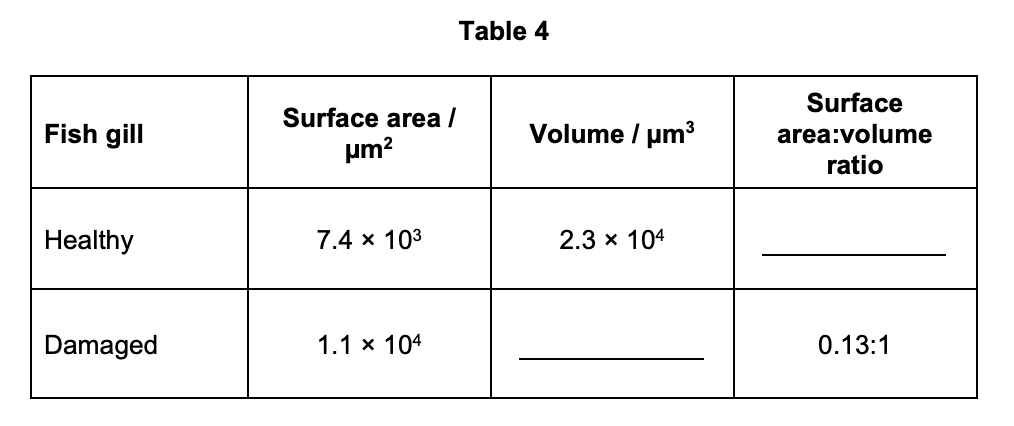
Answer
Mark Scheme
- 1 mark for each correct row If no marks awarded, accept for 1 mark, 0.3217 (correct ratio calculation not given to 2 significant figures) OR Number that can be rounded to 85 000 eg 84615 (correct calculation not given to 2 significant figures) (1 mark)
Tips from examiner reports
- Surface area to volume ratio = surface area ÷ volume (not volume ÷ surface area)
- Give answers to the number of significant figures specified in the question
- Round correctly: 84 615 to 2 s.f. is 85 000, not 84 000
The damage to the gills causes uncontrolled cell division in the cells around the capillaries in the gill filaments. Other than surface area:volume ratio, describe one way this uncontrolled cell division changes the gills, as shown in Figure 11.
Explain how this difference would affect gas exchange.
Include:
- Difference
- Explanation
Answer
Mark Scheme
- (Difference) 1. More cells (between water and capillary/ blood) OR Wider/thicker filament/lamella (1 mark)
- (Explanation) 2. Longer diffusion pathway OR Longer diffusion distance (1 mark)
-
- (So) slower gas exchange OR (So) slower absorption of oxygen OR (So) slower release of carbon dioxide (1 mark)
Comments from mark scheme
(Difference)
- More cells (between water and capillary/ blood) OR Wider/thicker filament/lamella; (Explanation)
- Longer diffusion pathway OR Longer diffusion distance;
- (So) slower gas exchange OR (So) slower absorption of oxygen OR (So) slower release of carbon dioxide OR (So) slower rate of diffusion;
Tips from examiner reports
- Uncontrolled cell division creates a longer/thicker diffusion pathway, leading to slower (not ‘less’) diffusion
- Be specific about which structures are thicker — name the gill filaments or lamellae rather than just saying ‘gills are thicker’
Use Figure 12 to complete Table 5 to show two differences between the circulation of blood in fish and the circulation of blood in a mammal.
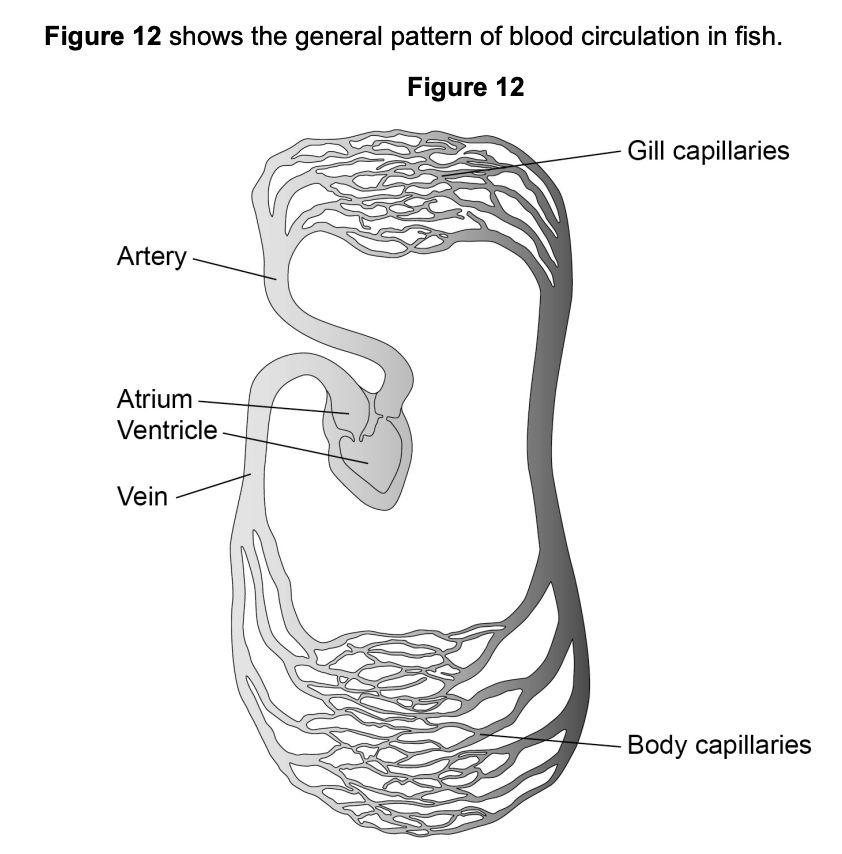
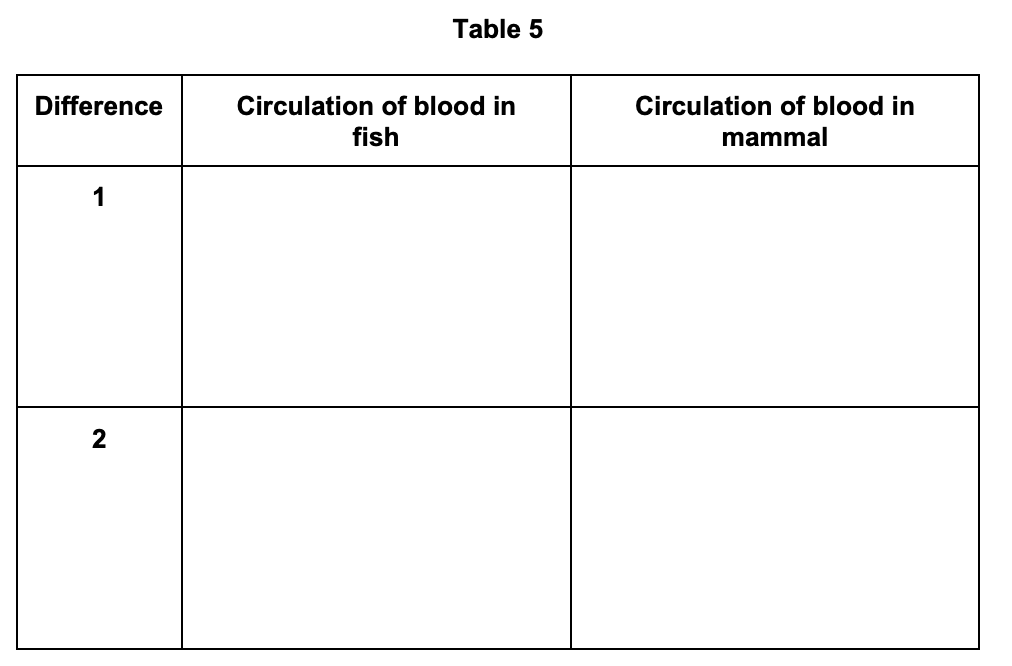
Answer
Mark Scheme
- 1 mark for each correct row (1 mark)
Tips from examiner reports
- Compare the actual circulatory system structures (heart chambers, blood vessels) not just where gas exchange happens
- Counter-current flow vs unidirectional flow relates to gas exchange at the gills, not to the circulatory system itself
- Don’t compare where blood is oxygenated (gills vs lungs) — compare how the circulation is arranged
Describe the transport of carbohydrate in plants.
(5 marks)Answer
Mark Scheme
- Sucrose actively transported into phloem (cell); OR Sucrose is co-transported/moved with H⁺ into phloem (cell) (1 mark)
- (By) companion/transfer cells (1 mark)
- Lowers water potential (in phloem) and water enters (from xylem) by osmosis (1 mark)
- ((Produces) high(er) (hydrostatic) pressure; OR (Produces hydrostatic) pressure gradient (1 mark)
- Mass flow to respiring cells (1 mark)
Comments from mark scheme
- Accept sieve (element/tube/cell) for phloem (cell)
- Accept description of gradient, eg higher WP
- Accept transport OR movement for flow
- Accept buds/young leaves/fruit/seeds/shoot tip/root tip/ meristems/root 6 Accept facilitated diffusion
Tips from examiner reports
- Sucrose is the carbohydrate transported in phloem — be specific
- Movement in phloem is by mass flow (not diffusion), driven by a pressure gradient
- Know the co-transport mechanism: H⁺ ions are actively pumped out, then flow back in with sucrose via co-transporter proteins
- At the sink, sucrose moves into cells by facilitated diffusion or active transport — not by diffusion
- Don’t use vague language like ‘sugar is used at the sink’ — say it enters cells
Compare and contrast the structure of starch and the structure of cellulose.
(6 marks)Answer
Mark Scheme
- Both polysaccharides OR Both are glucose polymers OR Both are made of glucose monomers (1 mark)
- Both contain glycosidic bonds (between monomers) (1 mark)
- Both contain carbon, hydrogen and oxygen/C, H and O (1 mark)
- Starch has α-glucose and cellulose has βglucose (1 mark)
- Starch (molecule) is helical/coiled and cellulose (molecule) is straight (1 mark)
- Starch (molecule) is branched and cellulose is not/unbranched (1 mark)
- Cellulose has (micro/macro) fibrils and starch does not (1 mark)
Comments from mark scheme
Must include 1, 2 OR 3 to achieve 6 marks All statements must be clearly comparative or linked by the candidate, not inferred from separate statements. Additional mark point 8. Starch has 1–6 glycosidic bonds and cellulose does not OR Starch contains two types of molecule and cellulose contains one type of molecule OR Starch is amylose and amylopectin and cellulose is one type of molecule;
Tips from examiner reports
- Make direct comparisons between cellulose and starch — don’t just list features of each
- Don’t confuse myofibrils (muscle) with microfibrils (cellulose)
- Stick to structural comparisons — don’t explain functions unless asked
Describe the complete digestion of starch by a mammal.
(4 marks)Answer
Mark Scheme
- Hydrolysis (1 mark)
- (Of) glycosidic bonds (1 mark)
- (Starch) to maltose by amylase (1 mark)
- (Maltose) to glucose by disaccharidase/maltase (1 mark)
- Membrane-bound (disaccharidase/maltase) (1 mark)
Comments from mark scheme
Other than 5., do not penalise incorrect site for digestion or incorrect site of enzyme production 5. Accept microvilli for membrane
Tips from examiner reports
- Starch is digested in two stages: first to maltose (a disaccharide), then maltose to glucose — not straight to glucose
- Say ‘maltose’ not just ‘disaccharide’ when naming the product of starch digestion
- Mention hydrolysis of glycosidic bonds
- Don’t describe bile salt action or co-transport in the context of starch digestion
- Membrane-bound enzymes (e.g. maltase) on the epithelial cell surface are often overlooked
Describe the induced-fit model of enzyme action and how an enzyme acts as a catalyst.
(3 marks)Answer
Mark Scheme
- Substrate binds to the active site/enzyme OR Enzyme-substrate complex forms (1 mark)
- Active site changes shape (slightly) so it is complementary to substrate OR Active site changes shape (slightly) so distorting/breaking/forming bonds in the substrate (1 mark)
- Reduces activation energy (1 mark)
Comments from mark scheme
Accept for ‘binds’, fits
Scientists investigated the action of the enzyme ATP synthase. They made reaction mixtures each containing:
Tick () one box to show which other substrate the scientists must add to the reaction mixtures to produce ATP.
(1 marks)Answer
Mark Scheme
- Adenosine diphosphate (1 mark)
The scientists investigated the effect of concentration of inorganic phosphate (Pi) on ATP synthase activity. After 2 minutes, they stopped each reaction and then measured the concentration of ATP. Figure 1 shows the scientists’ results
Suggest and explain a procedure the scientists could have used to stop each reaction
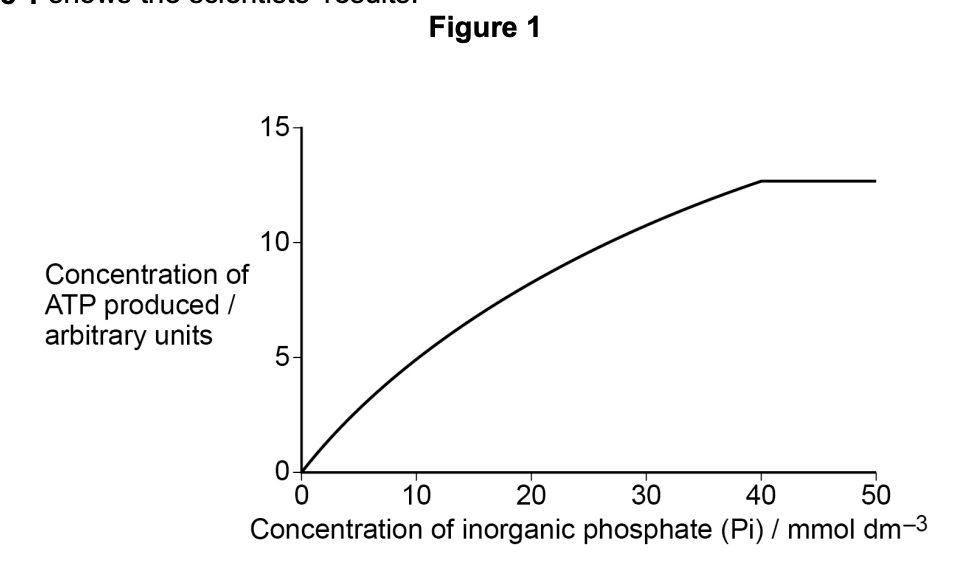
Answer
Mark Scheme
- Mark in pairs, 1 and 2 OR 3 and 4 OR 5 and 6 1. Boil OR Add (strong) acid/alkali (1 mark)
-
- Denatures the enzyme/ATP synthase (1 mark)
- OR 3. Put in ice/fridge/freezer (1 mark)
-
- Lower kinetic energy so no enzyme-substrate complexes form (1 mark)
- OR 5. Add high concentration of inhibitor (1 mark)
-
- Enzyme-substrate complexes do not form (1 mark)
Comments from mark scheme
- Accept heat at > 50oC OR at very high temperatures
- Accept for ‘denatures’, a description of denaturation
- Accept ES for enzyme substrate complex
Tips from examiner reports
- Know the induced-fit model well — the active site changes shape slightly when the substrate binds
Explain the change in ATP concentration with increasing inorganic phosphate concentration.
(2 marks)Answer
Mark Scheme
- (With) increasing Pi concentration, more enzyme-substrate complexes are formed (1 mark)
- At or above 40 (mmol dm⁻³) all active sites occupied OR At or above 40 (mmol dm⁻³) enzyme concentration is a limiting factor (1 mark)
Tips from examiner reports
- If you’re testing the effect of one substrate’s concentration, all other substrates are in excess — they can’t be the limiting factor
- ADP is not a limiting factor when phosphate concentration is the variable being tested
Explain the advantage for larger animals of having a specialised system that facilitates oxygen uptake.
(2 marks)Answer
Mark Scheme
- Large(r) organisms have a small(er) surface area:volume (ratio); OR Small(er) organisms have a large(r) surface area:volume (ratio) (1 mark)
- Overcomes long diffusion pathway OR Faster diffusion (1 mark)
Comments from mark scheme
2.Accept short diffusion pathway 2. Accept for ‘faster’, more
Tips from examiner reports
- Describe the relationship between animal size and SA:V ratio clearly
- Explain why larger animals have a smaller SA:V ratio — not just state it
Suggest how the environmental conditions have resulted in adaptations of systems using Model A rather than Model B.
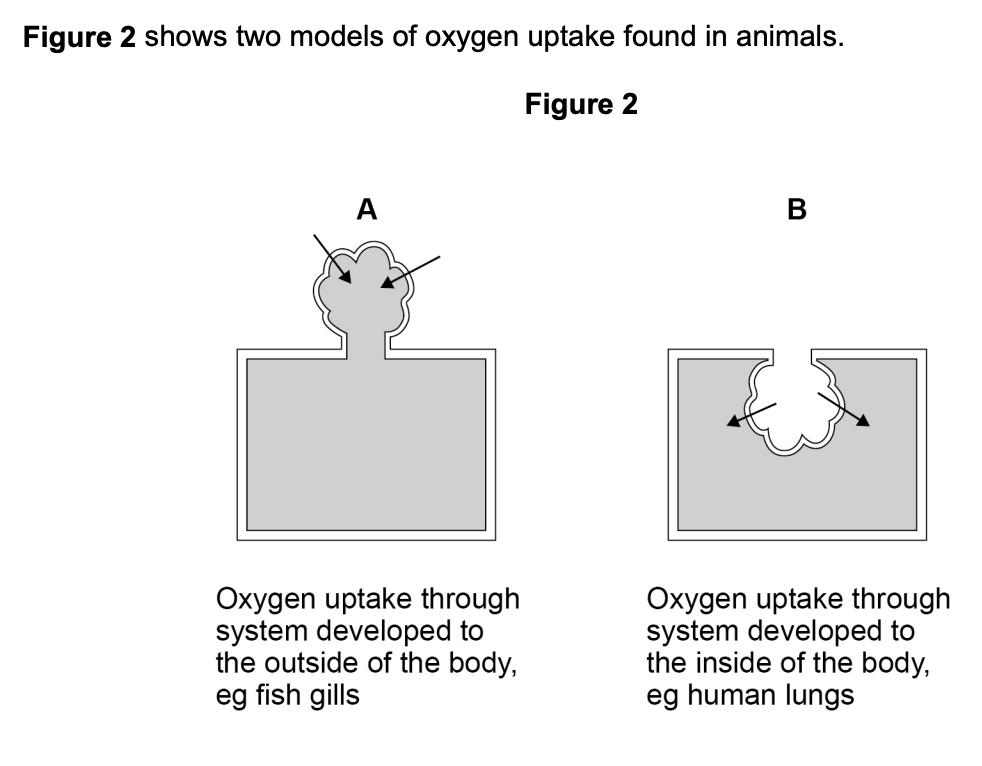
Answer
Mark Scheme
- Mark in pairs, 1, and 2 OR 3. and 4. 1. Water has low(er) oxygen partial pressure/concentration (than air) (1 mark)
-
- So (system on outside) gives large surface area (in contact with water) OR So (system on outside) reduces diffusion distance (between water and blood) (1 mark)
-
- Water is dense(r) (than air) (1 mark)
-
- (So) water supports the systems/gills (1 mark)
Tips from examiner reports
- Link your answer to the specific context and data provided
- Don’t just recall the counter-current principle without applying it to the question
Figure 3 shows changes in concentration of oxygen in two gas exchange systems.
A student studied Figure 3 and concluded that the fish gas exchange system is more efficient than the human gas exchange system.
Use Figure 3 to justify this conclusion.
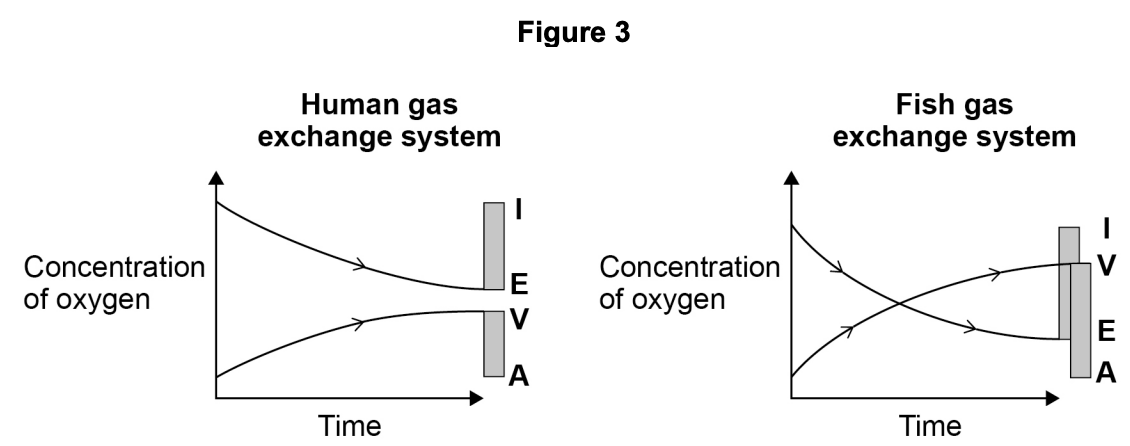
Answer
Mark Scheme
- In fish, blood leaving (V) has more oxygen than water leaving (E) (1 mark)
- (But) in humans, blood leaving (V) has less oxygen than air leaving (E) (1 mark)
- Difference in oxygen (concentration) between artery and vein is greater in fish than in humans (1 mark)
- (So) fish remove a greater proportion from the oxygen they take in (1 mark)
Tips from examiner reports
- Extract and use information from figures carefully — relate what you see to the biological principles
- Don’t skip data interpretation questions — practise reading unfamiliar graphs
Explain how the counter-current principle allows efficient oxygen uptake in the fish gas exchange system.
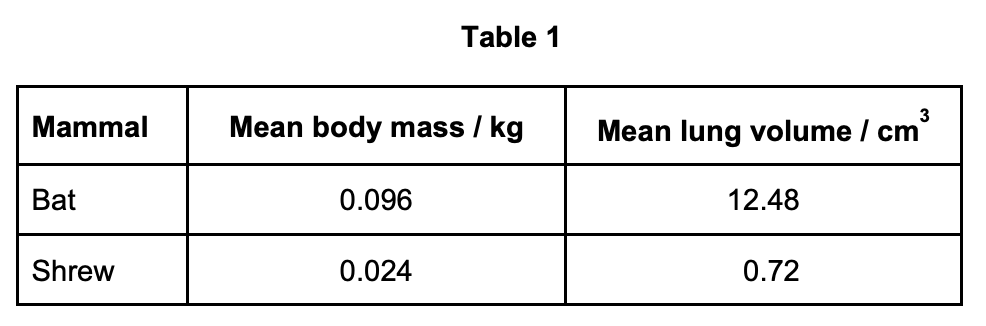
Answer
Mark Scheme
- Blood and water flow in opposite directions (1 mark)
- Diffusion/concentration gradient (maintained) along (length of) lamella/filament (1 mark)
Comments from mark scheme
Accept for 2 marks, suitably labelled diagram
Table 1 shows features of two mammals. Bats are flying mammals; shrews are ground-living mammals.
Calculate how many times the lung volume per unit of body mass of the bat is greater than that of the shrew.
Give your answer to an appropriate number of significant figures. Give one suggestion to explain this difference.
(3 marks)Answer
Mark Scheme
- and 2. Correct answer for 2 marks, 4.3 (times greater);; Accept for 1 mark, (1 mark)
- 333333333 (correct answer not given to 2 significant figures) OR Evidence of 130 (cm³ kg⁻¹) and 30 (cm³ kg⁻¹) Correct explanation for 1 mark, (1 mark)
- Provides more oxygen for respiration (1 mark)
Tips from examiner reports
- Discriminated well, but many lost marks by using an inappropriate number of significant figures.
- Tips: ‘Appropriate significant figures’ usually means 2-3 sf for biology. Don’t leave a long string of decimal places.
Describe how one amino acid is added to a polypeptide that is being formed at a ribosome during translation.
(3 marks)Answer
Mark Scheme
- tRNA brings specific amino acid (to ribosome) (1 mark)
- Anticodon (on tRNA) binds to codon (on mRNA) (1 mark)
- Amino acids join by condensation reaction (using ATP) OR Amino acids join to form a peptide bond (using ATP) (1 mark)
Tips from examiner reports
- In translation, specific tRNA molecules carry specific amino acids — state this clearly
- Don’t just say ‘tRNA carries amino acids’ — emphasise the specificity
Table 2 shows:
- mRNA codons and the amino acid coded for by each codon
- the type of bond formed by the R group of some of the amino acids.
Crystallin is a structural protein found in the human eye. An inherited disease that leads to blindness is caused by changes in properties of crystallin. The replacement of the amino acid Arg with the amino acid Gly causes these changes.
Use information in Table 2 to suggest why this amino acid replacement changes the properties of crystallin.
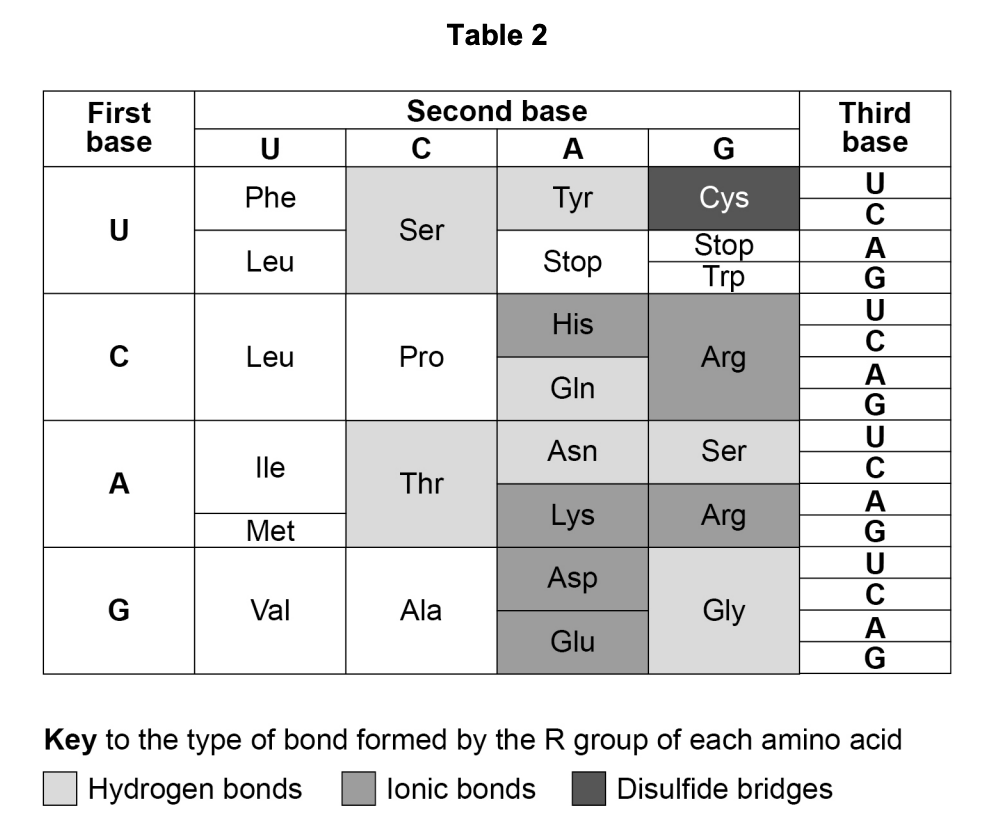
Answer
Mark Scheme
- Hydrogen bonds form instead of ionic bonds (1 mark)
- Changes the tertiary structure (of the crystallin) (1 mark)
Comments from mark scheme
- Ignore reference to active site
Tips from examiner reports
- Link mutations to their effect on protein structure: changed base sequence → changed amino acid → changed tertiary structure → changed function
The amino acid replacement of Arg with Gly is caused by a single base substitution mutation in the DNA. The non-mutant DNA triplet is TCC. Complete Table 3.
Give:
- the mRNA codon complementary to the non-mutant DNA triplet
- the mutated mRNA codon that could cause the change from Arg to Gly in the crystallin protein
- the DNA triplet complementary to this mutated mRNA codon.
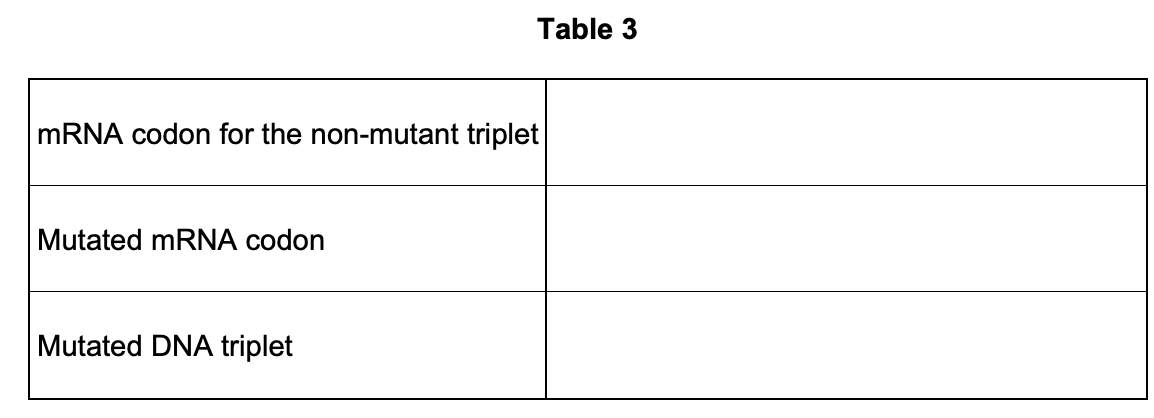
Answer
Mark Scheme
- 3 correct = 2 marks (1 mark)
- 2 correct = 1 mark (1 mark)
- 0 or 1 correct = 0 marks (1 mark)
A student box dissected an organ from a mammal to observe blood vessels. He dissected a slice of the organ and identified two blood vessels.
Suggest two ways the student could improve the quality of his scientific drawing of the blood vessels in this dissection.
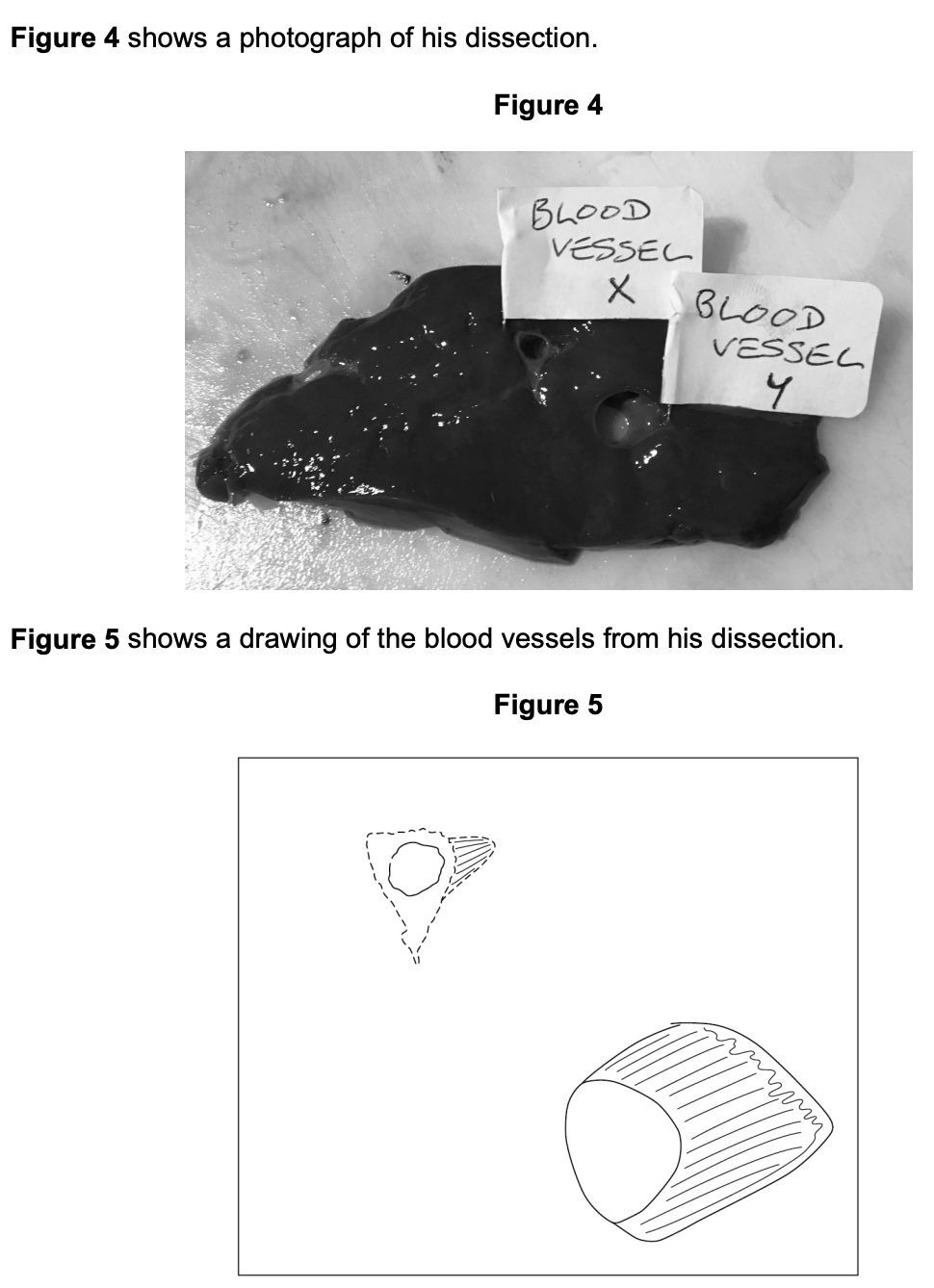
Answer
Mark Scheme
- Only use single lines/do not use sketching (lines)/ensure lines are continuous/connected (1 mark)
- Add labels/annotations/title (1 mark)
- Add magnification/scale (bar) (1 mark)
- Draw all parts to same scale/relative size (1 mark)
- Do not use shading/hatching (1 mark)
Tips from examiner reports
- Draw conclusions from the data — don’t just describe the results
- Consider whether IAA is broken down by light or still produced in the dark
- Don’t confuse IAA movement with bending/phototropism
Identify the type of blood vessel labelled as X and the type of blood vessel labelled as Y in Figure 4.
Describe one feature that allowed you to identify the blood vessels. Blood vessel X = Blood vessel Y = Feature =
(2 marks)Answer
Mark Scheme
- Blood vessel X – artery/arteriole and Blood vessel Y – vein/venule (1 mark)
- (Difference in) lumen size OR (Difference in) wall thickness (1 mark)
Comments from mark scheme
Ignore name of blood vessel, eg. (pulmonary) artery
Describe two precautions the student should take when clearing away after the dissection.
(2 marks)Answer
Mark Scheme
- Carry/wash sharp instruments by holding handle OR Carry/wash sharp instruments by pointing away (from body)/down (1 mark)
- Disinfect instruments/surfaces (1 mark)
- Disinfect hands OR Wash hands with soap (and water) (1 mark)
- Put organ/gloves/paper towels in a (separate) bag/bin/tray to dispose (1 mark)
Comments from mark scheme
- and 2. Accept for ‘instruments’, a suitable named example, eg. scalpel
- and 3. Accept for ‘disinfect’, sanitise OR use antiseptic
Tips from examiner reports
- Know the nitrogen cycle: saprobionts decompose organic matter → ammonification → nitrification (NH₄⁺ → NO₂⁻ → NO₃⁻) → uptake by plants
- Don’t say saprobionts are anaerobic (most are aerobic) or that nitrates are denitrified to ammonia (denitrification produces N₂)
Describe how a sample of chloroplasts could be isolated from leaves.
(4 marks)Answer
Mark Scheme
- Break open cells/tissue and filter OR Grind/blend cells/tissue/leaves and filter (1 mark)
- In cold, same water potential/concentration, pH controlled solution (1 mark)
- Centrifuge/spin and remove nuclei/cell debris (1 mark)
- (Centrifuge/spin) at high(er) speed, chloroplasts settle out (1 mark)
Comments from mark scheme
- Accept homogenise and filter
- Accept for ‘same water potential/ concentration’, isotonic
- Accept for ‘pH controlled’, buffered
Tips from examiner reports
- Know the steps for chloroplast isolation: homogenise tissue in cold isotonic buffer, filter, then centrifuge
- Be precise with each step — vague descriptions lose marks
Scientists grew two groups of plants:
- control plants with all the inorganic ions needed
- iron-deficient plants with all the inorganic ions needed but without iron ions.
After 1 week, the scientists measured the mass of protein and the mass of chlorophyll in the chloroplasts isolated from samples of leaves of these two groups of plants. Table 4 shows the scientists’ results.
Some proteins found inside the chloroplast are synthesised inside the chloroplast.
Give one feature of the chloroplast that allows protein to be synthesised inside the chloroplast and describe one difference between this feature in the chloroplast and similar features in the rest of the cell.
Feature = Structural difference =
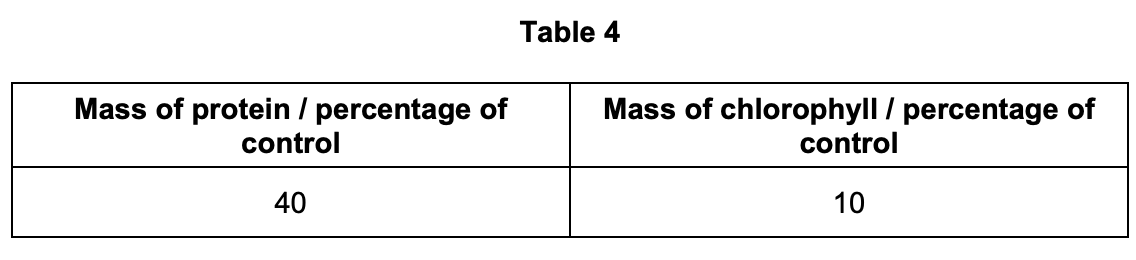
Answer
Mark Scheme
- Mark in pairs, 1 and 2 OR 3 and 4 1. DNA (1 mark)
-
- Is not associated with protein/histones but nuclear DNA is OR Is circular but nuclear DNA is linear OR Is shorter than nuclear DNA (1 mark)
-
- Ribosomes (1 mark)
-
- Are smaller than cytoplasmic ribosomes (1 mark)
Comments from mark scheme
- Accept: 70S ribosomes in chloroplast, but 80S ribosomes in cytoplasm
Tips from examiner reports
- Know chloroplast structure: outer and inner membranes, thylakoids (stacked into grana), stroma, lamellae
- Practise ratio calculations — divide the larger value by the smaller to express the ratio
The ratio of protein to chlorophyll in control plants is 9:1 Use the information in Table 4 to calculate the ratio of protein to chlorophyll in iron-deficient plants.
(1 marks)Answer
Mark Scheme
- Correct answer for 1 mark, 36:1 (1 mark)
Use Figure 6 to suggest why iron-deficient plants have a reduced growth rate
(3 marks)Answer
Mark Scheme
- Less (thylakoid) membrane OR Fewer/smaller grana (1 mark)
- Smaller surface area (of membrane in chloroplast)/less chlorophyll (1 mark)
- (Less chlorophyll so) reduced light absorption (1 mark)
- (So) slower rate of photosynthesis (1 mark)
Tips from examiner reports
- If the question tells you a statistical test confirmed significance, don’t then say ‘no stats test was done’
- Read the stem carefully — it often gives you important information to use in your answer
Figure 7 shows the mean distance between centromeres and the poles (ends) of the spindle during mitosis.
Calculate the rate of movement of the centromeres during phase E.
Give your answer in μm minute–1 and to 3 decimal places
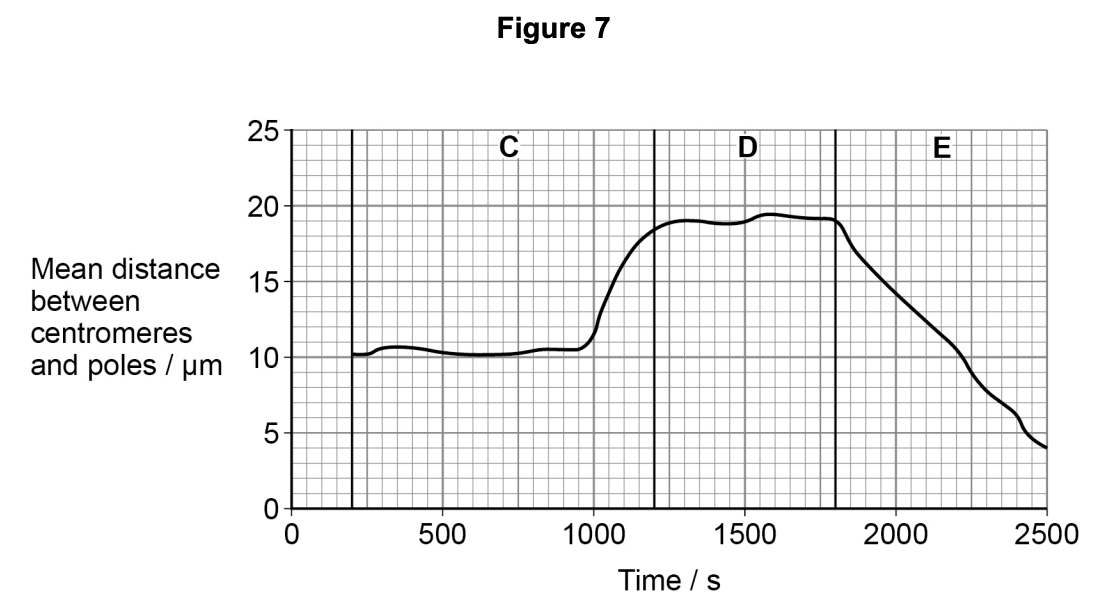
Answer
Mark Scheme
- Correct answer for 2 marks, 1.286 (1 mark)
Tips from examiner reports
- Read graphs carefully and extract values accurately
- Show your calculations when manipulating numbers from graphs
Name the three phases of mitosis shown by C, D and E on Figure 7.
Describe the role of the spindle fibres and the behaviour of the chromosomes during each of these phases.
(5 marks)Answer
Mark Scheme
C = D = E = 2. (In) prophase, chromosomes condense (1 mark) 3. (In) prophase OR metaphase, centromeres attach to spindle fibres (1 mark) 4. (In) metaphase, chromosomes/pairs of chromatids at equator/centre of spindle/cell (1 mark) 5. (In) anaphase, centromeres divide (1 mark) 6. (In) anaphase, chromatids (from each pair) pulled to (opposite) poles/ends (of cell) (1 mark) 7. (In) prophase/metaphase/anaphase, spindle fibres shorten (1 mark)
Comments from mark scheme
If mark point 1 is not credited = 4 max Do not carry forward error from 1. Accept letters for stages as indicated in 1. 2. Accept chromatin for ‘chromosomes’ and for ‘condense’, shorten and thicken 6. Accept for ‘chromatids’, chromosomes but reject homologous chromosomes 7. Accept for ‘shorten’, contract
Tips from examiner reports
- Match mitotic stages to what you see in diagrams: prophase (condensed chromosomes), metaphase (chromosomes at equator), anaphase (chromosomes moving apart), telophase (two groups forming)
- Know the role of spindle fibres in moving chromosomes
ADCs are molecules made of a monoclonal antibody linked to a cancer drug. Figure 8 shows how an ADC enters and kills a tumour cell. The process of entering the cell and the breakdown of the antibody to release the drug is very similar to phagocytosis.
Use your knowledge of phagocytosis to describe how an ADC enters and kills the tumour cell.
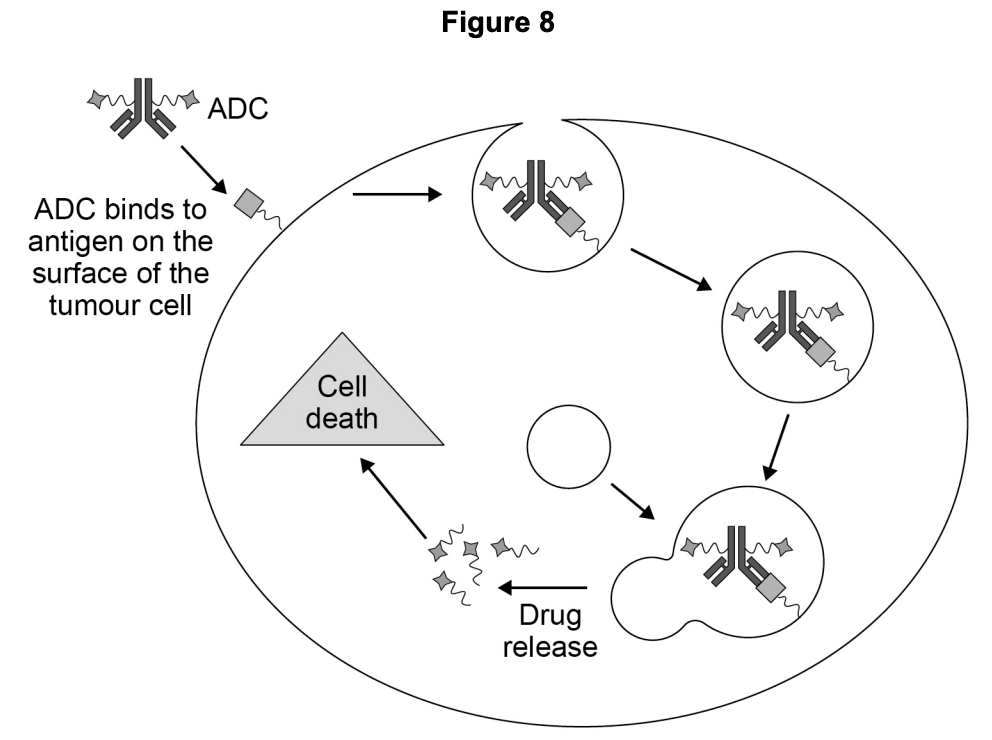
Answer
Mark Scheme
- Cell ingests/engulfs the antibody/ADC OR Cell membrane surrounds the antibody/ADC (to take it inside the cell) (1 mark)
- Lysosomes fuse with vesicle/phagosome (containing ADC) (1 mark)
- Lysozymes breakdown/digest the antibody/ADC to release the drug (1 mark)
Comments from mark scheme
- Accept endocytosis for ingest/engulf
- Accept hydrolytic enzyme for lysozyme
Tips from examiner reports
- Use the information provided in diagrams and figures — don’t ignore them
- For phagocytosis questions, focus on the innate immune response, not acquired/adaptive immunity, unless asked
- Apply your knowledge to the specific context given
Some of the antigens found on the surface of tumour cells are also found on the surface of healthy human cells.
Use this information to explain why treatment with an ADC often causes side effects
(2 marks)Answer
Mark Scheme
- ADC will bind to non-tumour/healthy cells (1 mark)
- Cause death/damage of non-tumour/healthy cells OR Cause damage to other organs/systems (1 mark)
Comments from mark scheme
- Reject reference to active site
Calculate the volume of antibody solution that the scientists would have injected into a 23 g mouse.
Give your answer in dm³ and in standard form.
(2 marks)Answer
Mark Scheme
- Correct answer for 2 marks, 9.2 x 10‒5 (1 mark)
- Accept for 1 mark, 0.046 (correct mass injected into 23g mouse) 0.000092 (correct answer but not in standard form) (1 mark)
Suggest one reason why there are no data for Group G and Group H after day 8
(1 marks)Answer
Mark Scheme
- Mice died OR Not ethical to continue (1 mark)
Suggest and explain two further investigations that should be done before this ADC is tested on human breast cancer patients.
(2 marks)Answer
Mark Scheme
- Tested on other mammals to check for safety/side effects (1 mark)
- Tested on (healthy) humans to check for safety/side effects (1 mark)
- See if repeat doses stop the tumours regrowing (in Group J) (1 mark)
- Investigate different concentrations of ADC to find suitable/safe dosage (1 mark)
Comments from mark scheme
- Accept named mammal, eg rat
- Accept: Tested on (healthy) human tissue/cells to check for no side-effects
Tips from examiner reports
- In essays about ions, explain why each ion is important for the specific metabolic process
- Include consequences of the ion being absent or the process failing
- Hydrogen ions in the electron transfer chain are NOT actively transported — they move down their electrochemical gradient through ATP synthase
Describe how a triglyceride molecule is formed.
(3 marks)Answer
Mark Scheme
- One glycerol and three fatty acids (1 mark)
- Condensation (reactions) and removal of three molecules of water (1 mark)
- Ester bond(s) (formed) (1 mark)
Comments from mark scheme
Accept all marks in suitably labelled diagram OR in a balanced equation
Tips from examiner reports
- A triglyceride = one glycerol + three fatty acids joined by ester bonds via condensation reactions
- Three water molecules are released — one per ester bond formed. Don’t forget to state this
Put a tick () in one box that contains correct information about one of these fatty acids.
(1 marks)Answer
Mark Scheme
- Palmitoleic acid is an unsaturated fatty acid represented by diagram K (1 mark)
The percentage of saturated fatty acids compared with unsaturated fatty acids found in lipid stores in seeds differs in different populations. Scientists investigated two populations of the plant, Helianthus annuus. The scientists grew young plants from seeds collected from each population. They placed the seeds on wet tissue paper so that the root growth was visible.
They grew seeds from each population at two temperatures:
- warm temperature of 24 °C
- cool temperature of 10 °C
After 10 days, the scientists measured the length of each root.
Table 6 shows some of the properties of the two populations and the scientists’ results.
The mean ±2 × standard deviation includes 95% of the data. The scientists used a data logger to measure the length of the root rather than a ruler.
Suggest one reason why they used a data logger and explain why this was important in this investigation.
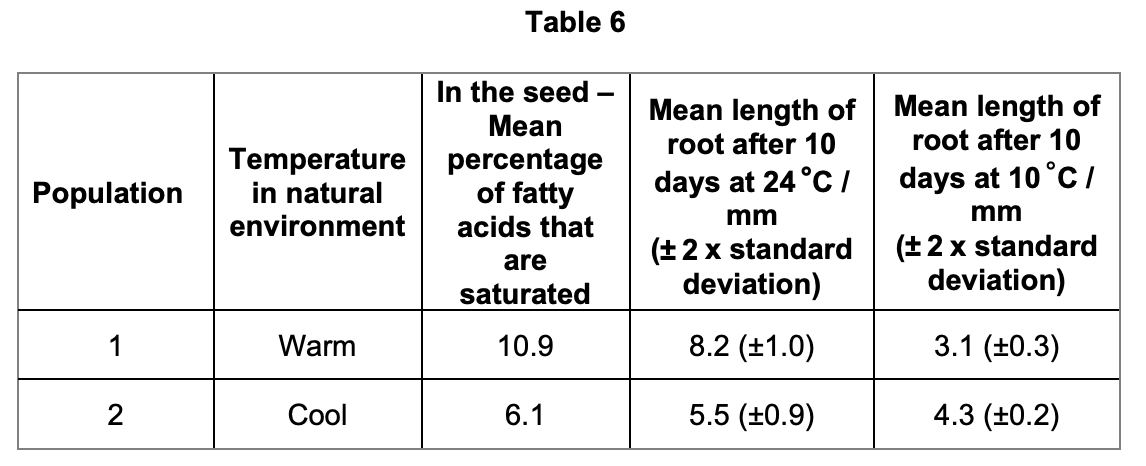
Answer
Mark Scheme
- To increase accuracy/resolution because differences/lengths are small (1 mark)
- To increase accuracy because reduces risk of human error (1 mark)
- To increase accuracy because roots are less (likely to be) damaged (1 mark)
- To reduce error/uncertainty because differences/lengths are small (1 mark)
Comments from mark scheme
Ignore ‘precision’
Tips from examiner reports
- In PCR: the number of DNA copies doubles each cycle → exponential increase
- The curve plateaus because primers, nucleotides, or DNA polymerase run out or polymerase denatures
- Don’t say ‘DNA fragments are the limiting factor’ or ‘DNA polymerase is used up’
- Explain the shape of the curve, don’t just describe it
It is known that:
Use this information and Table 6 to show how each population is better adapted for its natural environment when compared with the other population.
- during respiration saturated fatty acids yield more energy than unsaturated fatty acids
- saturated fatty acids have higher melting points than unsaturated fatty acids
- lipases in seeds act more rapidly on liquid substrates.
Answer
Mark Scheme
- Population 1 grew longer roots in warm temperatures and population 2 grew longer roots in cool temperatures (1 mark)
- Standard deviations do not overlap so difference (in mean) unlikely to be/not due to chance (1 mark)
- Population 1 (is better adapted to warm conditions because it) has more saturated fatty acids so more energy available (and more growth) (1 mark)
- Population 2 (is better adapted to cool conditions because it) has more unsaturated/liquid fatty acids so more lipase activity (and more growth) (1 mark)
Comments from mark scheme
- Accept: ‘Standard deviations do not overlap showing difference (in mean likely to be) significant’
- and 4. Accept for ‘fatty acids’, fat
Tips from examiner reports
- Compare between populations, not just within a single population
- Use the data to make comparisons across groups, identifying key differences
Although these two populations are completely separate and show genetic variation, they are both called Helianthus annuus.
Explain why they are both given this name.
(1 marks)Answer
Mark Scheme
- Same species OR (If mated) can produce fertile offspring OR (It is) genus and species name (1 mark)
Complete Table 7 with ticks () to show which elements are found in the following biological molecules.
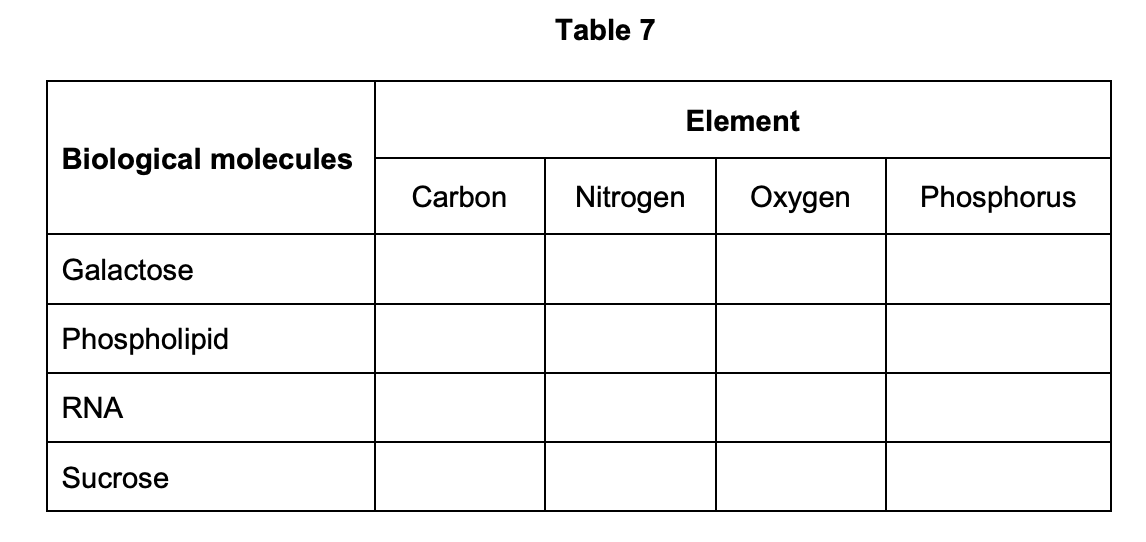
Answer
Mark Scheme
- 4 rows correct = 2 marks (1 mark)
- 2 or 3 rows correct = 1 mark (1 mark)
- 0 or 1 row correct = 0 marks (1 mark)
Tips from examiner reports
- Good knowledge overall.
- Common error: Incorrectly identifying elements in RNA.
- Tips: Remember RNA contains C, H, O, N AND phosphorus (from the phosphate group in nucleotides).
After Watson and Crick proposed the model of DNA structure, scientists investigated box the possible mechanisms for DNA replication. Two scientists grew a bacterial population, providing them with a nitrogen source containing only the heavy isotope of nitrogen, 15 N. As soon as all the DNA in this population contained 15 N, the scientists changed the nitrogen source to one containing only the lighter isotope of nitrogen, 14 N. They changed the nitrogen source at 0 hours. During the investigation, the scientists measured the size of the population of bacterial cells. Figure 11 shows the scientists’ results.
The generation time for a population of bacteria is the time taken for all the bacteria to divide once by binary fission.
Use Figure 11 and the following equation to calculate the generation time for this population of bacteria.
Give your answer in hours.
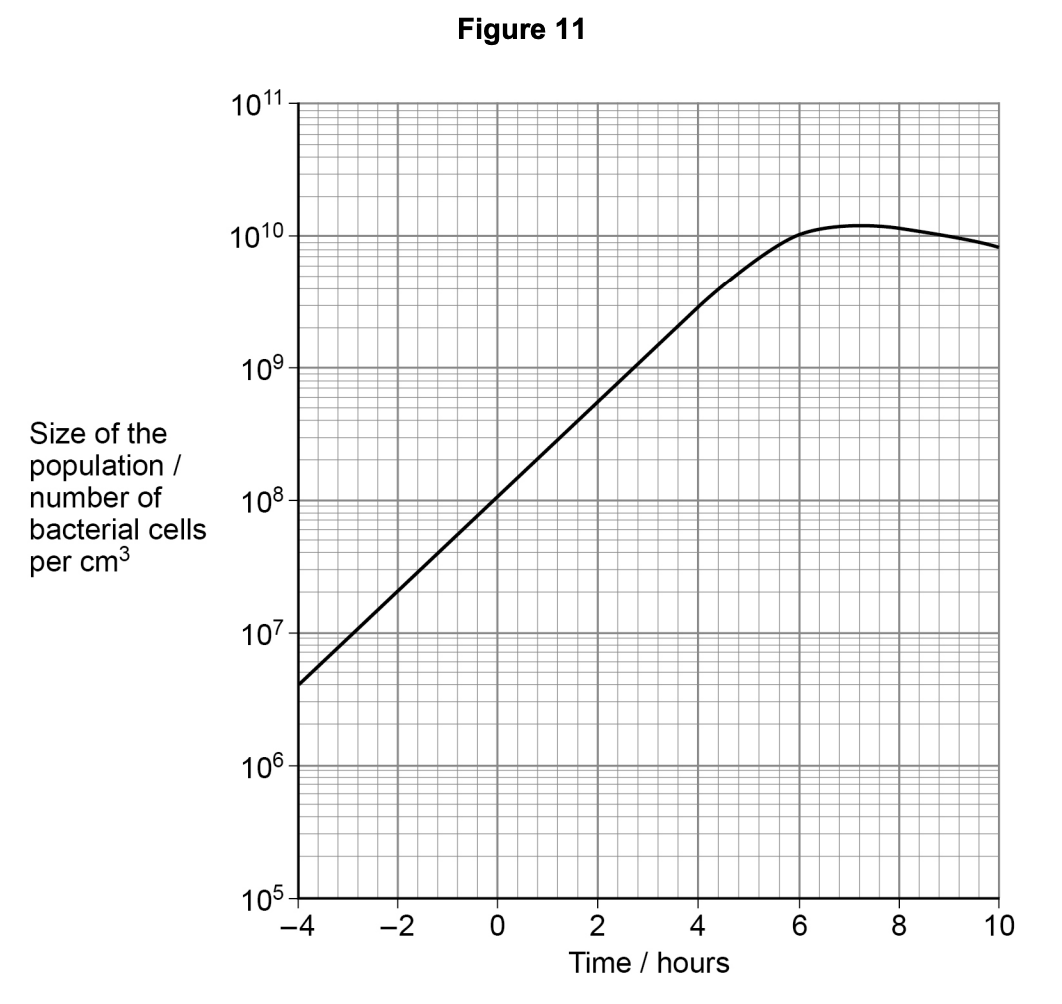

Answer
Mark Scheme
- Correct answer for 2 marks, 0.8376308/0.84/0.8 (hours) (1 mark)
- Accept for 1 mark, Evidence of 4 x 10⁶ and 3 x 10^9 (written in any format, for correct readings from graph) OR Evidence of 9.550746785 (correct number of generations) OR Evidence of 1.1938443348 (correct generations/hour) OR Evidence of 50.26 (correct generation time in minutes) (1 mark)
Comments from mark scheme
Accept correct rounding to any number of decimal places
Tips from examiner reports
- Practise reading logarithmic scales — values between marks are not evenly spaced
- Read both axes carefully before extracting data
At intervals during this investigation, the scientists removed samples of the bacterial population, isolated the DNA and measured the density of the DNA. DNA made using 15 N has a higher density than DNA made using 14 N. Figure 12 shows the scientists’ results.
Which of these models, P, Q or R, is supported by the results shown in Figure 12?
Give the letter and name of the model supported and explain why the results do not support the other models.
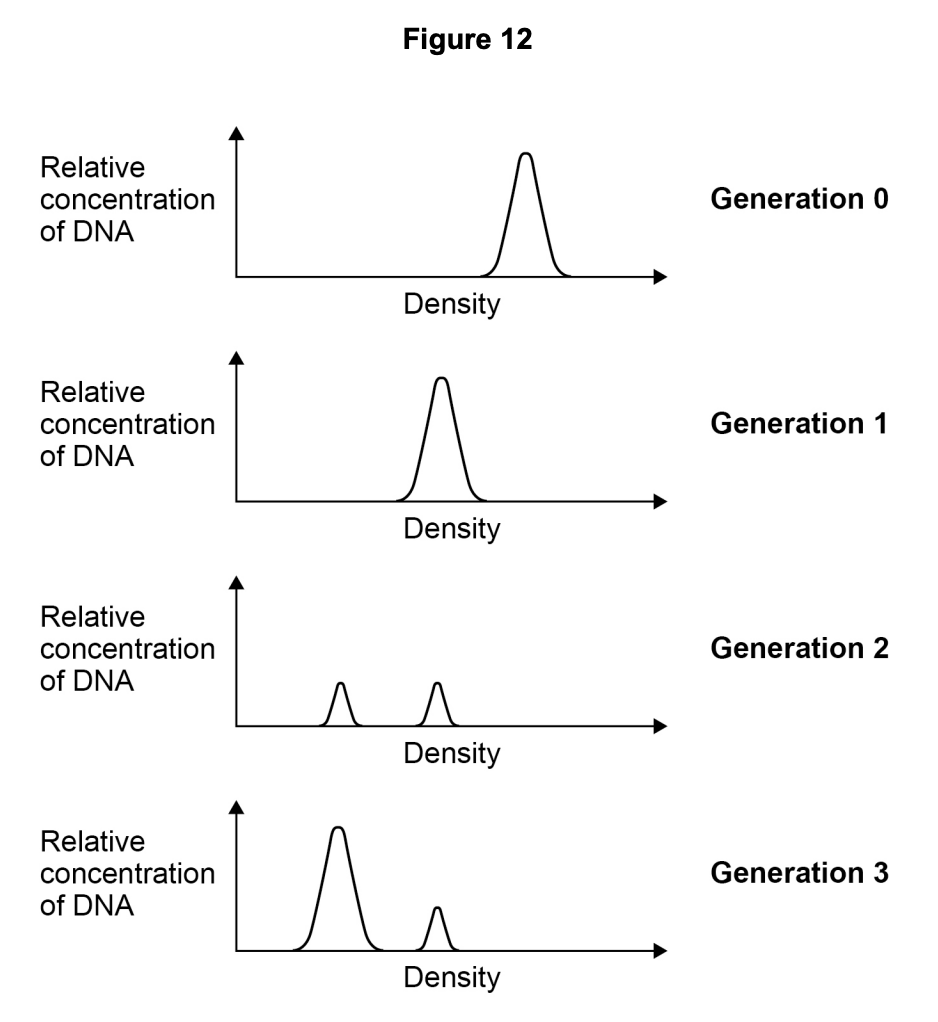
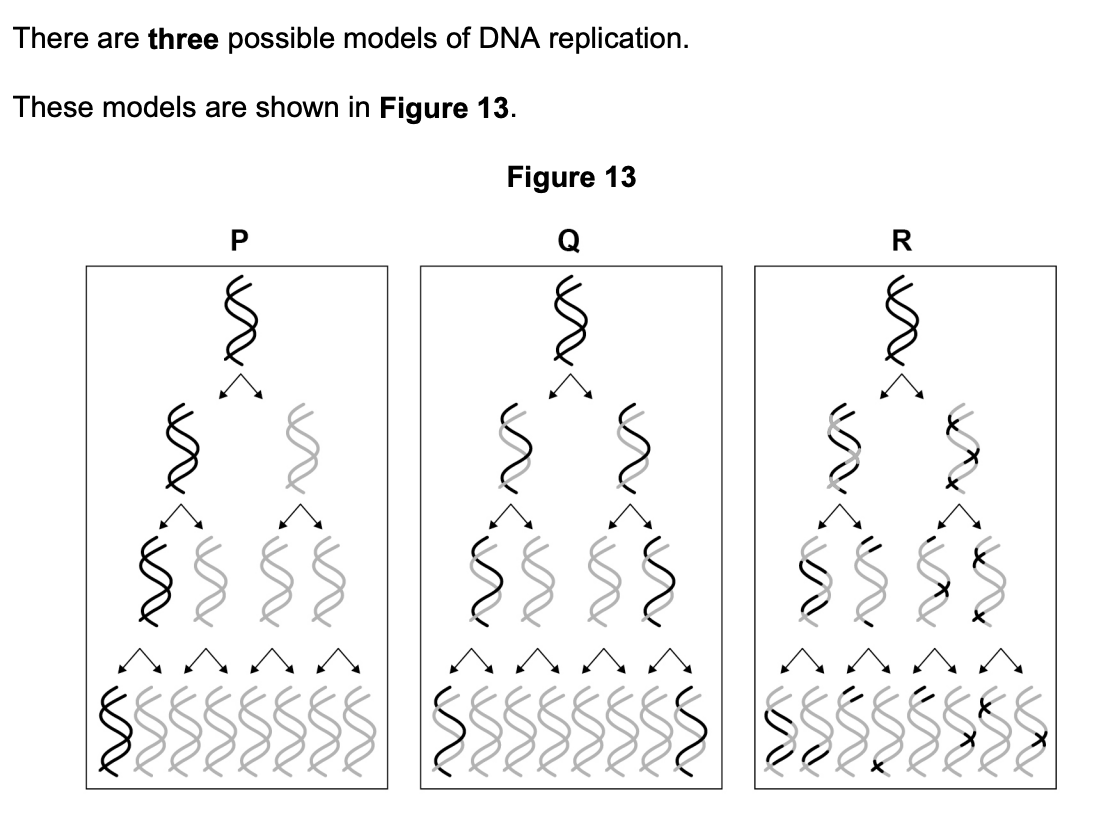
Answer
Mark Scheme
- (Model) Q and (Name) Semi-conservative (replication); Explanation (1 mark)
- (Model) P (is unsupported because) There should be two peaks in generation 1 OR (Only) one peak is shown in generation 1 OR There should be 3:1 (ratio) of peaks in generation 2 OR There should not be an intermediate/15N 14N peak in generation 1/2/3 OR The original/generation 0/ 15N peak should be in generation 1/2/3 (1 mark)
- (Model) R (is unsupported because) There should be >2 peaks in generation 2/3 OR There should be one wide/overlapping peak in generation 3 (1 mark)
Comments from mark scheme
Accept answers 2. and 3. in either order Accept for ‘peak’, density OR distribution 3. Accept for ‘>2’, many OR several
Describe the structure of DNA.
(5 marks)Answer
Mark Scheme
- Polymer of nucleotides (1 mark)
- Each nucleotide formed from deoxyribose, a phosphate (group) and an organic/nitrogenous base (1 mark)
- Phosphodiester bonds (between nucleotides) (1 mark)
- Double helix/2 strands held by hydrogen bonds (1 mark)
- (Hydrogen bonds/pairing) between adenine, thymine and cytosine, guanine (1 mark)
Comments from mark scheme
- Accept ‘Polynucleotide’
- Accept for ‘phosphate’. phosphoric acid
Tips from examiner reports
- Use ALL the information provided — don’t just focus on one table or figure
- A probability value ≥ 0.05 means no significant difference; < 0.05 means significant difference
- Consider limitations: artificial vs natural conditions, time period, depth, location
- Don’t confuse ‘probability’ with ‘chance’ when explaining statistical tests
Name and describe five ways substances can move across the cell-surface membrane into a cell.
(5 marks)Answer
Mark Scheme
- (Simple) diffusion of small/non-polar molecules down a concentration gradient (1 mark)
- Facilitated diffusion down a concentration gradient via protein carrier/channel (1 mark)
- Osmosis of water down a water potential gradient (1 mark)
- Active transport against a concentration gradient via protein carrier using ATP (1 mark)
- Co-transport of 2 different substances using a carrier protein (1 mark)
Comments from mark scheme
For any answer accept a correct example If no reference to ‘small/ non-polar’ for
- accept this idea from ‘large/charged’ given in description of 2.
- Reject if active rather than passive
- For ‘carrier protein’ accept symport OR cotransport protein
Tips from examiner reports
- Specify channel proteins or carrier proteins — don’t just say ‘proteins’
- Molecules move down a concentration gradient (from high to low) — don’t say ‘from high gradient to low gradient’
- Know the co-transport mechanism: ions are pumped out creating a gradient, then flow back in alongside another molecule via a co-transporter
Contrast the structure of the two cells visible in the electron micrographs shown in Figure 14.
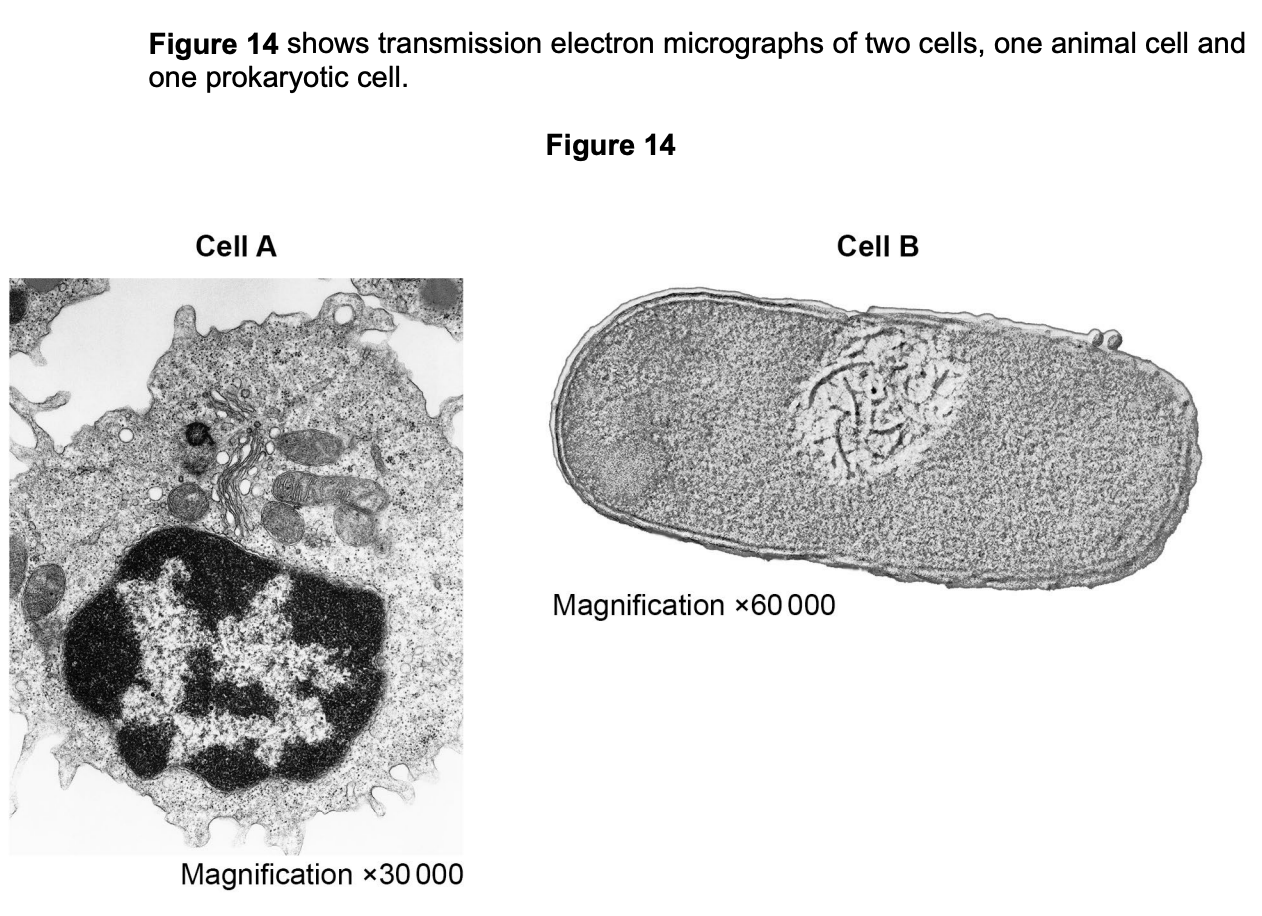
Answer
Mark Scheme
- Magnification (figures) show A is bigger than B (1 mark)
- A has a nucleus whereas B has free DNA (1 mark)
- A has mitochondria whereas B does not (1 mark)
- A has Golgi body/endoplasmic reticulum whereas B does not (1 mark)
- A has no cell wall whereas B has a murein/glycoprotein cell wall (1 mark)
- A has no capsule whereas B has a capsule (1 mark)
- A has DNA is bound to histones/proteins whereas B has DNA not associated with histones/proteins OR A has linear DNA whereas B has circular DNA (1 mark)
- A has larger ribosomes (1 mark)
Comments from mark scheme
Accept in all marking points, animal/eukaryote for A and prokaryote/ bacterium for B 5. Accept peptidoglycan
Tips from examiner reports
- A bacterial capsule is a slimy layer outside the cell wall — don’t confuse it with a viral capsid (protein coat)
- These are completely different structures in different organisms
Figure 1 shows a cell from the lining of the ileum specialised for absorption of products of digestion. SGLT1 is a carrier protein found in the cell-surface membrane of this cell, it transports glucose and sodium ions (Na⁺) into the cell.
The action of the carrier protein X in Figure 1 is linked to a membrane-bound ATP hydrolase enzyme.
Explain the function of this ATP hydrolase.
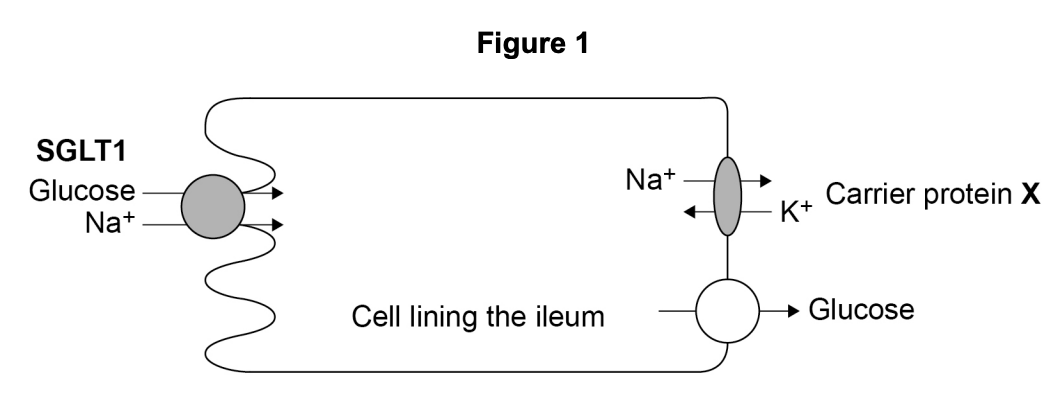
Answer
Mark Scheme
- (ATP to ADP + Pi ) Releases energy (1 mark)
- (energy) allows ions to be moved against a concentration gradient OR (energy) allows active transport of ions (1 mark)
Comments from mark scheme
- Reject ‘produces/makes/creates energy’.
- For ‘ions’ accept Na⁺ or K⁺
- Do not accept if this movement is of glucose not ions.
The movement of Na⁺ out of the cell allows the absorption of glucose into the cell lining the ileum. Explain how
(2 marks)Answer
Mark Scheme
- (Maintains/generates) a concentration/diffusion gradient for Na⁺ (from ileum into cell) (1 mark)
- Na⁺ moving (in) by facilitated diffusion, brings glucose with it OR Na⁺ moving (in) by co-transport, brings glucose with it (1 mark)
Comments from mark scheme
- Accept ‘(Maintains/generates) a lower concentration of Na⁺ inside the cell compared with outside the cell’.
- Accept ‘co-transporter’ for ‘co-transport’.
Describe and explain two features you would expect to find in a cell specialised for absorption.
(2 marks)Answer
Mark Scheme
- Folded membrane/microvilli so large surface area (for absorption) (1 mark)
- Large number of co-transport/carrier/channel proteins so fast rate (of absorption) OR Large number of co-transport/carrier proteins for active transport (1 mark)
- Large number of mitochondria so make (more) ATP (by respiration) Membrane-bound (digestive) enzymes so maintains concentration gradient (for fast absorption) (1 mark)
Comments from mark scheme
- Reject references to ‘villi’.
- Accept ‘brush border’ for ‘microvilli’.
- Accept named examples of digestive enzymes.
Tips from examiner reports
Students confused villi and microvilli. Stating ‘large surface area’ or ‘protein carriers in the membrane’ was not enough — the feature had to be described AND explained. ‘Thin membranes/walls’ is a misconception that should not appear at A-level.
Draw phospholipids on Figure 2 to show how the carrier protein, SGLT1, would fit into the cell-surface membrane. Do not draw more than eight phospholipids.
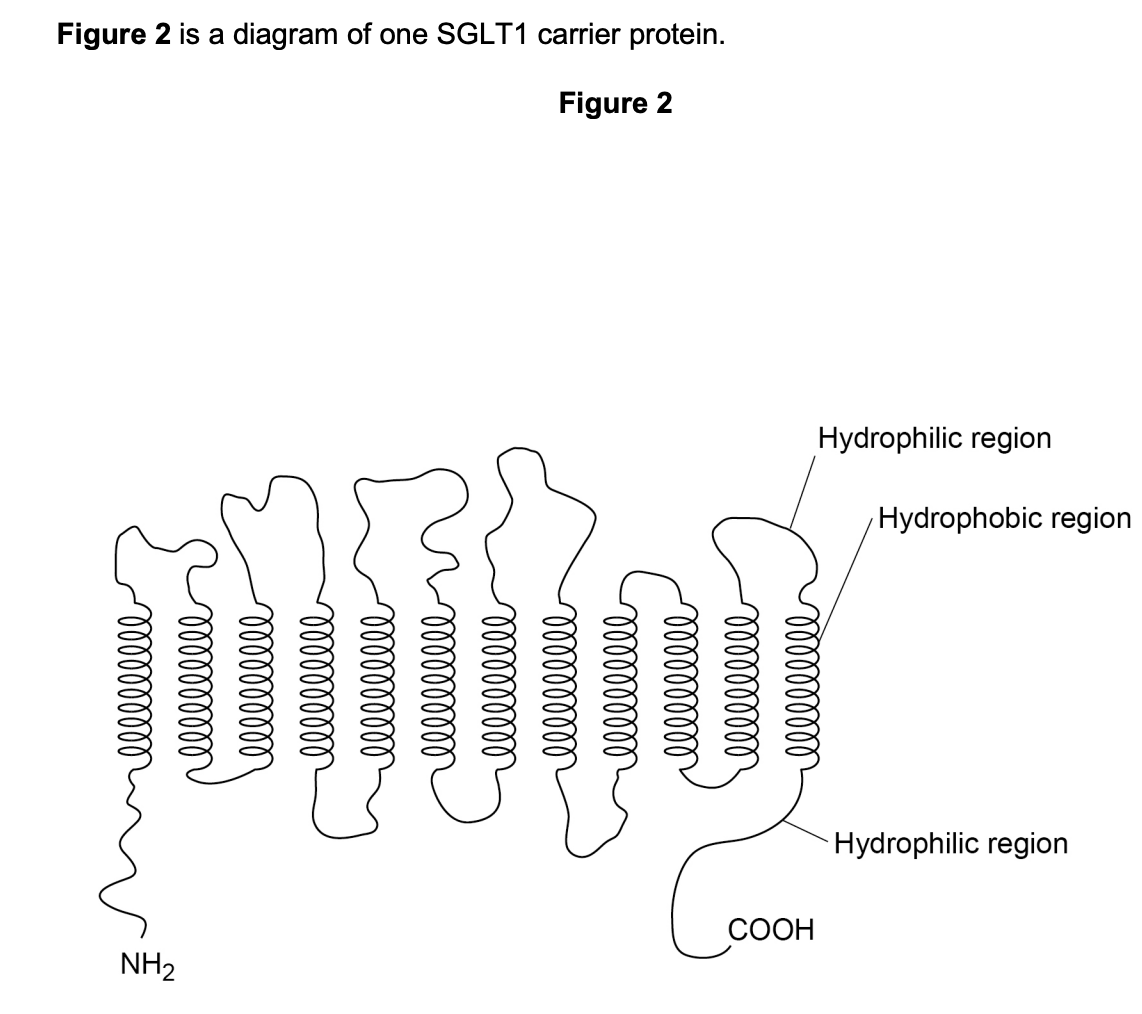
Answer
Mark Scheme
- Phospholipids drawn with head and two tails (1 mark)
- Correctly positioned as a bilayer on either side of SGLT1 (1 mark)
Comments from mark scheme
- Some of every ‘head’ must extend into the hydrophilic region and some of every ‘tail’ must extend into the hydrophobic region.
- Reject phospholipids drawn within the protein.
Tips from examiner reports
Only 32% scored 2 marks. Most students could draw a fluid-mosaic model from scratch but struggled when phospholipids had to be drawn around a given protein. Hydrophilic heads must sit in the hydrophilic zone and hydrophobic tails in the hydrophobic zone of the protein.
Figure 2 shows the SGLT1 polypeptide with NH₂ at one end and COOH at the other end.
Describe how amino acids join to form a polypeptide so there is always NH₂ at one end and COOH at the other end. You may use a diagram in your answer.
Answer
Mark Scheme
- One amine/NH₂ group joins to a carboxyl/COOH group to form a peptide bond (1 mark)
- (So in chain) there is a free amine/NH₂ group at one end and a free carboxyl/COOH group at the other OR Each amino acid is orientated in the same direction in the chain (1 mark)
Comments from mark scheme
Accept on diagram, for example (at least) two amino acids joining by a correctly drawn peptide bond (MP1) with NH₂ at one end and COOH at the other (MP2).
- Ignore incorrect names of NH₂ and COOH groups.
- Allow ECF for incorrect naming of groups.
Tips from examiner reports
Drawing a labelled diagram (free amine group at one end, free carboxyl group at the other end) was the most effective approach. Many students had inaccurate knowledge of amino acid structure; written answers that contradicted the diagram negated marks.
To study lipid digestion, a scientist placed a tube into the gut of a healthy 20-year-old man. The end of the tube passed through the stomach but did not reach as far as the ileum. The scientist fed the man a meal containing triglycerides through the tube. The scientist also used the tube to remove samples from the man’s gut at intervals after the meal. The scientist measured the type of lipid found in the samples. Some of her results are shown in Table 1
Use your knowledge of lipid digestion to explain the differences in the results for samples A and B shown in Table 1. You should assume that no absorption had occurred.
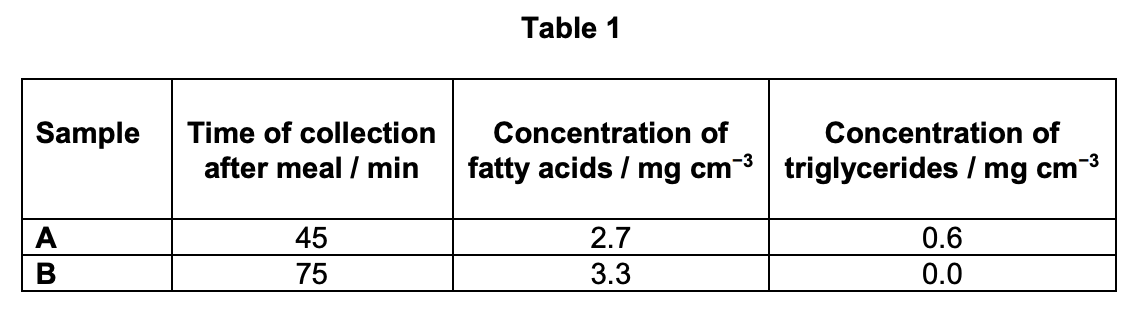
Answer
Mark Scheme
- Triglycerides decrease because of the action of lipase (1 mark)
- Triglycerides decrease because of hydrolysis (of triglycerides) (1 mark)
- Triglycerides decrease because of digestion of ester bonds (between fatty acid and glycerol) (1 mark)
Comments from mark scheme
Triglycerides decreasing or fatty acids increasing only need to be stated once. Accept ‘lower/higher/quoted numbers’ for ‘decrease/increase’. Only withhold one mark if there is no/incorrect reference to triglycerides decreasing or fatty acids increasing
Tips from examiner reports
Many gave GCSE-level answers, incorrectly placing fat digestion in the stomach. The question asked for differences between samples A and B — long descriptions of only sample A were not credited. Only 10% gave a full A-level answer.
After collecting the samples, the scientist immediately heated them to 70 °C for 10 minutes. Explain why.
(2 marks)Answer
Mark Scheme
- To denature the enzymes/lipase (1 mark)
- So no further digestion/hydrolysis/catalysis occurred (1 mark)
Comments from mark scheme
- Accept description of denaturation in terms of change in tertiary structure.
- Accept ‘break down’ for digestion
Tips from examiner reports
73% scored at least 1. Partial answers often just stated ‘no further reactions occurred’ without linking this to the investigation. ‘Killed enzymes’ was a common incorrect phrase. Answers that said ‘this was the optimum temperature to speed up the reaction’ scored zero.
Describe the role of micelles in the absorption of fats into the cells lining the ileum
(3 marks)Answer
Mark Scheme
- Micelles include bile salts and fatty acids (1 mark)
- Make the fatty acids (more) soluble in water (1 mark)
- Bring/release/carry fatty acids to cell/lining (of the ileum) (1 mark)
- Maintain high(er) concentration of fatty acids to cell/lining (of the ileum) (1 mark)
- Fatty acids (absorbed) by diffusion (1 mark)
Comments from mark scheme
- Ignore other correct components of micelles. 2 and 3 only. For ‘fatty acids’ accept fats/lipids.
- Reject if absorbed by facilitated diffusion
- Ignore if micelles themselves are being absorbed. Ignore references to monoglycerides.
Tips from examiner reports
Only 5% scored 3 marks. Key misconception: micelles are formed AFTER digestion and BEFORE absorption — not by emulsification. Emulsification increases surface area for lipase; micelles then carry digested products to epithelial cells. Chylomicrons are a separate, later step.
At P on Figure 3, the pressure in the left ventricle is increasing. At this time, the rate of blood flow has not yet started to increase in the aorta.
Use evidence from Figure 3 to explain why.
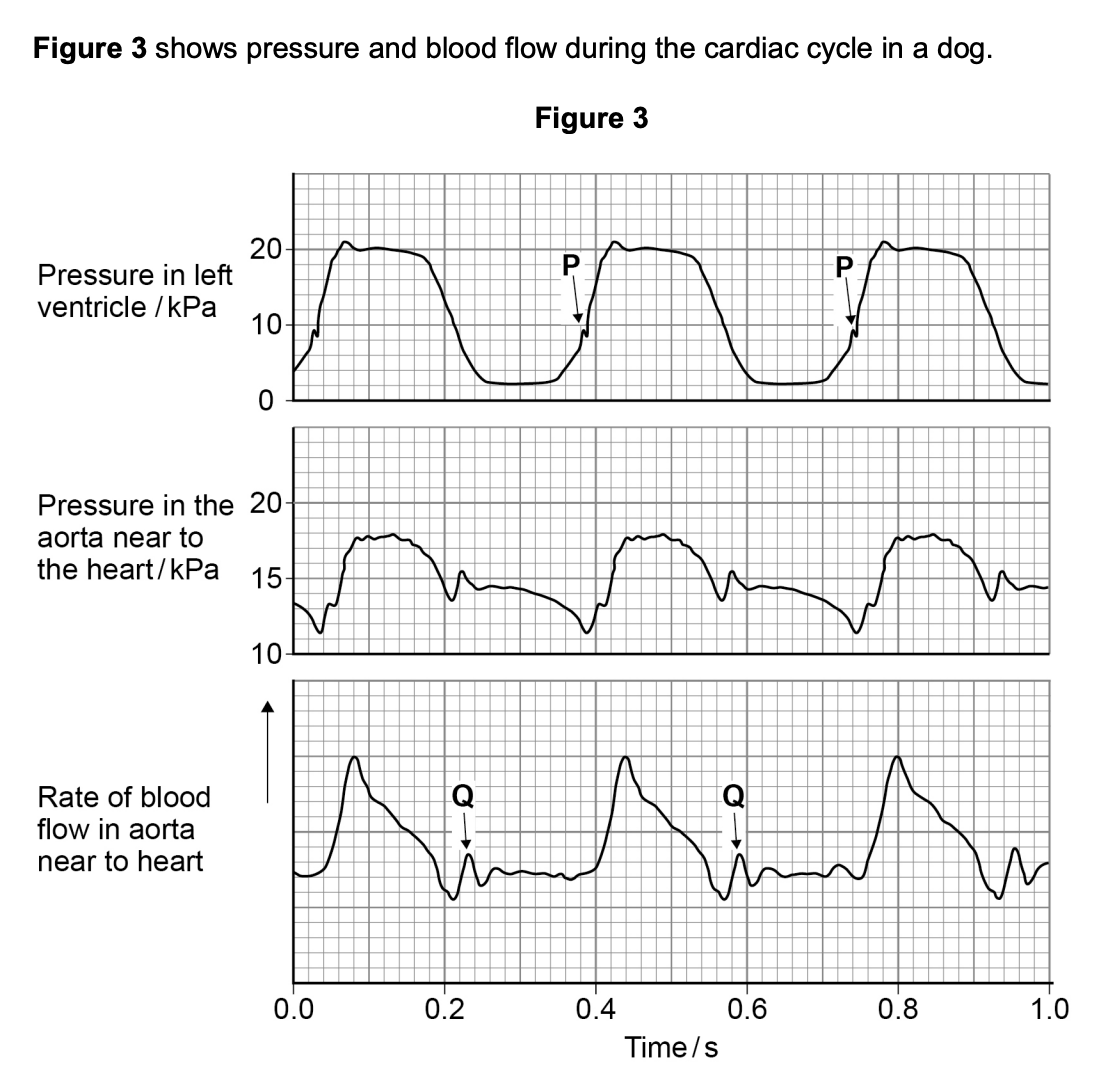
Answer
Mark Scheme
- Aortic/semi-lunar valves is closed (1 mark)
- Because pressure in aorta higher than in ventricle (1 mark)
Comments from mark scheme
- Accept ‘aorta valve’ or ‘valve to the aorta’ or ‘valve between the aorta and the ventricle’.
- Do not accept S-L/A-V valve.
- Accept 9-10kPa in ventricle and 13kPa in aorta.
- Ignore incorrect figures.
Tips from examiner reports
Only 35% scored at least 1 mark. Many confused the atria with the aorta. Blood flows along a pressure gradient; students also had to use evidence from the graph (pressure values) to score mark point 2 — general knowledge alone was insufficient.
At Q on Figure 3 there is a small increase in pressure and in rate of blood flow in the aorta.
Explain how this happens and its importance
(2 marks)Answer
Mark Scheme
- Elastic recoil (of the aorta wall/tissue) (1 mark)
- Smooths the blood flow OR Maintains rate of blood flow OR Maintains blood pressure (1 mark)
Comments from mark scheme
- Reject muscle contracting.
- Ignore reference to muscle relaxing.
- Ignore reference to preventing backflow of blood.
Tips from examiner reports
Only 11% scored any marks. The elastic recoil of the aorta smooths blood flow by stretching during systole and recoiling during diastole — it is not a secondary pump. Many answers incorrectly described the aorta as pumping blood.
A student correctly plotted the right ventricle pressure on the same grid as the left ventricle pressure in Figure 3.
Describe one way in which the student’s curve would be similar to and one way it would be different from the curve shown in Figure 3.
(2 marks)Answer
Mark Scheme
- Peaks/contractions at the same/similar time OR Same/similar pattern (1 mark)
- Lower pressure (1 mark)
Comments from mark scheme
Mark the answer as a whole.
- Accept ‘shape (of curve)’ for ‘pattern’.
Tips from examiner reports
Students confused themselves by referring to parts of the graph outside the left ventricle. The right ventricle pressure follows the same pattern as the left — it is not highest when the left is lowest.
Use information from Figure 3 to calculate the heart rate of this dog.
(1 marks)Answer
Mark Scheme
- 167 (beats minute–1) (1 mark)
Comments from mark scheme
Full answers 166.6 recurring, 164.383562, 171.428571 Accept any number of decimal places as long as rounding correct.
Tips from examiner reports
Only 34% calculated heart rate correctly. Incorrect answers ranged from a tiny fraction to thousands of beats per minute. Students should always sense-check whether their answer is biologically reasonable.
Anthocyanins are coloured pigments found in the cell vacuole of some plant cells. Anthocyanins cannot move across undamaged cell membranes. A student investigated how to extract anthocyanins from blueberries. She mixed 10 g of crushed, fresh blueberries with 100 cm³ of extraction solvent for 1 hour. She investigated three different extraction solvents:
When making up extraction solvent E, the student used a volume ratio of 70:30:1 ethanol:water:acid.
Tick () one box that shows the most appropriate volumes she would use to make up 100 cm³ of extraction solvent E.
A) 63.6cm³ ethanol, 27.3cm³ water, 9.1cm³ acid B) 69.3cm³ ethanol, 29.7cm³ water, 1.0cm³ acid C) 70.0cm³ ethanol, 30.0cm³ water, 1.0cm³ acid D) 70.7cm³ ethanol, 30.3cm³ water, 1.0cm³ acid
(1 marks)Answer
Mark Scheme
- B = 69.3cm³ solvent, 29.7cm³ water, 1.0cm³ acid (1 mark)
Tips from examiner reports
Practical experience was poorly demonstrated. Many could not explain why ethanol disrupts membranes or why acid damages membrane proteins. For the design question, suggesting ‘get colorimeter values from a book’ or drawing a calibration curve (when no standard solution was available) scored zero.
The student kept constant:
Name two other variables the student should have kept constant during this investigation.
- the mass of fresh blueberries
- the volume of extraction solvent
- the time for the mixture to stand.
Answer
Mark Scheme
- Temperature (1 mark)
- Agitation/mixing/stirring (1 mark)
- Source/age/type of blueberries (1 mark)
- Crushing of the blueberries (1 mark)
- Rinsing of the blueberries prior to mixing (1 mark)
- Concentration of ethanol/acid (1 mark)
Comments from mark scheme
Do not accept pH. Accept ‘Filtering method’.
After 1 hour, the student filtered the samples.
She placed the filtrate in a colorimeter and measured the light absorbance.
Her results are shown in Figure 4.
Use your knowledge of membrane structure to explain the results in Figure 4
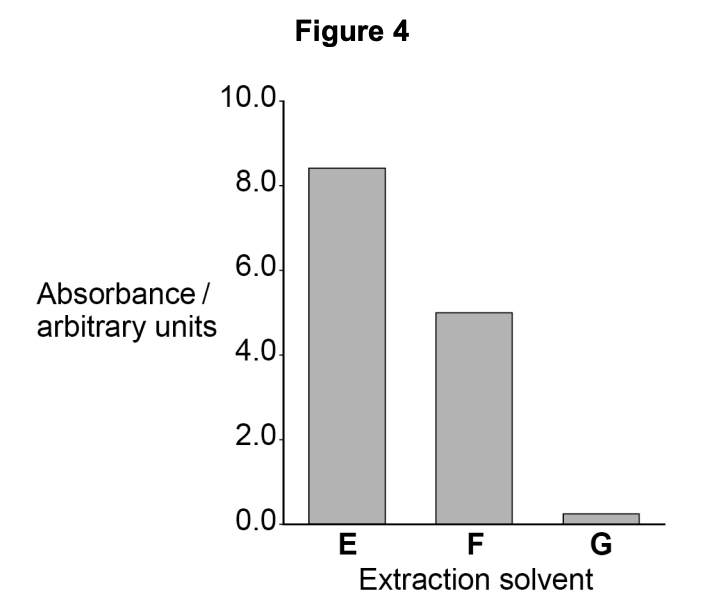
Answer
Mark Scheme
- Higher absorbance indicates more anthocyanin (1 mark)
- More membrane damage/permeability results in more anthocyanin release (1 mark)
- (E and F greater than water because) phospholipids dissolve in ethanol (1 mark)
- (E greater than F because) acid denatures membrane proteins (1 mark)
Comments from mark scheme
For ‘anthocyanin’ accept ‘pigment’.
- A direct comparative statement is not needed, can be taken from the answer as a whole. 1 and 2. Accept ‘most’ for ‘more’.
- Accept description of denaturation in terms of change in tertiary structure or breaking of hydrogen/ionic bonds.
Tips from examiner reports
Same report as Q4.1: practical experience lacking; students struggled to explain the effects of ethanol on membranes and acid on proteins. The design question required applying practical experience to school/college equipment — many did not attempt it.
A different student did this investigation. He did not have a colorimeter.
Describe a method this student could use to prepare colour standards and use them to give data for the total anthocyanin extracted.
(3 marks)Answer
Mark Scheme
- Use known concentration of blueberry juice/extract (1 mark)
- Prepare dilution series (1 mark)
- Compare (results) with colour standards to give score/value/concentration (1 mark)
Comments from mark scheme
- Accept descriptions and ‘serial dilutions’
- Accept dilution series in terms of pigment or solvent.
- For ‘colour standards’ accept ‘dilutions’.
Describe the role of DNA polymerase in the semi-conservative replication of DNA
(2 marks)Answer
Mark Scheme
- Joins (adjacent DNA) nucleotides (1 mark)
- (Catalyses) condensation (reactions) (1 mark)
- (Catalyses formation of) phosphodiester bonds (between adjacent nucleotides) (1 mark)
Comments from mark scheme
- Reject suggestions that it forms hydrogen bonds or joins complementary bases.
- Reject ‘nucleotide bases’
Tips from examiner reports
DNA polymerase does NOT form hydrogen bonds, complementary base pairs, or phosphodiester bonds between bases — it catalyses addition of nucleotides (forming phosphodiester bonds in the backbone). Many confused bases with nucleotides.
Figure 5 shows the percentage of rat cells undergoing DNA replication. Some cells contained a protein called cyclin D and some cells did not contain cyclin D. All cells were in early interphase at time 0
It took less time for 25% of cells with cyclin D to be undergoing DNA replication than for 25% of cells without cyclin D.
Use Figure 5 to calculate this time difference as a percentage decrease. Show your working.
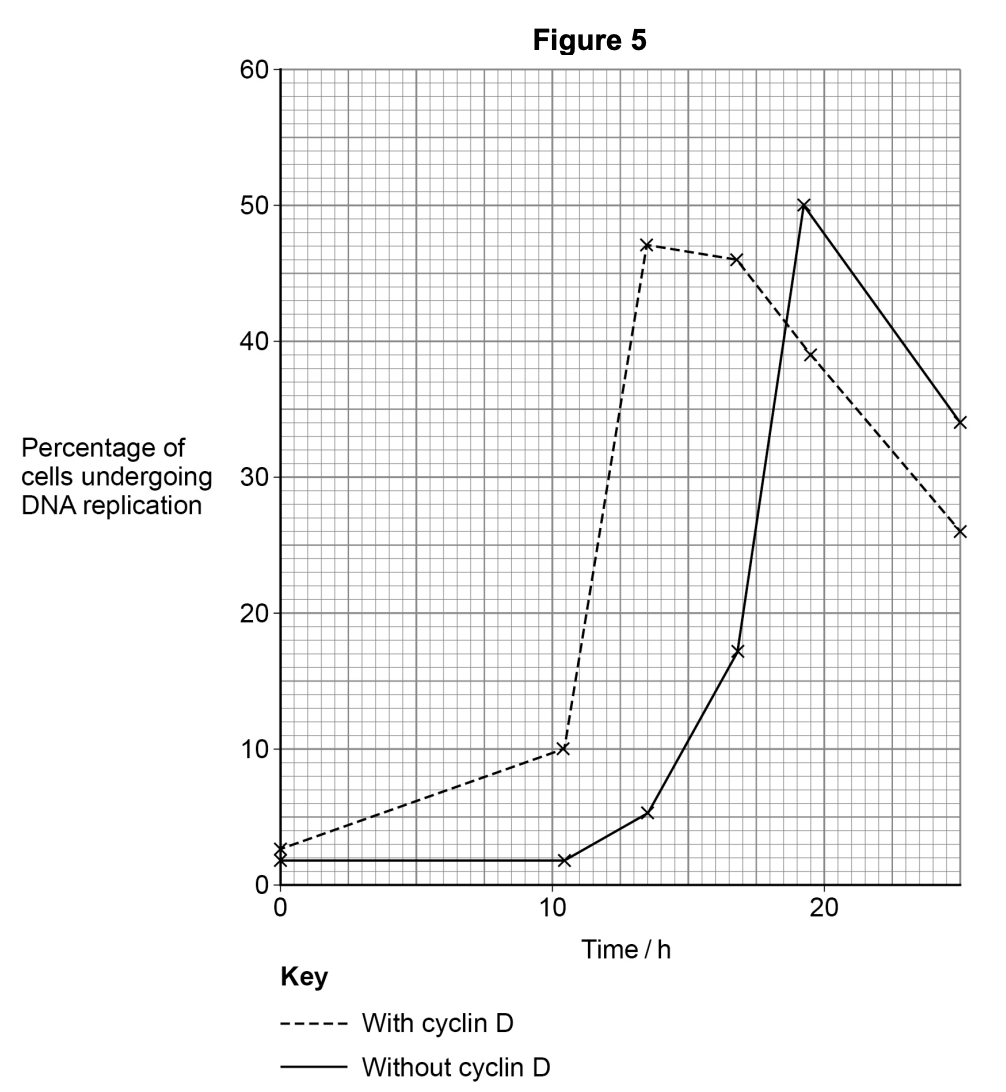
Answer
Mark Scheme
- Final answer with 2sf or 3sf in range 31.8 to 34.7% (1 mark)
Tips from examiner reports
Show all working in multi-step maths. Intermediate steps can still earn marks even if the final answer is wrong.
Cyclin D stimulates the phosphorylation of DNA polymerase, which activates the DNA polymerase.
Describe how an enzyme can be phosphorylated.
(2 marks)Answer
Mark Scheme
- Attachment/association of (inorganic) phosphate (to the enzyme) (1 mark)
- (Released from) hydrolysis of ATP (1 mark)
Comments from mark scheme
1 and 2. For ‘phosphate/Pi’ accept PO₄ 3– and P in a circle.
- Accept ‘phosphate goes to the enzyme’.
- Ignore named bonding or position of phosphate attaching to enzyme but reject formation of E-S complex.
- For ATP accept adenosine triphosphate.
- For ADP accept adenosine diphosphate.
Tips from examiner reports
Do not simply repeat words from the question stem. ‘Phosphate is used to phosphorylate the enzyme’ does not state that phosphate actually attaches/associates with the enzyme — the mechanism must be stated.
Some tumour cells contain higher than normal concentrations of cyclin D.
Use Figure 5 to suggest why higher than normal concentrations of cyclin D could result in a tumour.
(2 marks)Answer
Mark Scheme
- Shortens interphase (1 mark)
- Fast(er) cell cycle/division/multiplication/mitosis (1 mark)
- (Resulting in) a mass/group of abnormal/excessive cells (1 mark)
Comments from mark scheme
- Accept ‘starts mitosis earlier’.
- Accept ‘(May result in) mutation in a tumour suppressor gene’ OR ‘(May result in) mutation in an oncogene’. 2 and 3. Ignore uncontrolled growth;
- Accept ‘(Resulting in) a growth of abnormal/excessive cells’.
Tips from examiner reports
Cyclin D caused DNA replication to START EARLIER — not to happen more frequently. Reading figure data precisely was necessary; mark point 1 required correct interpretation of the graph.
Particulate matter is solid particles and liquid particles suspended in air. Polluted air contains more particulate matter than clean air.
A high concentration of particulate matter results in the death of some alveolar epithelium cells. If alveolar epithelium cells die inside the human body they are replaced by non-specialised, thickened tissue.
Explain why death of alveolar epithelium cells reduces gas exchange in human lungs
(3 marks)Answer
Mark Scheme
- Reduced surface area (1 mark)
- Increased distance for diffusion (1 mark)
- Reduced rate of gas exchange (1 mark)
Comments from mark scheme
1 and 2. Accept description of efficient gas exchange in healthy alveolar epithelium as long as reference made to the damaged tissue changing this.
Tips from examiner reports
Questions asking how gas exchange CHANGES (not just what adaptations are present) were answered poorly. Students needed to discuss rate of diffusion — at A-level, slower gas exchange (not less gas exchange) was credited for mark point 3.
Scientists grew alveolar epithelium cells and exposed the epithelium cells to different box concentrations of particulate matter. They calculated the percentage of these alveolar epithelium cells that died after 24 hours of exposure to particulate matter. Their results are shown in Figure 6.
Do the data in Figure 6 show a linear relationship between concentration of particulate matter and percentage of dead cells?
Use suitable calculations to justify your answer.
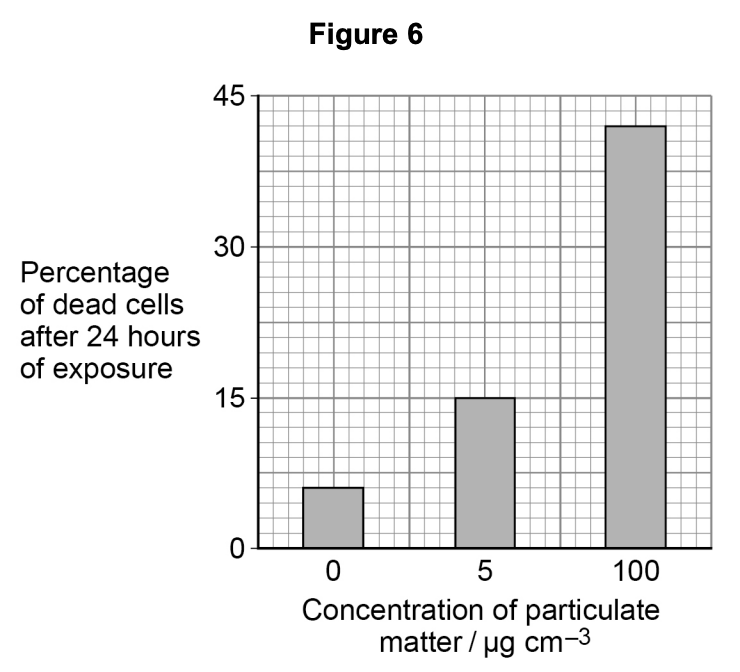
Answer
Mark Scheme
- EITHER 1. 9 (percent per 5 µg cm⁻³) (1 mark)
-
- 1.42/1.8 (percent per 5 µg cm⁻³) (1 mark)
- OR 3. 1.8 (percent per 1 µg cm⁻³ ) (1 mark)
-
- 0.28/0.36 (percent per 1 µg cm⁻³ ) (1 mark)
Tips from examiner reports
Linear does NOT mean directly proportional. Many incorrectly stated these were the same. Both maths skill 3.3 (gradient) and 3.5 (intercepts) approaches were accepted.
Alpha-gal is made of two galactose molecules. Galactose has the chemical formula C₆H₁₂O₆.
Give the chemical formula for the disaccharide, alpha-gal, and describe how it is formed from two galactose molecules.
(2 marks)Answer
Mark Scheme
- C₁₂H₂₂O₁₁ (1 mark)
- Condensation reaction (1 mark)
Comments from mark scheme
- Reject if any other named reaction or named bond given.
- Reject if reaction includes addition of water. Do not credit answers relating to other carbohydrates.
Tips from examiner reports
Nearly all students knew the condensation reaction and glycosidic bond, but only 49% could then work out the correct chemical formula. Knowing that water is lost is not enough — the formula must reflect this (e.g. C12H22O11 from two C6H12O6).
Some people eat red meat for many years without having any reaction, then have an allergic reaction to the alpha-gal in red meat. An allergic reaction is caused by an immune response.
Draw a labelled diagram of an antibody and identify the specific alpha-gal binding site.
(3 marks)Answer
Mark Scheme
- Y shape showing two long and two short (polypeptide) chains correctly positioned (1 mark)
- (Alpha-gal) binding site labelled on the end of the branches of the Y of the antibody (1 mark)
- Variable region labelled OR Constant region labelled OR Disulfide bridge/bond labelled (1 mark)
Comments from mark scheme
Drawing is nothing like an antibody = 0 marks. 2. Accept one or two being labelled, if two both must be correct. 3. Accept description of ‘variable region’. 3. Ignore labelling of light and heavy chains. 3. List rule applies
Tips from examiner reports
Most drew a basic Y shape but heavy/light chain detail was less common. Some negated a correct disulfide bridge answer by labelling the bond as a hydrogen bond or peptide bond.
A tick is a small animal that bites humans and feeds on their blood. This results in proteins from the tick saliva entering the human body.
Scientists have suggested one hypothesis for the allergic reaction to alpha-gal in red meat. They think that an earlier immune response to a tick bite can cause a person to have an allergic reaction to alpha-gal in red meat.
Suggest how one antibody can be specific to tick protein and to alpha-gal.
(2 marks)Answer
Mark Scheme
- (Part of tick protein and alpha-gal) have a similar shape/structure (1 mark)
- Antibody is complementary to both (tick protein and alpha-gal) OR Antigen-binding site is complementary to both (tick protein and alpha-gal) OR Antibody can form antigen-antibody complex with both (tick protein and alpha-gal) (1 mark)
Comments from mark scheme
- Accept ‘(Part of tick protein and alphagal) have the same shape/structure.’
- Do not credit reference to similar/same tertiary structure’. Ignore reference to alpha-gal being a protein.
- Reject reference to substrates or active sites
Tips from examiner reports
Many used enzyme terminology (active site, enzyme–substrate complex) for antibody–antigen binding — this was not credited. Alpha-gal is a carbohydrate, not a protein; many referred to its tertiary structure incorrectly.
Complete Table 2 to show three differences between DNA in the nucleus of a plant cell and DNA in a prokaryotic cell.
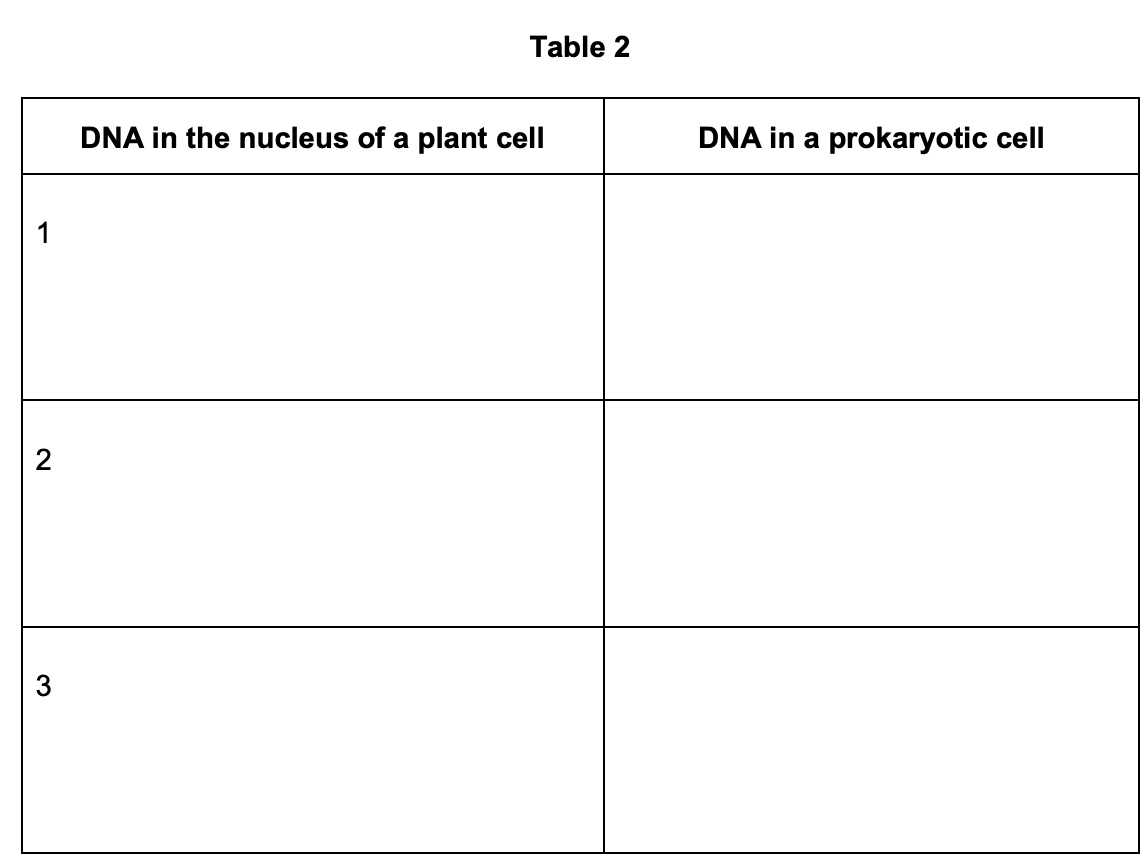
Answer
Mark Scheme
- Plant v prokaryote 1. (Associated with) histones/proteins v no histones/proteins (1 mark)
-
- Linear v circular (1 mark)
-
- No plasmids v plasmids (1 mark)
-
- Introns v no introns (1 mark)
-
- Long(er) v short(er) (1 mark)
Comments from mark scheme
Alternatives must be written directly opposite one another. Do not award if only half of a mark point is written. 2 and 3. Do not credit if suggestion that prokaryotic DNA only exists as plasmids. Reference to prokaryotic DNA being single stranded = max 2. Reference to prokaryotic DNA not being helical = max 2.
Tips from examiner reports
Only 26% scored 3 marks. Common misconceptions: prokaryotic DNA is NOT all in plasmids; prokaryotic DNA is NOT single-stranded; it DOES form a double helix. Answers that referred to the nucleus/cell as a whole rather than the DNA specifically were not credited.
Scientists investigated the genetic diversity between several species of sweet potato. They studied non-coding multiple repeats of base sequences.
Define ‘non-coding base sequences’ and describe where the non-coding multiple repeats are positioned in the genome.
(2 marks)Answer
Mark Scheme
- DNA that does not code for protein/polypeptides OR DNA that does not code for (sequences of) amino acids OR DNA that does not code for tRNA/rRNA (1 mark)
- (Positioned) between genes (1 mark)
Comments from mark scheme
- Accept the idea of not transcribed for ‘does not code for’.
- Do not credit ‘DNA that does not code for an amino acid’.
- Ignore reference to introns.
- Reject (positioned) ‘in introns’ or ‘between exons’.
- Accept ‘(Positioned) at the end of chromosomes’ or ‘(Positioned) in the telomeres’.
Tips from examiner reports
Very poorly answered. Most students thought all non-coding DNA is in introns — wrong. Non-coding DNA also includes intergenic regions between genes. Defining non-coding sequences as ‘sequences that don’t code for anything’ without elaborating was insufficient.
Use the information in Table 3 to complete the phylogenetic tree shown in Figure 8.
Write the letter that represents the correct species into each box.
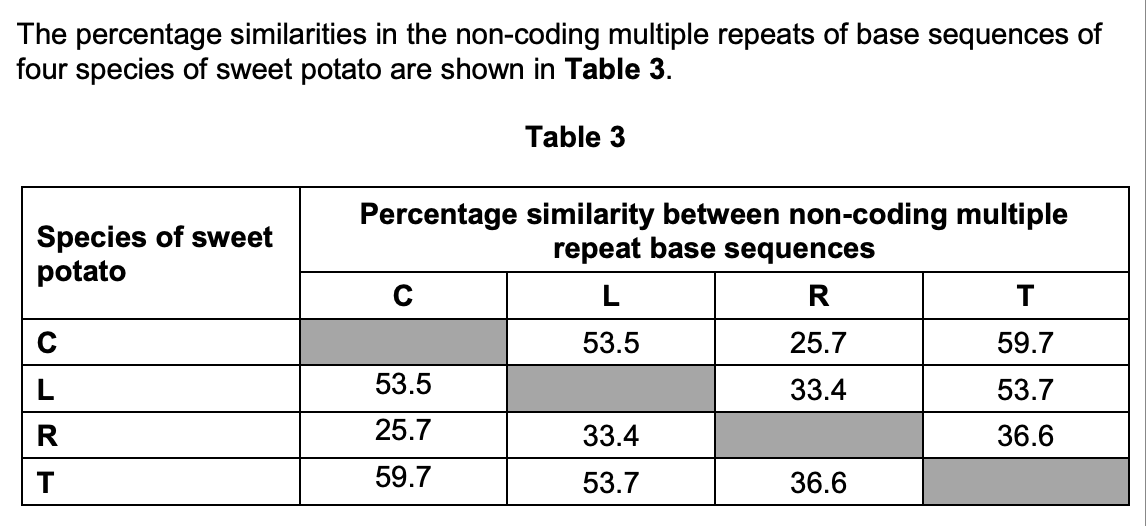
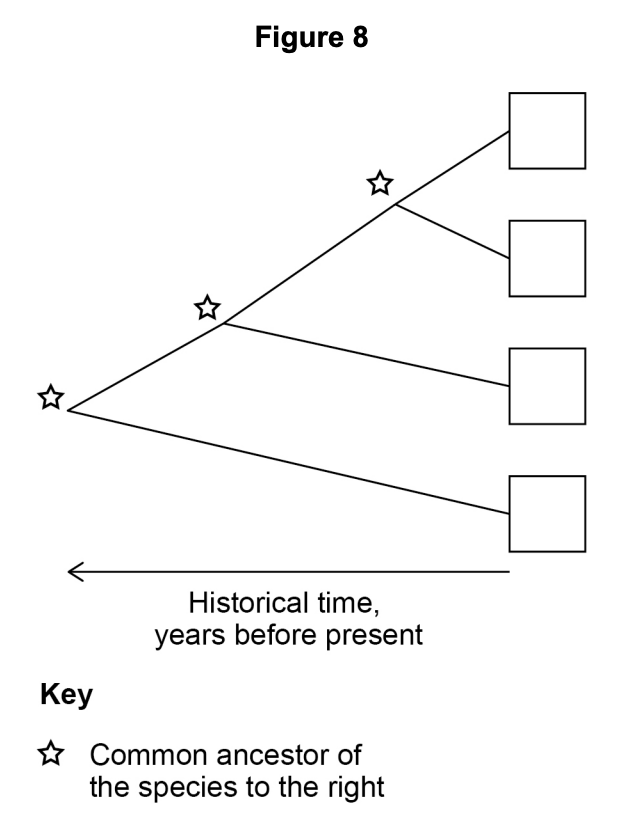
Answer
Mark Scheme
- Top to bottom C T L R (1 mark)
Tips from examiner reports
Students found phylogenetic diagrams difficult. Evolution proceeds from an extinct COMMON ANCESTOR — not from one current species to another. Q8.4 was about variation within species T, not introduction of a new species.
The scientists studied five individuals from each species. Within the five individuals of species T they found a percentage similarity of 66%.
Use Table 3 to evaluate how this information affects the validity of the phylogenetic tree.
(2 marks)Answer
Mark Scheme
- (Supported) more similar than with any other species (1 mark)
- (Not supported) high (intraspecific) variation in species T (compared with variation between T and C) (1 mark)
- Small sample (1 mark)
Comments from mark scheme
- Accept idea that species T has nearly as much variation as between T and C.
- Accept ‘Low/close similarity in species T (in relation to similarity between T and C)
Scientists investigated stomatal density on leaves of one species of tree. Figure 9 shows three examples of the square fields of view the scientists used to calculate a mean stomatal density.
Calculate the mean stomatal density in the three fields of view in Figure 9.
Give your answer as number of stomata per mm² Show your working.
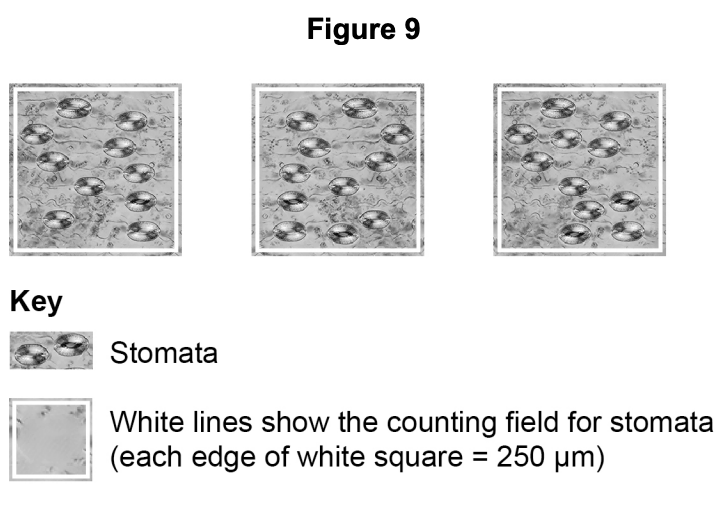
Answer
Mark Scheme
- 171 (per mm²) (1 mark)
- 1 mark for Mean of 10.7/11 stomata per square (1 mark)
Tips from examiner reports
Show each stage of working in calculations — intermediate values can earn marks. Recurring answers (e.g. 170.6̄) were accepted but students should round correctly to an appropriate number of significant figures.
The scientists used leaves from individual trees that had grown in different areas of box the world in different years. Each tree had grown in an area and year with known carbon dioxide concentration. Their results are shown in Figure 10.
Give a null hypothesis for this investigation and name a statistical test that would be appropriate to test your null hypothesis.
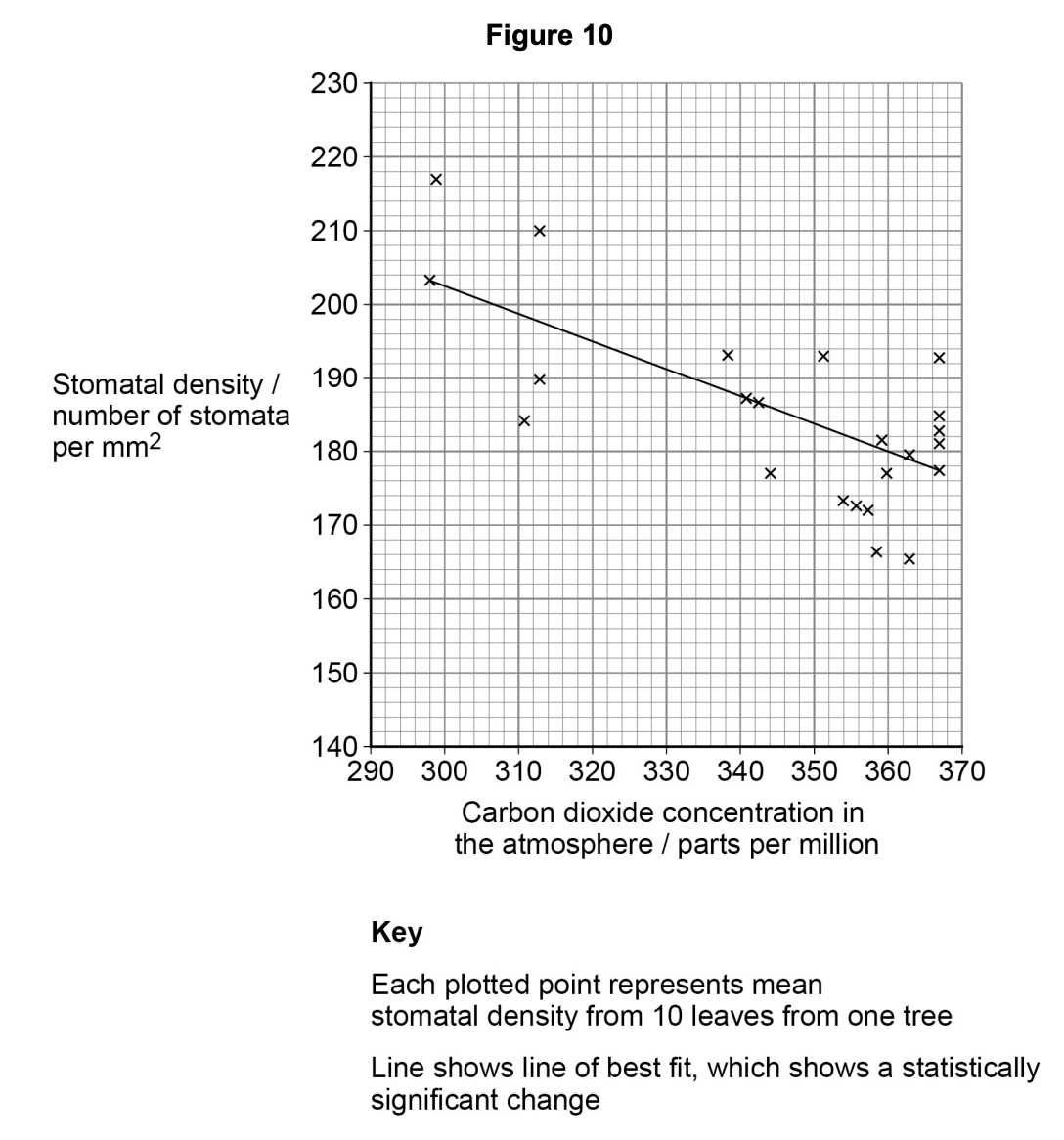
Answer
Mark Scheme
- There is no association/correlation/relationship between the concentration of carbon dioxide and the stomatal density OR The concentration of carbon dioxide does not affect the stomatal density (1 mark)
- Correlation coefficient (1 mark)
Comments from mark scheme
- Reject ‘There is no difference between the carbon dioxide concentration and the stomatal density’.
- Do not credit ‘The stomatal density does not affect the carbon dioxide concentration’.
- Accept ‘Spearman’s (rank)’ or other named correlation coefficient
Tips from examiner reports
Only 22% scored 2 marks. The null hypothesis is NOT an alternative hypothesis. A standard format ‘no difference between variables’ was not appropriate here. Know the three required statistical tests and the flowchart to select between them.
From 1910 to 2000, the carbon dioxide concentration in the atmosphere increased from 300 parts per million to 365 parts per million.
Use Figure 10 to calculate the mean rate of change in stomatal density from 1910 to 2000.
Give your answer as number of stomata per mm² per 10-year period. Show your working.
Give as number of stomata per mm² per 10-year period
(2 marks)Answer
Mark Scheme
- Final answer in range 2.6 to 2.7 1 mark for Stomatal density decrease of 24 to 25 (1 mark)
Comments from mark scheme
Accept any number of sf as long as rounding correct. Ignore minus signs.
A journalist saw Figure 10 and suggested that future increases in atmospheric carbon dioxide concentration could result in less transpiration.
Evaluate his suggestion.
(4 marks)Answer
Mark Scheme
- Increasing carbon dioxide (concentration) shows decreased stomatal density (1 mark)
- Fewer stomata means less transpiration (1 mark)
- Same (volume of) carbon dioxide can be absorbed for photosynthesis with smaller number of stomata (1 mark)
- Don’t know the size of the stomata (1 mark)
- Don’t know whether leaf size has changed (1 mark)
- Don’t know if this is true for all species (of plant) (1 mark)
- Don’t know how long the stomata are open for (1 mark)
- Don’t know if this trend will continue (beyond the concentrations of carbon dioxide shown in Figure (1 mark)
- (1 mark)
- Other factors affect transpiration (rate) (1 mark)
Comments from mark scheme
- Accept ‘There is a negative correlation between carbon dioxide (concentration) and stomatal density’.
- Accept ‘stomata per mm² ’ for ‘stomatal density’. 4, 5, 6, 7, 8. For ‘don’t know’ accept idea that these things may/have change(d).
- Accept ‘types’ for ‘species’.
- Accept ‘more species (of plant) should be tested’
- Accept named factors that affect transpiration (rate).
Tips from examiner reports
Only 13% scored more than 2 marks. Many wrongly stated no statistical test had been carried out — the legend clearly stated the line was statistically significant. Read the figure legend carefully before answering evaluation questions.
Describe how mRNA is formed by transcription in eukaryotes.
(5 marks)Answer
Mark Scheme
- Hydrogen bonds (between DNA bases) break (1 mark)
- (Only) one DNA strand acts as a template (1 mark)
- (Free) RNA nucleotides align by complementary base pairing (1 mark)
- (In RNA) Uracil base pairs with adenine (on DNA) OR (In RNA) Uracil is used in place of thymine (1 mark)
- RNA polymerase joins (adjacent RNA) nucleotides (1 mark)
- (By) phosphodiester bonds (between adjacent nucleotides) (1 mark)
- Pre-mRNA is spliced (to form mRNA) OR Introns are removed (to form mRNA) (1 mark)
Comments from mark scheme
Ignore DNA helicase.
- Reject hydrolysing hydrogen bonds.
- For ‘align by complementary base pairing’, accept ‘align to complementary bases’ or ‘align by base pairing’.
- Do not credit use of letters alone for bases.
- Reject suggestions that RNA polymerase forms hydrogen bonds or joins complem
Tips from examiner reports
Refer to RNA nucleotides and RNA polymerase when describing transcription — not DNA equivalents. RNA polymerase does NOT form hydrogen bonds or complementary base pairs; it catalyses addition of RNA nucleotides, forming phosphodiester bonds.
Describe how a polypeptide is formed by translation of mRNA
(6 marks)Answer
Mark Scheme
- (mRNA attaches) to ribosomes OR (mRNA attaches) to rough endoplasmic reticulum (1 mark)
- (tRNA) anticodons (bind to) complementary (mRNA) codons (1 mark)
- tRNA brings a specific amino acid (1 mark)
- Amino acids join by peptide bonds (1 mark)
- (Amino acids join together) with the use of ATP (1 mark)
- tRNA released (after amino acid joined to polypeptide) (1 mark)
- The ribosome moves along the mRNA to form the polypeptide (1 mark)
Tips from examiner reports
Confusion between tRNA and amino acids. It is the amino acid (attached to tRNA) that joins the growing polypeptide chain, not tRNA itself. ATP is used in peptide bond formation — this was rarely mentioned.
Define ‘gene mutation’ and explain how a gene mutation can have:
- no effect on an individual
- a positive effect on an individual.
Answer
Mark Scheme
- (Definition of gene mutation) 1. Change in the base/nucleotide (sequence of chromosomes/DNA) (1 mark)
-
- Results in the formation of new allele (1 mark)
- (Has no effect because) 3. Genetic code is degenerate (so amino acid sequence may not change) (1 mark)
- OR Mutation is in an intron (so amino acid sequence may not change) (1 mark)
-
- Does change amino acid but no effect on tertiary structure (1 mark)
-
- (New allele) is recessive so does not influence phenotype (1 mark)
- (Has positive effect because) 6. Results in change in polypeptide that positively changes the properties (of the protein) OR Results in change in polypeptide that positively changes a named protein (1 mark)
-
- May result in increased reproductive success OR May result in increased survival (chances) (1 mark)
Comments from mark scheme
For 4 marks at least one mark must be scored in each section of the answer.
- Accept named mutation for ‘change’.
- Accept description of ‘degenerate’, eg some amino acids have more than one triplet/codon.
- For ‘polypeptide’ accept ‘amino acid sequence’ or ‘protein’.
Tips from examiner reports
A gene mutation does NOT always change the amino acid sequence (degenerate code). Any mutation creates a new allele. For a beneficial effect, the key idea is increased survival and reproductive success — not just ‘changed appearance’ or ‘ability to find food’.
Describe how a non-competitive inhibitor can reduce the rate of an enzyme-controlled reaction.
(3 marks)Answer
Mark Scheme
- Attaches to the enzyme at a site other than the active site (1 mark)
- Changes (shape of) the active site OR Changes tertiary structure (of enzyme) (1 mark)
- (So active site and substrate) no longer complementary so less/no substrate can fit/bind (1 mark)
Comments from mark scheme
- Accept ‘attaches to allosteric/inhibitor site’
- Accept ‘no longercomplementary so less/no enzymesubstrate complexes form’
- Accept abbreviations of enzyme-substrate complex.
Tips from examiner reports
Over half scored full marks — a well-answered question. Non-competitive inhibitors bind to an allosteric site (not the active site or ‘the side of the active site’) and change the active site shape. Using ‘complementary’ should reflect genuine understanding, not rote learning.
Pectin is a substance found in some fruit and vegetables box . A scientist investigated the effect of pectin on the hydrolysis of lipids by a lipase enzyme. His results are shown in Figure 1.
The scientist concluded that pectin is a non-competitive inhibitor of the lipase enzyme.
Use Figure 1 to explain why the scientist concluded that pectin is a non-competitive inhibitor.
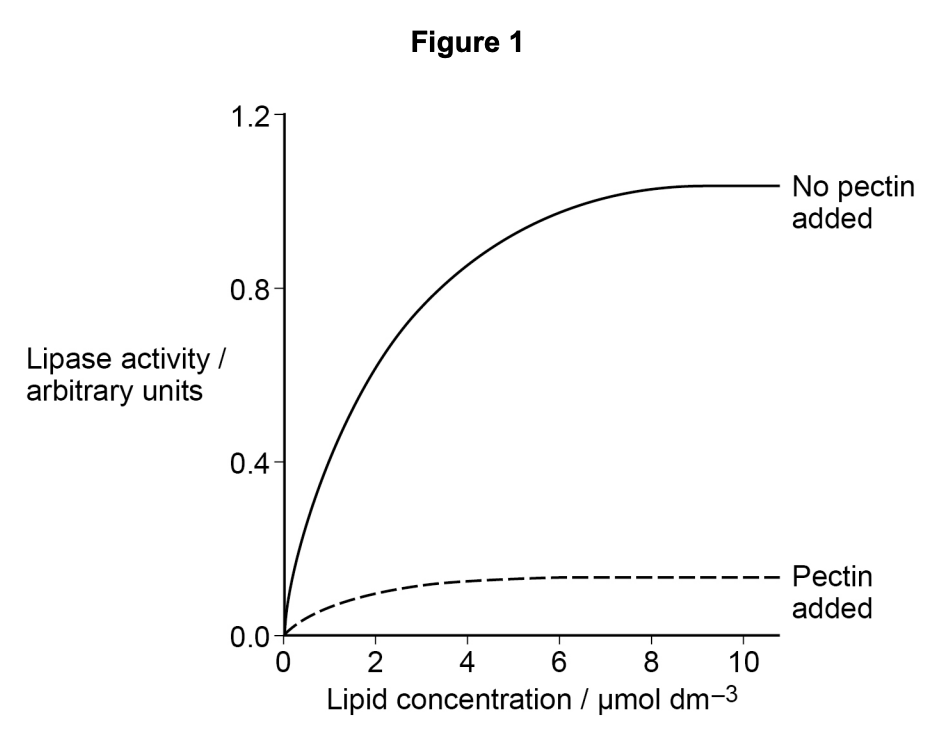
Answer
Mark Scheme
- (With inhibitor) increase substrate/lipid (concentration) does not increase/affect/change rate of reaction OR (With inhibitor) increase substrate/lipid (concentration) does not increase/affect/change lipase activity OR High substrate (concentration) does not overcome inhibition OR High substrate (concentration) does not meet maximum rate of reaction/lipase activity (1 mark)
Comments from mark scheme
Ignore references to competitive inhibitors.
Tips from examiner reports
Only one-third applied non-competitive inhibitor knowledge to the graph correctly. Many did not refer to the x-axis (substrate/lipid concentration) and incorrectly described the graph as showing changes over time.
The scientist also found that pectin stops the action of bile salts. He prepared two suspensions:
- suspension A – lipid and bile salts
- suspension B – lipid, bile salts and pectin.
He did not add lipase to either suspension. He observed samples from the suspensions using an optical microscope. Figure 2 shows what he saw in a typical sample from each suspension.
Calculate the maximum length of the large lipid droplet marked X in Figure 2. Using a ruler with millimetre intervals always includes an uncertainty in the measurement.
Use the uncertainty in your measurement to determine the uncertainty of your calculated maximum length. You can assume there is no uncertainty in the magnification.
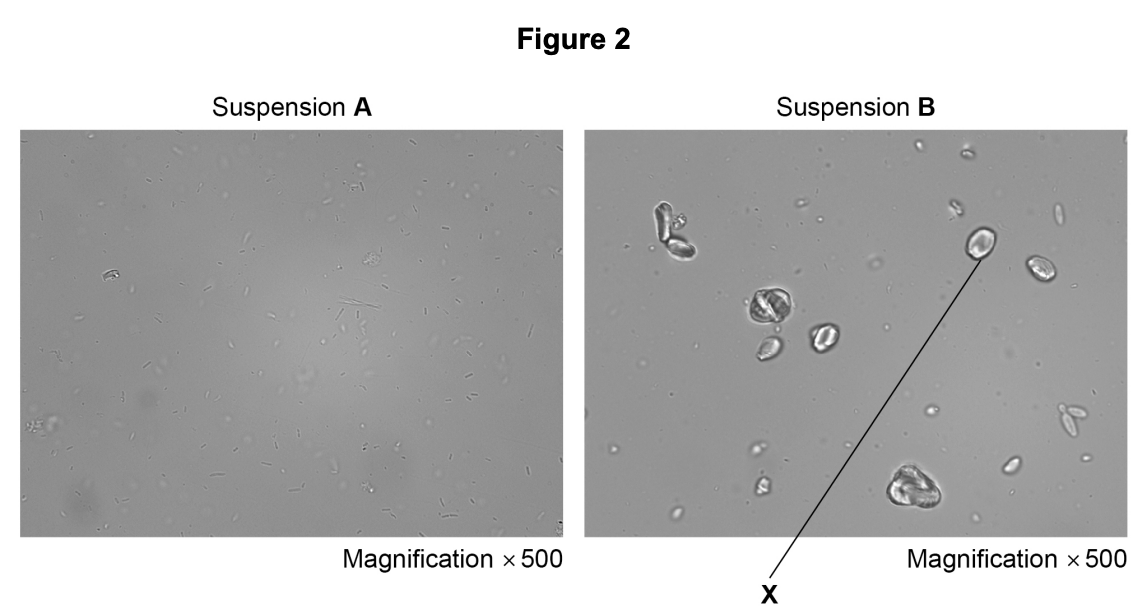
Answer
Mark Scheme
- (Maximum length) 8-10 (µm) (1 mark)
- (Uncertainty) (±) 2 (µm) (1 mark)
Tips from examiner reports
Fewer than 10% scored both marks. Magnification of maximum length was calculated correctly by about half, but uncertainty calculations (MS 1.11) were rarely done correctly. Uncertainty = half the smallest scale division; use Section L of the practical handbook.
No large lipid droplets are visible with the optical microscope in the samples from suspension A. Explain why.
(2 marks)Answer
Mark Scheme
- Emulsification (1 mark)
- (Cannot be seen) due to resolution (of optical microscope) (1 mark)
Comments from mark scheme
- Ignore ‘micelles’
- Ignore reference to magnification.
- For ‘resolution’ accept ‘wavelength of light’.
Tips from examiner reports
Emulsification was generally well described, but students could not explain WHY the emulsified droplets are invisible under the optical microscope. The issue is RESOLUTION (not magnification) — emulsified fat droplets are below the resolution limit of a light microscope.
Table 1 shows cell wall components in plants, algae, fungi and prokaryotes.
Complete Table 1 by putting a tick () where a cell wall component is present.
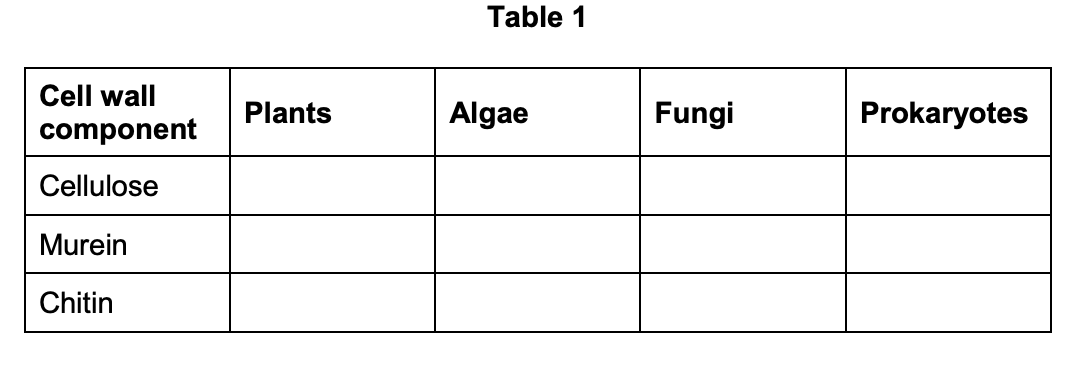
Answer
Mark Scheme
- No mark scheme available
Comments from mark scheme
1st 2 columns correct (Plants and Algae) = 1 mark 3rd column correct (Fungi) = 1 mark 4th column correct (Prokaryotes) = 1 mark Accept alternative symbols that clearly indicate the box but are not ticks eg X.
Tips from examiner reports
Straightforward recall of cell structure (section 3.2.1). No particular misconceptions noted.
Cell walls make up much of the fibre that people eat. Scientists investigated the relationship between the mass of fibre people ate each day and their risk of cardiovascular disease (CVD). They gathered data from a large sample of people and used this to calculate a relative risk.
- A relative risk of 1 means there is no difference in risk between the sample and the whole population.
- A relative risk of < 1 means CVD is less likely to occur in the sample than in the whole population.
- A relative risk of > 1 means CVD is more likely to occur in the sample than in the whole population.
Their results are shown in Figure 3. A value of ± 2 standard deviations from the mean includes over 95% of the data.
A student concluded from Figure 3 that eating an extra 10 g of fibre per day would significantly lower his risk of cardiovascular disease.
Evaluate his conclusion
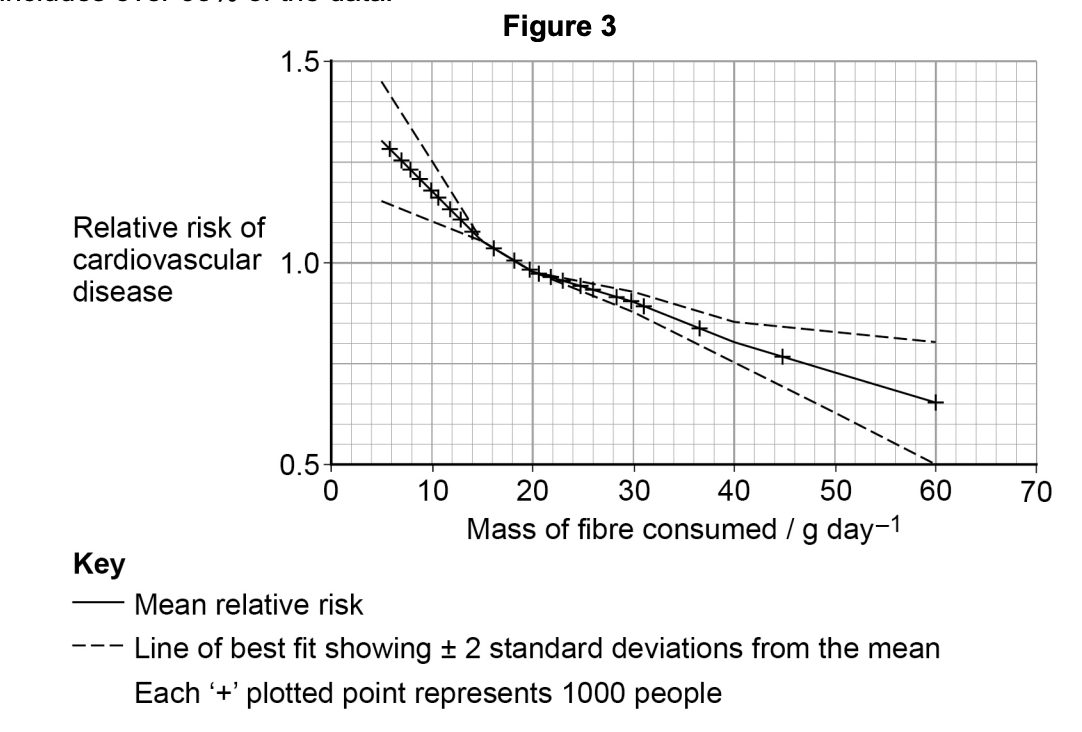
Answer
Mark Scheme
- Negative correlation (between fibre eaten per day and risk of cardiovascular disease) (1 mark)
- Original/current fibre intake (of student) not known (1 mark)
- (Idea of) significance linked to (2x) standard deviation overlap (at 10 g day⁻¹ change) (1 mark)
- If current intake between 5 and 30 (g day⁻¹ ) then (eating 10g more results in a significant) decrease in risk OR If current intake between 30 and 50 (g day⁻¹ ) then (eating 10g more results in) no significant decrease in risk (1 mark)
- Correlation does not mean causation OR Another named factor may be involved (1 mark)
- Little evidence/data for higher mass of fibre per day (1 mark)
- Large (2x) standard deviation at high/low mass of fibre makes (mean) less precise OR Large (2x) standard deviation at high/low amounts of fibre means there is a greater uncertainty (1 mark)
- No statistical test (to show if differences are significant) (1 mark)
Comments from mark scheme
- Accept positive correlation with reduced risk
- Accept ‘it depends on original/current fibre intake’.
- This is for the correct concept, ignore stated values.
- Ignore reference to probability and chance.
- Accept stated values between 5 and 30 for (significant) decrease in risk.
- Accept stated values between 30 and 50 for no significant decrease in risk.
- Ignore stated values less than 5 or more than 50.
- Examples of named factors - smoking, exercise, age, sex, genes, other aspects of diet.
- For ‘precise’ accept reliable or description of precise/reliable.
Tips from examiner reports
Difficult graph. Many did not grasp the idea of increasing fibre intake by 10 g — they just described the existing data. Standard deviation lines (not error bars) were unfamiliar to many students.
The scientists estimated the mean mass of fibre eaten per day using a food frequency questionnaire (FFQ). The FFQ asks each person how often they have eaten many types of food over the past year. An alternative method to calculate fibre eaten is for a nurse to ask each person detailed questions about what they have eaten in the last 24 hours.
Suggest one advantage of using the FFQ method and one disadvantage of using the FFQ method compared with the alternative method.
(2 marks)Answer
Mark Scheme
- (Advantage) 1. Over longer period so more representative OR Diet over 24 hr may not be representative OR Diet may vary during the year/from day to day OR Person more likely to be honest on questionnaire (rather than speaking to nurse) OR More cost effective because fewer people/nurses required (1 mark)
- (Disadvantage) 2. Relies on (long term) memory so may not be accurate OR Recall of 24 hr diet likely to be more accurate OR Estimation (from FFQ) may be less accurate (than details of last 24hrs) OR Person may be more honest when being interviewed (1 mark)
Comments from mark scheme
Only credit reference to ‘honesty’ once. 2. For ‘accurate’ accept only ‘valid’ or ‘close to true value’. 2. Accept examples of ‘estimation (from FFQ)’ eg frequency of eating may not give mass of fibre, type of food may not give mass of fibre, no information on portion size to give mass of fibre. These must all be accompanied by idea of reduced accuracy.
Tips from examiner reports
Many started answers correctly but did not complete the A-level explanation. ‘Collect a larger sample’ or ‘they can’t remember what they ate’ were incomplete — the impact on the validity of the data needed to be stated.
A group of students investigated biodiversity of different areas of farmland. They collected data in each of these habitats:
- the centre of a field
- the edge of a field
- a hedge between fields.
Their results are shown in Figure 4.
What data would the students need to collect to calculate their index of diversity in each habitat? Do not include apparatus used for species sampling in your answer.
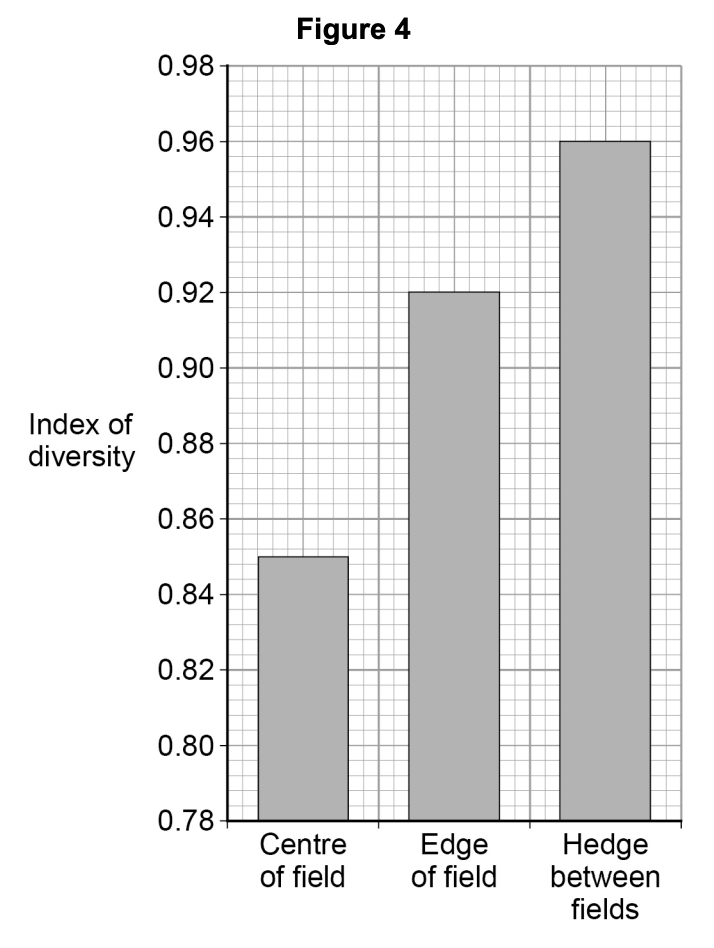
Answer
Mark Scheme
- (Number of species and) number of individuals in each species (in each habitat) OR (Number of species and) population of each species (in each habitat) (1 mark)
Comments from mark scheme
Accept organisms for individuals Ignore frequency. Accept abundance of each species.
Tips from examiner reports
About two-thirds scored the mark. Do not use the word ‘amount’ at A-level when referring to species — say ‘number’ or ‘proportion’. ‘Amount of each species’ was not credited.
Give two ways the students would have ensured their index of diversity was representative of each habitat.
(2 marks)Answer
Mark Scheme
- Random samples (1 mark)
- Large number (of samples) OR (Continue sampling) until stable running mean (1 mark)
Comments from mark scheme
Both marks can be awarded on one line. Ignore other answers unless they contradict mark points. 2. Accept many/multiple. Ignore several. 2. If a specified number is given, it must be 10 or more. 2. Accept ‘large sample (size)’
Tips from examiner reports
About one-third scored both marks. Fairness (same equipment, same area) without reference to sample size or magnitude was not credited. Repeating at different times of day/seasons was not relevant here.
Modern farming techniques have led to larger fields and the removal of hedges between fields.
Use Figure 4 to suggest why biodiversity decreases when farmers use larger fields.
(1 marks)Answer
Mark Scheme
- (Larger fields have relatively) More centre OR Less edge OR Less hedge OR Fewer species (1 mark)
Comments from mark scheme
gnore removal of hedge (as given in stem).
Tips from examiner reports
Many focused only on hedge removal rather than the broader point about larger fields. If a question says ‘use Figure X’, you must reference specific data from it — general biological knowledge alone was insufficient.
Farmers are now being encouraged to replant hedges on their land.
Suggest and explain one advantage and one disadvantage to a farmer of replanting hedges on her farmland.
(2 marks)Answer
Mark Scheme
- Advantage - 1. Greater (bio)diversity so increase in predators of pests OR Increase in predators of pests so more yield/income/less pesticides/less damage to crops OR Increase in pollinators so more yield/income OR May attract more tourists/subsidies to their farm so more income (from diversification) (1 mark)
- Disadvantage - 2. Reduced land area for crop growth/income OR Greater (bio)diversity so increase pest population OR Increase pest population so less yield/less income/(more) need for pesticides/(more) damage to crops OR Increased (interspecific) competition so less yield/income OR More difficult to farm so less income (1 mark)
Comments from mark scheme
Accept description of yield eg crop growth. For ‘crop’ accept ‘plant’. Accept other valid suggestions with explanation that will affect the farm as a whole. Examples of ‘more difficult to farm’ – can’t use large machinery, more difficult to plough/seed/harvest.
Tips from examiner reports
Most students scored MP2 (reduced crop area → reduced income), but very few could articulate an advantage TO THE FARMER of maintaining conservation areas (e.g. natural pest control, improved soil quality). Describing ecological benefits without linking to the farmer did not score.
Scientists collected data on 800 000 human births. The data showed the mass of each baby at birth and whether the baby needed to be transferred to a special care unit for very ill babies. Their results are shown in Figure 5.
Use Figure 5 to explain how human mass at birth is affected by stabilising selection
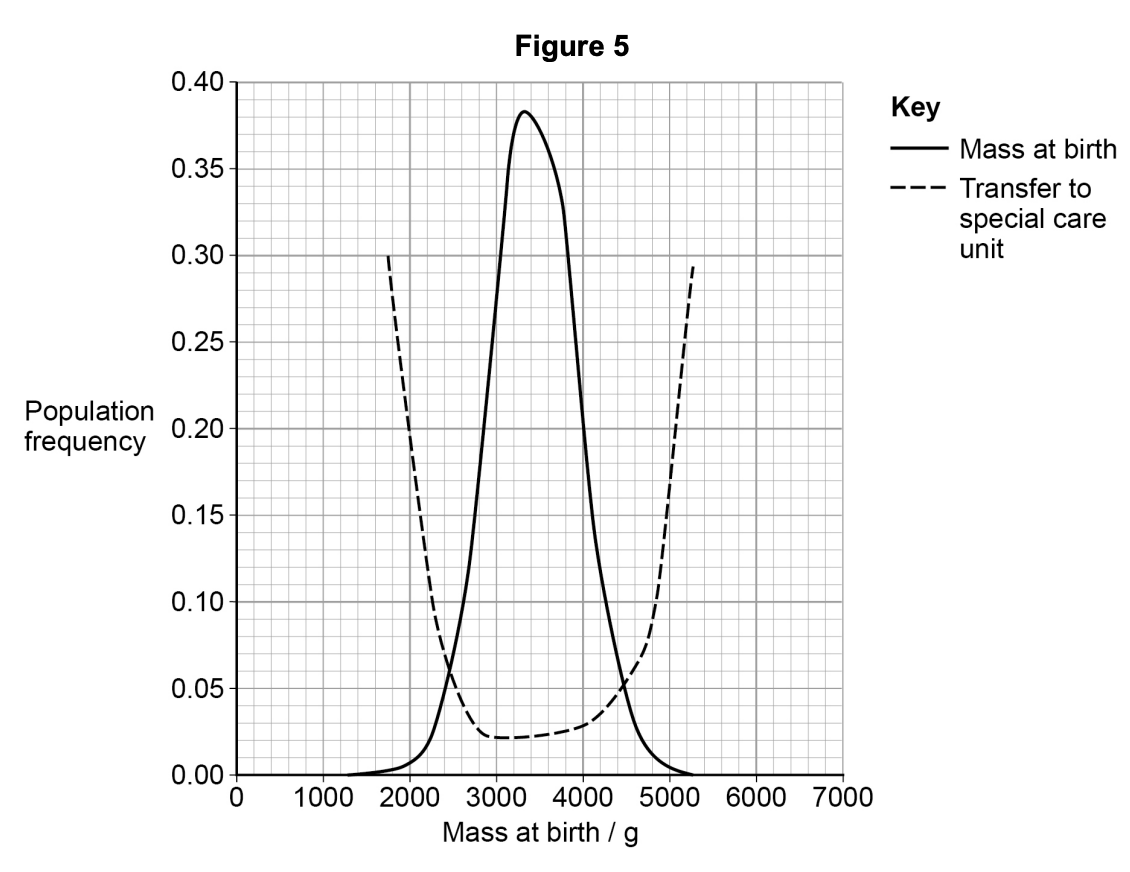
Answer
Mark Scheme
- (Most likely to be) transferred to a special care unit are those under 2800 g OR (Most likely to be) transferred to a special care unit are those over 4200 g (1 mark)
- Extreme mass babies least likely to survive (to reproduce) and so less likely to pass on their alleles (for extreme mass at birth) (1 mark)
- Extreme mass at birth decreases in frequency (in the population) OR Alleles (for extreme mass at birth) decrease in frequency (in the population); If neither 1 or 2 awarded allow correct stated mass less/more likely to survive for 1 mark (1 mark)
Comments from mark scheme
Accept converse answers linked to those with mass at birth at any value between 2800 and 4200 g.
- For ‘2800 g’ accept any value between 1400 g and 2800 g.
- For ‘4200 g’ accept any value between 4200 g and 5200 g.
- If values for both extremes are given, both must be correct.
- Reject data quoted below 1400 g or above 5200 g.
- Accept ‘proportion/percentage’ for ‘frequency’.
- Do not accept ’number’ for ’frequency’.
Tips from examiner reports
Fewer than 20% could apply natural selection principles to stabilising selection. Students must discuss allele frequencies — just describing the phenotype (e.g. ‘average-sized birds survive’) without linking to allele passing on and frequency change was insufficient.
The scientists studied the effect of one form, KIR2DS1, of the human KIR gene on mass at birth. In the following passage the numbered spaces can be filled with biological terms.
Write the correct biological term beside each number below, that matches the space in the passage.
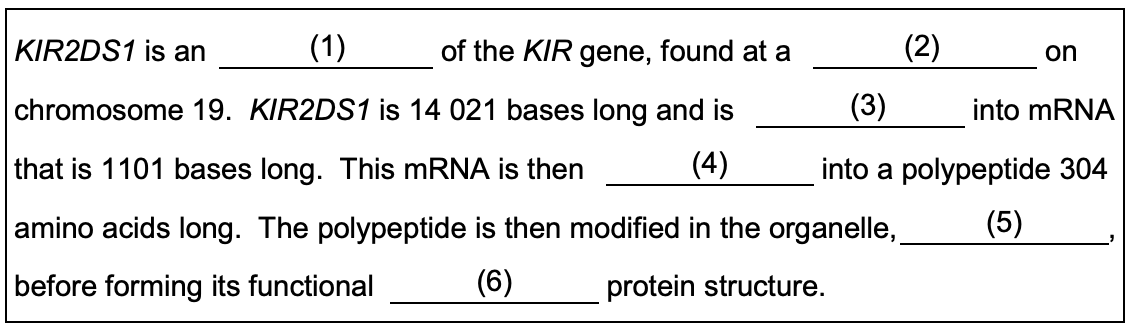
Answer
Mark Scheme
- Allele (1 mark)
- Locus/loci (1 mark)
- Transcribed (1 mark)
- Translated (1 mark)
- Golgi (apparatus)/Rough endoplasmic reticulum (1 mark)
- Tertiary (1 mark)
Tips from examiner reports
Use full terms: ‘rough endoplasmic reticulum’ not ‘RER’ (not a specification abbreviation). Do not use ‘quaternary structure’ for a single polypeptide; the passage described ‘the polypeptide’, so tertiary was correct.
The scientists studied 1500 more births. They recorded the mass at birth of each baby and the nature of the KIR gene in the mother’s genome. Some of their results are shown in Table 2
The scientists used a statistical test to test the following null hypothesis: ‘The presence of KIR2DS1 in the mother’s genome does not affect the frequency of births above 4500g’
Tick () one box that gives the name of the statistical test that the scientists should use with the data in Table 2 to test this null hypothesis.
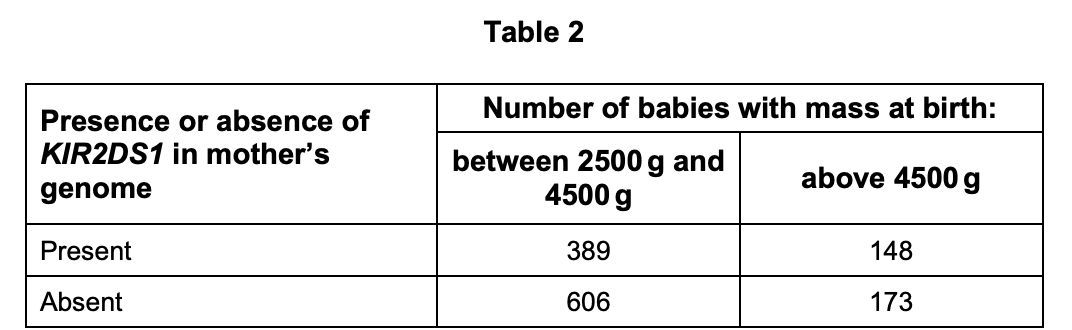
Answer
Mark Scheme
- A) Chi-squard (1 mark)
Tips from examiner reports
Fewer than half correctly chose the statistical test. Use the flowchart in Section O of the practical handbook to select chi-squared, Spearman’s rank or Student’s t-test.
The scientists calculated a P value of 0.03 when testing their null hypothesis. What can you conclude from this result?
Explain your answer.
(3 marks)Answer
Mark Scheme
- Probability that difference (in frequency of births above 4500 g) is due to chance is less than 0.05 OR Probability that difference (in frequency of births above 4500 g) is due to chance is (1 mark)
- 03 (1 mark)
- Reject null hypothesis (1 mark)
- Presence of KIR2DS1/allele does (significantly) affect the frequency of high birth mass (1 mark)
Comments from mark scheme
Ignore reference to critical value.
- Accept 5% for 0.05
- Accept 3% for 0.03
- Ignore results due to chance.
- Accept ‘Probability that difference (in frequency of births above 4500 g) is not due to chance is greater than 0.95’ OR ‘Probability that difference (in frequency of births above 4500 g) is not due to chance is 0.97’
- Accept ‘H0’ for null hypothesis.
- For ‘reject’ accept ‘do not accept’ but not ‘disprove/wrong’.
- Accept ‘Accept the alternate hypothesis/H1’.
- Do not accept ‘number’ for ’frequency’.
Tips from examiner reports
Correct interpretation of chi-squared P values was extremely rare. The null hypothesis should be REJECTED (not ‘disproved’). ‘Less than 5% chance that results are due to chance’ misuses both ‘results’ and ‘chance’ — say ‘the probability that this difference is due to chance is less than 0.05’.
Describe the structure of the human immunodeficiency virus (HIV).
(4 marks)Answer
Mark Scheme
- RNA (as genetic material) (1 mark)
- Reverse transcriptase (1 mark)
- (Protein) capsomeres/capsid (1 mark)
- (Phospho)lipid (viral) envelope (1 mark)
- Attachment proteins (1 mark)
Comments from mark scheme
Accept a labelled diagram.
- Reject nucleus/DNA/plasmids.
- Reject capsule.
- Reject if HIV has a cell membrane or a cell wall.
- Accept gp41 and/or gp 120.
- Accept glycoprotein.
- Accept description of attachment protein.
- Ignore ‘receptor protein’. Ignore cytoplasm
Tips from examiner reports
Over half scored 4–5 marks. Common error: referring to DNA as HIV’s genetic material (HIV has RNA). Attachment proteins are NOT antibodies. Later contradictions in the answer can negate correct earlier marks.
Some people infected with HIV do not develop AIDS. These people are called box HIV controllers. Scientists measured the number of HIV particles (the viral load) and the number of one type of T helper cell (CD4 cells) in the blood of a group of HIV controllers and also in a group of HIV positive patients who had symptoms of AIDS. The median values and the range of their results are shown in Table 3.
A test sample of 500mm³ of blood is taken from an HIV controller to determine the viral load.
Tick () one box that shows the number of virus particles that would be present in a test sample of blood taken from an HIV controller with the median viral load.
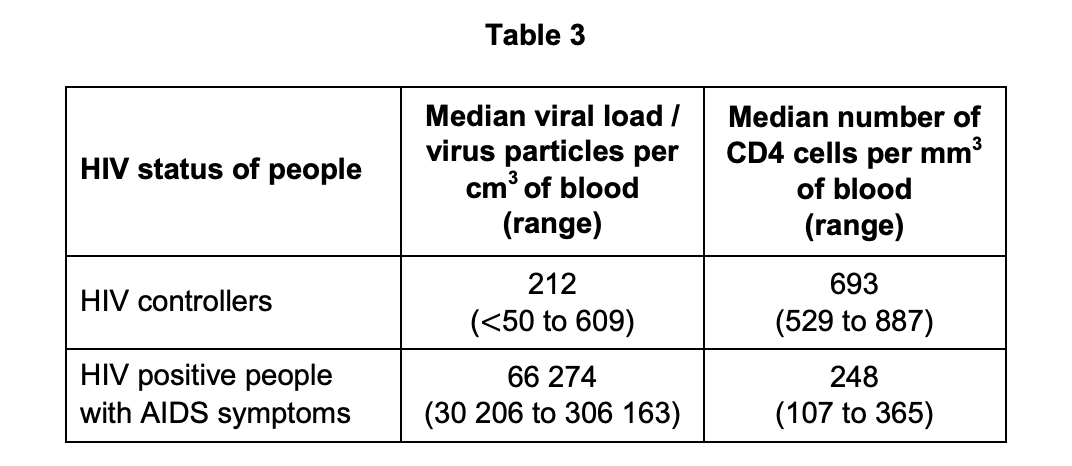
Answer
Mark Scheme
- d) 106 (1 mark)
Tips from examiner reports
40% correctly converted mm³ to cm³ (divide by 1000). This is maths skill 0.1.
Use the data in Table 3 and your knowledge of the immune response to suggest why HIV controllers do not develop symptoms of AIDS.
(3 marks)Answer
Mark Scheme
- (All) have more T helper/CD4 cells (1 mark)
- Lower viral load to infect/destroy helper T/CD4 cells (1 mark)
- (So more/continued) activation of B cells/cytotoxic T cells/phagocytes (1 mark)
- (With B cells more/continued) production of plasma cells/antibodies OR (With cytotoxic T cells more/continued) ability to kill virus infected cells (1 mark)
- (More able to) destroy other microbes/pathogens OR (More able to) destroy mutated/cancer cells (1 mark)
Comments from mark scheme
- Accept higher proportion of T helper/CD4 to virus particles.
- and 2. Statement must be comparative.
- For ‘infect’ accept ‘HIV does not reproduce in’.
- Accept ‘stimulation’ for ‘activation’.
- Ignore reference to B cells acting as phagocytes/antigenpresenting cells.
Tips from examiner reports
Students described the immune response well but very few linked the increase in T helper cells to the absence of AIDS symptoms (CD4 count maintained → normal immune function → AIDS not developing).
Scientists investigated the cell cycle in heart cells taken from mice 6 days before their birth and then at 4, 14 and 21 days after their birth. Their results are shown in Table 4. Age 0 days = day of birth.
Describe and explain the data in Table 4
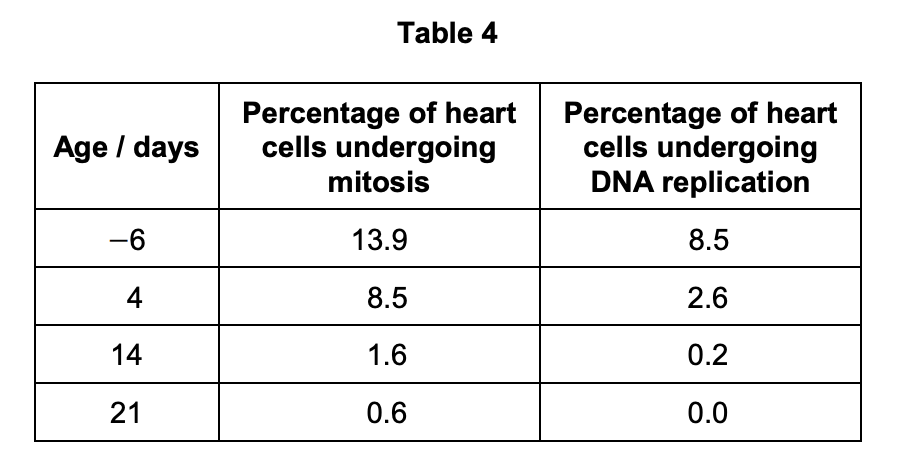
Answer
Mark Scheme
- (Trend of) slowing growth from before birth to 21 days OR (Trend of) decreasing percentage undergoing mitosis from before birth to 21 days OR (Trend of) decreasing percentage undergoing DNA replication from before birth to 21 days (1 mark)
- DNA replication happens before mitosis OR Heart growth slowing until (fully) developed OR These cells lost the ability to divide (1 mark)
Comments from mark scheme
- Accept ‘day -6’ for ‘before birth’.
- For ’21 days’ accept ‘until the end of the investigation’.
- Accept ‘Heart growing/developing before birth and becomes (fully) developed’.
- Accept reference to only unipotent cells/cardiomycetes dividing (at 21 days).
Tips from examiner reports
Describe the trend with specific start and end points (including ‘before birth’). DNA replication is NOT part of mitosis — it occurs during interphase of the cell cycle.
The scientists determined the percentage of heart cells undergoing DNA replication by using a chemical called BrdU. Cells use BrdU instead of nucleotides containing thymine during DNA replication.
Describe how BrdU would be incorporated into new DNA during semi-conservative replication
(5 marks)Answer
Mark Scheme
- DNA helicase (1 mark)
- Breaks hydrogen bonds (between 2 DNA strands) (1 mark)
- BrdU complementary to adenine (on template strand) OR BrdU forms hydrogen bonds with adenine (on template strand) (1 mark)
- DNA polymerase joins (adjacent) nucleotides (to incorporate BrdU into the new DNA strand) (1 mark)
- Phosphodiester bonds form (between nucleotides) (1 mark)
Comments from mark scheme
- Reject ‘hydrolyses hydrogen bonds’ 2 and 3. Accept H bonds for hydrogen bonds.
- Reject if DNA polymerase catalyses complementary base pairing or if DNA polymerase catalyses nucleotides joining to template strand.
Tips from examiner reports
Standard of answers improved compared with 2018. Common remaining error: writing ‘A’ (abbreviation) instead of ‘adenine’. DNA polymerase forms phosphodiester bonds between nucleotides — not between bases. Do not describe breaking of hydrogen bonds as hydrolysis.
Cells with BrdU in their DNA are detected using an anti-BrdU antibody with an enzyme attached.
Use your knowledge of the ELISA test to suggest and explain how the scientists identified the cells that have BrdU in their DNA.
(3 marks)Answer
Mark Scheme
- Add antibody (anti-BrdU with enzyme attached) to cells/DNA OR Add cells/DNA to antibody (anti-BrdU with enzyme attached) (1 mark)
- Wash (cells/DNA) to remove excess/unattached antibody OR Wash (immobilised antibody) to remove excess/unattached cells/DNA (1 mark)
- Add substrate to cause colour change (1 mark)
Comments from mark scheme
All mark points must relate to procedure. Do not negate any mark point for use of additional antibodies. 2. Allow ECF for absence of cells/DNA. 3. For ‘substrate’ accept description in context of enzyme.
Tips from examiner reports
Used one named antibody as stated — describing multiple antibodies led to confusion. The question asked HOW scientists identified the cells — a procedural description was required.
Ulva lactuca is an alga that lives on rocks on the seashore. It is regularly covered by seawater. Figure 6 shows a diagram ofUnlike plants, Ulva lactuca does not have xylem tissue.
Suggest how Ulva lactuca is able to survive without xylem tissue one Ulva lactuca alga.
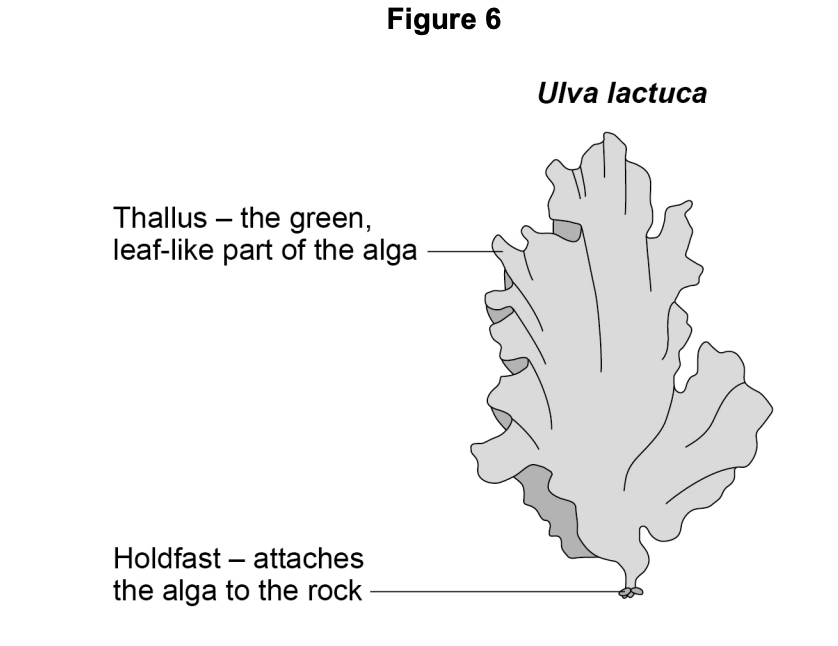
Answer
Mark Scheme
- Short diffusion pathway (to cells) OR It has a surface permeable (to water/ions into cells) (1 mark)
Comments from mark scheme
Accept the idea of not needing structural support as supported by the water. Ignore pores/stomata
Tips from examiner reports
Fewer than 10% scored this mark. Apply knowledge of leaf structure (3.3.2) or principles of transport system development (3.3.1) to the unfamiliar context.
On Figure 7 complete each box with an appropriate letter to show the type of cell division happening between each stage in the life cycle.
Use ‘T’ to represent mitosis and ‘E’ to represent meiosis.
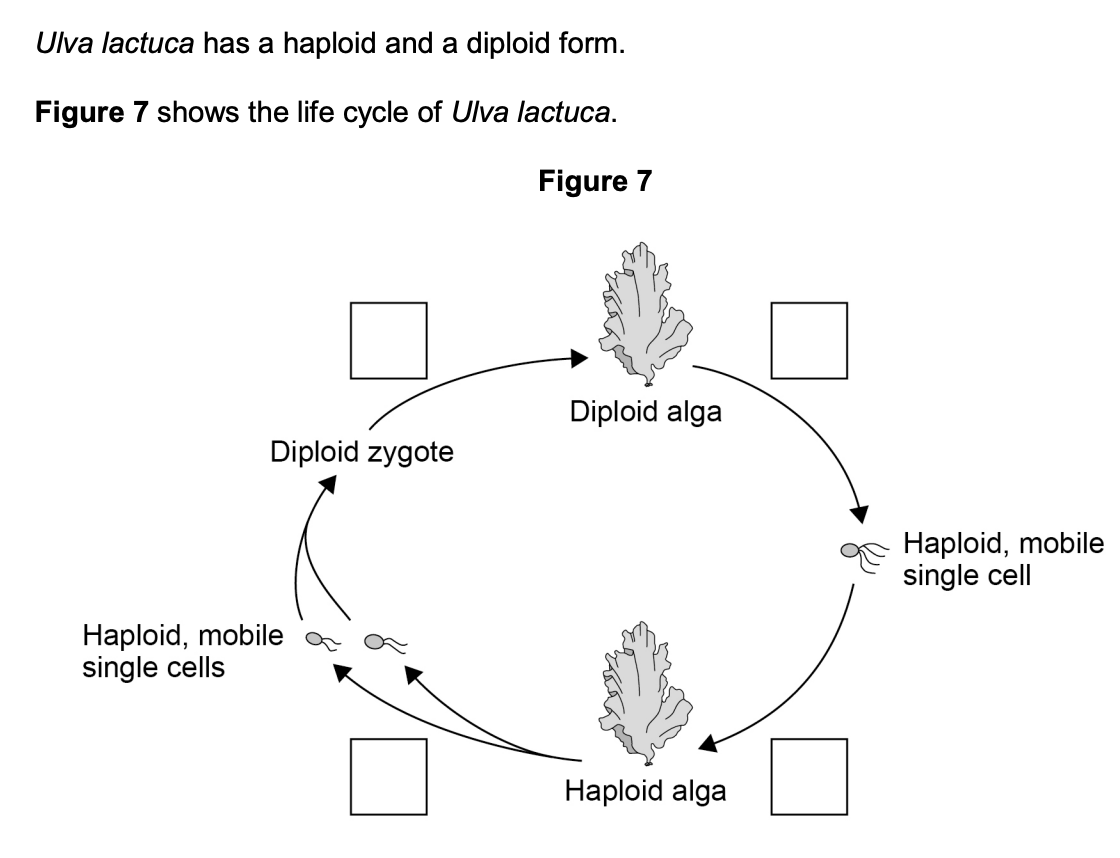
Answer
Mark Scheme
- E in top right box (1 mark)
- (1 mark) 2. 3 x T in top and bottom left and bottom right boxes (1 mark)
- (1 mark) (1 mark)
Tips from examiner reports
Only about a quarter of students correctly applied meiosis/mitosis knowledge to a life cycle diagram. Most could identify where meiosis occurred once but assumed it also happened elsewhere. Application to unfamiliar life cycles was tested.
Ulva prolifera also produces haploid, mobile single cells that can fuse to form a zygote.
Suggest and explain one reason why successful reproduction between Ulva prolifera and Ulva lactuca does not happen.
(2 marks)Answer
Mark Scheme
- They are different species (1 mark)
- (So) if fused together they would not produce fertile offspring OR (So) they have named characteristics that means they are reproductively isolated (1 mark)
Comments from mark scheme
- For ‘fuse’ accept ‘form a zygote’.
- Accept - if they fused together meiosis could not occur - if they fused together (chromosomes) could not form homologous pairs - if they fused production of gametes could not occur.
- Accept a description of characteristics that would lead to reproductive isolation eg - will not successfully fuse with one another - produce single cells at different times - description of geographical isolation. Accept the description on its own, the phrase ‘reproductive isolation’ is not required.
Tips from examiner reports
Different species cannot produce FERTILE offspring (or their gametes cannot fuse). Many stated the offspring would be infertile without applying this to the context of the question to explain reproductive isolation.
The water potential of leaf cells is affected by the water content of the soil. Scientists grew sunflower plants. They supplied different plants with different volumes of water.
After two days, they determined the water potential in the leaf cells by using an instrument that gave a voltage reading. The scientists generated a calibration curve to convert the voltage readings to water potential.
Figure 8 shows their calibration curve
The scientists needed solutions of known water potential to generate their calibration curve.
Table 5 shows how to make a sodium chloride solution with a water potential of −1.95 MPa
Complete Table 5 by giving all headings, units and volumes required to make 20 cm³ of this sodium chloride solution.
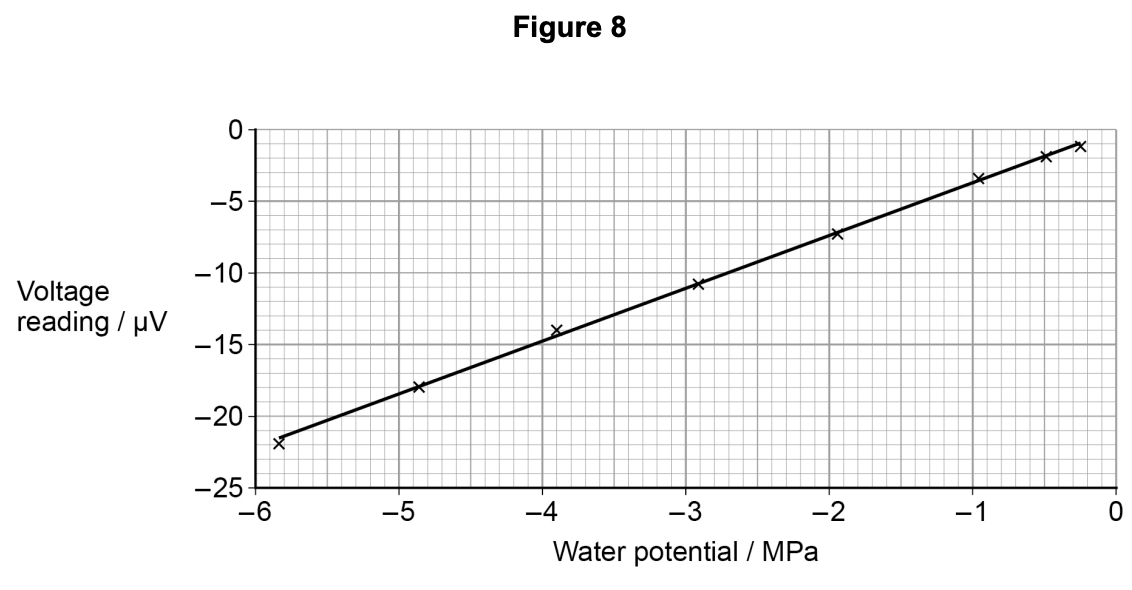
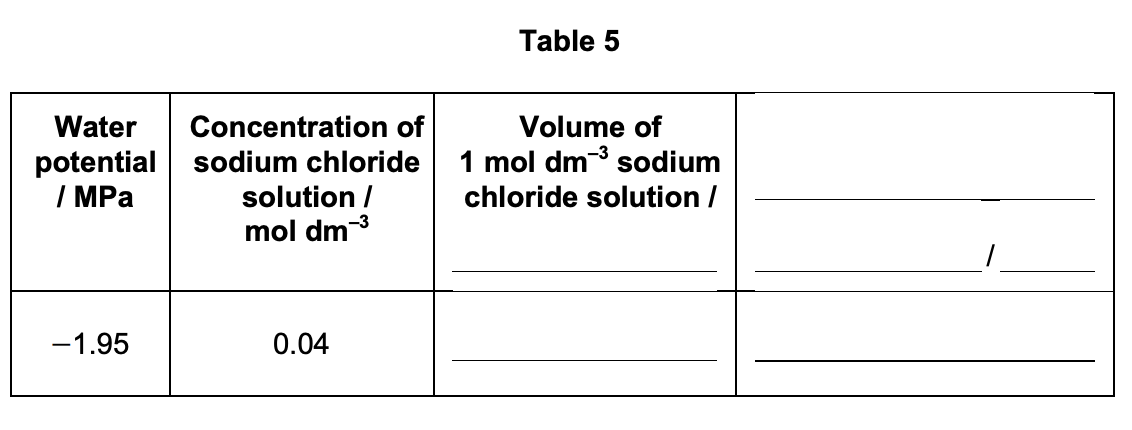
Answer
Mark Scheme
- No mark scheme available
Comments from mark scheme
Accept dm³/mm^3 for volume unit.
Tips from examiner reports
Just under half scored 1 mark (usually the top row). Volume units must be positive: cm³ or dm³, NOT cm⁻³ or dm⁻³.
There is a linear relationship between the water potential and the concentration of sodium chloride solution.
Use the data in Table 6 to calculate the concentration of sodium chloride solution with a water potential of −3.41MPa
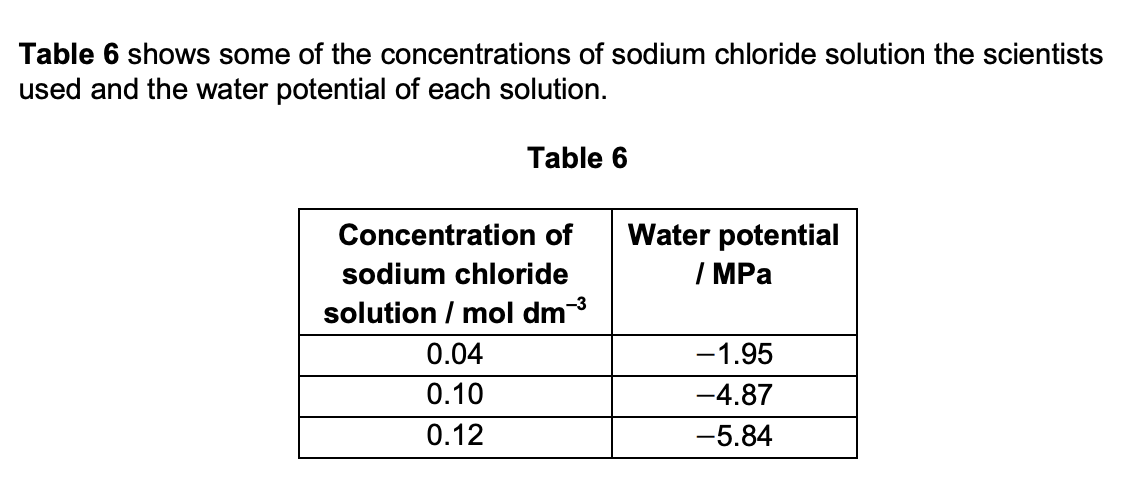
Answer
Mark Scheme
- Correct answer of 0.07 (mol dm⁻³ ) = 2 marks (1 mark)
Tips from examiner reports
About 60% scored the correct final answer. All data were given to 2 decimal places, so the final answer cannot be more accurate than 2 decimal places (maths skill 1.1). Answers with 3+ decimal places scored only 1 mark.
In addition to determining the water potential in the leaf cells, the scientists measured the growth of the leaves. They recorded leaf growth as a percentage increase of the original leaf area. Their results are shown in Figure 9.
One leaf with an original area of 60cm² gave a voltage reading of −7µV Use Figure 8 (on page 28) and Figure 9 to calculate by how much this leaf increased in area.
Give your answer in cm²
(2 marks)Answer
Mark Scheme
- Correct answer of 9 (cm² ) = 2 marks (1 mark)
Comments from mark scheme
Allow 9.0 Accept correct reading labelled on the graph shown on Figure 8 or Figure 9.
Tips from examiner reports
Many misread the axis: to the right of −2 the axis becomes LESS negative (i.e. −1.9, −1.8 etc.), not more negative. 69 cm³ (total leaf size) was a common 1-mark error — the question asked how much the area INCREASED.
Sunflowers are not xerophytic plants. The scientists repeated the experiment with xerophytic plants.
Suggest and explain one way the leaf growth of xerophytic plants would be different from the leaf growth of sunflowers in Figure 9.
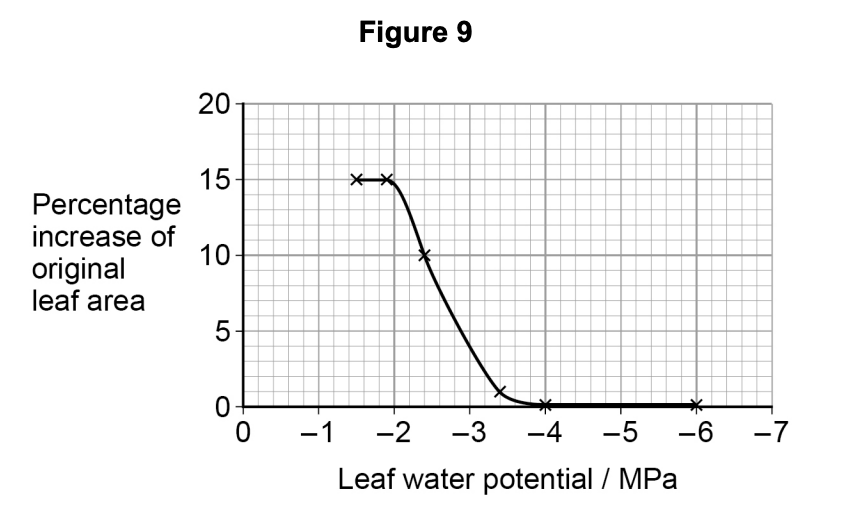
Answer
Mark Scheme
- EITHER 1. Low/slow growth (1 mark)
-
- Due to smaller number/area of stomata (for gas exchange) (1 mark)
- OR 3. Growth may continue at lower water potentials (1 mark)
-
- (Due to) adaptations in enzymes involved in photosynthesis/metabolic reactions (1 mark)
Comments from mark scheme
Mark as pair – 1 and 2 OR 3 and 4. 2. Reference to stomata must not relate only to water loss
Tips from examiner reports
The x-axis showed water potential of the LEAF, not the soil. Answers about xerophytes retaining more water were irrelevant.
Use your knowledge of gas exchange in leaves to explain why plants grown in soil with very little water grow only slowly
(2 marks)Answer
Mark Scheme
- Stomata close (1 mark)
- Less carbon dioxide (uptake) for less photosynthesis/glucose production (1 mark)
Comments from mark scheme
- ‘Less’ only required once.
- Reject ‘no photosynthesis’ but accept ‘carbon dioxide can’t enter so less photosynthesis’.
- Ignore oxygen for respiration but reject oxygen for photosynthesis.
- Ignore less water for photosynthesis.
- Accept only correct chemical formulae.
- For ‘glucose’ accept named product of photosynthesis eg triose phosphate, TP, amino acid, lipid.
Tips from examiner reports
The key was to use gas exchange knowledge: stomata close when water potential falls, reducing CO₂ entry, so photosynthesis rate falls — not just ‘less water for photosynthesis’. Plants need CO₂ for photosynthesis, not respiration.
A scientist investigated the affinity for oxygen of horse haemoglobin and mouse haemoglobin. Some of their results are shown in Table 7.
Plot the haemoglobin saturation data from Table 7 and use these points to sketch the full oxyhaemoglobin dissociation curves for a horse and a mouse.
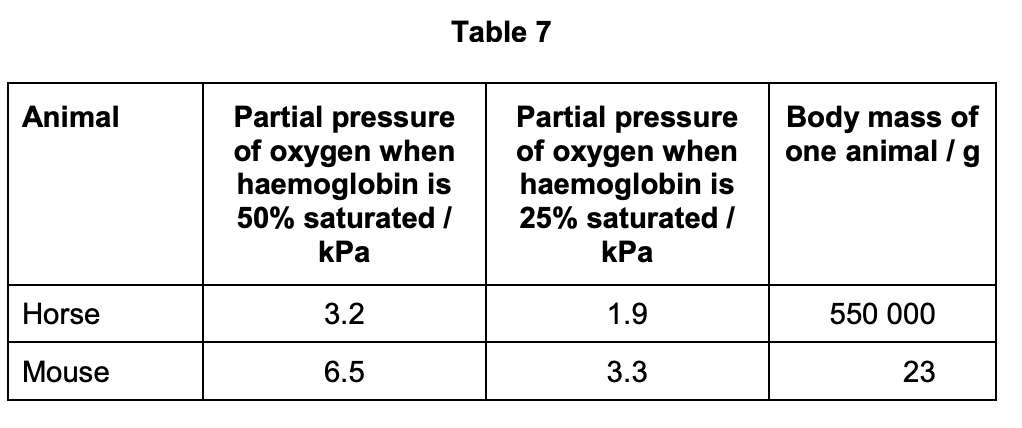
Answer
Mark Scheme
- y axis 0 – 100 in linear scale and x axis minimum 1 to 8 in linear scale and both axes use at least half size of grid (1 mark)
- Correct plots for 50% and 25% for both animals (1 mark)
- Both curves levelling off (at higher partial pressures and at percentage saturations ≤100%) (1 mark)
Comments from mark scheme
- If tick marks are used on the axis, they must be accurate to within ± half a small square.
- 25% - 1.9, 3.3 and 50% - 3.2 and 6.5
- Accept plot ± half a small square.
Tips from examiner reports
Three-quarters plotted data correctly, but only those who understood dissociation curves drew sigmoid curves with axes extending beyond the table values.
The following equation can be used to estimate the metabolic rate of an animal. Metabolic rate = 63 × BM–0.27 BM = body mass in grams
Use this equation to calculate how many times faster the metabolic rate of a mouse is than the metabolic rate of a horse
(2 marks)Answer
Mark Scheme
- Correct answer of 15 (times faster) = 2marks (1 mark)
Comments from mark scheme
Accept any number of significant figures ≥2, if rounding correct.
Tips from examiner reports
Three-quarters scored both marks. A pleasing result — show working for partial credit on the 25% who did not score fully.
The data in Table 7 show differences between the oxyhaemoglobin dissociation curve for a mouse and the oxyhaemoglobin dissociation curve for a horse.
Suggest how these differences allow the mouse to have a higher metabolic rate than the horse.
(3 marks)Answer
Mark Scheme
- Mouse haemoglobin/Hb has a lower affinity for oxygen OR For the same pO₂ the mouse haemoglobin/Hb is less saturated OR At oxygen concentrations found in tissue mouse haemoglobin/Hb is less saturated (1 mark)
- More oxygen can be dissociated/released/unloaded (for metabolic reactions/respiration) (1 mark)
Comments from mark scheme
- For ‘Hb is less saturated’ accept ‘less oxygen will be bound to Hb’.
- Accept ‘oxygen dissociated/released/unloaded more readily/easily/quickly’
- Reject ‘oxygen loaded more readily/easily/quickly’ or ‘more oxygen loaded’
Tips from examiner reports
Include ‘haemoglobin’ when describing affinity: ‘mouse haemoglobin has lower affinity for oxygen’. ‘Oxygen can be released MORE easily’ — the word ‘more’ was required.
Mammals such as a mouse and a horse are able to maintain a constant body temperature.
Use your knowledge of surface area to volume ratio to explain the higher metabolic rate of a mouse compared to a horse.
(3 marks)Answer
Mark Scheme
- Mouse 1. (Smaller so) larger surface area to volume ratio (1 mark)
-
- More/faster heat loss (per gram/in relation to body size) (1 mark)
-
- (Faster rate of) respiration/metabolism releases heat (1 mark)
Comments from mark scheme
Accept converse answers in relation to the horse.
- Accept larger SA:V.
- and 2. must be comparative.
- Ignore heat lost more easily/readily.
- Accept respiration/metabolism replaces heat.
- Reject produce/generate heat/energy.
Tips from examiner reports
Say ‘energy is RELEASED’ not ‘energy is produced’. The mouse has a larger SA:V ratio → more heat loss → higher metabolic rate to maintain body temperature.
Explain five properties that make water important for organisms.
(5 marks)Answer
Mark Scheme
- A metabolite in condensation/hydrolysis/ photosynthesis/respiration (1 mark)
- A solvent so (metabolic) reactions can occur OR A solvent so allowing transport of substances (1 mark)
- High heat capacity so buffers changes in temperature (1 mark)
- Large latent heat of vaporisation so provides a cooling effect (through evaporation) (1 mark)
- Cohesion (between water molecules) so supports columns of water (in plants) (1 mark)
- Cohesion (between water molecules) so produces surface tension supporting (small) organisms (1 mark)
Comments from mark scheme
- For ‘buffer’ accept ‘resist’.
- For ‘columns of water’ accept ’transpiration stream’. Do not credit ‘transpiration’ alone but accept description of ‘stream’.
- For ‘columns of water’ accept ‘cohesion-tension (theory)’. 5 and 6. For cohesion accept hydrogen bonding Ignore reference to pH. Allow other suitable properties but must have a valid explanation. For example ice floating so maintaining aquatic habitat beneath water transparent so allowing light penetration for photosynthesis
Tips from examiner reports
Give BOTH the property AND its importance. Water as a metabolite was almost never mentioned. Cohesive properties must be linked to maintenance of the transpiration stream — not just ‘aids transpiration’. High heat capacity ≠ high latent heat of vaporisation.
Describe the biochemical tests you would use to confirm the presence of lipid, non-reducing sugar and amylase in a sample.
(5 marks)Answer
Mark Scheme
- Lipid 1. Add ethanol/alcohol then add water and shake/mix OR Add ethanol/alcohol and shake/mix then pour into/add water (1 mark)
-
- White/milky emulsion OR emulsion test turns white/milky (1 mark)
- Non-reducing sugar 3. Do Benedict’s test and stays blue/negative (1 mark)
-
- Boil with acid then neutralise with alkali (1 mark)
-
- Heat with Benedict’s and becomes red/orange (precipitate) (1 mark)
- Amylase 6. Add biuret (reagent) and becomes purple/violet/mauve/lilac (1 mark)
-
- Add starch, (leave for a time), test for reducing sugar/absence of starch (1 mark)
Comments from mark scheme
4 max if marks gained from only 2 substance tests.
- Reject heating emulsion test.
- Accept ‘Add Sudan III and mix’.
- Ignore cloudy.
- Reject precipitate.
- Accept (for Sudan III) top (layer) red.
- Ignore details of method for Benedict’s test for this mp.
- Accept named examples of acids/alkalis.
- Do not credit mp5 if no attempt at mp4.
- For ‘heat’ ignore ’warm’/’heat gently’/’put in a water bath’ but accept stated temperatures ≥60°C.
- Heat must be stated again, do not accept using residual heat from mp4.
- Accept ‘do the Benedict’s test’ if full correct method given elsewhere.
- Accept ‘sodium carbonate, sodium citrate and copper sulfate solution’ for Benedict’s but must have all three if term ‘Benedict’s’ not used.
- Accept ‘sodium or potassium hydroxide and copper sulfate solution’ for ‘biuret’.
- Reject heating biuret test
Tips from examiner reports
For non-reducing sugars: carry out Benedict’s test FIRST (must be negative); then hydrolyse with BOILING ACID; then re-test with Benedict’s. Many missed the boiling acid step. ‘Cloudy’ in the emulsion test is no longer accepted.
Describe the chemical reactions involved in the conversion of polymers to monomers and monomers to polymers.
Give two named examples of polymers and their associated monomers to illustrate your answer.
(5 marks)Answer
Mark Scheme
- A condensation reaction joins monomers together and forms a (chemical) bond and releases water (1 mark)
- A hydrolysis reaction breaks a (chemical) bond between monomers and uses water (1 mark)
- A suitable example of polymers and the monomers from which they are made (1 mark)
- A second suitable example of polymers and the monomers from which they are made (1 mark)
- Reference to a correct bond within a named polymer (1 mark)
Comments from mark scheme
Ignore reference to dimers. 3. and 4. Polymers must contain many monomers. 3. and 4: suitable examples include - amino acid and polypeptide, protein, enzyme, antibody or specific example - nucleotide and polynucleotide, DNA or RNA - Alpha glucose and starch/glycogen - Beta glucose and cellulose. If neither specific carbohydrate example is given, allow monosaccharide/glucose and polysaccharide. 3. and 4. Reject (once) reference to triglycerides. 5. Reject reference to ester bond.
Tips from examiner reports
Dimers are NOT polymers — give polymer examples (polysaccharides, polypeptides, polynucleotides), not disaccharides/dipeptides. Condensation and hydrolysis involve bond FORMATION or BREAKAGE respectively.
Figure 1 shows all the chromosomes present in one human cell during mitosis. A scientist stained and photographed the chromosomes. In Figure 2, the scientist has arranged the images of these chromosomes in homologous pairs.
Give two pieces of evidence from Figure 1 that this cell was undergoing mitosis.
Explain your answers.
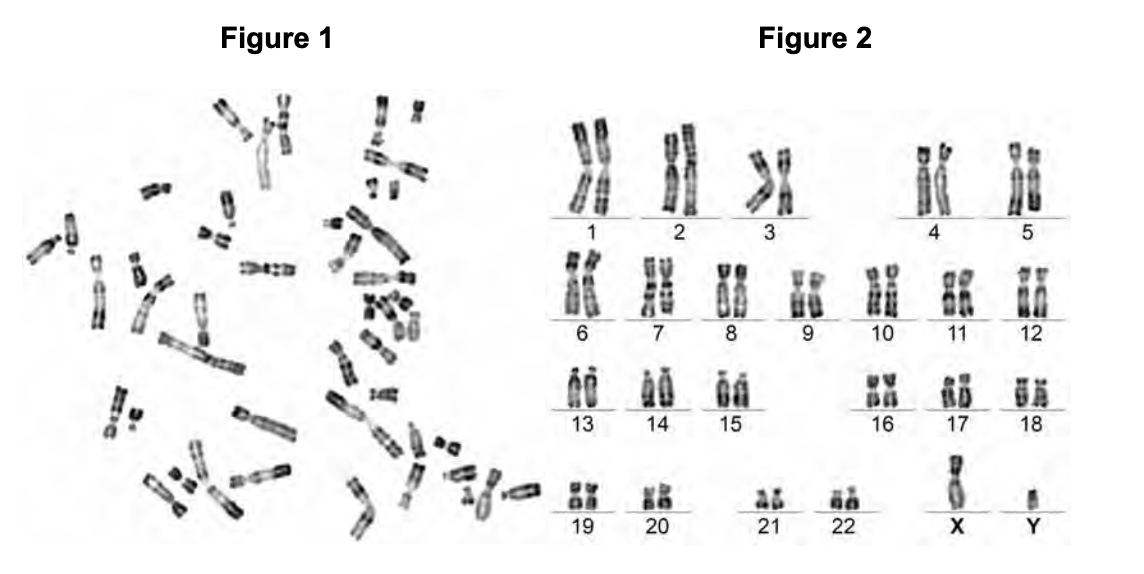
Answer
Mark Scheme
- The (individual) chromosomes are visible because they have condensed (1 mark)
- (Each) chromosome is made up of two chromatids because DNA has replicated (1 mark)
- The chromosomes are not arranged in homologous pairs, which they would be if it was meiosis (1 mark)
Comments from mark scheme
Both parts of each answer are required – evidence and explanation.
- For ‘they’ accept ‘chromosomes/chromatin/DNA’
- Accept ‘tightly coiled’ or ‘short and thick’ for condensed but do not accept ‘contracted’.
- Accept ‘sister chromatids’ for ‘two chromatids’.
- Accept not meiosis because bivalents/chiasmata/crossing over not seen. Ignore references to nucleus/nucleolus/nuclear membrane.
Tick one box that gives the name of the stage of mitosis shown in Figure 1.
(1 marks)Answer
Mark Scheme
- c) Prophase (1 mark)
When preparing the cells for observation the scientist placed them in a solution that had a slightly higher (less negative) water potential than the cytoplasm. This did not cause the cells to burst but moved the chromosomes further apart in order to reduce the overlapping of the chromosomes when observed with an optical microscope.
Suggest how this procedure moved the chromosomes apart.
(2 marks)Answer
Mark Scheme
- Water moves into the cells/cytoplasm by osmosis (1 mark)
- Cell/cytoplasm gets bigger (1 mark)
Comments from mark scheme
- Reject water moving into chromosomes/nucleus.
- Accept idea of cell/cytoplasm has greater volume/swells/expands.
- Ignore references to pressure changes, turgidity and chromosomes being more dilute.
- Ignore references to changing water/fluid contents of the cell.
- Allow ECF for ‘nucleus expands’ but not for ‘chromosomes expand’.
The dark stain used on the chromosomes binds more to some areas of the chromosomes than others, giving the chromosomes a striped appearance.
Suggest one way the structure of the chromosome could differ along its length to result in the stain binding more in some areas.
(1 marks)Answer
Mark Scheme
- Differences in base sequences OR Differences in histones/interaction with histones OR Differences in condensation/(super)coiling (1 mark)
Comments from mark scheme
Answer must be in context of differences in arrangement of chromosomes not just related to the properties of the stain. Accept spec section 8 ideas e.g. different methylation/acetylation Accept different genes Reject different alleles
In Figure 2 the chromosomes are arranged in homologous pairs.
What is a homologous pair of chromosomes?
(1 marks)Answer
Mark Scheme
- (Two chromosomes that) carry the same genes (1 mark)
Comments from mark scheme
Reject ‘same alleles’ Accept ‘same loci’ (plural) or ‘genes for the same characteristics’
Give two ways in which the arrangement of prokaryotic DNA is different from the arrangement of the human DNA in Figure 1.
(2 marks)Answer
Mark Scheme
- (Prokaryotic DNA) is 1. Circular (as opposed to linear) (1 mark)
-
- Not associated with proteins/histones (1 mark)
-
- Only one molecule/piece of DNA OR present as plasmids (1 mark)
Comments from mark scheme
Max 1 if prokaryotic DNA only found as plasmids OR if prokaryotic DNA is single stranded. Ignore references to nucleus, exons, introns or length of DNA. Do not credit converse statements. Ignore descriptions of eukaryotic DNA alone.
A student investigated the effect of surface area on osmosis in cubes of potato.
- He cut two cubes of potato tissue, each with sides of 35 mm in length.
- He put one cube into a concentrated sucrose solution.
- He cut the other cube into eight equal-sized smaller cubes and put them into a sucrose solution of the same concentration as the solution used for the large cube.
- He recorded the masses of the cubes at intervals.
His results are shown in Figure 3.
Describe the method the student would have used to obtain the results in Figure 3. Start after all of the cubes of potato have been cut. Also consider variables he should have controlled.
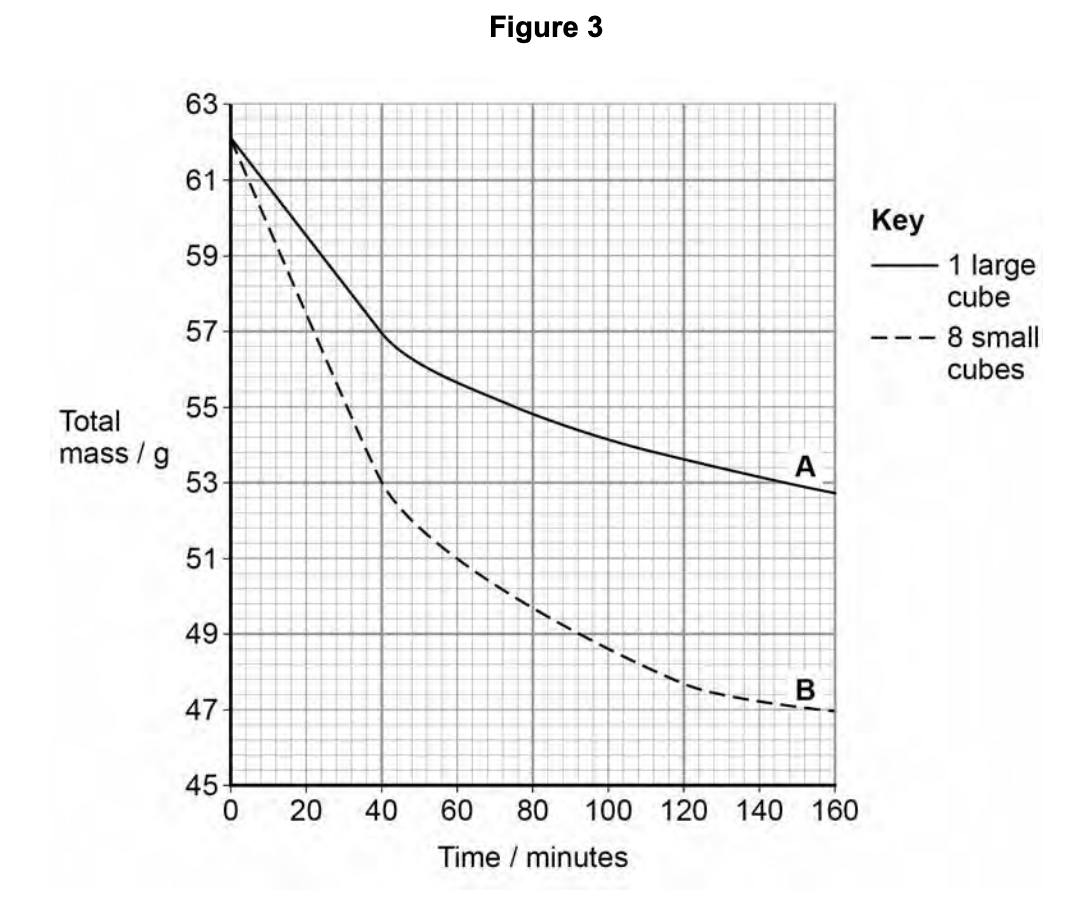
Answer
Mark Scheme
- Method to ensure all cut surfaces of the eight cubes are exposed to the sucrose solution (1 mark)
- Method of controlling temperature (1 mark)
- Method of drying cubes before measuring (1 mark)
- Measure mass of cubes at stated time intervals (1 mark)
Comments from mark scheme
Credit valid method descriptions to fulfil mp1, 2 and 3 (no explanation is required). 2. Accept ‘at room temperature’ for method 4. Accept time intervals between every 5 minutes with maximum of every 40 minutes. 4. Accept ‘weigh the cubes at stated time intervals
The loss in mass shown in Figure 3 is due to osmosis. The rate of osmosis between 0 and 40 minutes is faster in B (the eight small cubes) than in A (single large cube). Is the rate of osmosis per mm² per minute different between A and B during this time?
Use appropriate calculations to support your answer.
(3 marks)Answer
Mark Scheme
- Yes or No (no mark)
- Calculation of rate per mm² for both sets of data, accept answers in the range 1.6 × 10⁵ to 1.8 × 10⁵ and 1.5 × 10⁵ to 1.6 × 10⁵
Both correct = 3 marks One correct = 2 marks Neither correct — look below for max 2
Comments from mark scheme
Accept answers not given in standard form or to any number of significant figures ≥2sf as long as rounding correct.
Bees are flying insects that feed on nectar made in box flowers. There are many different species of bee.
Scientists investigated how biodiversity of bees varied in three different habitats during a year. They collected bees from eight sites of each habitat four times per year for three years.
The scientists’ results are shown in Figure 4 in the form they presented them.
What is meant by ‘species richness’?
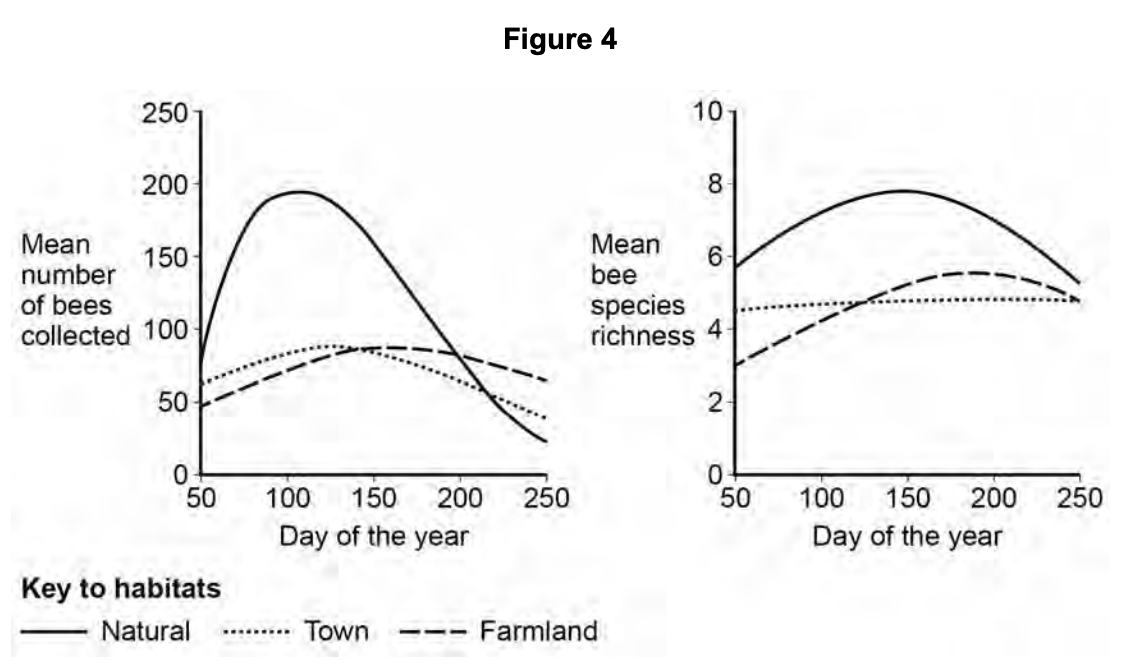
Answer
Mark Scheme
- (A measure of) the number of (different) species in a community (1 mark)
Comments from mark scheme
For ‘community’ accept ‘habitat/ecosystem/one area/environment’ Reject ‘in a population’
From the data in Figure 4, a student made the following conclusions. 1. The natural habitat is most favourable for bees. 2. The town is the least favourable for bees.
Does the data in Figure 4 support these conclusions?
Explain your answer.
Explain the following: 1. The natural habitat is most favourable for bees. 2. The town is the least favourable for bees
(4 marks)Answer
Mark Scheme
- Yes, natural best, because 1. Peak of (mean) bee numbers in natural habitat is highest (1 mark)
-
- The (mean) number of bees was higher in the natural habitat until day 200 (1 mark)
-
- (Mean) species richness in natural habitat higher at all times (1 mark)
- No, natural not best, because 4. Lowest (mean) number of bees after day 220 (1 mark)
- Yes, town worst, because 5. Peak of species richness higher in both natural and farmland OR Species richness lowest in town from day 125 (1 mark)
- No, town not worst, because 6. (Mean) species richness is lower in farmland until day 125 (1 mark)
-
- Similar (mean) number of bees to farmland (1 mark)
- OR (Mean) number of bees lower in farmland until day 140 (1 mark)
- General, no, because 8. Index of diversity of bees not measured OR The number of bees of each species is not known (1 mark)
Comments from mark scheme
- For accept description for ‘peak’.
- For ‘day 200’ accept any day between 190 and 210.
- For ‘until day 200’ accept ‘for 200 days’.
- For ‘day 220’ accept any day between 210 and 230. 5 and 6. For ‘day 125’ accept any day between 115 and 135.
- For ‘until day 125’ accept ‘for 125 days’.
- For ‘day 140’ accept any day between day 130 and 150.
- For ‘until day 140’ accept ‘for 140 days
The scientists collected bees using a method that was ethical and allowed them to identify accurately the species to which each belonged.
In each case, suggest one consideration the scientists had taken into account to make sure their method 1. was ethical. 2. allowed them to identify accurately the species to which each belonged.
(2 marks)Answer
Mark Scheme
- Must not harm the bees OR Must allow the bee to be released unchanged (1 mark)
- Must allow close examination OR Use a key (to identify the species) (1 mark)
Comments from mark scheme
- Accept method that allows close examination 2.Ignore references to DNA sequencing
- Accept ‘use photographs/specimens (to identify species)’
Suggest and explain two ways in which the scientists could have improved the method used for data collection in this investigation.
(2 marks)Answer
Mark Scheme
- Collect at more times of the year so more points on graph/better line (of best fit) on graph (1 mark)
- Counted number of individuals in each species so that they could calculate index of diversity (1 mark)
- Collected from more sites/more years to increase accuracy of (mean) data (1 mark)
Comments from mark scheme
Both suggestion and explanation is required for each mark point.
- The explanation must relate to the graph.
- For ‘accuracy’ accept ‘representative’.
Three of the bee species collected in the farmland areas were Peponapis pruinosa, Andrena chlorogaster and Andrena piperi.
What do these names suggest about the evolutionary relationships between these bee species?
Explain your answer.
(2 marks)Answer
Mark Scheme
- A. chlorogaster and A. piperi are more closely related (to each other than to P. pruinosa) (1 mark)
- Because they are in the same genus (1 mark)
Comments from mark scheme
- Must be a comparative statement.
- Accept A. chlorogaster and A. piperi share a more recent/closer common ancestor (than they do with P. pruinosa); Ignore references to A. chlorogaster and A. piperi not being related to P. pruinosa or not having a common ancestor with P. pruinosa.
Formation of an enzyme-substrate complex increases the rate of reaction. Explain how
(2 marks)Answer
Mark Scheme
- Reduces activation energy (1 mark)
-
- Due to bending bonds OR Without enzyme, very few substrates have sufficient energy for reaction (1 mark)
Comments from mark scheme
- Accept ‘reduces Ea’.
- Accept ‘Due to stress/pressure/tension on bonds’ OR ‘Due to weakening bonds’.
- Ignore references to ‘breaking bonds’
A scientist measured the rate of removal of amino acids from a polypeptide with and without an enzyme present. With the enzyme present, 578 amino acids were released per second. Without the enzyme, 3.0 × 10⁻⁹ amino acids were released per second. Calculate by how many times the rate of reaction is greater with the enzyme present.
Give your answer in standard form.
(2 marks)Answer
Mark Scheme
- 1.93 x 10¹¹ (1 mark)
Another scientist investigated an enzyme that catalyses the following reaction. ATP → ADP + Pi The scientists set up two experiments, C and L. Experiment C used:
- the enzyme
- different concentrations of ATP.
Experiment L used:
- the enzyme
- different concentrations of ATP
- a sugar called lyxose.
The scientists measured the rate of reaction in each experiment. Their results are shown in Figure 5.
Calculate the rate of reaction of the enzyme activity with no lyxose at 2.5 mmol dm⁻³ of ATP as a percentage of the maximum rate shown with lyxose.
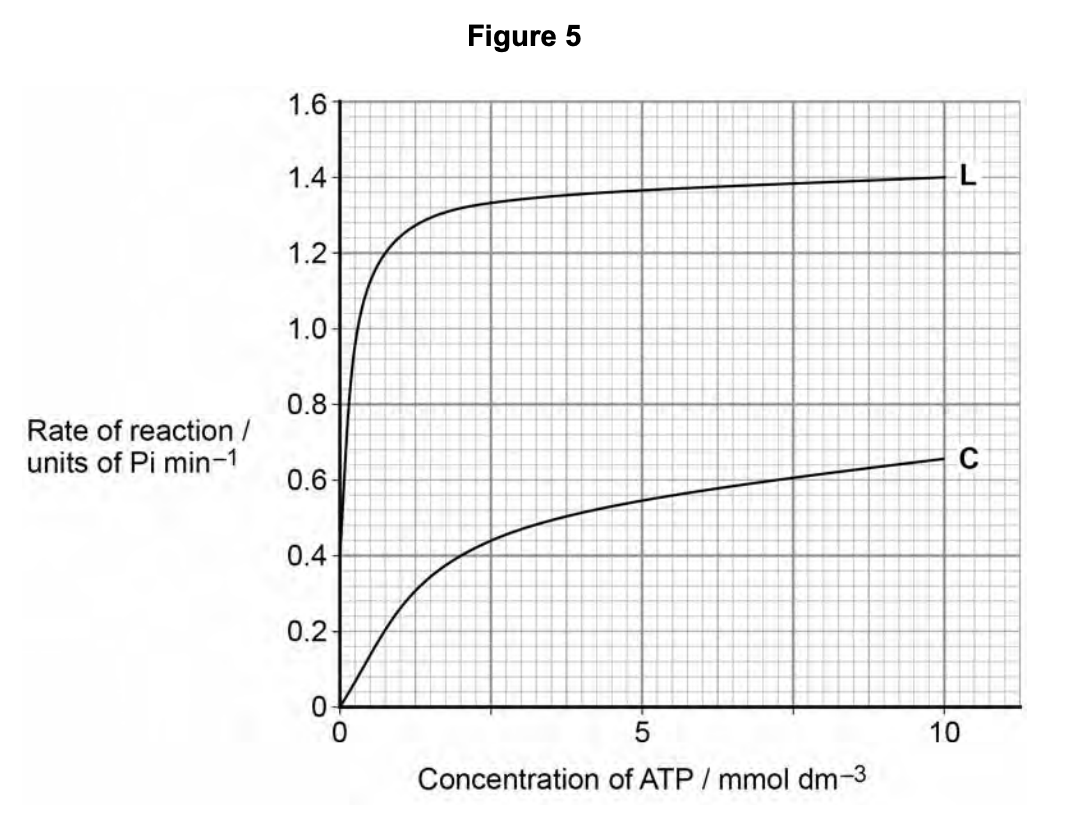
Answer
Mark Scheme
- 31.4 (1 mark)
Lyxose binds to the enzyme.
Suggest a reason for the difference in the results shown in Figure 5 with and without lyxose.
(3 marks)Answer
Mark Scheme
- (Binding) alters the tertiary structure of the enzyme (1 mark)
- (This causes) active site to change (shape) (1 mark)
- (So) More (successful) E-S complexes form (per minute) OR E-S complexes form more quickly OR Further lowers activation energy (1 mark)
Comments from mark scheme
Max 1 if lyxose acting as an inhibitor OR if answer linked to lower rate of reaction OR if lyxose used an energy source/respiratory substrate 3. Accept ‘acts as a co-enzyme’ 3. Accept description for E-S complexes.
Draw the general structure of an amino acid.
(1 marks)Answer
Mark Scheme
- No mark scheme available
The genetic code is described as degenerate.
What is meant by this?
Use an example from Table 1 to illustrate your answer
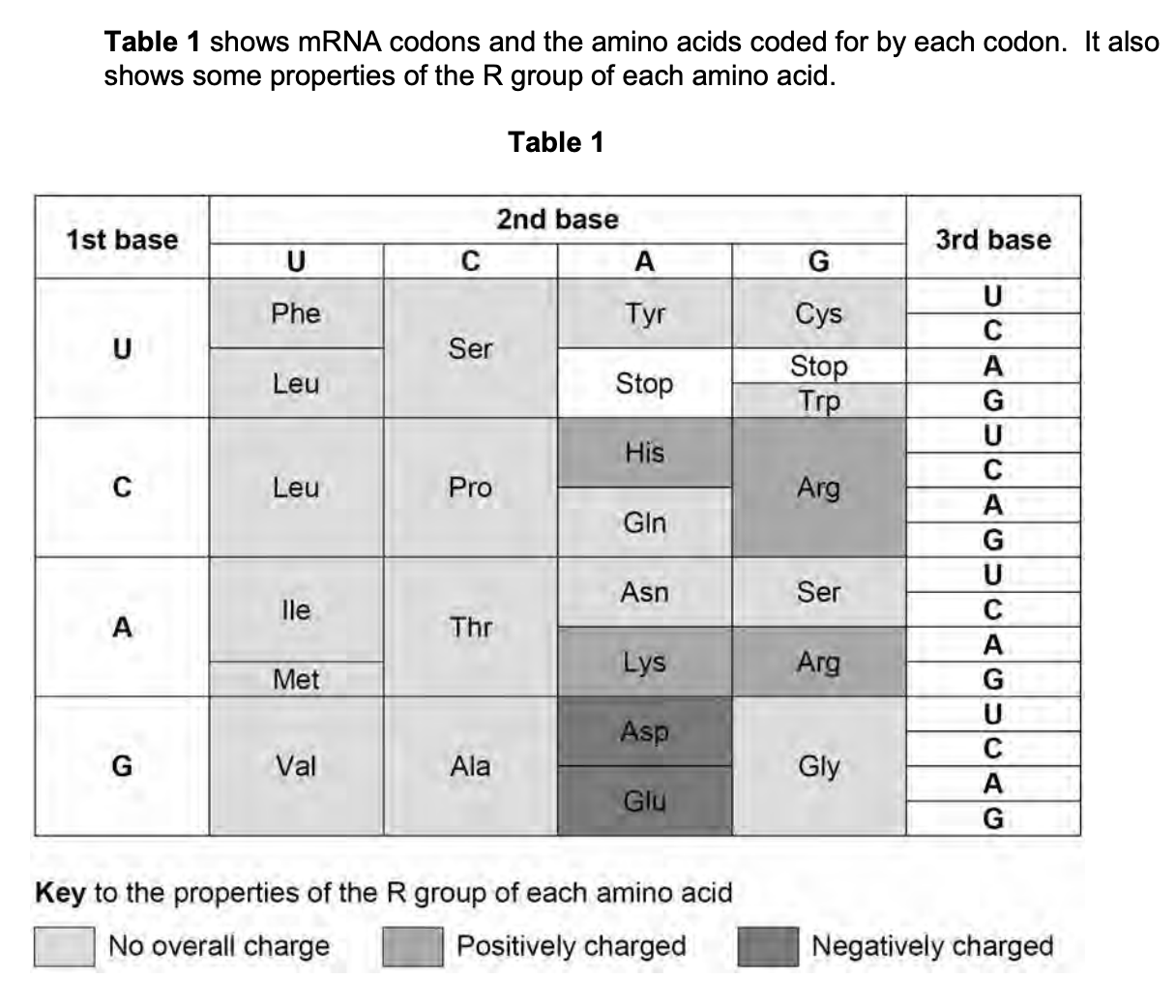
Answer
Mark Scheme
- More than one codon codes for a single amino acid (1 mark)
- Suitable example selected from Table 1 (1 mark)
Comments from mark scheme
- Accept ‘triplet’ or ‘sequence of 3 bases/nucleotides’ for ‘codon’.
- Reject ‘production/produces’ for ‘codes for’. Do not infer mp1 from mp2.
A scientist investigated changes in the amino acid sequence of a human enzyme box resulting from mutations. All these amino acid changes result from single base substitution mutations. This enzyme is a polypeptide 465 amino acids long. Table 2 shows the result of three of the base substitutions.
What is the minimum number of bases in the gene coding for this polypeptide?
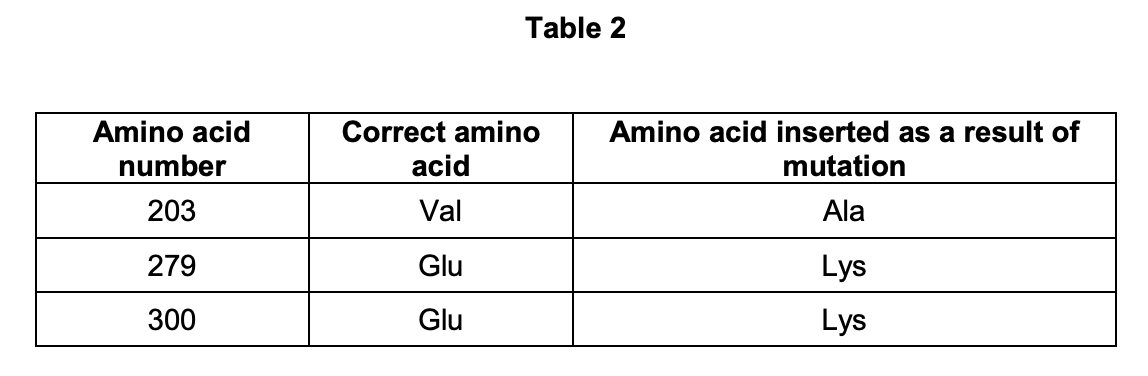
Answer
Mark Scheme
- 1395 (1 mark)
Comments from mark scheme
Accept 1398 and 1401 (for those that include start and/or stop codons)
Use information from Table 1 to tick ( ) one box that shows a base substitution mutation in DNA that would result in a change from Val to Ala at amino acid number 203
(1 marks)Answer
Mark Scheme
- CAA → CGA (1 mark)
A change from Glu to Lys at amino acid 300 had no effect on the rate of reaction catalysed by the enzyme. The same change at amino acid 279 significantly reduced the rate of reaction catalysed by the enzyme.
Use all the information and your knowledge of protein structure to suggest reasons for the differences between the effects of these two changes.
(3 marks)Answer
Mark Scheme
- (Both) negatively charged to positively charged change in amino acid (1 mark)
-
- Change at amino acid 300 does not change the shape of the active site OR Change at amino acid 300 does not change the tertiary structure OR Change at amino acid 300 results in a similar tertiary structure (1 mark)
-
- Amino acid 279 may have been involved in a (ionic, disulfide or hydrogen) bond and so the shape of the active site changes OR Amino acid 279 may have been involved in a (ionic, disulfide or hydrogen) bond and so the tertiary structure changed (1 mark)
- OR Amino acid 279 may be in the active site and be required for binding the substrate (1 mark)
Comments from mark scheme
- and 3. Reference to ‘shape’ of active site only needed once.
- Both parts are required for each mark option.
- For ‘a bond’ reject peptide bond.
Complete Figure 7 to show the chromosome content of the cells that would result from a normal meiotic division of the diploid parent cell shown in Figure 6
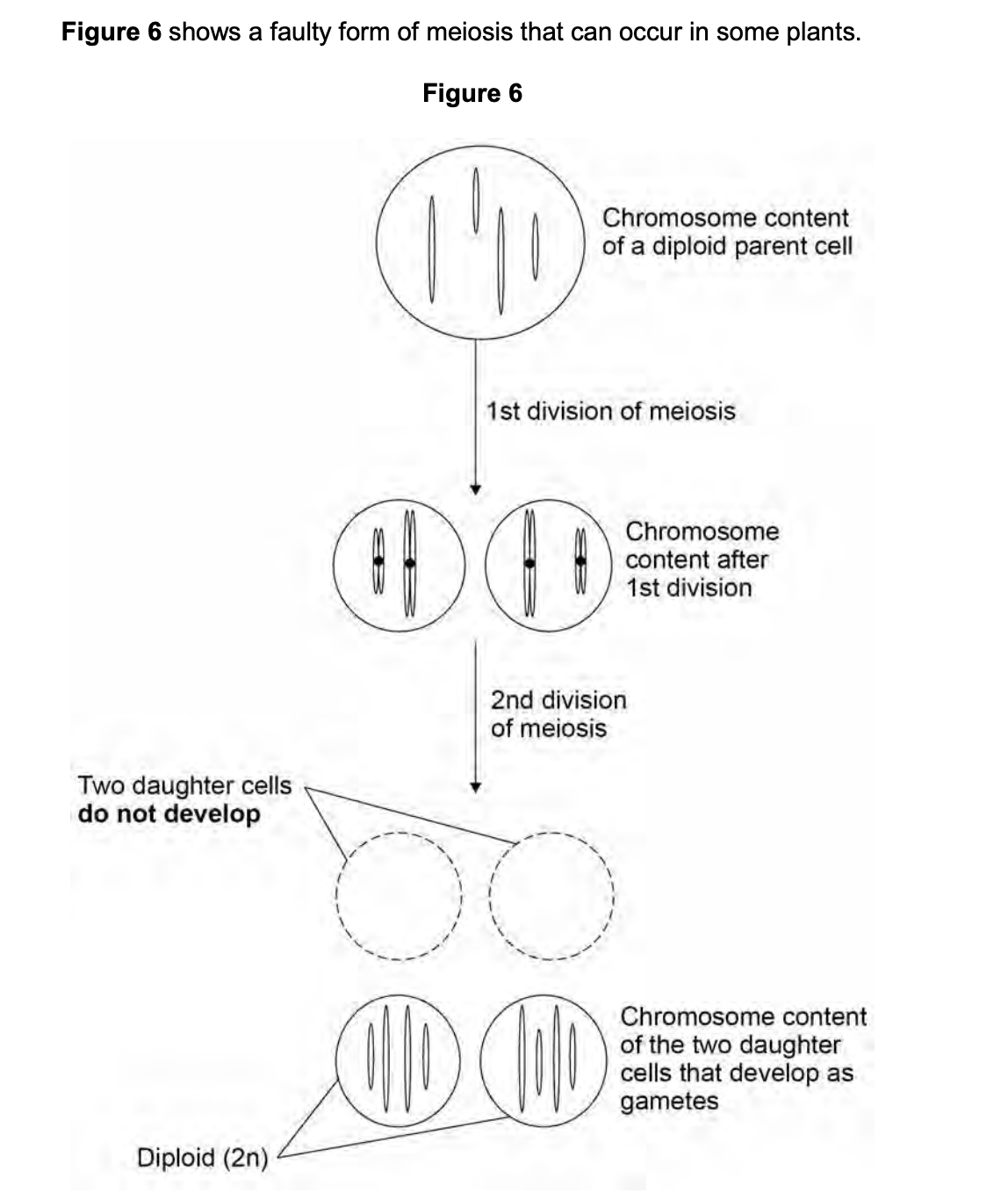
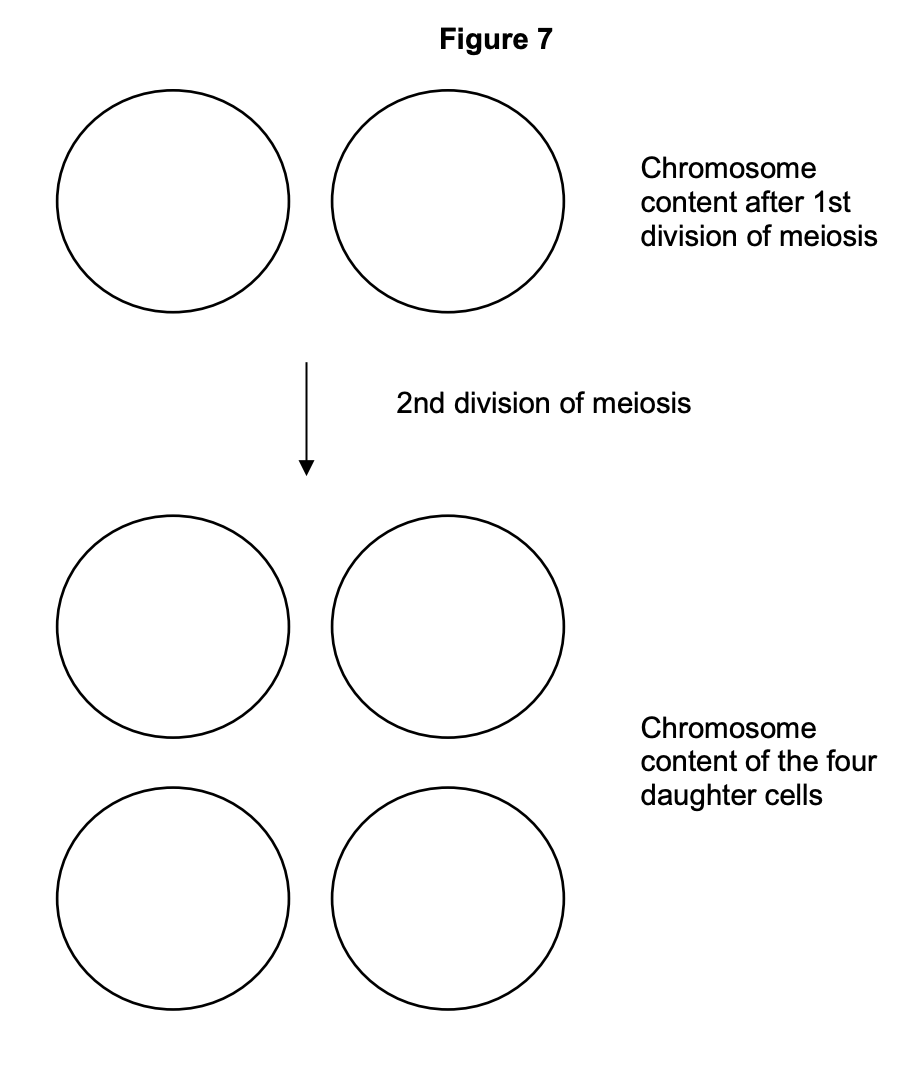
Answer
Mark Scheme
- 1 long and 1 short chromosome, each made up of 2 chromatids held (by centromere), in each cell of 1st division (1 mark)
- 1 long and 1 short (separate) chromosome in each cell of 2nd division (1 mark)
Comments from mark scheme
- Allow ECF for correct chromosomes shown in each cell from candidate’s 1 st division cells.
- Ignore drawing of centromere.
If two diploid (2n) gametes fuse at fertilisation, it can result in the growth of a tetraploid plant which has 4 copies of each chromosome. Red clover is a plant grown to produce cattle feed. Tetraploid red clover plants produce a higher yield than diploid red clover plants. Whether a red clover plant produces 2n gametes is genetically controlled. Scientists investigated the possibility of breeding red clover plants that only produced 2n gametes.
The scientists used the following null hypothesis. ‘The proportion of plants that produce 2n gametes will not change from one breeding cycle to the next.’
Complete Table 3 to show the expected number of plants that did not produce 2n gametes and the expected number of plants that did produce 2n gametes after 1 cycle.
- In breeding cycle 0, they grew red clover plants and identified plants that produced 2n gametes.
- In breeding cycle 1, they used the plants producing 2n gametes to produce offspring.
- In breeding cycles 2 and 3, they identified plants producing 2n gametes and used these to produce offspring.
Their results are shown in Table 3.
Give each answer to the nearest whole number.
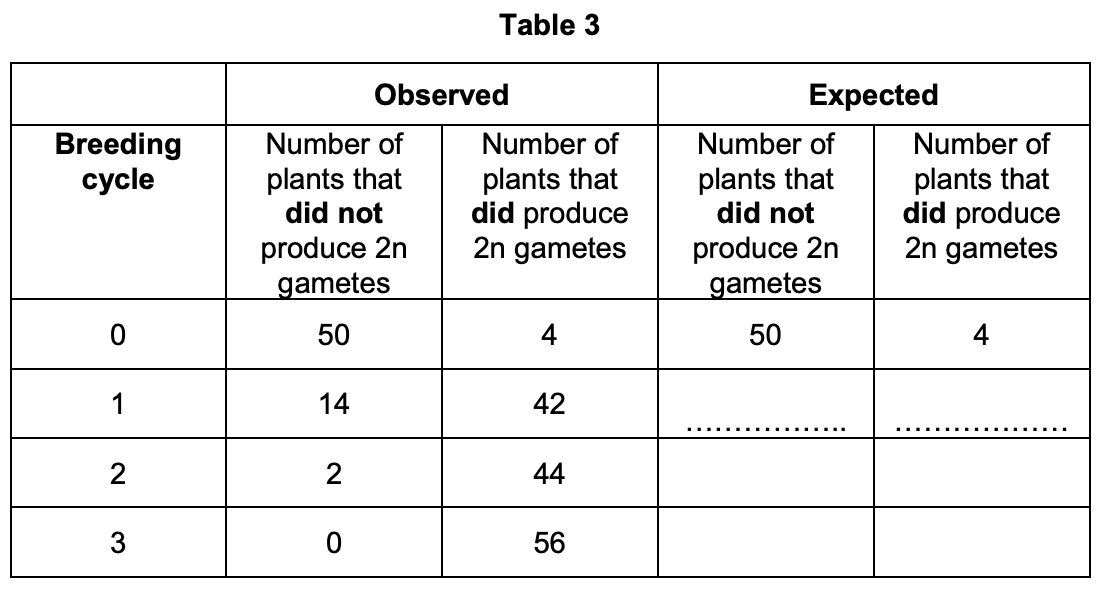
Answer
Mark Scheme
- 52 & 4 Allow 1 mark for numbers totalling 56 except 14/42 - repetition of observed values. (1 mark)
The scientists tested their null hypothesis using the chi-squared statistical test. After 1 cycle their calculated chi-squared value was 350 The critical value at P=0.05 is 3.841
What does this result suggest about the difference between the observed and expected results and what can the scientists therefore conclude?
(2 marks)Answer
Mark Scheme
- There is a less than 0.05/5% probability that the difference(s) (between observed and expected) occurred by chance (1 mark)
- Calculated value is greater than critical value so the null hypothesis can be rejected (1 mark)
- (The scientists can conclude that) the proportion of plants that produce 2n gametes does change from one breeding cycle to the next (1 mark)
Comments from mark scheme
- Reject ‘results (without reference to difference) occurring by chance’. Overall max 1 with this statement.
- Accept ‘there is a greater than 0.95/95% probability that the difference did not occur by chance’.
- and 2. Ignore ‘difference is significant’
- Do not accept ‘P value’ for ‘critical value’.
Use your knowledge of directional selection to explain the results shown in Table 3.
(3 marks)Answer
Mark Scheme
- The scientists selected/used for breeding plants that produced 2n gametes (1 mark)
- (So these plants) passed on their alleles (for production of 2n gametes to the next generation) (1 mark)
- The frequency of alleles for production of 2n gametes increased (in the population). (1 mark)
Comments from mark scheme
For ‘production of 2n gametes’ accept ‘abnormal meiosis’.
- Answer must be in context of the scientists selecting plants to breed. Accept ‘artificial selection’ or ‘selectively bred’. 2 and 3. Both mark points can be awarded if one correct reference is made to alleles (in either context).
- Do not accept ‘number’ for frequency. Accept converse answers linked to plants that produce n gametes.
When a person is bitten by a venomous snake, the snake injects a toxin into the person. Antivenom is injected as treatment. Antivenom contains antibodies against the snake toxin. This treatment is an example of passive immunity.
Explain how the treatment with antivenom works and why it is essential to use passive immunity, rather than active immunity.
(2 marks)Answer
Mark Scheme
- (Antivenom/Passive immunity) antibodies bind to the toxin/venom/antigen and (causes) its destruction (1 mark)
- Active immunity would be too slow/slower (1 mark)
Comments from mark scheme
- For ‘bind’ accept ‘attach’, ignore ‘attack’.
- For ‘destruction of toxin’ accept agglutination or phagocytosis.
- Ignore reference to antibodies ‘neutralising toxin/stopping damage’
- Reject reference to ‘killing’ toxin/venom.
- Accept ‘passive immunity is faster’, not simply ‘passive immunity is fast’.
A mixture of venoms from several snakes of the same species is used. Suggest why.
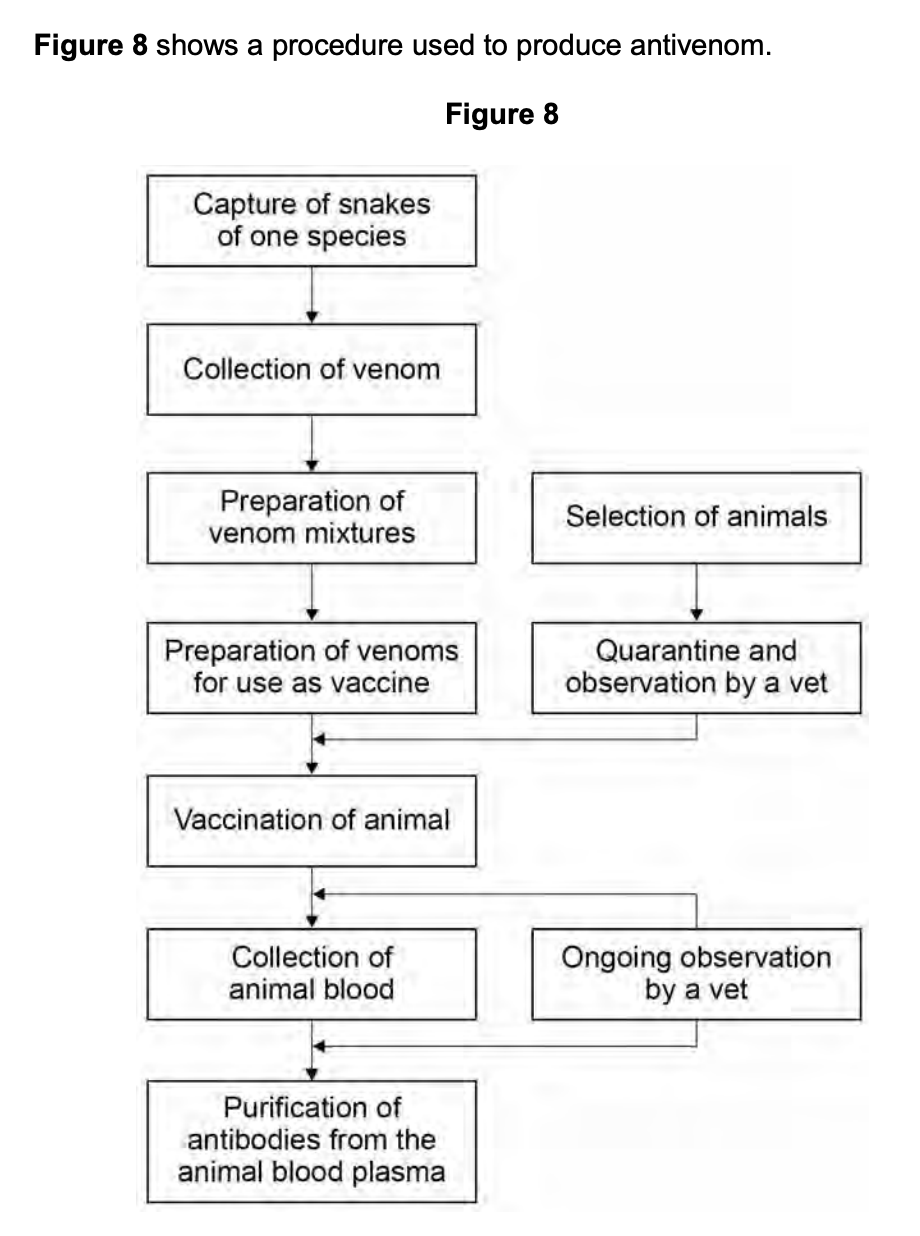
Answer
Mark Scheme
- May be different form of antigen/toxin (within one species) OR Snakes (within one species) may have different mutations/alleles (1 mark)
- Different antibodies (needed in the antivenom) OR (Several) antibodies complementary (to several antigens) (1 mark)
Comments from mark scheme
No mark points are available for answers related to collecting venom from different species of snake.
Horses or rabbits can be used to produce antivenoms. When taking blood to extract antibody, 13 cm³ of blood is collected per kg of the animal’s body mass. The mean mass of the horses used is 350 kg and the mean mass of the rabbits used is 2 kg
Using only this information, suggest which animal would be better for the production of antivenoms.
Use a calculation to support your answer.
(2 marks)Answer
Mark Scheme
- Horses because more antivenom/antibodies could be collected (as more blood collected) (1 mark)
- 4550 (cm³) v 26 (cm³) (blood collected) (1 mark)
Comments from mark scheme
- Accept 175 rabbits needed to (collect the volume of blood from) one horse.
During the procedure shown in Figure 8 the animals are under ongoing observation by a vet.
Suggest one reason why.
(1 marks)Answer
Mark Scheme
- (So) the animal does not suffer from the venom/vaccine/toxin (1 mark)
- (So) the animal does not suffer anaemia/does not suffer as a result of blood collection (1 mark)
- (So) the animal does not have pathogen that could be transferred to humans (1 mark)
Comments from mark scheme
Accept ‘To fulfil licence/legal requirements’. Accept ‘(So) the animal does not have pathogen that could result in it producing other antibodies (not wanted in the antivenom)’. For ‘pathogen’ accept correct form of pathogen
During vaccination, each animal is initially injected with a small volume of venom. Two weeks later, it is injected with a larger volume of venom.
Use your knowledge of the humoral immune response to explain this vaccination programme.
(3 marks)Answer
Mark Scheme
- B cells specific to the venom reproduce by mitosis (1 mark)
- (B cells produce) plasma cells and memory cells (1 mark)
- The second dose produces antibodies (in secondary immune response) in higher concentration and quickly OR The first dose must be small so the animal is not killed (1 mark)
Comments from mark scheme
- Accept in context of primary or secondary immune response.
- Credit idea of specificity if given once in relation to T or B cell.
- Accept a description for specificity.
- Accept ‘clone’ for ‘reproduce by mitosis’.
- ‘Clonal selection of B cells’ = MP1.
- Accept ‘a lot of antibody’ for ‘higher concentration of antibody’.
Scientists investigated the effect of a heat treatment on mass transport in barley plants.
- They applied steam to one short section of a leaf of the heat-treated plants. This area is shown by the arrows in Figure 9.
- They did not apply steam to the leaves of control plants.
- They then supplied carbon dioxide containing radioactively-labelled carbon to each plant in the area shown by the rectangular boxes in Figure 9.
- After 4 hours, they:
- found the position of the radioactively-labelled carbon in each plant. These results are shown in Figure 9.
- recorded the water content of the parts of the leaf that were supplied with radioactively-labelled carbon dioxide. These results are shown in Table 4.
The scientists concluded that this heat treatment damaged the phloem.
Explain how the results in Figure 9 support this conclusion.
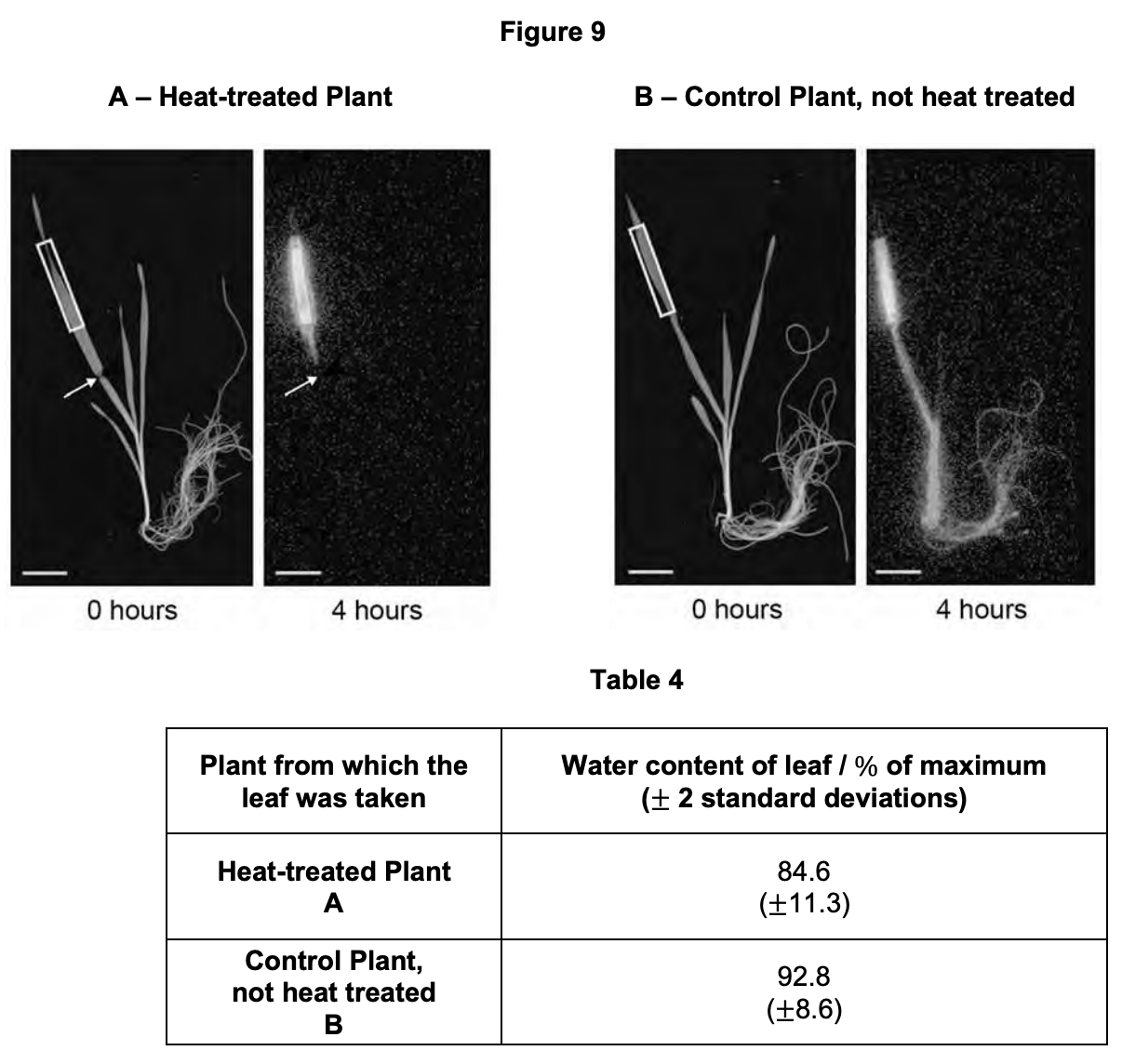
Answer
Mark Scheme
- EITHER 1. The radioactively labelled carbon is converted into sugar/organic substances during photosynthesis (1 mark)
-
- Mass flow/translocation in the phloem throughout the plant only in plants that were untreated/B/control OR Movement of sugar/organic substances in the phloem throughout the plant only in plants that were untreated/B/control (1 mark)
- OR 3. Movement in phloem requires living cells/respiration/active transport/ATP (1 mark)
-
- Heat treatment damages living cells so transport in the phloem throughout the plant only in plants that were untreated/B/control OR Heat treatment stops respiration/active transport/ATP production so transport in the phloem throughout the plant only in plants that were untreated/B/control (1 mark)
Comments from mark scheme
Do not mix and match – award either mp1 and mp2 or mp3 and mp4.
- For ‘organic substance’ accept named organic substance, eg glucose, sucrose, amino acid.
- Accept ‘translocation/mass transport in the phloem past the heat treatment only in the untreated plant/B/control’.
- Accept converse for heat-treated plant/A ie Movement of sugar/organic substances/mass flow/translocation in the phloem stops (beyond the heat treatment) in treated plants/A.
The scientists also concluded that this heat treatment did not affect the xylem.
Explain how the results in Table 4 support this conclusion
(2 marks)Answer
Mark Scheme
- (The water content of the leaves was) not different because (means ± 2) standard deviations overlap (1 mark)
- Water is (therefore) still being transported in the xylem (to the leaf) OR Movement in xylem is passive so unaffected by heat treatment (1 mark)
Comments from mark scheme
- For ‘not different’ accept ‘difference is not significant’ or ‘difference due to chance’.
The scientists then investigated the movement of iron ions (Fe3+) from the soil to old and young leaves of heat-treated barley plants and to leaves of plants that were not heat treated. Heat treatment was applied half way up the leaves. The scientists determined the concentration of Fe3+ in the top and lower halves of the leaves of each plant. Their results are shown in Figure 10.
What can you conclude about the movement of Fe3+ box in barley plants?
Use all the information provided.
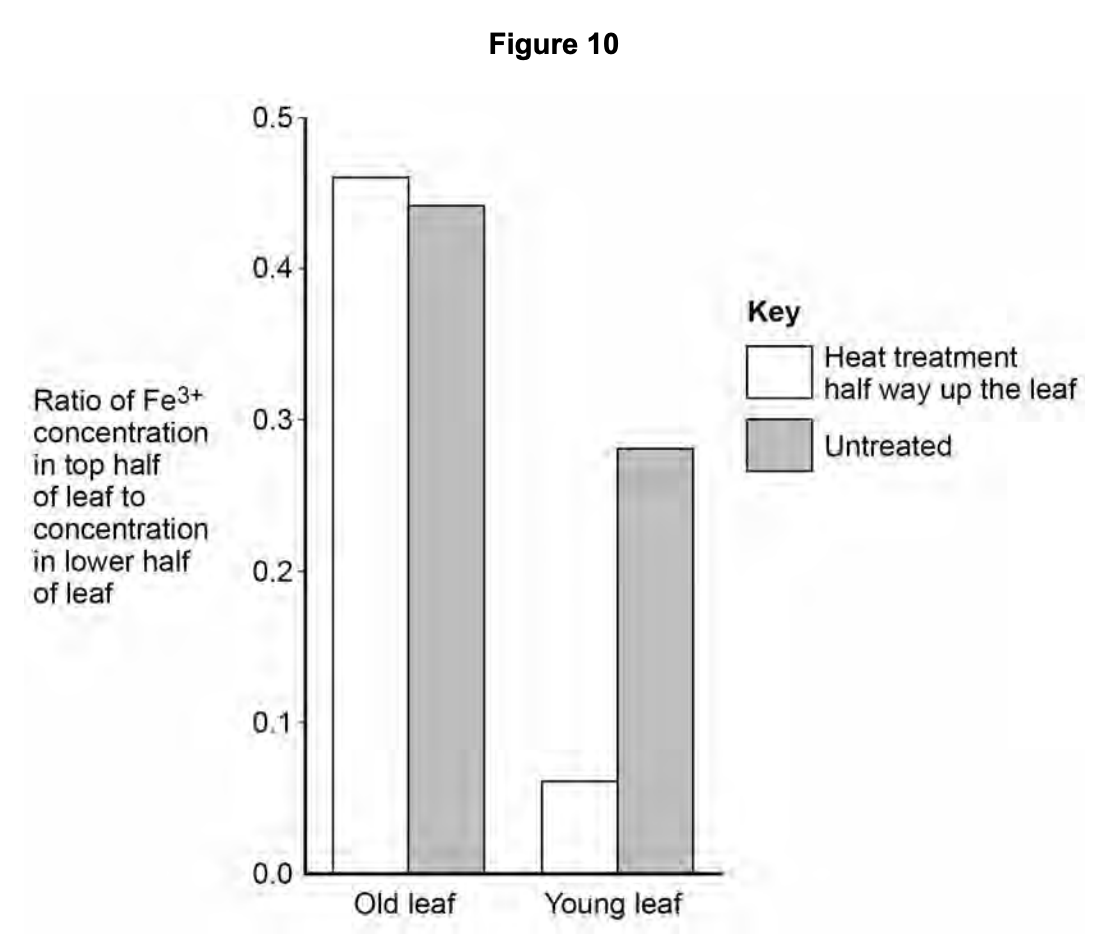
Answer
Mark Scheme
- Heat treatment has a greater effect on young leaves than old (1 mark)
- Heat treatment damages the phloem (1 mark)
- Fe3+ moves up the leaf/plant (1 mark)
- (Suggests) Fe3+ is transported in the xylem in older leaf (1 mark)
- In young leaf, some in xylem, as some still reaches top part of leaf (1 mark)
- (Suggests) Fe3+ is (mostly) transported in phloem in young leaf OR Xylem is damaged in young leaf OR Xylem is alive in young leaf (1 mark)
- Higher ratio of Fe3+ in (all/untreated) old leaves than (all/untreated) young (1 mark)
- All ratios show there is less Fe3+ in the top than the lower part of leaves (1 mark)
- (But) no statistical test to show if the difference(s) is significant (1 mark)
Comments from mark scheme
- Accept description of no/little/(slight) increase effect in old leaves and change in young leaves.
- Accept ‘more at the top’ for ‘higher ratio’.
- Accept ‘(But) no standard deviations to show if the difference(s) is significant’
Describe the role of two named enzymes in the process of semi-conservative replication of DNA.
(3 marks)Answer
Mark Scheme
- (DNA) helicase causes breaking of hydrogen/H bonds (between DNA strands) (1 mark)
- DNA polymerase joins the (DNA) nucleotides (1 mark)
- Forming phosphodiester bonds (1 mark)
Comments from mark scheme
- Reject ‘helicase hydrolyses hydrogen bonds’.
- Reject if suggestion that DNA polymerase joins the complementary nucleotides or forms H bonds.
- Reject if joining RNA nucleotides or forming RNA.
Scientists investigated the function of a eukaryotic cell protein called cyclin A. This protein is thought to be involved with the binding of one of the enzymes required at the start of DNA replication. The scientists treated cultures of cells in the following ways.
- C – Control cells, untreated
- D – Added antibody that binds specifically to cyclin A
- E – Added RNA that prevents translation of cyclin A
- F – Added RNA that prevents translation of cyclin A and added cyclin A protein
They then determined the percentage of cells in each culture in which DNA was replicating. Their results are shown in Table 5.
Suggest explanations for the results in Table 5
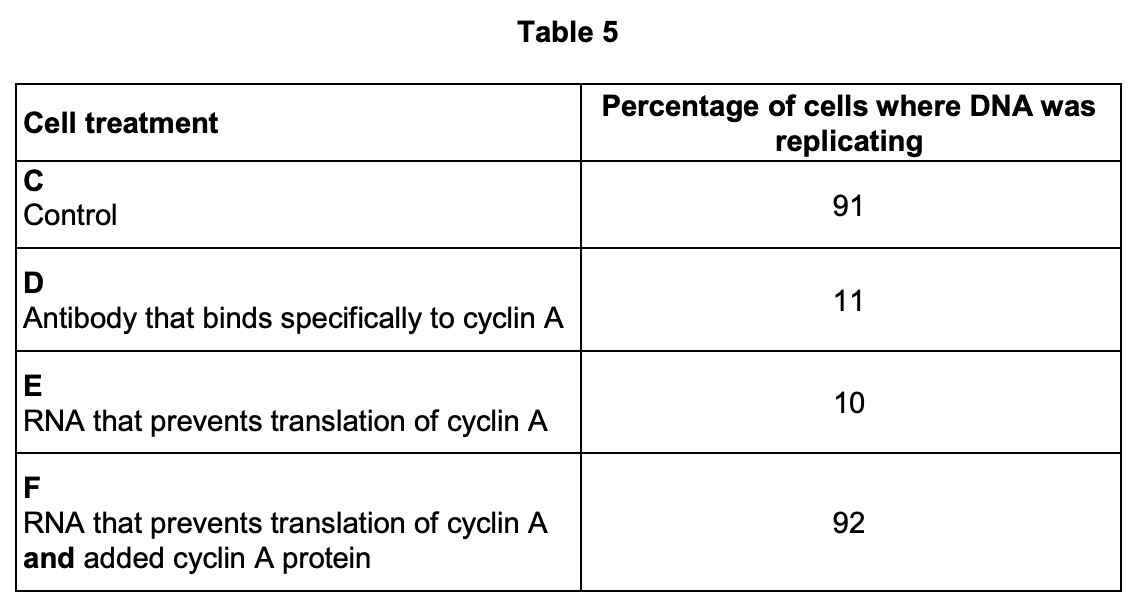
Answer
Mark Scheme
- (Treatment D Antibody binds to cyclin A so) it cannot bind to DNA/enzyme/initiate DNA replication (1 mark)
- (Treatment E) RNA interferes with mRNA/tRNA/ribosome/polypeptide formation (so cyclin A not made) (1 mark)
- In Treatment F added cyclin A can bind to DNA/enzyme (to initiate DNA replication) OR Treatment F shows that it is the cyclin A that is being affected in the other treatments OR Treatment F shows that cyclin A allows the enzyme to bind (to DNA) OR (Some cells in D or E) can continue with DNA replication because they have a different cyclin A allele OR (Some cells in D or E) can continue with DNA replication because the antibody/RNA has not bound to all the cyclin A protein/mRNA OR (Some cells in E) can continue with DNA replication because they contain previously translated cyclin A (1 mark)
Comments from mark scheme
- For ‘bind to enzyme’ accept ‘activate’.
- Idea of ‘initiate DNA replication’ must be linked to start not just less replication.
- and 3. For ‘enzyme’ accept named enzyme.
- Context needed for Treatment F but it does not need to be named.
Describe the gross structure of the human gas exchange system and how we breathe in and out.
(6 marks)Answer
Mark Scheme
- Named structures – trachea, bronchi, bronchioles, alveoli (1 mark)
- Above structures named in correct order OR Above structures labelled in correct positions on a diagram (1 mark)
- Breathing in – diaphragm contracts and external intercostal muscles contract (1 mark)
- (Causes) volume increase and pressure decrease in thoracic cavity (to below atmospheric, resulting in air moving in) (1 mark)
- Breathing out - Diaphragm relaxes and internal intercostal muscles contract (1 mark)
- (Causes) volume decrease and pressure increase in thoracic cavity (to above atmospheric, resulting in air moving out) (1 mark)
Comments from mark scheme
1, 2. Reject mp1 if structures from other physiological systems are named but award mp2 if the correct structures are in the correct order. 4. and 6. For thoracic cavity accept ‘lungs’ or ‘thorax’. 4. and 6. Reference to ‘thoracic cavity’ only required once. If idea of thoracic cavity is missing or incorrect, allow ECF for mark point 6. 5. Accept diaphragm relaxes and (external) intercostal muscles relax and lung tissue elastic (so recoils).
Mucus produced by epithelial cells in the human gas exchange system contains triglycerides and phospholipids.
Compare and contrast the structure and properties of triglycerides and phospholipids.
(5 marks)Answer
Mark Scheme
- Both contain ester bonds (between glycerol and fatty acid) (1 mark)
- Both contain glycerol (1 mark)
- Fatty acids on both may be saturated or unsaturated (1 mark)
- Both are insoluble in water (1 mark)
- Both contain C, H and O but phospholipids also contain P (1 mark)
- Triglyceride has three fatty acids and phospholipid has two fatty acids plus phosphate group (1 mark)
- Triglycerides are hydrophobic/non-polar and phospholipids have hydrophilic and hydrophobic region (1 mark)
- Phospholipids form monolayer (on surface)/micelle/bilayer (in water) but triglycerides don’t (1 mark)
Comments from mark scheme
All statements must be clearly comparative or linked by the candidate, not inferred from separate statements. Accept mark points shown on adjacent annotated diagrams. 5. Must relate to element. 7. Accept ‘non-polar’ for hydrophobic and ‘polar’ for hydrophilic.
Mucus also contains glycoproteins. One of these glycoproteins is a polypeptide with the sugar, lactose, attached.
Describe how lactose is formed and where in the cell it would be attached to a polypeptide to form a glycoprotein.
(4 marks)Answer
Mark Scheme
- Glucose and galactose (1 mark)
- Joined by condensation (reaction) (1 mark)
- Joined by glycosidic bond (1 mark)
- Added to polypeptide in Golgi (apparatus) (1 mark)
Give the two types of molecule from which a ribosome is made.
(1 marks)Answer
Mark Scheme
- One of RNA/ribonucleic acid(s)/nucleotide(s)/nucleic acid(s)/rRNA/ribosomal RNA/ribosomal ribonucleic acid and one of protein(s)/polypeptide(s)/amino acid(s)/ peptide(s)/ribosomal protein (1 mark)
Comments from mark scheme
Reject DNA, deoxyribonucleic acid, tRNA, transfer RNA, transfer ribonucleic acid, mRNA, messenger RNA, messenger ribonucleic acid. Ignore enzyme(s), base(s).
Describe the role of a ribosome in the production of a polypeptide. Do not include transcription in your answer.
(3 marks)Answer
Mark Scheme
- mRNA binds to ribosome (1 mark)
- Idea of two codons/binding sites (1 mark)
- (Allows) tRNA with anticodons to bind/associate (1 mark)
- (Catalyses) formation of peptide bond between amino acids (held by tRNA molecules) (1 mark)
- Moves along (mRNA to the next codon)/translocation described (1 mark)
Comments from mark scheme
Assume ‘it’ refers to ribosome.
Table 1 shows the base sequence of part of a pre-mRNA molecule from a eukaryotic cell.
Complete the table with the base sequence of the DNA strand from which this pre-mRNA was transcribed.
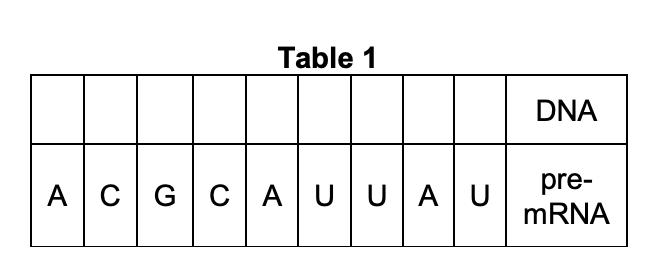
Answer
Mark Scheme
- TGCGTAATA (1 mark)
- Any errors = 0 marks (1 mark)
In a eukaryotic cell, the base sequence of the mRNA might be different from the sequence of the pre-mRNA. Explain why
(2 marks)Answer
Mark Scheme
- Introns (in pre-mRNA) (1 mark)
- Removal of sections of (pre-mRNA)/splicing (1 mark)
Comments from mark scheme
‘Introns removed’ scores 2 marks. Reference to ‘introns present in mRNA’ disqualifies mp1 but allow ECF for mp2. Accept for 1 mark mRNA contains only exons.
In mammals, in the early stages of pregnancy, a developing embryo exchanges substances with its mother via cells in the lining of the uterus. At this stage, there is a high concentration of glycogen in cells lining the uterus.
Describe the structure of glycogen.
(2 marks)Answer
Mark Scheme
- 1.Polysaccharide of α-glucose (1 mark)
- OR polymer of α-glucose (1 mark)
-
- (Joined by) glycosidic bonds OR Branched structure (1 mark)
Comments from mark scheme
- Ignore ‘Broken down’ 2.‘Energy produced’ disqualifies mp2
During early pregnancy, the glycogen in the cells lining the uterus is an important energy source for the embryo.
Suggest how glycogen acts as a source of energy. Do not include transport across membranes in your answer.
(2 marks)Answer
Mark Scheme
- Hydrolysed (to glucose) (1 mark)
- Glucose used in respiration (1 mark)
Suggest and explain two ways the cell-surface membranes of the cells lining the uterus may be adapted to allow rapid transport of nutrients.
(2 marks)Answer
Mark Scheme
- 1.Membrane folded so increased/large surface area (1 mark)
- OR Membrane has increased/large surface area for (fast) diffusion/facilitated diffusion/active transport/co-transport (1 mark)
-
- Large number of protein channels/carriers (in membrane) for facilitated diffusion (1 mark)
-
- Large number of protein carriers (in membrane) for active transport (1 mark)
-
- Large number of protein (channels/carriers in membrane) for co-transport (1 mark)
Comments from mark scheme
- Accept ‘microvilli to increase surface area’
- Reject reference to villi. Note feature and function required for each marking point and reference to large/many/more. List rule applies.
In humans, after the gametes join at fertilisation, every cell of the developing embryo undergoes mitotic divisions before the embryo attaches to the uterus lining.
What is the mean volume of each cell after 3 days? Express your answer in standard form. Show your working.
- The first cell division takes 24 hours.
- The subsequent divisions each take 8 hours. After 3 days, the embryo has a total volume of 4.2 × 10⁻³ mm³ .
Answer
Mark Scheme
- 3.3 x 10⁻⁵ OR 3.28 x 10⁻⁵ OR 3.281 x 10⁻⁵ (1 mark)
- 1 mark for Evidence of 128 (cells) Correct numerical calculation but not in standard form gains 1 mark (0.00003281 OR 0.0000328 OR 0.000033) (1 mark)
Comments from mark scheme
Accept any number of significant figures as long as rounding correct (3.28125 x 10⁻⁵ scores 2 marks)
Sodium ions from salt (sodium chloride) are absorbed by cells lining the gut. Some of these cells have membranes with a carrier protein called NHE3. NHE3 actively transports one sodium ion into the cell in exchange for one proton (hydrogen ion) out of the cell.
Use your knowledge of transport across cell membranes to suggest how NHE3 does this.
(3 marks)Answer
Mark Scheme
- Co-transport (1 mark)
- Uses (hydrolysis of) ATP (1 mark)
- Sodium ion and proton bind to the protein (1 mark)
- Protein changes shape (to move sodium ion and/or proton across the membrane) (1 mark)
Comments from mark scheme
- Accept ‘Na⁺ and H⁺ bind to protein’ but do not allow incorrect chemical symbols
Scientists investigated the use of a drug called Tenapanor to reduce salt absorption in the gut. Tenapanor inhibits the carrier protein, NHE3. The scientists fed a diet containing a high concentration of salt to two groups of rats, A and B.
- The rats in Group A were not given Tenapanor (0 mg kg⁻¹).
- The rats in Group B were given 3 mg kg⁻¹ Tenapanor.
One hour after treatment, the scientists removed the gut contents of the rats and immediately weighed them. Their results are shown in Table 2.
The scientists carried out a statistical test to see whether the difference in the means was significant. They calculated a P value of less than 0.05. They concluded that Tenapanor did reduce salt absorption in the gut.
Use all the information provided and your knowledge of water potential to explain how they reached this conclusion.
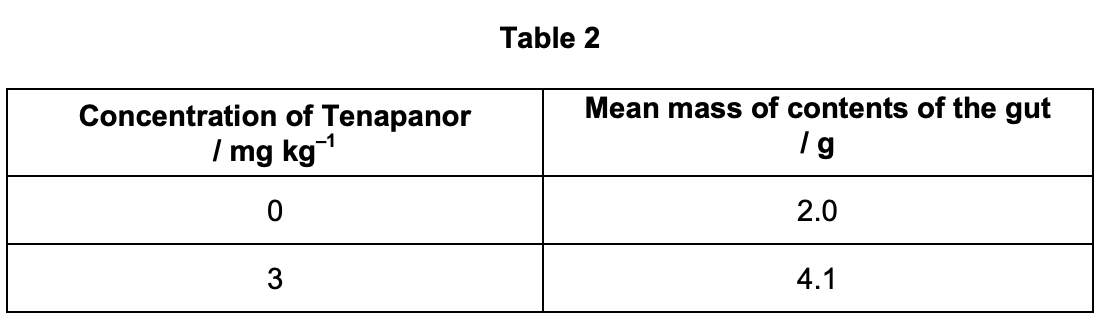
Answer
Mark Scheme
- Tenapanor/(Group)B/drug causes a significant increase; OR There is a significant difference with Tenapanor/drug/between A and B (1 mark)
- There is a less than 0.05 probability that the difference is due to chance (1 mark)
- (More salt in gut) reduces water potential in gut (contents) (1 mark)
- (so) less water absorbed out of gut (contents) by osmosis OR Less water absorbed into cells by osmosis OR Water moves into the gut (contents) by osmosis. OR (so) water moves out of cells by osmosis (1 mark)
Comments from mark scheme
- and 2. Reject references to ‘results’ being significant/due to chance once only.
- Do not credit suggestion that probability is 0.05% or 5.
- Accept ‘There is a greater than 0.95/95% probability that any difference between observed and expected is not due to chance
High absorption of salt from the diet can result in a higher than normal concentration of salt in the blood plasma entering capillaries. This can lead to a build-up of tissue fluid. Explain how.
(2 marks)Answer
Mark Scheme
- (Higher salt) results in lower water potential of tissue fluid (1 mark)
- (So) less water returns to capillary by osmosis (at venule end); OR (1 mark)
- (Higher salt) results in higher blood pressure/volume (1 mark)
- (So) more fluid pushed/forced out (at arteriole end) of capillary (1 mark)
Comments from mark scheme
For ‘salt’ accept ‘sodium ions’. Do not allow mix and match of points from different alternative pairs 3. Accept higher hydrostatic pressure
Bacteria are often used in industry as a source of enzymes. One reason is because bacteria divide rapidly, producing a large number of them in a short time.
Describe how bacteria divide.
(2 marks)Answer
Mark Scheme
- Binary fission (1 mark)
- Replication of (circular) DNA (1 mark)
- Division of cytoplasm to produce 2 daughter cells (1 mark)
- Each with single copy of (circular) DNA (1 mark)
Comments from mark scheme
- Ignore reference to ‘chromosome’
- Ignore ‘copy’.
- Ignore references to number of plasmids
Washing powders often contain enzymes from bacteria. These enzymes include proteases that hydrolyse proteins in clothing stains. Figure 1 shows the effect of temperature on a protease that could be used in washing powder.
Explain the shape of the curves at 50 °C and 60 °C.
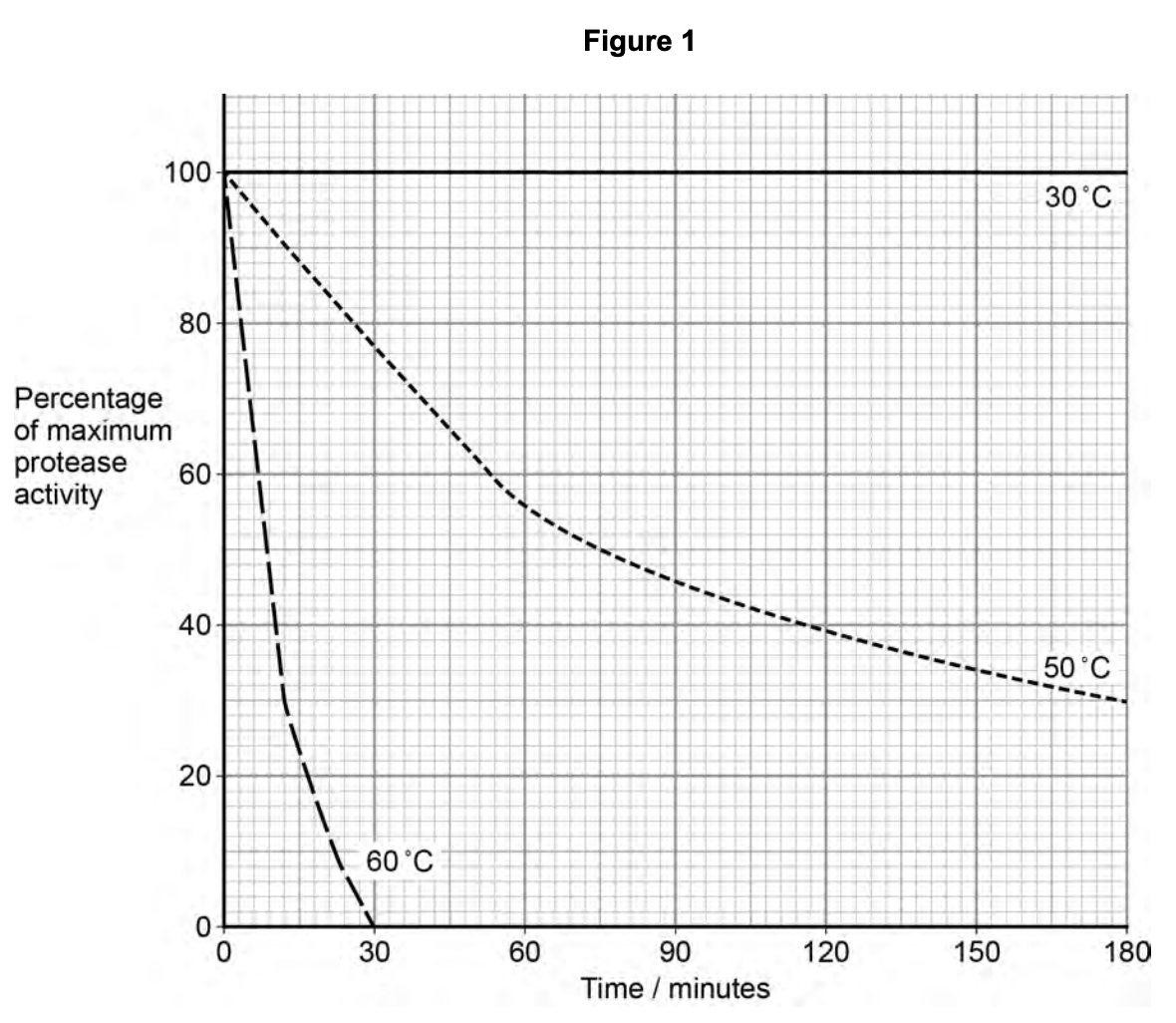
Answer
Mark Scheme
- Both denatured (by high temperature) (1 mark)
- Denaturation faster at 60 °C due to more (kinetic) energy (1 mark)
- Breaks hydrogen/ionic bonds (between amino acids/R groups) (1 mark)
- Change in shape of the active site/active site no longer complementary so fewer enzymesubstrate complexes formed/substrate does not fit (1 mark)
Comments from mark scheme
- Ignore references to disulphide bonds
- Accept ‘(at 60⁰ C) Change in shape of the active site/active site no longer complementary so no enzyme-substrate complexes formed/substrate does not fit;
Some proteases are secreted as extracellular enzymes by bacteria. Suggest one advantage to a bacterium of secreting an extracellular protease in its natural environment.
Explain your answer.
(2 marks)Answer
Mark Scheme
- To digest protein (1 mark)
- (So) they can absorb amino acids for growth/reproduction/protein synthesis/synthesis of named cell component; OR (So) they can destroy a toxic substance/protein (1 mark)
Comments from mark scheme
- For ‘digest’ accept ‘break down’ here.
- Accept ‘(so) they can destroy antibodies/antibiotics/ viral antigens/bacterial antigens’
Mammals have some cells that produce extracellular proteases. They also have cells with membrane-bound dipeptidases.
Describe the action of these membrane-bound dipeptidases and explain their importance.
(2 marks)Answer
Mark Scheme
- Hydrolyse (peptide bonds) to release amino acids (1 mark)
- Amino acids can cross (cell) membrane; OR Dipeptides cannot cross (cell) membrane; OR Maintain concentration gradient of amino acids for absorption; OR Ensure (nearly) maximum yield from protein breakdown (1 mark)
Comments from mark scheme
- Ignore references to crossing gut membranes.
- Accept ‘there are carrier proteins for amino acids’ 2.Accept ‘no carrier proteins for dipeptides’
Scientists investigated treatment of a human bladder infection caused by a species of bacterium. This species of bacterium is often resistant to the antibiotics currently used for treatment. They investigated the use of a new antibiotic to treat the bladder infection. The new antibiotic inhibits the bacterial ATP synthase enzyme.
Place a tick () in the appropriate box next to the equation which represents the reaction catalysed by ATP synthase.
(1 marks)Answer
Mark Scheme
- a) ADP + Pi ATP + H₂O (1 mark)
The new antibiotic is safe to use in humans because it does not inhibit the ATP synthase found in human cells.
Suggest why human ATP synthase is not inhibited and bacterial synthase is inhibited.
(1 marks)Answer
Mark Scheme
- Human ATP synthase has a different tertiary structure to bacterial ATP synthase OR Human ATP synthase has a different shape active site to bacterial ATP synthase OR Antibiotic cannot enter human cells/mitochondria OR Antibiotic not complementary (to human ATP synthase) (1 mark)
The scientists tested the new antibiotic on mice with the same bladder infection. They divided these mice into three groups, C, R and A.
- Group C was the control (untreated).
- Group R was treated with an antibiotic currently used against this bladder infection.
- Group A was treated with the new antibiotic.
They removed samples from the bladder of these mice after treatment and estimated the total number of bacteria in the bladder. Their results are shown in Figure 2.
The antibiotics were given to the mice at a dose of 25 mg kg⁻¹ per day.
Calculate how much antibiotic would be given to a 30 g mouse each day. Show your working.
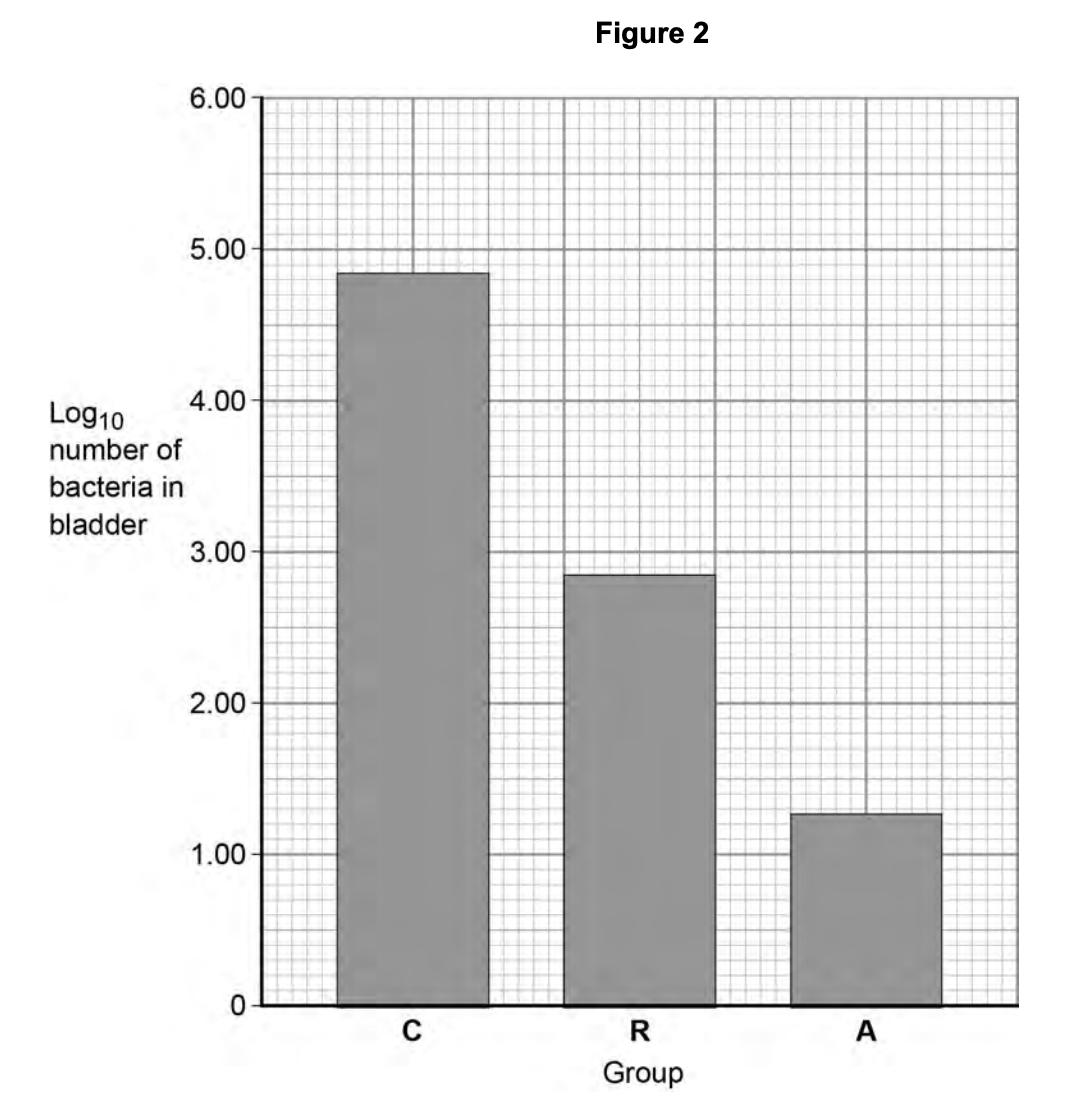
Answer
Mark Scheme
- 0.75 (1 mark)
- One mark for showing 30 g = 0.03 kg (1 mark)
- One mark for showing 0.025 mg g⁻¹ (1 mark)
Calculate the percentage difference in actual numbers of bacteria in group A compared with group R. The actual number of bacteria can be calculated from the log10 value by using the 10× function on a calculator. Show your working.
(2 marks)Answer
Mark Scheme
- Answer in range 97.0 – 97.8% (1 mark)
- OR Answer in range 3288 – 4368% (1 mark)
The scientists suggested that people newly diagnosed with this bladder infection should be treated with both the current antibiotic and the new antibiotic.
Explain why the scientists made this suggestion.
Use information from Figure 2 and your knowledge of evolution of antibiotic resistance in bacteria in your answer.
(3 marks)Answer
Mark Scheme
- (From Fig 2) New/old antibiotic does not kill all bacteria; OR (From Fig 2) Some bacteria are resistant to the new/old antibiotic (1 mark)
- Resistant bacteria will reproduce to produce (more) resistant bacteria (1 mark)
- (Use of both) one antibiotic will kill bacteria resistant to the other antibiotic; OR Unlikely that bacteria are resistant to both the new and the old antibiotic; OR Use of both antibiotics (likely to) kill all/most bacteria (1 mark)
Comments from mark scheme
Accept use of ‘A’ for ‘new antibiotic’ and ‘R’ for ‘old antibiotic’.
- Must relate to the bacteria that are still present – ‘some bacteria are killed’ or ‘the bacteria number is reduced’ is insufficient.
- Accept ‘resistant bacteria reproduce to pass on resistance gene/allele’
- ‘Use of both antibiotics will be more effective’ is insufficient.
2,4-D is a selective herbicide that kills some species of plants but not others. 2,4-D disrupts cell-surface membranes but the extent of disruption differs in different species. Scientists investigated the effect of 2,4-D on wheat plants (a crop) and on wild oat plants (a weed). They grew plants of both species in glasshouses. They put plants of each species into one of two groups, W and H, which were treated as follows:
Give three environmental variables that should be controlled when growing the plants before treatment with the different sprays.
- Group W – leaves sprayed with water
- Group H – leaves sprayed with a solution of 2,4-D. After spraying, they cut 40 discs from the leaves of plants in each group and placed them in flasks containing 10 cm³ de-ionised water. After 5 minutes, they calculated the disruption to cell-surface membranes by measuring the concentration of ions released into the water from the leaf discs. Their results are shown in Table 3. The lowest significant difference (LSD), is the smallest difference between two means that would be significant at P≤0.05
Answer
Mark Scheme
- Concentration of mineral ion/named mineral ion in soil (1 mark)
- Soil pH (1 mark)
- Temperature (1 mark)
- Light intensity/wavelength/duration (1 mark)
- Distance between seeds/plants (1 mark)
- Volume of water given (1 mark)
- CO₂ concentration (1 mark)
- Humidity (1 mark)
Comments from mark scheme
1 and 2. Allow ‘growing solution’ for ‘soil’. 2. pH alone is insufficient. 3. Allow ‘colour of light’ Reject ‘amount’ for mps 1, 4, 6 and 7. Ignore O₂ concentration Three correct = 2 marks Two correct = 1 mark One or none correct = 0 marks
Evaluate the use of 2,4-D as a herbicide on a wheat crop that contains wild oats as a weed.
Use all the information provided.
(4 marks)Answer
Mark Scheme
- 2,4-D causes an increase in release of ions from wild oat cells and 2,4-D does not affect/has little effect on the release of ions from wheat cells (1 mark)
- (For wheat) Difference is less than LSD/7 so difference is not significant; OR (For wild oats) Difference is more than LSD/10 so difference is significant (1 mark)
- Loss of ions from cells (likely to) lead to cell/plant death/damage; OR Disruption of cell membrane (likely to) lead to cell/plant death/damage (1 mark)
- No evidence here about death of plants as a result of this ion loss (1 mark)
- No evidence here of other ecological/environmental impact (1 mark)
Comments from mark scheme
- Accept reference to ‘concentration of ions in water’ or ‘disruption of the cell membranes’ in place of ‘release of ions’
- Accept ‘difference in release of ions from wild oats is 25 and difference in release of ions from wheat is 1’
- Accept ‘(For wheat) difference is less than LSD so greater than 5% probability that difference is due to chance’ OR ‘(For oats) difference is more than LSD so less than 5% probability that difference is due to chance’
- Accept ‘development of resistance’
The scientists incubated the flasks containing the leaf discs at 26 °C and gently shook the flasks.
Suggest one reason why the scientists ensured the temperature remained constant and one reason why the leaf discs were shaken
(2 marks)Answer
Mark Scheme
- (Maintain temperature) so that the rate of diffusion (of ions out of cells) remains constant OR (Maintain temperature) so no change in fluidity of phospholipids/kinetic energy of phospholipids; OR (Maintain temperature) so no change in shape/structure/denaturation of membrane proteins (1 mark)
- (Shaking) So all surfaces of the leaf discs are exposed (to water)/so all submerged; OR To maintain diffusion/concentration gradient (for ions out of leaf discs) (1 mark)
Comments from mark scheme
- Ignore references to rate of enzyme catalysed reactions
- Accept ‘so that leaf discs do not stick together’
Describe how phagocytosis of a virus leads to presentation of its antigens
(3 marks)Answer
Mark Scheme
- Phagosome/vesicle fuses with lysosome (1 mark)
- (Virus) destroyed by lysozymes/hydrolytic enzymes (1 mark)
- Peptides/antigen (from virus) are displayed on the cell membrane (1 mark)
Comments from mark scheme
- Accept vacuole fuses with lysosome
- Reject virus fuses with lysosome
Describe how presentation of a virus antigen leads to the secretion of an antibody against this virus antigen.
(3 marks)Answer
Mark Scheme
- Helper T cell/TH cell binds to the antigen (on the antigen-presenting cell/phagocyte) (1 mark)
- This helper T/TH cell stimulates a specific B cell (1 mark)
- B cell clones OR B cell divides by mitosis (1 mark)
- (Forms) plasma cells that release antibodies (1 mark)
Comments from mark scheme
- and 2. ‘Helper’ is required once only.
- Accept ‘This (helper) T cell stimulates a competent B cell’ ‘T cell stimulates B cell to undergo clonal selection’. This statement achieves mp2 and mp3.
Collagen is a protein produced by cells in joints, such as the knee. Rheumatoid arthritis (RA) is an auto-immune disease. In an auto-immune disease, a person’s immune system attacks their own cells. RA causes pain, swelling and stiffness in the joints. Scientists have found a virus that produces a protein very similar to human collagen.
Suggest how the immune response to this viral protein can result in the development of RA.
(2 marks)Answer
Mark Scheme
- The antibody against virus (antigen) will bind to collagen (1 mark)
- This results in the destruction of the (human) cells/collagen (1 mark)
Comments from mark scheme
- Ignore ‘attacks’
Figure 3 shows two different ways of classifying the same three species of snake.
- Classification X is based on the frequency of observable characteristics
- Classification Y is based on other comparisons of genetic characteristics.
All three species of snake belong to the Python family.
What do these classifications suggest about the evolutionary relationships between these species of snake?
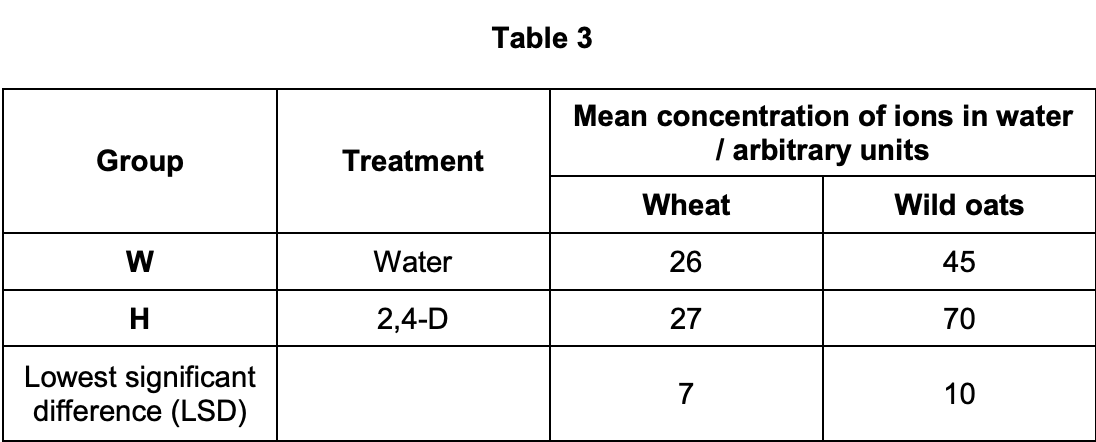
Answer
Mark Scheme
- (Without genetic analysis/X) mackloti and olivaceus have a more recent common ancestor with each other (than with papuana) (1 mark)
- (Genetic analysis indicates/Y) papuana and mackloti have a more recent common ancestor with one another (than with olivaceus) (1 mark)
Comments from mark scheme
Accept ‘more closely related to’ for ‘more recent common ancestor’
Complete Table 4 below to show the missing names of the taxa when classifying these snakes.
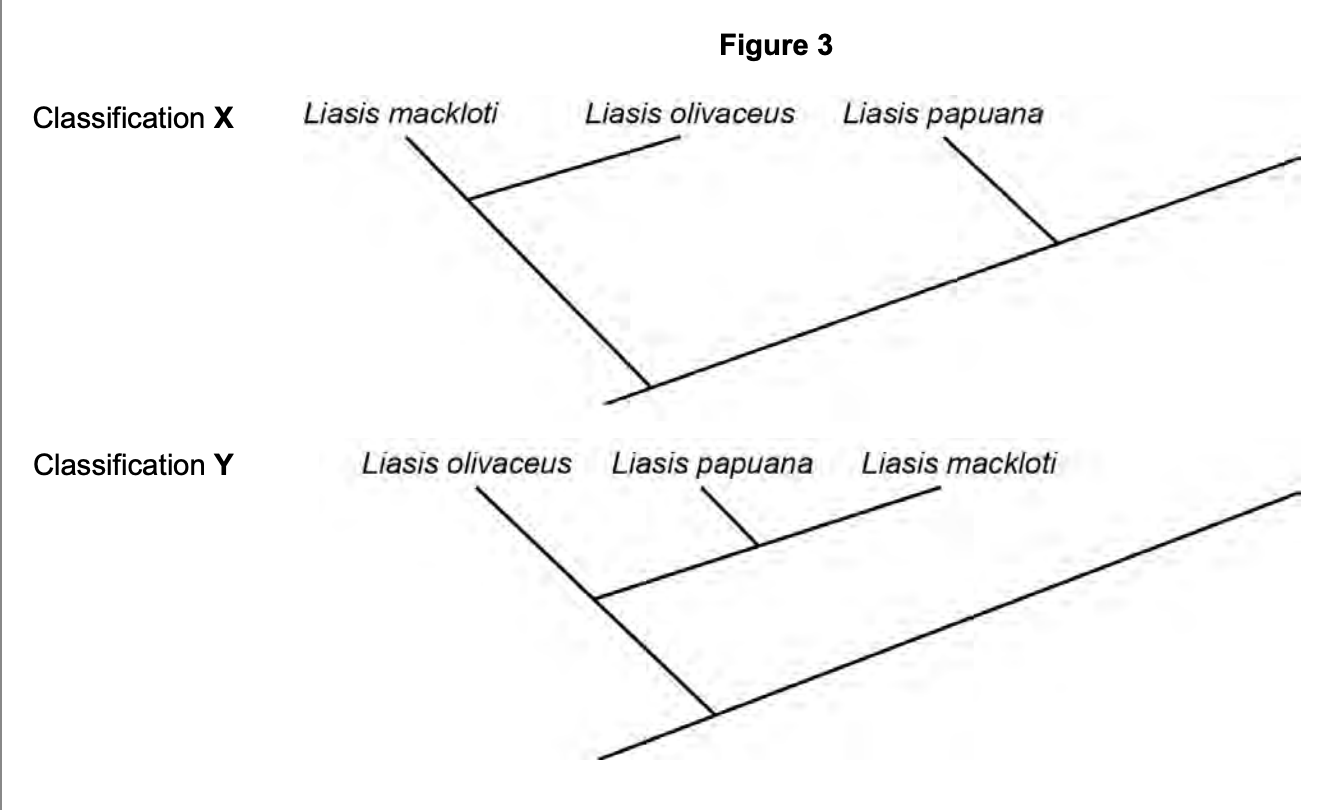
Answer
Mark Scheme
All 5 correct = Any errors =
There is a debate about the name of one of these species of snake. Some scientists name it Liasis papuana and other scientists name it Apodora papuana.
Give the name of the taxon about which the scientists disagree.
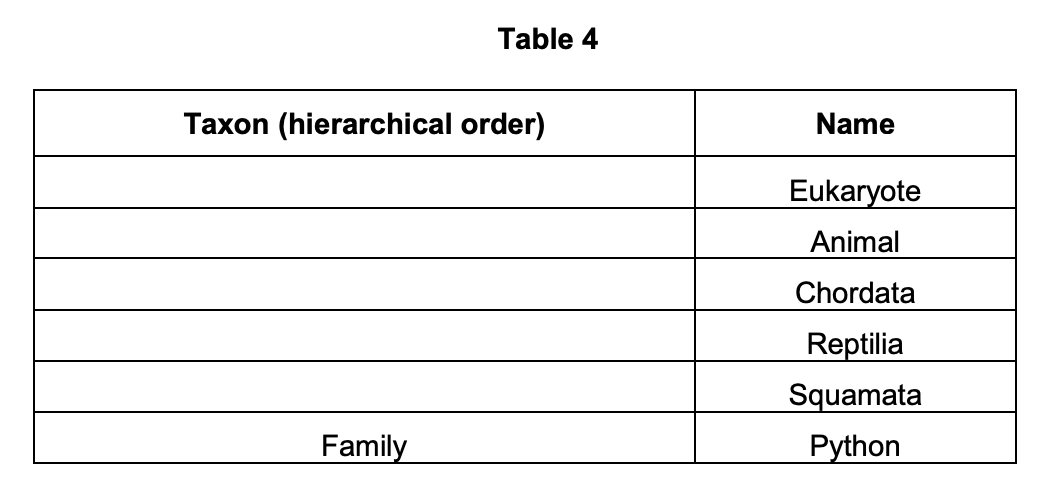
Answer
Mark Scheme
- Genus/genera (1 mark)
State three comparisons of genetic diversity that the scientists used in order to generate Classification Y.
(3 marks)Answer
Mark Scheme
- The (base) sequence of DNA (1 mark)
- The (base) sequence of mRNA (1 mark)
- The amino acid sequence (of proteins) (1 mark)
Figure 4 shows the stages of development of an insect called a damselfly. The adult damselfly uses a tracheal system for gas exchange.
Explain three ways in which an insect’s tracheal system is adapted for efficient gas exchange.
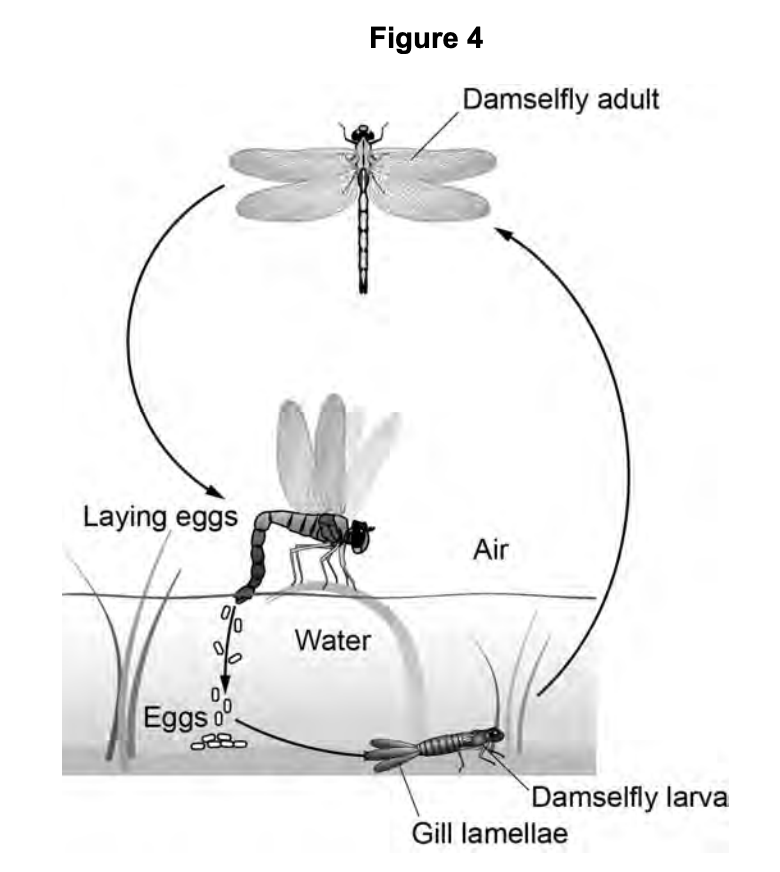
Answer
Mark Scheme
- Tracheoles have thin walls so short diffusion distance to cells (1 mark)
- Highly branched/large number of tracheoles so short diffusion distance to cells (1 mark)
- Highly branched/large number of tracheoles so large surface area (for gas exchange) (1 mark)
- Tracheae provide tubes full of air so fast diffusion (into insect tissues) (1 mark)
- Fluid in the end of the tracheoles that moves out (into tissues) during exercise so faster diffusion through the air to the gas exchange surface; OR Fluid in the end of the tracheoles that moves out (into tissues) during exercise so larger surface area (for gas exchange) (1 mark)
- Body can be moved (by muscles) to move air so maintains diffusion/concentration gradient for oxygen/carbon dioxide (1 mark)
Comments from mark scheme
- Do not accept unqualified references to thin membranes. Max 2 if any reference to blood Ignore references to spiracles
- Accept ‘water’ for fluid. Accept ‘cells’ and ‘tissues’ as interchangeable words.
The damselfly larva is a carnivore that actively hunts prey. It has gills to obtain oxygen from water. Some other species of insect have larvae that are a similar size and shape to damselfly larvae and also live in water. These larvae do not actively hunt prey and do not have gills.
Explain how the presence of gills adapts the damselfly to its way of life
(2 marks)Answer
Mark Scheme
- Damselfly larvae has high(er) metabolic/respiratory (rate) (1 mark)
- (So) uses more oxygen (per unit time/per unit mass) (1 mark)
Comments from mark scheme
Idea of ‘more/high’ is needed for both mark points. 2. Accept ‘needs’ for ‘uses’ 2. Ignore references to absorbing/obtaining/uptake of more oxygen
A scientist measured the size of each gill lamella of the gills of 40 damselfly larvae. His results are shown in Table 5.
Calculate the mean surface area of one side of one gill lamella. Assume that a gill lamella is rectangular and give your answer to an appropriate number of significant figures. Include the percentage error (uncertainty) of surface area in your answer. Show your working.
Mean surface area = Percentage error (uncertainty) of surface area =
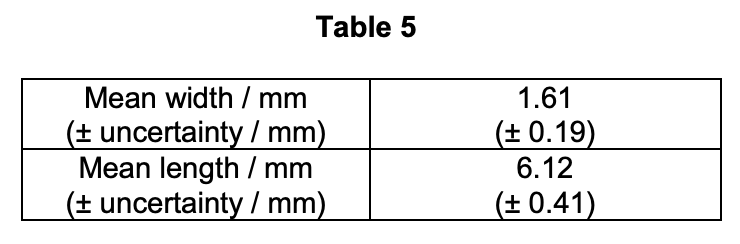
Answer
Mark Scheme
- Mean SA = 9.85 mm² /9.9 mm² (1 mark)
- Percentage uncertainty of SA = 18.5/18.7/19 (1 mark)
- If both answers incorrect 1 mark for Percentage uncertainty of dimensions 11.8/12 and 6.70/6.7 Surface area correctly calculated with correct units but not rounded to appropriate sf (9.8532 mm² ) Surface area correct (with appropriate sf) but no/incorrect unit given (1 mark)
Comments from mark scheme
Both answers correct = 3 marks 1 answer correct only = 2 Both answers incorrect = max 1
A student used an optical microscope to observe part of a damselfly larva gill. Figure 5 shows the drawing the student produced.
Suggest two ways the student could improve the quality of her scientific drawing of this gill.
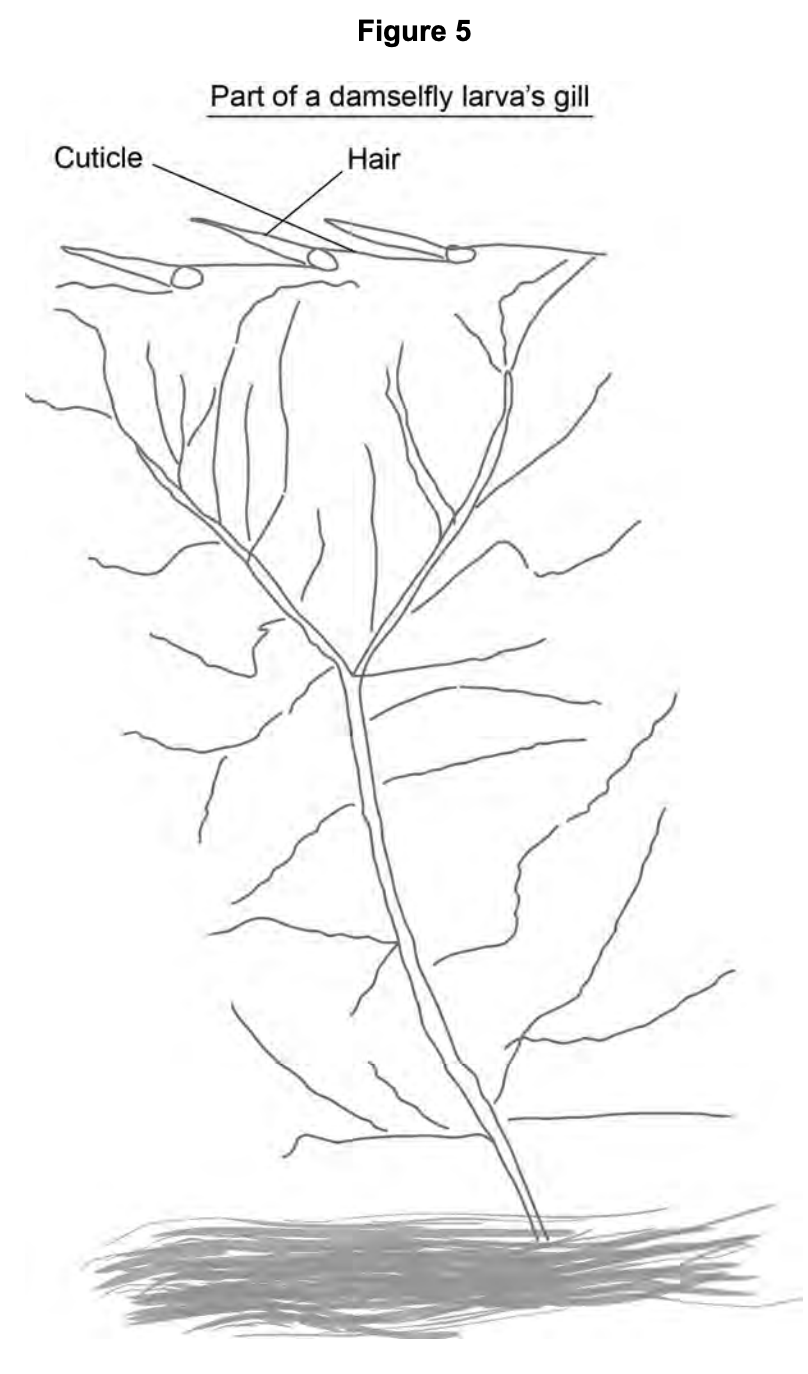
Answer
Mark Scheme
- Don’t use shading (1 mark)
- Only use single lines/don’t use sketching (lines)/ensure lines are continuous/connected (1 mark)
- Add further labels/annotations (1 mark)
- Don’t cross label lines (1 mark)
- Add magnification/scale (bar) (1 mark)
Comments from mark scheme
Reject ‘colour in’. Reject ‘use of electron microscopes’ Ignore ‘use a sharp pencil’
Contrast how an optical microscope and a transmission electron microscope work and contrast the limitations of their use when studying cells.
(6 marks)Answer
Mark Scheme
- TEM use electrons and optical use light (1 mark)
- TEM allows a greater resolution (1 mark)
- (So with TEM) smaller organelles/named cell structure can be observed OR greater detail in organelles/named cell structure can be observed (1 mark)
- TEM view only dead/dehydrated specimens and optical (can) view live specimens (1 mark)
- TEM does not show colour and optical (can) (1 mark)
- TEM requires thinner specimens (1 mark)
- TEM requires a more complex/time consuming preparation (1 mark)
- TEM focuses using magnets and optical uses (glass) lenses (1 mark)
Comments from mark scheme
- ‘clearer’ is not equivalent to ‘detail’
- Accept ‘Only optical can view live specimens’
- Accept ‘Only optical can show colour’
- Accept ‘TEM requires a more difficult preparation’ Ignore references to artefacts
Figure 6 shows an image from an optical microscope of meiosis occurring in a flower bud of a flowering plant. W and Z are undergoing meiosis.
Explain the appearance of W and Z.
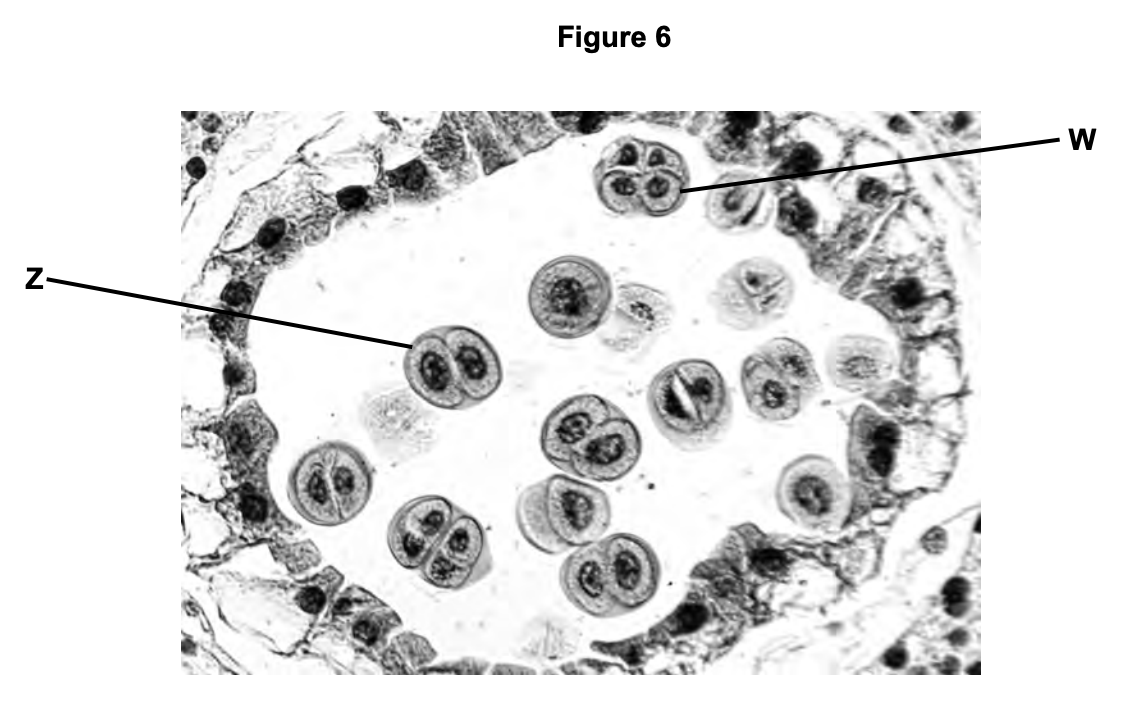
Answer
Mark Scheme
- W has 4 cells/nuclei since it is at the (end of) 2 nd division (of meiosis) (1 mark)
- Z has 2 cells/nuclei since it is at the (end of) 1 st division (of meiosis) (1 mark)
- W shows haploid cells/cells containing n chromosomes (1 mark)
- (Cells in) W contain half the (mass of) DNA of (Cells in) Z; OR (between Z and W) chromatids have separated; OR In Z homologous chromosomes have separated (1 mark)
Comments from mark scheme
Ignore ‘Z shows diploid cells/contains 2n chromosomes’ 4. Accept ‘W contains half the amount of DNA of Z’
An environmental scientist investigated a possible relationship between air pollution and the size of seeds produced by one species of tree.
He was provided with a very large number of seeds collected from a population of trees in the centre of a city and also a very large number of seeds collected from a population of trees in the countryside.
Describe how he should collect and process data from these seeds to investigate whether there is a difference in seed size between these two populations of trees.
(5 marks)Answer
Mark Scheme
- Use random sample of seeds (from each population) (1 mark)
- Use (large enough) sample to be representative of whole population (1 mark)
- Indication of what size was measured eg mass (1 mark)
- Calculate a mean and standard deviation (for each population) (1 mark)
- Use the (Student’s) t-test (1 mark)
- Analyse whether there is a significant difference between (the means of) the two populations (1 mark)
Comments from mark scheme
- Accept described, suitable method of random sampling.
- Reject description of inappropriate method of random sampling (eg random coordinates in the field/use of quadrats)
- Accept ‘running mean does not change’
- For representative accept ‘reliable, reproducible, repeatable’ OR a mean close to the true value.
- Accept ‘Use 95% confidence limits’
- Reject unqualified references to results being significant
Figure 1 shows a drawing of a neuromuscular junction.
Name the parts labelled A to D. A = B = C = D =
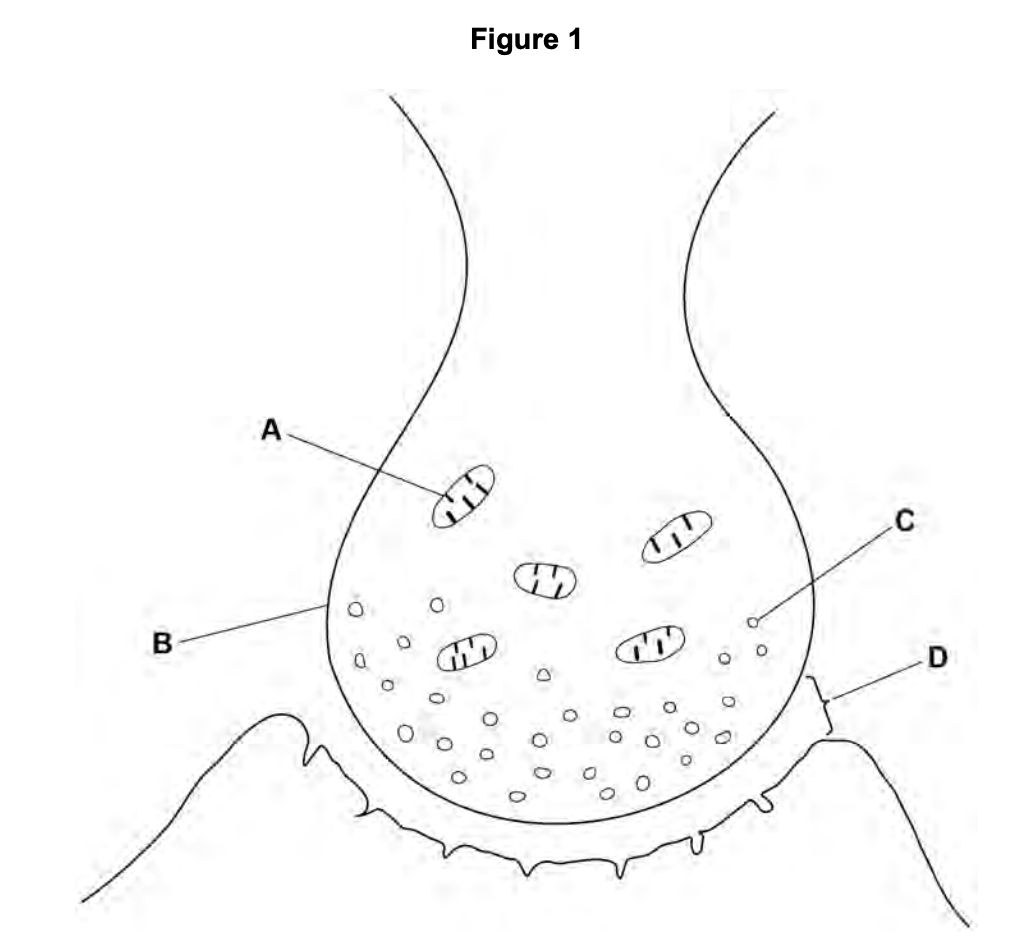
Hint
Look at each labelled structure carefully. What is the specific name for each part, not the contents or process it’s involved in?
Answer
Mark Scheme
A = B = C = D =
Comments from mark scheme
4 correct = 2 marks 2–3 correct = 1 mark 0–1 correct = 0 marks A. Accept mitochondria/crista(e). B. Accept synaptic knob/bulb or motor neurone. B. Accept nerve cell for neurone.
Tips from examiner reports
- ~41% got both marks.
- Common errors: Part C (vesicle) called ‘acetylcholine’ or ‘neurotransmitter’. Part D called ‘synapse’ instead of ‘synaptic cleft’.
- Tips: Name the structure, not what’s inside it.
Following the release of acetylcholine into a neuromuscular junction, a muscle contraction occurs.
Describe the sequence of events, following the release of acetylcholine, that leads to stimulation of this contraction. Do not include in your answer the events following the release of calcium ions in the myofibril.
(4 marks)Hint
Follow the sequence: What crosses the cleft? Where does it bind? What ions enter? Where do calcium ions come from in muscle?
Answer
Mark Scheme
- Acetylcholine/neurotransmitter diffuses (across synaptic cleft) (1 mark)
- (Acetylcholine/neurotransmitter) attaches to receptors on the sarcolemma (1 mark)
- Sodium ions enter leading to depolarisation/action potential (1 mark)
- Calcium (ions) released by endoplasmic/sarcoplasmic reticulum (1 mark)
Comments from mark scheme
1 and 2. Accept abbreviations for acetylcholine as term is in the question. 1, 2 and 3. Accept mark points in ‘context of a postsynaptic neurone’. 2. Accept postsynaptic membrane for sarcolemma. 3. Accept Na⁺ for sodium ions. 3. ‘Sodium ion channels opening’ on its own is not enough. 4. Accept Ca²⁺ / Ca (ions not required as given in question).
Tips from examiner reports
- Acetylcholine diffuses across the synaptic cleft (vesicles don’t move across)
- Acetylcholine binds to receptors on the sarcolemma/postsynaptic membrane — say ‘sarcolemma’ not just ‘muscle’
- Binding opens sodium ion channels and sodium ions enter — don’t skip the ion entry step
- Calcium ions are released from the sarcoplasmic reticulum (not into it)
- Only describe the events asked about — don’t go beyond what the question requires
Inhibitory synapses cause hyperpolarisation in postsynaptic neurones.
Explain how this inhibits synaptic transmission.
(2 marks)Hint
What happens to the charge inside a hyperpolarised neurone? How does this affect the amount of depolarisation needed to reach threshold?
Answer
Mark Scheme
- (Inside postsynaptic neurone/membrane/axon) is more negative OR Membrane/neurone/axon) potential is below resting potential OR Potential difference (across membrane) is greater (1 mark)
- More sodium ions (required to enter) for depolarisation OR More sodium ions (required to enter) for action potential OR Prevents sodium ions causing depolarisation (1 mark)
Comments from mark scheme
- Accept answers which refer to a ‘decrease in the resting potential’.
- Accept answers which refer to ‘reduces/lowers potential’ but not ‘reduces potential difference’.
- Accept p d for potential difference.
- Accept to ‘reach threshold’ or ‘generator potential’ for ‘action potential’.
- Accept Na⁺ for sodium ions
Tips from examiner reports
- During hyperpolarisation, the inside of the neurone becomes more negative than resting potential
- This means more sodium ions are needed to reach the threshold for depolarisation, inhibiting transmission
- Say ‘sodium ions’ not just ‘sodium’ — the charge on the ion matters
- Chloride ion entry or potassium ion loss causes the increased negativity
Figure 2 shows part of a relaxed myofibril. The myofibril represented in Figure 2 has 34 sarcomeres. The length of every sarcomere is 2 µm.
After contraction of this myofibril, the length of each sarcomere changed by 20%. Use the information provided to calculate the length of the myofibril after contraction.
Give your answer in mm and in standard form. Show your working
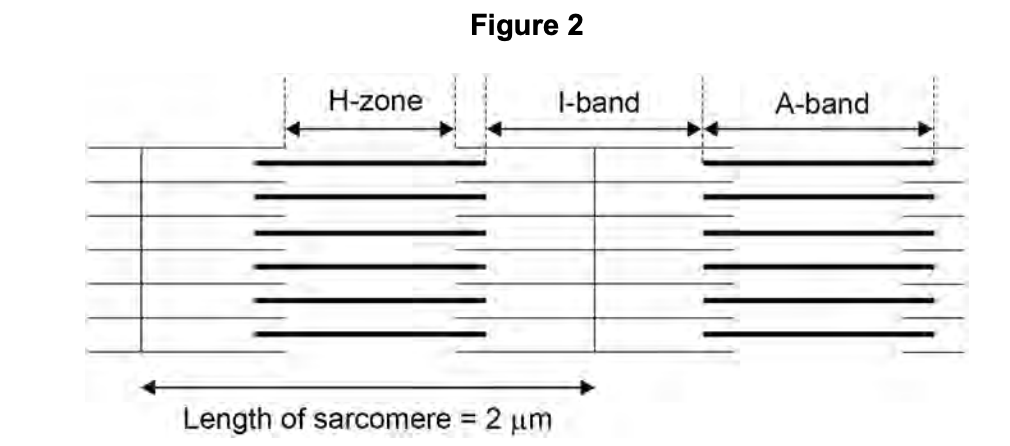
Hint
Calculate the new length after 20% increase, then multiply by number of sarcomeres. Check units and express in standard form.
Answer
Mark Scheme
- Correct answer of 5 / 5.4 / 5.44 x 10⁻² = 2 marks (1 mark)
- Incorrect answer but shows 5 / 54 / 544 (ignore position of any decimal point or preceding/subsequent zeros) = 1 mark (1 mark)
Comments from mark scheme
10⁻² is essential for two marks.
Tips from examiner reports
- Show your working in calculations and give the final answer in standard form if required
- Apply percentage changes correctly: 20% increase means multiply by 1.2, then calculate with the new value
- Don’t confuse 20% of 2 with 20% of the final answer
Which statement correctly describes the changes in length in a sarcomere when a myofibril contracts?
(1 marks)Hint
Remember which bands/zones change during contraction and which stay the same length.
Answer
Mark Scheme
- H-zone decreases, I-band decreases, A-band no change (1 mark)
Tips from examiner reports
- During muscle contraction: the H-zone and I-band get shorter, the A-band stays the same length, the sarcomere shortens overall
Fast muscle fibres have a higher concentration of glycogen than slow muscle fibres.
Explain how the difference in glycogen concentration is related to the different properties of these muscle fibres.
(4 marks)Hint
Compare fast and slow fibres for: contraction speed, duration of use, respiration type, ATP production rate. What is glycogen’s role?
Answer
Mark Scheme
- Fast (fibres) contract quickly whereas slow (fibres) contract slowly OR Fast (fibres) used for short time whereas slow(fibres) used for long time (1 mark)
- Fast (fibres mainly) use anaerobic respiration OR Slow (fibres) use aerobic respiration (1 mark)
- Fast (fibres) produce ATP quickly OR Slow (fibres) produce ATP slowly OR Less ATP/energy (per glucose) from anaerobic respiration OR More ATP/energy (per glucose) from aerobic respiration (1 mark)
- Glycogen is a store of glucose OR Glycogen hydrolysed to glucose OR Glycogenolysis (1 mark)
Comments from mark scheme
- Accept fast contract quicker OR slow contract slower OR fast used for shorter time OR slow used for longer time.
- Accept examples of short-time / power exercise e.g., sprinting, weightlifting and long-time exercise e.g., marathon, endurance.
- Accept ‘release energy’ for ‘produce ATP’ in first and second statements.
- Reject ‘produce energy’.
- Ignore number of ATP molecules produced but comparison must be correct.
Tips from examiner reports
- Compare fast and slow muscle fibres directly — mention both types, not just one
- Fast fibres use anaerobic respiration; slow fibres use aerobic respiration — say ‘use anaerobic/aerobic respiration’ not just ‘work anaerobically’
- Glycogen is hydrolysed to glucose (glycogenolysis) — don’t confuse with glycolysis
- Anaerobic respiration produces only 2 ATP per glucose, which is less than aerobic (but is produced quickly)
- Say ‘ATP is produced’ not ‘energy is produced’
A biologist investigated photosynthesis. They:
- measured the percentage of light absorbed by a plant when it was exposed to different wavelengths
- measured the rate of photosynthesis at each wavelength of light.
Figure 3 shows the results they obtained.
Using Figure 3, what can you conclude about the relationship between:
- the percentage of light absorbed and the rate of photosynthesis
- the colour of light and the rate of photosynthesis
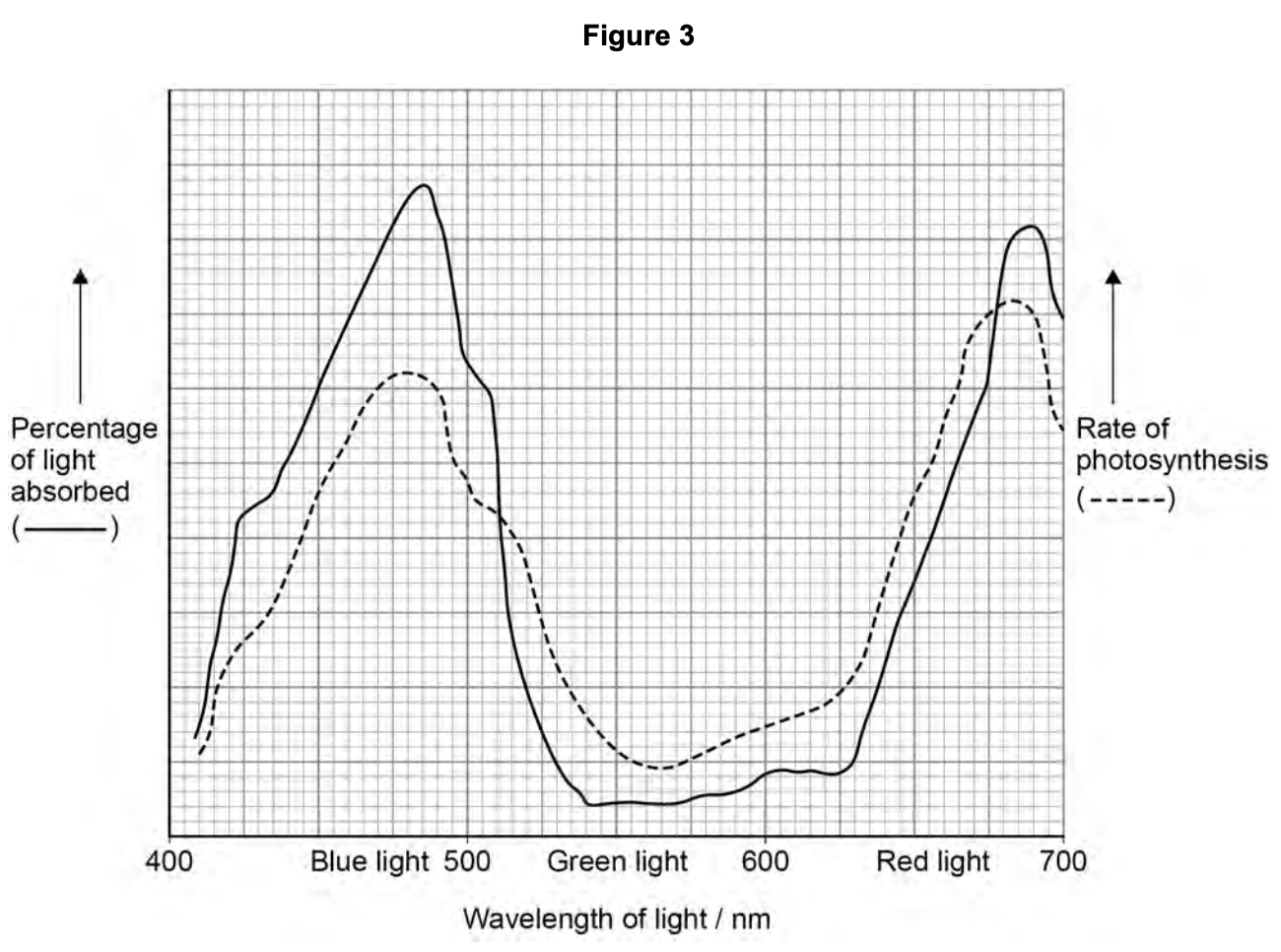
Hint
Describe relationships for BOTH: light absorption vs photosynthesis rate, AND different colours. Don’t forget to mention what happens with green light.
Answer
Mark Scheme
- (Percentage of light absorbed at each wavelength) correlates (with rate of photosynthesis) (1 mark)
- High(er)/increases (rate of photosynthesis) with blue and red light and low(er) /decreases (rate of photosynthesis) with green light (1 mark)
Comments from mark scheme
- Accept description of correlates e.g. as % light absorbed increases so does photosynthesis or converse.
- Ignore directly proportional.
- Ignore wavelength.
- Reject ‘no photosynthesis with green light’.
- Accept other words which are equivalent to ‘high(er)’ and ‘low(er)’.
Tips from examiner reports
- When describing absorption spectra, mention all key colours including green (which is mostly reflected, not absorbed)
- Link colour of light to rate of photosynthesis — don’t just say green is reflected without mentioning the effect on photosynthesis
- Refer to colours, not just wavelengths, if the question asks about colour
Give three environmental factors that should be controlled when measuring the rate of photosynthesis in this investigation. Do not include features of the plant in your answer.
(2 marks)Hint
Think about factors that directly affect the rate of photosynthesis. Be specific with terminology.
Answer
Mark Scheme
- Intensity/brightness of light (at each wavelength) (1 mark)
- Carbon dioxide concentration (1 mark)
- Temperature (1 mark)
- Water / Humidity (1 mark)
Comments from mark scheme
3 correct = 2 marks 2 correct = 1 mark 0–1 correct = 0 marks Ignore pH and nutrients.
- Accept ‘distance of/from light source’.
- Reject sunlight.
- Accept conc. for concentration.
- Accept water potential/Ψ (of soil).
Tips from examiner reports
- Name limiting factors precisely: ‘light intensity’ not ‘amount of light’, ‘carbon dioxide concentration’ not ‘amount of CO₂’
- pH of soil and nutrient content are not limiting factors of photosynthesis
Describe how the products of the light-dependent reaction are used in the light-independent reaction to produce triose phosphate. Do not include the role of ribulose bisphosphate (RuBP) in your answer.
(3 marks)Hint
Name the two products from light-dependent reactions used in the Calvin cycle. What does each one provide for the conversion of GP to TP?
Answer
Mark Scheme
- ATP and reduced NADP (1 mark)
- ATP provides energy (1 mark)
- GP reduced to triose phosphate (1 mark)
Comments from mark scheme
1 Accept NADPH or NADPH2 or NADP + H for reduced NADP. 3. Must have idea of reduction. This may be conveyed by stating GP converted to triose phosphate using reduced NADP. 3. Accept TP for triose phosphate as triose phosphate is named in the question. 3. If GP named it must be correct.
Tips from examiner reports
- The light-dependent reaction produces ATP and reduced NADP — both are used in the light-independent reaction
- Reduced NADP reduces GP to TP — this is a reduction, not an oxidation
- Say ‘reduced NADP’ not ‘reduced NAD’ — they are different molecules
- Don’t confuse molecules from photosynthesis with those from respiration (pyruvate, acetyl CoA)
- GP is glycerate 3-phosphate — if you name it, get the name right
In fruit flies, a gene for body colour has a dominant allele for grey body, G, and a recessive allele for black body, g.
Explain how you would determine if the genotype of a grey fly is homozygous or heterozygous for body colour.
(2 marks)Hint
To determine if a dominant phenotype is homozygous or heterozygous, what genotype should you cross it with? What offspring ratios would you expect?
Answer
Mark Scheme
- Cross with homozygous recessive (fly) OR Cross with a black (fly) OR Cross with gg (fly) (1 mark)
- Black offspring/flies then is heterozygous/Gg OR Black and grey offspring/flies then is Heterozygous/Gg OR No black offspring/flies then is homozygous/GG OR All grey offspring/flies then is homozygous/GG (1 mark)
Comments from mark scheme
- Accept cross with heterozygous (fly) Alternative mark scheme, if cross not used. Mark as pairs 3 with 4, and 5 with 6.
- DNA base sequencing;
- Compare base sequence with known alleles;
- Separate alleles using electrophoresis;
- Use gene/DNA probes to identify alleles OR Compare position/banding with known alleles OR Homozygous forms one band, heterozygous forms two bands;
Tips from examiner reports
- To determine genotype of a grey fly: cross it with a homozygous recessive (black) fly — this is a test cross
- Explain what the offspring ratios would tell you (all grey = homozygous dominant; mix of grey and black = heterozygous)
- You can also cross with a known heterozygous fly, but you must explain the expected outcomes
- Don’t just say ‘use a Punnett square’ — that’s a tool for prediction, not a breeding experiment
In fruit flies, males are XY and females are XX. A cross between a grey-bodied male fly and a black-bodied female fly produced some black-bodied females.
Explain how this shows that the gene for body colour is not sex-linked.
(1 marks)Hint
If the gene is on the X chromosome, what allele(s) would the male parent have? What would this mean for female offspring?
Answer
Mark Scheme
- (If sex-linked) grey/male fly would only have / pass on grey/dominant allele OR (If sex-linked) females would receive the grey/ dominant allele OR (If sex-linked) grey/male fly would not have / pass on black/recessive allele OR (If sex-linked) female (offspring) would be grey OR (If sex-linked) no female (offspring) would be black OR (If sex-linked) male (parent) could not have been heterozygous (1 mark)
- OR (If sex-linked) only black male (parent) could produce a black bodied female (1 mark)
Comments from mark scheme
Accept G for dominant allele and g for recessive allele.
Tips from examiner reports
- If a gene is sex-linked (on the X chromosome), a male can only pass his X-linked allele to daughters
- So if the grey male is crossed with a black female and the gene is sex-linked, all daughters would be grey (carrying father’s dominant allele)
- The Y chromosome carries very few genes — don’t say sex-linked genes are on the Y chromosome
A population of fruit flies contained 19% grey-bodied flies.
Use the Hardy–Weinberg equation to calculate the percentage of flies heterozygous for gene G. Show your working.
(2 marks)Hint
What does 2pq represent in Hardy-Weinberg? Make sure you’re using the correct values for p and q from the data given.
Answer
Mark Scheme
- Correct answer of 18 (%) = 2 marks (1 mark)
Incorrect answer but shows understanding that 2pq = OR Incorrect answer but shows understanding that 1 – (p2 + q2 ) =
Comments from mark scheme
- Accept 0.18 for one mark.
- Accept understanding of 2pq by using a calculation involving 2 x two different numbers.
Tips from examiner reports
- In Hardy-Weinberg: 2pq gives the frequency of heterozygotes — don’t divide by 2
- Make sure you identify the correct values of p and q from the data before calculating
- The equation is p² + 2pq + q² = 1 — don’t write 2pq² instead of 2pq
- You can also calculate heterozygote frequency as 1 - p² - q²
In fruit flies, a gene for wing shape has a dominant allele for curly wings, R, and a recessive allele for normal wings, r. The alleles for this gene are on a different pair of chromosomes from the gene for body colour. Fruit flies that are homozygous dominant for curly wings do not survive beyond the embryo stage.
A curly-winged fly, homozygous for grey body colour was crossed with a curly-winged, black-bodied fly.
Complete the genetic diagram to show all the possible genotypes and the ratio of phenotypes expected to develop into adults from this cross.
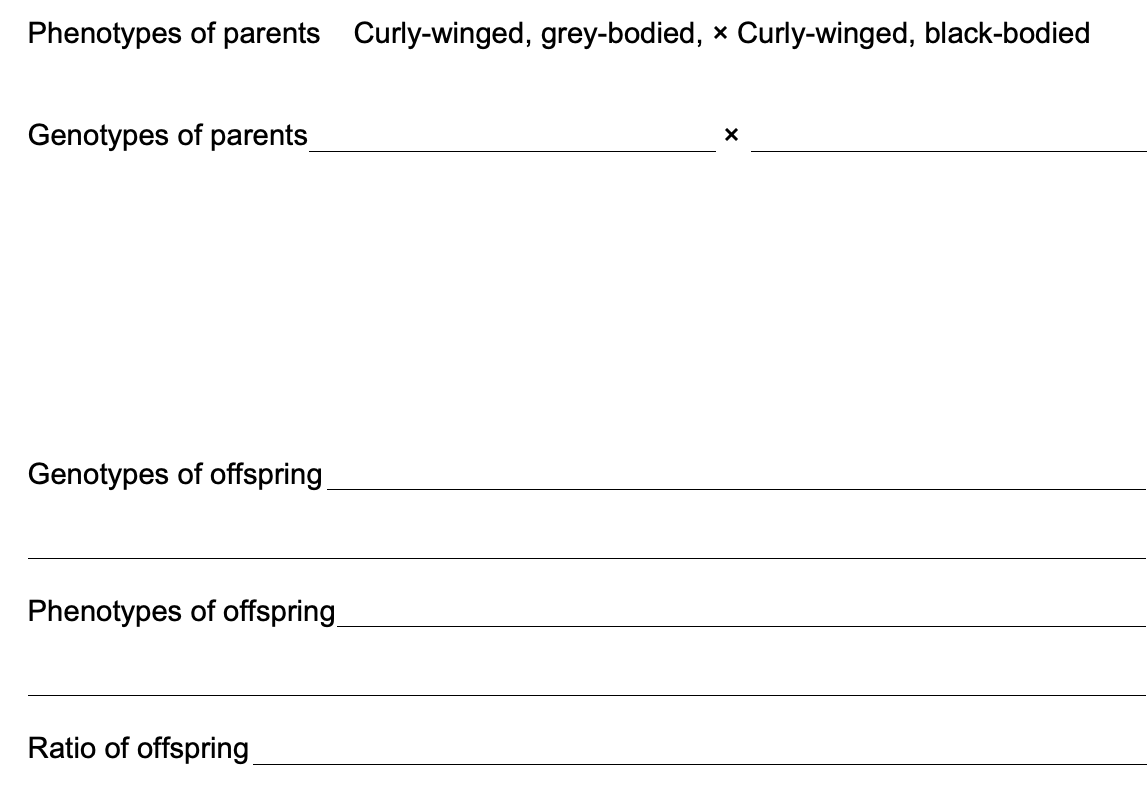
Hint
Set up the dihybrid cross correctly. Remember to exclude any genotypes that don’t survive (as stated in the question) when calculating the final ratio.
Answer
Mark Scheme
- RrGG and Rrgg (1 mark)
- RrGg, (x2), rrGg, (and RRGg) (1 mark)
- Curly(-winged), grey(-bodied) and Normal(-winged), grey(-bodied) and ratio 2 : 1 (1 mark)
Comments from mark scheme
1 and 2. Accept the alleles in any order e.g. RGrG and accept if not shown on answer lines. Accept if different letters than shown are used for the alleles. 3. Accept ratios equivalent to 2 : 1. Note: If no mark awarded allow one (principle) mark when parental genotypes are incorrect but correct dihybrid genotypes shown for offspring from this cross.
Tips from examiner reports
- In dihybrid crosses, write out parental genotypes carefully, then produce a full genetic diagram
- Read the question for special conditions — e.g. if homozygous dominant organisms don’t survive, remove them from the offspring ratio
- A lethal allele changes the expected ratio (e.g. 9:3:3:1 becomes modified)
- Show genotypes and phenotypes of offspring clearly
A weed is a plant growing where it is not wanted. Fat hen is a weed which grows in some crop fields.
Describe how you could estimate the number of fat hen plants in a field.
(5 marks)Hint
Describe: grid setup, random sampling method, what to count, sample size for reliability. How do you scale up from quadrat to whole field?
Answer
Mark Scheme
- Use a grid OR Divide field/area into squares (1 mark)
- Method of obtaining random coordinates/numbers e.g. calculator/computer/random numbers table/generator (1 mark)
- Count number/frequency in a quadrat (1 mark)
- Large sample and calculate mean number (per quadrat) (1 mark)
- Multiply mean number of plants per m² by area of field OR Divide area of field by area of quadrat x mean number of plants per quadrat OR Multiply mean number of plants per quadrat/section by number of quadrats/sections in field (1 mark)
Comments from mark scheme
measures/map/area with coordinates.
- Accept Belt transect.
- If transect method used accept quadrats at regular intervals.
- Ignore amount/abundance. 3, 4 and 5. Accept sections/squares for quadrats. 4 and 5. Accept ‘average’ for ‘mean’.
- Accept large sample and method of calculating mean.
- Accept many/multiple for large sample but ignore several.
- If a specific number is given it must be 10 or more.
- Do not allow ‘scale up’ without further qualification.
Tips from examiner reports
- For estimating population size: place quadrats randomly using coordinates from a random number generator
- Count the organisms per quadrat, take a large sample (10+), calculate the mean
- To estimate total population: (area of field ÷ area of quadrat) × mean count per quadrat
- Don’t say ‘throw quadrats’ — use random coordinates
- ‘Scaling up’ alone isn’t enough — show the calculation method
In potato plant fields, fat hen plants can grow up to a height of 2 m and absorb large quantities of nutrients from the soil.
Fat hen has a negative effect on the growth of potato plants.
Use the information provided to explain why.
In your answer, name the type of competition occurring between fat hen plants and potato plants.
(3 marks)Hint
What type of competition is it between different species? What resources might plants compete for? Link each resource to specific biological molecules.
Answer
Mark Scheme
- Interspecific (competition) (1 mark)
- Less/no light (for potato plant) so less/no photosynthesis (1 mark)
- Less nitrates/nitrogen to produce amino acids/protein/DNA/RNA/ATP OR Less phosphate/phosphorus to produce DNA/RNA/phospholipids/RuBP/GP/triose phosphate/NADP/ATP (1 mark)
Comments from mark scheme
- Accept any named organic nitrogen or phosphorus containing molecule.
Tips from examiner reports
- Competition between different species is interspecific (not intraspecific, which is within the same species)
- Lack of nitrates/phosphates affects production of specific molecules: DNA, RNA, ATP, amino acids, proteins
- Competition for light reduces photosynthesis — say this rather than just ‘affects growth’
- Be specific about which resources are competed for and their biological importance
Table 1 gives some features of fat hen seeds. During a growing season, it was estimated that a total number of 550 fat hen plants grew on the fields of a farm.
Calculate the maximum mass, in kg, of viable fat hen seeds on this farm after a growing season. Show your working. Assume that all the seeds produced during the growing season remain on the farm. (Answer in kg)
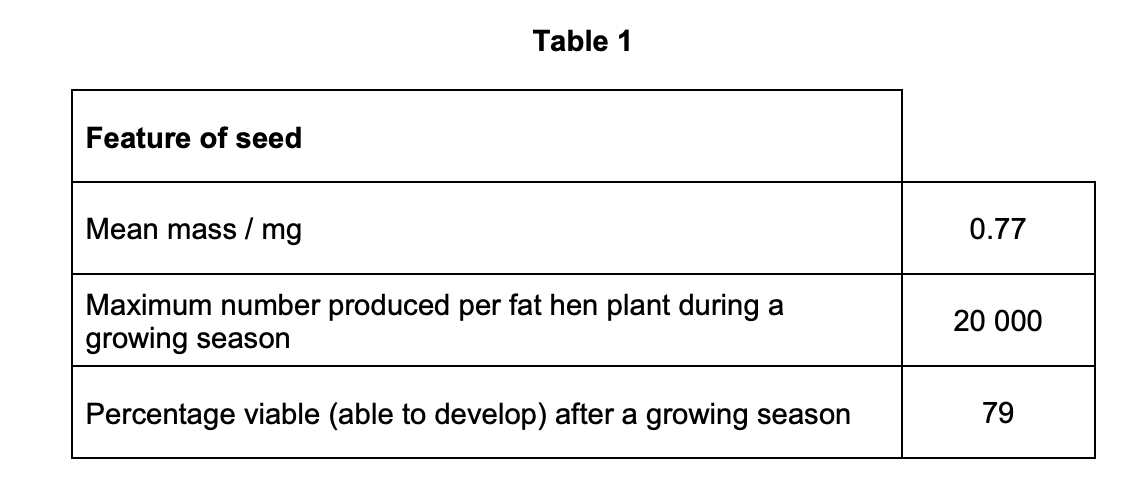
Hint
Include all factors: number of plants, seeds per plant, viability percentage, mass per seed. Check your units for the final answer.
Answer
Mark Scheme
- Correct answer of 6.69 / 6.7 = 2 marks (1 mark)
Incorrect answer but shows 669 / 67 (ignore position of any decimal point or preceding / subsequent zeros or numbers following 669) = OR Shows 0.012 = OR Shows 8.47 / 8.5 = OR Shows 8.69 = OR Shows 3.35 x 10⁻⁴ (in any correct mathematical form) =
Comments from mark scheme
Ignore any numbers after 6.69 Ignore any numbers after 0.012 Ignore any numbers after 8.47 / 8.5 Accept answers which would round to 3.35 x 10⁻⁴ for 1 mark.
Tips from examiner reports
- In multi-step calculations, include every piece of data given (e.g. number of plants, seeds per plant, viability percentage, mass per seed)
- Convert units correctly — if the answer is required in kg, convert from g or mg
- Show your working to earn partial marks even if the final answer is wrong
Describe the myogenic stimulation of the heart and how the regular contraction of the atria and ventricles is coordinated. Do not include the autonomic nervous system in your answer
(5 marks)Hint
Trace the pathway: Where do impulses originate? What does this stimulate? Where do they go next? Why is there a delay? How do they reach the ventricles?
Answer
Mark Scheme
- SAN releases (wave of) electrical activity (1 mark)
- (So) atria contract (at the same time) (1 mark)
- AVN relays/passes electrical activity after a (short) delay (1 mark)
- (Via) Purkyne tissue in/and bundle of His (1 mark)
- (So) ventricles contract (at the same time from bottom u (1 mark)
Comments from mark scheme
Penalise one mark for incorrect sequence. 1 and 3. Accept ‘impulse/s’ or ‘wave of depolarisation’ for electrical activity but reject ‘signal’, ‘message’ once only. 1 and 3. Accept ‘wave of excitation’. 2 and 5. Accept systole for ‘contract’. 4. Accept ‘Purkinje’ for Purkyne or similar spelling. If only the cardiac cycle is described allow one mark max atria contract and then ventricles contract.
Tips from examiner reports
- Know the cardiac conduction sequence: SAN → atrial contraction → AVN (with delay) → bundle of His → Purkyne tissue → ventricular contraction
- Don’t forget that the SAN stimulates atrial contraction before impulses reach the AVN
- Include the delay at the AVN — this allows the atria to empty before the ventricles contract
- Don’t confuse the SAN with the AVN
- If the question says don’t include the autonomic nervous system, don’t include it
Atrial fibrillation (AF) is a condition that causes an irregular heart rate. Scientists used a statistical test to investigate the association between different factors and the risk of developing AF.
Table 2 shows some of the scientists’ results, including the probability (P) values obtained using the statistical test.
What can you conclude from Table 2?
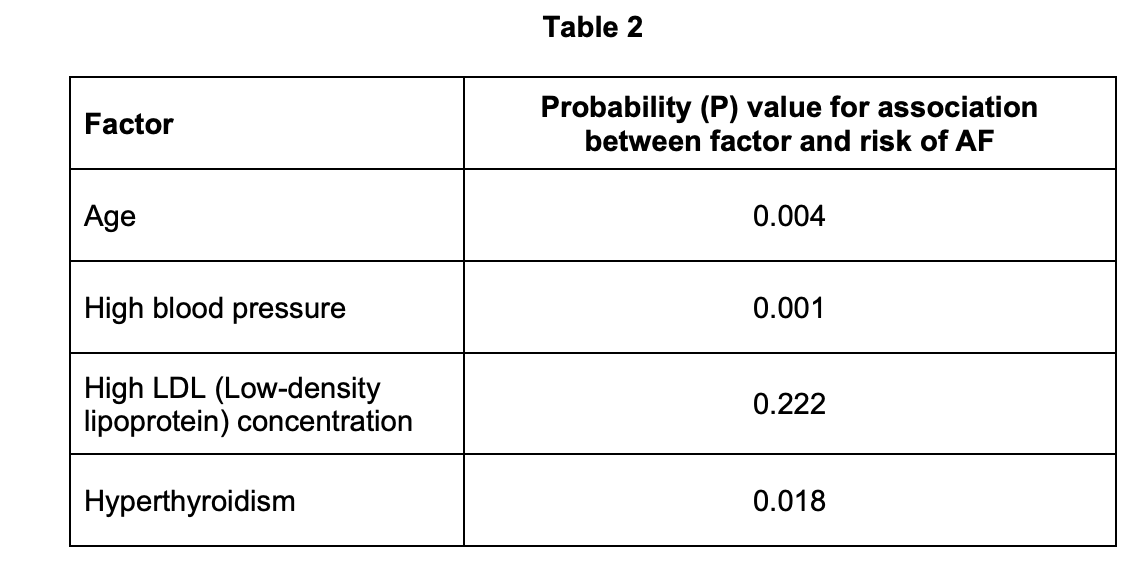
Hint
Remember: LOW p-value = significant (unlikely due to chance). HIGH p-value = not significant. Which factor has the lowest p-value?
Answer
Mark Scheme
- Significant with age, hyperthyroidism, and high blood pressure OR High risk (of AF) with age, hyperthyroidism and high blood pressure (1 mark)
- Most significant with high blood pressure OR Highest risk (of AF) with high blood pressure OR Least significant with hyperthyroidism (1 mark)
- Not significant with high LDL OR High LDL is not a (AF) risk factor (1 mark)
- (With) age, high blood pressure and hyperthyroidism reject the null hypothesis OR (With) high LDL accept the null hypothesis (1 mark)
Comments from mark scheme
1, 2 and 3. Reject ‘results are significant’ / ‘results not significant’ once only. 1, 2 and 3. Accept ‘significant difference’ or ‘no significant difference’. 1 and 2. Accept ‘not due to chance’ for ‘significant’. 1 and 2. Accept descriptions of ‘high and highest (risk) e.g. ‘more likely’ and ‘most likely’. 3. Accept ‘due to chance’ for ‘not significant’
Tips from examiner reports
- A high probability value (e.g. p > 0.05) means the difference is NOT significant — the result could be due to chance
- A low probability value (e.g. p < 0.05) means the difference IS significant
- Say ‘the difference is significant’ not ‘the results are significant’
- Don’t confuse high probability with high risk
BamH1 and HindIII are both restriction endonucleases. Figure 4 shows the positions where these enzymes cut a linear molecule of DNA.
In two experiments, multiple copies of the DNA molecule shown in Figure 4 were all completely cut into fragments using these restriction enzymes. The DNA fragments produced were then separated by electrophoresis. Experiment 1 – DNA cut into fragments using BamH1. Experiment 2 – DNA cut into fragments using BamH1 and HindIII.
Complete Figure 5 to show the relative positions of the bands following box electrophoresis in experiments 1 and 2.
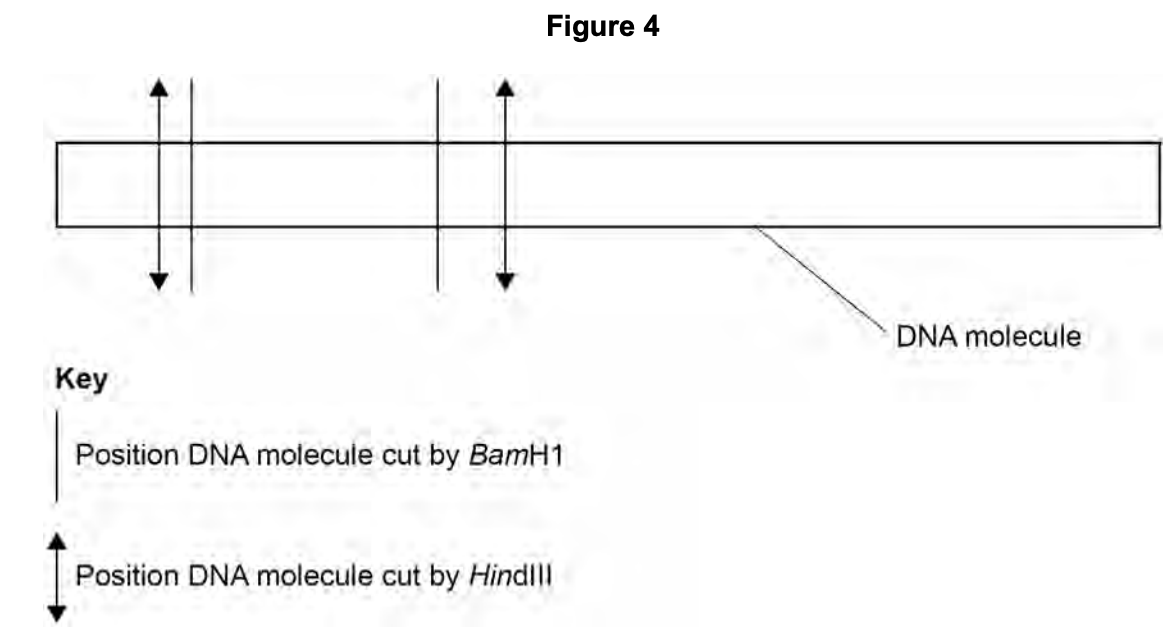
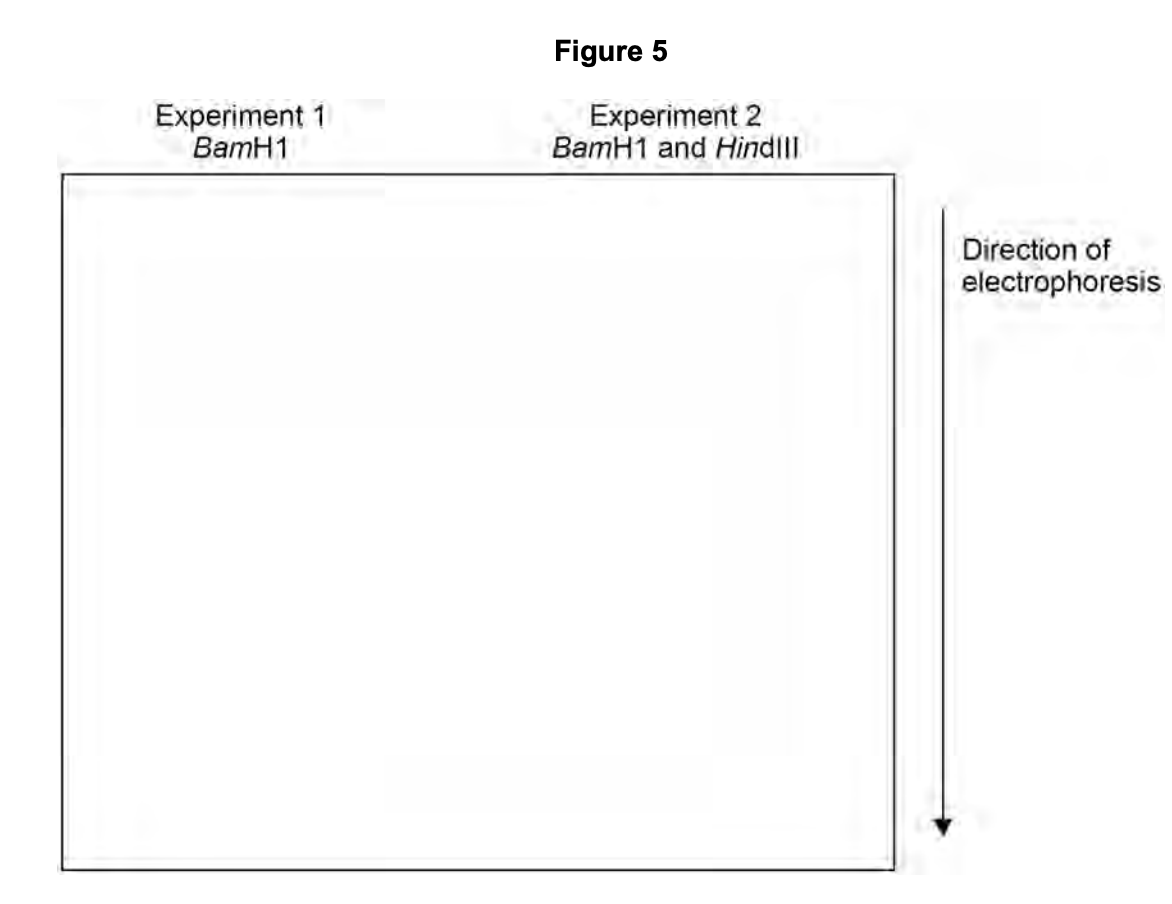
Hint
Count the number of restriction sites in each experiment. How many fragments does this produce? Remember: n cuts = n+1 fragments.
Answer
Mark Scheme
- Experiment 1 with 3 bands and experiment 2 with 5 bands in correct positions = 2 marks (1 mark)
- Experiment 1 with 3 bands and experiment 2 with 5 bands but not in correct positions = 1 mark (1 mark)
Comments from mark scheme
For two marks, the position of the second band from the top must be in the same position for both experiments. The lengths of the bands do not need to be the same, but the relative positions should be similar to the diagram shown.
Tips from examiner reports
- Understand how restriction enzymes cut DNA at specific recognition sequences and how gel electrophoresis separates fragments by size
- Different numbers of restriction sites produce different numbers of fragments/bands
- Practise interpreting gel electrophoresis diagrams — shorter fragments travel further
Suggest how you could determine the size of the different DNA fragments produced in these experiments.
(2 marks)Hint
How can you determine the size of an unknown DNA fragment after electrophoresis? What do you need to compare it to?
Answer
Mark Scheme
- (Separate) DNA fragments/ladder of known sizes/lengths (1 mark)
- Compare position/distance/bands with unknown fragment (1 mark)
Comments from mark scheme
- Ignore mass
Tips from examiner reports
- To determine fragment sizes from a gel, compare fragment positions with a DNA ladder of known sizes
- Don’t just describe how electrophoresis works — answer the specific question about how fragment sizes are determined
How many DNA fragments would be produced in experiment 2 if the original DNA molecule was a plasmid?
(1 marks)Hint
Look at the restriction map. How many times does the enzyme cut in experiment 2? Remember the relationship between cuts and fragments.
Answer
Mark Scheme
- 4 or four (1 mark)
Tips from examiner reports
- Count restriction sites carefully — the number of fragments = number of cuts + 1 (for linear DNA) or = number of cuts (for circular DNA)
Describe how restriction endonuclease and DNA ligase are used to insert a gene into a plasmid.
(2 marks)Hint
What does each enzyme do? One cuts, one joins. What specific features are produced/used in this process?
Answer
Mark Scheme
- Restriction endonucleases/enzymes cuts plasmid OR Restriction endonucleases/enzymes produce ‘sticky ends’ (1 mark)
- Ligase joins gene/DNA and plasmid OR Ligase joins ‘sticky ends’ OR Ligase forms phosphodiester bonds (1 mark)
Comments from mark scheme
- Accept ‘cuts DNA of plasmid’.
- Ignore restriction enzymes cuts out the gene.
- Ignore reference to hydrogen bonds or joining complementary base pairs.
Tips from examiner reports
- Restriction endonuclease cuts DNA at specific recognition sequences and creates sticky ends
- DNA ligase joins DNA fragments together by forming phosphodiester bonds — it doesn’t cut DNA or create sticky ends
- Don’t confuse the roles of these two enzymes
Plant cells are surrounded by a rigid cell wall. Cell wall plasticity refers to the ability of box a cell wall to stretch permanently. IAA is a growth factor which can activate enzymes that loosen the cell wall. Scientists investigated the effect of IAA concentration on cell wall plasticity and the growth of stem segments. Figure 6 shows some of the scientists’ results.
Use the information provided to explain the relationship between IAA concentration, cell wall plasticity and mean growth of the stem segments.
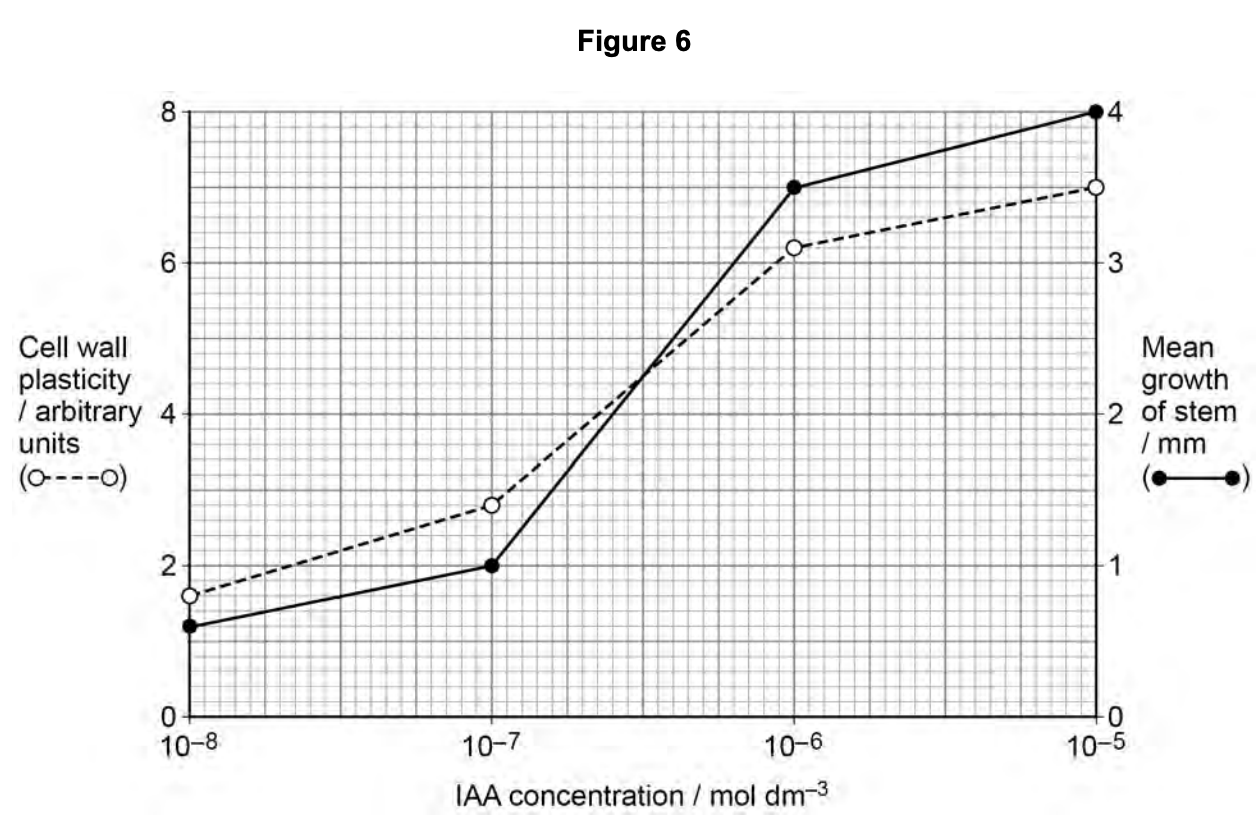
Hint
What does IAA do to cell wall plasticity? How does changing plasticity allow the cell to grow?
Answer
Mark Scheme
- Increasing IAA concentration increases (cell wall) plasticity OR IAA activates enzymes which increases (cell wall) plasticity (1 mark)
- Increase in (cell wall) plasticity results in cell elongation (1 mark)
Comments from mark scheme
1 and 2. Accept ‘stretching’ for plasticity, Reject ‘elasticity’ once only. 2. Idea of cell elongation or increase in cell length must be conveyed. 2. IAA causing cell elongation on its own is not enough.
Tips from examiner reports
- Read negative indices carefully: 10⁻⁸ is a lower concentration than 10⁻⁵
- If IAA increases cell wall plasticity, explain HOW this leads to cell elongation — don’t just say ‘IAA causes growth’
- Link plasticity to the cell wall being able to stretch, allowing water uptake and cell elongation
Use Figure 6 to calculate the percentage increase in mean growth of the stem segments when the IAA concentration was increased from 10–8 mol dm⁻³ to 10⁻⁵ mol dm⁻³ Give your answer to 2 significant figures. Show your working. (Answer as %)
(2 marks)Hint
Check which axis you need to use for the calculation. Calculate percentage increase and give your answer to the specified number of significant figures.
Answer
Mark Scheme
- Correct answer of 570 (%) = 2 marks (1 mark)
- (However, if working shows plasticity values used, e.g. 8 and 1.2 (or difference of 6.8) and answer of 570 (%) = 1 mark) Answer or working shows 560 / 566 / 567 (%) = 1 mark (However, if working shows plasticity values used, e.g. 8 and 1.2 (or difference of 6.8) and answer of 560 / 566 / 567 (%) = 0 marks) Answer of 120 (%) = 1 mark OR Answer of 230 (%) = 1 mark OR Answer of 340 (%) = 1 mark OR Answer of 780 (%) = 1 mark OR Answer of 1200 (%) = 1 mark (1 mark)
Comments from mark scheme
Accept 566 recurring for one mark. Ignore any numbers after 560 or 566 or 567.
Tips from examiner reports
- Read axis labels carefully — make sure you’re reading values from the correct axis
- Give your answer to the number of significant figures specified in the question
- Percentage increase = (new - original) / original × 100
Gibberellic acid (GA) is another plant growth factor. A student was asked to design box and carry out an investigation into the effect of different concentrations of GA on the growth of stem segments. The student was provided with:
Describe how the technician produced the 10⁻³ mol dm⁻³ solution.
- 10⁻¹, 10⁻², 10⁻³, 10⁻⁴ and 10⁻⁵ mol dm⁻³ concentrations of GA solution
- distilled water
- 6 Petri dishes and access to glassware
- 60 stem segments of different lengths. A technician produced the different concentrations of GA solution from a stock 10⁻¹ mol dm⁻³ concentration of GA.
Hint
What dilution factor do you need? Express this as a ratio of stock solution to water.
Answer
Mark Scheme
- 1 part/cm³ of 10⁻¹ /stock/GA and/to 9 parts/cm³ of (distilled) water, then 1 part/cm³ (of 10⁻² ) and/to 9 parts/cm³ of (distilled) water OR 0.1 parts/cm³ of 10⁻¹/stock/GA and/to 9.9 parts/cm³ of (distilled) water (1 mark)
Comments from mark scheme
Accept any volumes equivalent in parts to example provided. Accept ‘1 part/cm³ of 10⁻¹ /stock/GA and/to 9 parts/cm³ of (distilled) water, then repeat’.
Tips from examiner reports
- To make a dilution: state the volumes of stock solution and distilled water needed
- For a 100× dilution: mix 1 part stock with 99 parts water (e.g. 1 cm³ + 99 cm³)
- Or do serial dilution: 1 part + 9 parts twice (10× then 10× = 100×)
- Don’t just say ‘dilute with water’ without specifying volumes
Describe a suitable procedure the student could follow to investigate the effect of different concentrations of GA on the growth of stem segments. In your answer, you should include the variables that should be controlled in this investigation.
(5 marks)Hint
Include: control variables (be specific - not ‘amount’), control group (what solution?), measurements (initial AND final), sample size, replicates.
Answer
Mark Scheme
- Max 3 marks from mark points 3 to 8. 1. (Use distilled) water (control) and different (GA) concentrations and 10 (stem) segments in each (1 mark)
-
- Measure (length of) stem/segments at start and at end (of investigation) OR Determine increase/change in length OR Determine percentage change in length (1 mark)
-
- (Place stems in same) volume of solution/GA (1 mark)
-
- (Leave for same period of) time (1 mark)
-
- (Same) temperature (1 mark)
-
- (Same) species/type (of plant) (1 mark)
-
- (Same) age (of plant) (1 mark)
-
- (Same) diameter/thickness of stem/segments (1 mark)
Comments from mark scheme
- Accept use of specified number of segments in each dish with repeats, if total used = 60.
- Accept ‘cut to same length’ = measure at start.
- Accept ‘growth in length’ as ‘increase/change in length’. 3 to 8. Ignore pH, carbon dioxide, humidity, nutrients, and light.
- Accept any ‘named period of time’.
- Accept ‘same plant’.
- Accept (stems) at same stage of growth/development.
Tips from examiner reports
- Control variables: temperature, time, volume of solution, species/age of plant, diameter of segments
- Say ‘volume’ not ‘amount’ when describing solutions
- Measure initial and final length to calculate the change in length
- Include a control (e.g. distilled water with no GA) and use all the available samples
- Use enough replicates to calculate a reliable mean
A person with diabetes is in diabetes remission if their blood glucose concentration is box below the diabetes threshold concentration for at least 3 months. This diabetes remission is achieved without taking medication. Scientists investigated whether a weight-loss programme would result in type II diabetes remission. The scientists:
Give two reasons why a weight-loss programme could be used to treat type II diabetes but not type I diabetes.
- used a computer-generated list to select 380 volunteers from a large number of health centres
- selected volunteers aged 25 to 60 years, each with less than 5 years duration of type II diabetes
- divided the volunteers in the ratio 1 : 1 between experimental group P and control group Q
- placed group P on a weight-loss programme for the 2-year duration of this investigation
- recorded loss of mass and percentage of volunteers in each group in type II diabetes remission after 2 years.
Hint
Compare the two types: What happens to insulin production? What about response to insulin? What causes each type?
Answer
Mark Scheme
- Type l do not produce insulin OR Type lI do produce insulin (1 mark)
- In type II receptors/cells less sensitive/ responsive to insulin OR In type II receptors/cells are insulin ‘resistant’ (1 mark)
- Weight not linked to type l diabetes OR Weight linked to type lI diabetes (1 mark)
Comments from mark scheme
- Accept ‘Type I lack insulin’ or is ‘due to an immune response’ or ‘beta cells nonfunctional’.
- Accept ‘Type I do not produce enough insulin’.
- Accept ‘In Type II faulty/fewer receptors’.
- Accept ‘obesity’ for ‘weight’.
- Accept ‘diet’ and ‘exercise’ for ‘weight’ (as weight-loss programme may involve these).
- Ignore ‘lifestyle’.
Tips from examiner reports
- Type I: autoimmune — beta cells destroyed, no insulin produced
- Type II: cells/receptors become less sensitive to insulin — say ‘receptors’ or ‘cells’, not just ‘the body’
- Type II is linked to specific factors: weight, diet, lack of exercise — say these, not just ‘lifestyle’
The design of this investigation helps to support the validity of any conclusions obtained.
Suggest and explain three features of this investigation that justify this statement
(3 marks)Hint
Identify features of the experimental design that improve validity or reliability. Explain WHY each feature helps.
Answer
Mark Scheme
- Computer-generated list so no bias OR Selection of volunteers was random so no bias (1 mark)
- Large sample size so representative/reliable (1 mark)
- Two years so effect (could be) long term (1 mark)
- Control so comparison possible (1 mark)
- (Large) range/variety of ages so (age range) representative OR (Large) range/variety of ages so age is not a factor (1 mark)
Comments from mark scheme
- Accept ‘large number of health centres’ and accept ‘380/190’ for ‘large sample size’. 2 and 5. Accept ‘generalised’ (to the population) for ‘representative’.
- Accept if answer suggests 4 years.
- Accept ‘long period of time’ for ‘two years’.
- Accept ‘25-60 years’ for ‘(large) range’.
Tips from examiner reports
- Good experimental design features: random selection, large sample size, wide age range, control group, sufficient time period
- Explain WHY each feature is important, not just name it
Table 3 shows some of the scientists’ results.
Use the information provided to calculate the difference in number of volunteers between the two groups who achieved diabetes remission. Show your working.
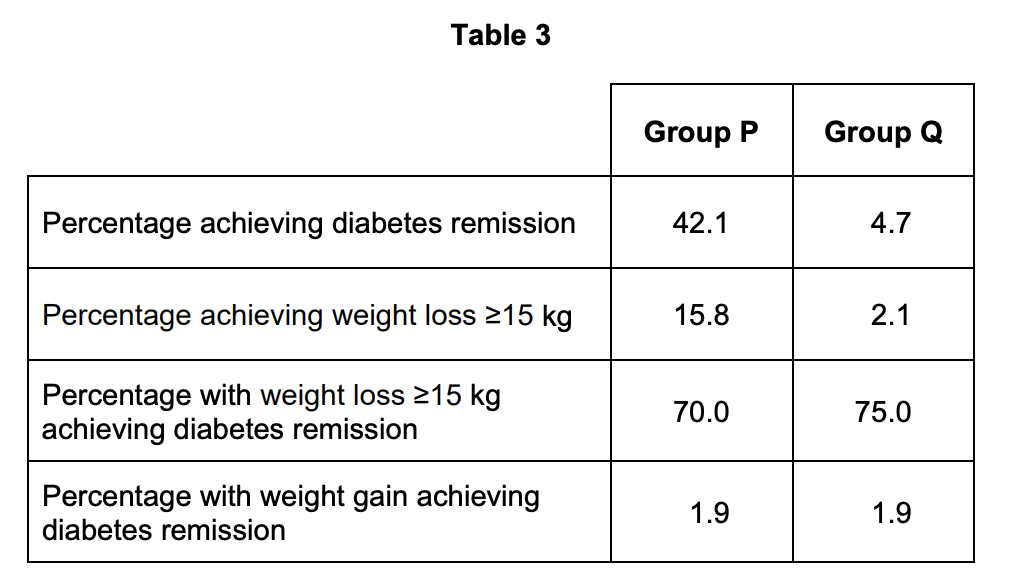
Hint
Calculate the actual number in remission for each group using the percentages given, then find the difference.
Answer
Mark Scheme
- Correct answer of 71 = 2 marks (1 mark)
Answer of 142 = OR 80 OR 9 in working = OR 79.99 OR 8.93 in working =
Comments from mark scheme
Accept for two marks, an answer that rounds up or down to 71. Accept for one mark, an answer that rounds up or down to 142.
Tips from examiner reports
- Use the correct group size in calculations — read the data carefully
- Show each step of your calculation
- Don’t just subtract percentages — calculate the actual numbers first if needed
Use all the information to evaluate whether a weight-loss programme is an effective treatment for type II diabetes.
(4 marks)Hint
Use ALL the data - both groups, both outcomes (remission and weight change). Consider study limitations: time period, age range, baseline data, statistical analysis.
Answer
Mark Scheme
- Max 3 marks from mark points 5 to 9. 1. Percentage/number in remission and percentage/number with weight loss is higher for group P (1 mark)
-
- High percentage with weight loss (≥15 kg) in both groups achieved remission (1 mark)
-
- Some with weight gain achieved remission (1 mark)
-
- Less than 50% in group P achieved remission (1 mark)
- 5.Only shows results for volunteers with less than 5 years of diabetes (1 mark)
-
- No results for those over 60 years (of age) OR No results for those under 25 years of age (1 mark)
-
- No statistical test to see if significant difference (in results) (1 mark)
-
- (Only shows remission) not cure OR Remission not (necessarily) long term (1 mark)
-
- Mass/weight (of volunteers) at beginning not known (1 mark)
Comments from mark scheme
1 Relates to first two rows of data. 2. Relates to third row of data.
- and 2. Accept numerical values/% for ‘high(er)’.
- Relates to fourth row of data.
- Accept ‘1.9%’ for some.
- Accept ‘Only 42.1%’ for less than ‘half’ but not simply ‘42.1%’. Idea of a ‘low’ percentage must be conveyed.
- Accept ‘difference not due to chance’ for ‘significant difference’.
- Reject ‘to see if results are significant’.
- Ignore standard deviation/SD.
Tips from examiner reports
- Use ALL the information provided, including data from tables and the study design
- Quote specific figures to support your evaluation
- A statistical test shows if a difference is significant — say ‘significant difference’, not ‘significant results’
- Consider limitations: age range, diabetes duration, sample size, whether remission is long-term
- Compare between groups, don’t just describe one group
Read the following passage. The wall gecko is a medium-sized lizard. In an isolated habitat of southern Italy, the wall gecko shows phenotypic diversity. Scientists investigated whether disruptive selection was leading to sympatric speciation in the wall gecko. Pale geckos live only on walls and are nocturnal (active at night). Dark geckos live mainly on the dark trunks of olive trees and are diurnal (active during the day). These diurnal geckos can change skin colour when occupying different surfaces during the day. Comparison of mitochondrial genes indicated that the diurnal geckos formed a distinct genetic group. This comparison also confirmed that all the geckos in the habitat were of the same species. The scientists used the mark-release-recapture method to estimate the size of the population of geckos in the habitat. 5 10 Use the information in the passage and your own knowledge to answer the following questions.
The wall gecko shows phenotypic diversity (lines 1–2).
Suggest two factors that have resulted in this phenotypic diversity.
(2 marks)Hint
Think about what creates genetic variation WITHIN a population. Don’t confuse with factors that cause speciation.
Answer
Mark Scheme
- Mutations/genotype/alleles (1 mark)
- Environment/habitat OR (Natural) selection (1 mark)
- Epigenetics (1 mark)
- Crossing over (1 mark)
- Independent segregation/assortment (of homologous chromosomes) (1 mark)
- Random fusion of gametes OR Random fertilisation (1 mark)
Comments from mark scheme
- Accept named different habitats, e.g. ‘walls’ and ‘trees/trunks.
- Accept selection pressure e.g. predation.
- Accept recombination.
- Accept ‘Random assortment’.
Tips from examiner reports
- Sources of genetic variation: mutation, crossing over, independent segregation, random fertilisation, environment, epigenetics
- Don’t give two examples from the same category to try to score two marks
- Geographical isolation and speciation are not sources of variation within a population
The ability of diurnal geckos to change skin colour (lines 7–8) is advantageous. Explain why.
(2 marks)Hint
How does matching the background help survival? Think about predator-prey relationships and what happens to survivors.
Answer
Mark Scheme
- Provides camouflage (1 mark)
- (So) not seen by predators/prey OR Less predation OR Obtain/catch (more) prey (1 mark)
Comments from mark scheme
- Accept description of camouflage.
- Accept ‘stops predation’.
- Accept descriptions of reduced predation e.g. ‘fewer are eaten’.
Tips from examiner reports
- Camouflage helps organisms blend with their background — say ‘blending in’ or ‘harder for predators to see’
- Don’t just say ‘hiding’ without explaining how
- Be clear about which organism is the predator and which is the prey
The scientists concluded that it was probable that disruptive selection was leading to sympatric speciation in the wall gecko.
Use the information in the passage to evaluate this conclusion
(5 marks)Hint
Consider: same species, same habitat but different activity times. What type of selection is occurring? What prevents gene flow? Could speciation occur?
Answer
Mark Scheme
- Mark point 1 required for max marks 1. (Geckos in) same habitat/environment/area OR No geographical isolation/separation (between geckos) (1 mark)
-
- (Possibly) allopatric speciation as different (areas of same) habitat(s)/environment/area OR (Possibly) geographical isolation/separation as different (areas of same) habitat(s) (1 mark)
-
- (Could lead to) separate gene pools OR Reproductive isolation (1 mark)
-
- Mutation(s) (1 mark)
-
- Selection for (both) extremes/colours OR Disruptive selection (occurs) as two extremes/ colours (1 mark)
-
- (Analysis shows that) diurnal geckos are a distinct (genetic) group (1 mark)
-
- (Genomes/DNA indicates geckos are) same species (1 mark)
Comments from mark scheme
- Accept ‘walls’ and ‘trees/trunks’ as different habitats.
- Accept ‘can’t interbreed’ in correct context, i.e., not when describing a species.
- Accept ‘no gene flow’.
- Reject mutation(s) if context incorrect e.g., ‘mutate to adapt’, ‘mutation caused by selection’.
- Accept description of selection e.g. ‘favoured’.
Tips from examiner reports
- For speciation: mutation → new alleles → different selection pressures → reproductive isolation → new species
- Mutations are random — they are not caused by environmental changes
- Disruptive selection favours both extremes of a characteristic
- Reproductive isolation means no gene flow between groups
- Consider whether speciation is allopatric (geographical separation) or sympatric (same habitat)
Explain how comparison of mitochondrial genes could indicate that the nocturnal geckos formed a distinct genetic group (lines 9–10).
In your answer, explain how new techniques enable the comparison of genes to be completed rapidly.
(3 marks)Hint
Same species means same genes but different alleles. What would you compare to show genetic divergence? How can modern techniques speed this up?
Answer
Mark Scheme
- Compare DNA base/nucleotide sequence OR Compare banding/position of DNA fragments (1 mark)
- A distinct (group) will have different alleles/DNA/banding (from other group/s) OR If not distinct (group) will have similar alleles/DNA/banding (to other group/s) (1 mark)
- DNA sequencing is automated/computerised OR Genetic/DNA fingerprinting is automated/ computerised OR PCR amplifies DNA/genes OR Genetic fingerprinting/electrophoresis separates fragments/genes/alleles OR Use of DNA probes/hybridisation to identify genes/alleles (1 mark)
Comments from mark scheme
- Idea of ‘comparison’ must be conveyed.
- Accept alleles/VNTRs for ‘DNA fragments’. 1 and 2. Accept genes for ‘DNA fragments’ in 1 but reject genes in mark point 2. 1 and 3. Ignore ‘gene machine’.
- Accept in context of either nocturnal or diurnal group being the distinct group.
- Accept not ‘closely related’ for ‘distinct (group)’ and ‘closely related’ for ‘not distinct (group)’.
- Reject ‘species’ for ‘group’.
Tips from examiner reports
- When comparing DNA: compare the base sequences of the same gene — same gene but different alleles (different base sequences)
- The same species has the same genes but may have different alleles
- Say ‘DNA base sequences’ not just ‘mRNA sequences’ or ‘amino acid sequences’ when asked about genes
- PCR rapidly amplifies DNA — explain how it enables quick comparison
Describe and explain two precautions required to ensure that the estimate of the size of the population of geckos was valid (lines 12–13). Do not include sample size as one of the required precautions.
In your answer, include the formula to estimate the size of the population using the mark-release-recapture method. Include:
- Precaution 1
- Precaution 2
- Formula
Hint
For mark-release-recapture: What could invalidate your results? Explain WHY each precaution matters. What’s the formula?
Answer
Mark Scheme
- Marking not toxic so does not affect survival OR Marking not visible to predators OR Marking does not wash/rub off so recaptured (geckos) identified (1 mark)
- Time/delay after release so (geckos) spread (in the population) OR Time/delay before recapture so (geckos) spread (in the population) (1 mark)
- (Population =) (number in) first sample × (number in) second sample divided by (number) marked in second sample / number recaptured (1 mark)
Comments from mark scheme
1 and 2. Ignore births, deaths, reproduction, immigration, emigration.
- Accept ‘does not cause harm/death’ for does not affect survival’.
- Idea of marking affecting visibility required in relation to predators.
- Accept ‘after marking’ for ‘after release’
- Accept the correct equation/formula.
Tips from examiner reports
- In mark-release-recapture: population estimate = (number in 1st sample × number in 2nd sample) ÷ number of recaptured marked individuals
- Don’t subtract samples — multiply them
- The mark must not harm the organism, be visible for recapture, and not affect predation risk
- Allow time for marked individuals to disperse and mix back into the population
A student used chromatography to separate the different photosynthetic pigments in a chlorophyll solution.
She had the following materials. Chromatography paper A ruler and pencil Suitable glassware A solvent (solvent A) 2 cm³ of the chlorophyll solution
Describe how she could use these materials to separate the photosynthetic pigments by chromatography.
(4 marks)Hint
Think through the chromatography procedure step by step. Where does the chlorophyll solution go? Where does the solvent go? What level should the solvent be?
Answer
Mark Scheme
- Draw line/origin on (chromatography) paper (using ruler and pencil) (1 mark)
- (Use pipette/tubing/dropper to) add chlorophyll/solution to origin/line (1 mark)
- Add solvent/A below line/origin (1 mark)
- Remove/stop (from glassware) before solvent reaches end (of chromatography paper) OR Mark (position) where solvent reaches/front (1 mark)
Comments from mark scheme
Accept all marks on a labelled diagram. Allow filter paper for chromatography paper. 3. Accept ‘so solvent is not above line’ for ‘solvent below line’. 4. Accept remove/stop (immediately) when solvent reaches end/top. 4. Accept ensure solvent does not reach top/end. 4. Ignore Rf values.
Tips from examiner reports
- In chromatography: draw a pencil line (origin), apply the sample, place paper in solvent with the solvent level below the origin line
- Don’t confuse the sample solution with the solvent
- Remove the paper before the solvent reaches the top
- The solvent rises up the paper by capillary action, carrying pigments different distances
Using solvent A, the student separated five pigments. She then repeated her method using a different solvent, B. Using solvent B, she separated six pigments.
Explain the difference between these results.
(2 marks)Hint
Why do different pigments travel different distances? Think about how well each dissolves in the solvent.
Answer
Mark Scheme
For 2 marks = A but different solubility in (solvent) B OR For 2 marks = B but not in (solvent) A OR For 2 marks = A and B OR For 2 marks = B OR For 2 marks = 2. For 1 mark = response as for 2 marks but refers to solution rather than solvent (1 mark)
Comments from mark scheme
Accept ‘dissolves’ for solubility. Accept correct reference to ‘affinity’ for solubility e.g., ‘greater affinity’ (to solvent) indicates more soluble. Accept correct reference to ‘polarity’ for solubility’ e.g. pigments have different polarities. Accept ‘Rf value’ for solubility. Ignore ‘solvent stronger’.
Tips from examiner reports
- Different pigments separate because they have different solubilities in the solvent
- More soluble pigments travel further up the paper
- Don’t say the solvent is ‘stronger’ or ‘more concentrated’ — talk about different solubilities
- Pigments don’t have different wavelengths — they absorb different wavelengths
Glutamate is a neurotransmitter involved in the transmission of nerve impulses from pain receptors to the brain. Ziconotide is a drug that can reduce severe, constant pain. Ziconotide blocks the calcium ion channels at some of the synapses which use glutamate.
The transmission of glutamate at synapses is similar to that of acetylcholine.
Explain how ziconotide reduces severe, constant pain.
(5 marks)Hint
Trace the pathway: Ca²⁺ entry → vesicle movement → neurotransmitter release → diffusion → receptor binding → ion channels. Be precise with locations.
Answer
Mark Scheme
- No/fewer calcium ions enter synaptic knob OR No/less calcium enter synaptic knob via calcium ion channels (1 mark)
- No/fewer synaptic vesicles move to/fuse with presynaptic membrane and no/less glutamate is released (1 mark)
- No/less glutamate diffuses across (synaptic cleft) (1 mark)
- No/less (glutamate attaches) to receptors on the postsynaptic membrane (1 mark)
- No/fewer sodium ions enter (postsynaptic neurone) so no/ fewer impulses (sent to brain) (1 mark)
Comments from mark scheme
- Accept Ca²⁺/Ca++
- Accept ‘presynaptic neurone/knob’ for synaptic knob but not ‘presynaptic membrane’ on its own. 2, 3 and 4. Accept acetylcholine or neurotransmitter for glutamate.
- Accept Na⁺ .
- Accept ‘no transmission’ (‘of impulses’ is in passage) or ‘no depolarisation’ or ‘no action/generator potentials’ for fewer impulses, but reject ‘messages’ and ‘signals’.
- Accept ‘threshold (potential) not being reached’ for fewer impulses.
Tips from examiner reports
- Use precise terminology for synaptic transmission: calcium ions enter the synaptic knob (not ‘synapse’ or ‘presynaptic membrane’)
- Calcium causes vesicles to fuse with the presynaptic membrane, releasing neurotransmitter
- Neurotransmitter diffuses across the synaptic cleft and binds to receptors on the postsynaptic membrane
- Include every key term: vesicles, neurotransmitter name, receptors, postsynaptic membrane
Ziconotide is a polypeptide and acts on synapses in the spinal cord. Scientists investigated the effectiveness of ziconotide in reducing severe, constant pain. Ziconotide was injected into each patient’s cerebrospinal fluid that bathes the brain and spinal cord. Patients recorded the intensity of their pain using a statistically valid scale.
Suggest two reasons why the patients had ziconotide injected into their cerebrospinal fluid rather than taking a pill containing the drug
(2 marks)Hint
Consider why oral administration wouldn’t work. What would happen to the drug in the digestive system?
Answer
Mark Scheme
- Rapidly/quickly/directly reaches spinal cord (1 mark)
- Is broken down by enzymes OR Is broken down by acid OR Is too large to be absorbed (1 mark)
Comments from mark scheme
- Accept ‘synapses’ for spinal cord.
- Accept spinal cord and brain but reject brain on its own.
- Accept denatured by acid.
- Accept ‘not affected by acid/enzymes’
- Reject broken down by named enzymes which are not proteases.
- Ignore location of enzymes.
- Accept description for ‘absorption’ e.g. ‘cross the ileum’.
Tips from examiner reports
- Drugs taken orally may be hydrolysed/digested by enzymes or denatured by stomach acid
- Injecting near the target (e.g. cerebrospinal fluid) is faster and more direct — the drug reaches synapses/the spinal cord quickly
- Large drug molecules may not be absorbed through the gut wall
Ziconotide was injected at 3 ng kg⁻¹ h⁻¹ for 8 days into each patient. 1 ng = 1 × 10⁻⁹ g Calculate the total mass in grams of ziconotide injected after 8 days into a patient with a body mass of 82 kg Show your working.
(2 marks)Hint
Include ALL factors in the calculation: mass per second, number of patients, hours per day, number of days.
Answer
Mark Scheme
- Correct answer of 5/4.7(232) x 10⁻⁵ = 2 marks (1 mark)
- Answer of 5 or 47(232) with incorrect order of magnitude = 1 mark (1 mark)
Comments from mark scheme
Accept any equivalent numerical representation of the correct answer. Ignore numbers after 4.7 and 47
Tips from examiner reports
- In multi-step calculations, include every factor (e.g. don’t forget to multiply by the number of days or hours)
- Check that your answer has the right order of magnitude
When the patients recorded the intensity of pain, suggest two reasons why it was important to use a statistically valid scale.
(2 marks)Hint
Why use a control group? What does it allow you to compare? Think about what ‘significance’ really means.
Answer
Mark Scheme
- (Sensation of) pain is subjective OR Pain sensitivity/threshold/tolerance varies (1 mark)
- To ensure that differences (in pain detection) were (statistically) significant OR For (valid) comparison (1 mark)
Comments from mark scheme
- Accept ‘could exaggerate pain’.
- Accept ‘not due to chance’ for significant.
- Do not credit ‘to determine if results are significant.’
Tips from examiner reports
- A placebo/control group is needed for a valid comparison — it shows what happens without the treatment
- Pain is subjective — different people have different pain tolerance
- Say ‘to determine if the difference is significant’ not ‘to determine if the results are significant’
Figure 1 shows part of a phosphorus cycle, including the mass of phosphorus in two stores.
One teragram (Tg) is 1 × 10¹² grams. The supply of phosphorus to the soil is shown as a percentage of the total phosphorus mass of each store.
Calculate in teragrams the difference in the supply of phosphorus to the soil from the two stores shown in Figure 1. Show your working. Answer in Tg
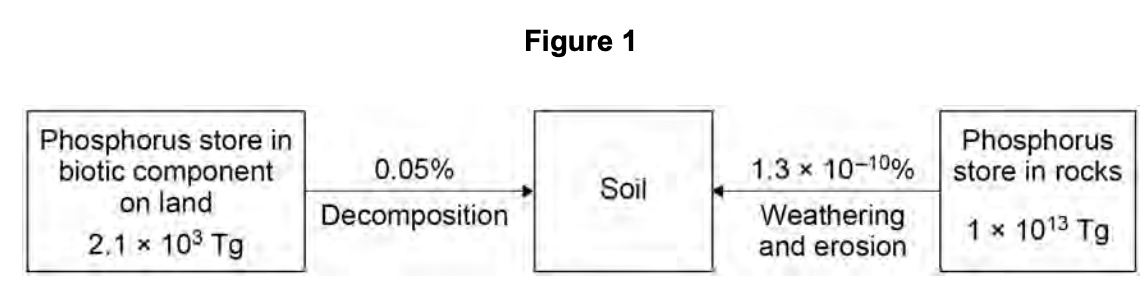
Hint
Calculate each store separately, then find the difference. Check your decimal places.
Answer
Mark Scheme
Correct answer of 12 = OR Correct answer of 11.95 = 2. Incorrect answer but shows 1195 (ignoring orders of magnitude) = 1 mark (1 mark)
Comments from mark scheme
Accept any numerical representation of the correct answer for two marks. Do not allow 1.05 or 13 to the incorrect order of magnitude e.g. x 101.
Tips from examiner reports
- Show your working in calculations — you can earn marks for correct steps even if the final answer is wrong
- Be careful with subtraction and check your arithmetic
Water shortage can inhibit crop production. Scientists investigated the effect of the mycorrhizal species Glomus intraradices on the growth of tomato plants under conditions of water shortage and no water shortage.
- The scientists planted tomato seeds into a large number of pots containing sterilised soil.
- They added a culture of G. intraradices to 50% of the pots and 50% were left untreated.
- After the seeds had developed into seedlings (young plants), the seedlings from the untreated and treated pots were planted into four separate large greenhouses (glasshouses).
- A very limited supply of water (water shortage) was provided to two of the greenhouses. A sufficient supply of water (no water shortage) was provided to the other two greenhouses.
- After 60 days, the scientists determined the mean mass of tomatoes (kg m⁻²) from each greenhouse.
Greenhouse P – untreated seedlings with water shortage Greenhouse Q – treated seedlings with water shortage Greenhouse R – untreated seedlings with no water shortage Greenhouse S – treated seedlings with no water shortage
Treated seedlings are plants grown with G. intraradices. Figure 2 shows the scientists’ results. The error bars represent ± 2 standard deviations from the mean, which includes over 95% of the data.
Using all the information, evaluate the effectiveness of using mycorrhizae to increase crop production under conditions of water shortage and no water shortage.
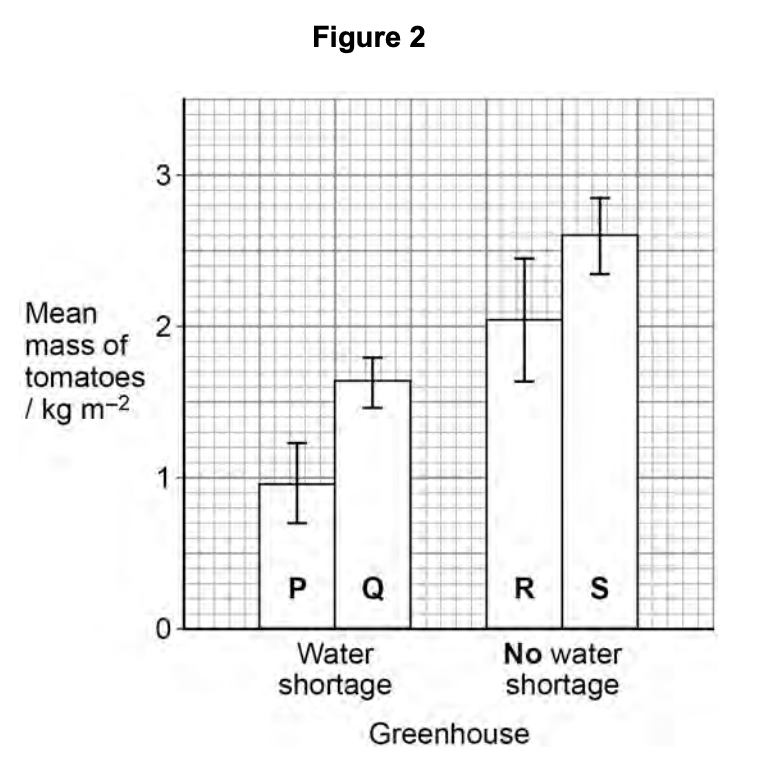
Hint
Look at error bars - do they overlap? Overlap means no significant difference. Also evaluate the experimental design.
Answer
Mark Scheme
- No significant difference (in production between untreated and treated) with no water shortage OR No significant difference (in production) between R and S (1 mark)
- Significantly greater/different (production in treated than untreated) with water shortage OR Significantly greater/different (production) in Q than P (1 mark)
- Significant decrease/difference (in production) of treated with water shortage OR Significant increase/difference (in production) of treated with no water shortage OR Significantly greater/different (production) in S than Q (1 mark)
- Overlap in SDs indicate no significant difference OR No overlap in SDs indicate a significant difference (1 mark)
- (Investigation) done in sterile soil (1 mark)
- (Investigation) done in green/glasshouse OR Not done in field (1 mark)
- Only one (mycorrhizae) species studied (1 mark)
- Only shows (results for) tomato(es) (1 mark)
- Large sample size increases validity/reliability (1 mark)
Comments from mark scheme
Max 3 marks from points 5 to 9 1, 2, 3 and 4. Accept descriptions of production e.g., more tomatoes and descriptions of treated and untreated seedlings / plants / seeds e.g., with / without mycorrhizae / Glomus / fungus. 1, 2, 3 and 4. Reject ‘results are significant’ or ‘results are not significant’ once, but only where there is no indication that these results are ‘different’, ‘greater’, ‘reduced’ etc. 1, 2, 3 and 4. Accept ‘not due to chance’ for significant and converse for not significant. 4. Accept ‘(error) bars’ for SDs. 5. Accept ‘only Glomus studied’. 6. Accept only shows ‘one crop’ or one ‘species or type of plant’. 9. Do not credit idea of variation between green/glasshouses.
Tips from examiner reports
- When interpreting error bars: overlapping bars suggest no significant difference; non-overlapping bars suggest a significant difference
- Say ‘significant difference’ not ‘significant results’
- Don’t just describe the data — interpret what it means statistically
The tomato seeds were planted into sterilised soil.
Suggest two reasons why the soil was sterilised.
(2 marks)Hint
Why sterilise soil before an experiment? What unwanted organisms or factors could affect results?
Answer
Mark Scheme
- Kill/remove/no (other) mycorrhizae/fungi (1 mark)
- Kill/remove/no nitrogen-fixing /nitrifying/denitrifying/saprobiotic bacteria (1 mark)
- Kill/remove/no pathogens (1 mark)
- Kill/remove/no pests (1 mark)
- Kill/remove/no competitors (1 mark)
- Kill/remove/no seeds/spores (1 mark)
- Is a (controlled) variable (1 mark)
Comments from mark scheme
1 to 6. Accept in context of organisms being present if soil not sterilised. 2. Accept saprophytes and saprobionts. 3. Accept removes disease-causing bacteria/viruses /microorganisms. 3. Removes ‘harmful bacteria’ is not enough. 4. Accept named pests. 6. Accept weeds or (other) plants
Tips from examiner reports
- Sterilisation kills microorganisms that could compete with or contaminate the culture
- It doesn’t remove nutrients or standardise pH
- Say ‘removes microorganisms/pests’ not just ‘removes harmful bacteria’
The soil used in this investigation had the recommended concentration of fertiliser.
Suggest two reasons why the soil contained the recommended concentration of fertiliser.
(2 marks)Hint
Read the context - these are potted plants in greenhouses. Why standardise fertiliser concentration?
Answer
Mark Scheme
- So mycorrhizae/water is the only variable OR (So fertiliser) is not a variable OR So fertiliser is a controlled variable (1 mark)
- Affects (crop) production/growth/mass (1 mark)
- (Concentration of fertiliser) would affect water potential of soil (1 mark)
- Does not affect pH (of soil) (1 mark)
- To provide (usual) soil/farming conditions (1 mark)
Comments from mark scheme
Ignore leaching and eutrophication.
- ‘For comparison’ on its own is not enough.
- Accept same amount of fertiliser.
- Accept benefits or limiting factor of named nutrient/ion
Tips from examiner reports
- Too much or too little fertiliser affects crop production/growth — explain why the recommended amount is important
- Don’t mention leaching or eutrophication for plants grown in pots in greenhouses — the fertiliser stays in the pot
In cats, males are XY and females are XX. A gene on the X chromosome controls fur colour in cats. The allele G codes for ginger fur and the allele B codes for black fur. These alleles are codominant. Heterozygous females have ginger and black patches of fur and their phenotype is described as tortoiseshell female. The two alleles, F and f of a different gene, which is not sex-linked, interact with the gene controlling fur colour. The allele F is dominant and stops the formation of pigment in the fur, resulting in white fur. The allele f is recessive and has no effect on fur colour.
Name the type of interaction between the two genes affecting fur colour.
(1 marks)Hint
What is it called when one gene masks or modifies the effect of another gene?
Answer
Mark Scheme
- Epistasis OR Epistatic (1 mark)
Comments from mark scheme
Ignore any words before or after epistasis e.g. dominant’. Accept phonetic spellings.
Tips from examiner reports
- Know the term: when one gene masks the expression of another gene, this is epistasis
- Don’t confuse epistasis with codominance or epigenetics
What phenotype would a cat with the following genotype have?
(1 marks)Hint
The phenotype must include all observable characteristics. Don’t forget sex if it’s relevant.
Answer
Mark Scheme
- Tortoiseshell female (1 mark)
Comments from mark scheme
Accept ‘female tortoiseshell’. Accept ‘ginger & black female’.
Tips from examiner reports
- Include all relevant information in the phenotype — if sex is relevant (e.g. sex-linked inheritance), include male/female
Complete the genetic diagram to show all the possible genotypes and the ratio of phenotypes expected in the offspring of this cross.
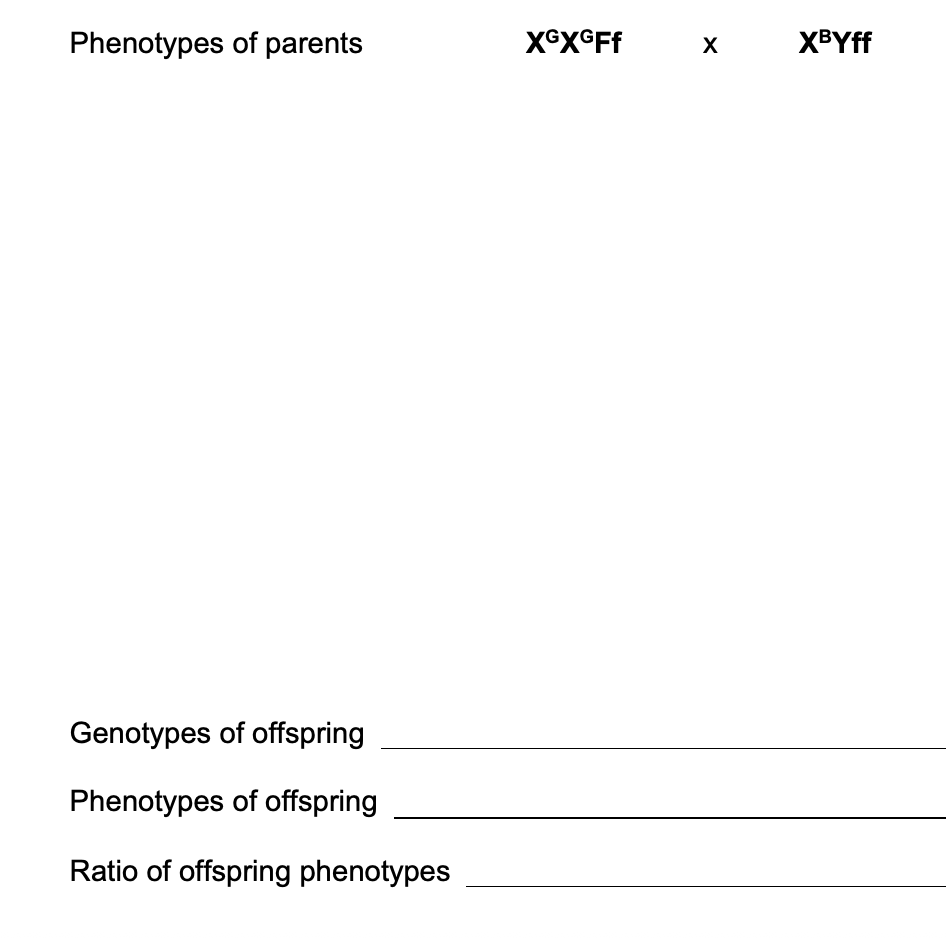
Hint
Include sex in your offspring phenotypes if relevant. Don’t combine ‘male white’ and ‘female white’ - they’re different phenotypes.
Answer
Mark Scheme
- CHECK FORMATTING FOR ANSWER! **** 1. (Gametes) XG F, XG f, XB f and Yf (1 mark)
-
- XG XB Ff, XG XB ff, XG YFf and XG Yff (1 mark)
-
- White female, Tortoiseshell female, White male, Ginger male, and ratio 1 (1 mark)
Comments from mark scheme
Allow one mark for correct dihybrid genotypes of offspring from incorrect parental gametes. 1 and 2. Accept if g and b are used throughout for G and B. 2. Accept the alleles within a genotype in any order. 1 and 2. Accept in Punnet square. 2 and 3. Accept any order of genotypes and phenotypes and accept if on incorrect answer lines. 3. Accept sequence of phenotypes does not need to mirror genotypes but must be correct. 3. Accept equivalent ratios e.g. 4:4:4:4. 3. Accept ‘Ginger and black’ for tortoiseshell and accept ‘no pigment’ for white.
Tips from examiner reports
- In sex-linked crosses, include the sex of offspring in the phenotypic ratio
- Don’t combine male and female offspring of the same colour into one category
- Write out the gametes first, then complete the genetic cross diagram
In a population, 36% of cats had the F allele and had white fur.
Use the Hardy–Weinberg equation to calculate the frequency of the f allele in this population. Show your working.
(2 marks)Hint
Identify which frequency the 36% represents. Is it p, q, p², or q²? Then calculate accordingly.
Answer
Mark Scheme
- Correct answer of 0.8 = 2 marks (1 mark)
Incorrect answer but shows ff/q 2 = OR Incorrect answer but shows ff/q 2 =
Comments from mark scheme
Accept answer of 80% for 2 marks.
Tips from examiner reports
- In Hardy-Weinberg: if 64% show the recessive phenotype, then q² = 0.64, so q = 0.8
- p² is the frequency of the homozygous dominant genotype — don’t confuse p² with the recessive phenotype
- The frequency of the recessive phenotype = q², not p or p²
Figure 3 shows the wavelengths of light absorbed by three types of photoreceptor found in the human retina.
Use Figure 3 and your knowledge of colour vision to explain how an orange colour is seen at 600 nm
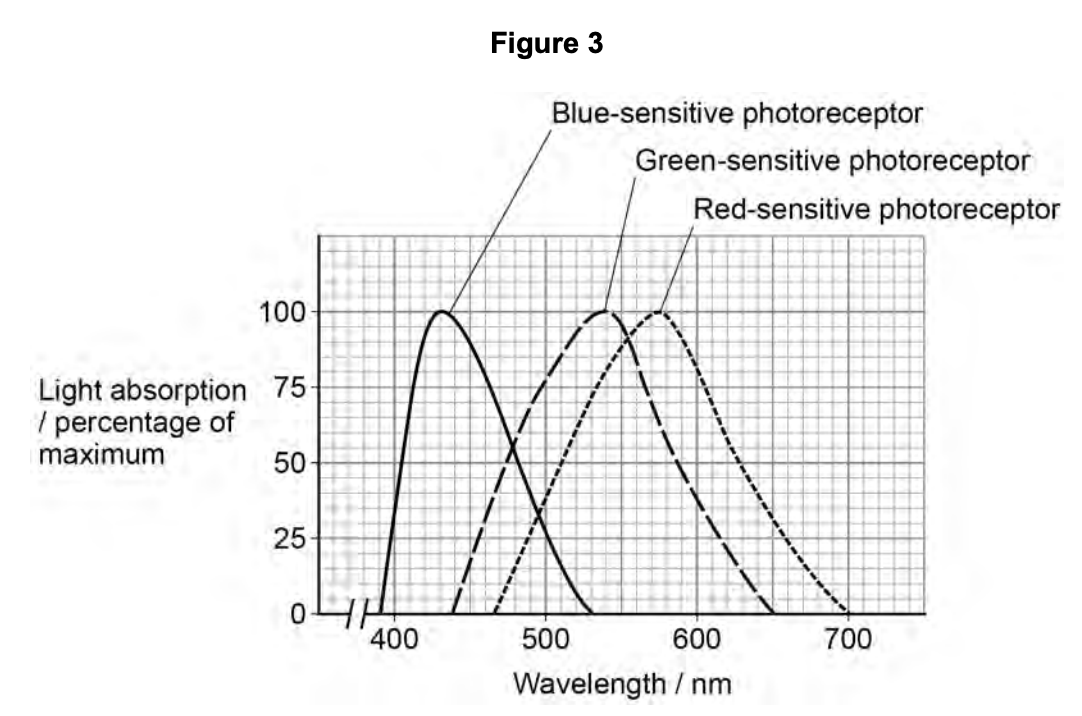
Hint
Use precise terminology: red-SENSITIVE cones (not ‘red cones’). Explain how different cones respond to different wavelengths.
Answer
Mark Scheme
- (Colour vision involves) cones (1 mark)
- (Each type of) photoreceptor has a different pigment OR (Each type of) photoreceptor absorbs particular/different (range of) wavelength(s) OR (Each type of) photoreceptor stimulated by particular/different (range of) wavelength(s) (1 mark)
- Greater absorption by ‘red sensitive’ than ‘green sensitive’ (cells/photoreceptors/cones) OR Provides percentage values which indicate difference in light absorption (at 600nm) OR More impulses to brain from ‘red sensitive’ than ‘green sensitive’ (photoreceptors/cones) OR More impulses along optic nerve from ‘red sensitive’ than ‘green sensitive’ (photoreceptors/cones) (1 mark)
Comments from mark scheme
1, 2 and 3. Reject ‘red cones/photoreceptors’ and ‘green cones/photoreceptors’ only once. 1 and 2. Each cone has a different pigment or absorbs particular wavelengths = Greater absorption by ‘red sensitive’ than ‘green sensitive’ cones = 3. Allow approximately correct percentage values. 3. Accept suitable alternatives for ‘sensitive’ e.g. detecting/absorbing. 3. Accept action potentials for impulses.
Tips from examiner reports
- There are three types of cone cells, each sensitive to different wavelengths of light (red, green, blue)
- Say ‘sensitive to red/green/blue light’ — the cones themselves are not coloured red, green, or blue
- Cones detect colour, rods do not — don’t say rods are involved in colour vision
- Different pigments in cones absorb different wavelengths (not different colours)
Which of the following statements is associated with high sensitivity to light in the retina?
(1 marks)Hint
What features increase sensitivity to low light levels?
Answer
Mark Scheme
- Box 3 correct - Several photoreceptors connecting to one neurone and spatial summation (1 mark)
Tips from examiner reports
- Several rod cells connect to one bipolar cell — this convergence (summation) gives high sensitivity in dim light
Variation in flower colour is considered one of the factors involved in the evolution of the following two species of monkeyflower.
Explain the different processes that may have been involved in the evolution of these two species of monkeyflower.
Use the information provided to justify your answer.
- Erythranthe lewisii (Great Purple Monkeyflower), which has pink flowers, is mostly found at higher altitudes (1600 to 3000 metres) and attracts bumblebees.
- Erythranthe cardinalis (Scarlet Monkeyflower), which has red flowers, is mostly found at lower altitudes (up to 2000 metres) and attracts hummingbirds. Bumblebees and hummingbirds are important in the pollination of flowers. Pollination involves the transfer of male gametes to female gametes.
Hint
Link geographical separation to different selection pressures to reproductive isolation to speciation. Be specific about what causes isolation.
Answer
Mark Scheme
- Geographical isolation/separation due to elevation/altitude (1 mark)
- Allopatric speciation due to isolation/separation (1 mark)
- Different selection pressures OR Different environment(s) (1 mark)
- (However) some overlap in distribution OR (Both) plants found in same area/habitat/altitude (1 mark)
- So (possibly) sympatric speciation (1 mark)
- (Variation due to) mutation(s) (1 mark)
- Reproductive isolation/separation due to different pollinators/distributions/altitudes OR Separate gene pools due to different pollinators/distributions/altitudes (1 mark)
- Change in allele frequency (in each population) OR Different allele frequency (in each population) (1 mark)
- Different species) can no longer (interbreed to) produce fertile offspring (1 mark)
Comments from mark scheme
- Accept selection (due to) flower colour.
- Accept different ‘abiotic conditions/factors’ for ‘different environment(s)’ or different named factor e.g. temperature, humidity but ‘different altitudes’ on its own is not enough.
- Only awarded if mark point 4 is credited.
- Reject mutation(s) if context incorrect e.g. ‘mutate to adapt’.
- Accept ‘no gene flow’ for separate gene pools.
- Accept ‘increase’ or ‘decrease’ for ‘change’.
Tips from examiner reports
- For speciation: mutation (random, not caused by environment) → new alleles → geographical/reproductive isolation → different selection pressures → allele frequencies diverge → reproductive isolation → new species
- Be specific about what causes reproductive isolation (e.g. different pollinators, different altitudes)
Describe and explain how three features of the cells in the proximal convoluted tubule allow the rapid reabsorption of glucose into the blood.
(3 marks)Hint
Focus on features of the CELLS, not the tubule structure. What adaptations help with reabsorption?
Answer
Mark Scheme
- Microvilli provide a large surface area OR Folded (cell-surface) membrane provides a large surface area (1 mark)
- Many channel/carrier proteins for facilitated diffusion (1 mark)
- Many carrier proteins for active transport (1 mark)
- Many channel/carrier proteins for co-transport (1 mark)
- Many mitochondria produce ATP OR Many mitochondria for active transport (1 mark)
- Many ribosomes to produce carrier/channel proteins (1 mark)
Comments from mark scheme
Max 2 from mark points 2, 3 and 4. For 2, 3, 4, 5 and 6 penalise omission of ‘many’ only once.
- Ignore ’brush border’. 3 and 4. Accept sodium-potassium pumps as an alternative to carrier proteins.
- Accept ‘cotransport protein’ or ‘symport’ for type of transport protein.
- Accept co-transport for active transport.
- Accept abundant rough endoplasmic reticulum for many ribosomes, but abbreviation is not enough.
Tips from examiner reports
- Proximal convoluted tubule cells have microvilli (large surface area), many mitochondria (ATP for active transport), and many carrier/channel proteins
- Don’t confuse microvilli with villi
- Say ‘many’ transport proteins to score the mark — just naming them isn’t enough
- Features of the cell, not the tubule structure (e.g. ‘one cell thick’ is about the tubule wall, not the cell)
Antidiuretic hormone (ADH) binds to V receptors found in cell-surface membranes in two parts of a nephron.
Name the two parts of a nephron where V receptors are found.
(1 marks)Hint
Which parts of the nephron are permeable to water under the influence of ADH?
Answer
Mark Scheme
- Collecting duct and distal (convoluted) tubule (1 mark)
Comments from mark scheme
Do not accept DCT for distal convoluted tubule.
Tips from examiner reports
- ADH acts on the collecting duct and distal convoluted tubule
- Write out the full name — ‘DCT’ is not an accepted abbreviation in the specification
V receptors only bind with ADH.
Suggest and explain why.
(2 marks)Hint
ADH binds to a receptor. How does binding work? Think about shape and specificity.
Answer
Mark Scheme
- Has a (specific) tertiary structure/shape (1 mark)
- (Structures are) complementary (1 mark)
Comments from mark scheme
- Accept in context of ADH or receptor.
- Ignore 3D.
- Reject reference to Antigen or antibody. 1 and 2. Reject reference to active site, enzyme, substrate or induced fit only once.
Tips from examiner reports
- ADH changes the tertiary structure/3D shape of aquaporins so they become complementary to the membrane
- Say ‘tertiary structure’ or ‘shape’ — not ‘active site’ or ‘substrate’ (aquaporins are channels, not enzymes)
A decrease in blood pressure stimulates the release of ADH.
Give the location of the receptors that detect a decrease in blood pressure and explain how the release of ADH will affect blood pressure. Include:
- Location
- Explanation
Hint
Where are blood pressure receptors located? What is the full sequence: more water reabsorbed → blood volume → blood pressure → detected where?
Answer
Mark Scheme
- Aorta OR Carotid artery/sinus (1 mark)
- (ADH) increases (re)absorption of water (1 mark)
- Increases volume of (blood) and pressure increases OR Increases volume of (blood) and pressure returns to normal (1 mark)
Comments from mark scheme
- Ignore arteries but reject named incorrect artery.
- Reject if other substances are also absorbed e.g. glucose, ions.
Tips from examiner reports
- ADH increases water reabsorption → increases blood volume → increases blood pressure
- Make the full chain: water reabsorption → blood volume → blood pressure
- Blood pressure receptors are in the aorta and carotid arteries — not the hypothalamus or pituitary gland
In the following passage, the numbered spaces can be filled with biological terms. An ecosystem supports a certain size of population of a species, called the (1) capacity. There are often numerous habitats within an ecosystem. Within a habitat, a species occupies a (2) governed by an adaption to both (3) and biotic conditions. Populations of different species form a (4) .
Write the correct biological term beside each number below that matches the space in the passage.
(2 marks)Hint
Know your key ecology definitions: community, population, niche, carrying capacity, abiotic factors.
Answer
Mark Scheme
- (1) carrying (2) niche (3) abiotic (4) community (1 mark)
Comments from mark scheme
All 4 correct = two marks. 2 or 3 correct = one mark. 1 correct = zero. (3) Accept physical, chemical, physicochemical or non-living.
Tips from examiner reports
- Key ecology terms: abiotic (non-living factors), community (all populations in an area), niche (role of an organism), carrying capacity
- Carrying capacity starts with ‘carrying’ not ‘maximum’
Suggest two reasons for conserving rainforests.
(2 marks)Hint
Think about all the reasons rainforests are important: biodiversity, climate, resources, economics.
Answer
Mark Scheme
- Conserve/protect species/plants/animals/organisms OR For (bio)diversity (1 mark)
- Conserve/protect habitats/niches OR Provides/many habitats/niches (1 mark)
- Reduces climate change (1 mark)
- Source of medicines/drugs/wood (1 mark)
- Reduces erosion/eutrophication (1 mark)
- (For) tourism (1 mark)
Comments from mark scheme
- Accept conserving land (and ways of life) for indigenous communities.
- Accept ‘reduces ’global warming’, ‘reduces greenhouse effect’, ‘removes/takes up ’carbon dioxide’ or ‘produces/provides oxygen’.
Tips from examiner reports
- Reasons to conserve rainforests: biodiversity, species conservation, carbon dioxide absorption, oxygen production, source of medicines, tourism, preventing soil erosion
Give three reasons for the low efficiency of energy transfer from secondary consumers to tertiary consumers in an ecosystem.
(3 marks)Hint
Where does energy go that isn’t passed to the next trophic level? Think about respiration, faeces, and undigested material.
Answer
Mark Scheme
- Heat (loss) from respiration (1 mark)
- (Food) not digested OR Not all eaten (1 mark)
- Excretion (1 mark)
Comments from mark scheme
- Accept faeces for not digested.
- Accept urin
Tips from examiner reports
- Energy is lost between trophic levels through: heat from respiration, faeces (undigested food), and urine (excretory products)
- Faeces are not an excretory product — they contain undigested food that was never absorbed
- Link heat loss specifically to respiration
The KRAS gene codes for a protein called K-Ras. The protein relays signals from outside a cell to a cell’s nucleus, stimulating cell division. An alteration in the KRAS gene produces an oncogene which can cause a tumour to develop.
Suggest and explain how an alteration in the KRAS gene can cause a tumour to develop.
(3 marks)Hint
What happens when a proto-oncogene mutates? What does the altered protein do? How does this lead to tumour formation?
Answer
Mark Scheme
- Mutation (in KRAS gene) OR Change in base sequence (of KRAS gene) (1 mark)
- Change in (signalling) protein OR More (signalling) protein/K-Ras produced (1 mark)
- (Results in) rapid/uncontrollable cell division (1 mark)
Comments from mark scheme
- Accept named mutation e.g. substitution.
- Accept mutation in promoter gene.
- Ignore epigenetic modifications.
- Accept change in amino acid sequence (of protein).
- Reject ‘no protein produced’ or suggests a non-functional protein is produced.
- Accept cell division cannot be regulated.
- Ignore growth.
- Reject meiosis for cell division, but accept mitosis.
Tips from examiner reports
- A mutation in a proto-oncogene can create an oncogene → oncogene produces a permanently active protein → uncontrolled cell division → tumour
- The mutated gene still produces a protein (it’s overactive, not absent or non-functional)
- Don’t confuse epigenetic changes with mutations in this context
Alterations in the KRAS gene can cause colorectal cancer (CRC). Scientists investigated the survival time of the following three groups of CRC patients who had type II diabetes.
- Group A – received no drug to treat type II diabetes
- Group B – received the drug metformin to treat type II diabetes
- Group C – received a combination of drugs (including metformin) to treat type II diabetes
The scientists used a statistical test to compare the survival time of these patients with CRC patients with no history of type II diabetes.
Table 1 shows some of the results obtained by the scientists.
Using the information provided, what can you conclude about the effects of type II diabetes and the different drug treatments on the survival time of CRC patients?
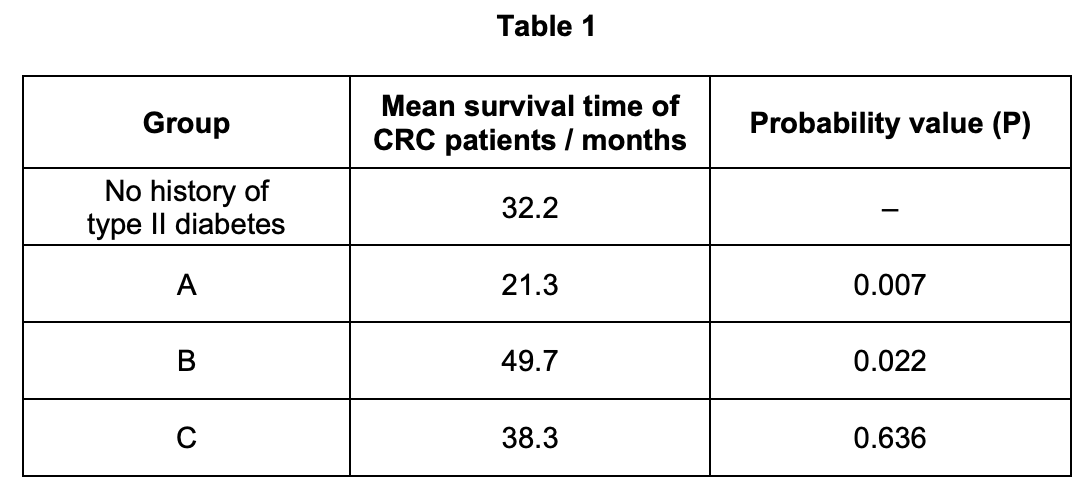
Hint
Use the probability values to determine significance. Remember: lower P value = more significant difference.
Answer
Mark Scheme
- A/untreated (type II diabetes) lowest survival (time) OR A/untreated (type II diabetes) lowers/reduces survival (time compared with control group) (1 mark)
- B/metformin increases survival (time) the most OR B/metformin has the highest survival (time) (1 mark)
- C/combined drugs increases survival (time) (1 mark)
- Groups A and B have a significant difference (in survival time compared with control) (1 mark)
- Group C has no significant difference (in survival time compared with control) (1 mark)
- (In group C) other drugs have reduced effect of metformin OR B/metformin is more effective (treatment/drug) than C/combined drugs (1 mark)
Comments from mark scheme
1 to 6. Accept descriptions of each group e.g. A = B = C =
Tips from examiner reports
- A low probability value (p < 0.05) means the difference is significant — the result is unlikely due to chance
- A high probability value means the difference is not significant
- Say ‘the difference is significant’ not ‘the results are significant’
Short tandem repeats (STRs) are short sequences of DNA, usually 2 to 7 base pairs. STRs are repeated a number of times, one after another. For example, the STR D5S818 is made up of AGAT repeated 7 to 16 times. STRs are found throughout the whole genome. The repeated sequences in STRs are common to all humans. Due to variation in the number of repeats, STRs can be used in genetic fingerprinting.
Describe how STRs could be removed from a sample of DNA.
(2 marks)Hint
What enzyme cuts DNA? What does it recognise to know where to cut?
Answer
Mark Scheme
- Restriction endonucleases/enzymes (1 mark)
- (Cut DNA) at specific base sequences/pairs OR (Cut DNA) at recognition/restriction sites (1 mark)
Comments from mark scheme
- Accept ‘at palindromic sequences’
Tips from examiner reports
- Restriction endonuclease cuts DNA at specific base sequences (recognition/restriction sites)
- Say ‘specific base sequence’ or ‘recognition site’ — not just ‘specific site’
Genetic fingerprinting using STRs requires amplification of the STRs using the polymerase chain reaction (PCR). The short base sequences either side of a specific STR are known.
Explain the importance of knowing these base sequences in PCR
(2 marks)Hint
Why do you need to know the base sequence to do PCR? What needs to be complementary to the target DNA?
Answer
Mark Scheme
- (For) primers (1 mark)
- (To produce) a complementary base sequence OR (Primers provide starting sequence) for DNA/taq polymerase OR (Primers) stop (original) DNA strands re-joining (1 mark)
Tips from examiner reports
- In PCR, you need to know the base sequence flanking the target DNA to design complementary primers
- Primers are short sequences that bind to complementary bases at the start of the target region
- The base sequence is not needed to choose restriction enzymes — that’s a different technique
A single STR molecule consisting of a 12 base pair sequence of AGAT was amplified 50 times using PCR.
Calculate the total number of base pairs in all the STR molecules after 50 cycles of PCR.
Show your working
(2 marks)Hint
Think about how many possible combinations there are at each STR locus, then how to combine them.
Answer
Mark Scheme
Correct answer of 1.35 x 1016 = OR Correct answer of 1.36 x 10¹⁶ (due to rounding at an earlier stage of the calculation) = OR Correct answer of 1.4 x 1016 = 2. Incorrect answer but shows 250 = 1 mark (1 mark)
Comments from mark scheme
Ignore any numbers after 1.35.
Tips from examiner reports
- Read the question carefully to identify which values to use in the calculation
- Don’t confuse total length with the length of one STR repeat unit
During genetic fingerprinting, the different STRs are separated by gel electrophoresis.
Give two features of STRs which enable them to be separated by gel electrophoresis.
(2 marks)Hint
What properties of DNA fragments determine how far they move in electrophoresis?
Answer
Mark Scheme
- Number of nucleotides/repeats/bases OR Length/mass (1 mark)
- (Negative) charge (1 mark)
Tips from examiner reports
- DNA fragments of different lengths travel different distances during gel electrophoresis
- Shorter fragments move further
- DNA has a negative charge due to phosphate groups — this is why it moves towards the positive electrode
- Say ‘number of nucleotides/bases’ or ‘length/mass’ — both are valid ways to describe why fragments separate
Read the following passage. ATP is essential for muscle contraction. The concentration of ATP in skeletal muscle is approximately 5 × 10⁻³ mmol g–1. During maximum exercise, ATP in skeletal muscle is used at a rate of approximately 3.7 mmol kg–1 s–1. If ATP was not resynthesised, maximum exercise would last a short time. Some studies have suggested that taking creatine supplements can improve muscle performance during intense short-term exercise. Eating more carbohydrate, known as ‘carbohydrate loading’, for a few days before exercise can improve muscle performance when exercising for a long time. During aerobic exercise, calcium ions in muscle cells have several roles. They activate the inclusion of glucose transport proteins, GLUT4, in the cell-surface membrane and the inclusion of fatty acid transport proteins, CD36, in mitochondrial membranes. An increase in muscle activity increases the concentration of carbon dioxide in the blood. This causes an increase in heart rate.
Use the information in the passage and your own knowledge to answer the following questions.
ATP is essential for muscle contraction (line 1).
Describe the roles of ATP in muscle contraction.
(2 marks)Hint
Where exactly is ATP used in muscle contraction? What does it do to the myosin heads?
Answer
Mark Scheme
- To break actinomyosin (bridges) (1 mark)
- To move/bend the myosin head/arm (1 mark)
- (So) actin (filaments) are moved (inwards) (1 mark)
- For active transport of calcium ions (into the sarcoplasmic/endoplasmic reticulum (1 mark)
Comments from mark scheme
- Accept ‘to form actinomyosin’.
- Accept ‘to detach or attach myosin and actin’.
- Reject reference to ‘active site’.
- Accept ‘to change shape of myosin head/arm’.
- Accept ADP/Pi moves (myosin) head/arm.
- Accept powerstroke/pivot /recocks etc. for movement.
- Ignore ‘sliding’.
Tips from examiner reports
- ATP is needed to break actinomyosin bridges — say ‘myosin’ not ‘myofibril’
- Include the myosin head/arm changing shape or moving when describing the sliding filament mechanism
- Both actin and myosin are involved — don’t leave one out
Calculate how long maximum exercise would last if ATP was not resynthesised (lines 3–4).
(1 marks)Hint
Carefully apply the formula or relationship given in the question.
Answer
Mark Scheme
- 1.35 OR 1.4 (1 mark)
Comments from mark scheme
Accept numbers after 1.35.
Tips from examiner reports
- Check your calculation carefully and show all working
Describe and explain how taking creatine supplements (lines 5–6) and ‘carbohydrate loading’ (lines 6–7) can improve performance of different types of muscle fibres during different types of exercise.
(5 marks)Hint
Link fibre types to exercise types. Explain how each fibre type is adapted for its role. Distinguish glycogen storage from glycolysis.
Answer
Mark Scheme
- Fast (skeletal muscle) fibres used during short-term/intense exercise (1 mark)
- Slow (skeletal muscle) fibres used during long(er)-term exercise (1 mark)
- Creatine used to form phosphocreatine (1 mark)
- (Phosphocreatine) combines with ADP to form ATP (1 mark)
- (Carbohydrate/glucose) stored as glycogen OR Glycogenesis (1 mark)
- Glycogen hydrolysed to glucose OR Glycogenolysis (1 mark)
- Glucose for respiration (1 mark)
Comments from mark scheme
Max 3 marks from mark points 3, 4, 5, 6 and 7. 1 and 2. Accept examples of shortterm/intensity exercise e.g. sprint and longerterm/endurance exercise, e.g. marathon or low(er) intensity exercise.
- Accept fast twitch fibres for fast (skeletal muscle) fibres
- Accept slow twitch fibres for slow (skeletal muscle) fibres.
- Accept glycolysis for respiration.
Tips from examiner reports
- Relate muscle fibre types to the type of exercise (not just aerobic/anaerobic respiration)
- Creatine is used to form phosphocreatine — know this energy store
- Don’t confuse glycogen with glucagon, or glycolysis with glycogenolysis/glycogenesis/gluconeogenesis
Suggest and explain how GLUT4 and CD36 transport proteins (lines 10⁻¹1) are beneficial during exercise.
(3 marks)Hint
How do glucose and fatty acids enter cells and get used for ATP production? Be specific about where in the cell each process occurs.
Answer
Mark Scheme
- (More) glucose enters (muscle) cells (1 mark)
- (Glucose/fatty acids enter by) facilitated diffusion (1 mark)
- Fatty acids used in Krebs cycle (1 mark)
- Respiration provides (more) ATP (1 mark)
Comments from mark scheme
Max 2 marks if only in context of glucose or only in context of fatty acids.
- Ignore more glucose leaves (liver) cells.
- Reject glucose enters mitochondria.
- Accept active transport or cotransport.
- Ignore gluconeogenesis.
- Accept in context of glucose or fatty acids.
- Accept for fatty acids ‘Krebs cycle produces ATP
Tips from examiner reports
- Glucose and fatty acids are used in respiration to produce ATP — say ‘ATP’ not just ‘energy’
- Fatty acids are used in the Krebs cycle (after conversion to acetyl CoA)
- Glucose enters muscle cells — state this step
- Fatty acids are not converted to glucose before being respired
An increase in muscle activity causes an increase in heart rate (lines 12–14).
Describe and explain how.
(4 marks)Hint
Trace the pathway from CO₂ detection to increased heart rate. Use precise terminology throughout.
Answer
Mark Scheme
- Increase in CO₂ detected by chemoreceptors (1 mark)
- Send (more) impulses to cardiac centre OR Send (more) impulses to the medulla (1 mark)
- More impulses (from centre/medulla) along sympathetic pathway/neurones/nerves OR Fewer impulses (from centre/medulla) along parasympathetic/vagus pathway/neurones /nerves (1 mark)
- (To) SAN (1 mark)
Comments from mark scheme
- Accept increase in acidity/H⁺ or decrease in pH for increase in CO₂.
- Ignore location of chemoreceptors. 2 and 3. Reject reference to ‘an/one impulse’ once only. 2 and 3. Reject ’signals’, ‘messages’ for ‘impulses’ once only. 2 and 3. Accept ‘action potentials’ for impulses.
Tips from examiner reports
- Chemoreceptors detect an increase in CO₂ concentration (decrease in pH, not increase)
- They send impulses (plural) to the cardiac centre — not a single ‘impulse’, ‘signal’, or ‘message’
- The cardiac centre sends impulses to the SAN to increase heart rate
- Better answers refer to the frequency of impulses increasing
In the following passage the numbered spaces can be filled with biological terms. During photosynthesis, plants produce (1) compounds which contain carbon, such as carbohydrates, lipids and proteins. Most of the sugars synthesised by plants are used by the plant in (2) . The rest are used to make other groups of biological molecules. These biological molecules form the biomass of the plants. Biomass can be measured in terms of mass of (3) per given area per given time. The chemical energy store in dry biomass can be estimated using (4) .
Write the correct biological term beside each number below, that matches the space in the passage 1= 2= 3= 4=
(2 marks)Answer
Mark Scheme
- Organic (1 mark)
- Respiration (1 mark)
- Carbon (1 mark)
- Calorimetry (1 mark)
Comments from mark scheme
4 correct = 2 marks 2–3 correct = 1 mark 0–1correct = 0 marks 2. Ignore aerobic/anaerobic. 3. Accept cells/tissue(s)/plant(s)/animal(s)/organism(s)/ NPP/ living material/biological molecules. 3. Ignore biomass/biological materials/organic matter and reference to ‘dry’. 4. Accept calorimeter but reject colorimeter. 4. Accept phonetic spellings.
Tips from examiner reports
- Know the four key terms: organic, respiration, calorimetry, carbon
- Don’t confuse calorimetry with colorimetry
- Don’t say photosynthesis when you mean respiration
Describe the light-independent reaction of photosynthesis.
(6 marks)Answer
Mark Scheme
- Carbon dioxide combines/reacts with ribulose bisphosphate/RuBP (1 mark)
- Produces two glycerate (3- )phosphate/GP using (enzyme) Rubisco (1 mark)
- GP reduced to triose phosphate (1 mark)
- Using reduced NADP (1 mark)
- Using energy from ATP (1 mark)
- Triose phosphate converted to glucose/hexose/RuBP/ribulose bisphosphate/named organic substance (1 mark)
Comments from mark scheme
1 to 6. Accept marks in suitable diagram.
- Accept idea of fixation for ‘reacts’.
- Accept: any answer which indicates that 2 × as much GP produced from one RuBP catalysed by Rubisco. 2 and 3. Reject GP once if incorrectly named e.g., glucose 3- phosphate.
- Must have idea of reduction. This may be conveyed by stating mp4. 3 and 6. Only accept TP if triose phosphate is also in the answer. However only penalise once.
- Accept NADPH or NADPH2 or NADPH + H for reduced NADP.
- Reject: Any reference to reduced NAD for mp4 but allow reference to reduction for mp3.
- and 5. must be in context of GP to triose phosphate.
Tips from examiner reports
- In the Calvin cycle (light-independent reaction): CO₂ + RuBP → GP → TP → useful organic molecules
- Reduced NADP reduces GP to TP — it’s a reduction, not oxidation
- Say ‘reduced NADP’ not ‘reduced NAD’
- Write ‘triose phosphate’ in full at least once — don’t just use ‘TP’ throughout
- GP stands for glycerate 3-phosphate — don’t call it ‘glucose phosphate’
- ATP releases energy for the reduction of GP
- Don’t describe the light-dependent reaction when asked about the light-independent reaction
Put a tick in the box next to the equation that shows how the net production of consumers, N, can be calculated where I represents the chemical energy store in ingested food, F represents the chemical energy lost to the environment in faeces and urine, R represents the respiratory losses to the environment.
(1 marks)Answer
Mark Scheme
- N = I – (F + R) (1 mark)
Tips from examiner reports
- Know the formula: net production of consumers = chemical energy stored in ingested food - faecal losses - respiratory losses
In the UK, some female cattle are only used for breeding. This female breeding herd has dairy cows and beef cows.
Table 1 shows data on dairy cows and beef cows in the UK female breeding herd in December 2013 and December 2017.
In December 2017, the female breeding herd was 48% of all female cattle in the UK.
Use Table 1 to calculate the percentage of all female cattle that were beef cows in the UK in December 2017.
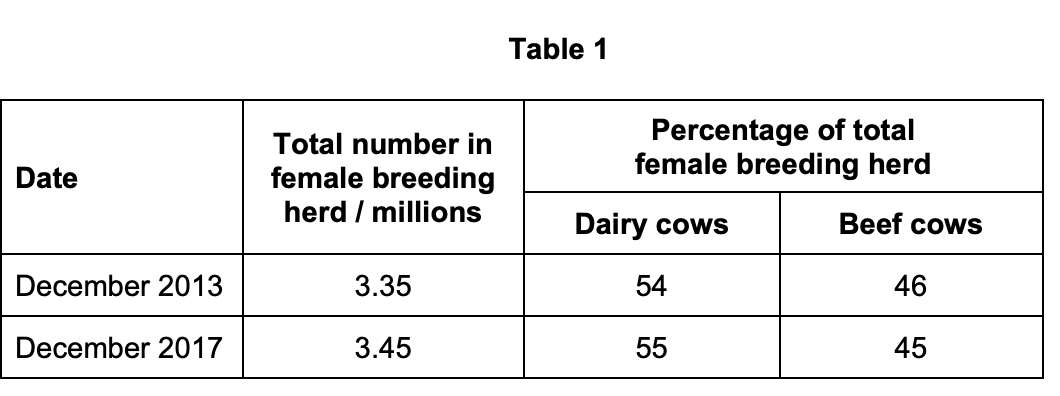
Answer
Mark Scheme
- 21.6 OR 22 (1 mark)
Tips from examiner reports
- Show your working and round correctly in calculations
Use Table 1 to calculate the increase in the number of dairy cows in the UK female breeding herd between December 2013 and December 2017. Show your working
(2 marks)Answer
Mark Scheme
- Correct answer of 88500/89000 = 2 marks (1 mark)
Incorrect but shows 1.8975/1.898/1.9/1.90 (million) /1897500 = OR Incorrect but shows 1.809/1.81/1.8/1.80 (million) / 1809000 =
Comments from mark scheme
Accept 90000 for 2 marks. Accept any of the answers in any correct mathematical form e.g., shows 1.8 (million) as 1800000.
Tips from examiner reports
- Show each step of multi-part calculations clearly
- Double-check your arithmetic when transferring numbers to the answer line
- Don’t express a numerical decrease as a percentage increase
Farming cattle for humans to eat is less efficient than farming crops because of energy transfer. Explain why.
(2 marks)Answer
Mark Scheme
- Energy lost between/at trophic/feeding levels (1 mark)
- Energy lost via respiration/excretion/faeces (1 mark)
Comments from mark scheme
- Accept description of trophic levels e.g., food chain.
- Accept energy lost via heat/metabolism/food not eaten/digested /muscle contraction/movement /maintaining temperature.
- Reject energy used in respiration.
- Reject energy produced/generated.
Tips from examiner reports
- Energy is lost between trophic levels — state this clearly
- Energy is released during respiration (not ‘used in’ respiration)
- Faeces represent energy that was never absorbed
- Don’t say ‘energy is produced’ — energy is transferred or released
Nitrogen-fixing bacteria such as Azotobacter chroococcum use the enzyme nitrogenase to produce ammonia from nitrogen gas in the air. A. chroococcum can use ammonium chloride as a direct source of ammonia. When a source of ammonia is not available this bacterium uses nitrogen fixation. A scientist investigated the effect of an increase in the concentration of ammonium chloride on the activity of nitrogenase in this bacterium. He prepared several liquid medium cultures of the bacterium. Each liquid culture had the same volume. He grew each culture in a different concentration of ammonium chloride. In each culture:
- he recorded the nitrogenase activity in arbitrary units
- he removed the bacteria and then recorded the concentration of ammonium chloride remaining in each liquid medium. Table 2 shows the scientist’s results.
Apart from temperature and pH, give two variables the scientist would have controlled when preparing the liquid medium cultures.
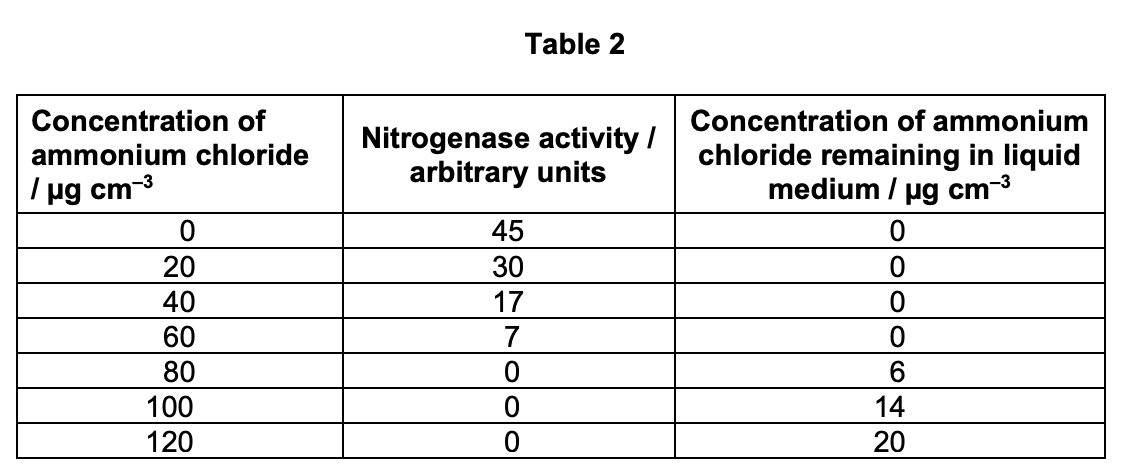
Answer
Mark Scheme
- Volume of (stock) bacteria (culture) (1 mark)
- Concentration of (stock) bacteria (culture) (1 mark)
- Concentration of glucose OR Concentration of (respiratory) substrate (1 mark)
- Volume of ammonium chloride (1 mark)
- Time (bacteria/culture left to divide) (1 mark)
- Concentration/volume of oxygen (1 mark)
- Concentration/volume of nitrogen (1 mark)
Comments from mark scheme
Accept vol. for volume and conc. for concentration. 1 and 2. If neither credited accept number/mass of bacteria for 1 mark. 1 and 2. Ignore volume/concentration of liquid culture. 3. Accept concentration of ion/named ion but ignore ammonium chloride. Ignore ‘same bacteria/species/type’. 1, 2, 3, 4, 6. and 7. Ignore amount. 3. Ignore ‘sugar’. 3 and 4. Ignore nutrients. 6 and 7. Ignore availability/access/exposure.
Tips from examiner reports
- Read the question carefully — if temperature and pH are excluded as control variables, don’t include them
- Don’t suggest the independent variable as a control variable
- Say ‘concentration’ or ‘volume’ not ‘amount’ — be precise with terminology
- If the stem says cultures have the same volume, don’t list volume as something to control
A student concluded that this investigation showed that ammonia inhibits nitrogenase activity in nitrogen-fixing bacteria.
Use all the information to evaluate the student’s conclusion.
(3 marks)Answer
Mark Scheme
- (For) 1. Nitrogenase activity decreases with increase in ammonium chloride (concentration) (1 mark)
-
- Nitrogenase activity zero with high (concentration of) ammonium chloride OR Ammonium chloride remains (in medium) when nitrogenase activity zero (1 mark)
- (Against) 3. Only used one species (1 mark)
-
- (Inhibition/results) may be due to chloride (ions) OR (Investigation) uses ammonium chloride not ammonia (1 mark)
Comments from mark scheme
1 and 2. Accept ammonia for ammonium chloride.
- Accept negative correlation between nitrogenase activity and ammonium chloride (concentration).
- Accept nitrogenase activity zero at 80/100/120/above 60 (µg cm³ of ammonium chloride).
- Accept ‘stops’ for zero.
- Accept only Azotobacter/A. chroococcum / chroococcum / one nitrogenfixing bacterium / one type/strain used.
- Reject ‘chlorine’. Ignore reference to statistical tests.
Tips from examiner reports
- Describe trends in data precisely — say whether activity decreases, reaches zero, etc.
- Consider alternative explanations: could it be the chloride ion causing the effect rather than ammonium?
- Note if only one species was tested — results may not apply to all species
- Don’t say ‘correlation doesn’t mean causation’ without a specific alternative explanation
- When differences are very large, suggesting a statistical test isn’t necessary
Nitrogenase catalyses the reduction of nitrogen during nitrogen fixation. The reaction requires 16 molecules of ATP for each molecule of nitrogen that is reduced. When ammonia inhibits nitrogenase activity, nitrogen-fixing bacteria may benefit. Explain how
(2 marks)Answer
Mark Scheme
- Less/no ATP/energy required/used OR More ATP/energy available (1 mark)
- ATP/energy can be used for growth/synthesis/replication OR Lower (rate of) respiration required OR ATP for phosphorylation (1 mark)
Comments from mark scheme
- Accept ATP can be used for ‘other reactions’, ‘movement’, ‘active transport’ or correctly named reaction.
- Ignore ‘aerobic’, ‘anaerobic’ in context of respiration.
- Reject ATP/energy used for/in respiration. 2.Reject mitosis.
Tips from examiner reports
- If less ATP is used for one process (e.g. nitrogen fixation), more is available for other processes (growth, protein synthesis, active transport)
- Energy is released during respiration, not ‘used in’ respiration
- If nitrogen fixation stops, the rate of respiration could decrease (less ATP demand)
Put a tick ( ) in the box next to the process that occurs in anaerobic respiration but does not occur in aerobic respiration. a) Phosphorylation of glucose b) Reduction of NAD c) Reduction of pyruvate d) Substrate-level phosphorylation
(1 marks)Answer
Mark Scheme
- Reduction of pyruvate (1 mark)
Tips from examiner reports
- Know which processes occur in anaerobic but not aerobic respiration: the reduction of pyruvate (to lactate in animals, or to ethanol + CO₂ in plants/yeast)
- Substrate-level phosphorylation occurs in both aerobic and anaerobic respiration
During the 48 hours, the coloured liquid moved to the left. Explain why.
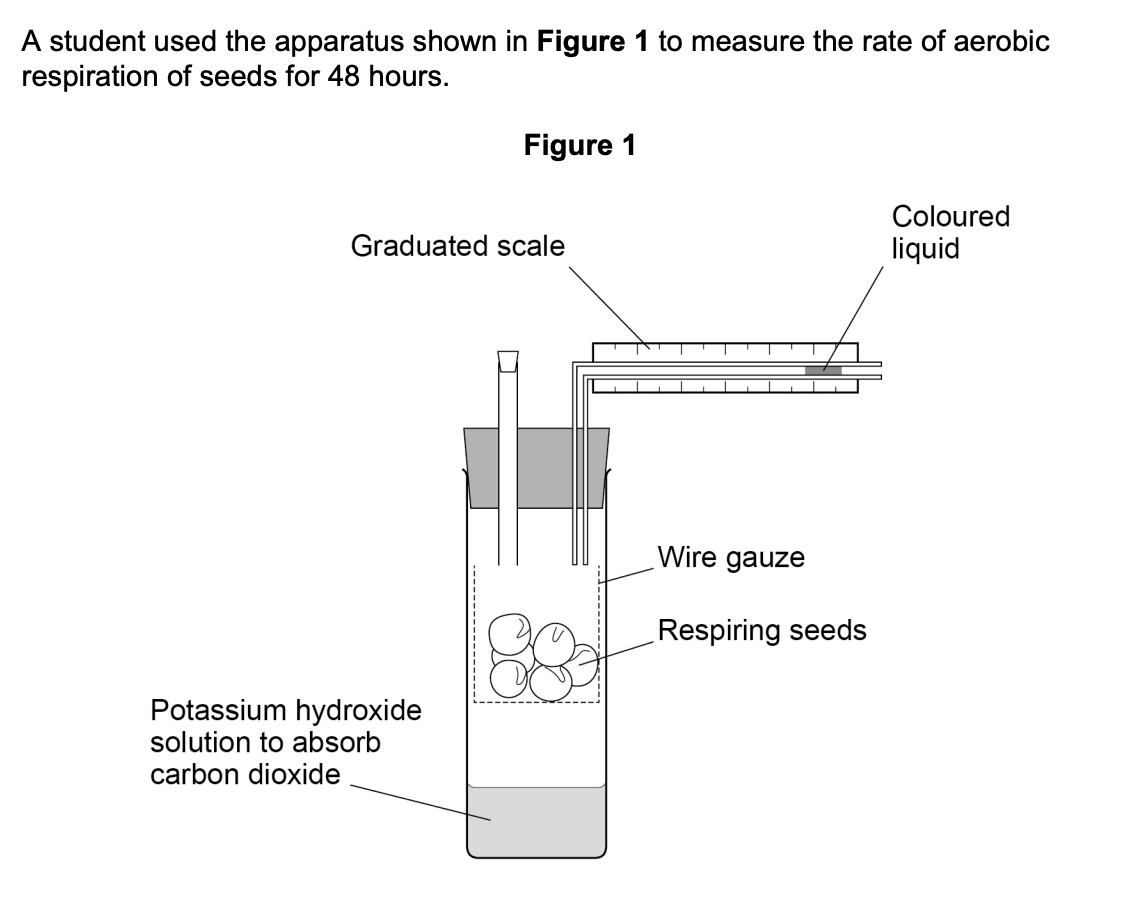
Answer
Mark Scheme
- Oxygen/O₂ taken up/used (by seeds) (1 mark)
- Carbon dioxide/CO₂ (given out) is absorbed by solution/potassium hydroxide/KOH (1 mark)
- Decrease in pressure/volume (of air inside) (1 mark)
Comments from mark scheme
- Ignore ‘negative pressure’ but reject reference to vacuum.
- Accept ‘air pressure higher than inside’.
Tips from examiner reports
- In a respirometer: organisms use O₂, KOH absorbs CO₂ → volume/pressure inside decreases → liquid moves toward the organisms
- It’s a decrease in volume/pressure, not an increase
- A vacuum is not produced — just a decrease in pressure
Apart from time, give two measurements the student would have to make to determine the rate of aerobic respiration of these seeds in cm³ hour –1
(2 marks)Answer
Mark Scheme
- Distance (drop/liquid moves) (1 mark)
- Diameter/radius/bore of tubing/lumen (1 mark)
Comments from mark scheme
Ignore time. 1.Accept description of distance, e.g. ‘start and end position’. 2. Accept (crosssectional) area of tubing/lumen.
Tips from examiner reports
- To calculate rate of oxygen uptake, you need: the distance moved by the liquid AND the diameter/radius of the tube (to calculate volume)
- ‘Time’ as a measurement is not needed if it’s already excluded by the question
- Don’t say ‘volume of oxygen’ — you’re measuring liquid displacement to calculate it
The student used the same apparatus to determine the volume of carbon dioxide the seeds produced during 48 hours.
Give the change the student would need to make to the contents of the apparatus and describe how he could calculate the volume of carbon dioxide produced
(3 marks)Answer
Mark Scheme
- Remove potassium hydroxide/KOH OR Remove solution which removes carbon dioxide. OR Replace potassium hydroxide/KOH with water (1 mark)
- Record distance liquid moves (without potassium hydroxide) (1 mark)
- Use difference in distance liquid moves (with potassium hydroxide and without potassium hydroxide) OR Use difference in (calculated) volumes (with potassium hydroxide and without potassium hydroxide) (1 mark)
Comments from mark scheme
Answers which add/use a syringe, reject mp2 and mp3.
- Reject if seeds removed or another organism used.
- Reject moves to the right.
- Accept ‘liquid would not move’.
- Accept ‘if liquid does not move (volume of) carbon dioxide produced is the same as (volume of) oxygen used’.
Tips from examiner reports
- Read the question carefully — ‘same apparatus’ means you can’t add extra equipment like a syringe
- To measure CO₂ production: remove/replace the KOH (so CO₂ isn’t absorbed) and observe which direction the liquid moves
- If only aerobic respiration occurs: CO₂ produced > O₂ used (because some CO₂ isn’t compensated), so liquid moves away from the organisms
- Use results from both setups to calculate CO₂ volume by difference
The student calculated that during the 48 hours, 6.2 × 10⁻⁴ cm³ of oxygen was absorbed by 40 g of seeds.
Calculate the oxygen uptake in cm³ g⁻¹ hour –1
(1 marks)Answer
Mark Scheme
- Answer in the range 3 × 10⁻⁷ to 3.33 × 10⁻⁷ (1 mark)
Comments from mark scheme
Accept equivalent answers in this range which are not in standard form. Accept 3.0 x 10⁻⁷ Ignore any numbers after 3.33.
Tips from examiner reports
- Show all steps in calculations including unit conversions
- Don’t forget to include the correct power of 10 in standard form
- Check which value to divide by — read the question to identify the correct denominator
Lemurs are small mammals. Lemurs live in trees and feed on leaves and fruit. Scientists used a computer program to predict the expected distribution of two species of lemur, Eulemur rufus and Eulemur rufifrons, on the island of Madagascar. These predictions were based on the environmental needs of each species. Then, the scientists determined the actual distribution of these two species of lemur on the island of Madagascar.
Figure 2 shows the scientists’ results.
Using Figure 2, give three conclusions you can make about the distribution of these lemur species.
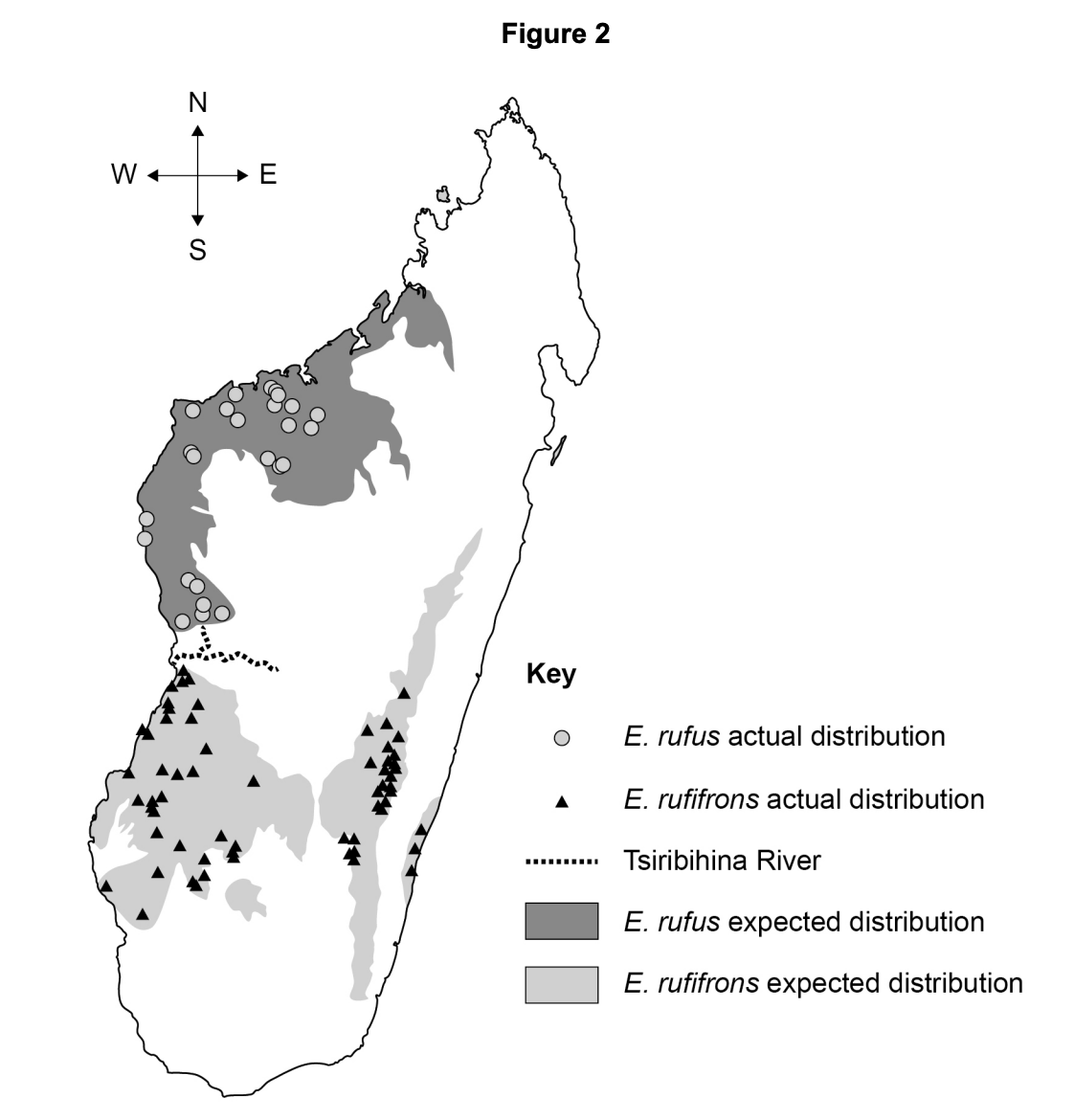
Answer
Mark Scheme
- E. rufus in north (west) OR E. rufus in the west OR E. rufus above river (1 mark)
- E. rufifrons in south OR E. rufifrons in west and east OR E. rufifrons below river (1 mark)
- (Actual) distribution similar to expected (distribution) OR (Actual) distribution similar to environmental needs OR (Actual) distribution (slightly) less than expected distribution (1 mark)
Comments from mark scheme
1 and 2. Accept equivalent valid statements e.g., for 1, no E. rufus in south. 1 and 2. If neither mark is awarded, accept, for one mark, ‘they are separated by the river’ OR ‘there is no overlap in their distribution/ranges’. 1 and 2. Accept converse. 1 and 2. Do not penalise ‘prefer’. 3. Accept for one or both species.
Tips from examiner reports
- Describe species distribution precisely — use compass directions and refer to geographical features (e.g. rivers)
- Compare actual distribution with expected distribution if data is provided
- Don’t speculate about environmental preferences without evidence
Using all the information, suggest how speciation happened to produce two species of lemur.
(5 marks)Answer
Mark Scheme
- Geographical isolation OR Allopatric speciation (1 mark)
- Reproductive separation/isolation OR No gene flow OR Gene pools separate (1 mark)
- Different selection pressures OR Different environmental/abiotic conditions/factors (1 mark)
- (Variation due to) mutation(s) (in different populations) (1 mark)
- (Different/advantageous) allele/s passed on/selected OR Change in frequency of allele/s (1 mark)
- (Eventually different species) cannot (inter)breed to produce fertile offspring (1 mark)
Comments from mark scheme
1.Ignore descriptions of geographical isolation.
- Reject sympatric. Ignore reference to two species at start.
- Reproductive isolation must be at beginning of process.
- Accept no interbreeding but must be a separate idea from mp 6 which relates to definition of a species.
- Reject no inbreeding.
Tips from examiner reports
- For allopatric speciation: geographical isolation → different selection pressures → different mutations/alleles selected → allele frequencies change → reproductive isolation → new species
- Mutations are random — not caused by the environment
- Reproductive isolation means organisms cannot interbreed to produce fertile offspring — include both parts
- Don’t confuse succession with speciation
The scientists used the mark box -release-recapture method to determine the number of lemurs in one area of forest. They captured, marked and released a first sample of 30 lemurs. A week later, they captured a second sample of 25 lemurs from the same area of forest. The scientists calculated that there were 250 lemurs in that area of forest.
Suggest one precaution needed when marking the lemurs to make sure the estimate of the number of lemurs is valid.
(1 marks)Answer
Mark Scheme
- (Marking) does not affect survival/predation/recapture (1 mark)
Comments from mark scheme
Accept. Mark does not rub/wash off/is non- toxic. Ignore ‘does not harm’ on its own unless it relates to survival/predation/recapture.
Tips from examiner reports
- Marks in capture-recapture must not affect survival (not visible to predators) and must not wash off
- Just saying ‘not cause harm’ isn’t specific enough — explain how it might cause harm (e.g. predation)
- Read the question — if it asks about the mark, don’t write about sample size or dispersal time
Using the information provided, calculate how many lemurs in the second sample were marked.
(1 marks)Answer
Mark Scheme
- 3 (1 mark)
Comments from mark scheme
Ignore any wording provided e.g. lemurs.
Tips from examiner reports
- Know how to rearrange the Lincoln index formula: population = (n1 × n2) / m
- Practise rearranging equations with three variables
CHECK FORMATTING WITH SUPERSCRIPT In humans, the ABO blood groups and Rhesus blood groups are under genetic control. The inheritance of the ABO blood groups is controlled by three alleles of a single gene, IA, IB and IO. The alleles IA and IB are codominant, and the allele IO is recessive to I A and recessive to IB.There are four ABO phenotypes, A, B, AB and O. The gene for the Rhesus blood groups has two alleles. The allele for Rhesus positive, R, is dominant to the allele for Rhesus negative, r. The genes for the ABO and Rhesus blood groups are not sex-linked and are not on the same chromosome. Figure 3 shows the phenotypes in a family tree for the ABO and Rhesus blood groups.
Give the genotypes of the ABO blood groups for individuals 1 and 2. Do not include the genotypes for the Rhesus blood groups in your answer
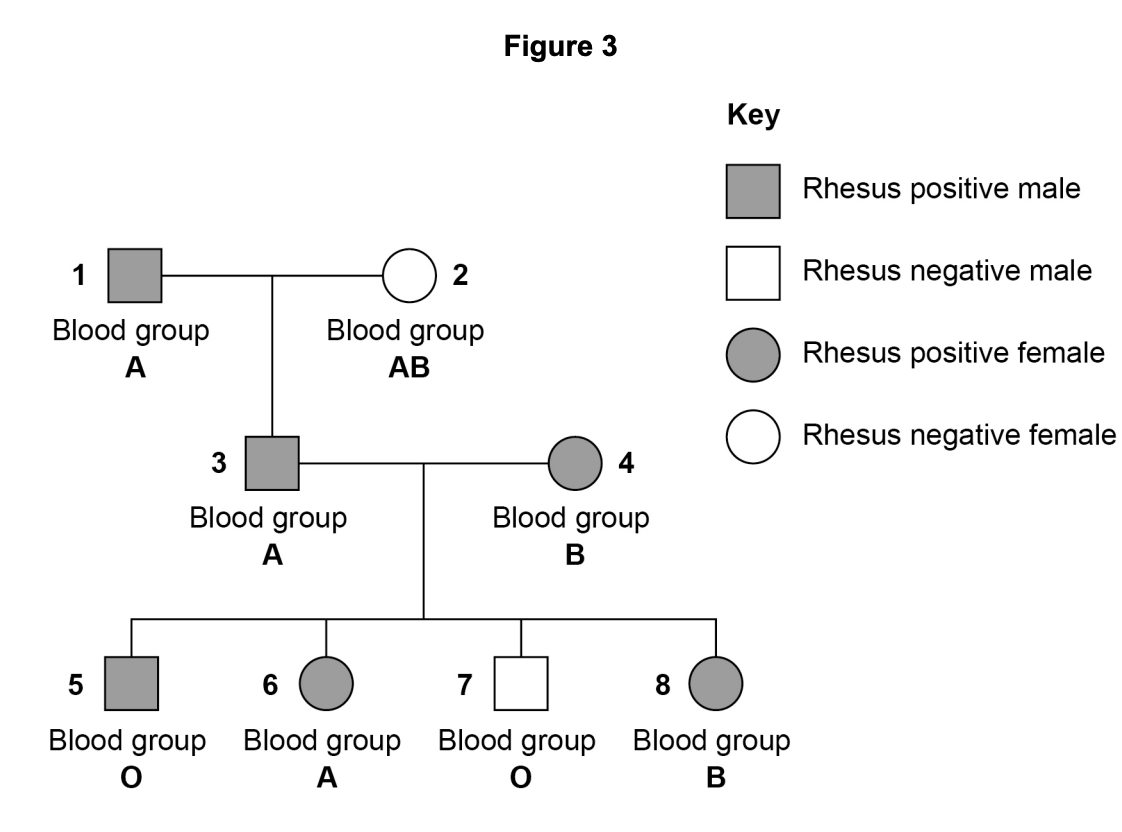
Answer
Mark Scheme
- CHECK FORMATTING *** (1) I AI O and (2) I AI B (1 mark)
Comments from mark scheme
Accept IOI A for (1) and I BI A for (2). Accept AO or OA for (1) and AB or BA for (2). Accept lower case for A, B and O.
Tips from examiner reports
- ABO blood group alleles are on autosomes (not sex chromosomes)
- If individual 1 has blood group A but has a child with blood group O, individual 1 must be heterozygous (IAi)
- Don’t write both possible genotypes — determine the correct one from the pedigree
Explain one piece of evidence from Figure 3 that the allele for Rhesus positive is dominant.
(2 marks)Answer
Mark Scheme
- Rhesus positive parents produce 7/Rhesus negative child OR 3 and 4 produce 7/Rhesus negative child OR Two Rhesus positive produce 7/Rhesus negative child (1 mark)
- Both Rhesus positive/3 and 4 have recessive allele OR Both Rhesus positive/3 and 4 are heterozygous/carriers OR If Rhesus positive was recessive, all children (of 3 and 4) would be Rhesus positive / have recessive (phenotype) (1 mark)
Comments from mark scheme
- Reject if incorrect evidence and correct evidence provided. 1.Accept Rhesus positive parents produce Rhesus positive and Rhesus negative child.
- Reject if incorrect explanation and correct explanation provided. 1 and 2. Accept ‘affected’ for Rhesus positive and ‘unaffected’ for Rhesus negative
Tips from examiner reports
- Use the correct individuals from the pedigree to provide evidence
- Read pedigree diagrams carefully — horizontal lines between individuals mean they are parents, not siblings
- If both parents can produce a recessive offspring (e.g. Rhesus negative), both must carry the recessive allele (both heterozygous)
Calculate the probability of individuals 1 and 2 producing a Rhesus positive son with blood group A (individual 3). You can assume that individual 1 is heterozygous for the Rhesus blood group. Show your working.
(2 marks)Answer
Mark Scheme
- Correct answer of 0.125 / 1 /8 / 12.5% = 2 marks (1 mark)
- Incorrect answer of 0.25 / 1 /4 / 25% = 1 mark (1 mark)
Comments from mark scheme
Accept 1 in 8 for 2 marks or accept 1 in 4 for 1 mark. Accept equivalent raw fractions e.g., 2 /16 for 2 marks or 4 /16 for 1 mark. Accept 12.5 for 1 mark.
Tips from examiner reports
- When calculating probability from a genetic cross, multiply the separate probabilities together
- Don’t forget to include the probability of the offspring being male or female (½) if sex is relevant
- Show each probability step clearly
Scientists determined the frequencies of the ABO alleles and ABO phenotypes in a large population. They then used a statistical test to determine if the frequencies of the four phenotypes differed significantly from the frequencies expected according to the Hardy–Weinberg equation.
The frequencies of the I A and IO alleles were 0.15 and 0.65.
What is the frequency of the IB allele?
(1 marks)Answer
Mark Scheme
- 0.2 OR 0.20 (1 mark)
Tips from examiner reports
- In Hardy-Weinberg with multiple alleles: the frequency of an allele = its value (e.g. 0.2), not 0.02
- Check your decimal places carefully
Name the statistical test you should use to determine if the observed frequencies of the four phenotypes differed significantly from the frequencies expected according to the Hardy–Weinberg equation.
State how many degrees of freedom should apply.
Statistical test = Number of degrees of freedom =
(2 marks)Answer
Mark Scheme
- Chi-squared (1 mark)
- 3 (1 mark)
Tips from examiner reports
- Use the chi-squared test when comparing observed and expected ratios in genetics
- Degrees of freedom = number of categories - 1
- Don’t confuse chi-squared with t-test, Spearman rank, or Mann-Whitney
The scientists concluded that the observed frequencies of the four phenotypes differed significantly from the expected frequencies.
Use your knowledge of the Hardy–Weinberg principle to suggest two reasons why.
(2 marks)Answer
Mark Scheme
- Selection (against/for a blood group/phenotype/allele) (1 mark)
- (High rate of) mutation (1 mark)
- Immigration/emigration (1 mark)
- No random mating. (1 mark)
Comments from mark scheme
1 to 4. Reject converse statements as context would be incorrect’ Ignore births/deaths. 3. Accept ‘migration’ or population is not isolated. 4. Ignore no ‘random fertilisation’.
Tips from examiner reports
- Hardy-Weinberg conditions can be disrupted by: mutation, immigration/emigration, natural selection, and non-random mating
- Don’t list crossing over, codominance, independent assortment, or random fertilisation — these don’t violate Hardy-Weinberg assumptions
- If the question says the population is large, don’t say it’s small
Give two reasons why transmission across a cholinergic synapse is unidirectional
(2 marks)Answer
Mark Scheme
- (Only) the presynaptic neurone/knob/membrane releases/has neurotransmitter/acetylcholine (1 mark)
- (Only) the postsynaptic neurone/membrane has receptors OR No receptors in the presynaptic neurone/membrane (1 mark)
Comments from mark scheme
- Accept abbreviations for acetylcholine e.g., ACh, Ach, AChol.
- Ignore has/releases ‘transmitter’.
Tips from examiner reports
- At a cholinergic synapse: action potential arrives → calcium ions enter → vesicles fuse with presynaptic membrane → acetylcholine released into cleft → binds to receptors on postsynaptic membrane → sodium ion channels open
- Sodium ion channels are present in both pre- and postsynaptic neurones — don’t say they’re only in one
Name and explain the type of summation shown in Figure 4. Type of summation = Explanation =
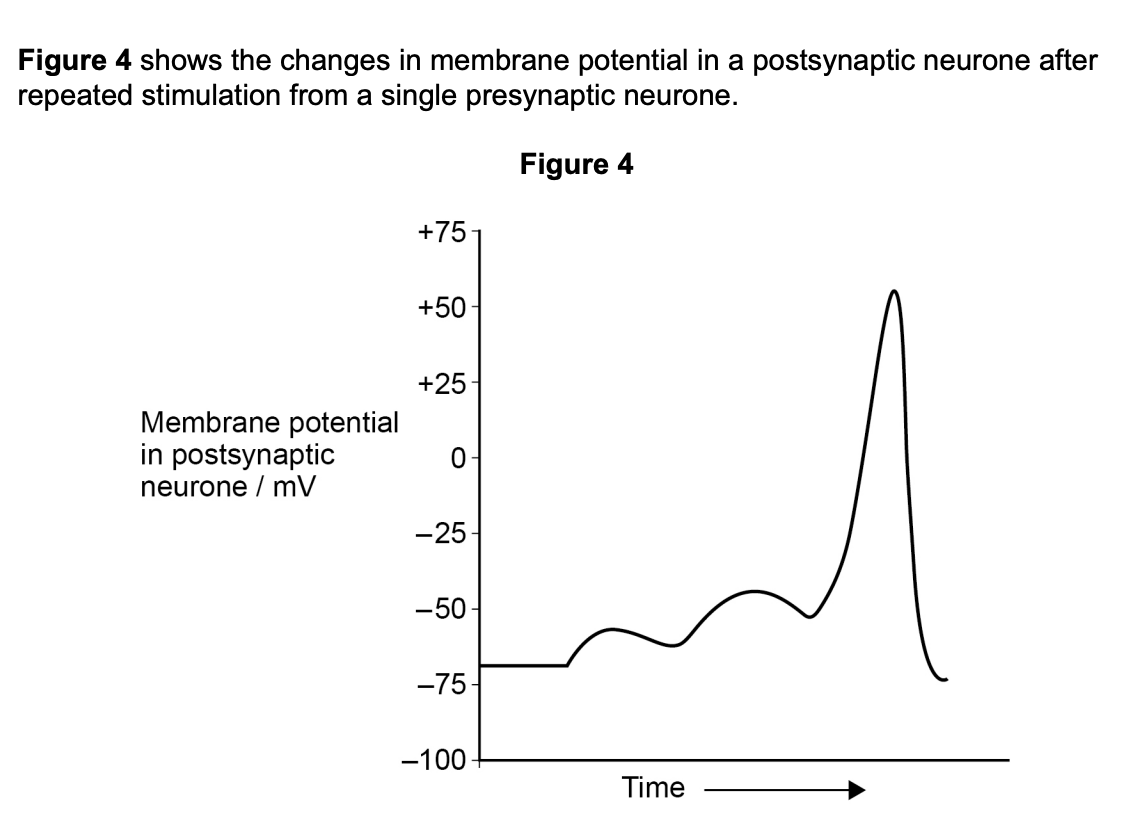
Answer
Mark Scheme
- Temporal (1 mark)
- (Several/repeated impulses in short time) provide (enough) neurotransmitter/acetylcholine to reach threshold OR (Several/repeated impulses in short time) so (enough) sodium ions enter to reach threshold OR (Several/repeated impulses in short time) increases membrane potential to reach threshold (1 mark)
Comments from mark scheme
- Accept abbreviations for acetylcholine e.g., ACh, Ach, AChol.
- Accept ‘to cause depolarisation’ or ‘to produce ‘action/generator potential’ for ‘to reach threshold’.
- Accept Na⁺ for sodium ions.
Tips from examiner reports
- Temporal summation: multiple impulses from ONE presynaptic neurone in quick succession, releasing enough neurotransmitter to reach the threshold
- Don’t confuse temporal with spatial summation (which involves multiple presynaptic neurones)
- Explain the mechanism: repeated neurotransmitter release → cumulative sodium ion entry → membrane depolarisation reaches threshold
Myasthenia gravis (MG) is an autoimmune disease caused when antibodies bind to box the sarcolemma (postsynaptic membrane) of neuromuscular junctions. This can weaken contraction of muscles. Mestinon is a drug that inhibits the enzyme acetylcholinesterase. Mestinon can help in the treatment of MG.
Suggest and explain how MG can weaken contraction of muscles. Do not include details of myofibril or muscle contraction in your answer.
(2 marks)Answer
Mark Scheme
- Less/no acetylcholine/neurotransmitter binds to receptor/s (1 mark)
- Less/no depolarisation OR Fewer/no action potential(s) OR Fewer/no sodium ions enter to reach threshold (1 mark)
Comments from mark scheme
- Accept abbreviations for acetylcholine e.g., ACh, Ach, AChol
- Ignore competitive inhibition but reject ‘’active site’.
- Accept ‘takes longer for depolarisation or action/generator potential to be produced’.
- Ignore ‘weaker action potential/depolarisation’.
- Accept Na⁺ for sodium ions.
Tips from examiner reports
- In myasthenia gravis: antibodies bind to acetylcholine receptors on the postsynaptic membrane (sarcolemma)
- Say ‘receptors’ — not just the membrane
- This prevents acetylcholine binding → less/no depolarisation → fewer/no action potentials
- Action potentials are all-or-nothing — you can have fewer of them, but individual ones aren’t ‘weaker’
Mestinon can help in the treatment of MG. Explain how.
(3 marks)Answer
Mark Scheme
- Less/no acetylcholine/neurotransmitter broken down (1 mark)
- (More) acetylcholine attaches to receptors (1 mark)
- Depolarisation (of sarcolemma) occurs OR Action potential(s) produced OR (Enough) sodium ions enter to reach threshold OR Fewer/no antibodies attach (1 mark)
Comments from mark scheme
- Accept (more) acetylcholine/neurotransmitter present/remains. 1 and 2. Accept acetylcholine/neurotransmitter remains attached to receptors (for longer) = 2 marks. 1 and 2. Accept ACh or other abbreviations e.g. AChol for acetylcholine.
- Accept Na⁺ for sodium ions.
Tips from examiner reports
- If a drug inhibits acetylcholinesterase, less acetylcholine is broken down → more acetylcholine remains in the cleft → more binding to receptors → more depolarisation
- Include ‘receptors’ when describing binding
- MG is the disease (myasthenia gravis), not a molecule or antibody
Scientists investigated the production of laboratory rats with the characteristics of type II diabetes. The scientists used the following method.
- They divided the rats into two groups, A and B, and fed them different diets for 2 weeks.
- They fed the rats in group A the normal diet containing 12% fat.
- They fed the rats in group B a high-fat diet containing 56% fat.
- After 2 weeks, they injected both groups of rats with 35 mg kg⁻¹ of the drug streptozotocin (STZ) to induce diabetes.
- 1 week later, the scientists determined the mean body mass and mean blood glucose concentration for each group.
Table 3 shows the results.
Calculate how many grams of STZ should be injected into a rat with a mass of 230.45 g. Show your working.
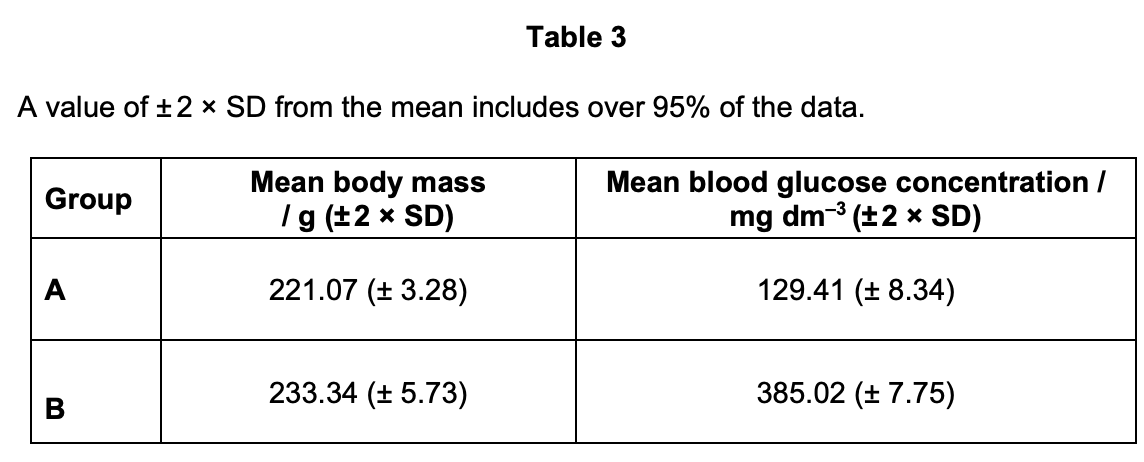
Answer
Mark Scheme
- Correct answer of 8.1 / 8.07/ 8.066 / 8.0658 / 8.06575 × 10⁻³ = 2 marks (1 mark)
Incorrect answer but shows 8 / 8.1 / 8.07 / 8.066 / 8.0658 / 8.06575 = Correct answer but not in standard form = Incorrect rounding of correct answer in correct standard form e.g., 8.06 x 10⁻³ =
Comments from mark scheme
Note. To award 2 marks × 10⁻³ is required. Accept 8 x 10⁻³ for 2 marks but 8.0 x 10⁻³ = 1 mark due to incorrect rounding
Tips from examiner reports
- Convert units carefully (e.g. mg to g: divide by 1000)
- Give answers in standard form when appropriate
- Round correctly — 8.0658 rounds to 8.07 (not 8.06)
- Check you’re dividing the right numbers
Suggest and explain why STZ was injected per unit of body mass.
(2 marks)Answer
Mark Scheme
- For (valid) comparison as rats vary in mass OR (So) each rat receives a quantity relative to their mass OR (So) concentration in the blood/body is the same (1 mark)
Comments from mark scheme
Accept ‘standardisation’ for ‘comparison’. Accept ‘weight’ for mass but ignore size.
Tips from examiner reports
- Drug dosage per body mass ensures a valid comparison between animals of different sizes
- Say ‘mass’ not ‘size’
- Link varying mass to needing proportional doses for a fair comparison
The scientists concluded that group B rats could be used for studying type II diabetes in humans.
Use all the information and your knowledge of type II diabetes to evaluate this conclusion.
(5 marks)Answer
Mark Scheme
- SDs do not overlap (for blood glucose concentration) OR SDs do not overlap (for mass) (1 mark)
- So significant difference/increase (in blood glucose concentration) OR So significant difference/increase (in mass) (1 mark)
- (Type II diabetes) causes high blood glucose (concentration) (1 mark)
- Obesity/high body mass is a (risk) factor (in type II diabetes) OR High fat (diet) is a (risk) factor (in type II diabetes) (1 mark)
- (Investigation) done on rats (not humans) (1 mark)
- (Only shows) results after short-time period OR Long-term effects not known (1 mark)
Comments from mark scheme
- Accept ‘difference/increase is not due to chance’ for significant difference/increase. Ignore reference to stats test.
- Accept ‘associated/linked/have’ for causes.
- Accept 1, 2 or 3 weeks.
Tips from examiner reports
- Evaluate experimental design: was it done on rats or humans? Was the time period long enough?
- When interpreting error bars/SDs: if they don’t overlap, the difference is likely significant
- Use precise terminology: say ‘glucose’ not ‘sugar’; say ‘the difference is significant’ not ‘the results are significant’
- Link high-fat diet/obesity to type II diabetes as supporting evidence
The scientists repeated the investigation using much higher doses of STZ. This led to destruction of pancreatic cells. The scientists concluded that these rats would not be suitable for studying type II diabetes.
Give two reasons why the scientists made this conclusion.
(2 marks)Answer
Mark Scheme
- (Type II) still produce/release insulin (1 mark)
- (Type II) cells/receptors less/not responsive/sensitive to insulin (1 mark)
- Pancreatic cells not destroyed (in type II diabetes) (1 mark)
- Damage to pancreatic cells may affect processes/reactions (in the body) (1 mark)
Comments from mark scheme
- Accept ‘type 1 would not produce/release insulin’ or this would cause type I diabetes.
- Accept involves ‘faulty receptors’ or ‘fewer receptors’.
- Ignore pancreas is not destroyed.
Tips from examiner reports
- Type I diabetes: beta cells destroyed → no insulin produced
- Type II diabetes: cells/receptors less responsive to insulin, beta cells not destroyed
- Say ‘receptors’ when describing reduced sensitivity — don’t just say ‘less responsive to insulin’
- If beta cells are destroyed (type I), other pancreatic functions (e.g. glucagon release, enzyme production) could also be affected
Name the part of the body which releases antidiuretic hormone (ADH) into the blood.
(1 marks)Answer
Mark Scheme
- Posterior pituitary (1 mark)
Comments from mark scheme
Accept phonetic spelling. Ignore any other additional wording
Tips from examiner reports
- ADH is released from the posterior pituitary gland — say ‘posterior pituitary’ specifically
- The hypothalamus produces ADH but the posterior pituitary releases it into the blood
Alcohol decreases the release of ADH into the blood.
Suggest two signs or symptoms which may result from a decrease in ADH.
(2 marks)Answer
Mark Scheme
- Dehydration/thirst (1 mark)
- Frequent urination OR Increase in volume of urine (1 mark)
- Less concentrated urine OR Dilute urine OR Urine paler/lighter in colour (1 mark)
Comments from mark scheme
- Ignore amount.
- Accept increased urination
Tips from examiner reports
- Decreased ADH → less water reabsorption → large volumes of dilute urine → possible dehydration and thirst
- Don’t give symptoms of increased ADH when asked about decreased ADH
- Don’t confuse effects of decreased ADH with effects of alcohol consumption (headaches, dizziness, etc.)
Describe the effect of ADH on the collecting ducts in kidneys.
(3 marks)Answer
Mark Scheme
- (Stimulates) addition of channel proteins into membrane (1 mark)
- Increases permeability to water OR (More) water (re)absorbed (1 mark)
- By osmosis (1 mark)
Comments from mark scheme
1.Accept aquaporins for channel proteins.
- Accept movement for addition.
- Accept (stimulates) opening of channel proteins in membrane.
- Accept for reabsorbed ‘enters blood’ or ‘leaves collecting duct’.
Tips from examiner reports
- ADH increases the permeability of the collecting duct to water by inserting aquaporins into the membrane
- Water is reabsorbed out of the collecting duct (not into it) by osmosis
- Include all three elements: aquaporins in membrane, water reabsorbed from collecting duct, by osmosis
Read the following passage.
BRCA1 and BRCA2 are human genes that code for tumour suppressor proteins. Mutations in BRCA1 and BRCA2 can cause cancer. Specific inherited mutations in these genes increase the risk of female breast cancers and ovarian cancers and have been associated with increased risks of several other types of cancer. Genetic testing, using DNA from saliva, can screen for all known harmful mutations in both genes. ER-positive breast cancers have receptors for the hormone oestrogen. These cancers develop as a result of increased oestrogen concentrations in the blood. Effective treatment of ER-positive breast cancers often involves the use of drugs which have a similar structure to oestrogen. Blood tests can be used to test for cancers. Men with prostate cancer have a high concentration of prostate-specific antigen (PSA) in their blood. Urinary infections and a naturally enlarged prostate can also increase concentrations of PSA. Recent research has indicated that several cancers result from epigenetic abnormalities. Treatment with drugs might be able to reverse the epigenetic changes that cause cancers.
Use the information in the passage and your own knowledge to answer the following questions.
BRCA1 and BRCA2 are human genes that code for tumour suppressor proteins. Mutations in BRCA1 and BRCA2 can cause cancer (lines 1–2). Explain how.
(3 marks)Answer
Mark Scheme
- Change in DNA base sequence/triplet (1 mark)
- Change in (sequence of) amino acids OR Change in primary/tertiary/3 0 structure (1 mark)
- (Results in) rapid/uncontrollable cell division (1 mark)
Comments from mark scheme
- Ignore reference to protein not being formed.
- Reject (different) amino acids formed.
- Ignore 3D structure.
- Accept cell division cannot be regulated.
- Ignore growth.
- Accept cell replication but ignore cell reproduction.
Tips from examiner reports
- A mutation is a change in the DNA base sequence — mention DNA, not RNA or amino acid sequence
- Mutation → changed primary structure (amino acid sequence) → changed tertiary structure/shape of protein
- Say ‘uncontrolled cell division’ not ‘growth of cells’
- Don’t confuse mutations with epigenetic changes (methylation)
Genetic testing, using DNA from saliva, can screen for all known harmful mutations in both genes (lines 5–6).
Describe how this DNA could be screened for all known harmful mutations in both genes.
(4 marks)Answer
Mark Scheme
- Use of PCR to amplify (DNA/sample) (1 mark)
- Cut (DNA) using restriction endonuclease/enzymes (1 mark)
- Separate (DNA fragments) using electrophoresis (1 mark)
- Addition of (labelled) DNA probes and binding (by DNA hybridisation) (1 mark)
- (Mutations) identified by fluorescence/radioactivity OR Compare positions/bands (to known) DNA sample with (all harmful) mutations (1 mark)
Comments from mark scheme
- Accept description of amplification. 2.
- Accept use of microarray for electrophoresis.
- Ignore primers.
- Reference to probe being complementary is insufficient.
- Accept identification using Xray/photographic/film/autoradiography or UV light. Note if only DNA sequencing is used award max 3 marks for the following. 1 Use of PCR to amplify (DNA/sample);
- Sequence the DNA sample;
- Compare DNA sequence with known DNA sequence of mutation;
Tips from examiner reports
- Genetic screening techniques: PCR to amplify DNA, restriction enzymes to cut at specific sites, gel electrophoresis to separate fragments, DNA probes to identify specific sequences
- DNA probes bind (hybridise) to complementary base sequences — use the word ‘bind’
- Don’t confuse DNA probes with primers (used in PCR)
- Say ‘DNA base sequence’ not ‘amino acid sequence of genes’
Effective treatment of ER-positive breast cancers often involves the use of drugs which have a similar structure to oestrogen (lines 9–10).
Suggest and explain how these drugs are an effective treatment of ER-positive breast cancers.
(3 marks)Answer
Mark Scheme
- (Drug) binds to (oestrogen/ER) receptor (1 mark)
- Prevents binding of oestrogen/hormone (1 mark)
- No/fewer transcription factor(s) bind to promoter OR RNA polymerase not stimulated/activated (1 mark)
Comments from mark scheme
- Accept (inactive) transcription factor for receptor. 1 and 2. Reject active site/enzyme - substrate complex once only.
Tips from examiner reports
- Oestrogen receptor-blocking drugs work by binding to the oestrogen receptor (transcription factor), preventing oestrogen from binding
- Without oestrogen binding, the transcription factor can’t activate the promoter/RNA polymerase → gene not transcribed
- Don’t say the drug binds to oestrogen itself
- Don’t use enzyme terminology like ‘active site’ or ‘enzyme-substrate complex’ for receptors
Blood tests can be used to test for cancers (line 11).
However, the results of blood tests may not be conclusive when testing for prostate cancer. Explain why.
(2 marks)Answer
Mark Scheme
- High/increased (concentration of) PSA not always linked to (prostate) cancer OR High/increased (concentration of) PSA could be a false positive (1 mark)
- (Could be) due to urinary infection OR (Could be) due to enlarged prostate (1 mark)
Comments from mark scheme
- Accept ‘urine infection’.
Tips from examiner reports
- Use information from the passage to support your answer
- A raised PSA level doesn’t necessarily indicate cancer — it could be caused by an enlarged prostate or urinary infection
- Don’t suggest the prostate has no blood supply — PSA enters the blood from the prostate
Treatment with drugs might be able to reverse the epigenetic changes that cause cancers (lines 16–17).
Suggest and explain how.
(3 marks)Answer
Mark Scheme
- (Drugs could) increase methylation of oncogene(s) (1 mark)
- (Drugs could) decrease methylation of tumour suppressor gene(s) (1 mark)
- (Increased) methylation of DNA/gene(s) inhibits transcription/expression (of genes) OR Decreased methylation of DNA/gene(s) stimulates transcription/expression (of genes) (1 mark)
- Decreased acetylation of histones inhibits transcription/expression (of genes) OR (Increased) acetylation of histones stimulates transcription/expression (of genes) (1 mark)
Comments from mark scheme
Ignore methylation of histones and acetylation of DNA/genes. Ignore protooncogenes. 3. Accept promoter (region) for DNA/gene 3 and 4. Ignore ‘switching on’ and ‘switching off’ genes once but accept as alternative(s) for 1 mark if used correctly in context of transcription/ expression for both points 3 and 4.
Tips from examiner reports
- Epigenetics involves methylation (of DNA) and acetylation (of histones) — know both
- Methylation of tumour suppressor genes inhibits their transcription → cell division isn’t controlled → cancer
- Say ‘transcription/expression of genes’ not ‘genes switched on/off’ — be precise
- Epigenetic changes don’t cause mutations — they affect gene expression without changing the base sequence
- Don’t confuse oncogenes with proto-oncogenes
Describe the process of glycolysis.
(4 marks)Answer
Mark Scheme
- Phosphorylation of glucose using ATP (1 mark)
- Oxidation of triose phosphate to pyruvate (1 mark)
- Net gain of ATP (1 mark)
- NAD reduced (1 mark)
Comments from mark scheme
Accept all mark points in diagrams. 2. Accept removal of hydrogen from triose phosphate for oxidation. 3. Accept any description that indicates a net gain e.g., 4 produced, 2 used. 4. Accept NADH/NADH2/NADH + H⁺ produced.
Tips from examiner reports
- Glycolysis: glucose → phosphorylated glucose (using ATP) → triose phosphate → pyruvate
- Triose phosphate is oxidised to pyruvate — say ‘oxidised’ not just ‘converted’ or ‘broken down’
- Net gain of 2 ATP per glucose — make this clear
- Reduced NAD is produced — mention this
- Don’t confuse glycolysis with glycogenesis, glycogenolysis, or gluconeogenesis
Malonate inhibits a reaction in the Krebs cycle.
Explain why malonate would decrease the uptake of oxygen in a respiring cell.
(2 marks)Answer
Mark Scheme
- Less/no reduced NAD/coenzymes OR Fewer/no hydrogens/electrons removed (and passed to electron transfer chain) (1 mark)
- Oxygen is the final/terminal (electron) acceptor (1 mark)
Comments from mark scheme
- Accept less/no FAD reduced.
Tips from examiner reports
- If the Krebs cycle is inhibited: fewer reduced coenzymes (reduced NAD/FAD) are produced → fewer electrons/hydrogen atoms enter the electron transfer chain → less oxygen needed as the final electron acceptor
- Oxygen is the final electron acceptor in the electron transfer chain — know this
- Don’t just say ‘anaerobic respiration would occur’ without explaining the mechanism
- Don’t confuse respiration molecules with photosynthesis molecules (NADPH, RuBP)
Explain how a resting potential is maintained across the axon membrane in a neurone.
(3 marks)Answer
Mark Scheme
- Higher concentration of potassium ions inside and higher concentration of sodium ions outside (the neurone) OR potassium ions diffuse out OR sodium ions diffuse in (1 mark)
- (Membrane) more permeable to potassium ions (leaving than sodium ions entering) OR (Membrane) less permeable to sodium ions (entering than potassium ions leaving) (1 mark)
- Sodium ions (actively) transported out and potassium ions in (1 mark)
Comments from mark scheme
- Accept ‘more’ for ‘higher concentration’.
- Accept ‘sodium ions can’t diffuse in (due to alternative explanation).
- Accept for ‘less permeable to sodium ions’ is ‘impermeable to sodium ions’ or ‘sodium gates/channels are closed’ (alternative explanation). 1, 2 and 3 reference to ions or Na⁺ and K⁺ is required. If mentioned once allow for all mark points. 1, 2 and 3. If an answer provides two or three of these mark points without any reference to ions – award one maximum mark.
- Accept 3 Na⁺ out and 2 K + in but reject if numbers used are incorrect.
Tips from examiner reports
- The sodium-potassium pump actively transports 3 Na⁺ out and 2 K⁺ in — don’t reverse the ratio
- This is active transport, not diffusion
- The membrane is more permeable to K⁺ than Na⁺, so K⁺ diffuses out more easily, making the inside more negative
- Make sure you describe ion movement in the correct direction — don’t contradict yourself
Explain why the speed of transmission of impulses is faster along a myelinated axon than along a non-myelinated axon.
(3 marks)Answer
Mark Scheme
- Myelination provides (electrical) insulation (1 mark)
- (In myelinated) saltatory (conduction) OR (In myelinated) depolarisation at nodes (of Ranvier) (1 mark)
- In non-myelinated depolarisation occurs along whole/length (of axon) (1 mark)
Comments from mark scheme
- Reject thermal insulation.
- Accept description of (electrical) insulation.
- Accept action potentials for depolarisation. 2 and 3. ‘Messages’ or ‘signals’ disqualifies firs
Tips from examiner reports
- Myelin provides electrical insulation (not thermal insulation)
- In myelinated neurones, depolarisation only occurs at nodes of Ranvier → saltatory conduction → faster impulse
- Say ‘depolarisation occurs at nodes’ not ‘impulses jump from node to node’
- In non-myelinated neurones, depolarisation occurs along the entire length → slower
- Use the term ‘depolarisation’ or ‘action potential’ — not ‘impulse’ when describing the mechanism
A scientist investigated the effect of inhibitors on neurones. She added a respiratory inhibitor to a neurone. The resting potential of the neurone changed from –70 mV to 0 mV. Explain why.
(3 marks)Answer
Mark Scheme
- No/less ATP produced (1 mark)
- No/less active transport OR Sodium/potassium pump inhibited (1 mark)
- Electrochemical gradient not maintained OR (Facilitated) diffusion of ions causes change to 0 mV OR (Results in) same concentration of (sodium and potassium) ions (either side of membrane) OR No net movement of (sodium and potassium) ions (1 mark)
Comments from mark scheme
- Accept Na⁺ not/fewer moved out and K⁺ not/fewer moved in.
- Accept reaches electrical equilibrium/balance.
- Accept concentration gradient of sodium and potassium ions not maintained.
Tips from examiner reports
- A respiratory inhibitor reduces ATP production → the sodium-potassium pump can’t function → Na⁺ and K⁺ ions reach equal concentrations on both sides → resting potential approaches 0 mV
- Don’t just say ‘energy can’t be produced’ — say ‘ATP production is reduced’
- Start with the effect on ATP, then the pump, then ion distribution, then resting potential
Use your knowledge of indoleacetic acid (IAA) to explain the growth curvature shown in Figure 1.
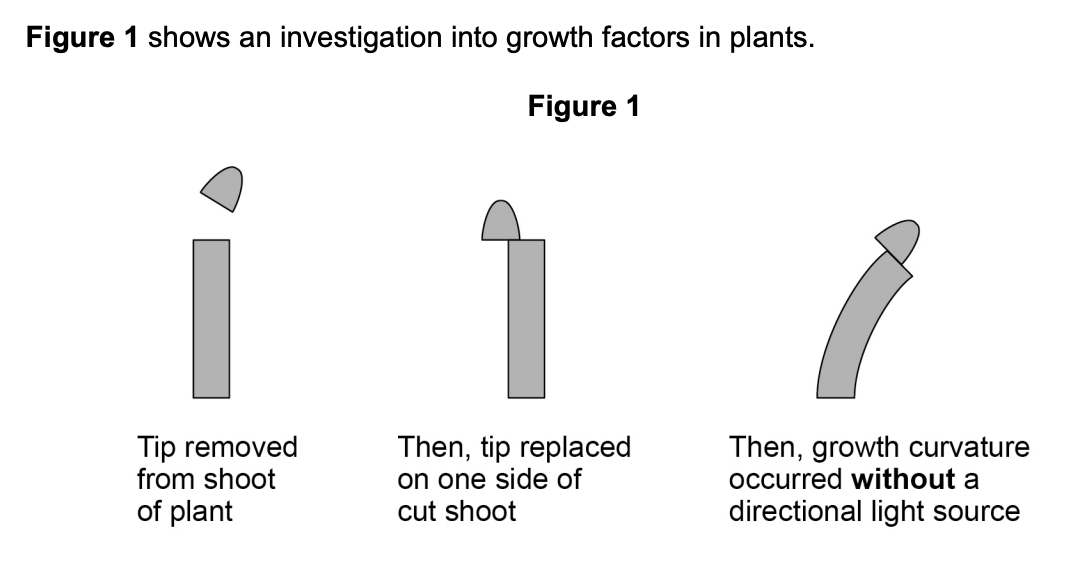
Answer
Mark Scheme
- Tip produces IAA (1 mark)
- IAA diffuses (into shoot) (1 mark)
- (More) elongation of cells on one side (than other) (1 mark)
Comments from mark scheme
- Accept source/release for produces but ignore contains/stores IAA. 1 and 2. Accept auxin for IAA.
- Accept IAA diffuses down.
- Accept (more) elongation of cells on left side.
- Reject any reference to shaded/dark side or away from light.
Tips from examiner reports
- IAA is produced in the shoot tip and diffuses down — state this clearly
- Don’t describe phototropism if there’s no directional light source mentioned in the question
- Say ‘cell elongation’ specifically — ‘more growth’ or ‘more elongation’ alone isn’t precise enough
A bioassay is a method to determine the concentration of a substance by its effect on box living tissues. Figure 2 shows the practical procedure used in a growth curvature bioassay to determine the concentration of IAA in shoot tips.
Using the procedure in Figure 2 and the calibration curve in Figure 3, describe how you could compare the IAA concentration in shoot tips from two different plant species.
In your answer you should refer to all the variables that should be controlled to produce a valid comparison.
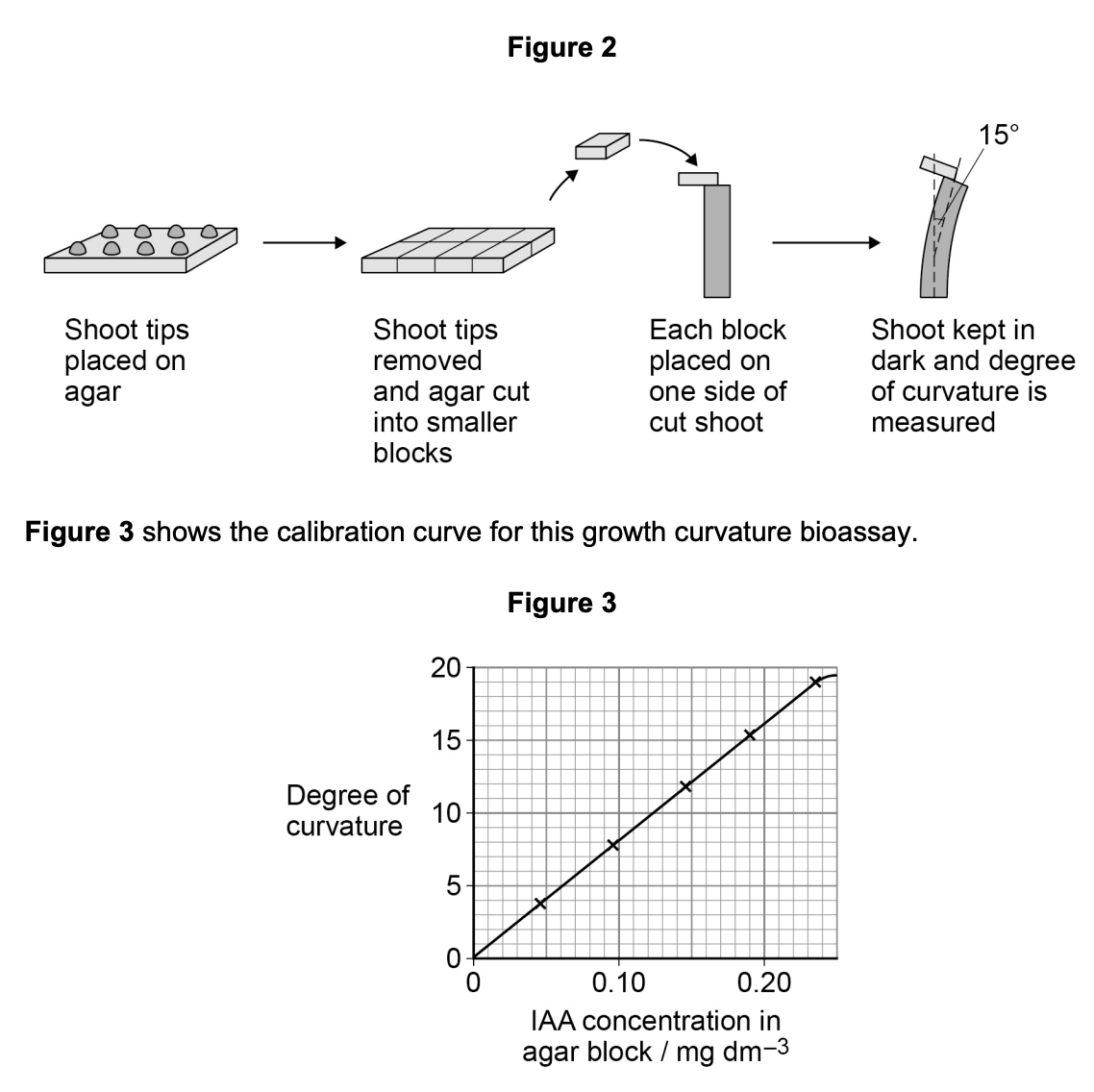
Answer
Mark Scheme
- Size of shoot/tip (1 mark)
- Number of shoot tips (1 mark)
- Size/type of agar (block) (1 mark)
- (Shoots) at same stage of growth/development (1 mark)
- Time (period) tips kept on agar OR Time (period) agar/block kept on (cut shoot) OR Time (period shoots) kept in dark (1 mark)
- Temperature (1 mark)
- (Repeat several times and) calculate a mean (1 mark)
- Compare/read degree of curvature (on calibration curve) to determine (IAA) concentration OR Higher the degree of curvature the higher the IAA conc (1 mark)
Comments from mark scheme
Mark points 1 to 6 = max 3. 1 to 6. Ignore pH, species, carbon dioxide, humidity, nutrients, water and light. 3. Accept ‘amount of agar’. 4. Accept (Shoots/plants) are same age.
Tips from examiner reports
- List control variables relevant to the specific investigation
- Suggest repeats and calculating a mean to improve reliability
- A calibration curve uses known concentrations to estimate unknown ones — explain how it would be used
A scientist investigated the effect of a directional light stimulus on the distribution of box IAA in shoot tips. The scientist set up three experiments as shown in Figure 4. All variables were controlled apart from exposure to light.
State two conclusions about IAA that you can make from the results shown in Table 1.
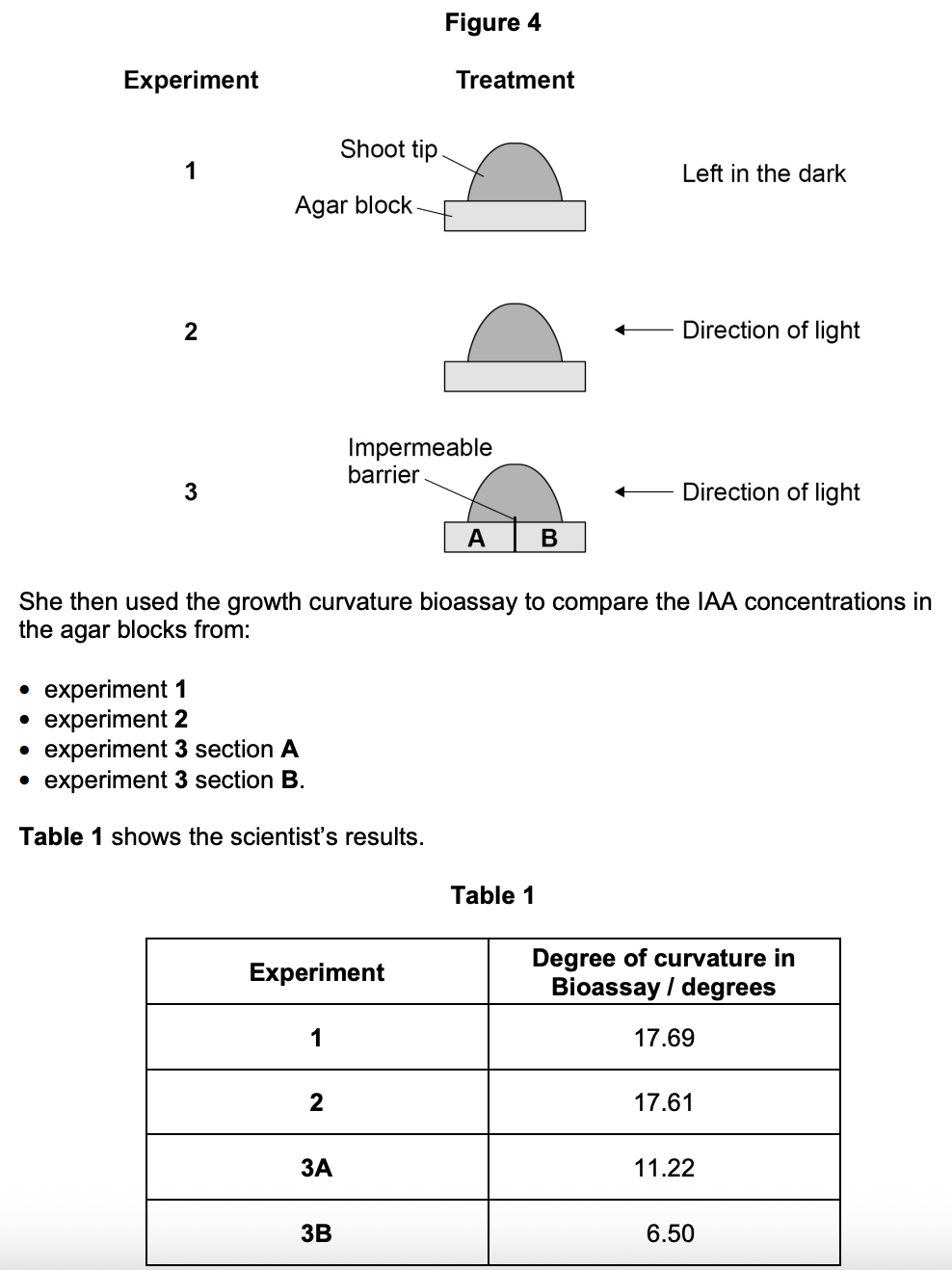
Answer
Mark Scheme
- (IAA) is not broken down by light OR (IAA) is produced in the dark OR Light/dark does not affect (IAA) production (1 mark)
- (IAA) moves away from light OR (IAA) moves to shaded side (1 mark)
Comments from mark scheme
- IAA accumulates on shaded side is not enough on its own, idea of movement is required.
Tips from examiner reports
- Draw conclusions from the data — don’t just describe the results
- Consider whether IAA is broken down by light or still produced in the dark
- Don’t confuse IAA movement with bending/phototropism
In fruit flies, males have the sex chromosomes XY and the females have XX. In fruit flies, a gene for eye colour is carried on the X chromosome. The allele for red eyes, R, is dominant to the allele for white eyes, r.
Male fruit flies are more likely than female fruit flies to have white eyes. Explain why.
(2 marks)Answer
Mark Scheme
- Males have one allele (1 mark)
- Females need two recessive alleles OR Females must be homozygous recessive OR Females could have dominant and recessive alleles OR Females could be heterozygous/carriers (1 mark)
Comments from mark scheme
1 Accept males only need one allele. 1 and 2. Ignore references to X and Y chromosomes. 1 and 2. Accept r as recessive allele and R as dominant allele. If no reference to allele, accept for one mark male needs one recessive gene whereas females need two recessive genes.
Tips from examiner reports
- For sex-linked inheritance: males need only one copy of the recessive allele (on the X chromosome) to show the trait; females need two copies
- Use the term ‘allele’ not ‘gene’ when explaining inheritance patterns
- The allele is on the X chromosome, not the Y chromosome
Tick ( ) one box next to the statement which correctly describes the phenotypes produced from this cross. a) All offspring red-eyed b) All females red-eyed, all males white-eyed c) All males red-eyed, all females white-eyed d) All males white-eyed, females red-eyed and females white-eyed
(1 marks)Answer
Mark Scheme
- All females red-eyed, all males white-eyed. (1 mark)
Tips from examiner reports
- Know the outcomes of sex-linked crosses — practise genetic diagrams with X-linked alleles
In fruit flies, the genes for body colour and for wing development are not on the sex box chromosomes. The allele for grey body colour, G, is dominant to the allele for black body colour, g. The allele for long wings, L, is dominant to the allele for short wings, l.
A geneticist carried out a cross between fruit flies with grey bodies and long wings (heterozygous for both genes) and fruit flies with black bodies and short wings. Table 2 shows the results of this cross.
Explain the results in Table 2.
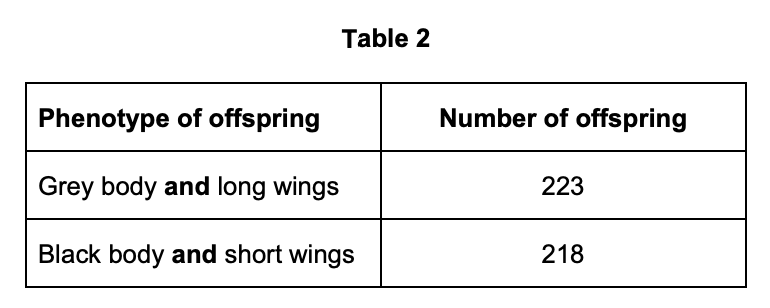
Answer
Mark Scheme
- The (two) genes are linked OR Autosomal linkage (1 mark)
- No crossing over (occurs) OR (Linked) genes are close together (1 mark)
- No Gl and no gL (gametes produced) OR No Ggll and no ggLl (offspring produced) OR Only GL and gl (gametes produced) (1 mark)
Comments from mark scheme
- Accept ‘Alleles are linked’ (accept symbols for alleles) but reject if context suggests alleles of the ‘same gene’.
- Accept crossing over less likely to occur. 1 2, and 3. Ignore reference to independent assortment.
Tips from examiner reports
- A 1:1 ratio (instead of 1:1:1:1) in a dihybrid cross suggests the genes are linked (on the same chromosome)
- If no crossing over occurs, only parental combinations appear in the offspring
- Don’t suggest epistasis, lethal combinations, or random fertilisation to explain linked gene ratios
The first generation of a population of fruit flies had 50 females. Calculate how many female fruit flies would be produced from this population in the fifth generation. You can assume:
Give your answer in standard form
- each female produces 400 offspring each generation
- half the offspring produced each generation are female
- there is no immigration or emigration
- no flies die before reproducing. Show your working.
Answer
Mark Scheme
- Correct answer of 8 × 1010 = 3 marks (1 mark)
- Correct answer not in standard form = 2 marks (1 mark)
Tips from examiner reports
- Read the question carefully — note whether it asks about generations, males/females, or both
- Convert units correctly and express answers in standard form if required
- Show all working clearly
Neonatal diabetes is a disease that affects newly born children. The disease is caused by a change in the amino acid sequence of insulin.
This change prevents insulin binding to its receptor.
Explain why this change prevents insulin binding to its receptor.
(2 marks)Answer
Mark Scheme
- Changes tertiary structure (1 mark)
- No longer complementary (to receptor) (1 mark)
Comments from mark scheme
- Reject change in tertiary structure of receptor.
- Reject ‘active site’ or reference to enzyme or substrate.
Tips from examiner reports
- Insulin binds to a receptor that is complementary in shape — say ‘complementary’ not ‘fits’
- Don’t use enzyme terminology (active site, substrate, enzyme) for receptor binding
- Write ‘tertiary structure’ in full — don’t abbreviate
- A change in receptor shape means insulin is no longer complementary → can’t bind
Phosphoinositide 3 box -kinase (PI3K) is an enzyme in several metabolic processes. Figure 5 shows the role of PI3K in the control of blood glucose concentration.
A decrease in the activity of PI3K can cause type II diabetes.
Use Figure 5 to explain why.
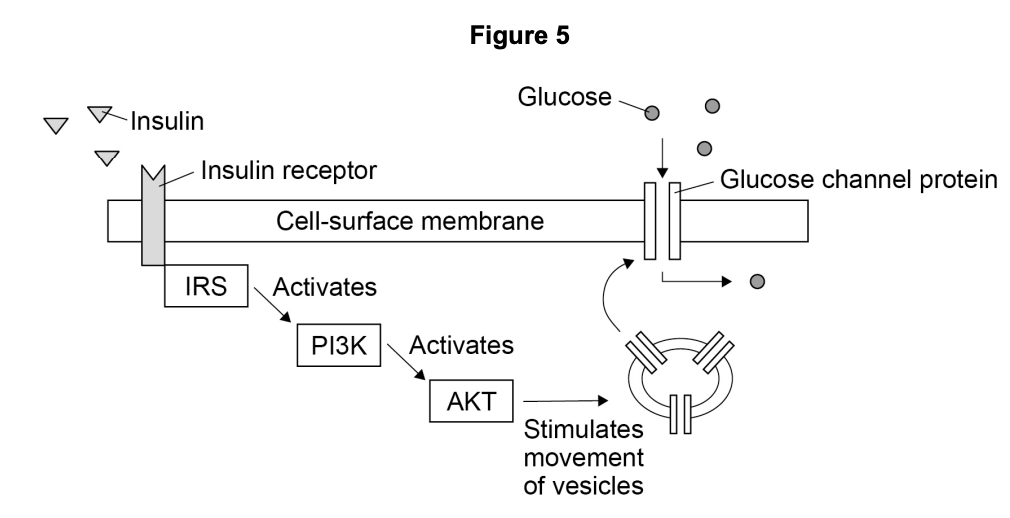
Answer
Mark Scheme
- Less/no AKT activated (1 mark)
- Fewer/no vesicles move to membrane OR Fewer/no (channel) proteins in membrane (1 mark)
- Less/no glucose diffuses into cell (so high blood glucose (1 mark)
Comments from mark scheme
- Accept ‘fuse with membrane’.
Tips from examiner reports
- Follow the signalling pathway step by step: less AKT activated → fewer vesicles move to the cell-surface membrane → fewer glucose channel proteins inserted → less glucose enters the cell
- Mention the cell-surface membrane specifically
- Vesicles contain channel proteins, not glucose itself
- Be clear about the direction of glucose movement
Using your knowledge of the kidney, explain why glucose is found in the urine of a person with untreated diabetes.
(3 marks)Answer
Mark Scheme
- High concentration of glucose in blood/filtrate (1 mark)
- Not all the glucose is (re)absorbed at the proximal convoluted tubule (1 mark)
- Carrier/co-transport proteins are working at maximum rate OR Carrier/co-transport proteins/ are saturated (1 mark)
Comments from mark scheme
- Accept tubule for filtrate.
- Reject no glucose is (re)absorbed.
- Accept all carrier/co-transport proteins are ‘in use’ but reject all carriers are ‘used up’.
- Accept symport for carrier protein.
- Accept not enough carrier proteins to absorb all the glucose.
Tips from examiner reports
- Say ‘high concentration’ not ‘high amount’ or ‘high level’
- Write out ‘proximal convoluted tubule’ in full — don’t just use ‘PCT’
- If glucose concentration in filtrate is very high, co-transport proteins can’t reabsorb all of it → glucose appears in urine
- Say ‘less glucose reabsorbed’ not ‘no glucose reabsorbed’
Myelodysplastic syndromes (MDS) are a group of malignant cancers. In MDS, the bone marrow does not produce healthy blood cells. Haematopoietic stem cell transplantation (HSCT) is one treatment for MDS. In HSCT, the patient receives stem cells from the bone marrow of a person who does not have MDS. Before the treatment starts, the patient’s faulty bone marrow is destroyed.
For some patients, HSCT is an effective treatment for MDS. Explain how
(3 marks)Answer
Mark Scheme
- Produce healthy (blood) cells (1 mark)
- No MDS/faulty/cancerous (blood) cells (1 mark)
- Stem cells divide/replicate (1 mark)
Comments from mark scheme
1 and 2. Produce only healthy/normal (blood) cells = two marks.
- Accept produce ‘normal’ /non-MDS cells.
- Accept no (cancerous) tumour. 1 and 3. Ignore reference to totipotent/pluripotent/ multipotent/unipotent
- Accept ‘clone’ for divide.
Tips from examiner reports
- Stem cells can divide (by mitosis) AND differentiate into specialised cells
- Don’t forget to mention that stem cells can replicate/divide — it’s not enough to just say they differentiate
- Stem cell treatment aims to replace faulty cells with healthy, normal cells
MDS can develop from epigenetic changes to tumour suppressor genes. In some patients, the drug AZA has reduced the effects of MDS. AZA is an inhibitor of DNA methyltransferases. These enzymes add methyl groups to cytosine bases.
Suggest and explain how AZA can reduce the effects of MDS in some patients.
(3 marks)Answer
Mark Scheme
- (AZA) reduces methylation (of DNA/cytosine/gene) (1 mark)
- (Tumour suppressor) gene is transcribed/expressed (1 mark)
- Prevents rapid/uncontrollable cell division OR Cell division can be controlled/stopped/slowed (1 mark)
Comments from mark scheme
- Reject any reference to mutation.
- Accept mRNA produced for transcription/transcribed.
- Ignore gene is ‘switched on’ or activated but allow protein is formed.
- Ignore growth.
Tips from examiner reports
- AZA reduces methylation of tumour suppressor genes → allows transcription/expression of these genes → cell division is controlled
- Say ‘transcription’ or ‘expression’ — not ‘switched on’ or ‘translated’
- Include all three steps: reduced methylation → gene expressed → cell division controlled
Scientists investigated the effectiveness of AZA in patients with MDS. box A total of 360 patients were randomised in the ratio of 1:1 to receive AZA or conventional drugs (control).
Figure 6 shows the scientists’ results.
The control patients were treated with conventional drugs.
Give two reasons why.
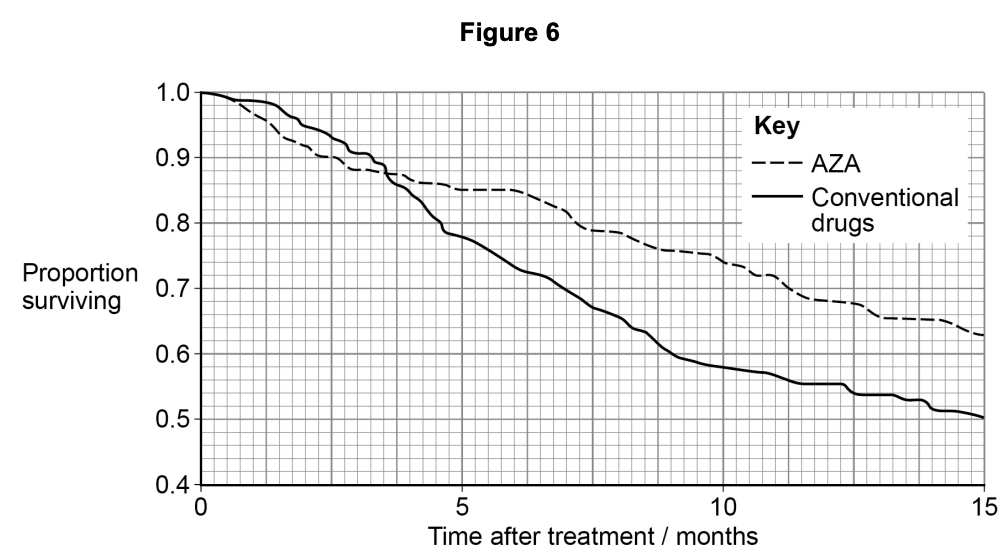
Answer
Mark Scheme
- Effect of AZA can be compared (1 mark)
- Unethical not to treat (control group) (1 mark)
Comments from mark scheme
- Comparison on its own is not enough for a mark.
Tips from examiner reports
- A control group receiving conventional treatment allows comparison of the new treatment’s effectiveness
- It would be unethical not to give cancer patients any treatment
- Don’t confuse a control group with a placebo group
Use Figure 6 and the information provided to calculate the difference in the number of patients surviving at 10 months after treatment with AZA compared with conventional drugs.
(2 marks)Answer
Mark Scheme
- Correct answer of 29/28.8 = 2 marks (1 mark)
- Working shows 0.74 and 0.58 = 1 mark (1 mark)
Tips from examiner reports
- Read graphs carefully and round correctly — 28.8 rounds to 29, not 28
- Show the values you’ve read from the graph in your working
Hepatitis B is a life-threatening liver infection caused by the hepatitis B virus (HBV). Figure 7 shows the structure of HBV.
Use Figure 7 to calculate how many times larger in diameter this cell is than HBV. You should use the lipid layer to measure the diameter of HBV.
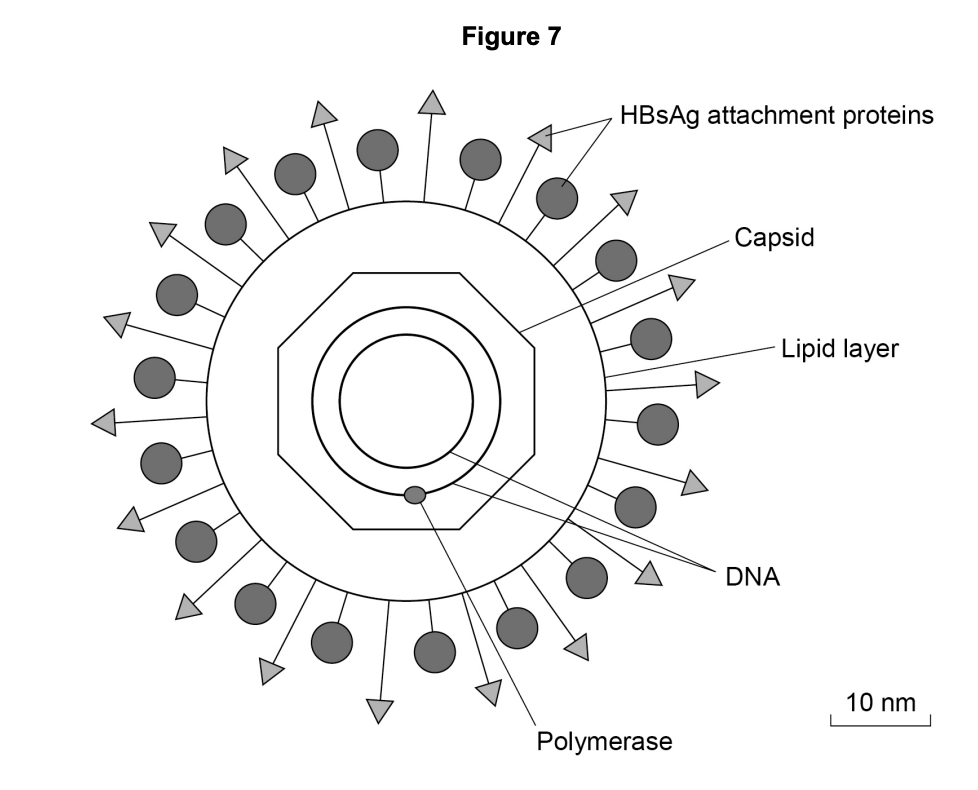
Answer
Mark Scheme
- Correct answer of 625 = 2 marks (1 mark)
- Shows 625 but decimal point incorrect = 1 mark (1 mark)
Tips from examiner reports
- Show your working and check unit conversions
- Common errors: putting the decimal point in the wrong place or dividing by the wrong number
- Convert between mm, µm, nm carefully
Scientists investigated the effectiveness of two types of RNA interference (RNAi) box molecules on reducing HBV replication. These molecules were:
- short hairpin RNA (shRNA)
- long hairpin RNA (IhRNA).
The scientists infected mouse liver cells with HBV and transferred either shRNA or lhRNA into these cells. Then they determined the concentration of the attachment proteins, HBsAg, in these cells.
The concentration of HBsAg is a measure of HBV replication.
Figure 8 shows the scientists’ results. The error bars represent ±2 standard deviations from the mean, which includes over 95% of the data.
One method of transferring RNAi molecules into cells involves combining these molecules with a lipid.
Suggest why this increases uptake of RNAi molecules into cells.
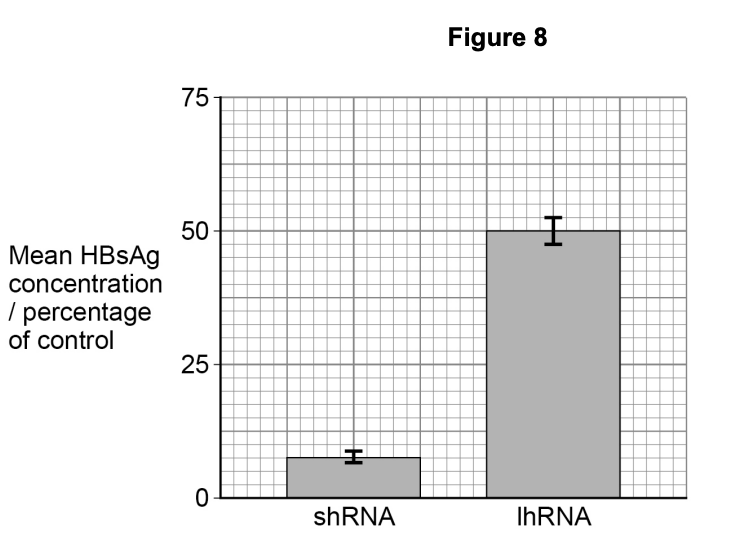
Answer
Mark Scheme
- (Cell/membrane has a) phospholipid bilayer OR No channel/carrier protein (for uptake) OR No need for channel/carrier protein (for uptake) (1 mark)
Tips from examiner reports
- The phospholipid bilayer is hydrophobic — large or charged molecules can’t pass through without transport proteins
- Be specific: say ‘phospholipid bilayer’ not just ‘lipid layer’ or ‘lipids’
- If no carrier/channel proteins are available, molecules can’t cross the membrane by facilitated diffusion
Using all the information provided, evaluate the use of the two types of RNAi in treating hepatitis B in humans.
Do not refer in your answer to how RNAi reduces HBV replication.
(5 marks)Answer
Mark Scheme
- Both are more effective than the control (1 mark)
- Differences in the means not (likely to be) due to chance OR Significant difference (in effectiveness between both types) (1 mark)
- (As) SDs do not overlap (1 mark)
- HBsAg (reduced), not zero OR Replication (reduced), not zero (1 mark)
- Not (investigated in) humans OR (Investigated in) mice (1 mark)
- shRNA (more effective as) 7.5% (of control) compared with 50% for lhRNA (1 mark)
- No indication of sample size/number (1 mark)
- Long term effects not known OR Side effects not known (1 mark)
- No statistical test to determine significance (1 mark)
- (Investigated) in vitro OR Not (investigated) in vivo (1 mark)
Comments from mark scheme
Mark points 4 to 10 = 4 max.
- Accept both (results) are below the control.
- Reject ‘results are significant’.
- Accept significantly higher or significantly lower in correct context.
- Accept error bars do not overlap.
- Accept 42.5% difference.
- Accept (mean) concentration for %.
- Accept ‘could be toxic’ for side effects not known.
- Accept not done inside an organism or not done in liver (organ) but ‘only tested in liver cells’ is insufficient unless qualified. Ignore only ‘one study’ or ‘no repeats’.
Tips from examiner reports
- When evaluating: consider whether the study was on animals or humans, in vivo or in vitro, sample size, duration, long-term effects
- If standard deviations overlap, the difference may not be significant
- Say ‘the difference is significant’ not ‘the results are significant’
- Use specific data from the figures to support your evaluation
Describe and explain how the polymerase chain reaction (PCR) is used to amplify a DNA fragment.
(4 marks)Answer
Mark Scheme
- (Requires DNA fragment) DNA polymerase, (DNA) nucleotides and primers (1 mark)
- Heat to 95 °C to break hydrogen bonds (and separate strands) (1 mark)
- Reduce temperature so primers bind to DNA/strands (1 mark)
- Increase temperature, DNA polymerase joins nucleotides (and repeat method) (1 mark)
Comments from mark scheme
1 and 4. Accept Taq polymerase for DNA polymerase. 2. Accept temperature in range 90 to 95 °C. 3. Accept temperature in range 40 to 65 °C. 4. Accept temperature in range 70 to 75 °C.
Tips from examiner reports
- PCR steps: heat to 90-95°C to break hydrogen bonds (denature DNA) → cool to allow primers to bind (anneal) → heat to 72°C for DNA polymerase to add nucleotides (extend)
- The enzyme is DNA polymerase (specifically Taq polymerase) — don’t say RNA polymerase, reverse transcriptase, or just ‘polymerase’
- Primers bind to complementary sequences flanking the target DNA
- Free DNA nucleotides are needed for the new strands — don’t forget this step
Explain the shape of the curve in Figure 9.
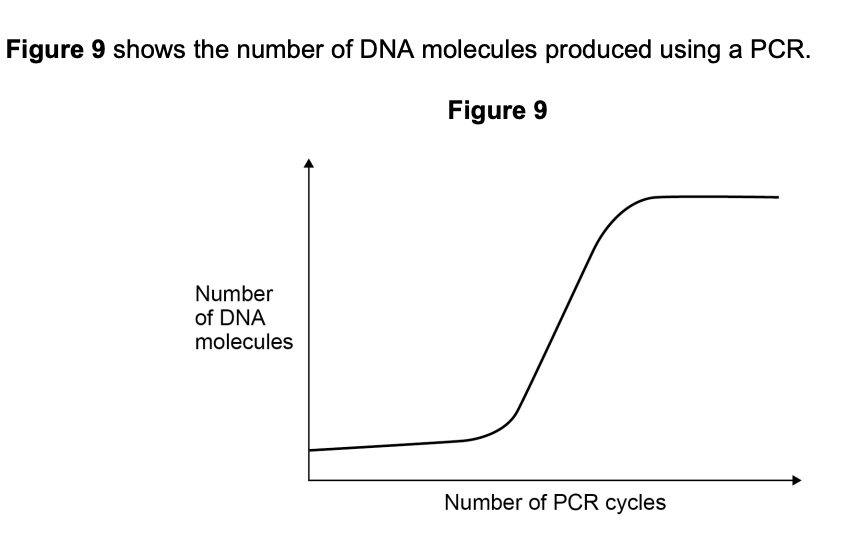
Answer
Mark Scheme
- (Initially) number (of molecules) doubling is low OR Doubles each cycle to produce exponential increase (1 mark)
- Plateaus as no more nucleotides/primers (1 mark)
Comments from mark scheme
- First alternative relates to idea of low numbers i.e., 2, 4, 8, 16, 32 etc.
- Accept ‘levels out’ or ‘flattens’ for plateaus.
- Accept enzyme/polymerase (eventually) denatures.
Tips from examiner reports
- In PCR: the number of DNA copies doubles each cycle → exponential increase
- The curve plateaus because primers, nucleotides, or DNA polymerase run out or polymerase denatures
- Don’t say ‘DNA fragments are the limiting factor’ or ‘DNA polymerase is used up’
- Explain the shape of the curve, don’t just describe it
A coral reef is an underwater ecosystem formed as a ridge of mainly calcium box carbonate deposits. Algae are photosynthesising organisms. Some algae grow on coral reefs. Succession results in a wide variety of fish living on coral reefs.
Describe a method that could be used to determine the mean percentage cover of algae on a coral reef. Do not include information on the difficulties of using your method underwater.
(3 marks)Answer
Mark Scheme
- Method of randomly determining position (of quadrats) e.g. random numbers table/generator (1 mark)
- Large number/sample of quadrats (1 mark)
- Divide total percentage by number of quadrats/samples/readings (1 mark)
Comments from mark scheme
- Ignore line/belt transect.
- Accept many/multiple/lots but ignore several.
- Ignore point quadrat.
- Accept squares/frames (of a grid) for quadrats.
- If a specified number is given, it must be 10 or more.
Tips from examiner reports
- For random sampling: use a random number generator to select coordinates for quadrat placement
- Use a large number of quadrats (10 or more) and calculate a mean
- Don’t say ‘throw quadrats randomly’
- Percentage cover means estimating how much of the quadrat is covered — not counting individual organisms
Explain how succession results in a wide variety of fish living on coral reefs. Do not describe the process of succession in your answer.
(2 marks)Answer
Mark Scheme
- Increase in variety/diversity of species/plants/animals; OR Increase in number of species/populations (1 mark)
- Provides more/different habitats/niches OR Provides greater variety/types of food (1 mark)
Comments from mark scheme
- Accept increase in biodiversity or species richness.
- Ignore shelter/homes/environments.
- Ignore ‘more food’ but accept ‘more food sources’.
- Accept ‘less hostile’ (environment).
Tips from examiner reports
- Succession involves changes in the community over time — don’t confuse it with speciation
- As succession progresses: more species colonise → more habitats/niches available → greater biodiversity
- Say ‘increase in species/biodiversity’ not just ‘more plants’ or ‘more food’
Ecologists investigated the effect of two fish species, the redband parrotfish and the box ocean surgeonfish, on algal growth on an artificial reef. They made this artificial reef by submerging many large concrete blocks at a depth of 16–18 metres off the coast of Florida. They attached four large wire cages, A, B, C and D, to each block and populated the cages as shown.
- A – No fish
- B – Two redband parrotfish
- C – Two ocean surgeonfish
- D – One redband parrotfish and one ocean surgeonfish
After 34 weeks, the ecologists measured the mean percentage cover of all algae within each set of wire cages. The ecologists used a statistical test to find out whether the mean for each set of cages was significantly lower than the mean for set A. Table 3 shows the probability (P) values that the ecologists obtained using this statistical test.
Using all the information, evaluate the effect of the two fish species on algal growth on coral reefs.
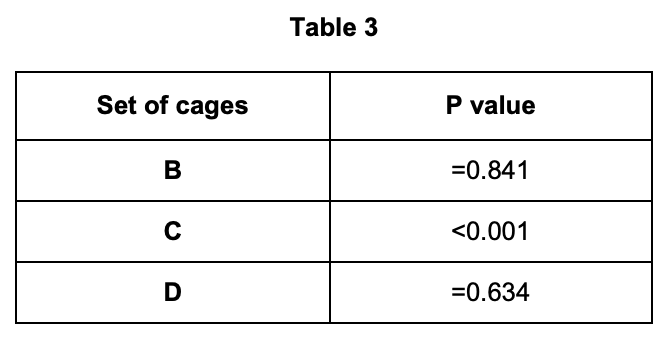
Answer
Mark Scheme
- Significant (difference/decrease) with C (compared with A) (1 mark)
- No significant (difference/decrease) with B and D (compared with A) (1 mark)
- Reference to less than 5%/0.05 probability that difference is (less likely) due to chance OR Reference to more than 95%/0.95 probability that difference is not due to chance (1 mark)
- Species of algae not known OR Species of algae may differ (on other reefs) (1 mark)
- Only done off (coast of) Florida OR Not done on other reefs (1 mark)
- Only done at 16 to 18 metres OR Not done (on reefs) at other depths (1 mark)
- Only 34 weeks (1 mark)
- Concrete/artificial reef could affect results/growth OR Natural reef results/growth may differ (1 mark)
- Cage may allow other fish/animals to enter (1 mark)
Comments from mark scheme
- Accept any reference to composition of reef being different (from natural).
Tips from examiner reports
- Use ALL the information provided — don’t just focus on one table or figure
- A probability value ≥ 0.05 means no significant difference; < 0.05 means significant difference
- Consider limitations: artificial vs natural conditions, time period, depth, location
- Don’t confuse ‘probability’ with ‘chance’ when explaining statistical tests
Read the following passage.
Lake Malawi in East Africa has more species of fish than any other lake in the world. Many of these species have evolved from a common ancestor. Lake Malawi is one of the largest lakes in the world and was formed several million years ago. Since then, the water level has fluctuated greatly. As a result, what is now a large lake was at one time many smaller, separate lakes. The country of Malawi has a total area of 118 000 km2. The actual land area is only 94 080 km2, because approximately one-fifth of the country is Lake Malawi.
In December 1990, forests covered 41.4% of the actual land area of Malawi. In December 2016, forests covered 26.4% of the actual land area of Malawi. Deforestation and farming along the shores of Lake Malawi have caused increased soil erosion and loss of nutrients into the lake. This has resulted in a decrease in some fish populations. The mark-release-recapture method can be used to estimate the size of a fish population. However, this method can produce unreliable results in very large lakes.
Use the information in the passage and your own knowledge to answer the following questions.
Lake Malawi in East Africa has more species of fish than any other lake in the world (line 1).
Suggest and explain how this speciation may have occurred.
(4 marks)Answer
Mark Scheme
- Variation/differences due to mutation/s (1 mark)
- (Reference to) allopatric (speciation) (1 mark)
- Smaller/different lakes have different environmental conditions OR Smaller/different lakes have different selection pressures (1 mark)
- Reproductive separation/isolation OR No gene flow OR Gene pools remain separate (1 mark)
- Different alleles passed on/selected OR Change in frequency of allele/s (1 mark)
- Eventually different species/populations cannot breed to produce fertile offspring (1 mark)
Comments from mark scheme
- Ignore sympatric speciation.
- Accept different populations for different lakes.
Tips from examiner reports
- Use information from the passage to support your answer about speciation
- For allopatric speciation: geographical isolation (e.g. separate lakes) → different selection pressures → different allele frequencies → reproductive isolation → new species
- Say ‘alleles’ not ‘genes’ when discussing changes in frequency
- Reproductive isolation means cannot interbreed to produce fertile offspring — include both parts
- Don’t confuse succession with speciation
The percentage of forest cover in Malawi decreased between December 1990 and December 2016 (lines 9–10).
Calculate the mean loss of forest cover in km2 per week during this time period.
(2 marks)Answer
Mark Scheme
- Correct answer of 10/10.4 = 2 marks (1 mark)
- Working shows 14,112 = 1 mark (1 mark)
Comments from mark scheme
- Ignore any numbers after 10.4
Tips from examiner reports
- Show your working clearly in multi-step calculations
- Check whether to use total area or land area (they may be different)
- Double-check your final answer when transferring to the answer line
Loss of nutrients into Lake Malawi has resulted in a decrease in some fish populations (lines 12–13).
(4 marks)Answer
Mark Scheme
- (Growth/increase of) algae/surface plants/algal bloom blocks light (1 mark)
- Reduced/no photosynthesis so (submerged) plants die (1 mark)
- Saprobiotic (microorganisms) aerobically respire OR Saprobiotic (microorganisms) use oxygen in respiration (1 mark)
- Less oxygen for fish to respire (1 mark)
Comments from mark scheme
- Accept: Saprobiont/saprophyte/ saprotroph
- Neutral: decomposer
Tips from examiner reports
- Read the question very carefully — ‘into’ means nutrients entering the lake (increasing), not leaving it
- Follow the chain: excess nutrients → algal bloom → less light → submerged plants die → decomposers use oxygen → less oxygen for fish → fish die
- Mention photosynthesis (plants can’t photosynthesise without light) and respiration (fish and decomposers need oxygen)
- Decomposers are saprobionts — mention them specifically
The mark-release-recapture method can be used to estimate the size of a fish population (lines 13–14).
(4 marks)Answer
Mark Scheme
- Capture/collect sample, mark and release (1 mark)
- Ensure marking is not harmful (to fish) OR Ensure marking does not affect survival (of fish) (1 mark)
- Allow (time for) fish to (randomly) distribute before collecting a second sample (1 mark)
- (Population =) number in first sample × number in second sample divided by number of marked fish in second sample/number recaptured (1 mark)
Comments from mark scheme
- Accept examples e.g., marking should not be toxic.
Tips from examiner reports
- Mark-release-recapture: capture, mark, release → allow time to disperse → recapture second sample → use the Lincoln index formula
- The mark must not affect survival or predation risk
- Population estimate = (n₁ × n₂) / m — multiply the two samples, don’t add or subtract them
- Don’t forget to include the release step
Suggest why the mark-release-recapture method can produce unreliable results in very large lakes (lines 14–15).
(1 marks)Answer
Mark Scheme
- Less chance of recapturing fish OR Unlikely fish distribute randomly/evenly (1 mark)
Comments from mark scheme
Accept ‘harder to capture marked fish’ (recaptured fish) but ignore ‘harder to capture fish’. Accept that fish may remain in one area. Accept fish may congregate
Tips from examiner reports
- In large lakes, fish may not distribute randomly, making recapture unreliable
- It may be difficult to recapture enough fish in a large lake for an accurate estimate
- Focus on issues specific to ‘large lakes’ — don’t just list general capture-recapture problems
The iris in the human eye is a muscular structure. The iris changes the size of the pupil. Figure 1 shows the muscles in the iris.
Suggest and explain how the interaction between the muscles labelled in Figure 1 could cause the pupil to constrict (narrow).
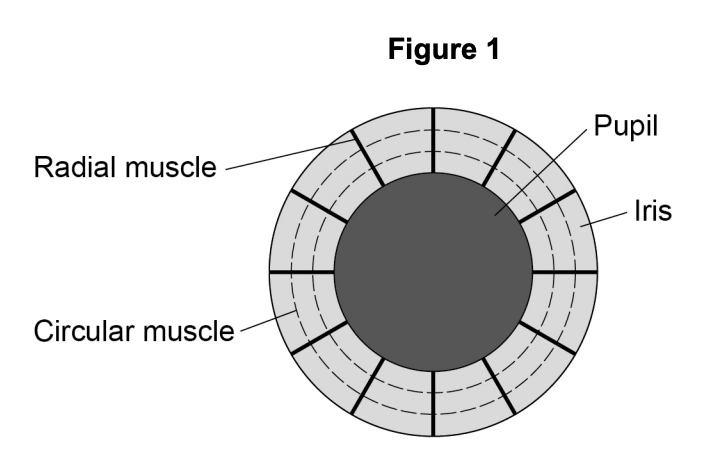
Answer
Mark Scheme
- Circular muscle contracts (1 mark)
- Radial muscle relaxes (1 mark)
Comments from mark scheme
1 and 2. Accept, for one mark ‘both muscles contract’ or ‘both muscles relax’ as names of muscles are in Figure 1. Reject muscles constrict.
Tips from examiner reports
Only 60% scored any marks. Use ‘contract’ or ‘relax’ for muscle action — not constrict, expand, widen, or shorten. Pupil constriction: circular muscles CONTRACT and radial muscles RELAX. Pupils do not contain rods or cones.
The fovea of the eye of an eagle has a high density of cones. An eagle focuses the image of its prey onto the fovea.
Explain how the fovea enables an eagle to see its prey in detail. Do not refer to colour vision in your answer.
(3 marks)Answer
Mark Scheme
- High (visual) acuity (1 mark)
- (Each) cone is connected to a single neurone (1 mark)
- (Cones send) separate (sets of) impulses to brain (1 mark)
Comments from mark scheme
- Accept no retinal convergence.
- Accept ‘bipolar/nerve cell’ for neurone.
- Accept ‘optic nerve’ for brain.
- Reject ‘signals’, ‘messages’ for ‘impulses’.
- Accept ‘action potential’.
Tips from examiner reports
Only 14% scored maximum marks. Each cone connects to its own separate neurone and sends separate impulses to the brain — this gives high visual acuity. ‘Messages’ or ‘signals’ instead of ‘impulses’ was not credited.
The retina of the human eye has an area of approximately 1.094 × 103 mm² The circular fovea in a human eye has a diameter of 3 × 103 µm Calculate the area of the fovea as a percentage of the area of the retina. The area of a circle is πr² Use π = 3.14 in your calculation. Show your working.
(2 marks)Answer
Mark Scheme
- Correct answer of 0.6 (%) = 2 marks (1 mark)
- Incorrect answer but shows number sequence 7065 / 7068 / 7069 / (ignore position of decimal point) = 1 mark (1 mark)
Tips from examiner reports
45% scored both marks. Common errors: not converting µm to mm, not calculating area as a percentage of the total retina area. Use π from your calculator if available — the question did not penalise this.
The retina of an owl has a high density of rod cells.
Explain how this enables an owl to hunt its prey at night. Do not refer to rhodopsin in your answer.
(3 marks)Answer
Mark Scheme
- High (visual) sensitivity (1 mark)
- Several rods connected to a single neurone (1 mark)
- Enough (neuro)transmitter to reach/overcome threshold OR Spatial summation to reach/overcome threshold (1 mark)
Comments from mark scheme
- Accept retinal convergence.
- Accept ‘bipolar/nerve cell’ for neurone
- Accept 2, ‘many’ or more for ‘several’
- Reject ‘signals’, ‘messages’ for ‘impulses’.
- Accept named neurotransmitter.
- Accept depolarisation, ‘action potential’ or ‘generator potential’ for ‘to reach threshold’.
- Generator potentials combine to reach threshold/ depolarisation/action potential/generator potential.
Tips from examiner reports
Only 10% scored both marks. Many rods connect to ONE bipolar neurone — their signals summated, making it easier to reach the threshold → high sensitivity in dim light. ‘Weak impulses combining’ was not credited; use ‘summation’ or explain the threshold mechanism.
Testosterone is a steroid hormone that belongs to a group of male sex hormones called androgens.
Steroid hormones are hydrophobic.
Explain why steroid hormones can rapidly enter a cell by passing through its cell-surface membrane.
(2 marks)Answer
Mark Scheme
- Lipid soluble (1 mark)
- (Diffuse through) phospholipid (bilayer) (1 mark)
Comments from mark scheme
- Ignore ‘not water soluble’ or ‘fat soluble’. 1 and 2. Ignore reference to joining to receptors/channels/carriers but reject passage through protein channels/carriers.
Tips from examiner reports
Steroid hormones are ‘lipid soluble’ — not ‘fat soluble’ or ‘non-polar’ (these were not credited). They pass directly through the phospholipid bilayer, not through protein channels or by active transport.
In the cytoplasm, testosterone binds to a specific androgen receptor (AR). An AR is a protein.
Suggest and explain why testosterone binds to a specific AR.
(2 marks)Answer
Mark Scheme
- Has a (specific) tertiary structure/shape (1 mark)
- (Structures are) complementary (1 mark)
Comments from mark scheme
- Accept in context of AR or testosterone.
- Ignore 3D.
- Reject reference to antigen.
- Reject reference to active site, enzyme, substrate or induced fit.
Tips from examiner reports
Most students mentioned complementary shapes but fewer mentioned tertiary structure/shape of the receptor. Some disqualified themselves by calling the interaction an enzyme–substrate complex. Both complementary shape AND tertiary structure were needed for full marks.
The binding of testosterone to an AR changes the shape of the AR. This AR molecule now enters the nucleus and stimulates gene expression.
Suggest how the AR could stimulate gene expression.
(2 marks)Answer
Mark Scheme
- (AR is) a transcription factor (1 mark)
- Binds to DNA/promoter (1 mark)
- (Stimulates) RNA polymerase (1 mark)
Comments from mark scheme
- Ignore ‘binds to bases’ or ‘binds to gene’. 1 and 2. Reject reference to active site, enzyme, substrate or induced fit.
Tips from examiner reports
Only 27% scored any marks. The androgen receptor (AR) binds to the promoter region and stimulates RNA polymerase activity, increasing transcription. References to methylation, acetylation or histones were incorrect here.
The gene that codes for the AR has a variable number of CAG repeats. Some studies have shown an association between the number of CAG repeats and the risk of developing prostate cancer.
Table 1 shows the results of a statistical test from one study.
What can you conclude from the data in Table 1?
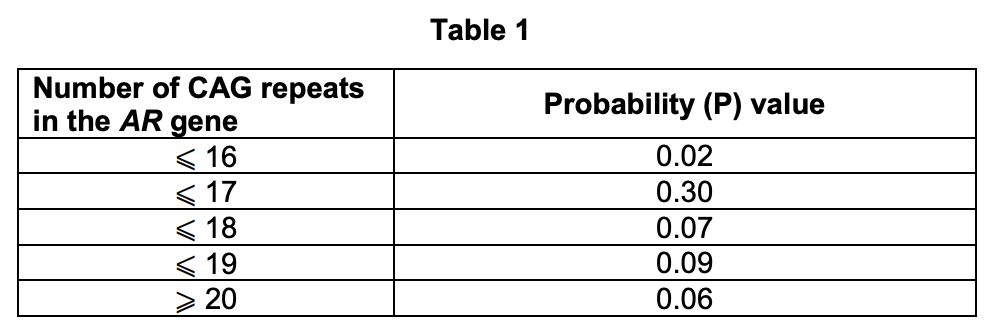
Answer
Mark Scheme
- With 16 or fewer than 16 (repeats the association) is significant (1 mark)
- With 17 or more than 17 (repeats the association) is not significant (1 mark)
- With 16 or fewer than 16 (repeats) there is less than a 5% or less than 0.05 probability of being due to chance OR With 17 or more than 17 (repeats) there is more than a 5% or more than 0.05 probability of being due to chance OR Explanation of a probability value e.g. 0.30 is a 0.30 or 30% probability of being due to chance (1 mark)
- With 16 or fewer than 16 (repeats) reject the null hypothesis OR With 17 or more (repeats) accept the null hypothesis (1 mark)
Comments from mark scheme
If none of the marks is awarded allow principle mark of (prostate) cancer more likely with 16 or less than 16 (repeats) or (prostate) cancer less likely with 17 or more than 17 (repeats) OR Alternative principle mark Correctly links significant/not significant to correct probability value/percentage or to rejecting/accepting the null hypothesis.
- Reject ‘the results are significant’.
- Accept ‘difference in results is significant’. 2, 3 and 4. Accept reference to any number of repeats (e.g. 18) between 17 to 20 for 17 or more than 17 (repeats).
- Accept equivalent responses in terms of 95% or 0.95 probability.
Tips from examiner reports
Fewer than 30% scored any marks. The main error: assuming more CAG repeats = higher cancer risk — the data showed the OPPOSITE at ≤17 repeats. P values show the probability the difference is due to chance, not the probability of developing cancer.
Figure 2 shows one type of calorimeter.
A calorimeter can be used to determine the chemical energy store of biomass. A known mass of biomass is fully combusted in a calorimeter. The heat energy released from this combustion increases the temperature of the water in the calorimeter. The increase in the temperature of a known volume of water is recorded.
Other than the thermometer, explain how two features of the calorimeter shown in Figure 2 would enable a valid measurement of the total heat energy released.
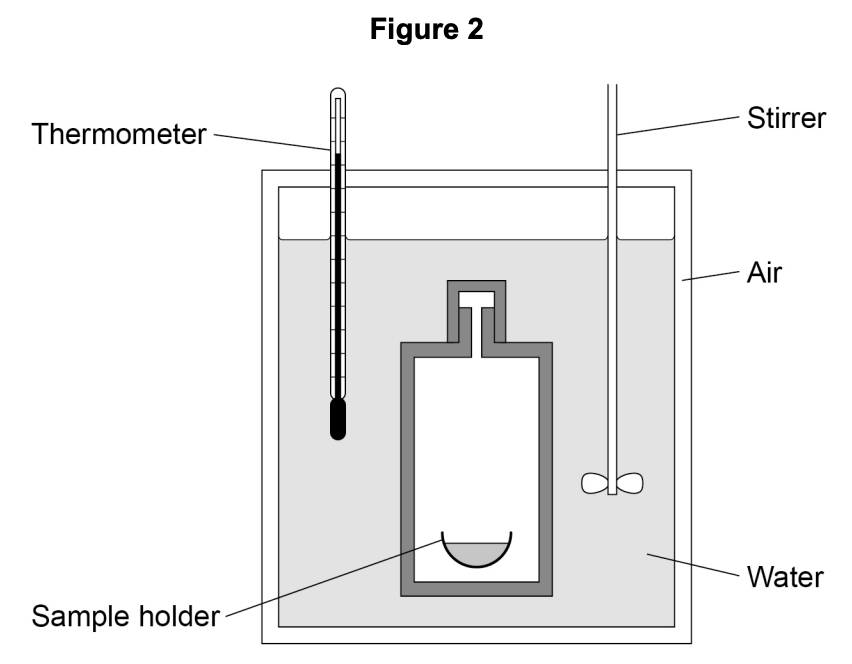
Answer
Mark Scheme
- Stirrer distributes heat (energy) (1 mark)
- Insulation/space/air reduces loss/gain of heat OR Insulation/space/air reduces conduction/convection (1 mark)
- Water has high (specific) heat capacity (1 mark)
Comments from mark scheme
- Accept stirrer ensures equal/even temperature or prevents build up of ‘hot spots’.
- Reject vacuum.
Tips from examiner reports
60% scored zero. The stirrer ensures even heat distribution and the air space acts as insulation (not a vacuum). Water’s high specific heat capacity was rarely mentioned. The oxygen concentration inside the calorimeter is not a relevant feature.
A 2 g sample of biomass was fully combusted in a calorimeter. The volume of water in the calorimeter was 100 cm³ The increase in temperature recorded was 15.7 °C 4.18 J of energy are needed to increase the temperature of 1 cm³ of water by 1 °C Use this information to calculate the heat energy released in kJ per g of biomass. Show your working.
(2 marks)Answer
Mark Scheme
- 3.28 / 3.3 (kJ g−1) = 2 marks (1 mark)
- Incorrect answer but shows 328 / 33 (ignore any subsequent numbers and decimal point) = 1 mark OR Incorrect answer of 6.56 / 6.6 (kJ g−1) (ignore any subsequent numbers) = 1 mark (1 mark)
Tips from examiner reports
Students who did not notice the sample was 2 g (not 1 g) still earned one mark. Units must be in kilojoules. Show working for partial credit.
Plants and algae produce fuels called biofuels. Scientists have used Chlorella to produce biofuel. Chlorella is a genus of single-celled photosynthetic alga. Chlorella can be grown in open ponds and fermenters.
In natural ecosystems, most of the light falling on producers is not used in photosynthesis.
Suggest two reasons why.
(2 marks)Answer
Mark Scheme
- (Light is) reflected (1 mark)
- (Light is) wrong wavelength (1 mark)
- (Light) misses chlorophyll/ chloroplasts/photosynthetic tissue (1 mark)
- CO₂ concentration or temperature is a limiting factor. (1 mark)
Comments from mark scheme
- Light is not absorbed on its own is not enough.
- Accept frequency for wavelength.
- Accept reference to absorbing specified wavelengths/frequencies.
Tips from examiner reports
40% scored zero. ‘Light not being absorbed’ was too vague. Specify: light missing or passing through without hitting chlorophyll/chloroplasts; light reflected; light the wrong wavelength (green). Temperature as a limiting factor was credited; CO2 needed to be stated as concentration.
The light absorbed by chlorophyll is used in the light-dependent reaction.
Name the two products of the light-dependent reaction that are required for the light-independent reaction.
(2 marks)Answer
Mark Scheme
- ATP (1 mark)
- Reduced NADP (1 mark)
Comments from mark scheme
Accept 1 and 2 in either order. 2. Reject Reduced NAD. 2. Accept NADPH/NADPH2
Tips from examiner reports
91% scored at least 1 mark, usually for ATP. Many missed reduced NADP — incorrect alternatives included reduced NAD, NAD, NADP, water, CO2, oxygen, RuBP and triose phosphate.
Chlorella cells can divide rapidly. A culture of 2000 Chlorella cells was set up in a fermenter. The cells divided every 90 minutes.
You can assume that there were no limiting factors and that no cells died during the 24 hours.
Calculate the number of cells in the culture after 24 hours.
Give your answer in standard form.
Show your working.
(2 marks)Answer
Mark Scheme
- Correct answer of 1.31/1.3 × 108 (ignoring any subsequent numbers after 1.31) = 2 marks (1 mark)
Incorrect answer but shows 216 = OR 65536 in any correct numerical form = OR Incorrect answer but shows 131 ignoring any subsequent numbers and ignoring any decimal point =
Tips from examiner reports
50% scored zero. The correct calculation is 2000 × 2^16 — NOT 2000^16. Always convert the final answer to standard form if requested.
Figure 3 shows the banding pattern of a single sarcomere.
Explain the banding pattern shown in Figure 3.
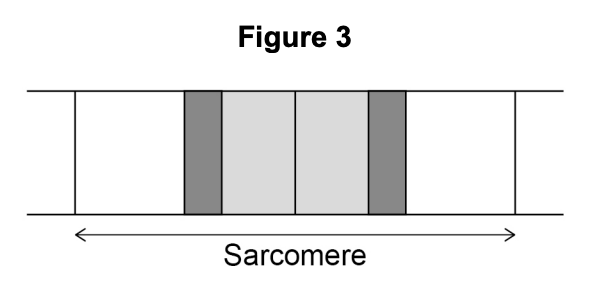
Answer
Mark Scheme
- Light/I band only actin (1 mark)
- H zone/band only myosin (1 mark)
- Darkest/overlapping region actin and myosin (1 mark)
Comments from mark scheme
1, 2 and 3. Accept any suitable descriptions that distinguishes these regions e.g. ‘white band’ for 1, ‘light grey’ for 2 and ‘dark grey’ for 3. Ignore references to A band.
Tips from examiner reports
Common confusion: some students reversed the positions of actin and myosin, gaining only 1 mark. A-band stays the same length (it contains myosin); I-band and H-zone decrease in length. The banding is not related to fibre type.
Creatinine is produced in muscle tissues. Creatinine diffuses into the blood. box The kidneys then excrete creatinine. A calibration curve can be used to determine the concentration of creatinine in urine.
One method of producing a calibration curve needs:
Creatinine-detecting solution reacts with creatinine to produce an orange colour.
Use the information provided to describe how you could produce a calibration curve for creatinine. Do not include details on the use of glassware in your answer.
- creatinine solution of known concentration
- distilled water
- creatinine-detecting solution
- a colorimeter.
Answer
Mark Scheme
- Use (distilled) water and creatinine solution to produce dilutions (series) (1 mark)
- Addition of (creatinine-)detecting solution (to each solution) (1 mark)
- Using a known/specified/constant volume of a solution (e.g. diluted creatinine solution) (1 mark)
- Record absorbance/transmission of solution/s using a colorimeter (1 mark)
- Plot dilution/concentration of (creatinine) solution against absorbance/transmission (1 mark)
Comments from mark scheme
- Accept description of dilutions (series). 2 and 3. The addition of a known/specific volume of (creatinine- )detecting solution = 2 marks. 4 and 5. Accept absorption for ‘absorbance’. 4 and 5. Accept description of absorbance or transmission.
- Reject calorimeter. Ignore details provided on ‘blank’.
Tips from examiner reports
For a calibration curve: include distilled water in dilutions; add the creatinine-detecting solution; measure absorbance or transmission (not just ‘read values’). Use ‘volume’ not ‘amount’ of solution — ‘amount’ was not credited.
Describe how you would determine the concentration of creatinine in a urine sample using your calibration curve.
(2 marks)Answer
Mark Scheme
- Use same volumes of solutions as used in producing (calibration curve) OR Add (creatinine-)detecting solution (to urine) (1 mark)
- Read off (creatinine) concentration against absorbance/transmission (value) obtained (1 mark)
Comments from mark scheme
- Ignore ‘add indicator’ on its own.
- Ignore calorimeter in this part of the question.
- Ignore ‘line of best fit’.
- Accept ‘compare’ for ‘read off’
Tips from examiner reports
To use a calibration curve: add creatinine-detecting solution to the urine sample in the same volume as used for calibration, read absorbance, then read concentration from the graph. Drawing a tangent to find concentration was incorrect.
Describe the sequence of events involved in transmission across a cholinergic synapse.
Do not include details on the breakdown of acetylcholine in your answer.
(5 marks)Answer
Mark Scheme
- Depolarisation of presynaptic membrane (1 mark)
- Calcium channels open and calcium ions enter (synaptic knob); 3 (Calcium ions cause) synaptic vesicles move to/fuse with presynaptic membrane and release acetylcholine/neurotransmitter; 4 Acetylcholine/neurotransmitter diffuses across (synaptic cleft) (1 mark)
- (Acetylcholine attaches) to receptors on the postsynaptic membrane (1 mark)
- Sodium ions enter (postsynaptic neurone) leading to depolarisation (1 mark)
Comments from mark scheme
- Accept action potential for depolarisation.
- Accept Ca²⁺ . 3 and 4. Accept abbreviations for acetylcholine as term is in the question.
- Accept Na⁺ .
- Accept ‘action potential’ or ‘generator potential’ for depolarisation.
Mutation is one cause of genetic variation in organisms.
Give two other causes of genetic variation.
(2 marks)Answer
Mark Scheme
- Crossing over (1 mark)
- Independent segregation/assortment (of homologous chromosomes) (1 mark)
- Random fusion of gametes OR Random fertilisation (1 mark)
Comments from mark scheme
- Accept independent assortment of alleles. Accept meiosis as an alternative for 1 or 2 if neither of these marks is awarded. 3 Accept random mating.
Tips from examiner reports
50% scored both marks. Three correct sources of genetic variation: crossing over, independent segregation/assortment of homologous chromosomes, and random fusion of gametes. Allopatric speciation, mutation, epigenetics and genetic drift are NOT sources of variation within meiosis.
In a species of flowering plant, the T allele for tallness is dominant to the t allele for dwarfness. In the same species, two alleles CR (red) and CW (white) code for the colour of flowers. When homozygous red-flowered plants were crossed with homozygous white-flowered plants, all the offspring had pink flowers.
Name the relationship between the two alleles that code for flower colour
(1 marks)Answer
Mark Scheme
- Codominance (1 mark)
Tips from examiner reports
77% correctly named codominance. Incorrect answers included epistasis, heterozygous, dominant, recessive and linkage.
A dwarf, pink-flowered plant was crossed with a heterozygous tall, white-flowered plant.
Complete the genetic diagram to show all the possible genotypes and the ratio of phenotypes expected in the offspring of this cross.
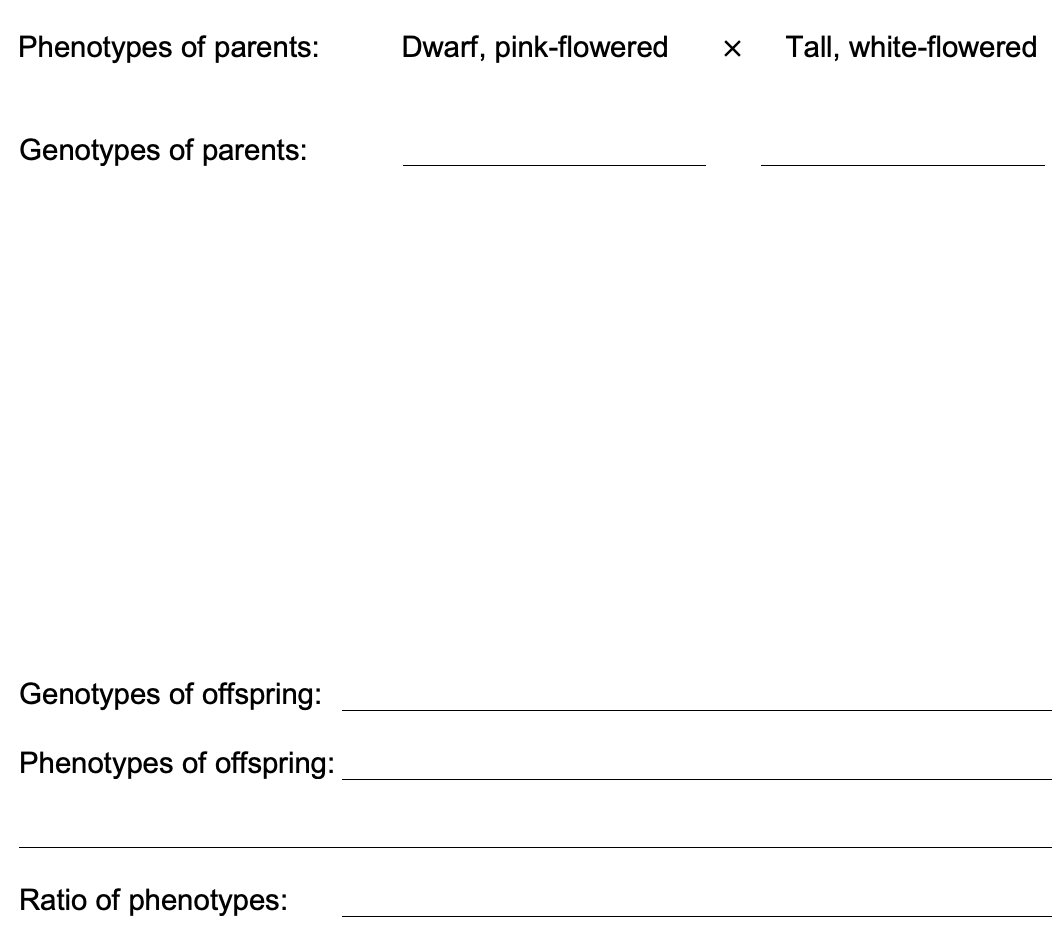
Answer
Mark Scheme
- CHECK FORMATTING *** 1. ttCRC W and TtCWC W (1 mark)
-
- TtCRC W, TtCWC W, ttCRC W and ttCWC W (1 mark)
-
- Tall pink, tall white, dwarf pink, dwarf white, and ratio 1 : 1 : 1 : 1 (1 mark)
Comments from mark scheme
2 and 3. Accept: any order of genotypes and phenotypes and ignore if on incorrect answer lines. 3. Accept: sequence of phenotypes does not need to mirror genotypes but must be correct. 3. Accept equivalent ratios e.g. 4:4:4:4. Allow equivalent of mark points 2 and 3 for cross using homozygous tall parent i.e. TTCWCW. Allow one mark for correct dihybrid genotypes of offspring from incorrect parental genotypes
Tips from examiner reports
59% scored all 3 marks. Most common error: showing the tall parental genotype as homozygous instead of heterozygous. A 9:3:3:1 ratio appeared in some scripts even when the rest of the cross was correct — check the ratio matches your offspring genotypes.
A population of this species of plant contained 9% of red-flowered plants.
Use the Hardy–Weinberg equation to calculate the percentage of pink-flowered plants in this population.
(2 marks)Answer
Mark Scheme
- Correct answer of 42% = 2 marks (1 mark)
Incorrect answer but shows understanding that 2pq = OR Answer = OR Answer =
Comments from mark scheme
- Accept: 0.42 for 1 mark.
- Accept 1 – (p2 + q2 ) for 2pq or equivalent using numbers.
- Accept: understanding of 2pq by using a calculation involving 2 × two different numbers
Tips from examiner reports
38% scored both marks. 2pq represents heterozygous pink-flowered plant frequency. Common error: using q = 0.09 (should be q² = 0.09, so q = 0.3). Never divide 2pq by 2.
A scientist investigated the effects of different fertilisers on the growth of spinach plants. The scientist:
- set up a large sample of identical pots of soil
- added different masses of different fertilisers to selected pots
- did not add fertiliser to the control pots
- planted the same number of young spinach plants in each pot
- after 20 days, determined the biomass of spinach plants in each pot.
The results the scientist obtained after 20 days are shown in Figure 4.
Calculate how many times greater the mean growth rate per day was using 37.5 g potassium nitrate than using 37.5 g ammonium sulfate. Assume the mean biomass of the spinach plants at the start of the investigation was 0.5 g per pot.
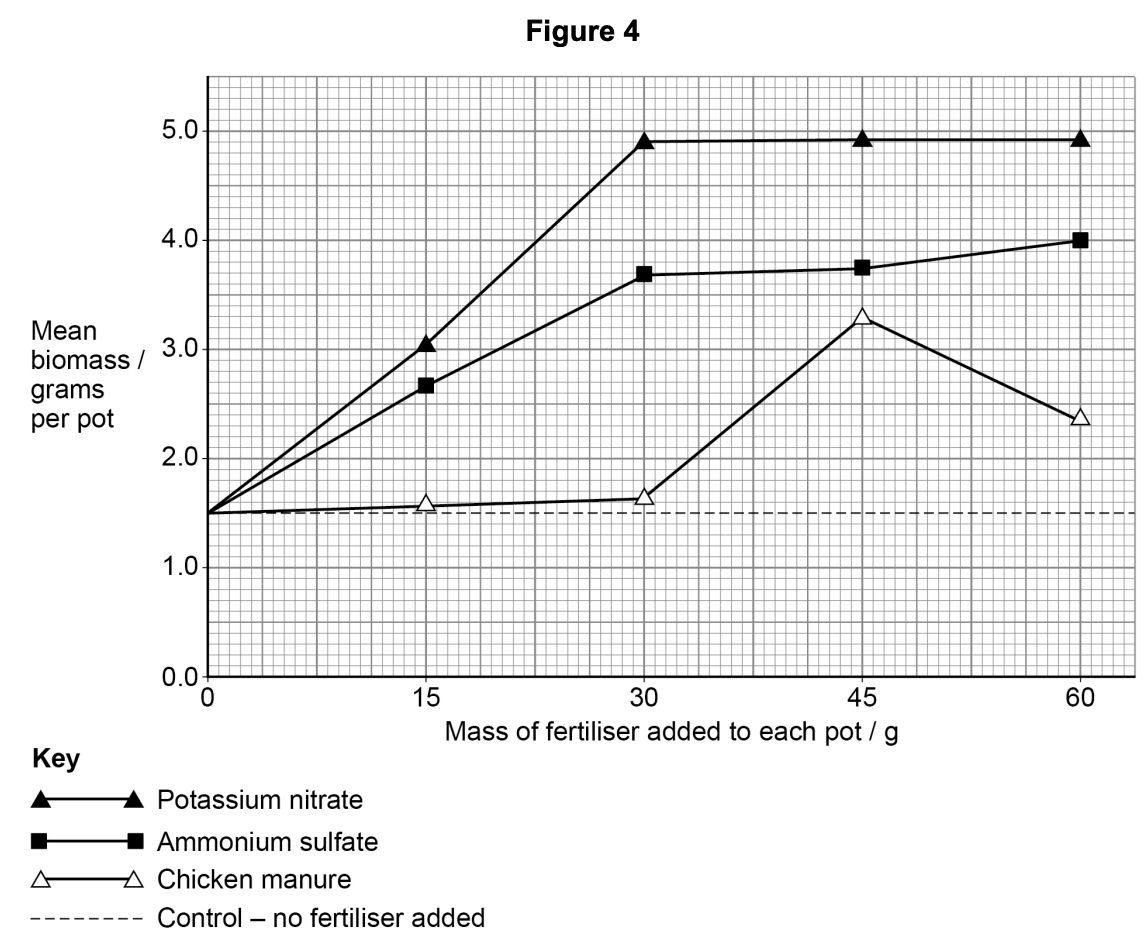
Answer
Mark Scheme
- 1.375 / 1.3746 / 1.38 / 1.4 (times greater) (1 mark)
Tips from examiner reports
38% correct. Many read off the graph correctly but forgot to subtract the initial mass (0.5 g per pot) to find growth over 20 days. Dividing by 20 to find daily growth was another common error.
Using all the information, evaluate the effect on plant growth of adding the different fertilisers to the soil.
(5 marks)Answer
Mark Scheme
- Potassium nitrate most effective and chicken manure least effective (1 mark)
- All fertilisers more effective than control (1 mark)
- No increase (in growth) with potassium nitrate above 30g (1 mark)
- Ammonium sulfate (shows) small/gradual increase after 30g (1 mark)
- Chicken manure effectiveness decreases after 45g OR Chicken manure effectiveness decreases at 60g; 6 Fertiliser/s provide nitrogen source for protein (1 mark)
- No statistical test (to determine if differences are significant) (1 mark)
- Only shows (results for) spinach (1 mark)
Comments from mark scheme
- Accept greatest/highest growth/mass for most effective, and lowest growth/mass for least effective.
- Accept ‘no SDs’ (to determine if differences are significant).
- Accept no (named) stats test, no error bars and no confidence limits.
- Accept only shows ‘one species’ or one type of plant.
Tips from examiner reports
92% scored at least 1 mark. Common precision errors: ‘at 30g’ instead of ‘above 30g’; ‘no effect’ instead of ‘no increase’. Irrelevant descriptions of decomposition or natural vs artificial fertiliser comparisons were not credited.
The scientist determined the dry mass of the spinach plants. First, he heated each sample at 80 °C for 2 hours.
Suggest what the scientist should do to ensure that he has removed all the water from the sample.
(2 marks)Answer
Mark Scheme
- Weigh and heat (1 mark)
- (Until) mass is constant (1 mark)
Comments from mark scheme
Accept ‘heat until sample remains the same mass’ for 2 marks.
- Ignore temperature.
- Accept weight for mass.
Tips from examiner reports
36% scored both marks. Method: heat/dry the sample; reweigh; heat again; repeat until constant mass is reached. Many stated heating without mentioning reweighing, or suggested non-heat methods like silica gel.
Alport syndrome (AS) is an inherited disorder that affects kidney glomeruli of both men and women. Affected individuals have proteinuria (high quantities of protein in their urine)
Suggest how AS could cause proteinuria.
(2 marks)Answer
Mark Scheme
- Affects/damages basement membrane OR More protein channels/carriers in basement membrane (1 mark)
- Proteins can pass into the (glomerular) filtrate/tubule (1 mark)
Comments from mark scheme
- Ignore nephron.
Tips from examiner reports
Only 8% scored both marks. Proteinuria is caused by proteins passing through the basement membrane of the glomerulus INTO the filtrate — not by failure to reabsorb them later. Students mentioning the basement membrane almost always scored both marks.
AS results from a sex-linked mutation.
In a male with AS, where would the sex-linked mutation be located? a) The homologous section of a Y chromosome b) The homologous section of an X chromosome c) The non-homologous section of a Y chromosome d) The non-homologous section of an X chromosome
(1 marks)Answer
Mark Scheme
- The non-homologous section of an X chromosome (1 mark)
Tips from examiner reports
45% correctly identified that a sex-linked mutation is on the non-homologous region of the X chromosome.
Scientists investigated the use of transplanted stem cells to treat AS in mice. box The scientists set up four experimental groups.
- Group A – 40 wild type* mice
- Group B – 40 AS mice
- Group C – 40 AS mice that received stem cells from AS mice
- Group D – 40 AS mice that received stem cells from wild type mice
*Wild type mice are mice not affected by AS.
After 20 weeks, the scientists measured the quantity of protein in the urine using a scale from 0 (lowest quantity) to +++++ (highest quantity).
The results the scientists obtained are shown in Table 2.
Using all the information, evaluate the use of stem cells to treat AS in humans.
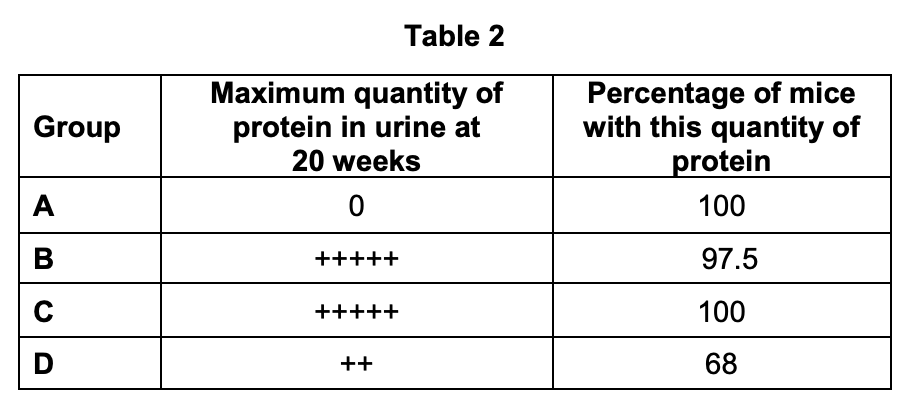
Answer
Mark Scheme
- Effective as D has lower protein (than B/C) (1 mark)
- Not fully effective as D has higher protein than A (1 mark)
- Do not know all results for other mice in D OR Only shows results for 68% of mice (1 mark)
- Some of D mice may have been cured OR Some of D may have died (1 mark)
- Do not know actual/numerical quantity of protein (1 mark)
- (Investigation) only on mice OR (Investigation) not on humans (1 mark)
- Rejection may occur (1 mark)
- Only shows results for 20 weeks/short-time period OR Long-term effects not known (1 mark)
Comments from mark scheme
Accept descriptions of each group e.g. A = wild type mice. B = AS mice. C = AS mice that received AS stem cells. D = mice that received wild type stem cells. Accept ‘healthy’ or ‘without AS’ for ‘wild type’. 6. Accept ‘rats’ for ‘mice’. 7. Accept ‘immune response’ for rejection. Ignore answers relating to sample size or statistical test.
Tips from examiner reports
90% scored at least 1 mark. Best evaluations considered BOTH the experimental design (short duration, mice not humans, risk of rejection) AND specific data issues (only 68% of group D mice shown; no numerical amount of protein given).
The scientists carried out further work to investigate how the transplanted stem cells developed after transplantation.
Suggest how the transplanted stem cells reduce proteinuria.
- The scientists transplanted stem cells from wild type male mice into AS female mice.
- After 20 weeks, they found that the quantity of protein in the urine of these female mice had significantly decreased.
- They examined cells from glomeruli in the female mice. Some of these cells contained a Y chromosome.
Answer
Mark Scheme
- (Transplanted stem cells) differentiate/specialise (1 mark)
- Reduce loss of protein at the glomerulus OR Prevents protein moving into filtrate (1 mark)
Comments from mark scheme
- Accept Bowman’s/renal capsule
Tips from examiner reports
60% scored zero. Stem cells differentiated into glomerular cells and reduced/prevented protein entering the filtrate. Many incorrectly focused on the Y chromosome or on dominant/recessive alleles.
A scientist produced transgenic zebrafish.
She obtained a gene from silverside fish. The gene codes for a growth hormone (GH).
She inserted copies of this GH gene into plasmids. She then microinjected these recombinant plasmids into fertilised egg cells of zebrafish.
Describe how enzymes could be used to insert the GH gene into a plasmid
(2 marks)Answer
Mark Scheme
- Restriction endonucleases/enzymes cuts plasmid; OR Restriction endonucleases/enzymes produces ‘sticky ends’ (1 mark)
- Ligase joins gene/DNA and plasmid OR Ligase joins ‘sticky ends’ (1 mark)
Comments from mark scheme
- Ignore restriction enzymes cuts out the gene.
- Reject restriction enzymes cuts the gene.
Tips from examiner reports
28% scored both marks. Restriction endonuclease cuts DNA at specific recognition sequences — NOT ‘cuts the gene’ (this disqualified the mark). More students described restriction endonuclease correctly than ligase.
Microinjection of DNA into fertilised egg cells is a frequent method of producing transgenic fish.
However, the insertion of the transferred gene into nuclear DNA may be delayed. Consequently, the offspring of transgenic fish may not possess the desired characteristic.
Suggest and explain how delayed insertion of the GH gene could produce offspring of transgenic fish without the desired characteristic.
(2 marks)Answer
Mark Scheme
- Cell division has occurred (before gene added) (1 mark)
- (Cells producing) gametes do not receive the gene (1 mark)
Comments from mark scheme
- Accept mitosis but reject meiosis.
- Accept DNA replication has occurred.
Tips from examiner reports
Only 2% scored both marks. Delayed insertion of the gene into nuclear DNA means cell divisions occur before the gene is present → gametes lack the gene. Many incorrectly focused on problems with inserting the gene into the plasmid or on differentiation.
The scientist investigated whether the transferred GH gene increased the growth of box transgenic zebrafish. She microinjected 2000 fertilised egg cells with the GH plasmid and left 2000 fertilised egg cells untreated. After 12 months, she determined the mean mass of the transgenic and non-transgenic fish.
The results the scientist obtained are shown in Table 3.
Using Table 3, what can you conclude about the effectiveness of the GH gene on the growth of zebrafish?
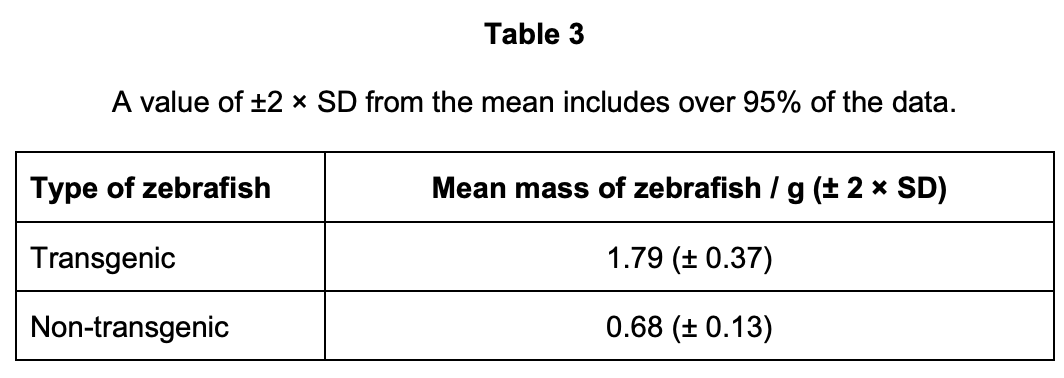
Answer
Mark Scheme
- No overlap in SDs (1 mark)
- Significant increase/difference (in growth/mass) OR Increase/difference (in growth/mass) is not due to chance (1 mark)
Comments from mark scheme
- Reject ‘the results are significant or not due to chance’.
Tips from examiner reports
40% scored both marks. The SDs do not overlap → the increase in growth is statistically significant. ‘The results are significant’ was not credited — say ‘the difference between means is significant’. Some students incorrectly stated SDs did overlap.
Explain how two features of the design of this investigation helped to ensure the validity of any conclusions obtained.
Do not include calculating the mean or SD in your answer.
(2 marks)Answer
Mark Scheme
- Large sample size so representative (1 mark)
- 12 months so can assess/allow growth (1 mark)
- Control (present) for comparison (1 mark)
Comments from mark scheme
2, Accept long time for 12 months. 2. Accept increase in mass for growth. 3. Accept description of the control.
Tips from examiner reports
Only 7% scored both marks. Describe the feature AND explain how it ensures valid conclusions. Large sample size: results are representative. Using 12 months: allows full growth to be measured. Age/sex/species of fish matching was not credited.
Read the following passage.
North American black bears can hibernate for up to 7 months without food or water. The bears survive using the fat stores in their bodies. The bears build up the fat stores during the summer. During hibernation, the heart rate of black bears decreases from a summer mean of 55 beats per minute to 14 beats per minute. Their metabolic rate falls by 75%. In many mammals, ‘uncoupling proteins’ help to maintain a constant body temperature during hibernation. Uncoupling proteins are found in the inner mitochondrial membrane and act as proton channels during chemiosmosis.
However, these proton channels do not generate ATP. In the mountains of North America, when winter changes into spring, the coat colour of snowshoe hares changes from white to brown. Climatic changes have caused the snow to melt earlier. This has reduced the survival rate of snowshoe hares in these habitats. The change in coat colour occurs when new fur replaces old fur. This is called moulting. Recent research has shown that snowshoe hares within a population moult at different times. Moulting at different times could be a major factor in ensuring the survival of snowshoe hare populations.
Use the information in the passage and your own knowledge to answer the following questions
Black bears can hibernate for up to 7 months without food or water (lines 1−2).
Suggest and explain how.
(3 marks)Answer
Mark Scheme
- Fat (store) used in respiration/metabolism (1 mark)
- Less energy/food (store) is required due to low respiration/metabolism OR Less energy/food (store) is required due less movement (1 mark)
- Gluconeogenesis (1 mark)
- Low surface area to volume reduces heat loss OR Fat (layer/insulation) reduces heat loss (1 mark)
- Long loop of Henle so less water lost (1 mark)
- Water provided from respiration (1 mark)
- Reduced/no urination (1 mark)
- Less evaporation (1 mark)
Comments from mark scheme
Mark points 1 to 4 = 2 max. Mark points 5 to 8 = 2 max. 1 and 2. Reject respiration ‘uses energy’ or ‘produces energy’. 3. Accept description in terms of using glycerol, fatty acids or amino acids. 5. Accept thick medulla (in kidney) for long loop of Henle. 8. Accept less sweating.
Tips from examiner reports
Only 4% scored all 3 marks. Best answers described: fat used in respiration during hibernation; reduced food intake due to lower metabolic rate. Gluconeogenesis was rarely described correctly — most confused it with glycogenolysis. Water produced from respiration was also credited.
During hibernation, the heart rate and the metabolic rate of black bears decrease (lines 3−5).
Use your knowledge of the nervous control of heart rate to describe how these are linked.
(4 marks)Answer
Mark Scheme
- (Lower metabolism so) less/low CO₂ (in blood) (1 mark)
- (Detected by) chemoreceptors (1 mark)
- (Chemoreceptors) located in aorta/medulla OR (Chemoreceptors) located in carotid artery (1 mark)
- Fewer impulses to cardiac centre; OR Fewer impulses to medulla (oblongata) (1 mark)
- (More) impulses along parasympathetic/vagus pathway/neurones/nerve OR Fewer impulses along sympathetic pathway/neurones/nerve (1 mark)
- (To) SAN (1 mark)
Comments from mark scheme
If neither mark point 1 or 2 credited = 3 max.
- Accept increase in pH or decrease in H ions/acidity for less CO₂. Ignore baroreceptors.
- Ignore detects oxygen, (concentration).
- Accept carotid body or aortic body. 4 and 5. Reject (once only) reference to ‘an/one impulse’. 4 and 5. Reject ‘signals’, ‘messages’ (once only) for ‘impulses’ 4 and 5. Accept ‘action potential/s’ for impulses.
Tips from examiner reports
36% scored zero. Chemoreceptors detect increased CO2 and decreased pH — not just oxygen. The cardiac centre sends signals via the sympathetic/parasympathetic nerves to the SAN, changing impulse FREQUENCY. Use ‘impulses’ not ‘messages’ or ‘signals’.
In many mammals, ‘uncoupling proteins’ help to maintain a constant body temperature during hibernation (lines 6−7).
Suggest and explain how.
(2 marks)Answer
Mark Scheme
- Allow passage of protons/H⁺ (1 mark)
- (Energy) released as heat (1 mark)
Comments from mark scheme
- Ignore direction of movement/diffusion/active transport.
- Accept ‘produces heat’ but reject ‘produces ‘heat energy’.
Tips from examiner reports
Only 7% scored both marks. Uncoupling proteins allow protons to pass through the inner mitochondrial membrane WITHOUT driving ATP synthase → energy released as heat, not ATP. Many just re-described chemiosmosis or referred to ‘energy production’.
Climatic change has reduced the survival rate of snowshoe hares in mountain habitats (lines 11−13).
Suggest and explain how.
(2 marks)Answer
Mark Scheme
- Less snow so less camouflage (1 mark)
- More hares seen/eaten/killed by predators (1 mark)
Comments from mark scheme
- Accept ‘snow melts’
- Accept description of less camouflage, e.g. more hares seen.
- Accept description of predation.
Tips from examiner reports
79% scored at least 1 mark. Snowshoe hares with white coats when snow melts early are no longer camouflaged → more easily caught by predators. Do not say they are camouflaged from prey — the hare IS the prey.
Snowshoe hares within a population moult at different times (line 15).
Explain how this could ensure the survival of snowshoe hare populations in these mountain habitats.
(4 marks)Answer
Mark Scheme
- Hares which moult earlier (more likely to) survive (1 mark)
- Hares which moult earlier (more likely to) reproduce (1 mark)
- Pass on (advantageous) allele (1 mark)
- Frequency of allele increases (in future populations) (1 mark)
Comments from mark scheme
- Accept less likely to be killed for ‘survive’.
- Accept description of survival e.g. not killed/eaten.
- Accept moult quicker/faster for earlier. 1 and 2. Answers must be in the context of moulting earlier/quicker/faster. Accept rabbits for hares. 2 and 3. Accept ‘pass on allele to offspring’ or ‘to next generation’ = 2 marks.
- ‘More alleles’ is not enough for a mark.
Tips from examiner reports
Only 11% scored all 4 marks. Use ‘allele’ not ‘gene’; ‘increased frequency’ not ‘more alleles’. The story of early-moulting allele providing camouflage from predators in warmer spring conditions → increased survival → allele frequency increases in population.
Succession occurs in natural ecosystems.
Describe and explain how succession occurs.
(4 marks)Answer
Mark Scheme
- (Colonisation by) pioneer species (1 mark)
- Pioneers/species/organisms change the environment/habitat/conditions/factors (1 mark)
- (Environment becomes) less hostile for other/new species OR (Environment becomes) more suitable for other/new species OR (Environment becomes) less suitable for previous species (1 mark)
- Change/increase in diversity/biodiversity (1 mark)
- (To) climax community (1 mark)
Comments from mark scheme
- Accept example of change e.g. forms soil/humus/organic matter/nutrients.
- Must convey idea of change being caused by pioneers/species/organisms
- Accept previous species out-competed. 4.Ignore increase in genetic diversity.
Tips from examiner reports
44% scored all 3 marks on succession. Pioneer species colonise first, alter the environment, making conditions more suitable for subsequent species. Avoid ‘more hospitable’ — say ‘more suitable’. Changes in biodiversity across seral stages were rarely mentioned. Over 11% scored zero by describing natural selection or speciation instead.
Figure 1 shows percentages of energy transferred from sunlight to a zebra in a grassland ecosystem. Use Figure 1 to calculate the percentage of sunlight energy that would be transferred into the faeces and urine of a zebra.
Give your answer to 3 significant figures.
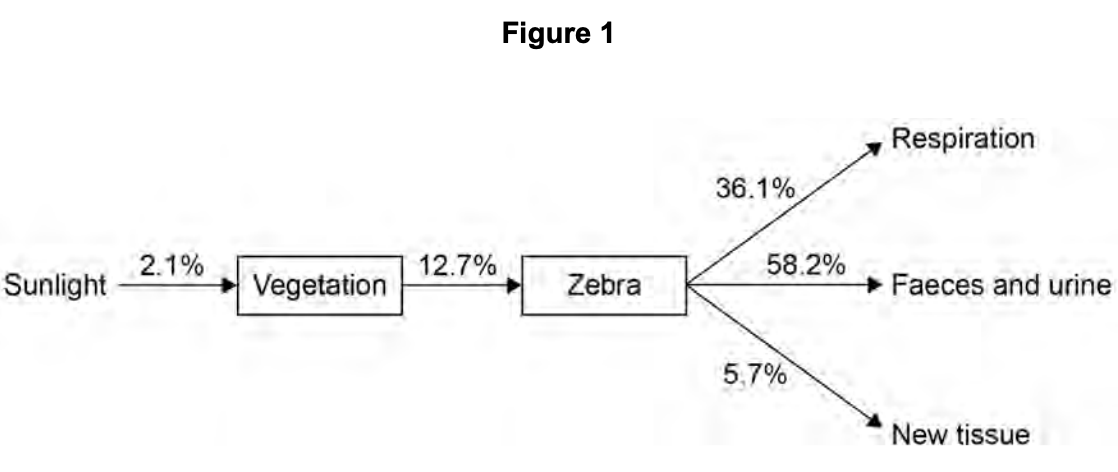
Answer
Mark Scheme
- 0.155 (1 mark)
Comments from mark scheme
Accept standard form e.g. 15.5 x 10⁻²
Tips from examiner reports
Percentage calculations: 0.155% of sunlight energy transferred to faeces and urine. Working out percentages of percentages caused many to be out by a power of 10. Answers in standard form were often wrong (1.55 × 10⁻³ %).
In this ecosystem the net productivity of the vegetation is 24 525kJ m−2 year−1
Use this information and Figure 1 to calculate the energy stored in new tissues of the zebra in kJ m−2 year−1
(2 marks)Answer
Mark Scheme
- Answer of 180/178/177.5 = 2 marks (1 mark)
- Incorrect answer but shows use of numbers 57 and 127 (with decimal points in any position) within the calculation = 1 mark (1 mark)
Comments from mark scheme
- Ignore any numbers following 177.5
Tips from examiner reports
40% scored both marks. Common transcription error: writing 117.54 instead of 177.54. Show all working.
Sickle cell disease (SCD) is a group of inherited disorders. People with SCD have sickle-shaped red blood cells. A single base substitution mutation can cause one type of SCD. This mutation causes a change in the structure of the beta polypeptide chains in haemoglobin.
Explain how a single base substitution causes a change in the structure of this polypeptide.
Do not include details of transcription and translation in your answer.
(3 marks)Answer
Mark Scheme
- Change in (sequence of) amino acid(s)/primary structure (1 mark)
- Change in hydrogen/ionic/disulfide bonds (1 mark)
- Alters tertiary/30 structure (1 mark)
Comments from mark scheme
- Reject amino acids are formed.
- Reject amino acids code.
- Reject active site.
- Ignore quaternary.
- Ignore 3D.
Tips from examiner reports
90% scored at least 1 mark. A base substitution changes the PRIMARY structure (new amino acid sequence) — not ‘a new amino acid is formed/produced’. Tertiary structure changes were negated by adding ‘change in active site’ (only applies to enzymes). A base substitution is NOT a frameshift mutation.
Haematopoietic stem cell transplantation (HSCT) is a long-term treatment for SCD. In HSCT, the patient receives stem cells from the bone marrow of a person who does not have SCD. The donor is often the patient’s brother or sister. Before the treatment starts, the patient’s faulty bone marrow cells have to be destroyed.
Use this information to explain how HSCT is an effective long-term treatment for SCD
(3 marks)Answer
Mark Scheme
- Produce healthy (red blood) cells OR Produce (normal) polypeptide/haemoglobin (1 mark)
- No sickle/faulty/SCD (red blood) cells (produced) OR No defective polypeptide/haemoglobin (1 mark)
- Stem/marrow cells (continuously) divide/replicate OR Less chance of rejection (from brother/sister) (1 mark)
Comments from mark scheme
- Produce only healthy (red blood) cells is only equivalent to mark point 1.
- Accept produce ‘normal’/non-SCD cells.
- and 3. Ignore type of stem cell e.g. pluripotent.
- Differentiate is not equivalent to divide/replicate
Tips from examiner reports
Only 12% scored all marks. Bone marrow STEM CELLS divide and differentiate into red blood cells — the answer required stating they replicate/divide. Sibling donor: lower chance of rejection. Very few mentioned no defective haemoglobin being produced.
A new long-term treatment for SCD involves the use of gene therapy. Figure 2 shows some of the stages involved in this treatment in a child with SCD.
Some scientists have concluded that this method of gene therapy will be a more effective long-term treatment for SCD than HSCT.
Use all the information provided to evaluate this conclusion.
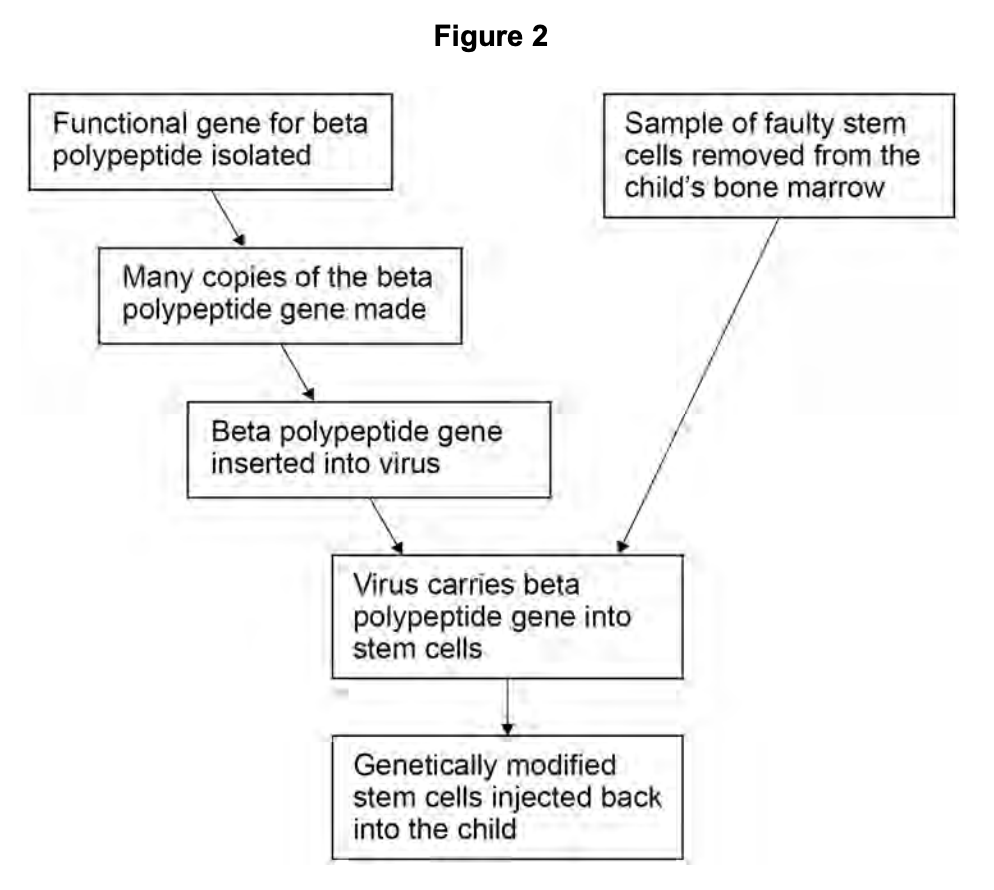
Answer
Mark Scheme
- (For gene therapy) 1. No destruction of bone marrow OR No destruction of stem cells (1 mark)
-
- Donors are not required (1 mark)
-
- Less/no chance of rejection (own stem cells) (1 mark)
- (Against gene therapy) 4. Sickle/faulty (red blood) cells still produced 5. Immune response against genetically modified cells/virus OR Long-term effect not known (as is new treatment) OR Virus could cause side effects (1 mark)
Comments from mark scheme
Max 2 marks for marking points 1, 2 and 3
- Accept no destruction of faulty bone marrow unless context indicates this is against gene therapy.
- Stating ‘only own cells used’ is not equivalent.
- Accept ‘virus could cause problems’ or ‘risk(s) with virus’
Tips from examiner reports
Only 5% scored all 3 marks. For gene therapy: no donor required; lower rejection risk. Against: side effects of viral vector; unknown long-term effects; immune response to virus. Few appreciated that SCD cells would still be produced during the gene therapy period.
A student investigated the effects of indoleacetic acid (IAA) on the growth of box oat seedlings (young plants).
The student:
- removed the shoot tip from each seedling and cut out a 10mm length of shoot
- placed 10 lengths of shoot into each of 5 Petri dishes
- added to each Petri dish an identical volume of 5% glucose solution
- added to each Petri dish 40 cm³ of a different concentration of IAA solution
- left the Petri dishes at 20°C in the dark with their lids on for 5 days
- removed the shoots after 5 days and measured them
- determined the mean change in length of shoot at each concentration of IAA.
Table 1 shows her results.
Explain why the student removed the shoot tip from each seedling.
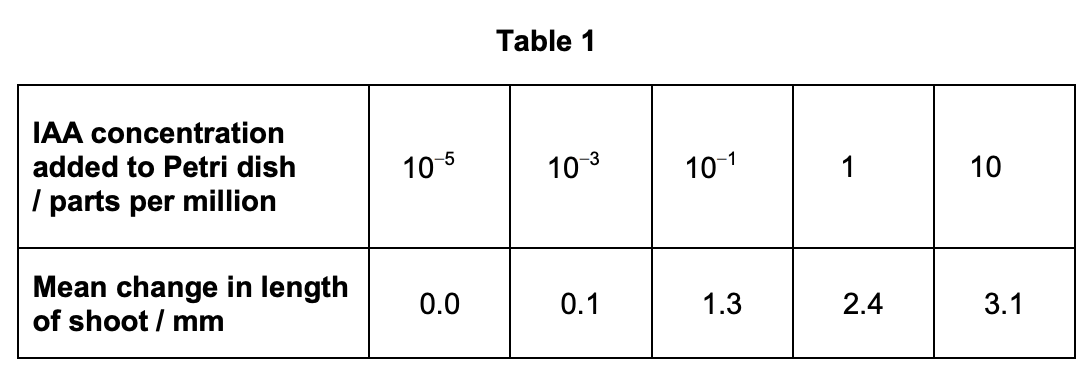
Answer
Mark Scheme
- Tip produces IAA (1 mark)
- Affects concentration of IAA OR Affects (shoot) length/growth/elongation (1 mark)
- Mitosis/division occurs in shoot tips (1 mark)
- Affects (shoot) length/growth/elongation (1 mark)
Comments from mark scheme
Mark in pairs 1 and 2 or 3 and 4. 1 and 2. Accept auxin for IAA.
- Ignore contains/stores IAA.
- Accept affects amount of IAA.
- Accept affects independent variable. 2 and 4. Ignore affects results.
Tips from examiner reports
80% scored at least 1 mark. IAA is PRODUCED BY the shoot tip (not just ‘contained in’). IAA stimulates growth/elongation of cells below the tip. Removing the tip does not prevent phototropism — it prevents growth.
Explain why the student added glucose solution to each Petri dish.
(2 marks)Answer
Mark Scheme
- For respiration (1 mark)
- Provide ATP/energy (for growth) (1 mark)
Comments from mark scheme
1.Ignore photosynthesis.
- Ignore aerobic/anaerobic (respiration).
- Reject glucose used in photosynthesis.
- Reject produce energy.
- Do not credit photosynthesis provides ATP.
Tips from examiner reports
75% scored at least 1 mark. Glucose used in respiration to provide ATP/energy for growth. ‘Energy is produced’ was not credited — say ‘energy is released from ATP’.
Explain why the lids were kept on the Petri dishes.
(2 marks)Answer
Mark Scheme
- To prevent/reduce evaporation (1 mark)
- (Which) alters concentration of (IAA) solution OR (Which) alters water potential (1 mark)
Comments from mark scheme
- Accept evaporation of (IAA/glucose) ‘solution’.
- Accept auxin for IAA.
- Ignore contamination.
Tips from examiner reports
Only 3% scored both marks. The lids prevent EVAPORATION of water from the IAA solutions — this maintains the concentration of IAA. Not contamination, oxygen, CO₂, temperature or humidity control.
Describe and explain the results shown in Table 1 and suggest how the results might have differed if lengths of root had been used.
(3 marks)Answer
Mark Scheme
- Increase in IAA concentration the higher/greater the mean (change in) length (1 mark)
- (High) IAA stimulates cell elongation (1 mark)
- In roots, growth/elongation less/inhibited (1 mark)
Comments from mark scheme
1, 2 and 3. Accept auxin for IAA. 3. Accept decrease in (mean) change in length but reject ‘decreases length’ on its own. 3. Accept ‘opposite results or ‘negative correlation’.
Tips from examiner reports
20% scored full marks. At HIGH IAA concentrations in roots, growth is INHIBITED (rate of elongation decreases) — roots do not shrink. Must include ‘mean change in length’ (not just ‘change’) and ‘concentration’ (not just ‘IAA’) in the description.
The student produced the different concentrations of IAA using a stock 1 g dm⁻³ solution of IAA (1 g dm⁻³ = 1 part per thousand) and distilled water.
Complete Table 2 with the volumes of stock IAA solution and distilled water required to produce 40cm³ of 10 ppm (parts per million) IAA solution.
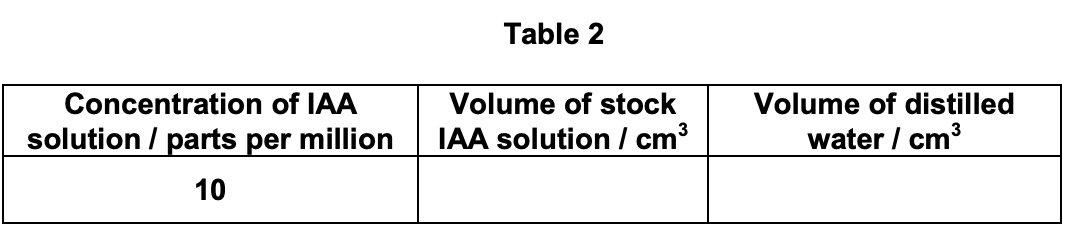
Answer
Mark Scheme
- 0.4 and 39.6 (1 mark)
Comments from mark scheme
Both numbers required and must be in order shown.
Tips from examiner reports
Only 12% provided correct dilution volumes. Give specific volumes of stock and water (e.g. 1 cm³ stock + 9 cm³ water). Remember: 10⁻⁸ is SMALLER than 10⁻⁵.
Scientists investigated the effect of a decrease in pH on muscle contraction. The scientists did the investigation with four different preparations of isolated muscle tissue: A, B, C and D.
A - mouse muscle fibres at typical pH of mouse muscle tissue (control 1). B - mouse muscle fibres at 0.5 pH units below typical pH. C - rabbit muscle fibres at typical pH of rabbit muscle tissue (control 2). D - rabbit muscle fibres at 0.5 pH units below typical pH. They measured the force of muscle contraction of the muscle fibres at 12 °C, 22 °C and 32 °C
Figure 3 shows the results the scientists obtained for B and D compared with the appropriate control.
A student looked at the results and concluded that a decrease in pH does cause a decrease in the force of muscle contraction.
Use Figure 3 to evaluate this conclusion.
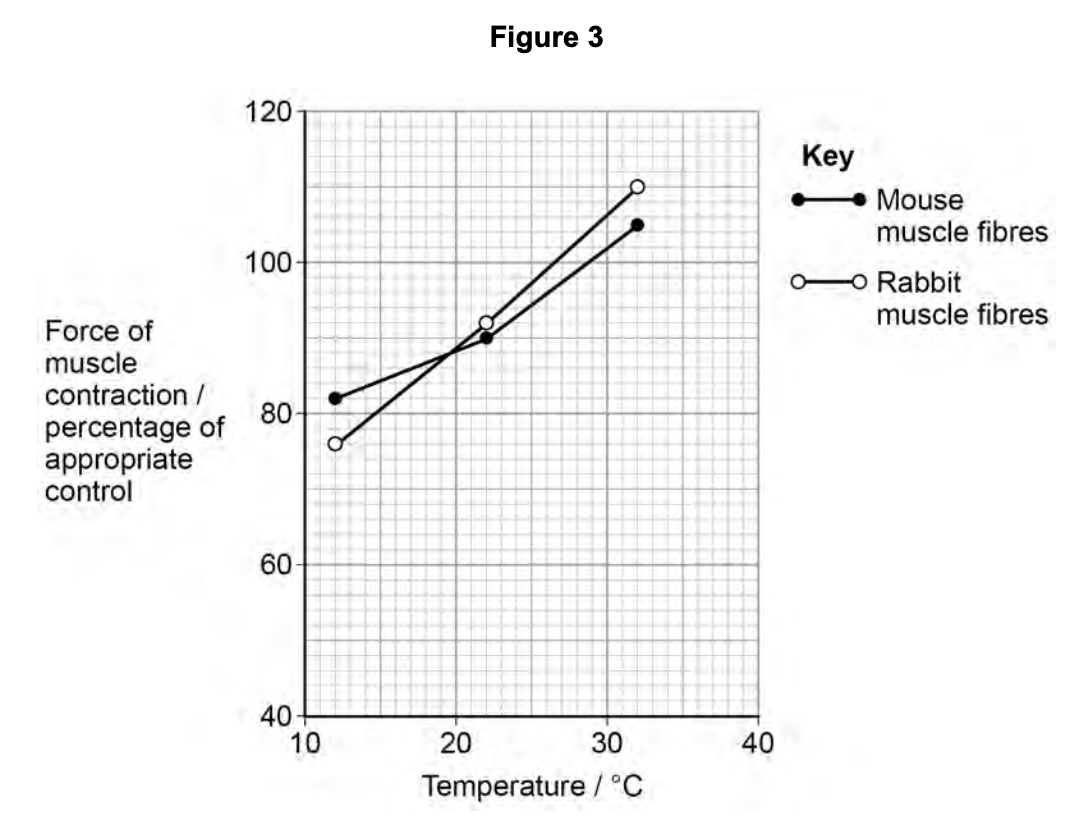
Answer
Mark Scheme
- 1.Lower (force of contraction) in mouse/B (than control/100%) below 29 °C OR Lower (force of contraction) in rabbit/D (than control/100%) below 26.5 °C (1 mark)
-
- Higher (force of contraction) in mouse/B (than control/100%) above 29 °C OR Higher (force of contraction) in rabbit/D (than control/100%) above 26.5 °C (1 mark)
- 3.Only (used) mouse and rabbit OR No other organism/species used (1 mark)
-
- Body temperature of mouse/rabbit higher (than temperatures investigated) (1 mark)
-
- Only used one/0.5 pH (below typical pH) OR (Should) use more pH values (1 mark)
-
- (Used) isolated muscle tissue (1 mark)
-
- No stats test to see if (difference is) significant (1 mark)
Comments from mark scheme
- Accept any temperature below 29 °C for mouse/B or any specified temperature below 26.5 °C for rabbit/D.
- Accept any temperature above 29 °C for mouse/B or any temperature above 26.5 °C for rabbit/D.
- and 2. Accept 27 °C for 26.5 °C and accept 28.5 °C for 29 °C.
- Accept only two animals/species used.
- Accept body temperature of mouse/rabbit not known
- Ignore SD.
Tips from examiner reports
Only 6% scored maximum marks. Students needed to evaluate the conclusion using the graph — especially the comparison with results at normal pH (shown by the y-axis). Lack of a statistical test must be linked to not knowing whether differences are significant.
Another group of scientists suggested that a decrease in the force of muscle contraction is caused by an increase in the concentration of inorganic phosphate, Pi, in muscle tissues.
Their hypothesis is that an increase in the concentration of Pi prevents the release of calcium ions within muscle tissues.
Explain how a decrease in the concentration of calcium ions within muscle tissues could cause a decrease in the force of muscle contraction.
(3 marks)Answer
Mark Scheme
- (Less/No) tropomyosin moved from binding site OR Shape of tropomyosin not changed so binding site not exposed/available (1 mark)
- (Fewer/No) actinomyosin bridges formed (1 mark)
- Myosin head does not move OR Myosin does not pull actin (filaments) OR (Less/No) ATP (hydrol)ase (activation) (1 mark)
Comments from mark scheme
1 and 2. Reject active site only once.
- Ignore troponin.
- Accept actin and myosin do not bind.
- Reject ATP synthase. Do not penalise reference to calcium rather than calcium ions. Credit all mark points even if context relates to what happens when calcium ions are present.
Tips from examiner reports
25% scored all marks. Calcium ions cause tropomyosin to move (via troponin), exposing the BINDING SITE on actin for myosin heads — not the ‘active site’. Myosin head moves/pulls actin filaments. Fewer actinomyosin cross-bridges → less force.
In muscles, pyruvate is converted to lactate during prolonged exercise.
Explain why converting pyruvate to lactate allows the continued production of ATP by anaerobic respiration.
(2 marks)Answer
Mark Scheme
- Regenerates/produces NAD OR oxidises reduced NAD (1 mark)
- (So) glycolysis continues (1 mark)
Comments from mark scheme
- Reject NADP and any reference to FAD.
- Accept descriptions of oxidation e.g. loss of hydrogen.
- Accept description of glycolysis e.g. glucose to pyruvate.
- Accept ‘for oxidising/converting triose phosphate to pyruvate’.
Tips from examiner reports
Only 50% scored any marks. In anaerobic respiration (lactic acid fermentation): pyruvate accepts hydrogen from reduced NAD → NAD is REGENERATED → glycolysis can continue. This does NOT involve the ETC, Krebs cycle or link reaction.
Describe the role of glucagon in gluconeogenesis. Do not include in your answer details on the second messenger model of glucagon action.
(2 marks)Answer
Mark Scheme
- (Attaches to receptors on target cells and) activates/stimulates enzymes (1 mark)
- Glycerol/amino acids/fatty acids into glucose (1 mark)
Comments from mark scheme
- Reject ‘produces enzymes’.
- Reject ‘glucagon converts’ as context suggests enzyme action.
- Ignore lipids/fats/proteins but reject glycogen.
- Reject occurs in pancreas.
Tips from examiner reports
Only 44% scored at least 1 mark. Gluconeogenesis: conversion of glycerol, amino acids or fatty acids to glucose. Glucagon activates enzymes — it does NOT act as an enzyme itself. ‘Glucagon converts glycogen to glucose’ describes glycogenolysis, not gluconeogenesis.
The gene that codes for glucagon is 9.531kilobases in length. The DNA helix makes one complete turn every 10 base pairs. Every complete turn is 3.4 nm in length. Use this information to calculate the length in micrometres (µm) of the gene for glucagon.
Give your answer to 3 significant figures.
(2 marks)Answer
Mark Scheme
- Correct answer of 3.24 = 2 marks (1 mark)
- Incorrect but multiplies by 34 (with decimal point in any position) = 1 mark OR Incorrect but shows sequence 324 = 1 mark OR (1 mark)
- 2 = 1 mark (1 mark)
Tips from examiner reports
80% scored at least 1. Convert nanometres to micrometres (divide by 1000). ‘3 significant figures’ means 3 sf, not 3 decimal places. Dividing instead of multiplying by 3.4 was common.
Metformin is a dru box g commonly used to treat type II diabetes. Metformin’s ability to lower the blood glucose concentration involves a number of mechanisms including:
Explain how increasing a cell’s sensitivity to insulin will lower the blood glucose concentration.
- increasing a cell’s sensitivity to insulin
- inhibiting adenylate cyclase.
Answer
Mark Scheme
- (More) insulin binds to receptors (1 mark)
- (Stimulates) uptake of glucose by channel/transport proteins OR Activates enzymes which convert glucose to glycogen (1 mark)
Comments from mark scheme
- Accept activates enzymes for glycogenesis.
- Reject active transport.
- Accept carrier proteins or GLUT 4 for channel proteins.
- Accept insulin stimulates addition of channel proteins in membranes.
Tips from examiner reports
Fewer than 50% scored any marks. Insulin binds to RECEPTORS (not active sites) on cell membranes. Glucose enters cells via carrier/channel proteins. Glycogen synthesis = GLYCOGENESIS (not gluconeogenesis or glycolysis). Enzyme activation was also required.
Explain how inhibiting adenylate cyclase may help to lower the blood glucose concentration.
(3 marks)Answer
Mark Scheme
- Less/no ATP is converted to cyclic AMP/cAMP (1 mark)
- Less/no kinase is activated (1 mark)
- Less/no glycogen is converted to glucose OR Less/no glycogenolysis (1 mark)
Comments from mark scheme
If no indication of less/no for any of the mark points award max 2 marks. Accept all marks in context of adrenaline. Ignore gluconeogenesis.
Tips from examiner reports
25% scored all 3 marks — the most effective discriminator. Second messenger model: glucagon → receptor → adenylyl cyclase → less cAMP → less protein kinase A activity → less glycogenolysis. ‘Glycolysis’, ‘glucolysis’ or ‘glucogenesis’ instead of glycogenolysis were not credited.
In fruit flies, a gene for body colour has a dominant allele for grey body, G, and a recessive allele for black body, g. A gene for eye colour has a dominant allele for red eyes, R, and a recessive allele for white eyes, r, and is located on the X chromosome. Figure 4 shows the phenotypes of fruit flies over four generations.
Give the full genotype of the fly numbered 6 in Figure 4. Genotype =
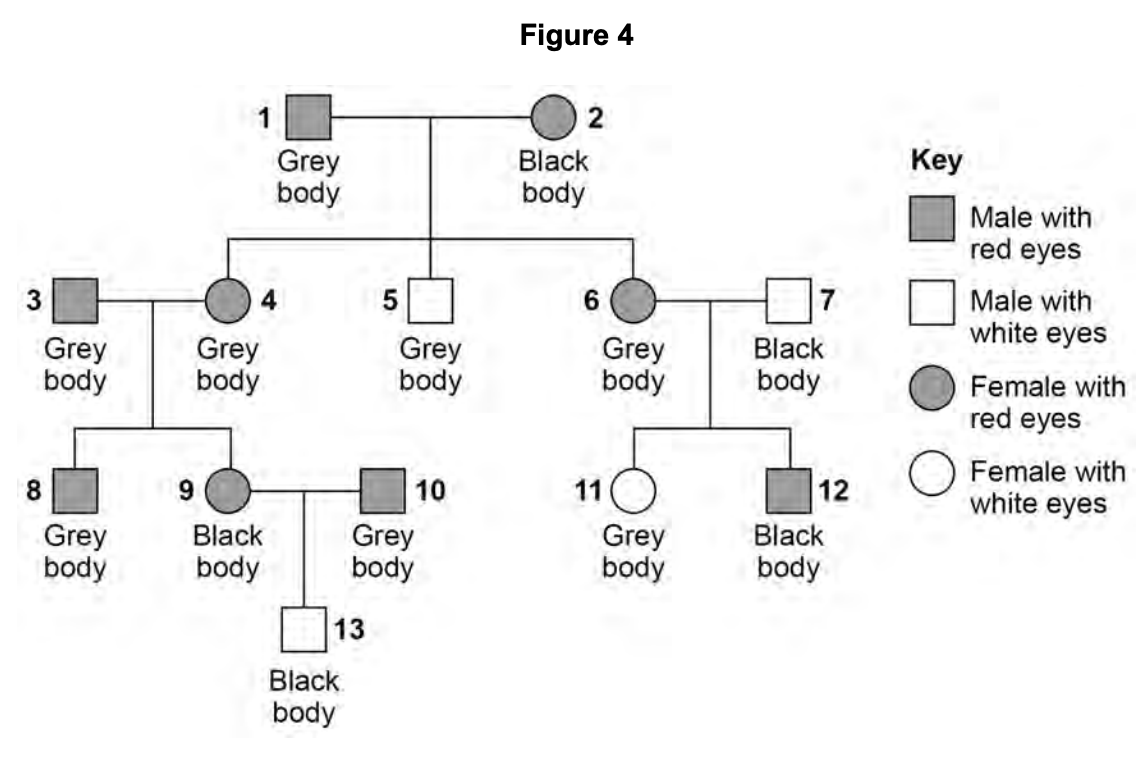
Answer
Mark Scheme
- CHECK FORMATTING GgXRXr (1 mark)
Comments from mark scheme
If it were recessive all flies of 3 and 4 would be grey OR 3 and 4 produce 9/black (fly) OR Grey parents produce black (fly);
Tips from examiner reports
Only 57% gave a correct genotype for a dihybrid sex-linked cross (GgX^R X^r or equivalent). Both alleles of each gene must be shown.
Give one piece of evidence from Figure 4 to show that the allele for grey body colour is dominant.
(1 marks)Answer
Mark Scheme
- (Fly) 3 (and 4) produce 9/black (fly) OR (Fly) 9 would not be black OR (Fly) 9 would be grey OR Grey parents/male produce black female (fly) (1 mark)
- (Fly) 3 would pass dominant allele to 9 (1 mark)
- (Fly) 2 (and 1) produce 5/grey (fly) OR Black female produces grey male OR (Fly) 5 could not be grey OR (Fly) 5 would be black (1 mark)
- (Fly) 5 would receive recessive allele from 2 (1 mark)
Comments from mark scheme
Mark in pairs 1 and 2 or 3 and 4. 2. Accept allele for grey colour would be passed on by 3. 4. Accept allele for black colour would be passed on by 2.
Tips from examiner reports
Only 18% scored this mark. Evidence that grey is dominant requires showing the grey allele MASKS the black allele in heterozygotes — not just that parents produced grey offspring or that more grey offspring were seen.
Explain one piece of evidence from Figure 4 to show that the gene for body colour is not on the X chromosome.
(2 marks)Answer
Mark Scheme
- CHECK FORMATTING 1. GgXr Xr and ggXRY (1 mark)
-
- GgXRXr , ggXR Xr , GgXr Y and ggXr Y (1 mark)
-
- Grey-bodied red-eyed female, black-bodied red-eyed female, grey-bodied white-eyed male, black-bodied white-eyed male and ratio 1 : 1 : 1 : 1 (1 mark)
Comments from mark scheme
1 and 2. Accept the following alternative notations for sexlinked crosses e.g. for mp 1 Ggrr and ggRY or Ggrr and gg R- or Ggrr and ggR i.e. space for Y chromosome. 2 and 3. Accept any order of genotypes and phenotypes. 3. Accept sequence of phenotypes does not need to mirror genotypes but must be correct. 3. Accept alternative ratios in correct proportions e.g. 4:4:4:4
Tips from examiner reports
Only 5% scored both marks. Sex linkage evidence requires specific allele-based reasoning: e.g. a black female (fly 9) must carry two copies of the black allele, one from each parent. Simply comparing numbers of grey vs black was not accepted.
A heterozygous grey-bodied, white-eyed female fly was crossed with a black-bodied, red-eyed male fly.
Complete the genetic diagram below to show all the possible genotypes and the ratio of phenotypes expected in the offspring from this cross.
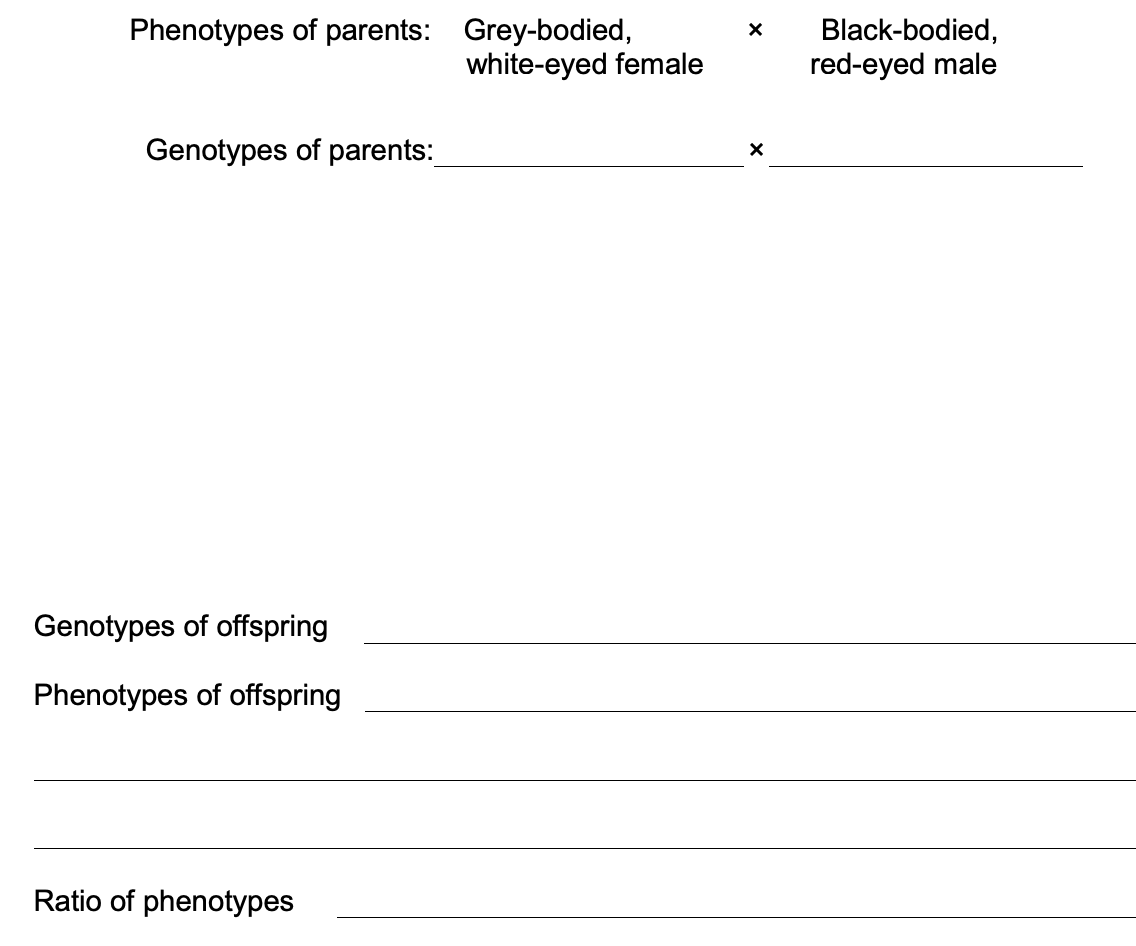
Answer
Mark Scheme
- Correct answer of 48% = 2 marks (1 mark)
Incorrect answer but shows understanding that 2pq = OR Incorrect answer but shows understanding that 1 – (p2 + q 2 ) =
Comments from mark scheme
- Accept 0.48 for 1 mark.
- Accept understanding of 2pq by using a calculation involving 2 x two different numbers
Tips from examiner reports
28% scored all 3 marks. Common errors: not including the sex of offspring in phenotypes; incorrect phenotype for male offspring in sex-linked crosses. Check each offspring genotype carefully.
A population of fruit flies contained 64% grey-bodied flies.
Use the Hardy–Weinberg equation to calculate the percentage of flies heterozygous for gene G.
(2 marks)Answer
Mark Scheme
- NADP, ADP, Pi and water (1 mark)
Tips from examiner reports
27% scored both marks. 2pq = frequency of heterozygous genotype. Calculated as: q² = (proportion of recessive phenotype), q = √q², p = 1 − q, 2pq. Calculating pq instead of 2pq scored zero.
In photosynthesis, which chemicals are needed for the light-dependent reaction?
70% correctly identified the chemicals for the light-dependent reaction (water, ADP, Pi, NADP).
(1 marks)Describe what happens during photoionisation in the light-dependent reaction
(2 marks)Answer
Mark Scheme
- Ink and (leaf) pigments would mix OR (With ink) origin/line in different position OR (With pencil) origin/line in same position OR (With pencil) origin/line still visible (1 mark)
Tips from examiner reports
44% scored both marks. Photoionisation: chlorophyll absorbs light → electrons excited → lost from chlorophyll → chlorophyll becomes positively charged. ‘Photolysis’ alone was not credited. Referring only to chloroplasts/photosystems (not chlorophyll) did not score.
A student obtained a solution of pigments from the leaves of a plant. Then the student used paper chromatography to separate the pigments. Figure 5 shows the chromatogram produced.
Explain why the student marked the origin using a pencil rather than using ink.
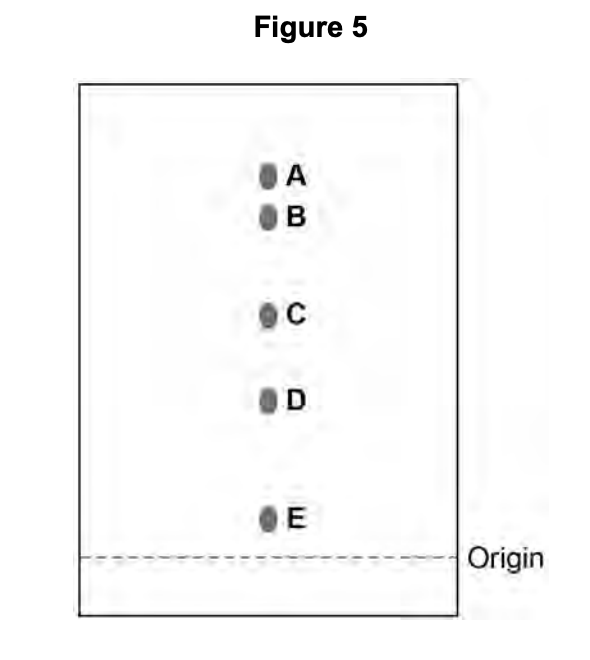
Answer
Mark Scheme
- Level of solvent below origin/line (1 mark)
- Remove/stop before (solvent) reaches top/end (1 mark)
Comments from mark scheme
- Reject water or any named aqueous solution.
- Accept named organic solvent.
Tips from examiner reports
Only 21% scored the mark. Pencil is used so the ORIGIN LINE is still visible after running — ink would dissolve in the solvent and mix with the pigments, contaminating the sample. Many only said ‘ink runs’ without explaining the consequence.
Describe the method the student used to separate the pigments after the solution of pigments had been applied to the origin.
(2 marks)Answer
Mark Scheme
- Accept any answer in range of 0.58 to 0.62 (1 mark)
Comments from mark scheme
Accept 0.58 or 0.62. Ignore any numbers which follow numbers in range.
Tips from examiner reports
Only 12% scored both marks. Chromatography method: mark origin in PENCIL; place solvent so it is BELOW the origin; remove before solvent reaches the top; mark solvent front. ‘Solvent’ means the organic solvent — not water.
Calculating the Rf values of the pigments can help to identify each pigment. An Rf value compares the distance the pigment has moved from the origin with the distance the solvent front has moved from the origin.
Rf = distance pigment has moved from the origin/ distance solvent front has moved from the origin
The distance each pigment has moved is measured from the middle of each spot.
Pigment A has an Rf value of 0.95
Use Figure 5 to calculate the Rf value of pigment C.
(1 marks)Answer
Mark Scheme
- (Absorb) different/more wavelengths (of light) for photosynthesis (1 mark)
Comments from mark scheme
Accept wider/larger range of wavelengths. Accept frequency for wavelength. Accept lightdependent reaction /photophosphorylation /photoionisation for photosynthesis
Tips from examiner reports
66% correctly calculated the Rf value using distance moved by pigment ÷ distance moved by solvent front.
The pigments in leaves are different colours.
Suggest and explain the advantage of having different coloured pigments in leaves
(1 marks)Answer
Mark Scheme
- (Short) single strand of DNA (1 mark)
- Bases complementary (with DNA/allele/gene) (1 mark)
Tips from examiner reports
46% scored the mark. Different pigments absorb different WAVELENGTHS of light → broader range of light can be used for photosynthesis. Must mention both wavelength/frequency AND photosynthesis.
What is a DNA probe?
(2 marks)Answer
Mark Scheme
- Restriction endonuclease/enzyme (1 mark)
- (Cuts DNA at specific) base sequence OR (Breaks) phosphodiester bonds OR (Cuts DNA) at recognition/restriction site (1 mark)
Comments from mark scheme
- Accept palindromic sequence.
Tips from examiner reports
Only 11% scored both marks. A DNA probe is SHORT, SINGLE-STRANDED, with a base sequence COMPLEMENTARY to the target sequence. Do not confuse with marker genes or primers. Many just repeated the role of probes from the question stem.
DNA probes are used to detect specific base sequences of DNA. The process is shown in Figure 6.
Describe how the DNA is broken down into smaller fragments.
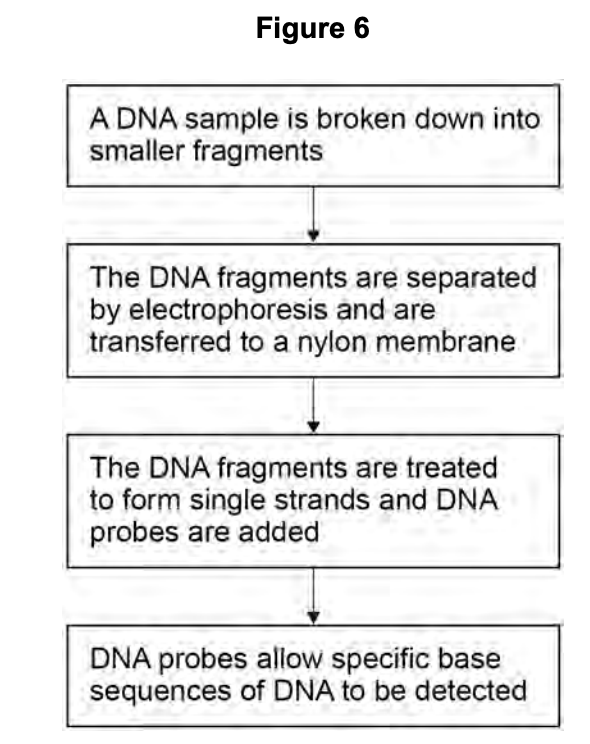
Answer
Mark Scheme
- (So DNA) probe binds/attaches/anneals - WRONG (1 mark)
Tips from examiner reports
70% scored at least 1 mark. Restriction endonuclease cuts DNA at specific RECOGNITION SITES (palindromic sequences; phosphodiester bonds). Incorrect enzymes: DNA helicase, DNA polymerase, reverse transcriptase. ‘Heating the DNA to break it down’ was not credited.
The DNA on the nylon membrane is treated to form single strands. Explain why
(1 marks)Answer
Mark Scheme
- (Lane 1 has DNA fragments) of known sizes/lengths (1 mark)
- Compare (position of viral fragment/s) (1 mark)
Tips from examiner reports
55% scored the mark. DNA must be made SINGLE-STRANDED (by heat or alkali) so the probe can hybridise via complementary base pairing. Some described exposing bases without linking to probe attachment.
A scientist used DNA probes and electrophoresis to screen four volunteers for five different viral DNA fragments. Figure 7 shows the results the scientist obtained. The lanes numbered 2 to 5 represent the four volunteers.
Lane 1 of Figure 7 enabled the size of the different viral fragments to be determined.
Suggest and explain how.
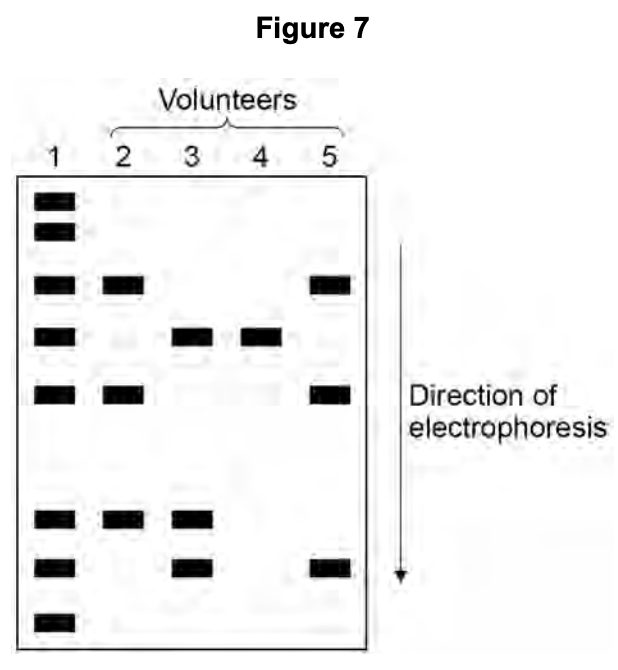
Answer
Mark Scheme
- (Lane 1 has DNA fragments) of known sizes/lengths (1 mark)
- Compare (position of viral fragment/s) (1 mark)
Tips from examiner reports
60% scored at least 1 mark. Lane 1 contains DNA fragments of KNOWN sizes — compare volunteer lanes to lane 1 to determine fragment sizes. Lane 1 is a size standard, not a control ‘containing five viral fragments’.
The lengths of the viral DNA fragments were:
- 600 base pairs
- 250 base pairs
- 535 base pairs
- 300 base pairs
- 500 base pairs Which volunteers had at least one of the viral DNA fragments with 250 base pairs or 535 base pairs?
Answer
Mark Scheme
- 3, 4, 5 with these numbers in any sequence (1 mark)
Comments from mark scheme
All three numbers required. Reject if more than three numbers given.
Tips from examiner reports
Only 17% correctly identified volunteers with 250 or 535 base pair fragments.
The sundew is a small flowering plant, growing in wet habitats such as bogs and marshes. The soil in bogs and marshes is acidic and has very low concentrations of some nutrients. The sundew can trap and digest insects.
Describe how you could estimate the size of a population of sundews in a small marsh.
(5 marks)Answer
Mark Scheme
- Use a grid OR Divide area into squares/sections (1 mark)
- Method of obtaining random coordinates/numbers e.g. calculator/computer/random numbers table/generator (1 mark)
- Count number/frequency in a quadrat/section (1 mark)
- Large sample and calculate mean/average number (per quadrat/section) (1 mark)
- Valid method of calculating total number of sundews, e.g. mean number of plants per quadrat/section/m2 multiplied by number of quadrats/sections/m2 (1 mark)
Comments from mark scheme
- Accept use of tape measures/map/area with coordinates.
- Accept Belt transect.
- If transect method used accept quadrats at regular intervals or current mark point 2.
- Accept % cover in quadrat/section.
- Ignore amount/abundance.
- Accept large sample and calculate mean %.
- Accept large sample and method of calculating mean.
- Accept many/multiple for large sample but ignore several. 4.If a specific number is given it must be 10 or more.
- Do not allow ‘scale up’ without further qualification.
- Do not award if % cover determined.
Tips from examiner reports
10% scored all 5 marks. Use a grid and random number generator for coordinates. Count individuals or percentage cover in each quadrat. Calculate MEAN per quadrat, then extrapolate: (total area ÷ quadrat area) × mean count. ‘Scaling up’ without detail did not score.
Suggest and explain how digesting insects helps the sundew to grow in soil with very low concentrations of some nutrients.
(2 marks)Answer
Mark Scheme
- Digestion/breakdown of proteins (1 mark)
- Provides amino acids OR (Sundew can) produce a named (organic) nitrogen-containing compound e.g. proteins, amino acids, DNA, ATP (1 mark)
- Digestion/breakdown of named (organic) phosphate-containing compound e.g. DNA, RNA (1 mark)
- Provides named (organic) phosphate-containing product e.g. nucleotides OR (Sundew can) produce a named phosphatecontaining compound e.g. ATP, DNA (1 mark)
Tips from examiner reports
70% scored zero. ‘Proteins digested → amino acids provided to sundew’ gained both marks. ‘Nutrients released’ was too vague. Nitrates/ammonium ions as products of digestion were not credited. ‘Phosphate’ as a product was accepted for 1 mark.
Guillain–Barré syndrome is a rare disease in which the immune system box damages the myelin sheath of neurones. Myelin sheath damage can cause a range of symptoms, for example numbness, muscular weakness and muscular paralysis. Sometimes, neurones of the autonomic nervous system are affected, causing heart rate irregularities.
Huntington’s disease is a disorder caused when a protein called huntingtin damages the brain. Huntingtin is produced because of a dominant, mutant allele.
The first successful drug trial to reduce concentrations of huntingtin in the human brain involved 46 patients. The patients received the drug for 4 months. The concentration of huntingtin was reduced in all the patients. The drug was injected at the base of the spine into the cerebrospinal fluid bathing the brain and spinal cord. The drug contains single-stranded DNA molecules. These single-stranded molecules inhibit the mRNA needed to produce huntingtin.
Symptoms of Huntington’s disease can start at any time, but usually develop between 30 and 50 years of age. The likelihood and age when symptoms start are linked to the number of CAG base sequence repeats in the gene for Huntington’s disease.
However, recent studies have suggested that epigenetics may also affect the age when symptoms first start.
Damage to the myelin sheath of neurones can cause muscular paralysis (lines 2–4). Explain how.
(3 marks)Answer
Mark Scheme
- (Refers to) saltatory conduction OR (Nerve) impulses/depolarisation/ions pass to other neurones OR Depolarisation occurs along whole length (of axon) (1 mark)
- (Nerve) impulses slowed/stopped (1 mark)
- (Refers to) neuromuscular junction OR (Refers to) sarcolemma (1 mark)
Comments from mark scheme
- Accept suitable description that refers to (transmission) from node to node (of Ranvier). 1 and 2. Accept action potentials for impulses.
- Accept action potential for depolarisation. 1, 2 and 3. Reject first mark awarded if answer refers to messages/signals for impulses. Reject even if impulse/s also referred to.
Tips from examiner reports
84% scored at least 1. Saltatory conduction at NODES OF RANVIER — do not say ‘impulses jump from node to node’. Myelin is electrically insulating — not thermally insulating. Damage to myelin slows action potential transmission.
Sometimes Guillain–Barré syndrome causes heart rate irregularities (lines 4–5). box Suggest and explain why.
(3 marks)Answer
Mark Scheme
- Slower/fewer impulse(s) along sympathetic/parasympathetic (pathway/neurones) (1 mark)
- (Impulses) from cardiac centre OR (Impulses) from medulla (1 mark)
- To SAN (1 mark)
Comments from mark scheme
- Accept action potentials for impulses. 1.Reject no impulses. 1, 2 and 3. Ignore ‘information’ but reject first mark awarded if answer refers to messages/signals for impulses. Reject even if impulse/s also referred to.
Tips from examiner reports
Only 44% scored at least 1 mark. The question was about impulses going TO the SAN (from the cardiac centre), not FROM the SAN. Guillain-Barré syndrome damages nerves → fewer impulses reach the SAN → heart rate changes. Both sympathetic and parasympathetic pathways should be named.
The first successful drug trial to reduce concentrations of huntingtin in the brain used single-stranded DNA molecules (lines 13–14).
Suggest and explain how this drug could cause a reduction in the concentration of the protein huntingtin.
(3 marks)Answer
Mark Scheme
- It/DNA is complementary to (m)RNA (1 mark)
- Binds to mRNA (for huntingtin) (1 mark)
- Prevents translation (1 mark)
Comments from mark scheme
- Accept (transcription) results in complementary (m)RNA. Ignore miRNA/siRNA/transcriptional factors.
- Ignore transcription
Tips from examiner reports
63% scored at least 1 mark. The drug contains single-stranded DNA complementary to the huntingtin mRNA → binds to mRNA → prevents translation. The drug is NOT complementary to the DNA coding strand; it does NOT prevent transcription.
Scientists from the first successful drug trial to reduce concentrations of box huntingtin (lines 9–11) reported that the drug is not a cure for Huntington’s disease.
Suggest two reasons why the drug should not be considered a cure. Do not include repeats of the drug trial in your answer.
(2 marks)Answer
Mark Scheme
- Small sample size OR Only 46 (1 mark)
- Only four-months OR short period (of trial) (1 mark)
- Huntingtin/protein reduced OR Huntingtin/protein still produced OR Huntingtin/protein not removed (1 mark)
- Allele/gene/mutation/mRNA (for Huntington’s) still present OR (May be) temporary OR Drug treatment repeated (1 mark)
- Brain already damaged OR Brain damage may continue (1 mark)
Comments from mark scheme
- Accept huntington for huntingtin. Ignore miRNA/siRNA/transcriptional factors.
Tips from examiner reports
87% scored at least 1 mark. Huntingtin protein would still be produced (drug reduces, not eliminates). Short trial period, small sample size, and existing brain damage are valid limitations. The mutation being passed on to offspring was not credited.
Suggest two reasons why people had the drug injected into the cerebrospinal fluid (lines 12–13) rather than taking a pill containing the drug.
(2 marks)Answer
Mark Scheme
- (Drug/DNA) will directly/quickly reach brain OR (Cerebrospinal) fluid bathes the brain (1 mark)
- (Drug/DNA) not destroyed by acid OR (Drug/DNA) not digested (by enzymes) (1 mark)
Comments from mark scheme
- Reject protein is digested.
- Ignore location of enzymes.
- Accept Drug/DNA denatured
Tips from examiner reports
Only 14% scored both marks. The drug (single-stranded DNA) could be digested by NUCLEASES (DNases) — not proteases. The drug must be delivered to the cerebrospinal fluid bathing the brain — ‘bathing the nervous system’ was too vague.
Suggest and explain one way epigenetics may affect the age when symptoms of Huntington’s disease start.
(2 marks)Answer
Mark Scheme
- (Increased) methylation of DNA/gene/allele (1 mark)
- Inhibits/prevents transcription; OR (1 mark)
- Decreased methylation of DNA/gene/allele (1 mark)
- Stimulates/allows transcription; OR (1 mark)
- Decreased acetylation of histone(s) (1 mark)
- Inhibits transcription; OR (1 mark)
- Increased acetylation of histone(s) (1 mark)
- Stimulates/allows transcription (1 mark)
Comments from mark scheme
- Reject acetylation of DNA. Accept gene expression for transcription but ignore gene switched on/off. Ignore methylation of histones. Accept DNA-histone complex as equivalent to histone(s)
Tips from examiner reports
Only 42% scored at least 1 mark. Increased methylation → DNA more tightly wound around histones → less transcription → later onset. Increased acetylation → DNA less tightly wound → more transcription → earlier onset. Must specify that it is the DNA/gene being methylated/acetylated, and must mention transcription/gene expression.
Heat stress is a condition that often occurs in plants exposed to high temperatures for a prolonged period of time. Heat stress is a major factor in limiting the rate of photosynthesis.
Heat stress decreases the light-dependent reaction of photosynthesis.
Explain why this leads to a decrease in the light-independent reaction.
(2 marks)Answer
Mark Scheme
- (Less/no) ATP (1 mark)
- (Less/no) reduced NADP (1 mark)
Comments from mark scheme
- Accept NADPH, NADPH + H, NADPH2 NADPH + H⁺
- Reject reduced NAD, NADH etc,
Another effect of heat stress is a decrease in the activity of the enzyme rubisco. A decrease in the activity of an enzyme means that the rate of the reaction it catalyses becomes slower. A decrease in the activity of the enzyme rubisco would limit the rate of photosynthesis. Explain why.
(2 marks)Answer
Mark Scheme
- (Less/no) carbon dioxide (reacts) with RuBP (1 mark)
- (Less/no) GP (1 mark)
Where precisely is rubisco found in a cell?
(1 marks)Answer
Mark Scheme
- Stroma (of/in chloroplast) (1 mark)
Scientists investigated the effect of temperature on the activity of two enzymes isolated from the leaf cells of cotton plants:
- Rubisco
- Rubisco activase – an enzyme that activates rubisco.
Figure 1 and Figure 2 show their results.
The scientists concluded that heat stress reduces the activity of rubisco in plant leaves by affecting rubisco activase.
Use all the information to evaluate their conclusion.
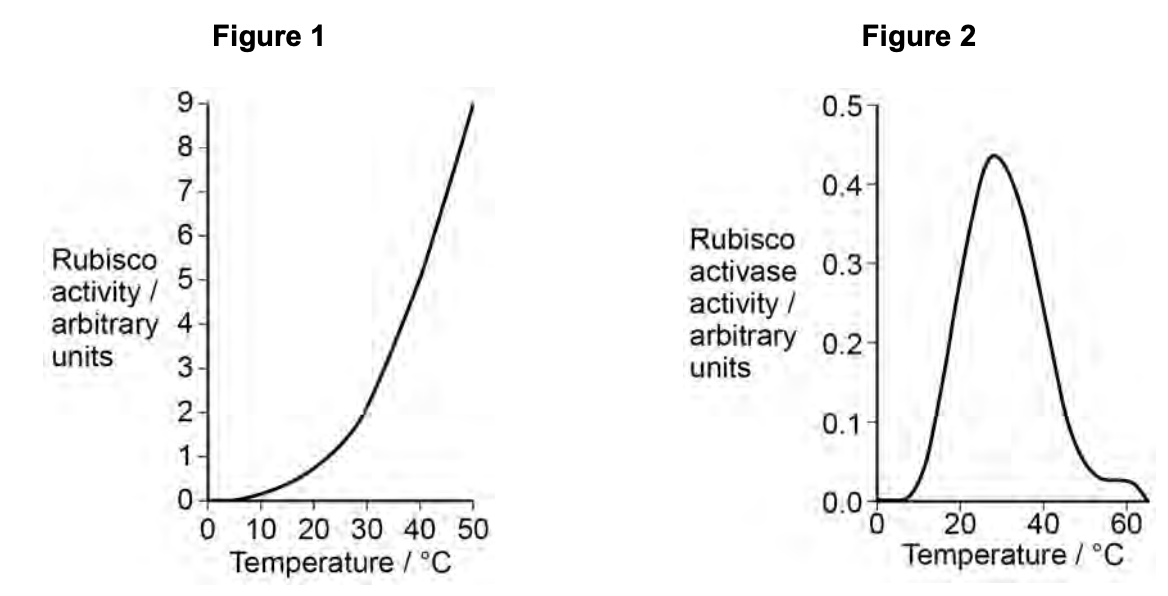
Answer
Mark Scheme
- Rubisco activity increases with temperature OR Rubisco optimum temperature is above (rubisco activase) (1 mark)
- (Rubisco) activase activity decreases at high temperatures (allow any temperature above 25 ºC.) OR (Rubisco) activase optimum (allow in range) 25 to 30 ºC. (1 mark)
- (Results/graphs suggest) activase cannot/does not affect activity of rubisco (1 mark)
- (Results are) only for cotton (1 mark)
- (Results are) for isolated enzymes (1 mark)
- No stats test (1 mark)
Comments from mark scheme
- Accept denatures at high temperature (allow any temperature above 25 ºC)
- Accept may not be the same in other species/types of plant Ignore: only one study
There are different types of gene mutation. box Put a tick () in the box next to the statement which describes incorrectly the effect of the mutation in an exon of a gene.
a) A substitution may not result in a change to the encoded amino acid. b) An inversion will result in a change in the number of DNA bases. c) A deletion will result in a frame shift. d) An addition will result in a frame shift.
(1 marks)Answer
Mark Scheme
- An inversion will result in a change in the number of DNA bases. (1 mark)
Comments from mark scheme
Reject if more than one box with tick. Ignore crossed-out ticks
Describe how alterations to tumour suppressor genes can lead to the development of tumours.
(3 marks)Answer
Mark Scheme
- 1.(Increased) methylation (of tumour suppressor genes) (1 mark)
- 2.Mutation (in tumour suppressor genes) (1 mark)
-
- Tumour suppressor genes are not transcribed/expressed OR Amino acid sequence/primary structure altered (1 mark)
-
- (Results in) rapid/uncontrollable cell division (1 mark)
Comments from mark scheme
- Accept abnormal methylation or hypermethylation
- Ignore decreased acetylation of histones
- Accept mRNA for transcription/transcribed
- Accept tertiary structure altered 3 Accept different amino acid
- Ignore reference to protein not being formed
- Accept cell division cannot be regulated 4 Ignore growth
A type of malignant tumour cell divides every 8 hours. box Starting with one of these cells, how many tumour cells will be present after 4 weeks? Assume none of these cells will die.
Give your answer in standard form.
(2 marks)Answer
Mark Scheme
- Correct answer of 1.9/1.93 x 1025 = 2 marks (1 mark)
- Incorrect answer but shows 84 = 1 mark (1 mark)
Comments from mark scheme
- Accept 2 x 1025 = 2 marks
- Ignore any numbers after 1.93
Yeast cells can respire aerobically or anaerobically. A student used the apparatus box shown in Figure 3 to measure the rate of respiration in yeast. She:
- positioned the flask in a water bath so that the yeast culture reached a constant temperature
- then left the apparatus for one hour before starting her investigation.
Suggest one reason why it was important that the student left the apparatus for one hour after the yeast culture reached a constant temperature.
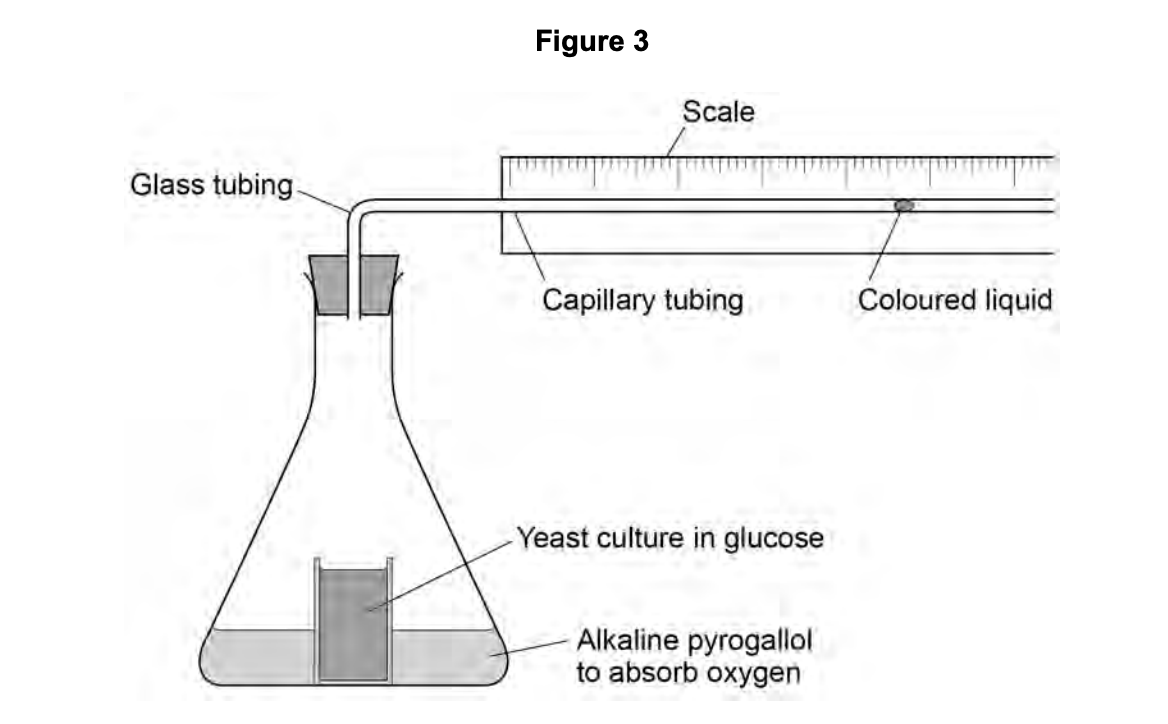
Answer
Mark Scheme
- 1.(So the) oxygen is used/absorbed/respired (1 mark)
During her investigation, the coloured liquid moved to the right. box Explain why it moved to the right
(2 marks)Answer
Mark Scheme
- Anaerobic respiration produces carbon dioxide (1 mark)
- Increase in pressure/volume (of gas) (1 mark)
Comments from mark scheme
- Reference to either volume or pressure required for the mark
The student found that the coloured liquid moved 1.5 cm in 24 hours. The diameter of the lumen (hole) of the capillary tubing was 1 mm. The volume of a capillary tubing is given by πr 2𝑙, where π is 3.14 and 𝑙 = length.
Calculate the volume of gas produced in cm³ hour−1
Show your working.
(2 marks)Answer
Mark Scheme
- Correct answer in range of (1 mark)
- 9 x 10⁻⁴ to 4.91 × 104 = 2 marks (1 mark)
- Incorrect answer buts shows division by 24 = 1 mark (1 mark)
Figure 4 shows a typical population growth curve for yeast under laboratory box conditions.
Explain why a log scale is used to record the number of cells.
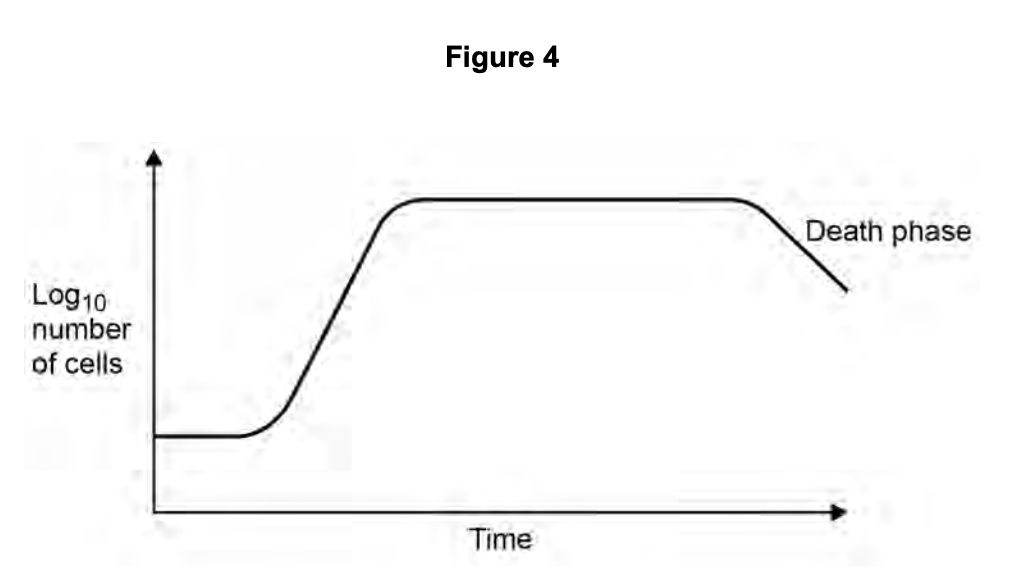
Answer
Mark Scheme
- Large range/difference/increase in numbers (1 mark)
Comments from mark scheme
- Accept reference to exponential (increase)
- Ignore if the answer only refers to numbers being high I. Ignore to ‘fit on the scale’
Many yeast cells die during the death phase.
Suggest one reason why.
(1 marks)Answer
Mark Scheme
- Decrease/no glucose/substrate OR Increase in ethanol/carbon dioxide/acidity (1 mark)
Comments from mark scheme
Accept decrease/no oxygen as Figure 4 is not linked to Figure 3. Accept competition for glucose/oxygen. Accept any named sugar Accept decrease in pH Accept increase in toxins
- Ignore food/nutrients
CHECK FORMATTING****
The following equation can be used to make predictions of the growth in the box population of yeast cells under ideal laboratory conditions. Xt = X0 ert Xt = the population after a certain time X0 = the population at the start e = 2.72 (base of natural logarithm) r = growth rate t = time period in hours over which r applies A population of 2000 yeast cells was left for 10 hours. The value for the growth rate was 0.5 Assuming no yeast cells died, calculate the predicted size of the population after 10 hours. Show your working.
(2 marks)Answer
Mark Scheme
- Correct answer of 298000 or 297766 or (1 mark)
- 59 or 296826 = 2 marks (1 mark)
- Incorrect answer but working shows 2000 × 2.72 = 1 mark (1 mark)
Comments from mark scheme
- Accept: any equivalent answer with appropriate rounding e.g. 2.98 × 10⁵ , 29.78 × 10⁴ etc.
Scientists investigated the process of succession on sand dunes. They measured the box percentage cover of different species of plants on sand dunes of different ages. Some of the results the scientists obtained are shown in Figure 5.
Describe how you would determine the mean percentage cover for beach grass on a sand dune.
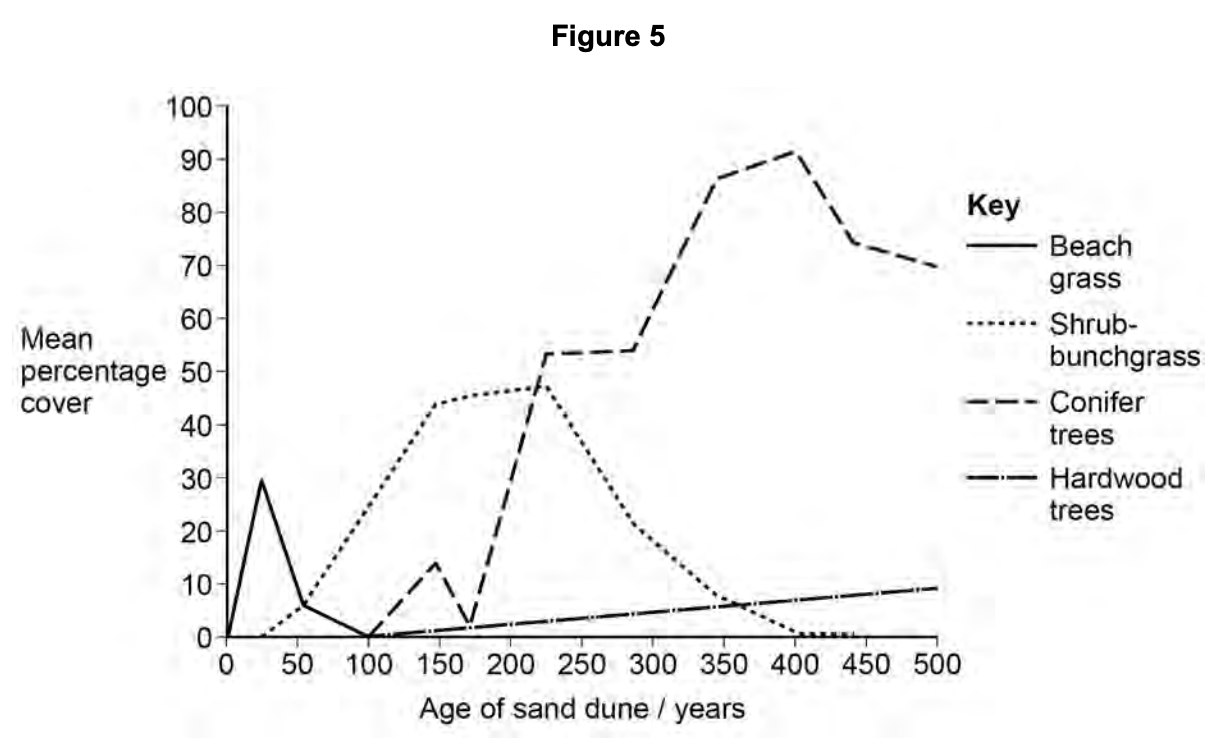
Answer
Mark Scheme
- Method of randomly determining position (of quadrats) e.g. random numbers table/generator (1 mark)
- Large number/sample of quadrats (1 mark)
- Divide total percentage by number of quadrats/samples/readings (1 mark)
Comments from mark scheme
- Ignore line/belt transect
- Accept many/multiple
- Ignore point quadrat
- If a specified number is given, it must be 20 or more
The scientists concluded that the results shown in Figure 5 were due to succession box taking place.
Use Figure 5 to explain why the scientists reached this conclusion.
(4 marks)Answer
Mark Scheme
- Beach grass is the pioneer (species) (1 mark)
- Pioneers/named species change the (abiotic) environment/habitat/conditions/factors (1 mark)
- (So) less hostile for named species OR (So) more suitable for named species (1 mark)
- Conifer/hardwood trees represent climax community (1 mark)
Comments from mark scheme
- Must convey idea of change being caused by a species
- Accept example of change e.g. more humus
The scientists also investigated how the proportion of sunlight reaching the ground box changed during succession. Some of the results the scientists obtained are shown in Figure 6.
Use Figure 5 to explain the results in Figure 6.
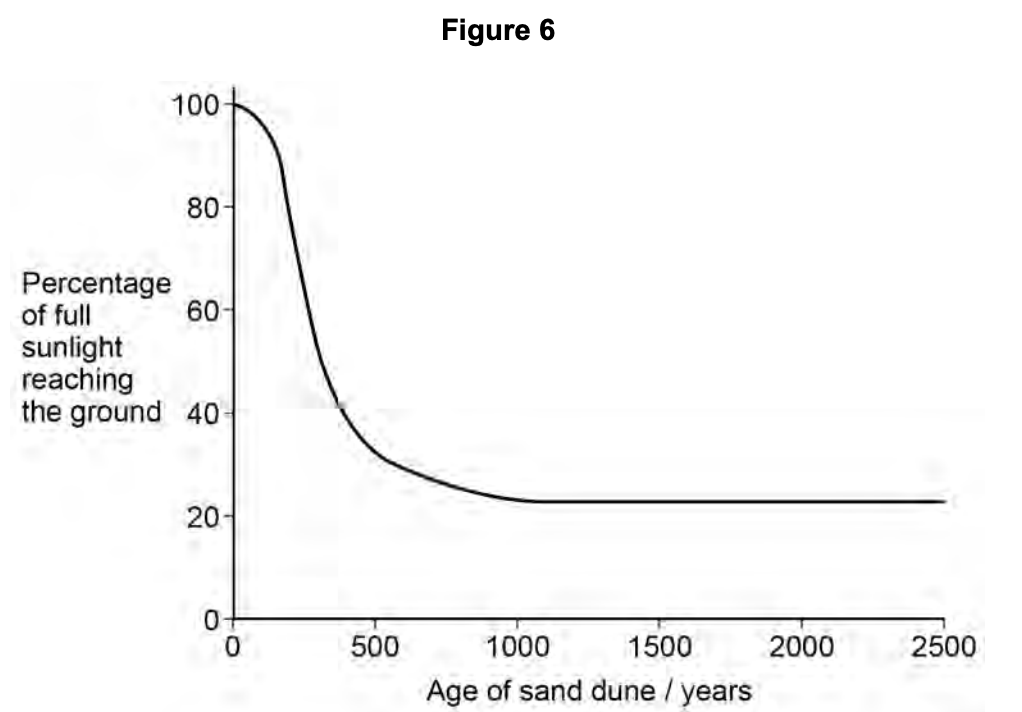
Answer
Mark Scheme
- Trees block/reduce (sun)light (1 mark)
Comments from mark scheme
Reject ‘blocks’ all of the light
Using evidence from Figure 6, what can you conclude about the net primary productivity (NPP) in the sand dunes that are older than 1000 years?
Explain your answer.
(2 marks)Answer
Mark Scheme
- 1.(NPP) remains constant (1 mark)
-
- GPP/photosynthesis and respiration constant (1 mark)
- OR 3. (NPP) low/decreases (1 mark)
-
- Less light so less photosynthesis/GPP (1 mark)
Comments from mark scheme
Mark in paired statements 1 and 2 or 3 and 4 2. Accept GPP/photosynthesis equals respiration 4. Reject no photosynthesis
Furosemide and CVT are drugs used to remove excess fluid from the body. Scientists investigated the effect of these drugs on the volume of urine produced by human volunteers. The scientists used the following method.
- They divided volunteers into three groups, A, B and C at random.
- They gave all the volunteers the same food for 3 days.
- After 3 days, they gave the volunteers in group A a tablet containing furosemide, the volunteers in group B a tablet containing CVT and the volunteers in group C a placebo (a tablet that did not contain either drug).
- They then found the mean volume of urine produced by each group in the 4 hours after taking the tablets.
Some of the results the scientists obtained are shown in Table 1. A value of ± 2 standard deviations from the mean includes over 95% of the data.
All the volunteers were given the same food for 3 days.
Suggest and explain one reason why they were given the same food
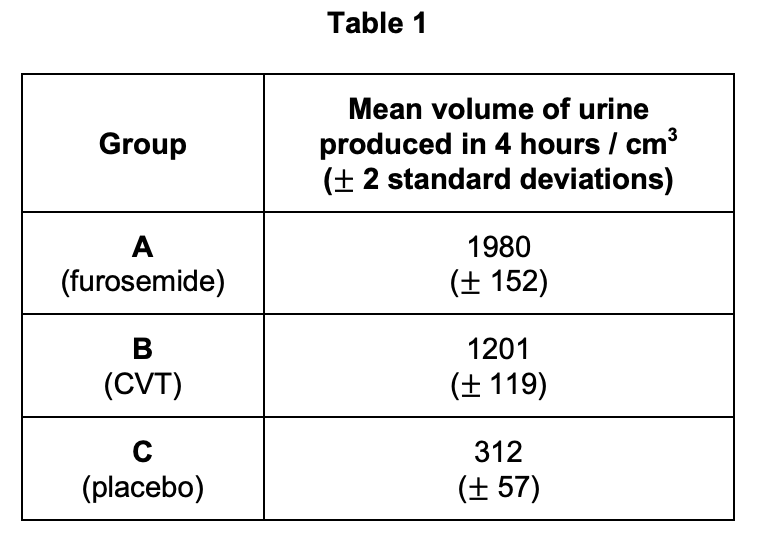
Answer
Mark Scheme
- Affects water potential (of blood/body) (1 mark)
- Affects volume of urine (produced/removed) (1 mark)
Comments from mark scheme
- Accept Ψ for water potential
Using Table 1, what can you conclude about the effectiveness of furosemide and CVT box in the removal of excess fluid from the body?
(2 marks)Answer
Mark Scheme
- Furosemide and CVT more effective than placebo/control/C OR Furosemide more effective (than CVT) (1 mark)
- Correct reference to a significant increase/difference as SD’s do not overlap (1 mark)
Comments from mark scheme
- Accept both (drugs)/A and B more effective than placebo/control/C
Furosemide is sometimes used to treat high blood pressure.
Suggest how furosemide would cause a decrease in blood pressure
(1 marks)Answer
Mark Scheme
- Lower volume of blood (1 mark)
Furosemide inhibits the absorption of sodium and chloride ions from the filtrate produced in the nephrons.
Explain how furosemide causes an increase in the volume of urine produced.
(3 marks)Answer
Mark Scheme
- 1.Water potential of filtrate/tubule decreased (1 mark)
-
- Less water (reabsorbed) by osmosis (from filtrate/tubule) (1 mark)
-
- Collecting duct (is where osmosis occurs) (1 mark)
Comments from mark scheme
- Accept correct reference to water potential gradient
- Accept maintains low water potential. 1 and 2. Accept nephron for filtrate/tubule.
- Accept no water (reabsorbed) for ‘less’
- Accept (more) water (absorbed) by osmosis (into filtrate/tubule)
- Accept proximal convoluted tubule or distal convoluted tubule or (descending) loop of Henle 3.Ignore PCT, DCT
The scientists also measured the mean rate of flow of blood plasma into the kidneys. box The results the scientists obtained are shown in Table 2.
The mean rate of flow of blood plasma is 60% of the mean rate of blood flow into the kidneys.
How much greater is the flow of blood into the kidneys with furosemide than with group C (placebo) over the 4 hours of the investigation?
Give your answer in cm³
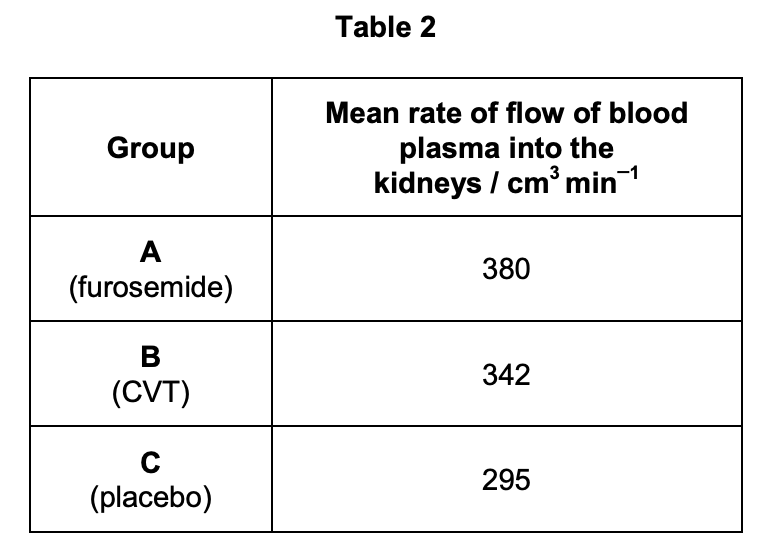
Answer
Mark Scheme
- Accept answers in the range 33840 to 34680 (1 mark)
In genetic crosses, the observed phenotypic ratios obtained in the offspring are often box not the same as the expected ratios.
Suggest two reasons why.
(2 marks)Answer
Mark Scheme
- Small sample size (1 mark)
- Fusion/fertilisation of gametes is random (1 mark)
- Linked Genes (1 mark)
- Epistasis (1 mark)
- Lethal genotypes (1 mark)
Comments from mark scheme
- Ignore breeding is random
- Accept crossing over / sex linkage
In tomato plants, the genes for height and for the type of leaf are on the same homologous pair of chromosomes. The allele T, for a tall plant, is dominant to the allele t, for a dwarf plant. The allele M, for normal leaves, is dominant to the allele m, for mottled leaves. A biologist carried out crosses between parent plants heterozygous for both genes and examined the offspring produced. The position of the two alleles for both genes was the same in each parent plant as shown in Figure 7. The phenotypes and number of offspring produced are shown in Table 3.
What would be the genotype of the offspring with dwarf plants and mottled leaves?
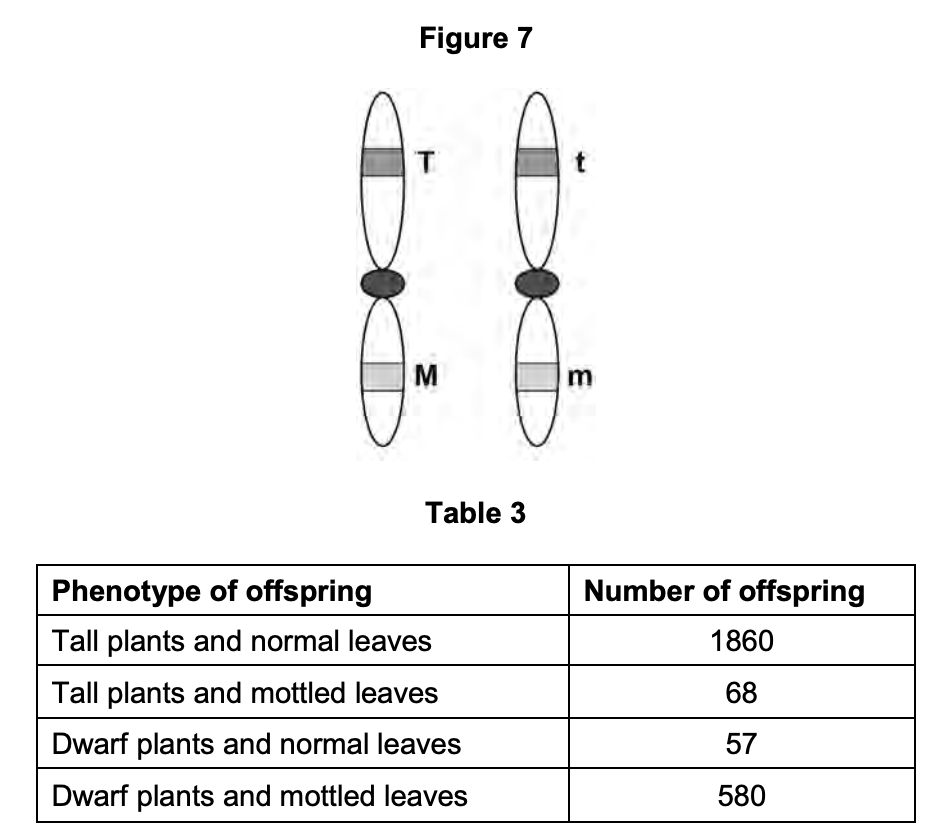
Answer
Mark Scheme
- ttmm (1 mark)
Comments from mark scheme
Accept mmtt or any order of these alleles e.g. mtmt, tmtm etc
Use the information provided to explain the results in Table 3.
(3 marks)Answer
Mark Scheme
- Genes are linked (1 mark)
- Produces few(er) tall, mottled and dwarf, normal offspring (1 mark)
- Crossing over (has occurred) (1 mark)
Comments from mark scheme
- Accept ‘Alleles are linked’ but reject if context suggests alleles of the ‘same gene’
- Accept produces few Tm and tM gametes
- Accept ‘fewer recombinants’
Complete Table 4 to show the expected ratio of phenotypes if the same cross had been carried out but the genes for height of plant and for the type of leaf were on different homologous pairs of chromosomes.
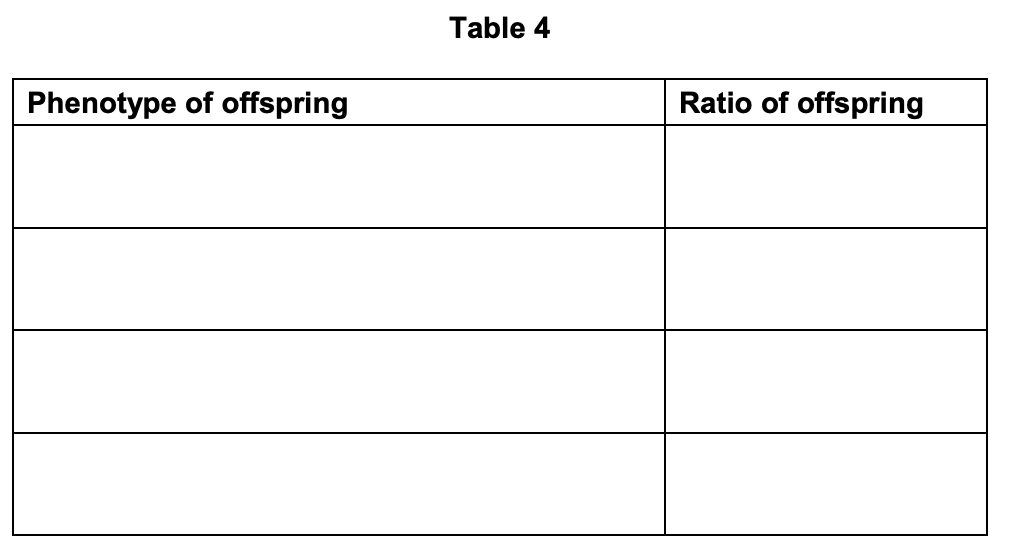
Answer
Mark Scheme
- One mark for each correct column (1 mark)
Comments from mark scheme
Note: Accept correct phenotypes in any order for one mark and correct ratio in any order e.g. 3:9:3:1 for one mark However, phenotypes and ratio must match for two marks Accept alternative wording e.g. short for dwarf
Dopamine is a neurotransmitter released in some synapses in the brain. The box transmission of dopamine is similar to that of acetylcholine. Dopamine stimulates the production of nerve impulses in postsynaptic neurones.
Describe how. Do not include in your answer the events leading to the release of dopamine and the events following production of nerve impulses at postsynaptic neurones.
(3 marks)Answer
Mark Scheme
- (Dopamine) diffuses across (synapse) (1 mark)
- Attaches to receptors on postsynaptic membrane (1 mark)
- Stimulates entry of sodium ions and depolarisation/action potential (1 mark)
Comments from mark scheme
2.Ignore name/nature of receptor e.g. cholinergic 3. Accept Na⁺ for sodium ions 3. Accept generator potential for action potential
Dopamine has a role in numerous processes in the brain including pain relief. The release of dopamine can be stimulated by chemicals called endorphins produced in the brain. Endorphins attach to opioid receptors on presynaptic neurones that release dopamine. Morphine is a drug that has a similar structure to endorphins and can provide pain relief. Explain how
(2 marks)Answer
Mark Scheme
- Morphine attaches to opioid receptors (1 mark)
- (More) dopamine released (to provide pain relief) (1 mark)
Comments from mark scheme
- Reject reference to active site
- Reject receptors release dopamine
GABA is a neurotransmitter released in some inhibitory synapses in the brain. GABA box causes negatively charged chloride ions to enter postsynaptic neurones.
Explain how this inhibits postsynaptic neurones.
(3 marks)Answer
Mark Scheme
- (Inside of postsynaptic) neurone becomes more negative/hyperpolarisation/inhibitory postsynaptic potential (1 mark)
- More sodium ions required (to reach threshold) OR Not enough sodium ions enter (to reach threshold) (1 mark)
- For depolarisation/action potential (1 mark)
Comments from mark scheme
- Ignore K⁺
- Accept -75mV or any value below this as equivalent to more negative
- Accept ‘decrease in charge’
- Accept Na⁺ for sodium ions
- Context must covey idea that depolarisation / action potential is less likely
What is meant by a genome?
(1 marks)Answer
Mark Scheme
- (All) the DNA in a cell/organism (1 mark)
Comments from mark scheme
Accept ‘(all) the ‘genes’/alleles’ ‘genetic material/code’ in a cell/organism/ person’ ‘the total number of DNA bases in a cell/organism’ Reject all the DNA/ genes within a species
Chromatin immunoprecipitation is one method to determine where a transcription factor binds to DNA. The principle behind this procedure is shown in Figure 8.
Explain why the antibody binds to the transcription factor.
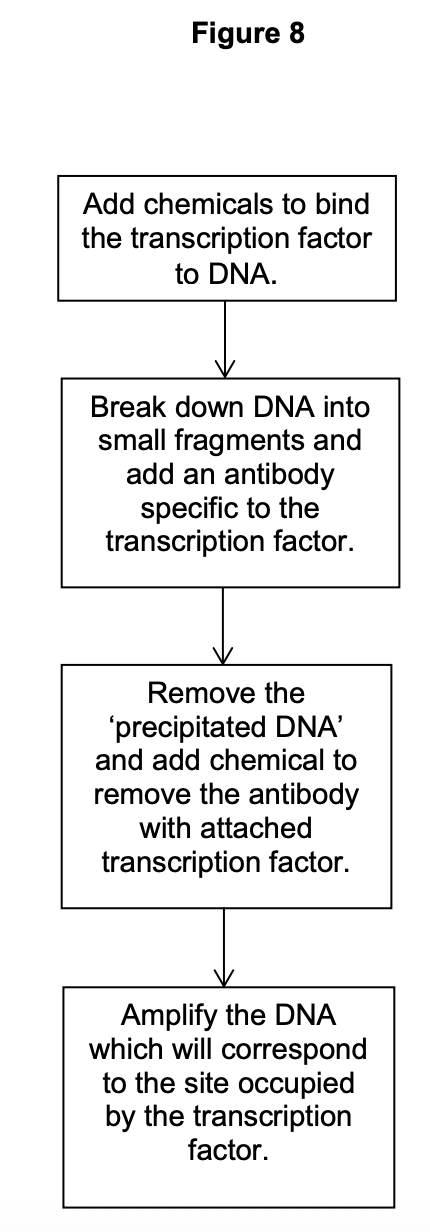
Answer
Mark Scheme
- (Transcriptional factor/antibody) has a specific/tertiary structure/shape (1 mark)
- Complementary (shape/structure) (1 mark)
Comments from mark scheme
- Accept (antibody) has a specific variable region
- Accept (transcription factor/antibody) has a specific binding site 1 and 2. Reject active site but only once.
Use Figure 8 to explain what ‘precipitated DNA’ consists of.
(1 marks)Answer
Mark Scheme
- DNA, transcription factor and antibody (1 mark)
Comments from mark scheme
Accept Nucleotides for DNA Ignore ‘reference to chemicals
Soybeans are used in a number of processed foods.
However, soybeans contain a protein known as P34 that causes an allergic response in some people. Scientists have created transgenic soybeans that produce single-stranded cDNA, which prevents transcription of the P34 gene. They used recombinant plasmids as vectors to transform soybean cells. After they had screened these cells for production of the P34 protein, they cultured the transformed cells to form soybean plants.
Suggest how single-stranded cDNA could prevent transcription of the P34 gene
(1 marks)Answer
Mark Scheme
- Binds to P34 gene/DNA/mRNA OR Binds to transcription factor gene/DNA OR Binds to promoter (1 mark)
Comments from mark scheme
Reject binds to transcription factor
Describe the roles of two named types of enzymes used to insert DNA fragments into box plasmids. Include:
- Type of enzyme
- Role
Answer
Mark Scheme
- Restriction (endonuclease/enzyme) to cut plasmid/vector (1 mark)
- Ligase joins gene/DNA to plasmid/vector (1 mark)
The soybean cells were screened for the presence of the P34 protein. This process involved the use of gel electrophoresis to separate proteins extracted from soybean cells.
Suggest two features of the structure of different proteins that enable them to be separated by gel electrophoresis.
(2 marks)Answer
Mark Scheme
- Mass/number of amino acids/polypeptides (1 mark)
- Charge (1 mark)
- R groups (differ) (1 mark)
Comments from mark scheme
- Accept weight for mass
- Ignore density/size
- Accept length of polypeptide/amino acid chain
- Accept primary structure /sequence of amino acids.
- Accept tertiary structure
Lactose is the main sugar in milk and is hydrolysed by the enzyme lactase. Lactase is box essential to newborn mammals as milk is their only source of food. Most mammals stop producing lactase when they start feeding on other food sources. Humans are an exception to this because some continue to produce lactase as adults. The ability to continue producing lactase is known as lactase persistence (LP) and is controlled by a dominant allele. A number of hypotheses based on different selection pressures have been put forward to explain LP in humans.
One hypothesis for LP in humans suggests that the selective pressure was related to some human populations farming cattle as a source of milk.
Describe how farming cattle as a source of milk could have led to an increase in LP.
(4 marks)Answer
Mark Scheme
- LP due to mutation OR Allele due to mutation (1 mark)
- Milk provides named nutrient (1 mark)
- Individuals with LP more likely to survive and reproduce OR Individuals with advantageous allele more likely to survive and reproduce (1 mark)
- Directional selection (1 mark)
- Frequency of allele increases (in the offspring/next generation) (1 mark)
Comments from mark scheme
- Reject mutation caused by drinking milk.
- Accept any correct named nutrient e.g. glucose, galactose, protein
- Ignore ‘sugar’ ‘lactose’ as named nutrient
- and 3. Reject (LP) gene
- Accept ‘individuals who produce lactase’ for ‘LP individuals’
- Accept ‘pass on allele/LP/characteristic’ for reproduce.
- Accept description of increasing frequency of allele e.g. ‘higher proportion’, ‘more common’ but ignore increase in number of allele
Use the information provided to explain why the number of people showing LP would rapidly increase once selection for this condition had been established.
(2 marks)Answer
Mark Scheme
- 1.Dominant allele (1 mark)
- 2.(Always) expressed/shown (when present in phenotype/offspring) OR Expressed when only one (dominant allele) present (1 mark)
Comments from mark scheme
- Accept mutation in an epistatic gene
Lactase persistence is caused by a mutation in DNA. This mutation does not occur in box the gene coding for lactase.
Suggest and explain how this mutation causes LP.
(2 marks)Answer
Mark Scheme
- Mutation in promoter (DNA/gene) for transcription factor OR Mutation in promoter (region/DNA) for the gene OR Mutation in gene for transcription factor (1 mark)
- Lactase gene continues to be transcribed/active (1 mark)
Read the following passage. box
Complete achromatopsia is a form of complete colour blindness. It is caused by having only rods and no functional cone cells. People with complete achromatopsia have difficulty in seeing detail.
Complete achromatopsia is caused by an autosomal recessive allele and is usually very rare in populations with only one in 40 000 being affected.
However on the Pacific island of Pingelap ten percent of the population are affected. One form of red-green colour blindness is caused by a sex-linked recessive allele which affects more men than women. People with this red-green colour blindness are unable to distinguish between red and green, and also between other colours. They have green-sensitive cones but the photoreceptive pigment they contain does not function. Scientists investigated the use of gene therapy to correct red-green colour blindness in monkeys. They injected viruses containing the gene for the green-sensitive pigment directly into the eyes of the monkeys. Although the monkeys maintained two years of colour vision, there is debate on whether this form of gene therapy is worthwhile. No clinical trials of this procedure have been carried out on humans. Current research into the treatment of red-green colour blindness involves the use of induced pluripotent stem cells (iPS cells). The use of iPS cells could have advantages over the use of gene therapy.
Use the information in the passage and your own knowledge to answer the following questions.
People with complete achromatopsia have difficulty in seeing detail (lines 2–3). Explain why
(3 marks)Answer
Mark Scheme
- No (functional) cones OR Only rods (1 mark)
- Cones are connected to a single neurone OR Several rods connected to a single neurone (1 mark)
- (Cones) Separate (sets of) impulses to brain OR (Rods) Single (set of) impulse/s to brain (1 mark)
Comments from mark scheme
- Accept correct reference to retinal convergence
- Accept ‘bipolar/nerve cell’ for neurone
- Accept ‘many’ 2 or more for ‘several’
- Accept ‘optic nerve’ for brain
- Reject ‘signals’, ‘messages’ for ‘impulses’
- Accept ‘action potential’
Ten percent of the population on the Pacific island of Pingelap are affected by box complete achromatopsia (lines 3–6).
Use the Hardy-Weinberg equation to calculate the percentage of this population who are heterozygous for this disorder.
Show your working.
(2 marks)Answer
Mark Scheme
- Correct answer in range 42 – 44% = 2 marks (1 mark)
- Incorrect answer but shows that understanding that 2pq = heterozygous/carriers = 1 mark (1 mark)
Comments from mark scheme
- Accept 1 – (p2+ q2)
- Accept understanding of 2pq by using calculation involving 2 × two different numbers
Red-green colour blindness affects more men than women (lines 7–8). Explain why.
(2 marks)Answer
Mark Scheme
- (Gene/allele) is on the X chromosome (1 mark)
- Females require two alleles/females can be heterozygous/carriers and males require one allele (1 mark)
Comments from mark scheme
- Reference to allele is essential but only required once
- Reference to females and males required
- Reject dominant allele
People with red-green colour blindness are unable to distinguish between red and box green, and also between other colours (lines 8–10).
(3 marks)Answer
Mark Scheme
- Green sensitive pigment/cones non-functional OR Cones that detect green light non-functional (1 mark)
- Three different types of pigment/cone (1 mark)
- Other/different colours (‘seen’) due to stimulation of more than one cone/pigment (1 mark)
Comments from mark scheme
1, 2 and 3. Reject reference to ‘green cones’/ ‘blue cones / ‘red cones’ but once only 1, 2 and 3. Reject reference to ‘green pigment’/ ‘blue pigment/ ‘red pigment’ but once only and only if ‘green cones’ etc, (see above) has not been rejected.
Current research into the treatment of red-green colour blindness involves the use of induced pluripotent stem cells (iPS cells) (lines 17–19).
Suggest how iPS cells could correct red-green colour blindness.
(2 marks)Answer
Mark Scheme
- (iPS cells) divide (1 mark)
- (iPS cells) develop/differentiate into (green sensitive) cones (1 mark)
Comments from mark scheme
- Accept ‘produce’/’specialise’ ‘turn in to’ / ‘genes switched on’ / ’turned on’ for ‘develop’ but ignore ‘grow’
- Reject develop into ‘green cones’/blue’ cones’/’red cones’ Ignore develop/differentiate into (blue/red sensitive) cones; Reject reference to develop in to ‘green pigment’/ ‘blue pigment/ ‘red pigment
The use of iPS cells could have advantages over the use of gene therapy to correct box red-green colour blindness (lines 19–20). Using the information from the passage, suggest and explain reasons why
(3 marks)Answer
Mark Scheme
- 1 (Use of iPS cells) long-term (1 mark)
-
- (Use of iPS cells) less chance of rejection/immune response (1 mark)
-
- (Use of iPS cells) single treatment (1 mark)
-
- Harm/side effects from using viruses (in gene thera (1 mark)
Comments from mark scheme
- Accept ‘gene therapy short-term’ or ‘only two years’
- Accept ‘permanent’
- Accept ‘gene therapy ‘regular/frequent treatment’’
Exercise causes an increase in heart rate.
Describe the role of receptors and of the nervous system in this process
(4 marks)Answer
Mark Scheme
- Chemoreceptors detect rise in CO₂/H⁺ /acidity/carbonic acid/fall in pH OR Baro/pressure receptors detect rise in blood pressure (1 mark)
- Send impulses to cardiac centre/medulla (1 mark)
- More impulses to SAN (1 mark)
- By sympathetic (nervous system for chemoreceptors/CO₂) OR By parasympathetic (nervous system for baro/pressure receptors/blood pressure) (1 mark)
Comments from mark scheme
- Ignore: location of receptors.
- Ignore: chemoreceptors detect oxygen. 2 and 3. Accept: action potentials.
- Reject: ‘messages’, ‘signals’, ‘an impulse’ or an ‘action potential’.
- Ignore: messages’, ‘signals’, ‘an impulse’ or an ‘action potential’ as emphasis here is on increase in frequency.
AMP-activated protein kinase (AMPK) is an enzyme that regulates a number of cellular processes. Exercise leads to activation of AMPK. Figure 1 shows one effect of activation of AMPK during exercise. CPT1 is a channel protein that transports fatty acids into mitochondria.
Using Figure 1, explain the benefit of activation of AMPK during exercise
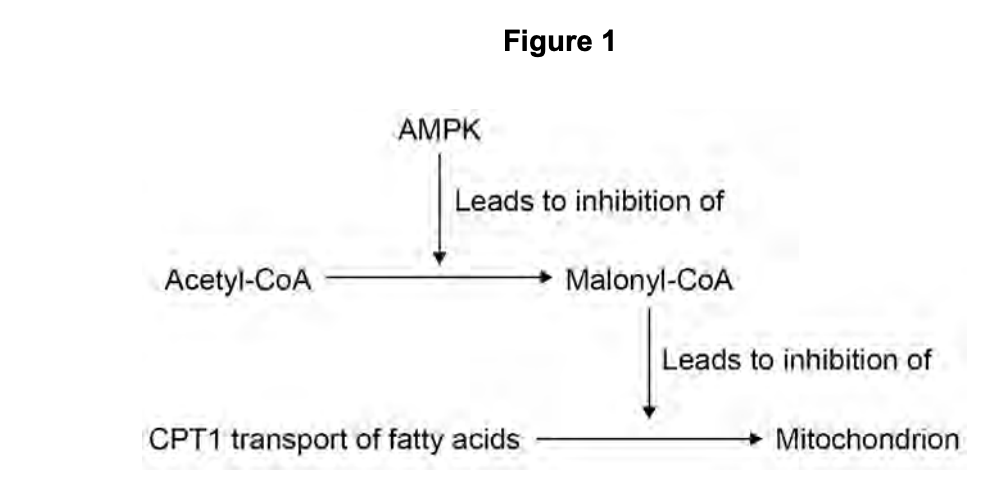
Answer
Mark Scheme
- Less/no malonyl-CoA (1 mark)
- (More) fatty acids transported/moved into mitochondria (1 mark)
- Respiration/oxidation of fatty acids provides ATP (1 mark)
Comments from mark scheme
- ‘Inhibition of malonyl-CoA’ on its own is not enough but accept production of malonyl-CoA is inhibited.
- Accept: ‘transport of fatty acids into mitochondria is not inhibited’.
- Ignore: method of entry.
- Accept: for respiration any stage of aerobic respiration e.g. Krebs (cycle), link (reaction) etc.
- Reject: production of energy, but accept production of energy in the form of ATP.
- Accept: acetyl CoA can enter Krebs cycle/mitochondria to provide ATP.
Dengue is a serious disease that is caused by a virus. The virus is carried from one person to another by a mosquito, Aedes aegypti. One method used to try to reduce transmission of this disease is the Sterile Insect Technique (SIT). This involves releasing large numbers of sterile (infertile) male A. aegypti into the habitat. These males have been made infertile by using radiation.
Explain how using the SIT could reduce transmission of dengue.
(2 marks)Answer
Mark Scheme
- Compete (with fertile males) to mate/for food/resources OR intraspecific competition (1 mark)
- Do not reproduce/breed OR Reduces population (of mosquitoes) (1 mark)
Comments from mark scheme
- Must convey idea of competition.
- Accept: ‘fewer mosquitoes’/’fewer offspring’.
Describe how the mark-release-recapture method could be used to determine the population of A. aegypti at the start of the investigation.
(3 marks)Answer
Mark Scheme
- Capture/collect/sample, mark and release (1 mark)
- Leave time for mosquitoes/Aedes to disperse before second sampling/collection (1 mark)
- (Population =) number in first sample × number in second sample divided by number of marked in second sample/number recaptured (1 mark)
Comments from mark scheme
- Accept: correct equation.
The release of radiation-sterilised A. aegypti has not been very successful in controlling the transmission of dengue.
Suggest one reason why.
(1 marks)Answer
Mark Scheme
- (Radiation) affects their ‘attractiveness’/courtship /survival/ life span (1 mark)
Comments from mark scheme
Accept: ‘die/less likely to survive due to radiation’. Accept: ‘disease can be transmitted by other means’ (other than mosquitoes).
Recently a new method was developed to control A. aegypti. Scientists produced transgenic males carrying a ‘lethal gene’ which kills their offspring before they can reproduce.
The scientists released transgenic males every week in one area of a city in Brazil. At regular intervals they determined the number of A. aegypti per km2 in the area where transgenic males were released and in a control area where no transgenic males were released.
Figure 2 shows their results.
Suggest why the scientists released more transgenic males every week
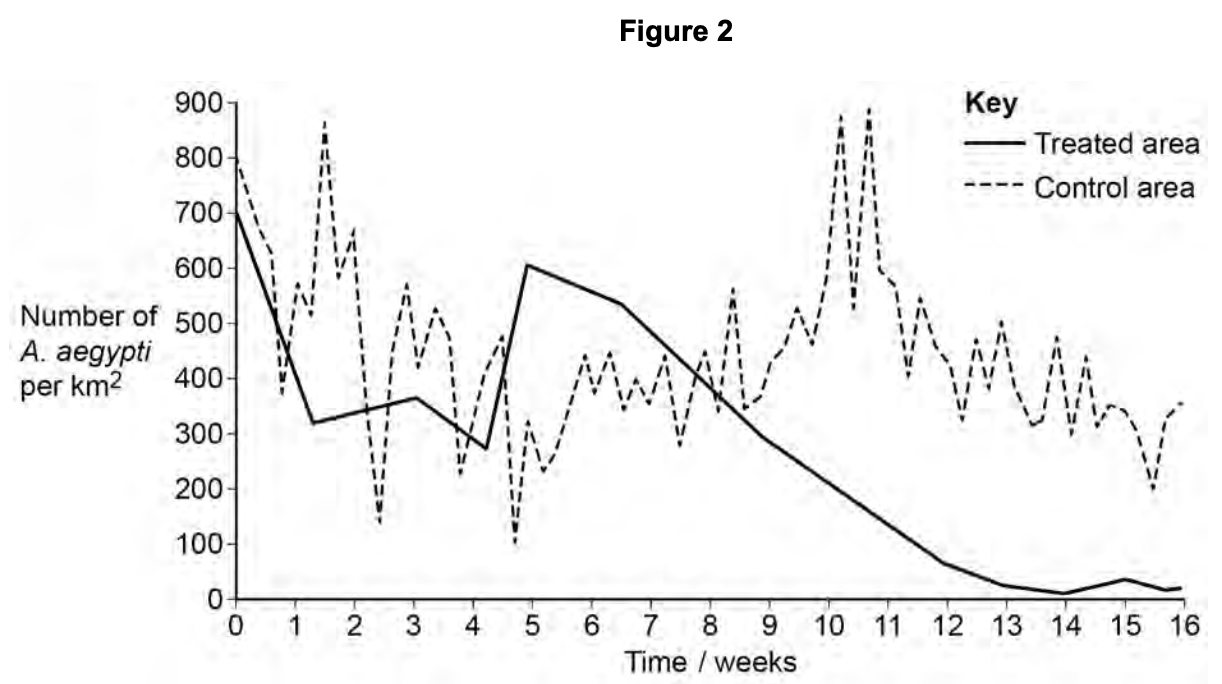
Answer
Mark Scheme
- To maintain number/competition as they die/have a short life span (1 mark)
Comments from mark scheme
Accept: to replace mosquitoes that have died.
The release of transgenic males proved successful in reducing the number of A. aegypti.
Describe how the results in Figure 2 support this conclusion.
(1 marks)Answer
Mark Scheme
- Number (of mosquitoes in treated area) is low/lower at/after 12/13/14/15/16 weeks = 2 marks (1 mark)
- For one mark accept number (of mosquitoes in treated area) is low/lower without reference to relevant week (1 mark)
Comments from mark scheme
Accept: amount for number. Accept: comparison of numbers (of mosquitoes) for lower/low.
Scientists investigated the effect of regular exercise on skeletal muscle fibres in mice. The scientists compared the muscle fibres of mice after six weeks of regular exercise (trained mice) with those of mice that had not exercised (control mice). The scientists stained the muscle fibres from both sets of mice to show succinic acid dehydrogenase activity. The darker the stain the greater the succinic acid dehydrogenase activity.
Figure 3 shows a typical set of results they obtained
Succinic acid dehydrogenase is an enzyme used in the Krebs cycle.
Suggest one reason for the difference in the staining between the muscle fibres of the control mice and the trained mice.
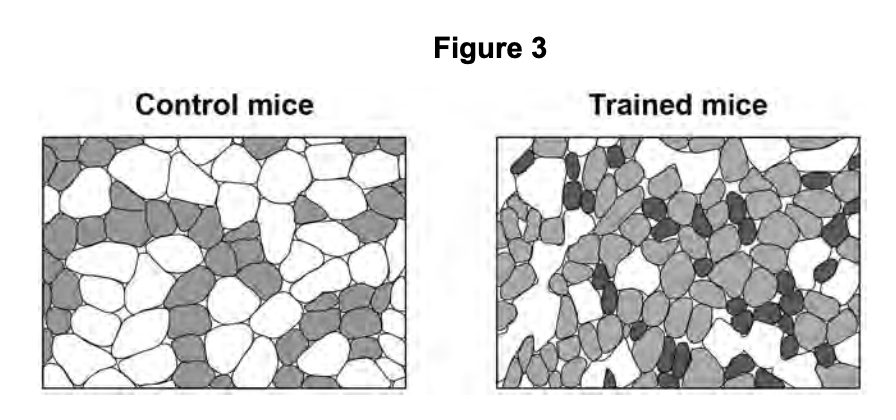
Answer
Mark Scheme
- Increase in aerobic respiration OR Increase in/more mitochondria OR Increase in/more slow muscle fibres (1 mark)
Comments from mark scheme
Ignore: reference to Krebs cycle as this in the stem of the question.
The scientists then compared the length of time that the control mice and the trained mice could carry out prolonged exercise. The trained mice were able to exercise for a longer time period than control mice. Explain why.
(3 marks)Answer
Mark Scheme
- (More aerobic respiration) produces more ATP (1 mark)
- Anaerobic respiration delayed (1 mark)
- Less or no lactate (1 mark)
Comments from mark scheme
- Accept: produces ATP faster.
- Accept: aerobic respiration can continue.
- Accept : no anaerobic respiration.
- Accept: lactic acid
The scientists determined the mean diameter of muscle fibres in trained mice using an optical microscope to examine sections of muscle tissue. The circular area (πr 2) of one field of view was 1.25 mm² The diameter of this area was equal to the diameter of 15 muscle fibres. Using this information, calculate the mean diameter in µm (micrometres) of muscle fibres in this section of tissue.
(2 marks)Answer
Mark Scheme
- Correct answer in range 84 to 84.2 = 2 marks (1 mark)
- For one mark accept incorrect answer but shows r (radius) = 0.63 (mm) OR d (diameter) = 1.26 (mm) (1 mark)
Comments from mark scheme
- Ignore: numbers after 0.63 and 1.26.
The scientists also compared the diameter of samples of muscle fibres taken from young mice and adult mice. Some of their results are shown in Figure 4.
Describe two differences between these samples of muscle fibres.
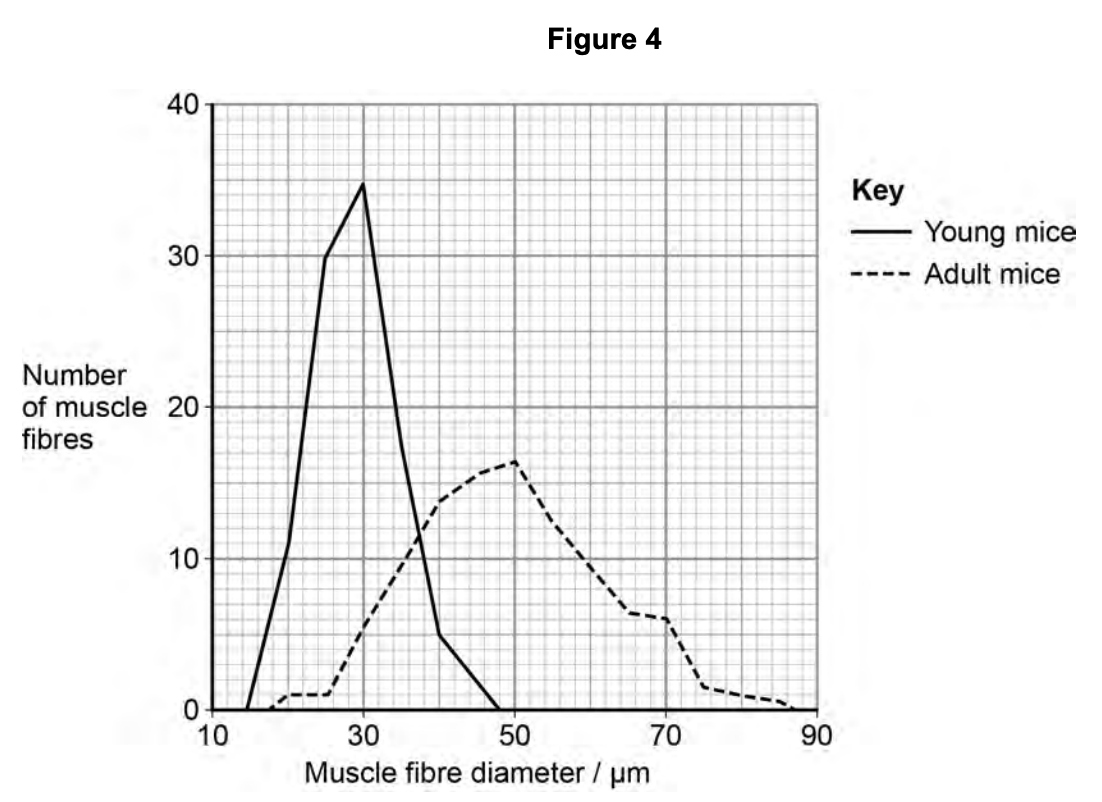
Answer
Mark Scheme
- A numerical comparison of range = 2 marks i.e. Young (fibres) range 14/15 – 47/48 (μm) and adult (fibres) 17/18 - 86/87/88 (μm) OR Young (fibres) range 32/33/34 and adult (fibres) range 68/69/70/71 (1 mark)
- Comparison of range without numbers = one mark i.e. Adult (fibres) greater range/spread/variation (of diameters) OR Young (fibres) smaller range/spread (of diameters) (1 mark)
- Comparison of mode = one mark i.e. Adult (fibres) peak/most common/frequent/mode at 50 (μm) and young (fibres) peak/most common/frequent/mode at 30 (μm) (1 mark)
Comments from mark scheme
- Accept: one mark for comparison of minimum values i.e. 14/15 compared to 17/18 Allow one mark for comparison of maximum values i.e. 47/48 compared to 86/87/88.
- Note: comparison of both maximum and minimum values = 2 marks.
A student isolated chloroplasts from spinach leaves into a solution to form a chloroplast suspension. He used the chloroplast suspension and DCPIP solution to investigate the light-dependent reaction of photosynthesis. DCPIP solution is blue when oxidised and colourless when reduced. The student set up three test tubes as follows:
- Tube 1 – 1 cm³ of solution without chloroplasts and 9 cm³ of DCPIP solution in light.
- Tube 2 – 1 cm³ of chloroplast suspension and 9 cm³ of DCPIP solution in darkness.
- Tube 3 – 1 cm³ of chloroplast suspension and 9 cm³ of DCPIP solution in light. The student recorded the colour of the DCPIP in each of the tubes at the start and after the tubes had been left at 20 °C for 30 minutes. His results are shown in Table 1
The solution that the student used to produce the chloroplast suspension had the same water potential as the chloroplasts.
Explain why it was important that these water potentials were the same.
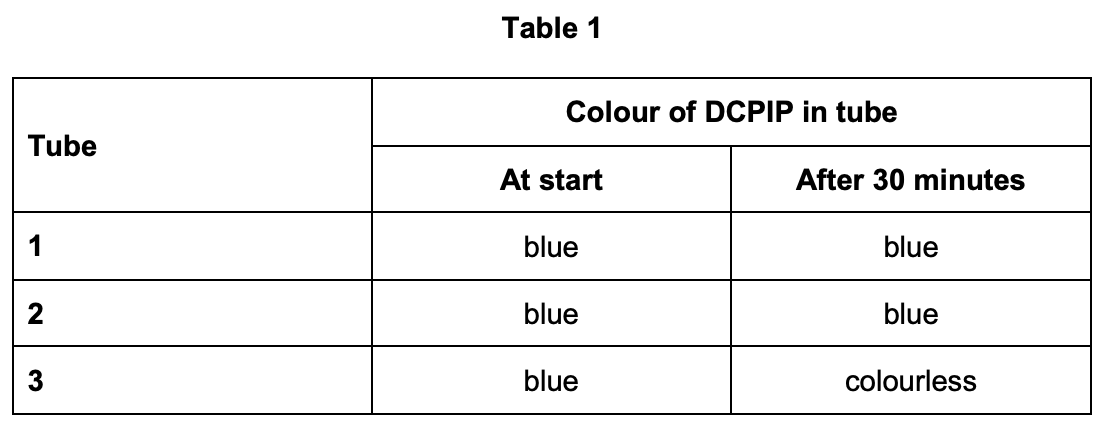
Hint
What would happen to the chloroplasts if water potentials weren’t kept the same?
Answer
Mark Scheme
- Osmosis does not occur (1 mark)
- Chloroplast/organelle does not burst/lyse/shrivel/shrink (1 mark)
Comments from mark scheme
- Accept: osmosis would occur if water potentials were not the same. 1 and 2, Accept: correct reference to osmotic lysis for 2 marks.
- Accept: chloroplast would burst/lyse/shrivel/shrink if water potentials were not the same.
- Reject: ‘cell bursts/shrivels’
- Ignore: damage to chloroplasts on its own is not enough for a mark.
- Reject: becomes turgid/flaccid
Explain why the student set up Tube 1.
(2 marks)Hint
What was removed from this tube? Would light alone affect DCPIP?
Answer
Mark Scheme
- To show light does not affect DCPIP (1 mark)
- To show chloroplasts are required (1 mark)
Comments from mark scheme
Ignore: comparison with other tubes.
Explain the results in Tube 3.
(2 marks)Hint
Explain what is happening with DCPIP to cause a change in colour, amd where does this occur?
Answer
Mark Scheme
- Reduction of DCPIP by electrons (1 mark)
- (From) chlorophyll/light dependent reaction (1 mark)
Comments from mark scheme
- Accept: hydrogen/H for electrons but not protons/hydrogen ions/H* on their own.
- Accept: from chloroplasts/photosystems/water
The student evaluated the effectiveness of different chemicals as weed-killers by assessing their ability to prevent the decolourisation of DCPIP in chloroplast suspensions.
He added different concentrations of each chemical to illuminated chloroplast suspensions containing DCPIP. He then determined the IC50 for each chemical. The IC50 is the concentration of chemical which inhibits the decolourisation of DCPIP by 50%.
Explain the advantage of the student using the IC50 in this investigation
(1 marks)Answer
Mark Scheme
- Provides a standard / reference point OR Can compare different chemicals/weedkillers OR Can compare different concentrations of chemicals/weed-killers (1 mark)
Comments from mark scheme
Accept: decolourises quicker than 100% or saves time waiting for complete decolourisation. Note: comparisons must be qualified. Accept: find the most effective weed-killer or the most effective concentration. Accept: answers relating to cost effectiveness.
Explain how chemicals which inhibit the decolourisation of DCPIP could slow the growth of weeds.
(2 marks)Hint
Think about how the light dependent reaction links to the light dependent reaction. What are the products are the light dependent reaction, and what would subsequently happen if they weren’t produced?
Answer
Mark Scheme
- Less/no ATP produced (1 mark)
- Less/no reduced NADP produced (1 mark)
- Less/no GP reduced/converted to TP (1 mark)
Comments from mark scheme
2, Accept: less/no NADPH/NADPH2/NADPH + H
Arbuscular mycorrhiza fungi (AMF) are fungi which grow on, and into, the roots of plants. AMF can increase the uptake of inorganic ions such as phosphate.
Suggest one way in which an increase in the uptake of phosphate could increase plant growth.
(1 marks)Answer
Mark Scheme
- Used to produce named phosphate compound in cells (1 mark)
- e.g. ATP/ADP/phospholipids/DNA/ RNA/RuBP/TP /GP etc. (1 mark)
Suggest one way in which AMF may benefit from their association with plants.
(1 marks)Answer
Mark Scheme
- Example of a carbon-containing biological compound e.g. carbohydrate/ amino acid/vitamin (1 mark)
Comments from mark scheme
Accept: sugars/organic (compounds). Ignore: products of photosynthesis. Ignore: starch.
Scientists investigated the effects of different AMF species on the productivity of the plant community of a prairie grassland ecosystem when growing in/on soil containing different phosphate concentrations.
The scientists set up identical plots of prairie grassland soil containing seeds of the plant species found in the ecosystem. The scientists added different AMF species and different concentrations of phosphate to particular plots. Control plots without AMF species were also set up. After 20 weeks the scientists determined the shoot biomass for each plot.
The results the scientists obtained are shown in Figure 5.
Explain why an increase in shoot biomass can be taken as a measurement of net primary productivity.
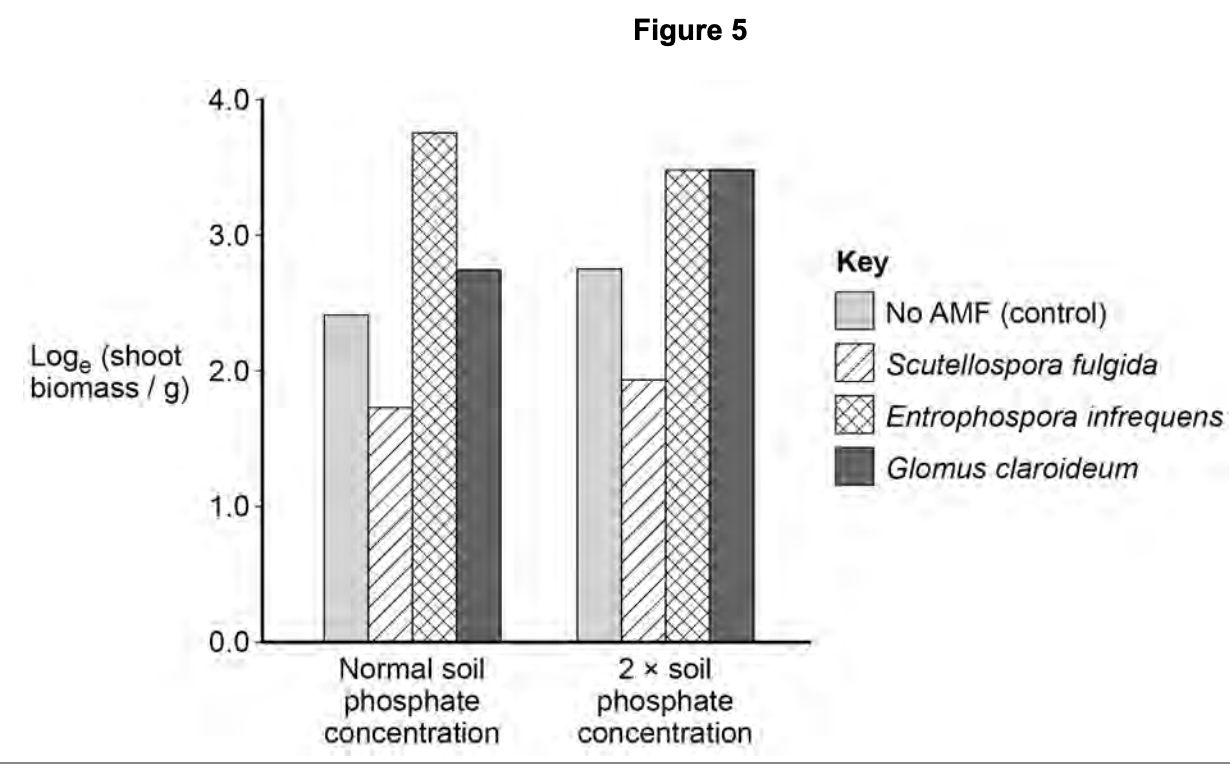
Answer
Mark Scheme
- Represents dry mass / mass of carbon (1 mark)
- Represents gross production minus respiratory losses (1 mark)
Comments from mark scheme
- Accept: NPP = GPP – R.
- Accept: Chemical energy minus respiratory losses. 1 and 2. Chemical energy store minus respiratory losses = 2 marks.
Using the data from Figure 5, evaluate the effect on plant productivity of adding AMF species and adding phosphate to the soil.
(4 marks)Answer
Mark Scheme
- For the control an increase in phosphate increases (plant) growth (1 mark)
- For Entrophospora an increase in phosphate reduces (plant) growth (1 mark)
- Scutellospora reduces (plant) growth (compared to control) (1 mark)
- Entrophospora and Glomus increases (plant) growth(compared to control) (1 mark)
- No SD/statistical test to determine significance (1 mark)
- Only 20 weeks of growth (1 mark)
- Underground/root growth not known (1 mark)
Comments from mark scheme
- Accept: no error bars.
- Accept: only shows shoot growth.
Using the ex button on your calculator, determine the rate of shoot biomass production in grams per day for the control plot in soil with normal phosphate concentration. Answer in g day⁻¹
(2 marks)Answer
Mark Scheme
- Answer in range 0.07 to 0.09 = 2 marks (1 mark)
- Answer in range 9.97 to 12.2 OR Shows division by 140 or 20 x 7 = 1 mark (1 mark)
Each year, a few people with type I diabetes are given a pancreas transplant. Pancreas transplants are not used to treat people with type II diabetes.
Give two reasons why pancreas transplants are not used for the treatment of type II diabetes.
(2 marks)Answer
Mark Scheme
- (Usually)Type II produce insulin (1 mark)
- Cells/receptors less sensitive/responsive (to insulin) OR Faulty (insulin) receptors (1 mark)
- (Treated/controlled by) diet/exercise (1 mark)
Comments from mark scheme
- Accept: cells/receptors do not respond.
- Accept: ‘fewer receptors’
- Accept: (Treated/controlled by) weight loss/medication/drugs.
- Ignore: diabetes is caused by diet/exercise.
The pancreas produces the hormone insulin.
Put a tick () in the box next to the statement which describes incorrectly the action of insulin.
a) Activates enzymes involved in the conversion of glucose to glycogen. b) Controls the uptake of glucose by regulating the inclusion of channel proteins in the surface membranes of target cells. c) Attaches to receptors on the surfaces of target cells. d) Activates enzymes involved in the conversion of glycerol to glucose.
(1 marks)Answer
Mark Scheme
- Activates enzymes involved in the conversion of glycerol to glucose. (1 mark)
Scientists investigated the use of induced pluripotent stem cells (iPS cells) to treat type I diabetes in mice. The scientists used four transcription factors to reprogramme skin cells to form iPS cells. The scientists then stimulated the in vitro differentiation of iPS cells into pancreatic cells.
The scientists set up three experimental groups:
- Group A – 30 mice with type I diabetes received pancreatic cell transplants derived from iPS cells.
- Group B – 30 mice with type I diabetes were left untreated.
- Group C – 30 mice without diabetes were left untreated. The scientists measured the blood glucose concentration of all the mice on a weekly basis for 12 weeks.
The results the scientists obtained are shown in Figure 6
Suggest how transcription factors can reprogramme cells to form iPS cells
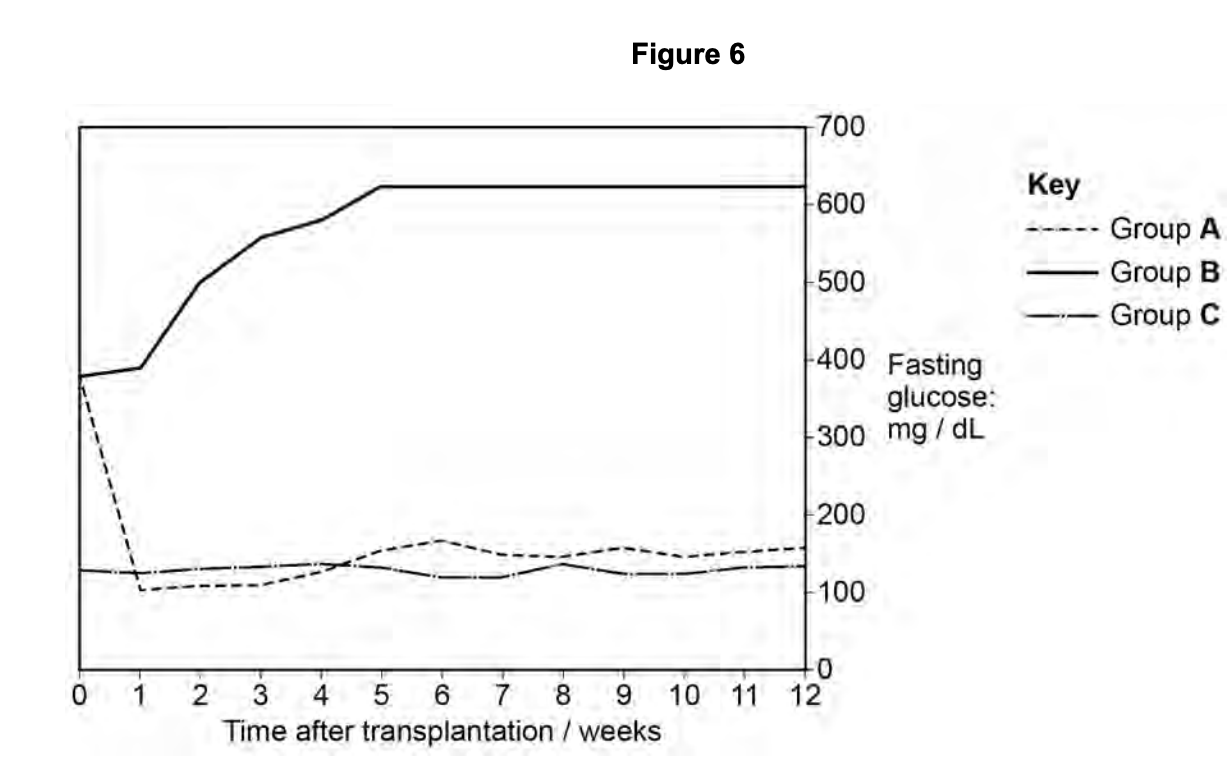
Answer
Mark Scheme
- Attach to gene/DNA/promoter region (1 mark)
- Stimulate/inhibit transcription/RNA polymerase (1 mark)
Comments from mark scheme
Note: Genes being expressed/inhibited or switched on/off is not enough on its own.
Using all the information provided, evaluate the use of iPS cells to treat type I diabetes in humans.
(4 marks)Answer
Mark Scheme
- (Effective as) group A/with iPS/treated lower than group B/with diabetes (1 mark)
- (Effective as) group A similar to group C/without diabetes (1 mark)
- (Investigation) done on mice not humans (1 mark)
- Only shows results for 12 weeks/short-time period / long-term effects not known (1 mark)
Comments from mark scheme
Ignore: Only one study / not repeated / sample size. 2. Accept: ‘healthy’ or ‘normal’ or control for group C.
What is meant by the term phenotype?
(2 marks)Answer
Mark Scheme
- (Expression / appearance / characteristic due to) genetic constitution/genotype/allele(s) (1 mark)
- (Expression / appearance / characteristic due to) environment (1 mark)
Comments from mark scheme
- Accept: named characteristic.
- Accept: homozygous / heterozygous / genes / DNA.
- Ignore:chromosomes
The inheritance of fruit colour in summer squash plants is controlled by two genes, A and B. Each gene has two alleles. Figure 7 shows the interaction of these two genes in controlling fruit colour in summer squash plants.
Name the type of gene interaction shown in Figure 7.
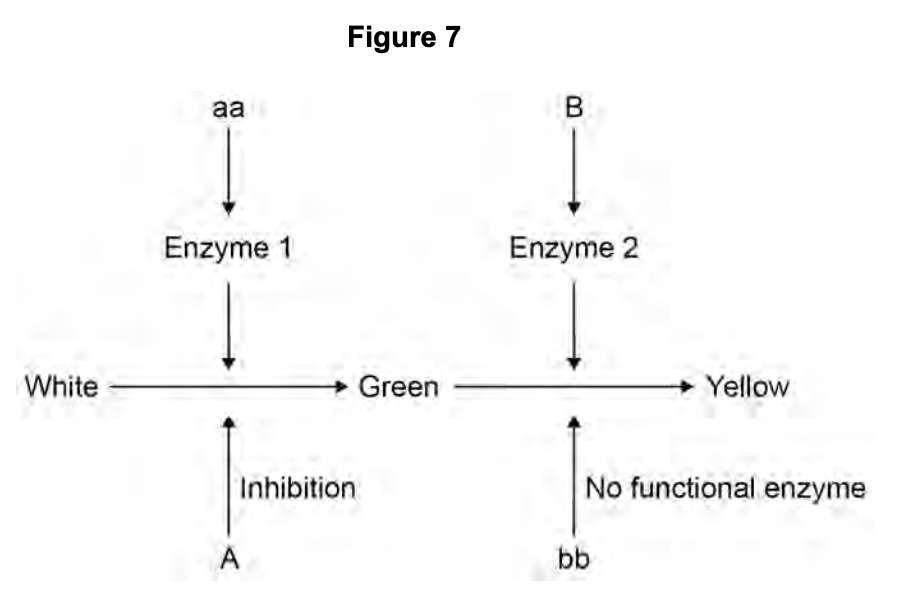
Answer
Mark Scheme
- Epistasis OR Epistatic (interaction/control) (1 mark)
Comments from mark scheme
Accept: phonetic spellings. Ignore: preceding word e.g.(recessive/dominant) epistasis.
What fruit colour would you expect the following genotypes to have?
- AAbb
- aaBB
Answer
Mark Scheme
- AAbb - white aaBB - yellow (1 mark)
Comments from mark scheme
Both correct for one mark.
Genes A and B are not linked.
Complete the genetic diagram to show all the possible genotypes and the ratio of phenotypes expected in the offspring of this cross.
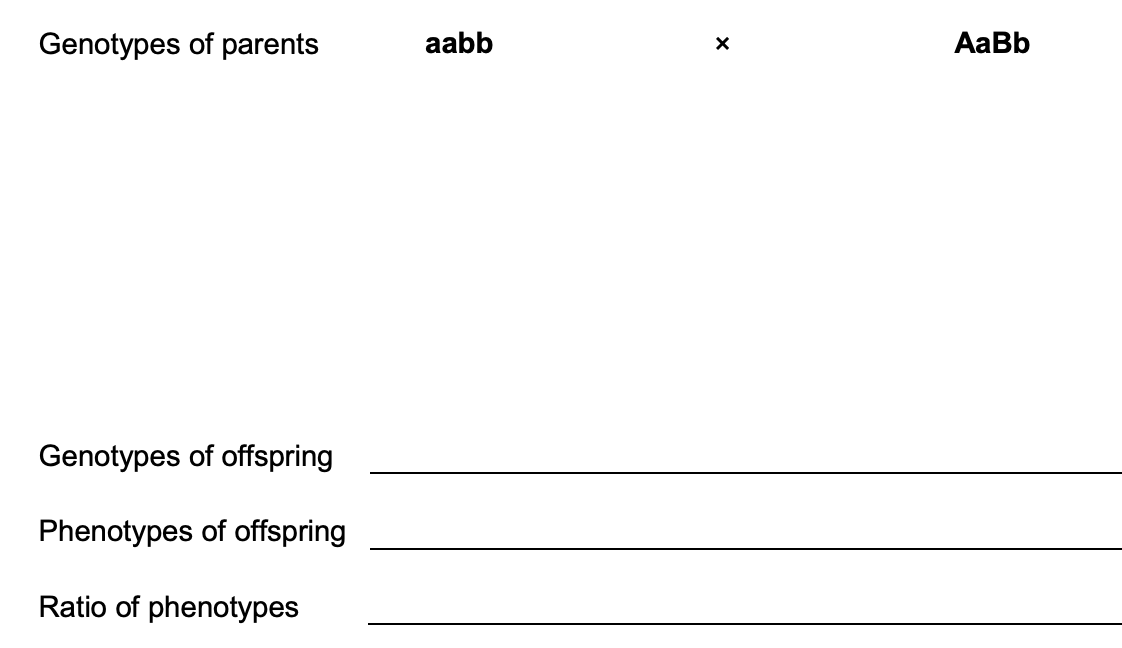
Answer
Mark Scheme
- AaBb, Aabb, aaBb, aabb (1 mark)
- White, (white), yellow, green (1 mark)
- 2 : 1 : 1 (1 mark)
Comments from mark scheme
Note: If genotypes are incorrect = zero marks.
- Accept: equivalent genotypes e.g. ABab for AaBb. Accept: sequence of phenotypes does not need to mirror genotypes but must be correct.
- Accept: ratios of 2:1:1 or 1:2:1 or 1:1:2 even if sequence of phenotypes do not match if mark points 1 and 2 have been awarded.
- Accept: alternative ratios in correct proportions e.g. 4:2:2
- Ignore: percentages/fractions.
A population of summer squash plants produced only green and yellow fruit. The percentage of plants producing yellow fruit in this population was 36%.
Use the Hardy−Weinberg equation to calculate the percentage of plants that were heterozygous for gene B.
(2 marks)Answer
Mark Scheme
- Correct answer of 32% = 2 marks (1 mark)
- Incorrect answer but shows understanding that 2pq = heterozygous (1 mark)
Comments from mark scheme
- Accept: understanding of 2pq by using a calculation involving 2 x two different numbers.
One way to detect and measure accurately the amount of RNA in a tissue sample is by RT-PCR (reverse transcriptase-polymerase chain reaction). RT-PCR uses a reaction mixture containing:
- the sample for testing
- reverse transcriptase
- DNA nucleotides
- primers
- DNA polymerase
- fluorescent dye. The principle behind this method is shown in Figure 8
Explain the role of reverse transcriptase in RT-PCR.
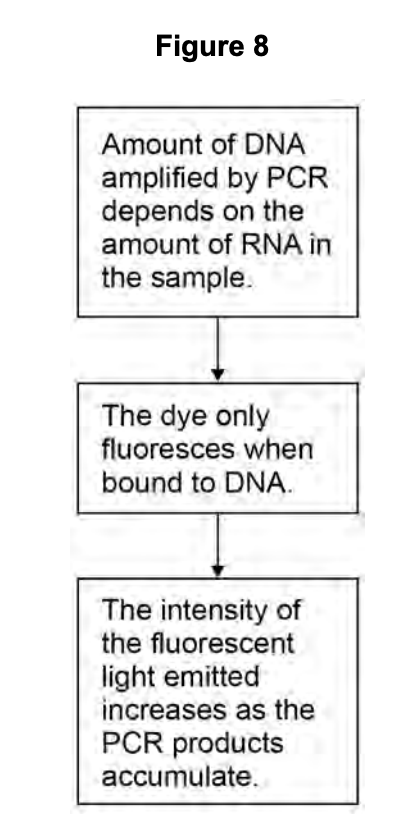
Answer
Mark Scheme
- Produces (c)DNA using (m)RNA (1 mark)
Comments from mark scheme
Accept: ‘converts’ (m)RNA to (c)DNA. Reject: tRNA
Explain the role of DNA polymerase in RT-PCR.
(1 marks)Answer
Mark Scheme
- Joins nucleotides to produce (complementary strand/s of) DNA (1 mark)
Comments from mark scheme
Accept: ‘joins DNA nucleotides’.
Any DNA in the sample is hydrolysed by enzymes before the sample is added to the reaction mixture. Explain why.
(2 marks)Answer
Mark Scheme
- To remove any DNA present (1 mark)
- As this DNA would be amplified/replicated (1 mark)
Comments from mark scheme
- Must be idea of removal/destruction.
- Accept: idea of DNA not being used as template.
Figure 9 shows the results from using RT-PCR to detect RNA in two different samples, A and B. A quantitative comparison can be made of the amount of RNA in samples A and B. This involves determining the number of cycles required to reach 50% maximum concentration of DNA (C). The amount of RNA in a sample can be measured as: 1 C Use this information to calculate the ratio for RNA content in sample A : RNA content in sample B.
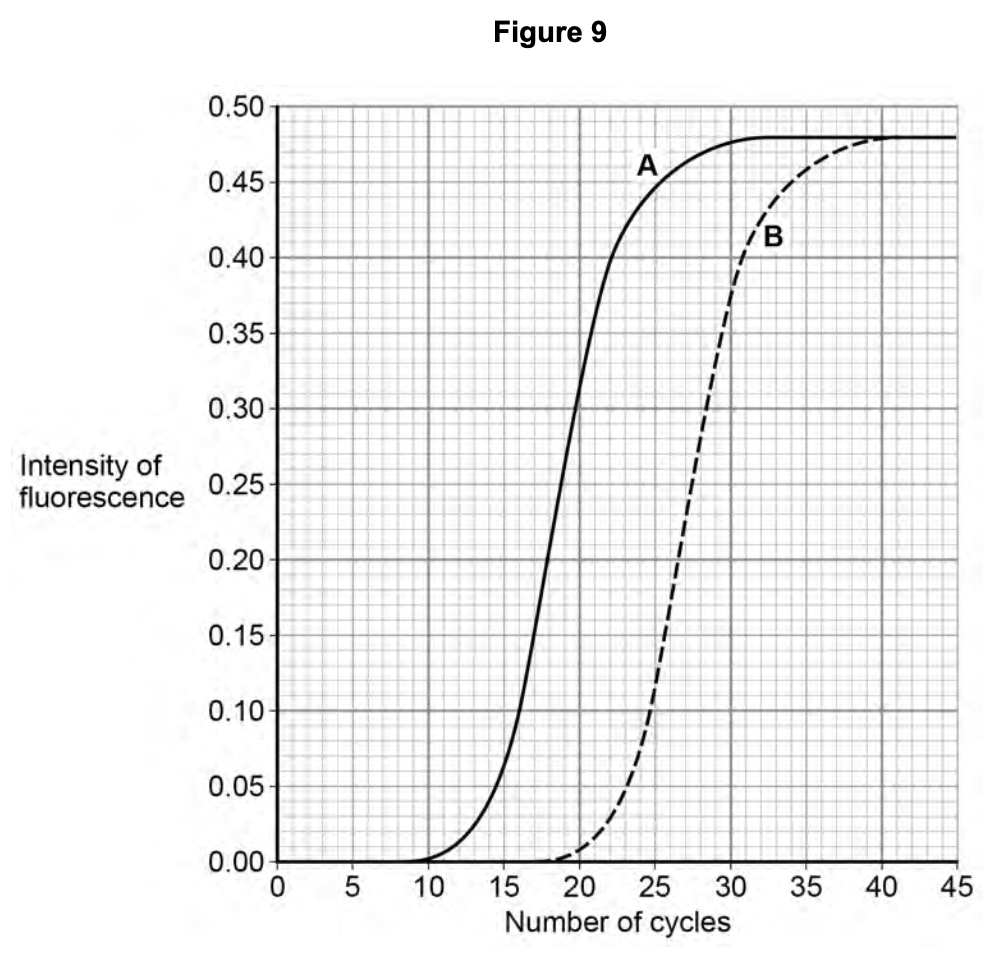
Answer
Mark Scheme
- 1, Ratio in range of 1.4 :1 to 1.5 :1= 2 marks (1 mark)
-
- One mark for answers which shows incorrect ratio but Shows 0.24 as a number or line on the graph (1 mark)
Comments from mark scheme
Note: ratio not expressed to 1 in correct range may be shown in different ways, for example as: 3:2 or simply as 1.5 for one mark.
Suggest one reason why DNA replication stops in the polymerase chain reaction
(1 marks)Answer
Mark Scheme
- Limited number of primers/nucleotides (1 mark)
Comments from mark scheme
Accept: DNA polymerase (eventually)denatures Accept: primers/nucleotides ‘used up’
Scientists have used the RT-PCR method to detect the presence of different RNA viruses in patients suffering from respiratory diseases. The scientists produced a variety of primers for this procedure. Explain why.
(2 marks)Answer
Mark Scheme
- Base sequences differ (1 mark)
- (Different) complementary primers required (1 mark)
Comments from mark scheme
- Accept: reference to either RNA or DNA base sequences but reject reference to DNA base sequence in viruses.
What is a gene pool?
(1 marks)Answer
Mark Scheme
- All the alleles in a population (1 mark)
Comments from mark scheme
Accept: The number of alleles in a population. Note: All or number of alleles in a species on its own is not enough on its own.
Lord Howe Island in the Tasman Sea possesses two species of palm tree which have arisen via sympatric speciation. The two species diverged from each other after the island was formed 6.5 million years ago. The flowering times of the two species are different.
Using this information, suggest how these two species of palm tree arose by sympatric speciation.
(5 marks)Answer
Mark Scheme
- Occurs in the same habitat/environment/population (1 mark)
- Mutation/s cause different flowering times (1 mark)
- Reproductive separation/isolation OR No gene flow OR Gene pools remain separate (1 mark)
- Different allele/s passed on/selected OR Change in frequency of allele/s (1 mark)
- Disruptive (natural) selection (1 mark)
- Eventually different species cannot (inter)breed to produce fertile offspring (1 mark)
Comments from mark scheme
- Accept: are not geographically isolated /separated.
- Accept: same place
- Accept: no interbreeding but must be a separate idea from mark point 6 which relates to definition of a species. Note: Answers relating only to allopatric speciation = 3 max, mark points 3, 4 and 6.
Alzheimer’s disease (AD) is a non-reversible brain disorder that develops over a number of years. At the start of 2014 the number of Americans with AD was estimated to be 5.4 million. Every 30 seconds another person in America develops AD. In the brain of a person with AD there is a lower concentration of acetylcholine. This affects communication between nerve cells and initially results in memory loss and confusion. Some of the symptoms of AD that are associated with communication between nerve cells are reduced by taking the drug donepezil. Donepezil inhibits the enzyme acetylcholinesterase. A gene mutation called E280A found on chromosome 14 causes early-onset AD at a mean age of 49 years. The age at which the E280A mutation is expressed to cause AD varies. Yaramul is a town in a historically isolated region of the Andes Mountains. The population of this town has the highest frequency of the E280A mutation in the world. The origin of the E280A mutation in this population has been traced back to a common ancestor in the 17th century. Natural selection has not reduced the frequency of the E280A mutation in the population. This autosomal dominant mutation involves a change in triplet 280 from GAA to GCA. Scientists analysed chromosome 14 from 102 individuals from Yaramul. They recorded a sample size of 204 and detected 75 E280A mutations but only 74 potential AD cases. The scientists identified individuals with the mutation by whole genome sequencing. They had decided that a DNA probe would not be a suitable method to detect the E280A mutation.
Assuming no one with AD died in 2014, calculate the annual percentage increase in AD cases in America for 2014 (lines 2–4).
(2 marks)Answer
Mark Scheme
- Correct answer of 19.4/19.41% OR (1 mark)
- 47/19.5% = 2 marks (1 mark)
- Incorrect answer but shows increase of 1,048,320 OR 1,051,200 = one mark (1 mark)
Comments from mark scheme
Accept: 19.46% for one mark.1. Accept: more acetylcholine present/remains. 1 and 2. Accept: remains attached for longer = 2 marks. 3. Must be sodium ions.
Explain how donepezil could improve communication between nerve cells (lines 7–9).
(3 marks)Answer
Mark Scheme
- Less/no acetylcholine broken down (1 mark)
- Acetylcholine attaches to receptors (1 mark)
- (More) Na⁺ enter to reach threshold/for depolarisation/action potential/impulse (1 mark)
Comments from mark scheme
- Accept: more acetylcholine present/remains. 1 and 2. Accept: remains attached for longer = 2 marks.
- Must be sodium ions
Suggest and explain two reasons why there is a high frequency of the E280A mutation in Yaramul (lines 13–15).
(2 marks)Answer
Mark Scheme
- Isolated so inbreeding/low genetic diversity/small gene pool (1 mark)
- Allele inherited (through generations) from (common) ancestor (1 mark)
Comments from mark scheme
- Ignore: Founder effect.
- Accept: no interbreeding with other populations.
- Reject: interbreeding within the population.
Explain why natural selection has not reduced the frequency of the E280A mutation in the population (lines 16–17).
(2 marks)Answer
Mark Scheme
- AD/symptoms develops late/at 49 (1 mark)
- Have already reproduced (1 mark)
Comments from mark scheme
Note: ‘It’ is not equivalent to AD/symptom as the question stem relates to the mutation.
The age at which the E280A mutation is expressed to cause AD can vary (lines 11–12).
Suggest and explain one reason for this
(2 marks)Answer
Mark Scheme
- Epigenetics/environment/named factor e.g. stress, alcohol, toxins, diet, exercise, smoking (1 mark)
- methylation (of genes) OR acetylation (of histones) (1 mark)
Comments from mark scheme
- Ignore: gender and lifestyle.
- If further details are provided the context must be correct e.g. increased methylation or decreased acetylation inhibit gene expression/transcription.
One scientific study which analysed chromosome 14 involved 102 individuals. The scientists recorded a sample size of 204. In this sample they detected 75 E280A mutations but only 74 potential AD cases (lines 19–21).
Suggest explanations for the figures the scientists recorded.
(2 marks)Answer
Mark Scheme
- One person was homozygous dominant/has two dominant alleles = 2 marks (1 mark)
- For one mark has two alleles/chromosomes (1 mark)
Comments from mark scheme
- Accept; homozygous dominant genotype e.g. ‘one person has AA’ for 2 marks.
- Accept: is diploid or has two copies of the gene.
Suggest why a DNA probe for the mutated triplet was not considered a suitable method for detection of the E280A mutation (lines 22–23).
(2 marks)Answer
Mark Scheme
- (GCA/triplet) is common/found in other places (1 mark)
- Would not know if it was the mutation/allele/gene OR Produces ‘false positives’ (1 mark)
Comments from mark scheme
- Accept: Probe will bind elsewhere.
Each type of cell has specific molecules on its (1) that identify it. An antibody is a (2) with two (3) binding sites. Antibodies are made and released by (4) cells. Vaccines can provide protection for individuals and populations against disease. The response to a vaccine is an example of (5) immunity. (6) immunity occurs when a large proportion of a population becomes immune to a disease.
Write the correct biological term beside each number below that matches the space in the passage.
(3 marks)Hint
The question asks for biological terms. Think about specific names for structures and cell types involved in the immune response.
Answer
Mark Scheme
- (Cell-surface) membrane (1 mark)
- Protein (1 mark)
- Antigen (1 mark)
- Plasma (1 mark)
- Active (1 mark)
- Herd (1 mark)
Comments from mark scheme
6 correct = 3 marks 4–5 correct = 2 marks 2–3 correct = 1 mark 0–1 correct = 0 marks 2. Accept immunoglobulin or glycoprotein 2. Ignore tertiary 2. Ignore polypeptide 3. Accept complementary/specific 3. Ignore identical 5. Ignore artificial 5. Ignore primary
Tips from examiner reports
- ~25% got full marks, only 3% scored zero.
- Common errors: ‘Surface’ instead of proper biological term (e.g., antigen/epitope). ‘B cell’ instead of plasma cell. ‘Passive’ instead of active immunity.
There is currently no effective vaccine available for HIV.
Suggest one reason why.
(1 marks)Hint
Think about what makes HIV particularly difficult to develop a vaccine against. Consider the virus’s properties, not how antibiotics work.
Answer
Mark Scheme
- (High rate of) mutation (1 mark)
- (High) genetic diversity (1 mark)
- HIV in cells could (still) spread infection (1 mark)
- HIV (DNA) embeds/inserts itself in host DNA (1 mark)
- Lack of funding/money (for research/development) (1 mark)
- HIV causes fewer T cells, so immune response (to the vaccine) does not happen (1 mark)
Comments from mark scheme
- Accept antigenic variability OR descriptions of antigenic variability
- Accept ‘HIV destroys/kills T cells’ for ‘HIV causes reduced T cells’
- Accept ‘so B cells not activated’ for ‘so immune response (to the vaccine) does not happen
- Ignore immune cells destroyed
Tips from examiner reports
- HIV is difficult to vaccinate against because its antigens mutate rapidly (antigenic variability)
- Don’t confuse how vaccines work with how antibiotics work
- Vaccines trigger an immune response — they don’t need to enter infected cells
Table 1 shows the action of two antibiotics. Using the information in Table 1, explain why each antibiotic is not effective against HIV. Ciprofloxacin = Penicillin =
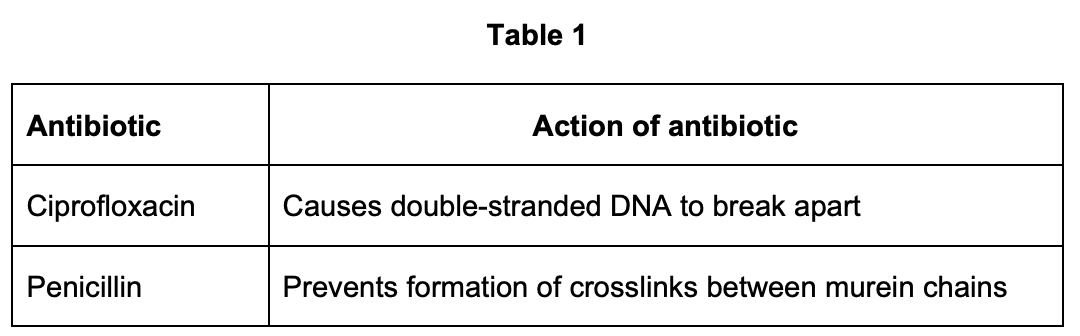
Hint
What type of genetic material does HIV have? Remember viruses don’t have the same structures as bacteria or fungi.
Answer
Mark Scheme
- (Ciprofloxacin) 1. (HIV) has RNA OR (HIV) does not have DNA (1 mark)
- (Penicillin) 2. (HIV) has no cell wall OR (HIV) does not contain murein (1 mark)
Comments from mark scheme
- Ignore any prefixes to RNA
- Reject references to single stranded DNA
- Reject any references to incorrect viral structures, eg viruses have a cell membrane OR a cell wall made of chitin
Tips from examiner reports
- HIV has RNA (single-stranded), not DNA
- Viruses don’t have cell walls or cell membranes — don’t describe these structures for viruses
- Don’t confuse viral structures with bacterial structures
A student investigated the effect of temperature on the rate of aerobic respiration in woodlice. Figure 1 shows the apparatus they used
The student altered the temperature of the water bath and measured how far the drop of coloured liquid moved every minute for 5 minutes. Other than those stated, suggest two variables the student should have kept constant in this investigation.
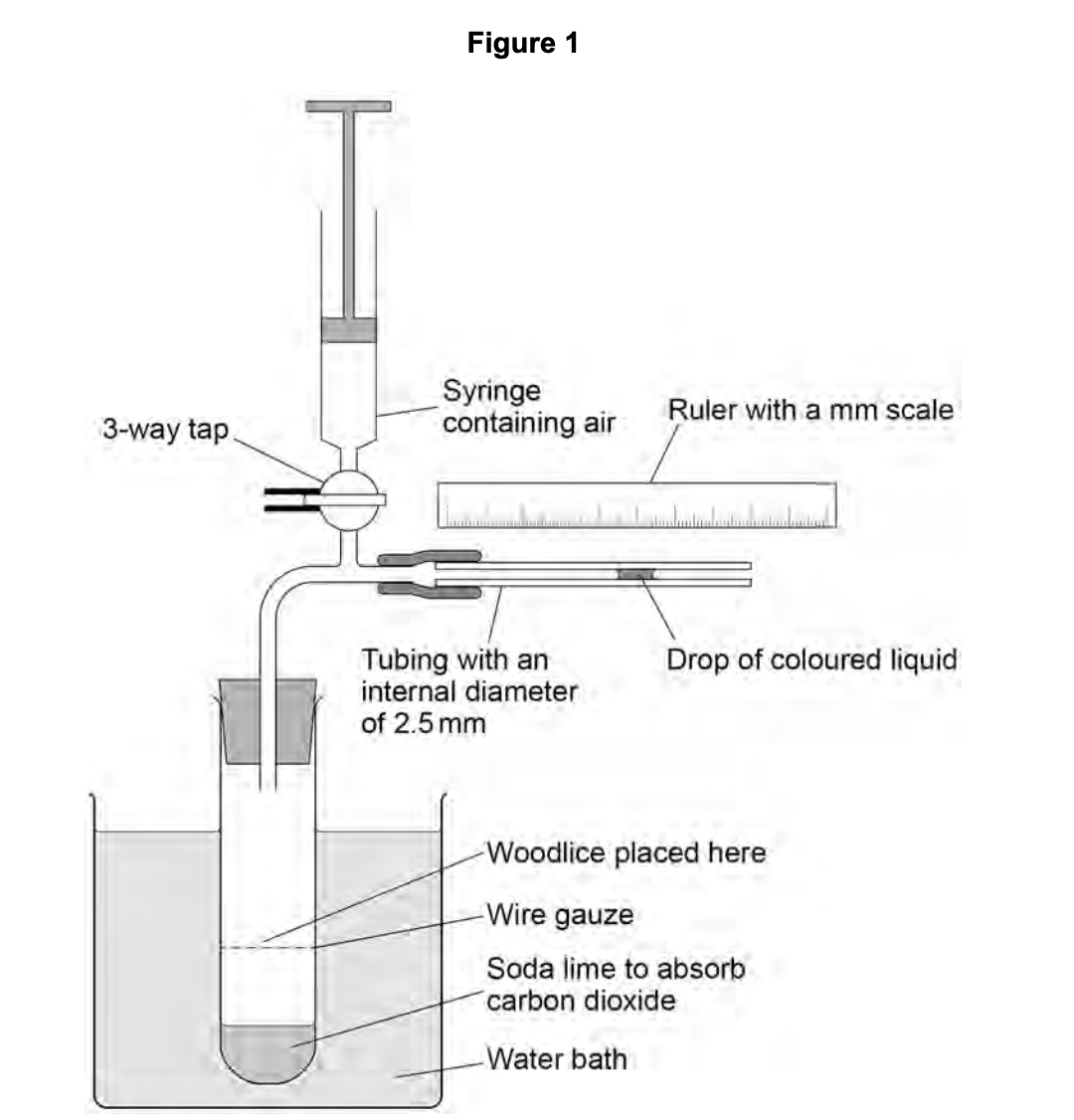
Hint
Read what’s already controlled in the question - don’t repeat these. Think about what specific variables could affect THIS investigation.
Answer
Mark Scheme
- Accept any two of the following for 1 mark (1 mark)
- Volume/mass soda lime Concentration of soda lime Number/mass of woodlice Age of woodlice Same woodlice Species/type of woodlice Time for woodlice to acclimatise to (water bath) temperature (Starting) concentration of oxygen (inside the apparatus) Light intensity (1 mark)
Comments from mark scheme
Accept weight/volume of woodlice for number/mass of woodlice Ignore ‘amount’ for concentration/volume/weight/mass
Tips from examiner reports
- Read the question carefully — if certain variables are already stated as controlled, don’t repeat them
- Use precise terms: say ‘concentration’ or ‘volume’ not ‘amount’
- Make sure your suggested control variables are relevant to the specific investigation, not generic
Describe how the student used the apparatus in Figure 1 to reset the drop of coloured liquid back to the right-hand end of the tubing
(2 marks)Hint
Look at the apparatus diagram. What would push air through the system to move the liquid drop?
Answer
Mark Scheme
- Open the (3-way) tap (1 mark)
- Push/press the syringe (down) (1 mark)
Comments from mark scheme
- Accept descriptions of opening the tap, eg push/move/turn
- Accept descriptions of the pushing the syringe down, eg apply pressure to the syringe
Tips from examiner reports
- Understand the apparatus — to reset a respirometer, use the syringe and tap as described
- Read the diagram carefully before describing how to operate the equipment
The student also set up a control experiment.
Suggest a suitable control experiment and explain why it was necessary
(2 marks)Hint
A control experiment removes the variable being tested while keeping everything else the same. Why do you need this?
Answer
Mark Scheme
- No woodlice and all other conditions/apparatus/equipment the same (1 mark)
- To show that (respiring) woodlice are causing the drop to move OR To show that (respiring) woodlice are taking up the oxygen OR To show that (respiring) woodlice are causing the change in volume/pressure (1 mark)
Comments from mark scheme
- Accept other inert objects instead of woodlice eg glass beads
- Accept dead woodlice for no woodlice
- Accept descriptions of ‘all other conditions/apparatus/equipment the same’ eg same investigation
- Accept to show that (respiring) woodlice are affecting the results
- Accept ‘no other factor(s)’ OR no other named factor OR ‘nothing else’ for woodlice
Tips from examiner reports
- A control experiment keeps everything the same except removes the variable being tested (e.g. no organisms but all other apparatus remains)
- A control experiment is not the same as a controlled variable
- Explain why you need a control: to show that any change is due to the variable being tested, not other factors
Figure 2 shows the student’s results at 25 °C The mass of the woodlice in the tube was 3.78 g
Use Figure 1 (on page 4) and Figure 2 to calculate the mean rate of oxygen uptake by the woodlice in mm³ s⁻¹ g–1 The formula for the volume of the capillary tubing is πr 2l.
Use π = 3.14 in your calculation. Show your working and give your answer to 2 decimal places.
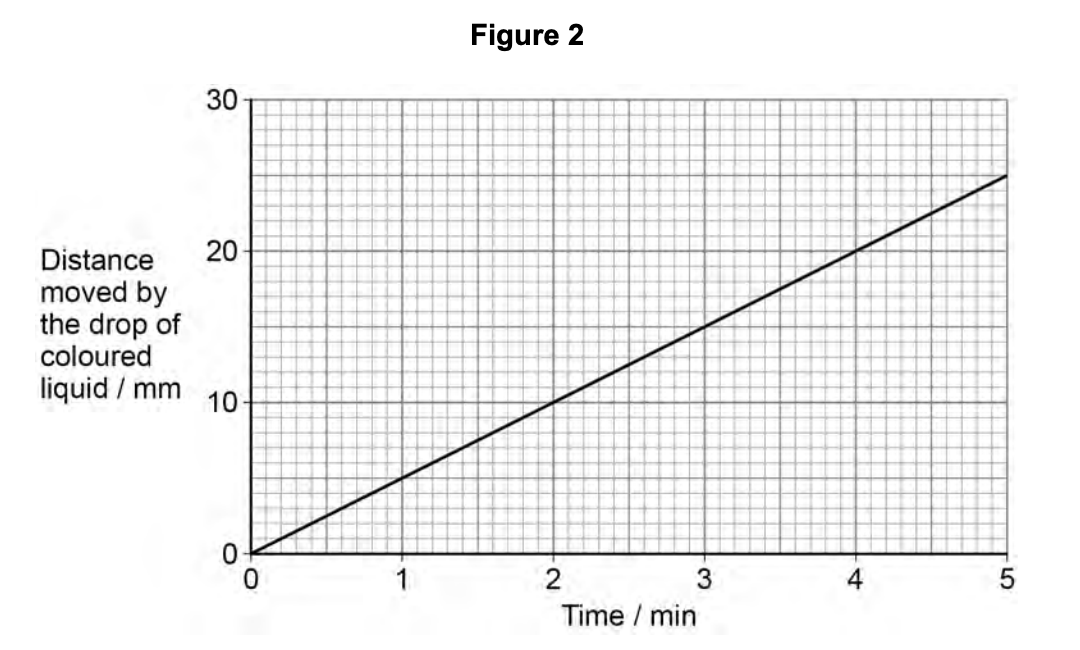
Hint
What formula do you need for volume? Make sure you use the correct measurement (radius, not diameter). Check the decimal places required.
Answer
Mark Scheme
- Correct answer of 0.11 = 3 marks (1 mark)
Tips from examiner reports
- Round to the correct number of decimal places as specified in the question
- Use the radius (not diameter) in calculations involving circles
- Show your working clearly at every step
Describe and explain the relationship between surface area to volume ratio of the human body and metabolic rate.
(3 marks)Hint
Focus on the HUMAN BODY as specified. What is the relationship between SA:V ratio and heat loss? How does this affect metabolic rate?
Answer
Mark Scheme
- As surface area to volume ratio increases, metabolic rate increases OR (Humans with) a large surface area to volume ratio have a high/fast metabolic rate (1 mark)
- (A large(r) surface area to volume ratio will) lose more heat (1 mark)
- (A high(er) rate of metabolism/respiration) releases/provides/replaces heat OR (A high(er) rate of metabolism/respiration) maintains body temperature (1 mark)
Comments from mark scheme
Accept the converse for all marking points
- Accept the relationship is proportional
- Ignore ‘directly’ if prefixing proportional
- Accept the relationship is positively correlated
- Accept lose heat faster/more easily
- Accept (a higher rate of metabolism/ respiration) releases energy OR produces /generates heat
- Reject produces energy/ heat energy
Tips from examiner reports
- Answer the question as asked — if it says ‘human body’, don’t compare elephants and mice
- A larger body has a smaller surface area to volume ratio → loses heat more slowly
- Higher metabolic rate produces more heat to maintain body temperature — say ‘heat is released in respiration’ not ‘energy is produced’
Table 2 shows the height and mass of two adults. Using suitable calculations, deduce which person has the smaller surface area to volume ratio. Show your working and complete the sentence below.
Give your answer to 3 significant figures.
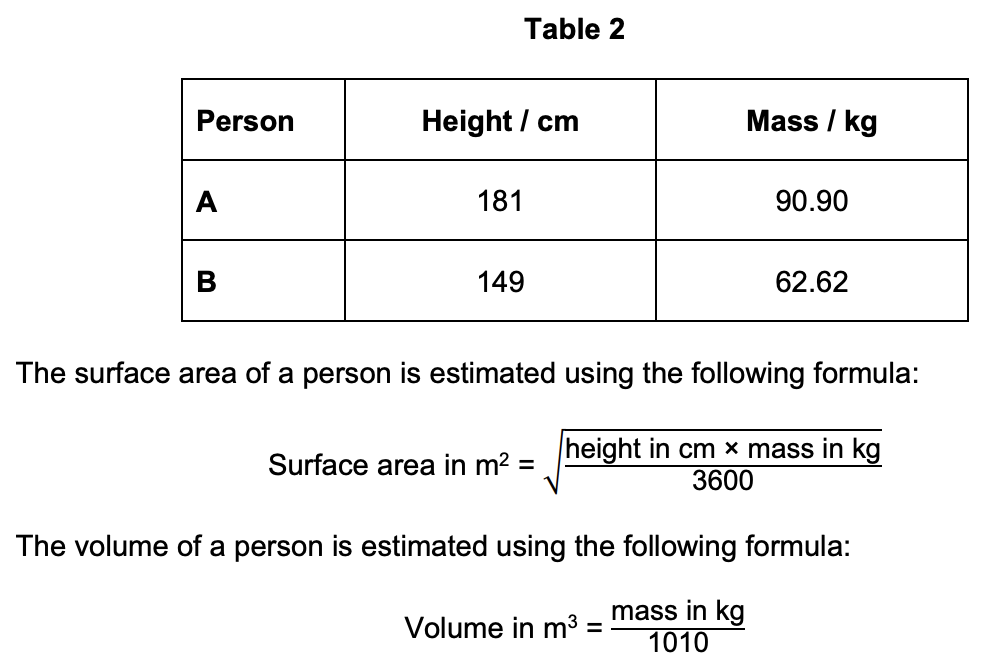
Hint
Show your working clearly. Check the question for how many significant figures are required for the final answer.
Answer
Mark Scheme
- Person A and correct ratio of 23.7:1 OR 23.8:1 = 3 marks (1 mark)
Tips from examiner reports
- Give ratios to the number of significant figures specified (e.g. 3 s.f.)
- A ratio like 24:1 is NOT three significant figures — convert to a decimal ratio if needed
- Show your working when calculating ratios
Which is not a possible explanation for the difference in surface area to volume ratio between person A and person B? a) Person A and person B have different body shapes b) Person A has a higher mass than person B. c) Person A is taller than person B.
(1 marks)Answer
Mark Scheme
- Due to a typographical error, this question has been discounted and all candidates will receive 1 mark, even the non-attempts. (1 mark)
Name two structural features of the gills of a fish that increase their surface area
(1 marks)Hint
The question asks about maintaining a concentration gradient, not about features that increase surface area or reduce diffusion distance.
Answer
Mark Scheme
- (Gill) lamella(e) and (gill) filament(s) (1 mark)
Comments from mark scheme
Accept primary and secondary lamellae Ignore (gill) arch and (gill) rakers
Tips from examiner reports
- The light-dependent reaction produces ATP and reduced NADP — both are used in the light-independent reaction
- Reduced NADP reduces GP to TP — this is a reduction, not an oxidation
- Say ‘reduced NADP’ not ‘reduced NAD’ — they are different molecules
- Don’t confuse molecules from photosynthesis with those from respiration (pyruvate, acetyl CoA)
- GP is glycerate 3-phosphate — if you name it, get the name right
Osteoarthritis (OA) is a disease resulting in joint damage which causes stiffness. Scientists investigated the use of a drug called pralnacasan to treat OA in 80 mice. The scientists:
- injected the knee joints of mice with an enzyme to cause joint damage
- split the mice randomly into 4 equal groups
- fed each group with food containing a different concentration of pralnacasan
- after 6 weeks, assessed the stiffness of the knee joints of the mice and scored them using an arbitrary scale.
Figure 3 shows their results.
Describe how the scientists determined the median of the stiffness scores
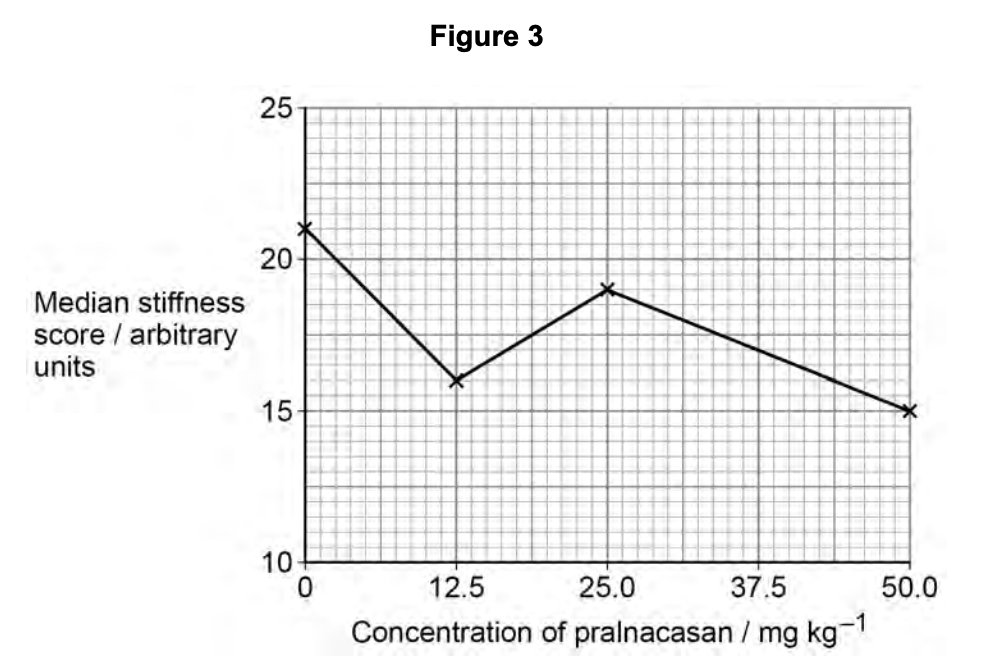
Hint
How do you find a median? What must you do to the data first? Be specific about which values you’re working with.
Answer
Mark Scheme
- Put the (stiffness) scores (for each concentration) in (value/rank) order and found middle value (1 mark)
Tips from examiner reports
- Median: arrange the data in order of size and find the middle value
- If there’s an even number, find the mean of the two middle values
- Say ‘rank’ or ‘order by size’ — ‘chronological’ means time order, which is different
Using all the information, evaluate the use of pralnacasan as an effective treatment for OA in humans.
(5 marks)Hint
Give reasons FOR and AGAINST. Look at ALL the data including the 0 mg/kg group (that’s the control!). Don’t contradict yourself about statistical significance.
Answer
Mark Scheme
- Max 4 for mark points 3 to 9 For 1. (All concentrations) reduced stiffness (compared with 0 mg kg⁻¹ ) (1 mark)
-
- (Reduced stiffness) could mean less damage/pain OR (Reduced stiffness) could improve movement/mobility Against 3. No idea of range/SD OR No statistical tests, so do not know if differences are due to chance/significant (1 mark)
-
- No result for 37.5 OR No data between 25.0 and 50.0 (1 mark)
-
- Not clear if enzyme/damage is the same (as OA) (1 mark)
-
- All mice had stiffness, so not (completely) effective/cured OR Only reduced the amount of stiffness (1 mark)
-
- (Investigation) carried out in mice OR (Investigation) not carried out in humans (1 mark)
-
- (Investigation) only six weeks OR Do not know long-term effect (1 mark)
-
- Small sample/20 (mice) in each group OR 20 (mice) is a small sample size (1 mark)
Tips from examiner reports
- When evaluating, give both supporting and opposing points
- Look carefully at the data: a group given 0 mg/kg IS a control group — don’t say there’s no control
- Don’t say ‘no stats test’ if you’ve already described differences as ‘significant’
- Don’t just describe the data — evaluate what it means
- Be consistent in your reasoning
Leigh syndrome (LS) is a rare, recessive, inherited condition. LS is caused by a mutation in any one of more than 75 different genes coding for proteins involved in oxidative phosphorylation. In 80% of people with LS, these mutations occur in nuclear DNA. In 20% of people with LS, these mutations occur in mitochondrial DNA (mtDNA). 15% of the nuclear DNA mutations that cause LS occur in the SURF1 gene. A mutated SURF1 gene codes for a shorter polypeptide than a non-mutated SURF1 gene.
Name one type of SURF1 gene mutation and explain how this mutation could lead to production of a shorter polypeptide.
-Type of mutation -Explanation
(2 marks)Hint
Name the type of mutation AND explain the mechanism - how does this specific mutation lead to a shorter polypeptide?
Answer
Mark Scheme
- Mark as pairs: 1 and 2 OR 3 and 4 1. Deletion/translocation (1 mark)
-
- Could mean triplet(s)/codon(s) missing OR Could mean amino acid(s) missing (from the polypeptide/SURF1) (1 mark)
-
- Substitution/inversion/addition/duplication/ deletion/translocation (1 mark)
-
- Could result in a (premature) stop triplet/codon (1 mark)
Tips from examiner reports
- Name the type of mutation (e.g. deletion, substitution) and explain its specific effect
- Don’t just say ‘a frameshift occurs’ — explain the consequence (e.g. all codons after the mutation change → different amino acids → non-functional protein)
- Don’t repeat the question stem as your explanation
Globally, the frequency of LS is 1 in 40 000 box In the Faroe Islands, which are 18 isolated islands, the frequency of LS is 1 in 1700
The population of the Faroe Islands is 49 053 Estimate the number of people in the Faroe Islands with LS caused by a mutation in the SURF1 gene.
Use information in this question and the information on page 12.
Give your answer to the nearest whole number. Show your working.
(3 marks)Hint
Read all the information given. What percentage of mutations are in nuclear DNA? Apply this to your calculation.
Answer
Mark Scheme
- Correct answer of 3 (people) = 3 marks (1 mark)
Tips from examiner reports
- Read the question carefully — consider ALL the information given (e.g. if only 80% of mutations are in nuclear DNA, factor that into your calculation)
- Show every step of your working
The frequency of LS is higher in the Faroe Islands than globally.
Suggest and explain one reason why
(2 marks)Hint
Think about what happens to allele frequencies in small, isolated populations. What is genetic drift?
Answer
Mark Scheme
- Mark as pairs: 1 and 2 OR 3 and 4 1. Genetic drift (1 mark)
-
- Frequency is higher by chance OR High frequency is not due to natural selection (1 mark)
-
- (Only) inbreeding/interbreeding (within a population) OR No (inter)breeding with other populations OR (Inherited from) common ancestor (1 mark)
-
- Low genetic diversity OR Small gene pool OR Little gene flow OR Higher chance of inheriting allele OR Frequency of allele higher (in offspring) (1 mark)
Tips from examiner reports
- Genetic drift: random changes in allele frequency that have a greater effect in small populations
- In small, isolated populations, a rare allele can become common by chance (not natural selection)
- Say ‘allele’ not ‘mutation’ when discussing changes in frequency
- Don’t just repeat the question — explain the mechanism
LS usually causes death within the first three years of life. Using all the information in this question, evaluate whether all people should be genetically screened for LS.
(3 marks)Hint
Consider what screening would achieve for THIS specific condition. Can it be treated? What are the benefits and drawbacks of knowing?
Answer
Mark Scheme
- 2 max for mark point 1 to 4 OR 5 to 7 Yes (no mark) 1. Some people could be heterozygous/carriers (1 mark)
-
- Could prevent (human) suffering/death OR Could allow for (informed) decisions about having children (1 mark)
-
- (But only) in families/people with a history of LS OR (only) in families/people in the Faroe Islands (where high frequency/1: 1700) (1 mark)
-
- Cost of screening might be cheaper than cost of treating LS (1 mark)
- No (no mark) 5. It is rare (globally) OR (Only) 1 in 40 000 (globally) (1 mark)
-
- Caused by (too) many genes/one of 75 genes OR Would need (too) many probes/75 probes (1 mark)
-
- (Too) expensive to produce tests/probes (for more than 75 different genes) OR (Too) expensive to screen all (1 mark)
Tips from examiner reports
- When evaluating screening programmes, consider: ethical issues, effectiveness of early detection, whether treatment exists, psychological impact, cost
- Don’t say ‘no stats test’ if it’s not meaningful in the context
- Consider whether the condition can be treated or managed if detected early
- Think logically — you can’t screen only carriers if you don’t know who they are yet
Define the biological term population.
(2 marks)Hint
What is the precise biological definition of a population? Include all required elements: organisms, species, place, and time.
Answer
Mark Scheme
- A group (of organisms) of the same species in a (particular) space at a (particular) time (1 mark)
- That can (potentially) interbreed (1 mark)
Tips from examiner reports
- A population = all the organisms of one species in a particular area at a particular time
- Include: same species, same area, same time — all three are needed
- Don’t define a community when asked for a population
Which statement correctly represents the species richness of the woodland?
(1 marks)Hint
Consider what the graph is showing and what each answer option would look like on the graph.
Answer
Mark Scheme
- N/A as removing question (1 mark)
Tips from examiner reports
- Read all options carefully before selecting an answer in multiple choice
A student studying the information in this question concluded that all woodlands should be protected to increase the biodiversity of birds.
Evaluate the student’s conclusion.
(4 marks)Hint
Evaluate whether the data SUPPORTS the conclusion. Consider sample size, time period, other factors that could explain the pattern.
Answer
Mark Scheme
- N/A as removing question (1 mark)
Tips from examiner reports
- When evaluating, give both ‘for’ and ‘against’ points
- Use the data from graphs and figures to support your evaluation
- Make sure you understand what the study is investigating before evaluating it
- Don’t confuse ‘reasons for protecting species’ with ‘evaluating the evidence for a conservation programme’
It is not possible to extrapolate the data for the number of bird species recorded breeding each year beyond 1979. Explain why.
(1 marks)Hint
Look at what the graph shows at the end of the time period. What does this suggest about the trend continuing?
Answer
Mark Scheme
- N/A as removing question (1 mark)
Tips from examiner reports
- Consider the limitations of the time period studied — what happens beyond the data range is unknown
- Don’t speculate beyond the data without saying ‘we cannot be sure’
Suggest how the changes in the index of similarity in the bird community provide evidence for the process of succession.
(2 marks)Hint
Consider the timescale shown. Is 30 years long enough for speciation? What does succession tell us about species diversity over time?
Answer
Mark Scheme
- N/A as removing question (1 mark)
Tips from examiner reports
- Succession is a gradual process occurring over years/decades — check the timescale on the axis
- Species diversity increases during succession as new species colonise and create more habitats
- Don’t say mutations caused speciation over 30 years — that’s not how succession works
Name the stage of a succession this represents.
Suggest one reason why the index of similarity is not absolutely constant
(2 marks)Hint
What is the stable end point of succession called? Why might species composition still fluctuate slightly even in a stable community?
Answer
Mark Scheme
- N/A as removing question (1 mark)
Tips from examiner reports
- A climax community is the final, stable stage of succession — say ‘climax community’ not just ‘climax’
- Species composition in a climax community remains relatively stable but small fluctuations can occur
- Don’t confuse succession with speciation or evolution by natural selection
The news website published the headline: The LPI shows human activities cause significant decrease in biodiversity.
Suggest three reasons why this headline is not valid.
Use all the information provided
(3 marks)Hint
What does the LPI actually measure? Consider limitations of this as a measure of global biodiversity.
Answer
Mark Scheme
- N/A as removing question (1 mark)
Tips from examiner reports
- Give specific, data-supported reasons for your conclusions
- Don’t say ‘no stats test’ as a catch-all criticism if the question doesn’t require one
- Focus on what the data actually shows, not on general criticisms
Phosphorus-containing substances and their importance in biological systems.
(25 marks)Hint
Focus on DIFFERENT phosphorus-containing substances (DNA, RNA, ATP, phospholipids). For each, explain its importance - don’t just describe the process it’s involved in.
Answer
Mark Scheme
- No mark scheme available
Tips from examiner reports
- In essays, focus on the specific topic in the title — don’t just write everything you know about a related subject
- Make sure the substances you discuss actually contain the element mentioned in the title (e.g. phosphorus)
- Proteins do not contain phosphorus — don’t include them if the essay is about phosphorus-containing substances
- Cover different topic areas from the specification to show breadth
- Always link back to the ‘importance of’ or ‘role of’ as stated in the essay title
The mechanisms and importance of transport within organisms.
(25 marks)Hint
Focus on TRANSPORT mechanisms in different systems. Make sure each topic is genuinely different (not sub-parts of the same specification topic). Link to the importance of transport.
Answer
Mark Scheme
- No mark scheme available
Tips from examiner reports
- In essays about transport, make sure each topic clearly relates to transport mechanisms
- Different specification sections (e.g. xylem and phloem) may count as one topic area if they’re in the same section
- Sucrose (not glucose) is transported in the phloem
- Water cannot move by active transport; ions don’t move by osmosis
- The second messenger model is important for understanding how hormones like insulin work — include it for depth
Describe how stimulation of a Pacinian corpuscle produces a generator potential.
(3 marks)Answer
Mark Scheme
- (There are) stretch-mediated sodium ion channels (in the membrane) (1 mark)
- (Increased pressure) deforms/changes (sensory neurone/axon) membrane/lamella(e) OR (Increased pressure) deforms/changes sodium ion channels (1 mark)
- Sodium ion channels open (1 mark)
- Sodium ions diffuse in (1 mark)
- Depolarisation (leading to generator potential) (1 mark)
Comments from mark scheme
-
-
- or 4. Accept Na⁺ Max 2 if only reference to sodium and not sodium ions
-
- Accept sodium ions move in down a concentration gradient
- Accept inside becomes positive
Tips from examiner reports
- Refer to ‘sodium ions’ not just ‘sodium’ — the charge matters
- Use the correct term: stretch-mediated sodium ion channels (not ‘stretch-mediated membrane’)
- Say sodium ions ‘diffuse in’ rather than there’s an ‘influx’
Scientists investigated the stimulation of a Pacinian corpuscle in the skin of a fingertip. The scientists applied two different pressures to the fingertip and recorded the changes in membrane potential of the Pacinian corpuscle’s sensory neurone. Figure 1 shows the scientists’ results.
Use Figure 1 to describe what is meant by the all-or-nothing principle.
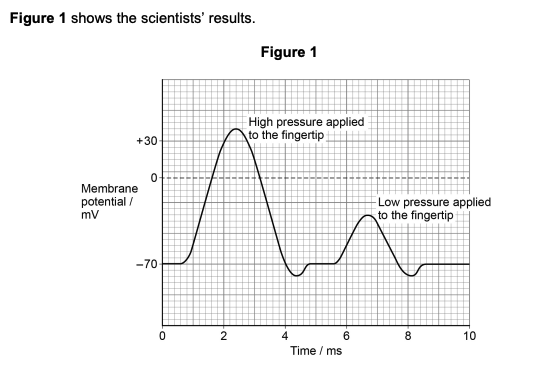
Answer
Mark Scheme
- An action potential is only generated/produced when threshold is reached OR An action potential is not generated/produced until/unless threshold is reached (1 mark)
- When high pressure was applied (to the fingertip), threshold was reached OR High pressure is (an) above threshold (stimulus) OR High pressure generates an action potential (1 mark)
Comments from mark scheme
- Ignore any numbers linked to threshold
- and 2 Accept impulse for action potential
- Accept references to ‘the first peak’ for high pressure
- Accept the converse for low pressure
Tips from examiner reports
- When asked to ‘use the figure’, reference specific values from the graph
- For the all-or-nothing principle: if the stimulus reaches the threshold, a full action potential is generated; if not, nothing happens
- You don’t need to memorise specific threshold values — use the figure provided
On Figure 1, from 0.6 ms to 4.0 ms, no new generator potential could be produced.
What is this time period called?
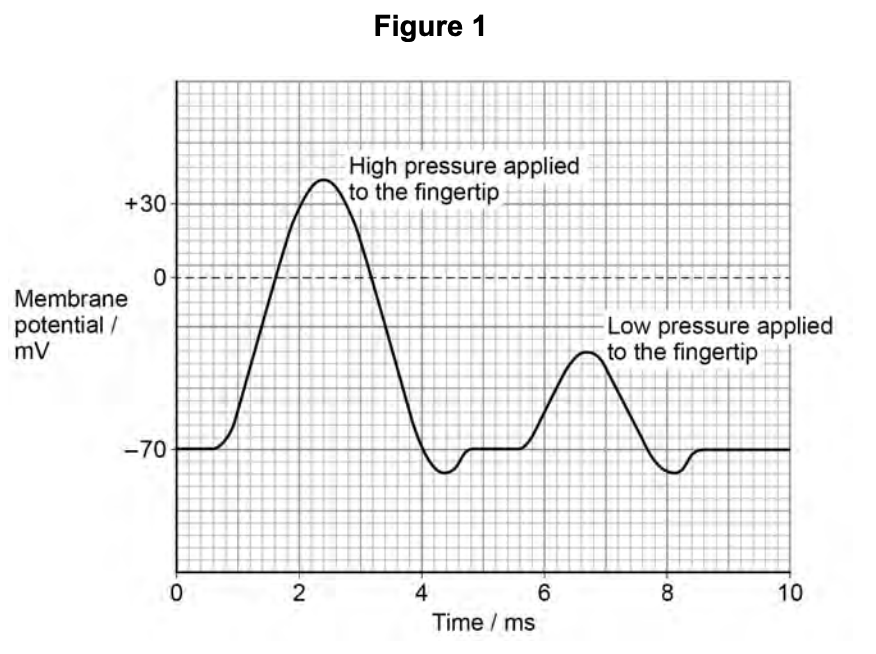
Answer
Mark Scheme
- (The) refractory (period) (1 mark)
Comments from mark scheme
Ignore any reference to absolute or relative Reject refraction period
Tips from examiner reports
- The refractory period is the time after an action potential during which another action potential cannot be generated
- Check the time values in the question and match them to the graph before answering
- Don’t confuse the refractory period with hyperpolarisation (which occurs at a different time)
A student investigated the effect of different sugars on the rate of respiration in yeast. Yeast normally respires glucose. Figure 2 shows the method she used for her first experiment.
Other than those stated, suggest two variables the student needed to keep constant in her investigation.
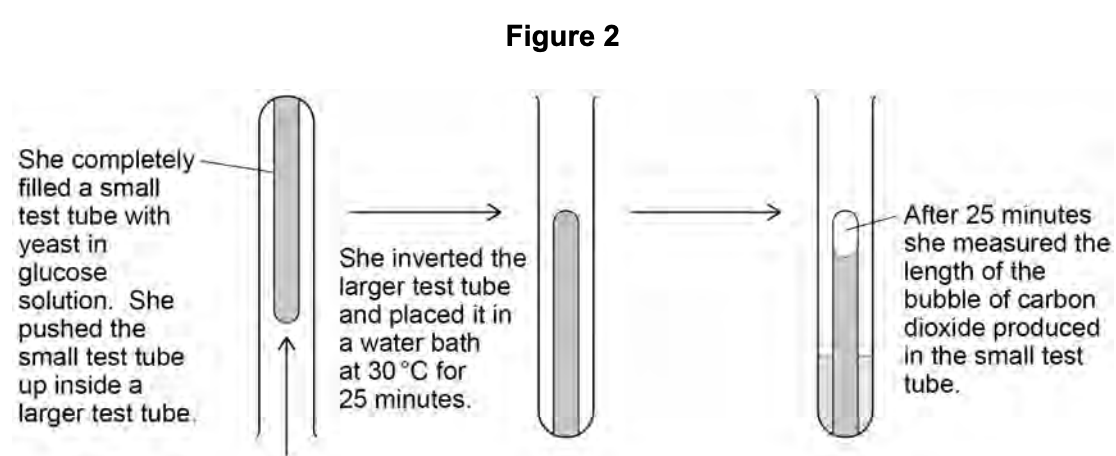
Answer
Mark Scheme
- Accept any two of the following for one mark: Concentration/mass of yeast Concentration/mass of glucose/sugar (solution/s) Concentration of oxygen (in solution) Volume of yeast Volume of glucose/sugar (solution/s) pH (of glucose/sugar solution/s) Species/type of yeast Size/diameter/volume of test tubes (1 mark)
Comments from mark scheme
Ignore number of yeast cells Ignore amount for volume or concentration
Tips from examiner reports
- Read the question carefully — ‘other than those stated’ means don’t repeat variables already mentioned
- Check the figure/diagram to see which variables are already controlled
- Use precise terms: ‘concentration’, ‘volume’, ‘mass’ — not ‘amount’
- Yeast cells are fungi, not plants — don’t suggest light or CO₂ as relevant variables
Figure 3 shows the result she obtained for yeast in glucose solution. Use Figure 2 and Figure 3 to calculate the rate of carbon dioxide production in mm s–1 for yeast in glucose solution.
Give your answer in standard form and to 2 significant figures (mm s–1) Show your working
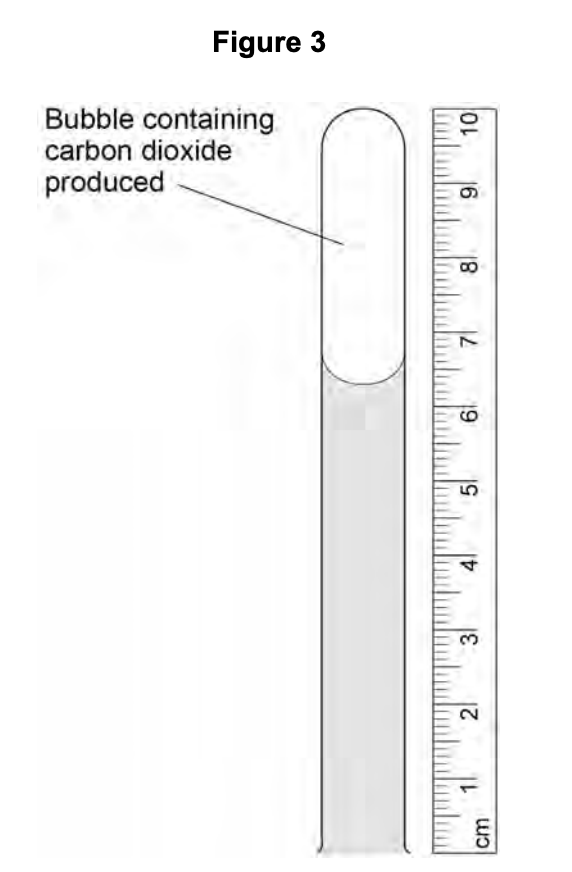
Answer
Mark Scheme
- Correct answer of 2.5 x 10⁻² = 2 marks (1 mark)
- 4.2 x 10⁻² (scale read from the wrong direction) = 1 mark (1 mark)
Tips from examiner reports
- Read scales carefully — check whether the unit is mm or cm
- Give your answer in standard form and to the correct number of significant figures as specified
The student repeated the experiment using yeast in maltose solution. She found the rate of carbon dioxide production was slower than with yeast in glucose solution. Suggest why.
(2 marks)Answer
Mark Scheme
- Maltose is a disaccharide (1 mark)
- (Time to be) hydrolysed into glucose OR (Time to) break glycosidic bond(s) (1 mark)
Comments from mark scheme
- Accept maltose is made of two glucose/ monosaccharides
- Accept monosaccharides for glucose
Tips from examiner reports
- Say ‘hydrolysed’ not ‘broken down’ when describing enzyme action on bonds
- Maltose is a disaccharide (two glucose units) — don’t call it a polysaccharide or monosaccharide
A second student used a different method to investigate the effect of different sugars on the rate of respiration in yeast. He set up a tube with yeast in glucose solution and added bromothymol blue. Bromothymol blue changes from blue to yellow when carbon dioxide is produced. To determine the rate of respiration, he timed how long it took for the solution to change from blue to yellow.
Suggest:
Include:
-
This method would be less accurate because
-
The accuracy of this method could be improved by
-
why the method the second student used would be less accurate than the method the first student used
-
how the accuracy of the method the second student used could be improved.
Answer
Mark Scheme
- This method would be less accurate because 1. Colour/endpoint is subjective (1 mark)
- The accuracy of this method could be improved by 2. (Have a) colour standard (of the yellow) as a reference for the end point (1 mark)
- OR (Have a) colorimeter/absorbance/transmission reading (of the yellow) as a reference for the end point (1 mark)
Comments from mark scheme
- Accept descriptions of the word ‘subjective’
- Accept use a colorimeter to time how long it takes to reach a certain value/absorbance/ transmission
- Ignore any references to coloured filters used in a colorimeter
Tips from examiner reports
- A colorimeter measures absorbance quantitatively — explain how to use it properly (e.g. time how long to reach a certain absorbance)
- Don’t confuse this experiment with one using a dilution series or calibration curve for concentration
- ‘Repeat and calculate a mean’ improves reliability, not accuracy
Complete the boxes A to D in Figure 4 to show the link reaction.
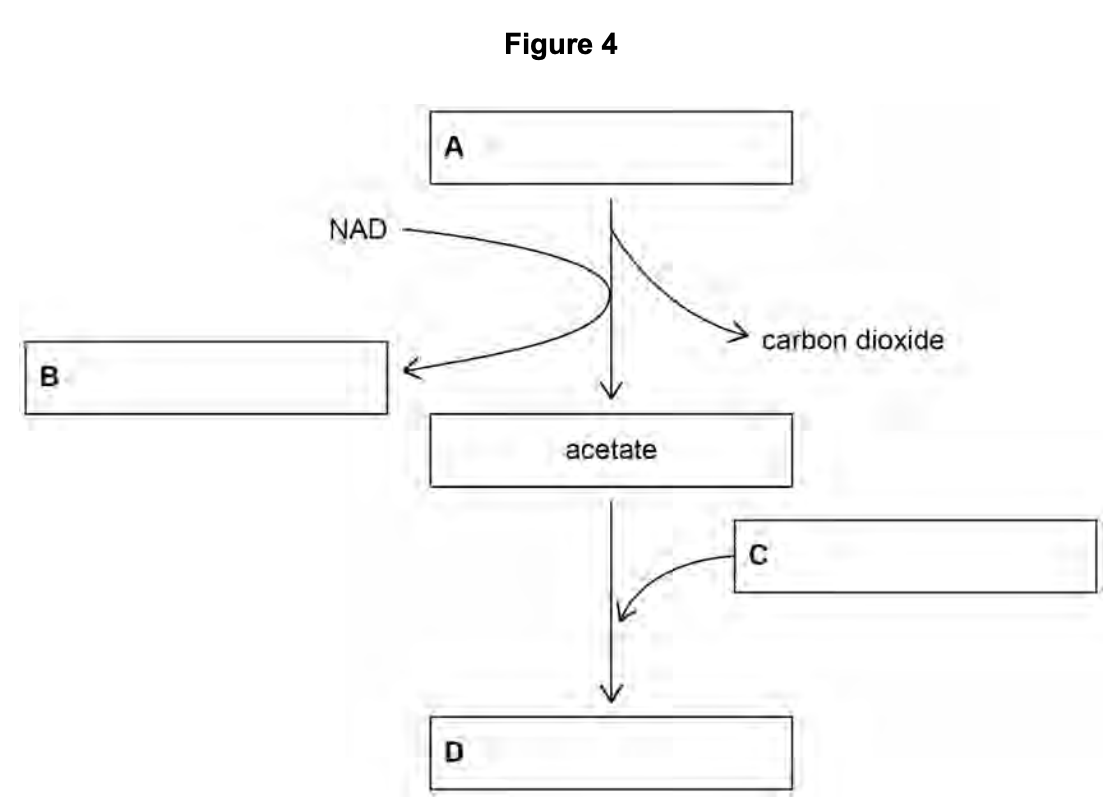
Answer
Mark Scheme
- All 4 correct = 2 marks (1 mark)
- Any 2 or 3 correct = 1 mark (1 mark)
Comments from mark scheme
Accept pyruvic acid for pyruvate For reduced NAD accept NADH, NADH + H⁺ or NADH2 For reduced NAD reject reduced NADP / NADPH / NADPH2 / NADPH + H⁺ For acetylcoenzyme A accept acetyl co A
Tips from examiner reports
- Know the link reaction: pyruvate → acetyl CoA (+ CO₂ + reduced NAD)
- Don’t confuse the link reaction with glycolysis — glucose is the substrate for glycolysis, pyruvate for the link reaction
Below are four statements about the structure of prokaryotic cells. 1. No prokaryotic cell has DNA that is associated with proteins. 2. No prokaryotic cell has membrane-bound organelles. 3. All prokaryotic cells have one or more flagella. 4. All prokaryotic cells have smaller ribosomes than eukaryotic cells.
Which statements about the structure of prokaryotic cells are correct? Tick (✓) one box
a) A statements 1, 2 and 3 b) B statements 1, 2 and 4 c) C statements 2, 3 and 4 d) D statements 1, 2, 3 and 4
(1 marks)Answer
Mark Scheme
- B – statements 1, 2 and 4 (1 mark)
Tips from examiner reports
- Only tick one box when instructed — read instructions carefully
A student investigated the effect of two antibiotics on the growth of the bacterium Micrococcus luteus. During the investigation, the student:
- transferred 9 cm³ of a liquid culture of M. luteus into each of three bottles
- added the antibiotic chloramphenicol to the first bottle
- added the antibiotic novobiocin to the second bottle
- added no antibiotic to the third bottle. After 24 hours, he diluted the contents of each bottle by 1 in 100 000 (10⁻⁵). He then transferred 0.25 cm³ samples from the first bottle onto each of 3 separate agar plates. He repeated this with 0.25 cm³ samples from the second bottle and the third bottle, resulting in 9 agar plates in total. He incubated the plates for 48 hours. Table 1 shows the number of colonies of bacteria he counted on each plate after 48 hours’ incubation
Calculate the mean number of bacteria in the undiluted bottle of liquid culture containing novobiocin.
Give your answer in standard form. Show your working.
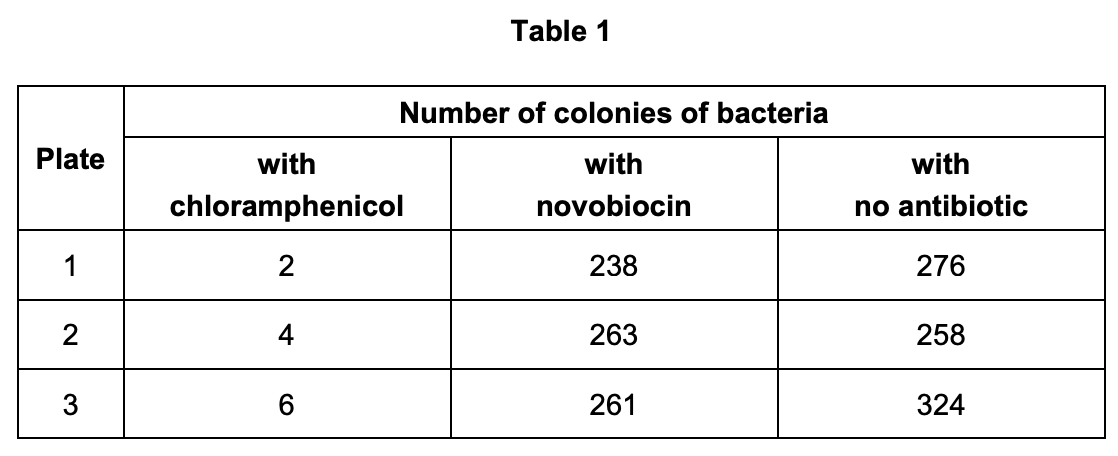
Answer
Mark Scheme
- A correct answer of 9(.144) x 108 = 2 marks (1 mark)
- Answer not in standard form (914 400 000) = 1 mark (1 mark)
Tips from examiner reports
- When calculating from dilution plates, multiply the mean colony count by the dilution factor
- If the dilution is 10⁻⁵, multiply the count by 10⁵ (100,000)
- Show each step of your calculation
Starting with a single bacterium, calculate how many generations it would take to produce at least the number of bacteria you have calculated for your answer in Question 03.2 You can assume no bacteria die. You could use the ln or log button on your calculator to calculate your answer Answer in generations
(1 marks)Answer
Mark Scheme
- 30 (1 mark)
Tips from examiner reports
- Show your working — errors carried forward from previous questions can still earn marks
- Know how to use ln or log for growth calculations
M. luteus is not resistant to chloramphenicol.
Suggest two reasons why the bacteria were able to grow in the culture containing chloramphenicol.
(2 marks)Answer
Mark Scheme
- The concentration (of chloramphenicol) was too low/dilute (to kill all) OR There were too many M. luteus/bacteria for chloramphenicol/antibiotic to kill (1 mark)
- (Contamination with) other/resistant bacteria (1 mark)
- Mutation (occurred) (1 mark)
Comments from mark scheme
Accept as an additional mark point 4. Chloramphenicol/ antibiotic not (evenly) mixed in the liquid culture/bottle
Tips from examiner reports
- Read the practical procedure carefully before answering
- Bacteria becoming ‘immune’ to antibiotics is incorrect — say ‘resistant’
- Think about what could explain zones of inhibition changing size
Following a body injury, bone marrow stem cells move to the site of damage and undergo cell differentiation. Figure 5 shows how this differentiation occurs.
Suggest how SCFR is destroyed by a lysosome.
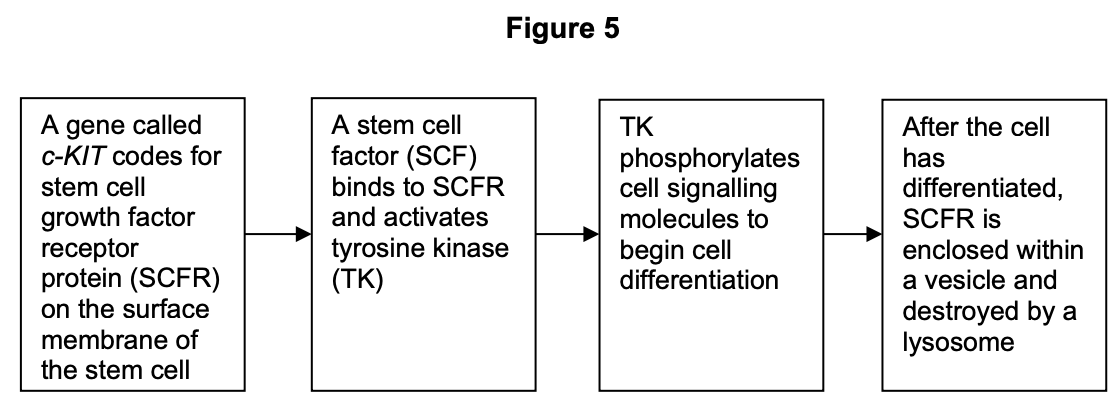
Answer
Mark Scheme
- (The vesicle) fuses/binds with a lysosome (1 mark)
- Lysozyme/s hydrolyses/digests (SCFR) OR Hydrolytic enzyme/s breaks down/hydrolyses/ digests (SCFR) (1 mark)
Comments from mark scheme
- Accept protease hydrolyses/digests (SCFR);
Tips from examiner reports
- Read figures carefully and understand the context before answering
- Don’t confuse receptor proteins with antigens or phagocytosis
- Lysosomes are organelles that contain digestive enzymes — they are not macrophages
- Don’t use lysosome and lysozyme interchangeably — they are different things
After a heart attack, cardiomyocytes (cardiac muscle cells) die, and become infarcted tissue. Infarcted tissue cannot contract. Stem cells in bone marrow cannot move to the infarcted tissue and differentiate into cardiomyocytes. Scientists used laboratory rats to investigate if bone marrow stem cell transplants could be used to repair infarcted tissue resulting from a heart attack. They split the rats into three groups.
- Control group did not get a transplant of bone marrow stem cells.
- c-KIT+ group got a transplant of bone marrow stem cells with a functioning c-KIT gene.
- c-KIT– group got a transplant of bone marrow stem cells with no functioning c-KIT gene.
After 9 days, the scientists measured the mean ventricular blood pressure of each of the three groups.
Using all of the information, suggest explanations for the results for the Control group and the c-KIT– group shown in Figure 6.
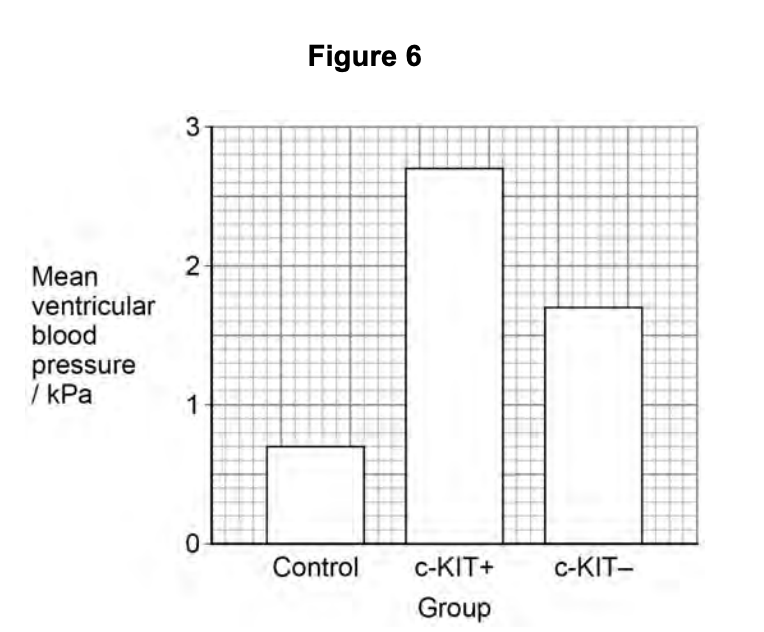
Answer
Mark Scheme
- Control 1. Cardiomyocytes/(cardiac muscle) cells have not been replaced OR Infarcted tissue is not repaired/replaced OR (The contraction of the ventricle is weak as) there is a small number of cardiomyocytes/ (cardiac muscle) cells still alive OR (The ventricular pressure is low as) cardiomyocytes/(cardiac muscle) cells are damaged/dead (1 mark)
-
- (Pressure is not zero as) not all cardiomyocytes/(cardiac muscle) cells died OR (Pressure is not zero as) not all cardiomyocytes/(cardiac muscle) cells became infarcted tissue (1 mark)
- c-KIT– 3. Higher than control, so (some) stem cells (must) have been able to differentiate OR Higher than control, so (some) cardiomyocytes/(cardiac muscle) cells have been replaced/infarcted tissues have been repaired (1 mark)
-
- (So) c-KIT is not the only gene responsible for differentiation OR (So) SCF must be able to bind to something other than SCFR OR (So) something else must be able to activate TK in cells (1 mark)
-
- Increase is less than c-KIT+ group as they could not make SCFR OR Increase is less than c-KIT+ group as they could not activate TK (1 mark)
Comments from mark scheme
Reject ‘some stem cells from bone marrow moved to the infarcted tissue’
Tips from examiner reports
- Explain the results, don’t just describe them or repeat the question stem
- Look at the data in the figure — if the control group still shows some activity, don’t say it shows none
Nine days after transplantation, the c-KIT+ group showed that 68% of infarcted tissue was made up of new cardiomyocytes. The control group had no new cardiomyocytes. Assuming that mean ventricular blood pressure is directly proportional to the number of cardiomyocytes, calculate the percentage of infarcted tissue that was made up of new cardiomyocytes in the c-KIT– group.
(2 marks)Answer
Mark Scheme
- A correct answer 34% = 2 marks (1 mark)
- Evidence of 2 and 1 = 1 mark An answer of 42.8/43% = 1 mark (answer that did not subtract the ‘control’ from read values) (1 mark)
Tips from examiner reports
- Read the mark scheme hints and attempt all parts of the question
All new cardiomyocytes produced:
All new cardiomyocytes produced:
Suggest how production of Connexin-43 and GATA-4 could give the result seen in the c-KIT+ group in Figure 6 (on page 13). Do not include details of transcription or translation in your answer
-
Connexin-43, a channel protein that allows electrical impulses to pass between cardiomyocytes
-
GATA-4, a transcriptional factor that stimulates the expression of genes for actin and myosin.
-
Connexin-43, a channel protein that allows electrical impulses to pass between cardiomyocytes
-
GATA-4, a transcriptional factor that stimulates the expression of genes for actin and myosin.
Answer
Mark Scheme
- Connexin-43 1. (Connexin-43) allows impulses to pass to the bottom/apex of the heart/ventricles OR (Connexin-43) allows impulses to pass through Purkyne tissue/the bundle of His (1 mark)
- GATA-4 2. More actinomyosin bridges OR More binding sites on actin OR More myosin filaments/heads (1 mark)
Comments from mark scheme
- Accept (connexin43) allows diffusion/movement of ions (between cardiomyocytes)
- Ignore references to signals/ information/ messages
- Accept cross bridges for actinomyosin bridges
- Accept more binding of myosin to actin
Tips from examiner reports
- Read figures carefully — if the data shows ventricular pressure, don’t discuss atrial conduction
- Link the protein’s function to the specific data shown (e.g. increased ventricular pressure)
- Don’t just state what a protein does — explain how it would produce the observed result
Scientists investigated the effect that the release of heated water into a river from a power station had on the biodiversity of a local fish community over 29 years.
They measured the species richness and the number of fish of each species at the same site in October every year. The scientists used this information to calculate an index of diversity (d) of fish for each year. Figure 7 and Figure 8 show their results.
CHECK FORMATTING *** The scientists used the following formula to calculate the index of diversity (d) of fish. d =N (N–1) / Σn (n–1) where N = total number of fish of all species and n = total number of fish of each species In some years, the values were N = 624 and Σn (n–1) = 64 792
Which years had these values?
Use Figure 8 and the formula above to work out your answer.
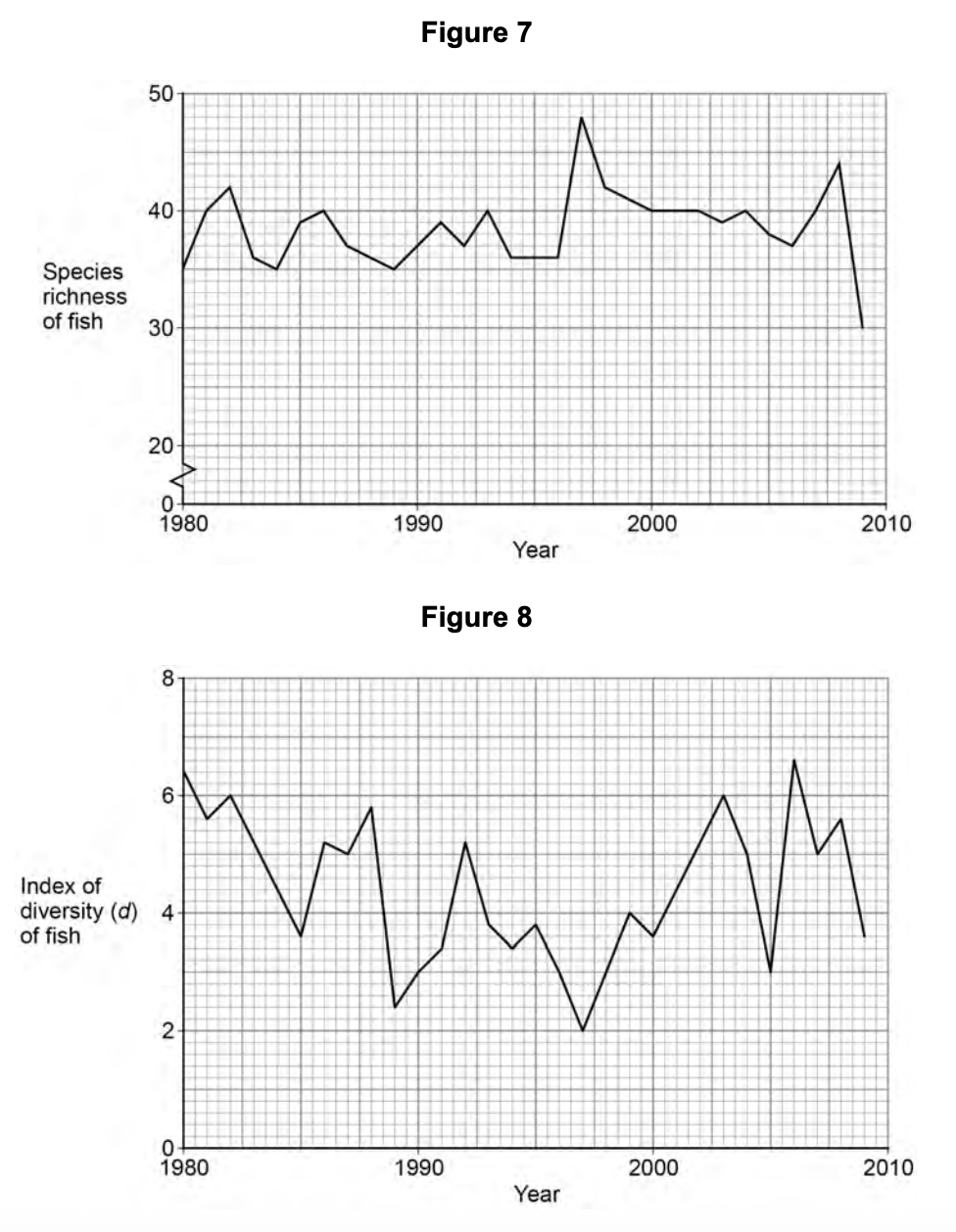
Answer
Mark Scheme
- 1982 and 2003 (1 mark)
Tips from examiner reports
- Read graph scales carefully — check the intervals on both axes
- Only give the number of answers requested — don’t give extra options
In 1997, the scientists recorded the highest species richness, but the lowest value of d over the 29 years.
Describe and explain how these results for 1997 were possible.
(2 marks)Answer
Mark Scheme
- There were many/48 (different) species OR (1997 had) the highest number of (different) species (1 mark)
- (However,) one/a few species were present in (very) large numbers OR Most species were present in (very) small numbers (1 mark)
Comments from mark scheme
- Accept a lot/lots of (different) species for many
- Accept dominated by one/a few species
- Ignore each/all species were present in (very) small numbers
Tips from examiner reports
- A high index of diversity means many species present in relatively equal numbers — not that each species has few individuals
- Use the data to support your answer — don’t ignore it and discuss competition and predation instead
A journalist studied Figure 7 and Figure 8 (on page 16) and concluded that releasing heated water from a power station has no effect on local fish communities.
Use all the information to suggest reasons why the journalist’s conclusion might not be valid.
(4 marks)Answer
Mark Scheme
- The species richness/d are lower after 29 years (1 mark)
- The data is only for one (fish/local) community/site OR The data might not be representative of all fish communities OR Other communities might have different (fish) species (1 mark)
- (The measurements) only done in October OR The community might be different at other times of year (other than October) (1 mark)
- The volume/temperature of the heated water (released each year) might have varied OR Timing/frequency of heated water release (each year) not known (1 mark)
- Fluctuations suggest other named factor had an effect (on biodiversity/species richness/d) (1 mark)
- Species richness/d are not the only measures of ‘effect’ (1 mark)
- Don’t know when the power station opened OR There is no data before 1980 OR There is no data before heated water was released OR No control (river) to compare with (1 mark)
Comments from mark scheme
- Named factors could include weather/oxygen concentration/food availability/plants/ predators/prey/ insects/ invertebrates/ fishing
Tips from examiner reports
- Avoid rote-learned responses (‘no stats test’, ‘no sample size’) unless they’re genuinely relevant to the specific question
- 29 years of data can show trends — don’t dismiss it as ‘not long enough’
- Evaluate what the data actually shows, in context
Give two types of cell that can stimulate an immune response.
(2 marks)Answer
Mark Scheme
- Pathogens OR Cells from an organism of a different species (1 mark)
- Cells from other organisms of the same species (1 mark)
- Abnormal body cells (1 mark)
- Antigen-presenting cells (1 mark)
Comments from mark scheme
Reject toxins
- Accept named examples of pathogens
- Accept bacteria/fungi
- Ignore viruses
- Accept named appropriate cells from other organisms of the same species
- and 3. Ignore B cells/T cells
- Accept cancer cells
- Accept cell infected with virus
Tips from examiner reports
- Read the question carefully — if it asks for types of cell involved in a specific process, give cells relevant to that process
- Don’t just list ‘B cells and T cells’ for every immunity question — think about what’s specifically being asked
An autoimmune disease causes the immune system to attack healthy body tissues. Scientists investigated the immune responses of healthy mice and mice with autoimmune disease. The chemical OXA causes an immune response in mice and can make their skin swell. Mice had olive oil applied to their left ear and OXA in olive oil applied to their right ear. The immune response was recorded in two ways:
- the cellular response by measuring the mean increase in ear thickness 24 hours after exposure to OXA
- the humoral response by measuring the mean concentration of anti-OXA antibody in blood 14 days after exposure to OXA. Table 2 shows the results of this investigation. The values in the brackets show ± 2 standard deviations. A value of ± 2 standard deviations from the mean includes over 95% of the data.
Suggest and explain one reason why olive oil was applied to the left ear of the mice
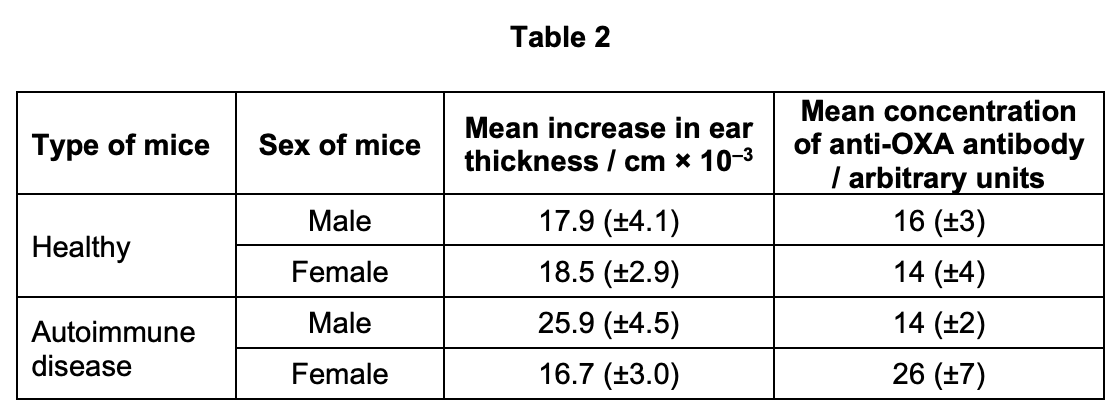
Answer
Mark Scheme
- As a control (experiment), to show that it is OXA affecting the (immune) response OR As a control (experiment), to show that (olive) oil is not affecting the (immune) response OR To use as a control/standard/reference/starting point, to compare with (after) OXA (exposure) (1 mark)
Comments from mark scheme
Reject ‘control/controlled variable’
Tips from examiner reports
- When asked to ‘suggest and explain’, do both — a suggestion alone or an explanation alone isn’t enough
- ‘As a control’ needs qualification — explain what you’re controlling for
- A control group is not the same as a controlled variable
Plot a suitable graph for mean increase in ear thickness for each group of mice in Table 2. Include the data for ± 2 standard deviations on your graph.

Answer
Mark Scheme
- Labelled axes correct way round, linear scale and units (1 mark)
- Mean points plotted correctly (1 mark)
- SD bars correctly plotted above and below the peak of each bar (1 mark)
Comments from mark scheme
- Reject if line graph drawn
- Reject if Y-axis does not cover at least half of the grid
- Reject if bars not of equal width
- Accept a dual bar chart drawn
- Reject if bars are touching (except dual bars)
- Accept interruption drawn on the y axis
- and 3. Allow all plots to the nearest half cm
Tips from examiner reports
- When drawing graphs: use a sensible scale, don’t have bars touching (unless it’s a histogram), include error bars correctly, and plot what was asked
- Choose scales that are easy to plot and read (e.g. 1, 2, 5, 10 per square)
What can you conclude about the effects of autoimmune disease on the cellular response and the humoral response in male and female mice?
Use the data to justify your conclusions.
(3 marks)Answer
Mark Scheme
- Cellular response 1. Female to female no significant difference in cellular response as SD overlap (1 mark)
-
- Male to male no significant difference in cellular response as SD overlap (1 mark)
-
- Significant increase in cellular response in autoimmune male compared with autoimmune female as SD do not overlap Humoral response 4. Male to male no significant difference in humoral response as SD overlap (1 mark)
-
- Female to female significant increase in humoral response as SD do not overlap (1 mark)
-
- Significant increase in humoral response in autoimmune female compared with autoimmune male as SD do not overlap (1 mark)
Comments from mark scheme
Max 2 for answers only relating to the cellular response or humoral response Accept ‘(ear) thickness’ for cellular response, and ‘concentration of antiOXA/antibody’ for humoral response If no other marks awarded, accept 1 principle mark for the idea that if SD overlap there is no significant difference or the converse
-
- and 4. Accept difference (likely) due to chance for no significant effect
-
- and 6. Accept increase not (likely) due to chance for significant increase Allow ‘error bars’ for ‘SD’
Tips from examiner reports
- Use data to justify conclusions — quote specific values or trends
- Don’t say ‘no stats test has been performed’ and then ignore the statistical data that IS provided
- Understand probability values and what they mean for significance
Some studies have shown that in humans, oestrogen has the opposite effect on two different autoimmune diseases. Oestrogen:
- accelerates the progression of systemic lupus erythematosus (SLE)
- prevents the progression of rheumatoid arthritis (RA). The scientists investigated the effect of oestrogen on the immune response in healthy mice and mice with autoimmune disease. Table 3 shows the scientists’ results.
A student studying these data made the following conclusions. 1. In humans, SLE is caused by an overproduction of antibodies. 2. In humans, RA is caused by an overproduction of cytotoxic T cells (TC cells).
Evaluate the student’s conclusions.
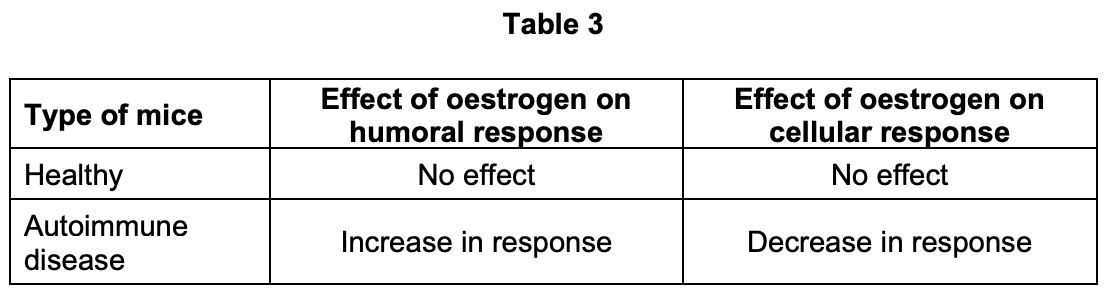
Answer
Mark Scheme
- Supporting 1. (Oestrogen) increases the humoral response that produces antibody (1 mark)
-
- More antibodies could increase progression of SLE (1 mark)
-
- (Oestrogen) decreases the cellular response that produces TC cells (1 mark)
-
- Fewer TC cells could decrease/slow progression of RA (1 mark)
-
- Mice and humans are both mammals, so likely to have similar effects in both (1 mark)
- Against 6. Increase in response might mean quicker production of antibody (not more) OR Decease in response might mean slower production of TC cells (not fewer) (1 mark)
-
- Decrease in cellular response could (also) mean fewer antigen-presenting cells (and not just TC cells) (1 mark)
-
- (Investigation) done in mice/not humans (1 mark)
-
- Table 3 does not state which type of autoimmune disease the mice had OR Mice might not suffer from SLE/RA (1 mark)
Tips from examiner reports
- Manage your time — don’t spend so long on the essay that you can’t finish other questions
- Read the question carefully — understand what the study actually shows before evaluating
- Avoid rote-learned criticisms (‘no stats test’, ‘no sample size’) unless genuinely applicable
- If scientists performed the investigation, assume the sample size was sufficient unless told otherwise
In mice, one type of autoimmune disease is inherited as a dominant allele. Would the Hardy–Weinberg principle hold true for a population of mice, some of which had this autoimmune disease?
Explain your answer.
(2 marks)Answer
Mark Scheme
- No – no mark 1. Mice with autoimmune disease will be unlikely to reproduce/survive OR Mice with autoimmune disease will be selected against (1 mark)
-
- Will not pass on allele (for autoimmune disease) OR Allele frequency (for autoimmune disease) will reduce/change (1 mark)
- Yes – no mark 3. As long as the autoimmune disease did not affect the mice’s ability to reproduce/survive (1 mark)
-
- The allele frequency will remain constant/not change (1 mark)
Tips from examiner reports
- Hardy-Weinberg assumptions: large population, random mating, no migration, no mutation, no selection
- Don’t confuse Hardy-Weinberg conditions with mark-release-recapture assumptions (no births/deaths)
- A dominant allele doesn’t automatically increase in frequency — Hardy-Weinberg predicts stable frequencies
- Think carefully about which assumption is being violated in the specific context
The importance of interactions between organisms and their environment
(25 marks)Answer
Mark Scheme
- No mark scheme available
Tips from examiner reports
- In essays, ensure each topic is at A-level depth, not GCSE level
- Know the specification structure — plant tropisms, taxes, and kineses are all part of one topic (survival and response)
- Include specific interactions between organisms and their environment, not just descriptions of processes
- Descriptions of peacock feathers attracting mates or camel adaptations are GCSE level — go deeper
The importance of membranes in the functioning of cells
(25 marks)Answer
Mark Scheme
- No mark scheme available
Tips from examiner reports
- Focus your essay on the specific title — if it says ‘importance of membranes in cells’, link everything back to membranes
- Don’t add a loosely related topic for ‘importance’ that isn’t connected to membranes
- Gas exchange should mention specific membrane features, not just ‘thin membranes’
- The electron transfer chain moves protons across the membrane — this is not classical active transport
- Be careful with cholera as beyond-spec material — the toxin works via a receptor and second messenger, not by directly opening channels
Amino acids are used to make proteins. Table 1 shows the R groups of six different amino acids.
Use Table 1 to identify the three different amino acids used to make the polypeptide shown in Figure 1.
- Left amino acid =
- Middle amino acid =
- Right amino acid =
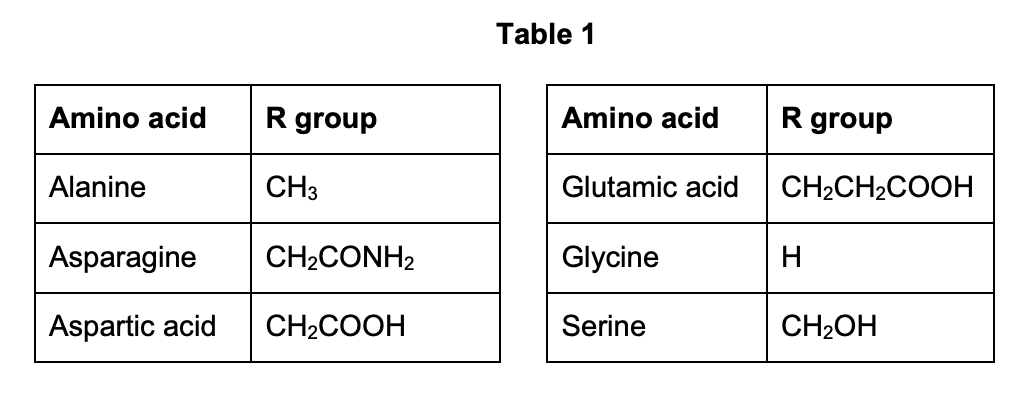
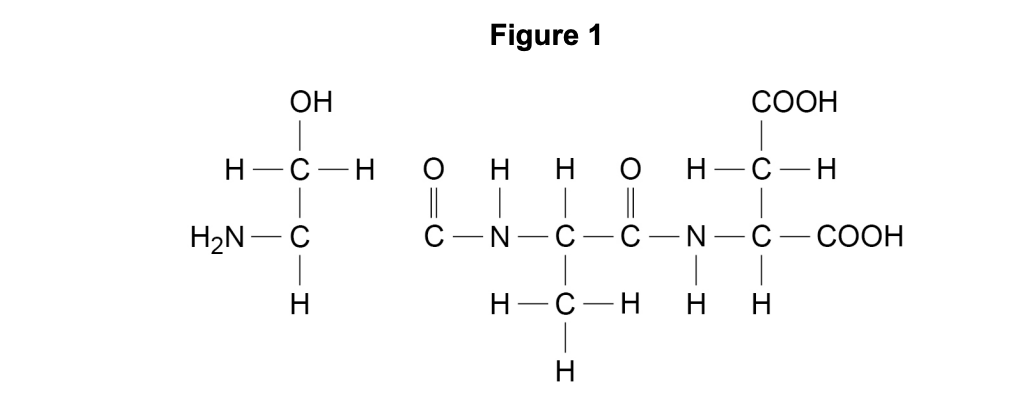
Answer
Mark Scheme
- Two marks for three correct answers, one mark for two correct answers (1 mark)
- (Left amino acid) Serine (Middle amino acid) Alanine (Right amino acid) Aspartic (acid) (1 mark)
Tips from examiner reports
- Know what R groups are on amino acids
- Read structures from left to right unless told otherwise
Table 2 shows three statements and names of four biological molecules.
Put a tick () in each box where the statement is true for the biological molecule
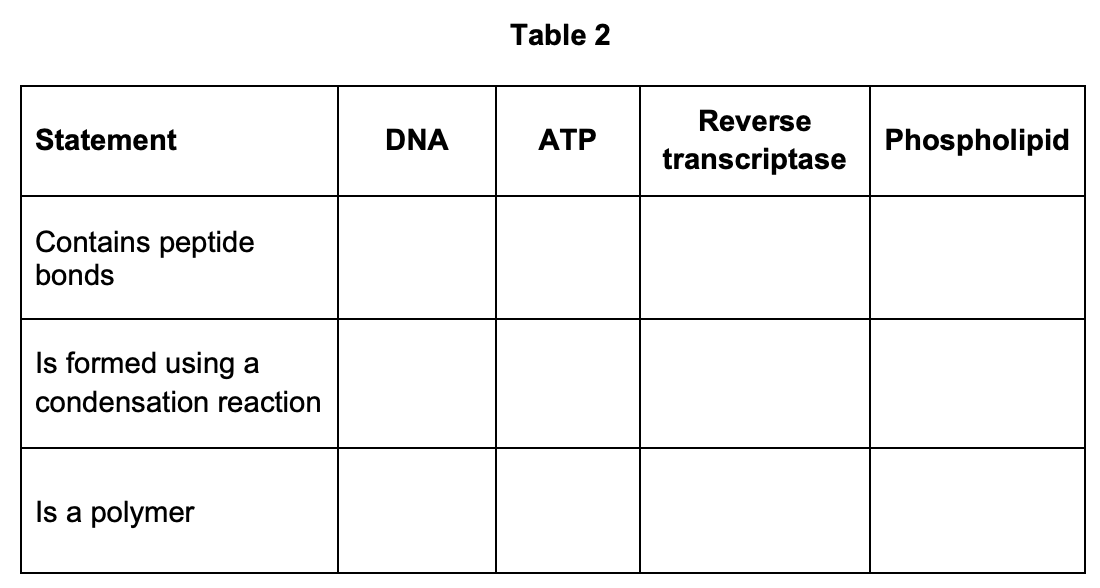
Answer
Mark Scheme
- One mark for each correct row (1 mark)
Tips from examiner reports
- Know the basic properties of carbohydrates, lipids, proteins, and nucleic acids — this is fundamental knowledge
The number of amino acids in the beta chains in Figure 2 is 3.546% greater than in the alpha chains. Each alpha chain contains 141 amino acids.
Calculate how many amino acids there are in total in the haemoglobin molecule shown in Figure 2.
Give your answer to the nearest whole number.
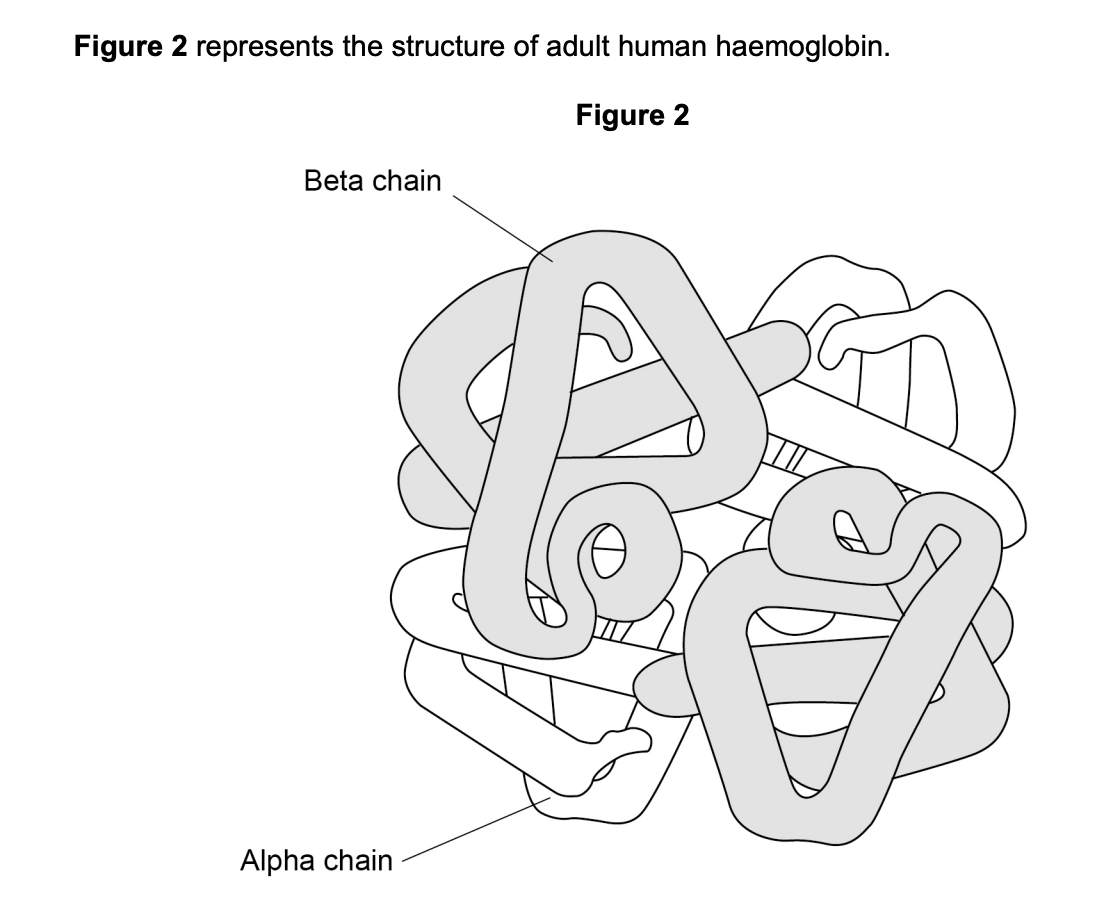
Answer
Mark Scheme
- Correct answer of 574 (amino acids) = 2 marks (1 mark)
- 573.99936 = 1 mark (1 mark)
Tips from examiner reports
- Haemoglobin has 2 alpha and 2 beta polypeptide chains — don’t forget there are two of each
When a substance called BPG binds to haemoglobin, it reduces the affinity of haemoglobin for oxygen.
Figure 3 shows an oxyhaemoglobin dissociation curve for haemoglobin in normal conditions.
Sketch a curve on Figure 3 to show the oxyhaemoglobin dissociation curve for haemoglobin when BPG binds to it.
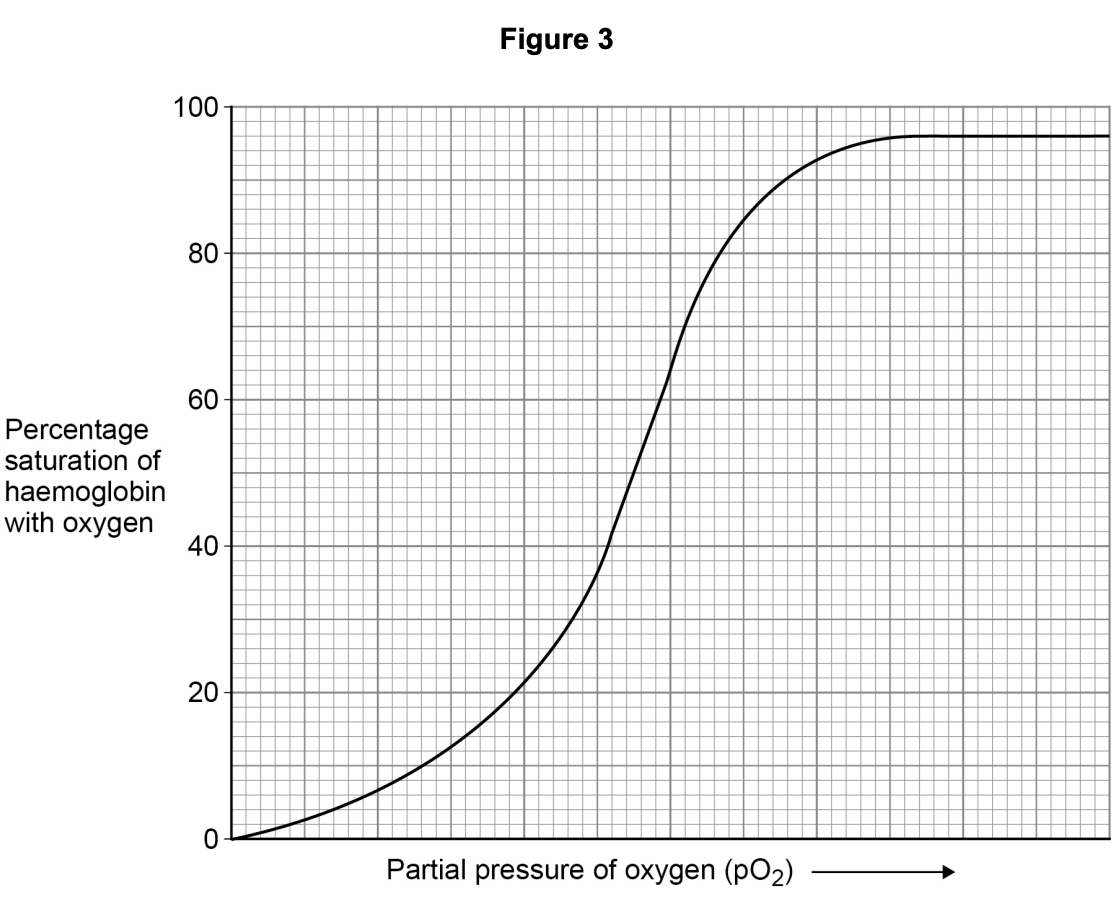
Answer
Mark Scheme
- Accept curve drawn to the right, following the same pattern and starting at Y = 0 and finishing at the same percentage saturation as original curve (1 mark)
Tips from examiner reports
- Reduced affinity for oxygen shifts the curve to the right, but the maximum saturation still reaches the same level at high pO₂
- Don’t draw the curve with a lower maximum percentage saturation
Suggest and explain when it would be an advantage to a human for BPG to bind to haemoglobin.
(2 marks)Answer
Mark Scheme
- During exercise OR At low pO₂ (in the tissues) (1 mark)
- (Allowing) more oxygen for respiration OR (Allowing) more aerobic respiration OR To delay anaerobic respiration (1 mark)
Comments from mark scheme
- Accept ‘high altitude’ or ‘lack of red blood cells’ for ‘exercise’
- Accept when there is a high pCO₂ (in the tissues)
- Accept at low concentration of O₂ (in the tissues)
- Accept descriptions of aerobic respiration, eg more oxygen to act as a terminal electron acceptor
- Accept oxygen can unload/dissociate easier/more readily for respiration
Tips from examiner reports
- Give a specific situation when it would be advantageous (e.g. during exercise)
- Use comparative language: ‘more oxygen is released’ not just ‘oxygen is released’
- Don’t just repeat the question stem — explain the advantage
Figure 4 shows a diagram of a Pacinian corpuscle.
Name the structures labelled P, Q and R shown in Figure 4. P = Q = R =
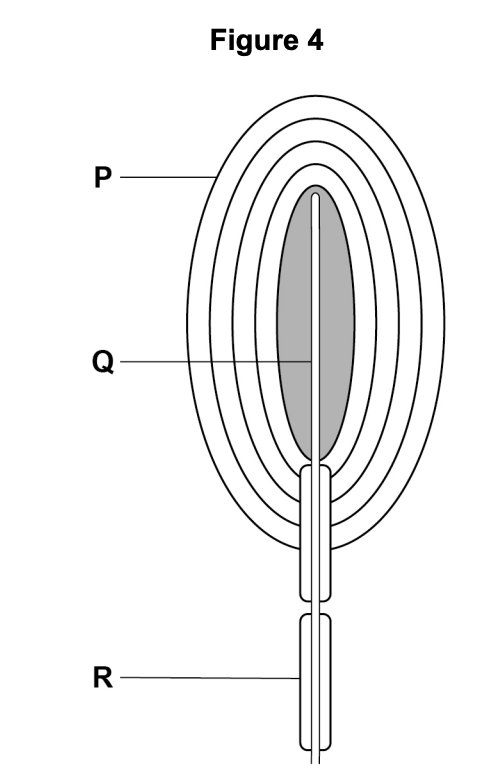
Answer
Mark Scheme
- Two marks for three correct structures, one mark for two correct structures (1 mark)
P = Capsule/lamella(e) Q = Axon (membrane) R = Schwann cell(s) OR R =
Comments from mark scheme
P – accept connective tissue Q – accept (sensory) neurone Q – accept nerve cell Q – ignore nerve
Tips from examiner reports
- Know the structures of a Pacinian corpuscle: lamellae (layers), sensory neurone ending, myelin sheath
- Be specific: say ‘sensory neurone’ not just ‘nerve’
- Don’t confuse lamellae with nodes of Ranvier or stretch-mediated channels with structural components
Two students (A and B) investigated reaction time in response to touch.
Calculate the percentage uncertainty in the measurement of Trial 1 in Table 3.
Put a tick () in the correct box below.
- Student A sat with her eyes shut and her forearm resting on a worktop so that her hand was over the edge.
- Student B held a ruler vertically between student A’s thumb and first finger, with the ruler at 0 mm lightly touching student A’s first finger.
- Student B released the ruler.
- As soon as student A felt the ruler fall, she closed her thumb and first finger to catch the ruler as shown in Figure 5.
- Student B measured the distance the ruler had fallen to the nearest mm
A) 0.633% B) 1.27% C) 2.53% D) 12.6%
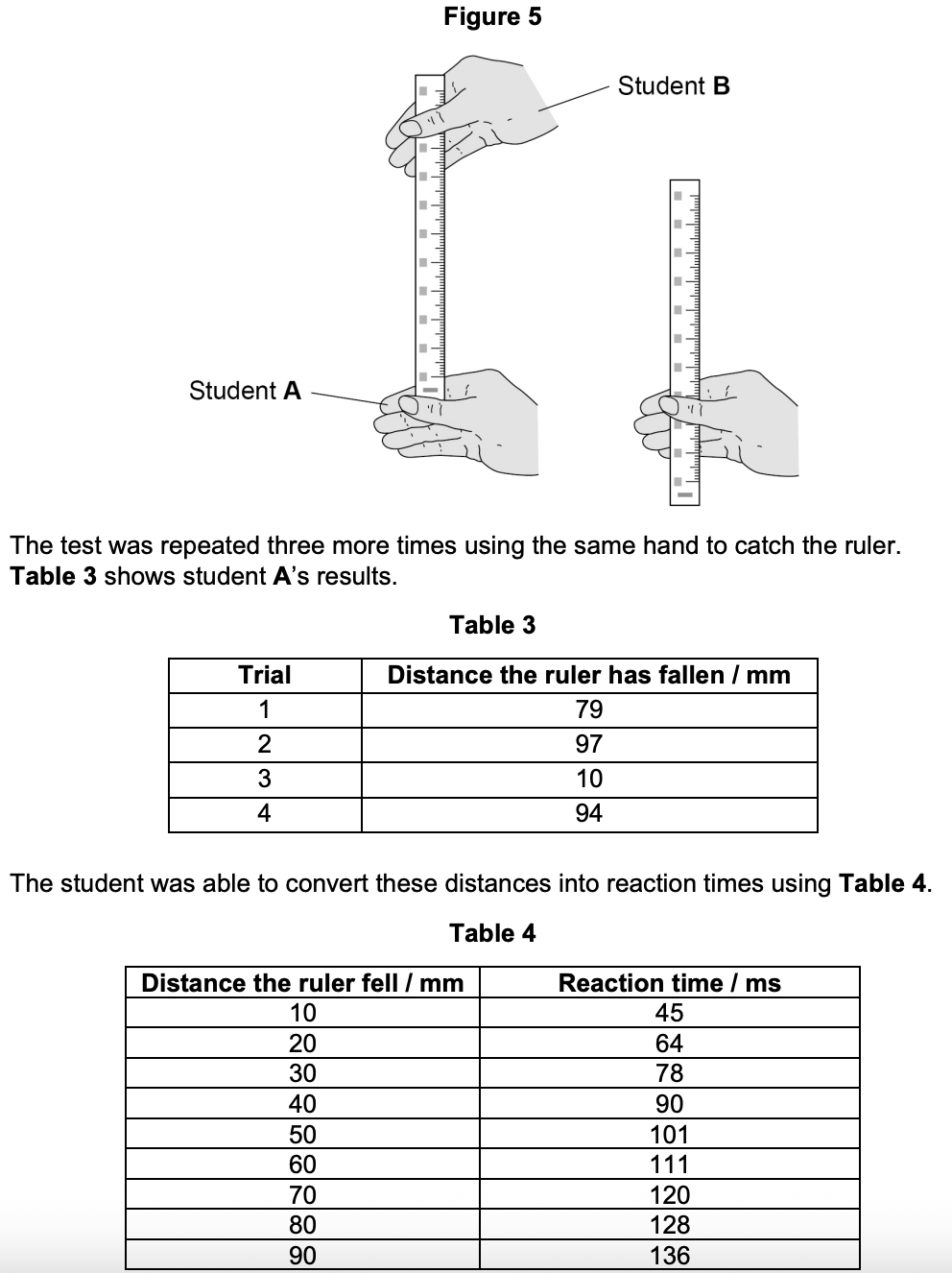
Answer
Mark Scheme
- 1.27% (1 mark)
Tips from examiner reports
- Percentage uncertainty = (absolute uncertainty / measured value) × 100
- Know how to calculate uncertainty for different measuring instruments
In this investigation, it is not possible for a student to react in less than 45 ms Suggest one explanation for the value recorded in Trial 3 in Table 3
(1 marks)Answer
Mark Scheme
- The student started to move/close her hand before the ruler was released (1 mark)
- The ruler did not fall vertically/was not placed vertically (1 mark)
- The ruler stuck to her skin (1 mark)
- (Student B) held the ruler too high/higher (1 mark)
Tips from examiner reports
- Consider the context of the experiment — what factors could explain the observation?
- Don’t mention equipment (e.g. stop clocks) that wasn’t used in the investigation
Student A estimated that the length of the nerve pathway involved was 175 cm Use Table 3 and Table 4 to calculate the mean speed of nerve impulse transmission. Do not use the value for Trial 3 in your calculation. (Answer in m s–1)
(2 marks)Answer
Mark Scheme
- Correct answer of 12.9 / 13 (m s–1) = 2 marks (1 mark)
- Use of reaction time of 136 (ms)/0.136 (s) in answer = 1 mark (1 mark)
Tips from examiner reports
- Speed = distance / time — know this basic formula
- Convert milliseconds to seconds: divide by 1000
- Show unit conversions clearly in your working
In response to touch, nerve impulses can be transmitted at speeds of 76.2 m s–1 Suggest three reasons why, in this investigation, the estimated speed of student A’s impulse transmission was less than 76.2 m s–1
(3 marks)Answer
Mark Scheme
- Synaptic transmission OR Transmission at neuromuscular junction (1 mark)
- Time for muscle contraction (1 mark)
- Time taken for (stretch-mediated) sodium ion channels to open (in the Pacinian corpuscle) (1 mark)
- Student may have been distracted/not concentrating (1 mark)
- Time taken for coordination/comprehension (by the brain) (1 mark)
Comments from mark scheme
Ignore answers relating to the estimate of the length of the nerve pathway involved
- Accept (involves) synapses For 1 mark, accept correct reference to student conditions/medication eg tiredness, antidepressants
Tips from examiner reports
- Consider the context: the measured speed might differ from the accepted value because the experiment measures reaction time (which includes processing time), not just nerve impulse speed
- Don’t give answers that aren’t relevant to the context (e.g. ‘low temperature’, ‘less myelination’) unless the question suggests these factors
- Don’t confuse reaction time (ms) with transmission speed (m/s)
A student prepared a stained squash of cells from the root tips of garlic to calculate a mitotic index. He:
- cut the end 5 mm from 10 garlic roots
- placed the root tips into a Petri dish containing 5 cm³ of hydrochloric acid for 12 minutes
- rinsed the root tips in distilled water
- placed one of the root tips on a microscope slide and added toluidine blue stain
- placed a coverslip onto the microscope slide, and gently pressed the coverslip downwards on the root tip
- observed the root tip using an optical microscope.
Suggest why the student soaked the root tips in hydrochloric acid in step 2.
(2 marks)Answer
Mark Scheme
- To break down links between cells/cell walls OR To separate cells/cell walls OR To break down/hydrolyse cellulose/cell wall (1 mark)
- Allowing the stain to pass/diffuse into the cells OR Allowing the cells to be (more easily) squashed (1 mark)
- To stop mitosis (1 mark)
Comments from mark scheme
- Ignore references to any bonds
- Accept to stop cell division/cell cycle
Tips from examiner reports
- Acid is used in root tip preparations to dissolve the middle lamella (pectin) holding cells together, so individual cells can be separated
- Don’t say acid ‘kills bacteria’ or is used for staining
Pressing the coverslip downwards enabled the student to observe the stages of mitosis clearly. Explain why.
(2 marks)Answer
Mark Scheme
- To create a single/thin layer of cells OR To spread out cells (1 mark)
- So that light could pass through (1 mark)
Tips from examiner reports
- In root tip squash preparation: squash the tissue to spread cells into a single layer so they don’t overlap
- This makes individual cells easier to see under the microscope
- You’re not removing bubbles, making cells thin, or squashing organelles
Name the stage of mitosis shown in cell G.
Explain the appearance of this cell. Stage of mitosis = Explanation =
(2 marks)Answer
Mark Scheme
- Anaphase (1 mark)
- Chromatids moved/pulled to opposite poles/ends (1 mark)
Comments from mark scheme
- Reject ‘Anaphase I (of meiosis)’
- Accept ‘chromosomes’ for ‘chromatids’
- Reject homologous chromosomes for chromatids
Tips from examiner reports
- Know the stages of mitosis from diagrams: in anaphase, chromatids separate and move to opposite poles
- The centromere divides during anaphase — don’t confuse stages
Use Figure 6 to calculate a mitotic index for the cells in this field of view
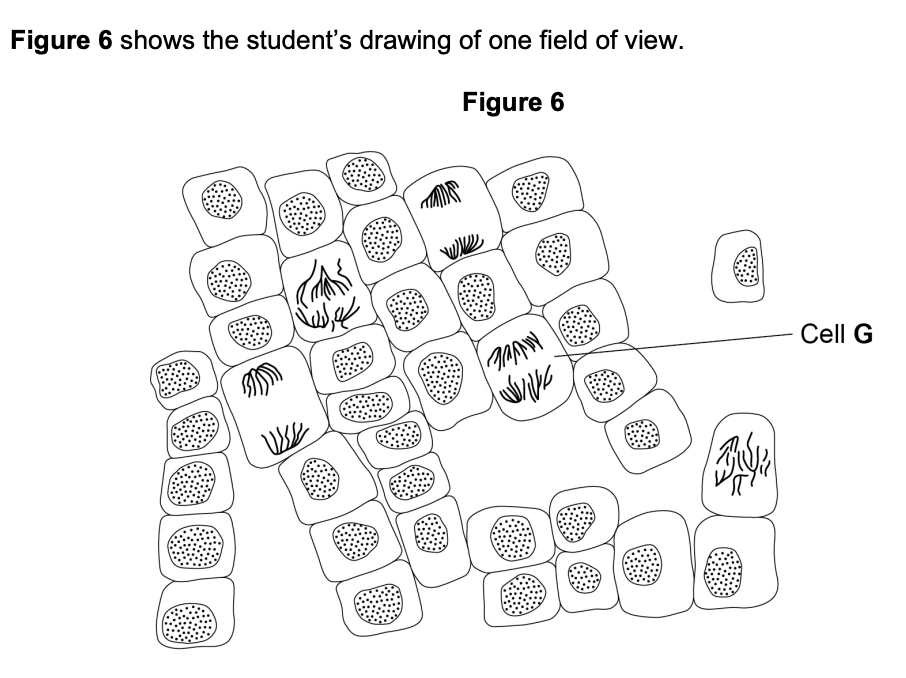
Answer
Mark Scheme
- 0.1 / 0.13 / 0.128 (1 mark)
Comments from mark scheme
Accept any correct rounding of 0.128205128205128 Reject answers expressed as a percentage
Tips from examiner reports
- The mitotic index is a proportion/decimal — don’t convert it to a percentage unless asked
Other students in the class followed the same method, but calculated different mitotic indices. Apart from student errors, suggest two explanations why.
(2 marks)Answer
Mark Scheme
- (Garlic roots) are a different age OR (Garlic) grown in different conditions (1 mark)
- (Root tips) from different (garlic) plants/bulbs/species (1 mark)
- Single field of view is not representative of a root tip OR (Other) students may have looked at more fields of view OR (Other) students may have calculated a mean (1 mark)
- (Different fields of view are from) different parts of the root tip (1 mark)
- Cells/roots undergo mitosis/cell division at different times/rates (1 mark)
Comments from mark scheme
- Accept suitable descriptions of conditions, eg in different temperatures
- Accept ‘samples’ for ‘fields of view’
- Reject different sized fields of view
- Reject different number of cells (per field of view)
Tips from examiner reports
- The mitotic index is a proportion, so having more or fewer cells in the field of view doesn’t change it
- Don’t include student errors if the question says ‘apart from student errors’
- Don’t say students used a different method if the question says they all followed the same method
Complete the following definitions. The genome is = The proteome is =
(2 marks)Answer
Mark Scheme
- Genome 1. (The) complete set of genes in a cell/organism OR (All) the DNA in a cell/organism (1 mark)
- Proteome 2. Range of proteins that a cell/organism can produce OR Range of proteins the genome/DNA can code for (1 mark)
Comments from mark scheme
- Accept (all) the genes/alleles/ genetic material/ genetic code in a cell/organism
- Accept the total number of DNA bases in a cell/organism
- Reject all the DNA/genes within a species/ population
- Do not accept number of proteins unqualified
- Ignore range of proteins that a species/population can produce
Tips from examiner reports
- Genome = all the DNA/genes of an organism — don’t confuse with genotype (alleles of an individual)
- Proteome = all the proteins a cell/organism can produce — must include ‘can produce’ or ‘coded for by the genome’
- Don’t confuse proteome with phenotype
Recombinant DNA technology can involve the transfer of fragments of human DNA into bacteria. The bacteria are then used to produce human proteins.
Give two reasons why bacteria are able to use human DNA to produce human proteins.
(2 marks)Answer
Mark Scheme
- (The) genetic/DNA code is universal OR The same triplets/codons code for the same amino acids (in all species) (1 mark)
- (The mechanism of) transcription is universal (1 mark)
- (The mechanism of) translation is universal (1 mark)
Comments from mark scheme
- Do not accept ‘DNA is universal’ unqualified
- Reject the genetic code is degenerate
- Ignore anything after ‘genetic/DNA code is universal’ unless incorrect
- and 3. Accept descriptions of universal, eg transcription/ translation are the same in humans and bacteria
- and 3. If neither is stated, accept ‘(the mechanism of) protein synthesis is universal’ for 1 mark
- Accept bacteria have ribosomes, and so could translate (human mRNA)
Tips from examiner reports
- The genetic code is universal means the same codons code for the same amino acids in all organisms
- Don’t confuse universal with degenerate (degenerate means more than one codon can code for the same amino acid)
- This question isn’t about genetic engineering techniques (sticky ends, plasmids, etc.)
Suggest and explain one reason why bacteria might not be able to produce every human protein.
(1 marks)Answer
Mark Scheme
- Cannot splice (pre-mRNA), so cannot remove introns OR Do not have Golgi (apparatus), so cannot process/modify (proteins) OR Do not have transcriptional factors (required), so cannot carry out transcription/produce mRNA (1 mark)
Comments from mark scheme
Accept do not have spliceosomes/ spliceozyme for cannot splice Accept ‘rough endoplasmic reticulum’ for ‘Golgi’ Accept (human protein) is too complex and bacteria do not have Golgi (apparatus)
Tips from examiner reports
- Bacteria cannot splice mRNA — they don’t remove introns, so a human gene with introns would produce incorrect mRNA in bacteria
- Both suggest AND explain: say ‘bacteria cannot splice out introns’ AND explain why this means the correct protein wouldn’t be made
Antithrombin is a protein. Antithrombin prevents blood from clotting too much. Some people have a deficiency of antithrombin in their blood, so they need to inject the protein. Genetically modified goats are used to produce this protein. The human antithrombin gene is transferred into goat embryos. The adult goats then make human antithrombin protein. Figure 7 shows an example of a DNA fragment that can be transferred into the cells of goats.
The enhancer stimulates region M.
Name regions M and N shown in Figure 7

Answer
Mark Scheme
- (Region M) promoter (1 mark)
- (Region N) terminator (1 mark)
Tips from examiner reports
- Know the difference between promoters, exons, introns, and regulatory sequences in DNA
- Don’t confuse VNTRs with start/stop codons or introns/exons
Explain the purpose of the marker gene.
(1 marks)Answer
Mark Scheme
- Shows that the (antithrombin) gene has been taken up (by cells/embryos/goats) OR Shows transgenic/transformed goat cells/goat embryos/goats OR Allows detection of genetically modified cells/ organisms/mammals/goats (1 mark)
Tips from examiner reports
- Give a specific, detailed answer — ‘to see the gene’ is too vague
- Explain the purpose of each technique clearly
The enhancer only stimulates region M in the milk-producing glands of a goat.
Suggest two explanations for the importance of the enhancer being included in the DNA fragment transferred.
(2 marks)Answer
Mark Scheme
- Milk/protein/antithrombin is easy to extract from a goat OR Extracting milk/protein/antithrombin from a goat does it no harm (1 mark)
- If (antithrombin was produced) in their blood, could prevent/affect clotting OR (Antithrombin) could damage other cells (1 mark)
Tips from examiner reports
- Read the whole question including the introductory text
- An enhancer is a regulatory sequence that increases transcription — don’t confuse it with a promoter
- If a protein is produced in milk, it can be harvested without harming the animal
- Proteins in milk are not inherited by offspring — they are produced by the mother’s mammary glands
Mature leaves from slow-growing, shade-tolerant plants produce poisonous chemicals that are a defence against being eaten by herbivores.
Suggest how this benefits slow-growing, shade-tolerant plants.
(2 marks)Answer
Mark Scheme
- (In the shade, so) less/slower rate of photosynthesis (1 mark)
- (Slow-growing, so) would take a long time to replace (mature leaves) OR Leaves more likely to reach maturity OR Leaves take a long time to mature (1 mark)
- Plants can maintain (a large enough) surface area for photosynthesis OR Plants can absorb enough light (1 mark)
Comments from mark scheme
- Accept any named aspect of photosynthesis that uses light, eg LDR, photoionisation
- Accept would take a long time to make cellulose or any other correct named compound
Tips from examiner reports
- Read the question carefully — address the specific aspects mentioned (e.g. ‘slow-growing’ and ‘shade-tolerant’)
- Don’t just repeat the stem or say ‘they survive because they’re not eaten’
- Herbivores are not ‘predators’ of plants — use correct ecological terms
Scientists measured the concentration of poisonous chemicals produced by box shade-tolerant plant species in six taxa. They compared this with the mean concentration of poisonous chemicals produced by all plants and the phylogenetic relationships between the six taxa. Figure 9 shows the scientists’ results.
A journalist published the following summary of these results. ‘The more recently a shade-tolerant plant species evolved, the greater the concentration of poisonous chemicals it produces.’
Do the data in Figure 9 support this summary?
Justify your answer
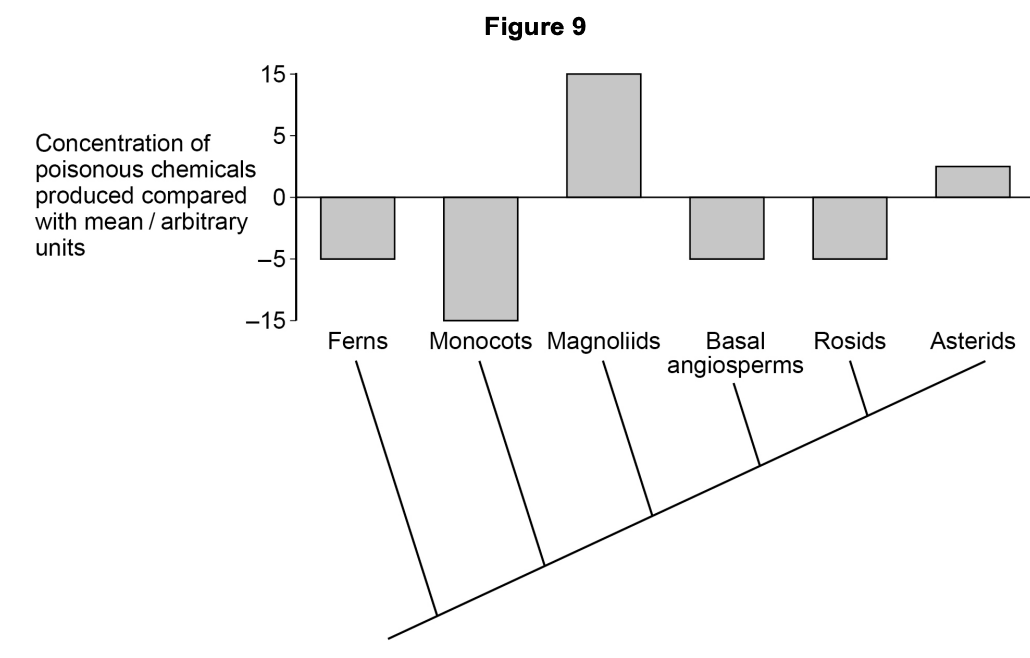
Answer
Mark Scheme
- Yes (no mark) 1. The most recently evolved species/asterids produce more than the mean concentration (1 mark)
-
- The least recently evolved species/ferns produce less than the mean concentration (1 mark)
- No (no mark) 3. The highest concentration was not in the most recently evolved species/asterids OR The highest concentration was in magnoliids OR Magnoliids produce more than more recently evolved species/basal angiosperms/rosids/ asterids (1 mark)
-
- The lowest concentration was not in the least recently evolved species/ferns OR The lowest concentration was in monocots OR Monocots evolved more recently but produce a lower concentration than ferns (1 mark)
-
- The least recently evolved species/ferns have the same concentration as more recently evolved species/basal angiosperms/rosids (1 mark)
-
- Basal angiosperms and rosids have the same concentration but evolved at different times (1 mark)
Comments from mark scheme
Ignore answers relating to no statistical testing Accept ‘newest species’ for most recently evolved species/asterids Accept ‘oldest species’ for least recently evolved species/ferns
Tips from examiner reports
- Read phylogenetic trees carefully — check which end shows the most recent species
- Use data to justify your answer, not rote-learned phrases like ‘no stats test’
- Don’t give multiple alternatives as your single answer
The uses and importance of ATP in organisms
(25 marks)Answer
Mark Scheme
- No mark scheme available
Tips from examiner reports
- If the essay title is about the use of ATP, focus on how ATP is used, not how it’s made
- Don’t write pages describing how ATP is produced in respiration/photosynthesis if the question asks about its use
- Active transport uses carrier proteins, not channel proteins
- Link the importance of ATP back to the specific process, don’t just say ‘ATP is needed for this’
- Water in photosynthesis undergoes photolysis, not hydrolysis
The importance of cycles in biology
(25 marks)Answer
Mark Scheme
- No mark scheme available
Tips from examiner reports
- Focus on the cyclic elements if the essay is about cycles — don’t describe the whole of photosynthesis or respiration
- Complete the cycle in your description — e.g. show how RuBP is regenerated in the Calvin cycle
- Interphase is part of the cell cycle, not a stage of mitosis
- For ‘importance of’, go beyond GCSE-level statements like ‘without respiration we would die’
- The menstrual cycle or water cycle at GCSE level does not count as beyond-specification material
In one species of squirrel, Sciurus carolinensis, fur colour is controlled by one gene, with two codominant alleles. CG represents the allele for grey fur colour, and CB represents the allele for black fur colour.
Table 1 shows the three possible phenotypes
In a population of 34 S. carolinensis, 2 had black fur.
Use the Hardy–Weinberg equation to estimate how many squirrels in this population had brown-black fur. Show your working.
**CHECK FORMATTING
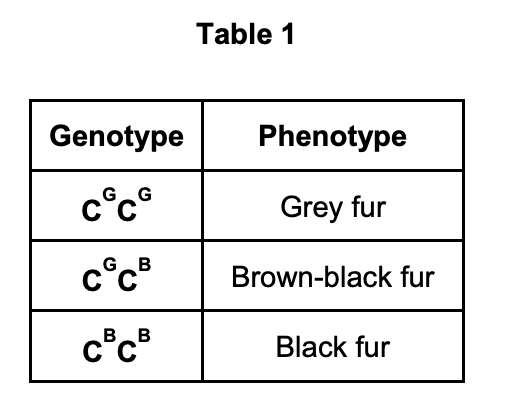
Answer
Mark Scheme
- Answer of 12/13 = 2 marks (1 mark)
- 0.36(48)/0.365/0.37 = 1 mark (1 mark)
Tips from examiner reports
- Identify a clear starting point for calculations — don’t try to solve everything as algebra
- Show your working step by step
The actual number of squirrels in this population that had brown-black fur was 16. Use all of the information to calculate the actual frequency of the CG allele. Do not use the Hardy–Weinberg equation in your calculation.
Give your answer to 2 decimal places.
(1 marks)Answer
Mark Scheme
- 0.71 (1 mark)
Tips from examiner reports
- Allele frequencies must add up to 1 — if the question gives you some, calculate the rest
- Don’t use Hardy-Weinberg if the question says not to
- Your answer should be a frequency (between 0 and 1)
S. carolinensis were first introduced to the UK from North America in the 1870s. They are now widely distributed across the UK. S. carolinensis from both North America and the UK show exactly the same genotypic and phenotypic variation. An identical mutation causing black fur has also been found in several other species closely related to S. carolinensis.
Use this information to deduce which one of the following conclusions is most likely true.
Tick (✓) one box.
a) The mutation that caused black fur happened after S. carolinensis was introduced to the UK from North America. b) The mutation that caused black fur happened in a common ancestor of S. carolinensis and other closely related species. c) The mutation that caused black fur happened independently in S. carolinensis and all other closely related species. d) The phenotypic variation shown in S. carolinensis and other closely related species is caused by genetic drif
(1 marks)Answer
Mark Scheme
- B = The mutation that caused black fur happened in a common ancestor of S. carolinensis and other closely related species. (1 mark)
Tips from examiner reports
- Read all options carefully in multiple choice before selecting your answer
The mutation that caused the CB allele was due to a 24 base-pair deletion from the CG allele.
The protein coded for by the CB allele is 306 amino acids long. Calculate the percentage reduction in size of the protein coded for by the CB allele compared with the protein coded for by the CG allele.
Give your answer to 3 significant figures and show your working.
** CHECK FORMATTING
(2 marks)Answer
Mark Scheme
- 2.55% = 2 marks (1 mark)
- 2.61% = 1 mark (question misread ie 8/306x100) (1 mark)
Tips from examiner reports
- Identify which data to use from figures and tables — read labels carefully
- Percentage change = (new - original) / original × 100
In S. carolinensis, fur colour depends on the distribution and relative amounts of light pigments and dark pigments in the hairs of the fur. Figure 1 shows how the protein produced from the CG allele can result in the production of a light pigment or a dark pigment.
The deletion mutation in the CB allele results in the production of a receptor protein that does not have glutamic acid. The lack of glutamic acid in the receptor protein has the same effect as αMSH leaving the receptor protein. 0 1 . 5 Use Figure 1 and this information to suggest why S. carolinensis with the genotype CB CB have black fur rather than grey fur.
** CHECK FORMATTING
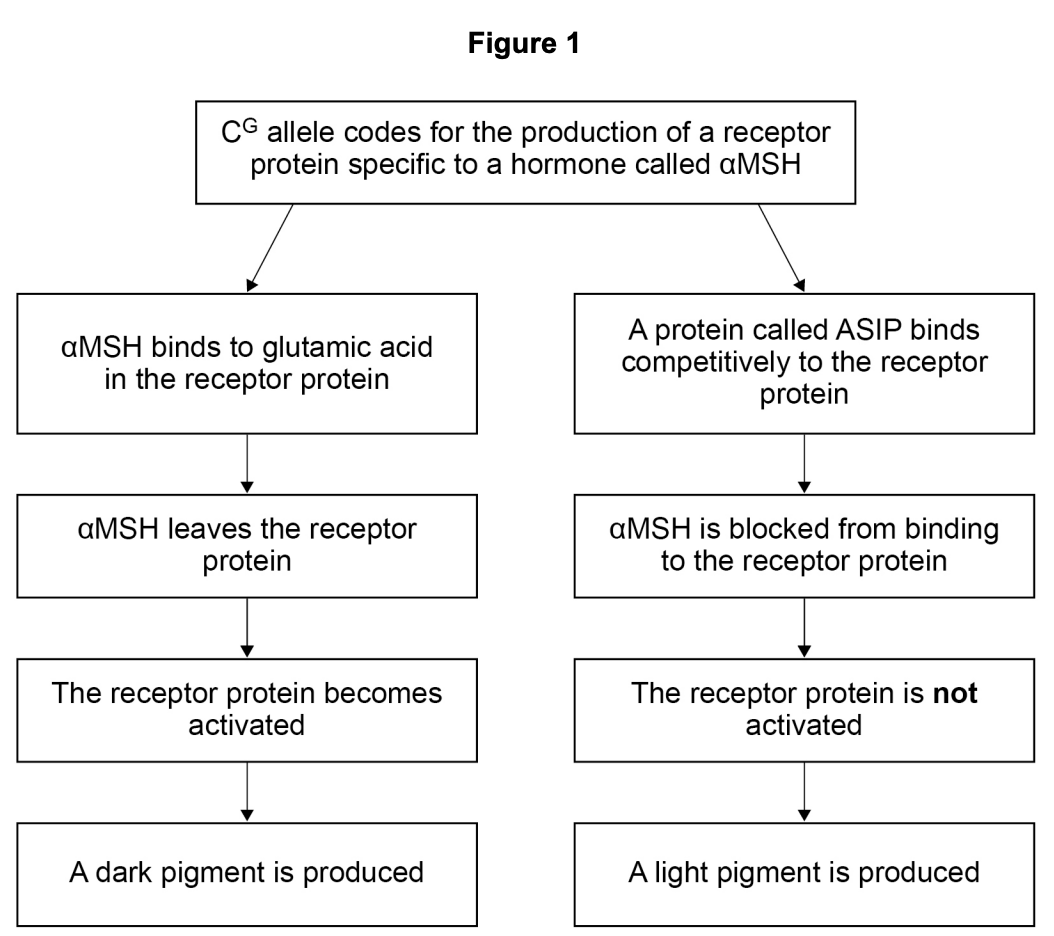
Answer
Mark Scheme
- Mutation/lack of glutamic acid leads to (permanent) activation of the receptor/protein (1 mark)
- (Because) the receptor/protein does not require the binding/leaving of αMSH (to become activated) (1 mark)
- ASIP (might) not (be) able to bind to the receptor/protein (1 mark)
- (Only) the dark pigment is produced (1 mark)
Comments from mark scheme
- Answer must convey the idea that binding/leaving is not required
Tips from examiner reports
- Don’t repeat the question stem as your answer — it rarely scores marks
- Use ALL the information in the figure, not just part of it
- Don’t misinterpret the data — read the figure legend carefully
Describe how the human immunodeficiency virus (HIV) is replicated once inside helper T cells (TH cells).
(4 marks)Answer
Mark Scheme
- RNA converted into DNA using reverse transcriptase (1 mark)
- DNA incorporated/inserted into (helper T cell) DNA/chromosome/genome/nucleus (1 mark)
- DNA transcribed into (HIV m)RNA (1 mark)
- (HIV mRNA) translated into (new) HIV/viral proteins (for assembly into viral particles) (1 mark)
Comments from mark scheme
- Reject ‘messenger’ or ‘m’ before RNA
- Accept descriptions of transcription
- Accept descriptions of translation
- Accept named viral protein, eg capsid
- Reject viral cells
Tips from examiner reports
- For virus replication: attachment → entry of genetic material → host cell produces viral components → assembly → release
- Be specific — say ‘host cell ribosomes translate viral mRNA’ not just ‘cell machinery makes new viruses’
HIV-1 is the most common type of HIV. HIV-1 binds to a receptor on TH cells called box CCR5. Current treatment for HIV-1 involves the use of daily antiretroviral therapy (ART) to stop the virus being replicated. Only 59% of HIV-positive individuals have access to ART. Scientists have found that two HIV-1-positive patients (P and Q) have gone into remission (have no detectable HIV-1). This happened after a blood stem cell transplant (BSCT).
Use the information given to evaluate the use of BSCT to treat HIV infections.
- Patient P was given two BSCTs, and patient Q was given one BSCT.
- All BSCTs came from a donor with TH cells without the CCR5 receptor.
- In addition, patient P had radiotherapy, and patient Q had chemotherapy. Both of these treatments are toxic.
- Both patients (P and Q) stopped receiving ART 16 months after BSCT. 18 months after stopping ART, both patients had no HIV-1 RNA in their plasma, no HIV-1 DNA in their TH cells and no CCR5 on their TH cells.
Answer
Mark Scheme
- For 1. (There appears to be) no virus/ HIV(-1)/RNA/DNA, so could be a cure/effective (1 mark)
-
- No CCR5/receptor, so not get HIV(-1) in the future OR No CCR5/receptor, so nothing for HIV(-1) to bind to (1 mark)
-
- Only one transplant/BSCT needed (shown by patient Q) 4. Would not need (daily) ART (16 months after BSCT) (1 mark)
- Against 5. Don’t know if chemotherapy/radiotherapy is needed OR Do not know if BSCT alone would be effective (1 mark)
- OR Do not know which treatment is having the effect OR Could be due to chemotherapy/radiotherapy (1 mark)
-
- Only for HIV-1 (1 mark)
-
- Don’t know if it would work in all people OR Only worked/tried in 2 cases (1 mark)
-
- Might not be long term OR Only 18 months (1 mark)
-
- HIV-1 may mutate and be able to bind to a different receptor (on TH cells) (1 mark)
-
- Might be a lack of (suitable stem cell/BSCT) donors (1 mark)
Comments from mark scheme
Max 4 for reasons for or against
- Ignore virus is killed
- Reject less CCR5/less HIV(-1) bind
- Accept: chemotherapy/radiotherapy is toxic/harmful/has sideeffects
- Accept: Might not work in other types of HIV
- Accept stem cells/BSCT (might be) rejected
Tips from examiner reports
- Evaluate in context — don’t give generic rote-learned responses (‘no control’, ‘no stats test’, ‘small sample size’) without checking if they apply
- Read the scenario carefully — is it a controlled trial or an accidental discovery?
Scientists investigated movement in adult pine beetles. Adult beetles emerge from box cracks in tree bark.
The scientists released a newly emerged adult beetle, G, from the centre of a sample area that had a single light source coming from one direction. They made a drawing of the beetle’s path of walking. They repeated this with three more beetles, J, P and R.
Figure 2 shows the scientists’ results.
Name the type of behaviour shown by beetles G, J, P and R, and suggest one advantage to adult beetles of the type of behaviour shown. Behaviour = Advantage =
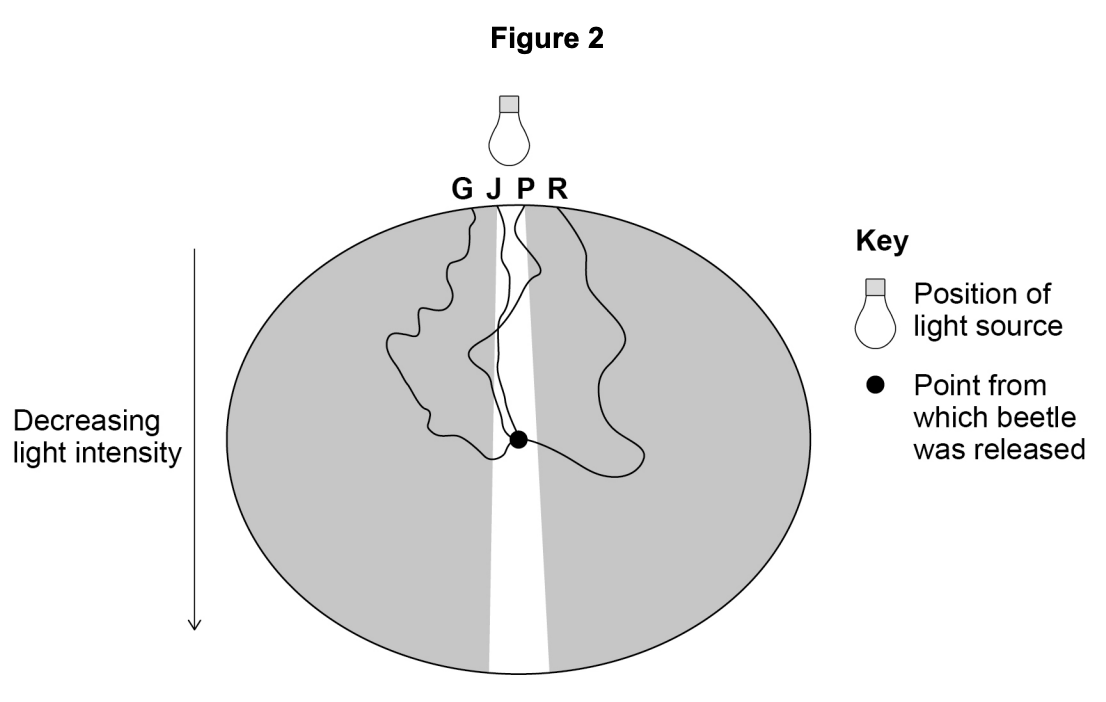
Answer
Mark Scheme
- Behaviour 1. (Positive photo) taxis (1 mark)
- Advantage 2. Accept any suitable suggestion, eg to avoid competition, to find a mate, increase dispersal, to avoid predators (1 mark)
Comments from mark scheme
- Reject negative (photo) taxis
- Neutral – to move into the open or to move out of the tree bark
Tips from examiner reports
- Taxis is movement towards or away from a stimulus; kinesis is a change in speed or rate of turning
- Read the data carefully — if beetles move towards light, don’t say they move away
- Beetles don’t photosynthesise — they’re animals
At higher temperatures and higher light intensities, adult pine beetles normally box
When preparing to fly, these adult beetles walk slowly. The scientists investigated the movement of adult beetles at different temperatures, and in the light and the dark. They created a box that was half in the light and half in the dark. They released an adult beetle at the midpoint of the central dividing line between light and dark areas. They recorded the path of the beetle’s movement and its location after 5 minutes. From this, they calculated the mean speed of movement. They repeated the experiment with many beetles and at several temperatures.
Figure 3 shows the scientists’ results.
After studying these experiments, a student concluded:
Suggest reasons why these conclusions might not be valid.
-
move more
-
fly rather than walk.
-
there is a significant change in movement between 35 °C and 37.5 °C
-
between 35 °C and 37.5 °C, more beetles move away from the light
-
between 35 °C and 37.5 °C, more beetles have a slower walking speed.
Answer
Mark Scheme
- No stats test, so do not know if change (in movement away from light) is significant (1 mark)
- Between 35 °C and 36.5 °C more than half of beetles are still found on the light side (1 mark)
- (At higher temperatures/above 35 °C) beetles might be flying (not walking) OR (Y-axis) states speed of movement, might not just be walking speed (1 mark)
- Slowing of movement happens before 35 °C (1 mark)
- Slowing of movement could be due to beetles preparing to fly (and not temperature) (1 mark)
- Speed (of movement) not recorded above 35 °C/ between 35 and 37.5 °C/between 35 and 40 °C; OR Speed (of movement) not recorded at 37.5 °C (1 mark)
- (Mean speed could mean) some might walk very quickly and others stay still/not move (1 mark)
Tips from examiner reports
- If the question asks why conclusions might NOT be valid, give reasons against validity
- Don’t give rote-learned answers like ‘small sample size’ if the question states many repeats were done
- Read the stem carefully before answering
Freshwater marshes have one of the highest rates of gross primary production (GPP) and net primary production (NPP) of all ecosystems.
Carbon use efficiency (CUE) is the ratio of NPP:GPP. Freshwater marshes have a high CUE.
Use your knowledge of NPP to explain why freshwater marshes have a high CUE and the advantage of this. Do not refer to abiotic factors in your answer.
(2 marks)Answer
Mark Scheme
- Low respiration (1 mark)
- More growth/biomass/colonisation (1 mark)
Comments from mark scheme
- Accept less energy lost in respiration
- Allow examples of more carboncontaining molecules eg glucose
Tips from examiner reports
- GPP and NPP relate to plants (producers), not animals
- NPP = GPP - respiratory losses
- Carbon dioxide is needed for photosynthesis, not respiration (in plants, CO₂ is used in the Calvin cycle)
Freshwater marsh soils are normally waterlogged. This creates anaerobic conditions.
Use your knowledge of the nitrogen cycle to suggest why these soils contain relatively high concentrations of ammonium compounds and low concentrations of nitrite ions and nitrate ions.
(2 marks)Answer
Mark Scheme
- Less nitrification OR Fewer/less active nitrifying bacteria; OR Nitrification/nitrifying bacteria require oxygen/aerobic conditions (1 mark)
- (Less) oxidation/conversion of ammonium (ions) to nitrite (ions) and to nitrate (ions) (1 mark)
- More denitrification OR More/more active denitrifying bacteria OR Denitrification/denitrifying bacteria do not require oxygen OR Denitrification/denitrifying bacteria require anaerobic conditions (1 mark)
- (So more) nitrate (ions) reduced/converted to nitrogen (gas) (1 mark)
Comments from mark scheme
- Order must be nitrite then nitrate
- Accept ammonia for ammonium ions
- Accept correct chemical formulae for ions, eg there will be little oxidation/conversion of NH4 + → NO2 - → NO3 -
- Ignore ‘breakdown’ for oxidation/conversion
- Accept correct chemical formulae eg So more NO3 - reduced/converted to N₂;
Tips from examiner reports
- Know the nitrogen cycle: saprobionts decompose organic matter → ammonification → nitrification (NH₄⁺ → NO₂⁻ → NO₃⁻) → uptake by plants
- Don’t say saprobionts are anaerobic (most are aerobic) or that nitrates are denitrified to ammonia (denitrification produces N₂)
State the assumption the student has made and suggest why this assumption might not be valid.
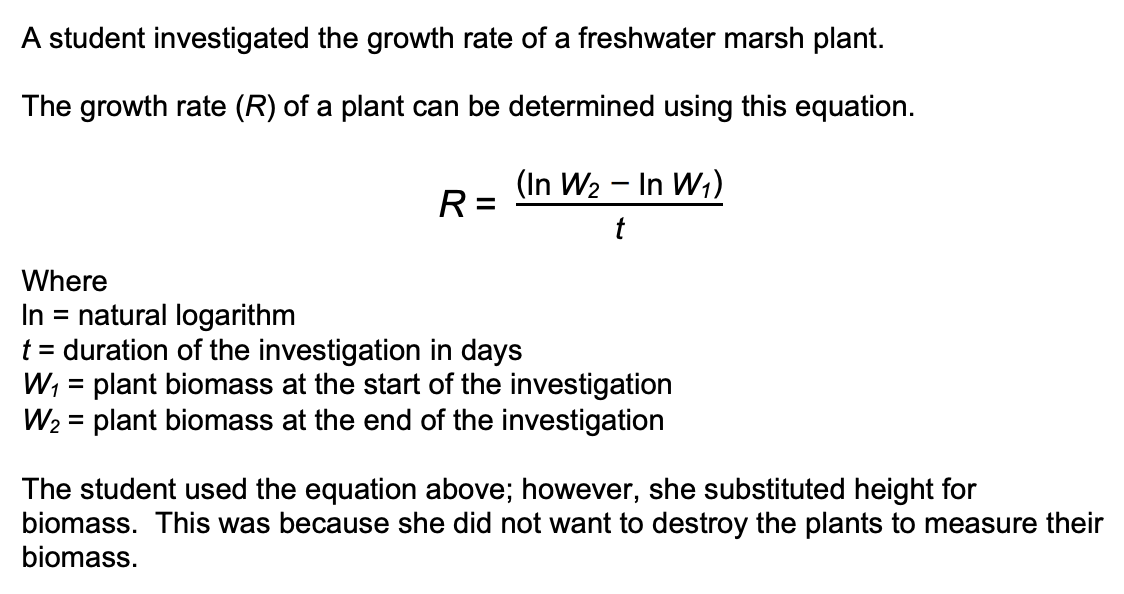
Answer
Mark Scheme
- Assumed that height is (directly) proportional to biomass (1 mark)
- (Plants may put biomass into) other named aspect of growth (other than height) OR Height does not include the roots OR Some increase in height results from water gain (1 mark)
Comments from mark scheme
- Accept descriptions of ‘is proportional to’, eg correlates to, is equivalent to
- Examples of other named aspects of growth could include root growth, flower/seed/fruit formation, lateral growth, wider leaves
Tips from examiner reports
- An assumption is something taken to be true without proof — state it clearly
- Biomass includes all organic material in an organism — it’s not the same as dry mass (though dry mass is used to estimate it)
At the end of the investigation, the student noted the freshwater marsh plant had grown 268 mm in height, and now measured 387 mm. She calculated the rate of growth (R) to be 0.097 mm m–1 day–1
Use this information and, substituting height for biomass, use the equation to calculate the duration of the student’s investigation.
Give your answer to the nearest full day. Show your working.
(2 marks)Answer
Mark Scheme
- Answer of 12 days = 2 marks (1 mark)
- 12.16 (12.15774433) = 1 mark (1 mark)
Tips from examiner reports
- Show your working clearly and calculate the starting value before finding the change
- Follow instructions about rounding (e.g. ‘to the nearest full day’)
The action of endopeptidases and exopeptidases can increase the rate of protein digestion. Describe how.
(2 marks)Answer
Mark Scheme
- Exopeptidases hydrolyse peptide bonds at the ends of a polypeptide/protein AND endopeptidases hydrolyse internal peptide bonds within a polypeptide/protein (1 mark)
- More ‘ends’ OR More surface area (1 mark)
Comments from mark scheme
- Reference to ‘hydrolyse’ required at least once
- Accept even if via action of incorrect enzyme
Tips from examiner reports
- Give full, detailed answers — a single mark point alone may not be enough
- Cover all parts of the specification for the topic
As humans age, there is a decrease in body protein.
Give the name of one body protein that could have resulted in:
- reduced muscle power =
- reduced immunity =
Answer
Mark Scheme
- Actin/myosin/tropomyosin (1 mark)
- Antibodies (1 mark)
Comments from mark scheme
- Accept troponin
- Accept ATP synthase/hydrolase
- Accept immunoglobulins
- Accept lysozyme
Tips from examiner reports
- Name specific proteins when asked for examples — starch and glycogen are not proteins
- For reduced immunity, name immune proteins (e.g. antibodies/immunoglobulins) not just ‘cells’
Scientists investigated the effect of two types of dietary protein on the ability of old men to produce body proteins.
Table 2 shows information about the two types of dietary protein investigated.
Figure 4 shows the percentage of protein absorbed that becomes body protein in old box men following a meal of casein or whey.
A statistical test confirmed that the difference between the results shown in Figure 4 was significant.
Suggest which type of dietary protein would be better for old men to eat to cause a net gain of body proteins.
Use the information provided to explain your answer
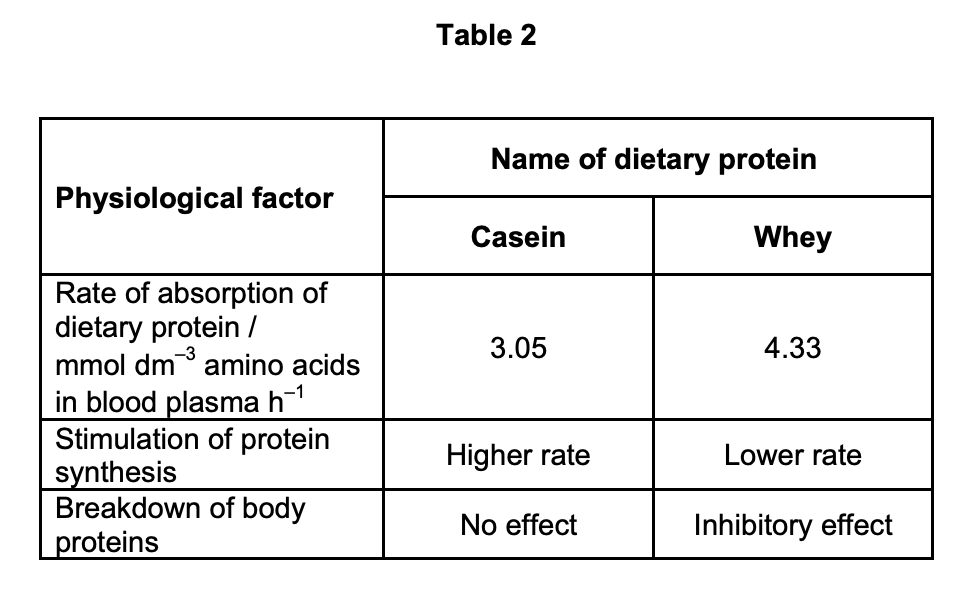
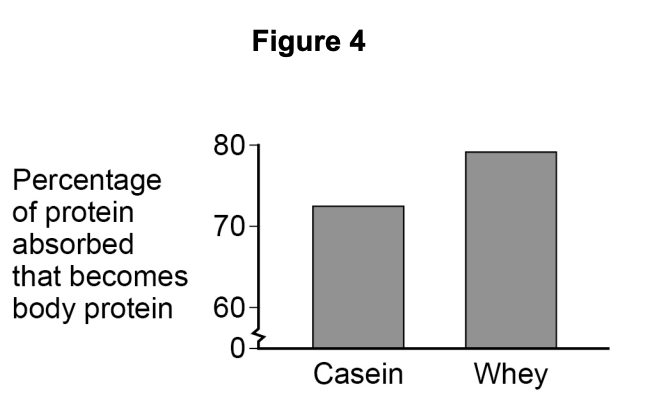
Answer
Mark Scheme
- Whey (no mark) as it: 1. Is absorbed quicker OR It has a faster/higher/greater/the highest/the greatest/the fastest rate of absorption (1 mark)
-
- Still stimulates/increases protein synthesis (even if lower than casein) (1 mark)
-
- Prevents/inhibits/limits breakdown of body proteins (1 mark)
-
- Significantly more becomes body protein (1 mark)
Comments from mark scheme
If student selects casein allow 1 mark only for ‘as it stimulates a higher rate of protein synthesis’
- and 4. Accept use of data to show differences
Tips from examiner reports
- If the question tells you a statistical test confirmed significance, don’t then say ‘no stats test was done’
- Read the stem carefully — it often gives you important information to use in your answer
Plants transport sucrose from leaves to other tissues for growth and storage. SUT1 is a sucrose co-transporter protein. Scientists investigated whether the cells of tobacco plant leaves used SUT1 to transport sucrose to other tissues.
The scientists used a radioactively labelled DNA probe to show that the cells of tobacco plant leaves contained the SUT1 gene.
Describe how they would do this. Do not include PCR in your answer.
(4 marks)Answer
Mark Scheme
- Extract DNA and add restriction endonucleases/restriction enzymes (1 mark)
- Separate fragments using electrophoresis (1 mark)
- (Treat DNA to) form single strands OR (Treat DNA to) expose bases (1 mark)
- The probe will bind to/hybridise/base pair with the SUT1/gene (1 mark)
- Use autoradiography (to show the bound probe) (1 mark)
Comments from mark scheme
- Ignore method used to separate strands
- Accept use photographic or X ray film (to show the bound probe)
- X rays alone is not sufficient
Tips from examiner reports
- Know the difference between DNA probes, marker genes, and primers — don’t confuse them
- A DNA probe is a short, labelled piece of single-stranded DNA that binds to a complementary sequence
- The probe can be labelled radioactively or fluorescently — state which is used in the question
To study the role of SUT1 in tobacco plants, scientists reduced the expression of the SUT1 gene.
When the SUT1 gene is transcribed, the SUT1 mRNA produced is called ‘sense’ SUT1 mRNA. The scientists genetically modified plants by inserting an extra gene so that this also allowed the production of ‘antisense’ SUT1 mRNA.
The scientists had two types of tobacco plants:
Suggest how the production of ‘antisense’ SUT1 mRNA in type A plants would reduce the expression of the SUT1 gene
- type A – plants that were genetically modified
- type B – plants that were not genetically modified.
Answer
Mark Scheme
- Antisense mRNA is complementary to ‘sense’ mRNA (1 mark)
- Antisense mRNA would bind/base pair to (sense) mRNA; OR Double stranded (m)RNA forms (1 mark)
- Ribosomes would not be able to bind (1 mark)
- Preventing/less translation (of mRNA) OR Preventing/less production of SUT1 (protein) (1 mark)
Comments from mark scheme
- Accept descriptions of translation
Tips from examiner reports
- Antisense mRNA binds to (complementary) mRNA, preventing translation — it does NOT bind to the gene or make a wrong protein
- Say ‘translation of the mRNA is prevented’ not ‘translation of the gene is prevented’ — genes are transcribed, mRNA is translated
The scientists hypothesised that lower rates of sucrose transport from leaves would cause reduced growth. To test this hypothesis, the scientists provided leaves of type A and type B plants with labelled carbon dioxide (¹⁴CO₂). To estimate sucrose transport out of leaves, they measured the percentage of 14C remaining in the leaves for 16 hours. Figure 5 shows their results
Calculate the ratio of percentage of 14C remaining in leaves of type B to type A plants 16 hours after providing ¹⁴CO₂
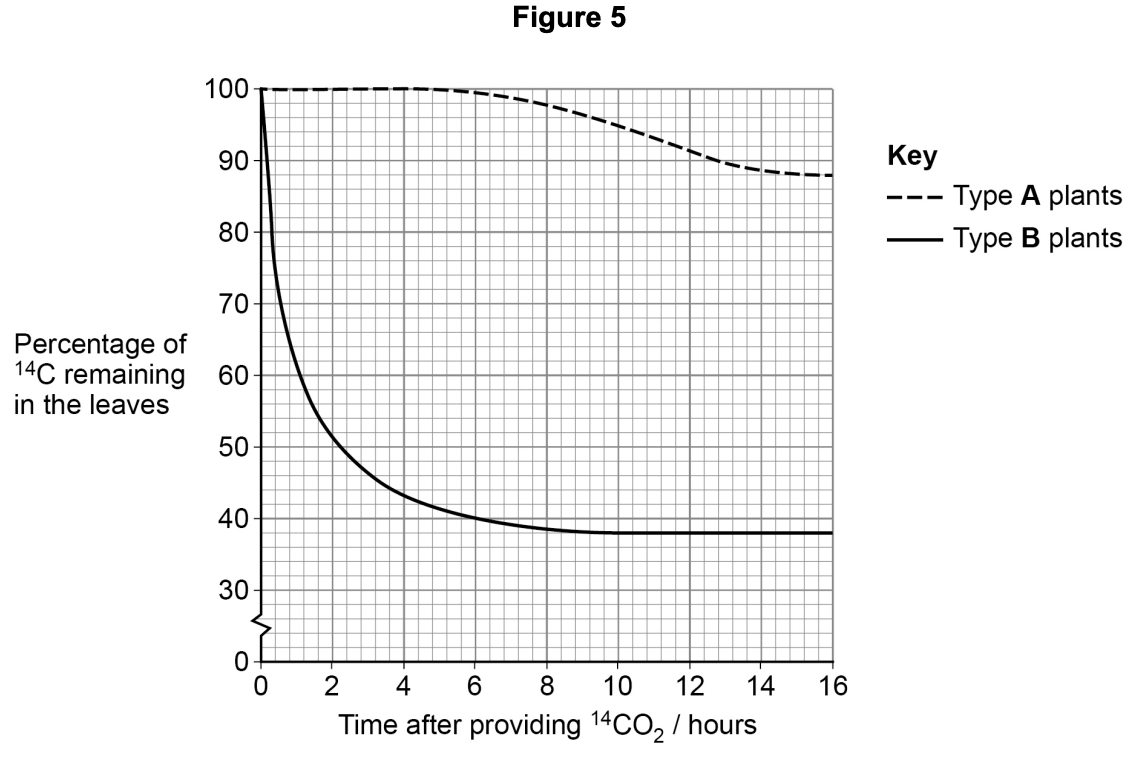
Answer
Mark Scheme
- 0.4 (318): 1 (1 mark)
Tips from examiner reports
- Express ratios as ‘something to 1’ in biology — simplify both numbers by dividing by the smaller one
In type B plants, the percentage of 14C remaining in the leaves does not reach zero per cent, as shown in Figure 5.
Suggest two reasons why.
(2 marks)Answer
Mark Scheme
- Some (¹⁴CO₂) used to make cellulose/cell walls (1 mark)
- Some (¹⁴CO₂) converted into starch (which remains in the leaf) (1 mark)
- Not all (¹⁴CO₂) fixed/used in photosynthesis; OR Not enough RuBP (to combine with all of the14CO2) (1 mark)
- Some used to reform RuBP OR Some (is still) in glycerate 3-phosphate/GP/triose phosphate/in the Calvin cycle (1 mark)
Comments from mark scheme
- Accept some becomes lipids/ proteins/DNA/RNA/ nucleotides
- Accept some (¹⁴CO₂) converted into glucose
- Accept descriptions of this
Tips from examiner reports
- Read the question carefully — ¹⁴C is a radioactive isotope of carbon, not the same as ¹⁴CO₂
- Carbon from ¹⁴CO₂ enters organic molecules via photosynthesis (Calvin cycle) — some remains in these molecules even when the ¹⁴CO₂ supply stops
The scientists measured physiological differences between type A plants and box type B plants. Table 3 shows the scientists’ results as they presented them.
Sucrose is able to inhibit the production and activity of rubisco in box leaves of a plant. Type A plants have decreased dry mass compared with type B plants.
Use all the information to suggest and explain how the physiological factors in Table 3 would contribute to the decreased dry mass observed in type A plants
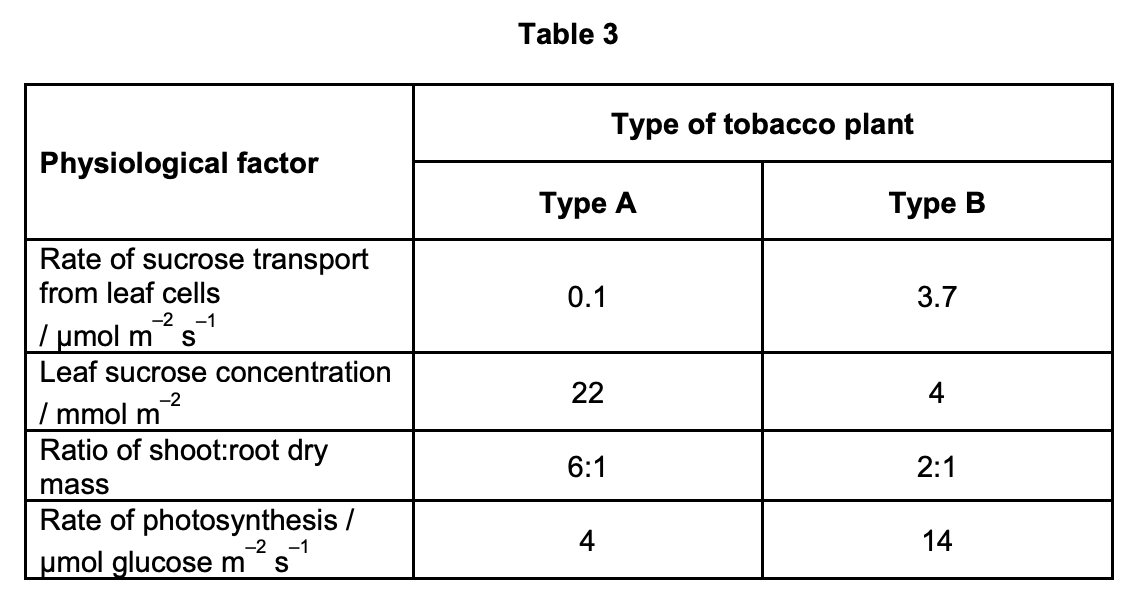
Answer
Mark Scheme
- Reduced SUT1 expression/less SUT 1 (protein) means less sucrose exported (so concentration increases in leaves); 4 max (1 mark)
- (Increased sucrose in leaves) inhibits rubisco, so less ¹⁴CO₂ fixed into GP; OR (Increased sucrose in leaves) inhibits rubisco, so less ¹⁴CO₂ combines with RuBP; OR (Increased sucrose in leaves) inhibits rubisco, so less Calvin cycle/light independent reaction/s (1 mark)
- Less sucrose transported to roots, so roots do not develop/grow (as shown by larger shoot to root dry mass ratio) (1 mark)
- Roots less developed so fewer minerals available for growth (1 mark)
- Less growth means less dry mass (1 mark)
Comments from mark scheme
- Accept less rubisco or less active rubisco for ‘inhibits rubisco’
- Accept: roots less developed so less water available for photosynthesis
- Accept: less photosynthesis/light independent reaction/s means less dry mass;
Tips from examiner reports
- Link your answer to the specific context — e.g. how does this affect root development or growth?
- Say ‘minerals’ or ‘mineral ions’ not just ‘nutrients’ when discussing absorption by roots
The importance of complementary shapes of molecules in organisms
(25 marks)Answer
Mark Scheme
- No mark scheme available
Tips from examiner reports
- In essays, use the induced-fit model (A-level), not just lock and key (GCSE)
- Complementary shapes specifically refers to molecular shapes fitting together (like enzyme and substrate) — not all binding is due to complementary shapes (e.g. oxygen binds to haemoglobin via coordinate bonds)
- Only discuss topics relevant to the essay title — in vitro cloning and ELISA aren’t relevant if the title says ‘in organisms’
- For ‘importance of’, give A-level depth explanations, not just ‘without it we would die’
The importance of ions in metabolic processes
(25 marks)Answer
Mark Scheme
- No mark scheme available
Tips from examiner reports
- In essays about ions, explain why each ion is important for the specific metabolic process
- Include consequences of the ion being absent or the process failing
- Hydrogen ions in the electron transfer chain are NOT actively transported — they move down their electrochemical gradient through ATP synthase
Guppies are small fish. Female guppies are dull in colour. Male guppies can be bright or dull in colour.
Scientists investigated the effect of female brain size on choosing a mate. They used laboratory-bred female guppies with large brains and with small brains. They set up a fish tank as shown in Figure 1.
They observed each female for 10 minutes and recorded which male they were attracted towards. They repeated this with 45 large-brained females and 45 small-brained females.
Suggest three possible limitations of this investigation.
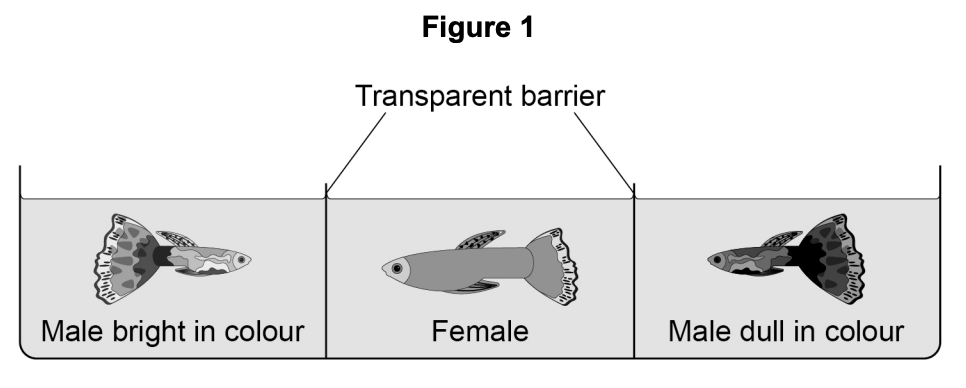
Answer
Mark Scheme
- Laboratory-raised female (guppies) might not react/behave/choose in the same way (as wild guppies) (1 mark)
- (Transparent) barrier might not allow for normal (courtship) behaviour/interaction (1 mark)
- Do not know if (guppies) have been used in previous experiments (1 mark)
- 10 minutes might not be long enough for females to make a (final) choice OR Not enough time for females to make a (final) choice (1 mark)
Comments from mark scheme
Ignore answers relating to sample size
- Accept laboratoryraised female (guppies) might not be representative of wild females
- Accept choice might involve chemical/ mechanical signals/interaction
- Accept colour might not be the only thing females are attracted to
- Accept descriptions of a choice eg ‘show attraction’
Tips from examiner reports
Only 1.42% scored all 3 marks. ‘Limitation’ means a restriction of the investigation — not expected results or improvements. Give the limitation AND explain why it is a problem. Rote-learnt phrases (‘no control’, ‘don’t know long-term effects’) without context scored zero.
Guppies with large brains are better at identifying predators. box The scientists found that only female guppies with large brains were attracted to male guppies bright in colour.
Suggest and explain the advantage of this behaviour to the population of guppies
(3 marks)Answer
Mark Scheme
- (Females with large brains) will mate with males bright in colour (1 mark)
- Their (male) offspring would be (more likely to be) bright in colour (1 mark)
- (Bright in colour male) offspring could attract larger brained females (1 mark)
- The population/offspring could (evolve to) have larger brains (1 mark)
- The population/offspring are better at identifying/avoiding predators (1 mark)
Comments from mark scheme
Accept answers that include references to alleles 4. and 5. Ignore answers relating to females only
Tips from examiner reports
Roughly 20% scored 1, 2 and 3 marks respectively. Common error: stating females with large brains would ‘tell’ brightly coloured males about predators — this anthropomorphises animal behaviour.
Describe how the behaviour of female guppies could result in sympatric speciation
(3 marks)Answer
Mark Scheme
- Not geographically isolated (1 mark)
- (Leading to) reproductive isolation OR Gene pools kept separate (1 mark)
- Changes in allele frequencies (1 mark)
- Cannot breed/mate to produce fertile offspring (1 mark)
Comments from mark scheme
- Accept are in the same area
- Accept large brained females will only mate with males bright in colour and small brained females will only mate with males dull in colour
- Reject gene frequencies
- Reject inbreeding
Tips from examiner reports
Discriminated well. Most students missed the key idea of sympatric speciation (no geographical barrier). Genetic drift was frequently misused. Answers described how a species changes over time but not how it splits into two separate species.
In northern India, there is a conflict of interests between farmers of livestock (eg cows) and people trying to conserve ibex (a type of wild goat). When livestock are given extra food, their populations can grow too large and compete with ibex.
Name the type of competition between livestock and ibex.
(1 marks)Answer
Mark Scheme
- Interspecific (competition) (1 mark)
Tips from examiner reports
60% scored the mark. ‘Interspecies’ instead of ‘interspecific’ was wrong. Students incorrectly thought they had to name what livestock and ibex compete for.
Livestock will outcompete ibex if they:
- are in the same habitat
- eat a similar diet. Scientists investigated this conflict of interests. Table 1 summarises some of the scientists’ findings.
There must be a balance between the need for conservation of the ibex and the need for farmers to keep livestock.
Using all the information, suggest and explain three actions that the farmers could take to achieve this balance.
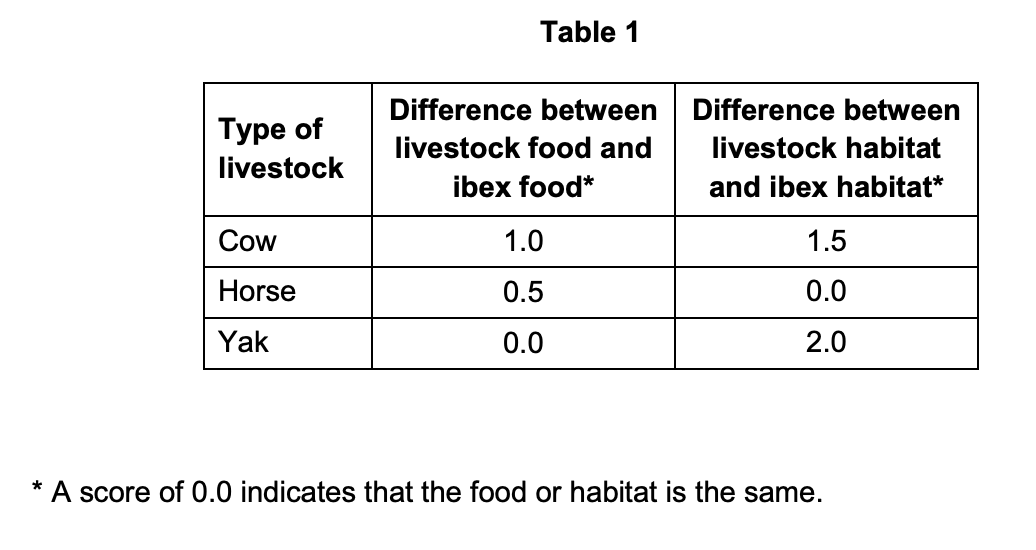
Answer
Mark Scheme
- Do not provide the livestock/cows/horses/yaks with extra food, as their populations will not grow large enough to cause competition OR Keep small numbers of livestock/cow/horse/yak, so their populations will not grow large enough to cause competition (1 mark)
- Do not farm horse/choose animals other than horse to farm, as they have the same habitat and (very) similar food to the ibex (1 mark)
- Keep horses (but) in enclosed/separate areas, as they occupy the same habitats as ibex (1 mark)
- Farm cows, as they have the least similar food and (one of the least similar) habitat (to that of the ibex) (1 mark)
- Farm yaks, as despite eating the same food, they live in a very different habitat (1 mark)
- (Only) grow crops, so no competition (1 mark)
Comments from mark scheme
Requires suggestion and explanation for each mark 2. Accept farm fewer horses as they have the same habitat and (very) similar food to the ibex 3. Accept descriptions of enclosed areas, eg fenced areas or accept do not let horses out 6. Accept examples of crops
Tips from examiner reports
Only 4% scored all 3 marks; over 50% scored zero. Use all the information given. ‘Habitat’ cannot be changed by farmers (it is the natural environment of wild animals). Ibex are wild goats — farmers cannot alter their diet.
In Europe, viruses have infected a large number of frogs of different species. The viruses are closely related and all belong to the Ranavirus group. Previously, the viruses infected only one species of frog.
Suggest and explain how the viruses became able to infect other species of frog
(2 marks)Answer
Mark Scheme
- Mutation in the viral DNA/RNA/genome/genetic material (1 mark)
- Altered (tertiary structure of the) viral attachment protein (1 mark)
- Allows it/attachment protein/virus to bind (to receptors of other species) (1 mark)
Comments from mark scheme
- Accept named examples mutations
- Accept ‘antigen’ for ‘attachment protein’
- Accept causes antigenic variability
- Accept descriptions of binding eg is complementary
Tips from examiner reports
30% scored 2 marks. Generic responses (‘the virus mutates’) were not enough — the mutation must be linked to the virus evading the immune response (e.g. changed antigen shape → existing antibodies no longer complementary).
Name two techniques the scientists may have used when analysing viral DNA to determine that the viruses were closely related.
(1 marks)Answer
Mark Scheme
- For one mark, accept any two of the following: • The polymerase chain reaction • Genetic/DNA fingerprinting • (Gel) electrophoresis • DNA/genome sequencing (1 mark)
Comments from mark scheme
Accept PCR for polymerase chain reaction Accept autoradiography Accept DNA hybridisation Accept compare DNA/base sequence for ‘DNA sequencing’ Ignore compare mRNA base sequence Ignore compare amino acid sequence Ignore DNA probes
Tips from examiner reports
Only 25% scored the mark. The question asked about ANALYSING VIRAL DNA — not mRNA, proteins or immunological comparisons.
Determining the genome of the viruses could allow scientists to develop a vaccine. Explain how.
(2 marks)Answer
Mark Scheme
- (The scientists) could identify proteins (that derive from the genetic code) OR (The scientists) could identify the proteome (1 mark)
- (They) could (then) identify potential antigens (to use in the vaccine) (1 mark)
Comments from mark scheme
- Reject if answer suggests vaccine contains antibodies
Tips from examiner reports
Only 11% scored 2 marks. Antibodies bind to antigens (on the pathogen surface) — not to DNA or RNA. Students incorrectly described using an antigen to make an antibody for a vaccine.
Describe how the B lymphocytes of a frog would respond to vaccination against Ranavirus.
You can assume that the B lymphocytes of a frog respond in the same way as B lymphocytes of a human. Do not include details of the cellular response in your answer.
(3 marks)Answer
Mark Scheme
- B cell (antibody) binds to (viral) specific/complementary receptor/antigen (1 mark)
- B cell clones OR B cell divides by mitosis (1 mark)
- Plasma cells release/produce (monoclonal) antibodies (against the virus) (1 mark)
- (B/plasma cells produce/develop) memory cells (1 mark)
Comments from mark scheme
- Accept B cell forms antigen-antibody complex
- Accept B cell undergoes clonal selection/expansion
Tips from examiner reports
37% scored all 3 marks. Errors included not naming plasma cells, and making B cells become macrophages. Many included T cell responses despite being told not to.
A journalist studied the data in Table 2. She made the following suggestion. ‘If an adult takes the maximum number of tablets allowed for either of the medicines, then the person would have more than the RDA of sodium.’ The RDA (recommended daily allowance) of sodium for an adult human is 2.4 g per day.
Is the journalist’s statement true for both of the medicines in Table 2?
Use suitable calculations to support your answer. Show your working.
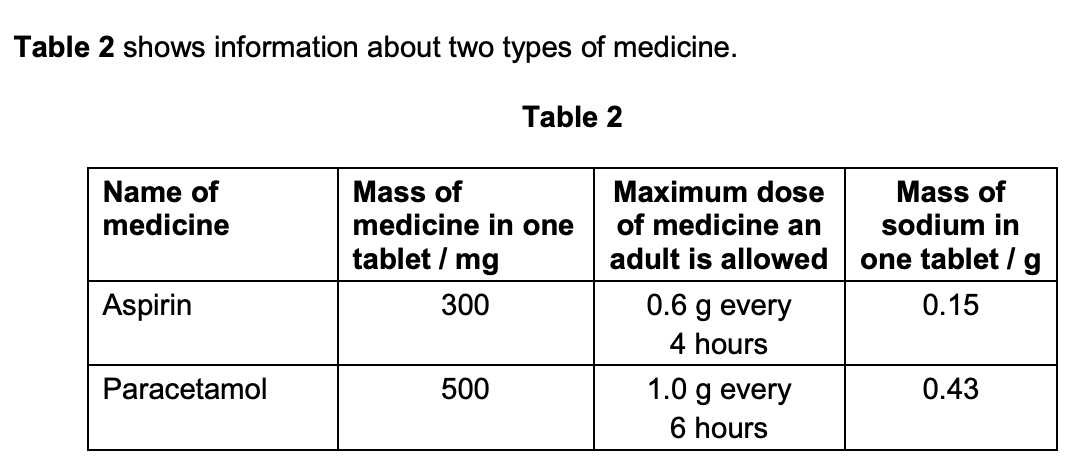
Answer
Mark Scheme
- (No for aspirin) 1.8 g (1 mark)
- (Yes for paracetamol) 3.44 g (1 mark)
Comments from mark scheme
Accept for one mark evidence of 1.8 and 3.44 but no/wrong stated units
- Accept maximum dose of aspirin has 0.6 g less than RDA
- Accept maximum dose of paracetamol has 1.04 g more than RDA
Tips from examiner reports
Nearly 50% scored 2 marks. Errors: forgetting units on the calculation, or not accounting for the maximum dose allowed when calculating number of doses.
Doctors investigated the link between high sodium concentrations in medicines and box hypertension (high blood pressure). They analysed medical records of patients. 1 292 337 of these patients had taken medicines containing high sodium concentrations. Each of these patients was paired with a patient from a control group.
Give two factors that should have been the same for each pair of patients and one factor that should have been different.
Same factor 1 Same factor 2 Different factor
(2 marks)Answer
Mark Scheme
- Same Accept any two of the following for one mark 1. BMI, age, sex/gender, other/previous medications, ethnicity, diet, exercise, health (issues) Different 2. No sodium in the (same) medicine (1 mark)
Comments from mark scheme
- Ignore weight
- Ignore placebo
- Ignore ‘salt’ for sodium
- Accept concentration of sodium in medicine
Tips from examiner reports
70% scored at least 1. For the control, students gave generic suggestions (‘give a placebo’) without considering the actual investigation design.
Doctors found:
Calculate how many of the control patients had hypertension. Show your working.
- 4.73% of the patients who had taken medicines containing high sodium concentrations suffered from hypertension
- there were 7.18 times fewer control patients with hypertension.
Answer
Mark Scheme
- Correct answer of 8513/8514 for 2 marks (1 mark)
- Allow 1 mark for 61 127(.5401) in answer Incorrect answer but shows sequence of 8513(6) with decimal point in any position = 1 mark (1 mark)
Tips from examiner reports
66% scored both marks. Both 8513 and 8514 were acceptable (rounding difference). Show working for partial credit.
A high concentration of sodium in the blood can affect blood volume and cause hypertension.
Use your knowledge of water potential to suggest how high sodium concentrations in the medicines taken could affect blood volume.
(3 marks)Answer
Mark Scheme
- (Sodium ions) lower the water potential (of blood) (1 mark)
- Water would move into the blood by osmosis (from cells/tissue fluid) (1 mark)
- Increasing the blood volume (1 mark)
Comments from mark scheme
- Accept make the blood water potential more negative
- Accept decrease the blood water potential
Tips from examiner reports
44% scored 3 marks. Errors: trying to bring the kidney or tissue fluid formation into answers about ADH/collecting duct. Focus specifically on what ADH does at the collecting duct.
In the UK in 2016, there were 525 048 deaths. Cancer caused 30.4% of all deaths. Throat cancer caused 5% of all deaths from cancer.
Calculate the mean number of people who died of throat cancer per month in 2016. Show your working
(2 marks)Answer
Mark Scheme
- 665 (people per month) (1 mark)
- Allow one mark for 7980/7981 in working (number of deaths from throat cancer per year) (1 mark)
Tips from examiner reports
72% scored both marks — similar maths skills to Q4.3.
Increased methylation of the promoter region of a tumour suppressor gene causes one type of human throat cancer.
In this type of throat cancer, cancer cells are able to pass on the increased methylation to daughter cells. The methylation is caused by an enzyme called DNMT. Scientists have found that a chemical in green tea, called EGCG, is a competitive inhibitor of DNMT. EGCG enables daughter cells to produce messenger RNA (mRNA) from the tumour suppressor gene.
Suggest how EGCG allows the production of mRNA in daughter cells.
(3 marks)Answer
Mark Scheme
- (EGCG) binds to active site of DNMT (1 mark)
- (DNMT) cannot methylate (promoter region of tumour suppressor gene) (1 mark)
- Transcription(al) factor(s) can bind (to promoter region) (1 mark)
- RNA polymerase (stimulated/activated) (1 mark)
Comments from mark scheme
- Ignore active site changes shape
- Ignore ‘forms enzyme-substrate’ complex
- Accept less methylation (of promoter region/tumour suppressor gene)
Tips from examiner reports
Only 14% scored 3 marks. Confusion about what is the enzyme (DNMT) and what is the substrate. EGCG competes with the substrate for the active site of DNMT — it does NOT bind to the promoter region.
A reporter who reviewed all of this work concluded that drinking green tea could be a cure for cancer.
Suggest three reasons why his conclusion might not be valid
(3 marks)Answer
Mark Scheme
- Only investigated in throat cancer OR Might not work for other types of cancer (1 mark)
- Not all cancers are caused by (increased) methylation (of a tumour suppressor gene) OR There are other causes of cancer (1 mark)
- Only a significant reduction with 20/50/above 10 (µmol) (1 mark)
- Do not know how much EGCG is in green tea (1 mark)
- Only reduces growth rate (of cancer cells) OR No evidence of cancer being cured (1 mark)
- In vivo cells/cells in the body might respond (to EGCG) differently (from those grown in vitro) (1 mark)
Comments from mark scheme
- Allow converse, ie no significant effect with 5/10 (µmol)
Tips from examiner reports
89% scored at least 1 mark. Many gave rote-learnt responses that did not match the investigation: ‘no statistical tests’ (two EGCG concentrations were already stated as significant); ‘no control’ (there was one). Read the figure before evaluating.
Describe the advantage of the Bohr effect during intense exercise.
(2 marks)Answer
Mark Scheme
- Increases dissociation of oxygen (1 mark)
- For aerobic respiration at the tissues/muscles/cells OR Anaerobic respiration delayed at the tissues/muscles/cells OR Less lactate at the tissues/muscles/cells (1 mark)
Comments from mark scheme
- Accept unloading/ release/reduced affinity for dissociation
Tips from examiner reports
Only 58% scored at least 1 mark. Haemoglobin with high affinity LOADS oxygen — it does NOT unload easily. State that oxygen is available for aerobic respiration — not just that it is released.
A cyclist completed a fitness test on an exercise bike. The intensity of the exercise was increased every 10 seconds. The test finished when he was unable to cycle any further. The partial pressure of oxygen (pO₂) and of carbon dioxide (pCO₂) in air breathed out was measured. Figure 3 shows the results of the cyclist’s fitness test.
VT can be identified as the first point when there is an increase in pO₂ breathed out, without an equivalent increase in pCO₂ breathed out.
Use Figure 3 to determine the time after the exercise started when the cyclist reached VT.
Calculate the ratio of pO₂ to pCO₂ in breathed-out air at this time. Show your working.
Time when the cyclist reached VT (mins) = Ratio of pO₂ to pCO₂ at VT =
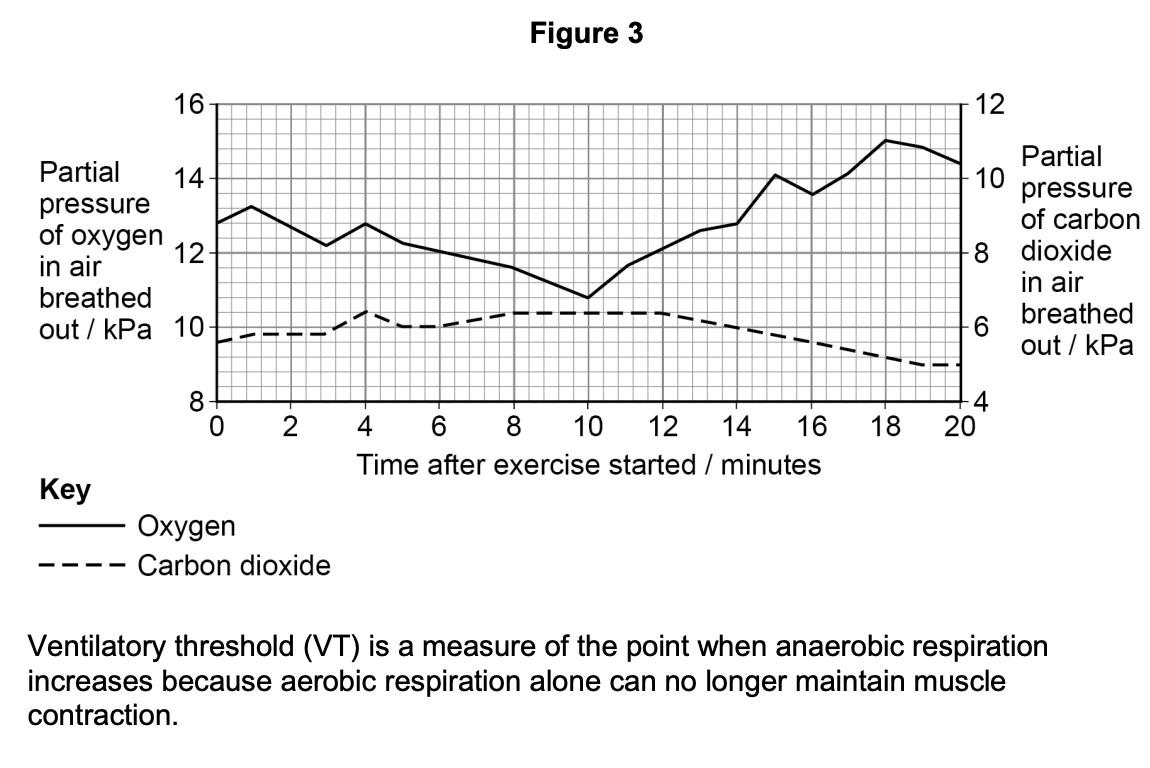
Answer
Mark Scheme
- (Time) 10 minutes (1 mark)
- (Ratio) 1.6875(:1); Allow 1 mark for correct ratio calculated from wrong time (1 mark)
Tips from examiner reports
Only 27% scored both marks. Most common error: not reading from the correct axis values.
An increase in the intensity of exercise produces an increase in the volume of carbon dioxide produced.
However, Figure 3 shows that the pCO₂ in air breathed out did not show a large increase during the exercise.
Suggest one physiological change that would cause this result.
Explain how the physiological change would allow for the removal of the increase in the volume of carbon dioxide produced.
(2 marks)Answer
Mark Scheme
- Increase in breathing (rate) (1 mark)
- Similar/same pCO₂ per breath, but more breaths; OR (1 mark)
- Increase in tidal volume (1 mark)
- Similar/same pCO₂ per breath, but increased volume per breath (1 mark)
Tips from examiner reports
Only 0.5% scored 2 marks. Understand what pCO2 means (partial pressure of CO2) and what a physiological change is. Do not describe long-term training effects when asked about short-term exercise physiology.
When muscle fibres have very low concentrations of ATP, they may get ATP in the box following ways.
At more than 80% of maximum muscle effort, ATP can only be made for a limited time.
Use Figure 4 to suggest one reason why.
Tick () the correct box.
a) ATP cannot move into muscle fibres at a fast-enough rate b) Muscle fibres have a limited amount of phosphocreatine. c) Muscle fibres produce too much lactate. d) Muscle fibres quickly run out of ADP.
- AMPK (an enzyme) oxidises fatty acids.
- Phosphocreatine donates phosphate to ADP in anaerobic conditions. Figure 4 shows how these chemicals work.
Answer
Mark Scheme
- D = Muscle fibres have a limited amount of phosphocreatine (1 mark)
Tips from examiner reports
Majority scored the mark — glycolysis provides ATP for muscle contraction.
GW1516 is a performance-enhancing drug. GW1516 activates AMPK and develops slow muscle fibres at rest.
Use Figure 4 to justify why professional athletes are not allowed to take GW1516. Do not include details of chemiosmotic theory in your answer.
(4 marks)Answer
Mark Scheme
- More acetylcoenzyme A would enter the Krebs cycle (1 mark)
- (So) the Krebs cycle generates (more) reduced coenzymes OR (So more) reduced coenzymes pass their electrons to the electron transfer chain (1 mark)
- (So more) ATP would be produced (1 mark)
- Athletes could build (slow) muscle (fibres) without exercising (1 mark)
- (Having more) slow muscle (fibres) would increase endurance (1 mark)
Comments from mark scheme
-
- and 3. idea for more is required once
- Accept examples of reduced coenzymes
- Reject production of reduced NADP or NADPH2
- Ignore ‘develop (slow) muscle (fibres) at rest’ as in stem of question
- Accept description of not exercising, eg without training
- Accept descriptions of endurance in terms of delayed onset of anaerobic respiration
Tips from examiner reports
82% scored at least 1 mark. Must use Figure 4 as instructed. Confusion between slow and fast muscle fibres, and between the Krebs cycle and Calvin cycle. Slow muscle fibres use aerobic respiration — they do not ‘make’ ATP directly by contracting.
EPO is another performance-enhancing drug. It can increase the haematocrit (the percentage of red blood cells in blood).
A heart attack is caused by a lack of glucose and oxygen being delivered to cardiac muscle via the coronary arteries. The overuse of EPO can increase the risk of a heart attack.
Suggest how.
(2 marks)Answer
Mark Scheme
- (EPO) causes blood to thicken (1 mark)
- (The thickened blood) could block the coronary arteries OR (The thickened blood) slows blood flow OR (The thicker blood) could cause clots (1 mark)
Comments from mark scheme
- Accept descriptions of thickening, eg more viscous
- Reject atheroma/plaque (forms)
- Accept could cause thrombus/embolus
Tips from examiner reports
Under 3% scored 2 marks. Red blood cells themselves cannot supply nutrients to the heart in this context. The correct mechanism involves a thrombus/embolus blocking coronary vessels, reducing blood supply to cardiac muscle.
The normal haematocrit for human males is 47(±5)%. For professional male cyclists, the maximum haematocrit allowed is 50%. A student suggested that professional male cyclists should be allowed to use EPO until their haematocrit is 50%.
Give two reasons why this suggestion is not valid.
(2 marks)Answer
Mark Scheme
- Some cyclists will gain a bigger advantage/increase OR Cyclists with a haematocrit of 50% would not be able to gain an advantage (1 mark)
- There are health risks (associated with) taking EPO (1 mark)
Comments from mark scheme
- Accept use of the data, or suitable calculations, eg some may have an 8% increase, others 0%
- Some cyclists might naturally have a haematocrit over 50% (and so not be allowed to compete)
- Accept dangerous side-effects of taking EPO, or examples of health risks
Tips from examiner reports
Only 5% scored 2 marks. Poor language quality evident. ‘47(±5)%’ means a range — standard deviations of the two groups do not apply here. Rote-learnt ‘no statistical test’ was wrong since one had been carried out.
The functions of enzymes and their importance in organisms.
(25 marks)Answer
Mark Scheme
- No mark scheme available
Tips from examiner reports
Essay on enzyme FUNCTION — prolonged discussion of structure was not relevant. The induced-fit model was required, not just lock-and-key. Coenzymes (NAD, NADP) are NOT enzymes. In vitro enzyme use (e.g. in recombinant DNA technology) was not relevant — the title specifies ‘in organisms’.
The causes and importance of variation and diversity in organisms.
(25 marks)Answer
Mark Scheme
- No mark scheme available
Tips from examiner reports
Causes and importance of variation and diversity rarely answered beyond GCSE level. Technical terminology was absent. Explanations of meiosis and evolution were often wrong or outdated.
Describe how ultrafiltration occurs in a glomerulus.
(3 marks)Answer
Mark Scheme
- High blood/hydrostatic pressure (1 mark)
- Two named small substances pass out eg water, glucose, ions, urea (1 mark)
- (Through small) gaps/pores/fenestrations in (capillary) endothelium (1 mark)
- (And) through (capillary) basement membrane (1 mark)
Comments from mark scheme
Ignore references to podocytes
- Ignore references to afferent and efferent arterioles
- Ignore ‘increasing/higher blood pressure’ as does not necessarily mean high
- Accept correct named ions
- Accept mineral ions/minerals
- Accept amino acids/small proteins
- Ignore references to molecules not filtered
- Accept epithelium for endothelium
Tips from examiner reports
Only 10% scored all 3 marks. State ‘high blood/hydrostatic pressure’ specifically — not just ‘pressure’. Afferent and efferent arterioles are not part of the glomerulus. Small molecules (water, glucose, urea) pass through GAPS in the endothelium and basement membrane — not through cells. Large molecules (proteins) are retained.
Glucose and water are reabsorbed by the proximal convoluted tubule of a nephron.
Put a tick () in the box next to the correct ways in which glucose and water are reabsorbed. A) Glucose by active transport and water against a water potential gradient B) Glucose by diffusion and water down a water potential gradient C) Glucose by facilitated diffusion and active transport and water against a water potential gradient D) Glucose by facilitated diffusion and active transport and water down a water potential gradient
(1 marks)Answer
Mark Scheme
- Glucose by facilitated diffusion and active transport and water down a water potential gradient (1 mark)
Tips from examiner reports
Over 75% scored the mark — well answered.
The equation shows the relationship between urine concentration in arbitrary units (𝑦𝑦) and mean length of the loop of Henle in mm (𝑥𝑥). 𝑦𝑦 = 0.72𝑥𝑥 + 4
Calculate the mean length of the loop of Henle in an organism that produces urine with a concentration of 16.56 arbitrary units (Answer in mm)
(1 marks)Answer
Mark Scheme
- 17.4 (1 mark)
Tips from examiner reports
About 80% scored the mark. Errors: incorrect rounding; wrong algebraic rearrangement (dividing first then subtracting gave an answer of 19).
Scientists investigated the relationship between the thickness of the kidney medulla of different species of mammals and the concentration of their urine. Figure 1 shows their results.
Explain the pattern shown by the results in Figure 1.
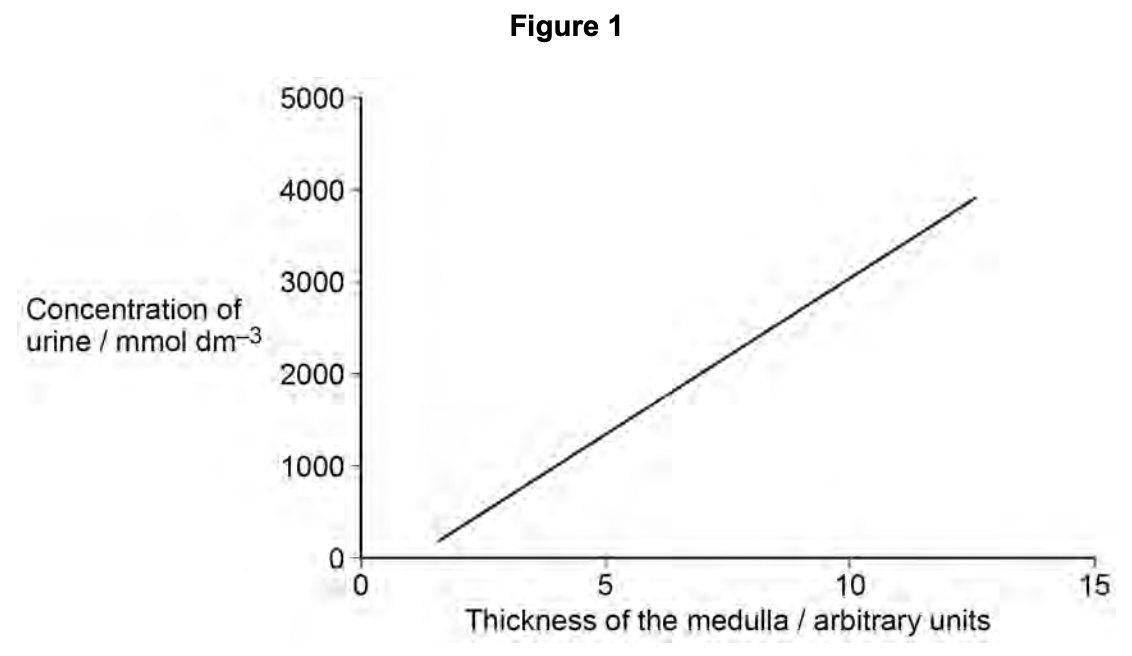
Answer
Mark Scheme
- Thicker medulla means a longer loop (of Henle) (1 mark)
- (The longer the loop of Henle means) increase in sodium ion concentration (in medulla) OR (The longer the loop of Henle means) sodium ion gradient maintained for longer (in medulla) OR (The longer the loop of Henle means) more sodium ions are moved out (into medulla) (1 mark)
- (Therefore) water potential gradient maintained (for longer), so more water (re)absorbed (from loop and collecting duct); OR More water is (re)absorbed from the loop (of Henle) / collecting duct by osmosis (1 mark)
Comments from mark scheme
- Must have idea of increase/longer/m ore
- Reject water being reabsorbed into the loop of Henle
- Direction is important
- Accept Ψ for water potential
Tips from examiner reports
Only 2% scored all 3 marks. The loop of Henle is in the MEDULLA. A thicker medulla → higher sodium ion concentration (not just ‘ion concentration’) → lower water potential in medulla → more water reabsorbed from filtrate BY OSMOSIS. Many described water moving into (not out of) the loop.
Describe the role of saprobionts in the nitrogen cycle
(2 marks)Answer
Mark Scheme
- (They use enzymes to) decompose proteins/DNA/RNA/urea (1 mark)
- Producing/releasing ammonia/ammonium compounds/ammonium ions (1 mark)
Comments from mark scheme
- Accept any named molecule containing nitrogen eg enzymes, NAD, ATP, amino acids
- Accept digest/breakdown/hydrolyse for decompose
- Ignore ‘nitrogen -containing compounds’ unqualified
- Accept (they) perform ammonification
- Accept named ammonium compound
Tips from examiner reports
Two-thirds scored at least 1 mark. Name SPECIFIC nitrogen-containing compounds (e.g. ammonia, ammonium ions, nitrites, nitrates — not just ‘nitrogen compounds’). Do not describe the whole nitrogen cycle — answer only the part asked.
One environmental issue arising from the use of fertilisers is eutrophication. Eutrophication can cause water to become cloudy.
You are given samples of water from three different rivers.
Describe how you would obtain a quantitative measurement of their cloudiness.
(3 marks)Answer
Mark Scheme
- Accept any valid method, for example 1. Use of colorimeter (1 mark)
-
- Measure the absorbance/transmission (of light) (1 mark)
-
- Example of how method can be standardised eg same volume of water, zeroing colorimeter, same wavelength of light, shaking the sample (1 mark)
Comments from mark scheme
Principle is
- Named apparatus
- What is measured
- Standardisation of method
- Reject calorimeter
- Reject if samples are filtered unless filtering to remove debris
- Accept descriptions
- Ignore references to calibration curves
Tips from examiner reports
About 85% scored at least 1 mark. Use ‘colorimeter’ not ‘calorimeter’. State WHAT to measure (absorbance/transmission) — not just ‘read the colorimeter’. A calibration curve was not needed in this context. Many added Benedict’s solution inappropriately — read the question.
Figure 2 shows a photograph of a dissected heart.
Name valve A and chamber B.
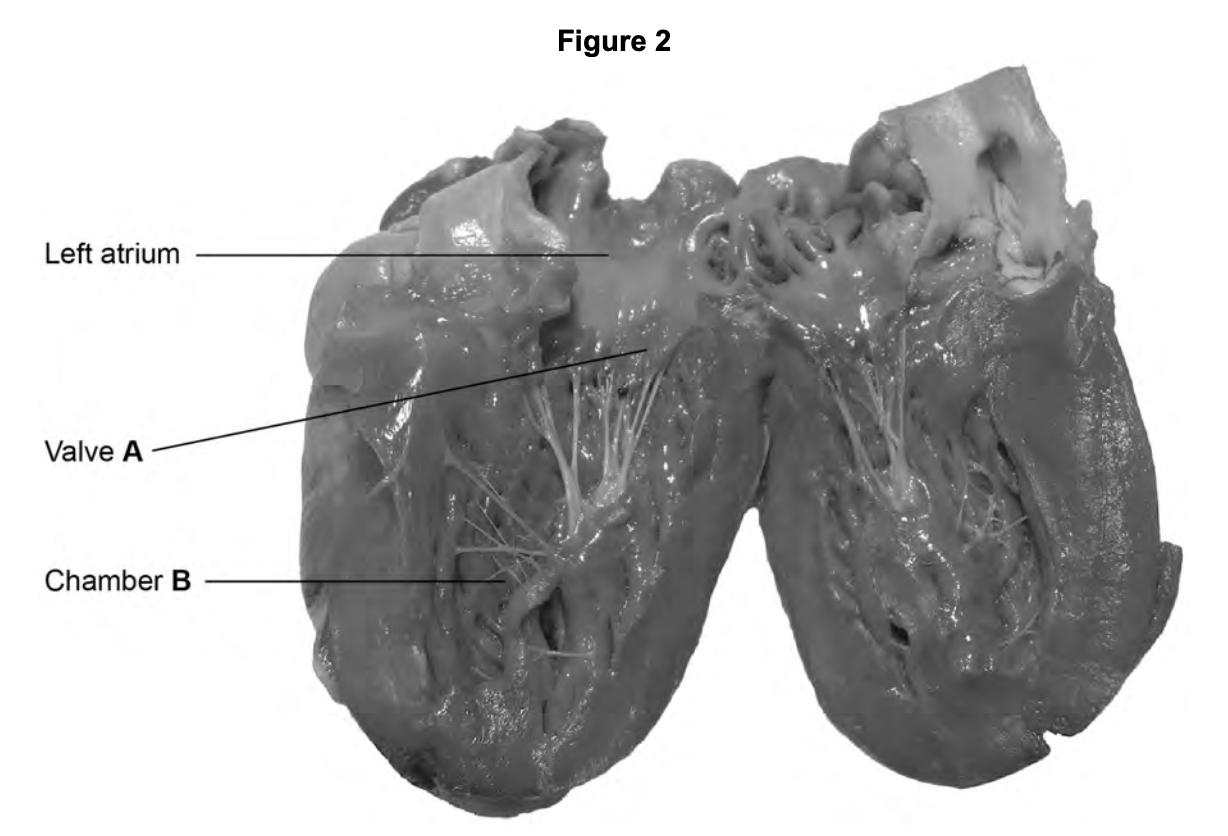
Answer
Mark Scheme
- Valve A (Left) atrioventricular Chamber B Left ventricle (1 mark)
Comments from mark scheme
Reject right side in either context Accept mitral/bicuspid for Valve A. Reject tricuspid for Valve A Ignore AV for Valve A
Tips from examiner reports
About 50% scored the mark. Those who failed usually named ‘semi-lunar valve’. Look at the position of tendons in the figure to identify which valve it is. The bicuspid (mitral) valve was accepted but is not a specification term.
Give two safety precautions that should be followed when dissecting a heart.
(1 marks)Answer
Mark Scheme
- Accept any two suitable safety precautions for 1 mark, eg (1 mark)
- Use a sharp scalpel/scissors Wash hands/wear gloves Disinfect bench/equipment Cover any cuts Cut away from self/others/on a hard surface Safe disposal (1 mark)
Comments from mark scheme
Ignore take care with scalpel/scissors or keep away from fingers Ignore goggles
Tips from examiner reports
Only about 40% scored the mark. Avoid generic lab rules (‘wear goggles’, ‘be careful’) — describe a specific risk and precaution relevant to THIS investigation.
Explain how valve A in Figure 2 maintains a unidirectional flow of blood.
(2 marks)Answer
Mark Scheme
- Pressure in (left) atrium is higher than in ventricle/B causing valve to open; OR (When) pressure above valve is higher than below valve it opens (1 mark)
- Pressure in (left) ventricle/B is higher than in atrium causing valve to close; OR (When) pressure in below valve is higher than above valve it closes (1 mark)
Comments from mark scheme
- and 2. Ignore pressure in front of/behind valve
- and 2. As long as direction of opening/closing of valve is correct, ignore ‘semi lunar’
- Accept cords/tendons prevent valve turning inside out
Tips from examiner reports
Over two-thirds scored zero. Many gave rote-learnt responses about semi-lunar valves regardless of the figure. Explain the MECHANISM: increased ventricular pressure → pushes valve open (or higher atrial pressure → pushes valve closed) → unidirectional flow. Describing when it opens/closes without giving the cause was only a description, not an explanation.
A research scientist investigated the effect of caffeine on heart rate in human box volunteers.
The scientist divided volunteers into three groups. Each group was given the same volume of fluid.
Caffeine affects the autonomic nervous system.
- Each member of Group I was given a sports drink containing caffeine and sugar.
- Each member of Group J was given a sports drink containing caffeine and no sugar.
- Each member of Group K was given water. The scientist recorded the volunteers’ heart rate before the drink was given and for 120 minutes after the drink was given. Her results can be seen in Figure 3.
Suggest how caffeine could account for the results of Group I in Figure 3 at 60 minutes.
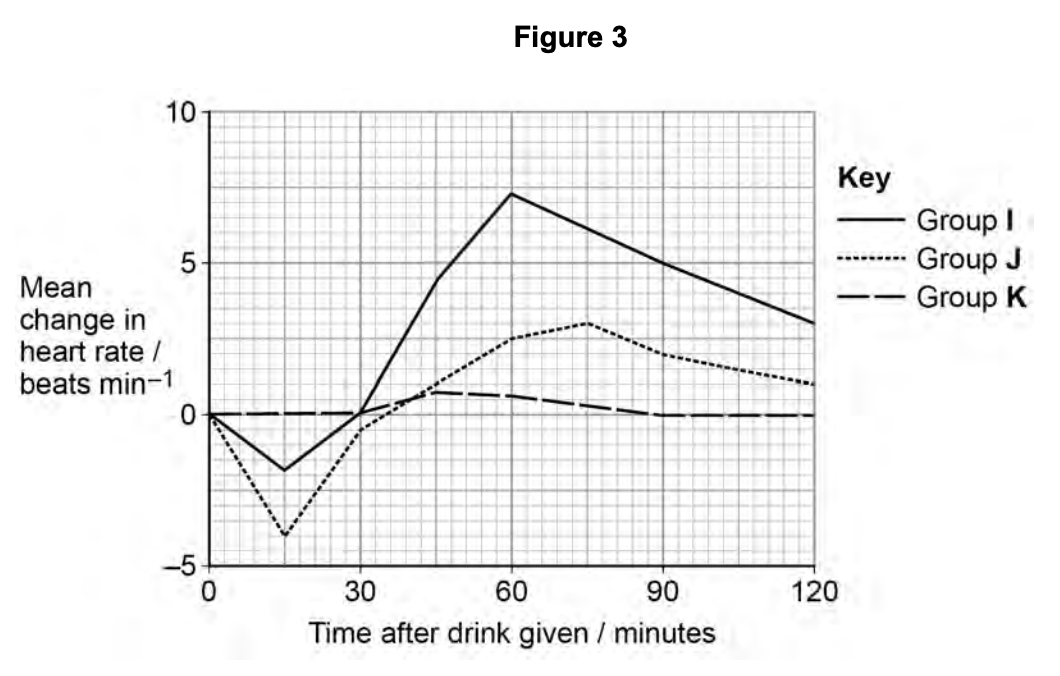
Answer
Mark Scheme
- More impulses/action potentials along sympathetic (nervous system pathway/branch) (1 mark)
- To SAN increasing the heart rate (seen in Figure (1 mark)
- (1 mark)
Comments from mark scheme
- Ignore signals/informatio n/ messages
- Idea of more impulses/action potentials is required
Tips from examiner reports
About 50% scored at least 1 mark. Caffeine increases the FREQUENCY of impulses via the sympathetic nerve to the SAN → increased heart rate. ‘An impulse was sent’ (not frequency) did not score MP1. Must link back to data in Figure 3 for MP2.
Before taking the drink, the mean heart rate of Group J was 68 beats per minute. Fifteen minutes after taking the drink, the mean volume of blood leaving the hearts of Group J was 4700 cm³ per minute.
Calculate the mean volume of blood leaving the heart at each beat fifteen minutes after taking the drink. (Answer in cm³)
(1 marks)Answer
Mark Scheme
- 73.4 (1 mark)
- (73.4375) (1 mark)
Tips from examiner reports
About 40% scored the mark. Use data from Figure 3 to find stroke volume: cardiac output ÷ heart rate. Common error: dividing 4700 by 88 (not reading heart rate from the figure).
The increase seen in Group I could be due to the combination of caffeine and sugar. Suggest one drink to be given to an additional group that should be investigated to find out if this is true.
Give a reason for your answer.
- Group to be given
- Reason
Answer
Mark Scheme
- Group to be given 1. Sugar solution (only) OR A drink with sugar (and no caffeine) (1 mark)
- Reason 2. To show/prove that sugar (alone) is not causing the increases (in HR) OR To show that sugar does not have an effect (1 mark)
Comments from mark scheme
- Accept ‘glucose’ for sugar
- Ignore named drinks unless qualified
- Ignore ‘sugar’ by itself
- Ignore references to use of a placebo tablet
- Accept ‘to see the effect of sugar’
Tips from examiner reports
Over 70% scored 2 marks. Give a specific control treatment (e.g. ‘give the same volume of water’) and explain its purpose (as a control/for comparison, to show heart rate change is due to caffeine).
Mitochondrial DNA (mtDNA) is a small circular DNA molecule located in mitochondria. It is 16 569 nucleotides long and contains 37 genes and a control region. Sports scientists investigated whether a mutation in the control region of mtDNA in human males was related to an ability to exercise for longer.
The control regions of Group T and Group C were the same length.
Name the type of gene mutation that is most likely to have occurred at nucleotide position 16 519
- The males in Group T had thymine at nucleotide position 16 519
- The males in Group C had a mutation resulting in cytosine at nucleotide position 16 519
Answer
Mark Scheme
- Substitution (1 mark)
Comments from mark scheme
Accept inversion or translocation Ignore ‘point mutation’
Tips from examiner reports
Nearly all scored the mark. Frameshift mutations were the most common wrong answers.
Group T and Group C completed the same 8-week training programme. The following measurements were taken at the start of the 8-week programme, and again at the end.
- VO2 max (a measure of maximal oxygen uptake). 2. Citrate synthase (CS) activity (CS is an enzyme involved in the Krebs cycle). The scientists then calculated the percentage increase in each measurement in both groups.
Figure 4 and Figure 5 show their results.
A student concluded from Figure 4 and Figure 5 that training has a positive effect on VO2max and CS activity.
Evaluate the student’s conclusion.
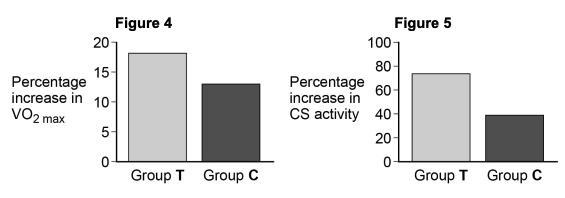
Answer
Mark Scheme
- (VO2 max and CS activity) increased for both groups (1 mark)
- No statistical test, so do not know if differences are significant OR No statistical test, so differences could be due to chance (1 mark)
- Only 8 weeks training OR Training did not last long (1 mark)
- Might not be true for all types of training/exercise/females (1 mark)
Comments from mark scheme
Max 2 marks for mark points 2, 3 and 4 2. Ignore standard deviation 2. Accept correct named statistical test eg t-test
Tips from examiner reports
Only 5% scored all 3 marks. Evaluation requires BOTH supporting and contradicting the conclusion. Do not explain why heart rate increased — the question only asked about the EFFECT OF TRAINING. ‘Results are significant’ was never accepted. ‘No standard error bars’ was not valid — standard error is not in the specification.
The mitochondrial DNA (mtDNA) control region is an area of mtDNA that is non-coding. This region stimulates the synthesis of both mtDNA and mitochondrial messenger RNA.
Use this information to suggest two reasons why the mutation at nucleotide position 16 519 could lead to the differences seen in Figure 5.
(2 marks)Answer
Mark Scheme
- In Group C: 1. Less mitochondrial replication/production (1 mark)
-
- Less transcription (of genes) for mitochondrial proteins/CS OR Less translation of (mRNA into) mitochondrial proteins (1 mark)
Comments from mark scheme
- and 2. Accept converse for Group T
- Accept less CS/enzyme is produced
Tips from examiner reports
About 70% scored zero. A mutation in the PROMOTER REGION of the mtDNA gene reduces the LEVEL OF TRANSCRIPTION/TRANSLATION → fewer copies of mtDNA made → fewer mitochondria → less CS activity. Changes to protein shape or active site do not apply here — the mutation is in a non-coding regulatory region.
The sports scientists investigated whether there was a correlation between the percentage change in VO2max and percentage change in CS activity in Group T. Figure 6 shows their results.
‘Having thymine at nucleotide position 16 519 in Group T causes an increase in ability to exercise for longer.’ Evaluate this conclusion.
Use all the data in this question.
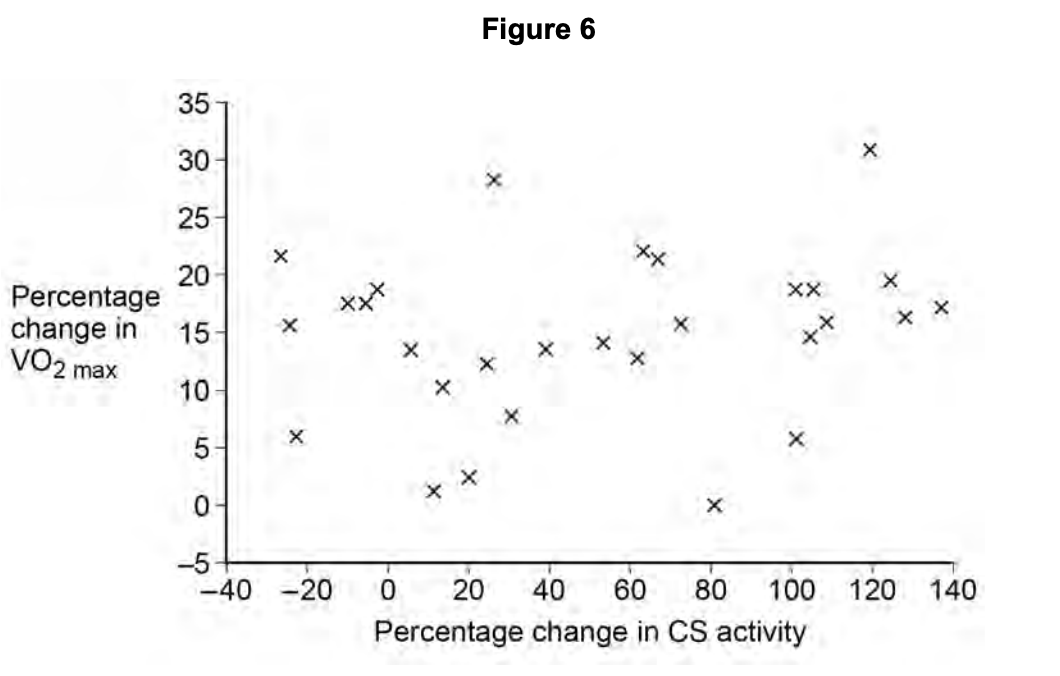
Answer
Mark Scheme
- For (no mark) 1. (From Figure 5 Group T have) increased CS activity for Krebs cycle (1 mark)
-
- (from Figure 4 Group T have) increased VO2 max so more oxygen (available) OR (from Figure 4 Group T have) increased VO2 max so more aerobic respiration OR (from Figure 4 Group T have) increased VO2max so delayed anaerobic respiration (1 mark)
- Against (no mark) 3. No correlation between (percentage change in) VO2 max and CS activity OR No correlation on Figure 6 (1 mark)
-
- It might not be thymine causing the increase OR There may be other differences in the control region (of Group T) that cause the increase (1 mark)
-
- VO2 max/CS activity not the only measures of ability to exercise for longer (1 mark)
Comments from mark scheme
Max 2 marks for mark points 3, 4 and 5 Ignore any answers relating to sample size or duration of investigation Ignore ‘correlation does not mean causation’ unless qualified 2. Accept ‘less lactate’ for delayed anaerobic respiration 4. Ignore ‘could be due to lifestyle/diet changes’ 5. Accept ideas that they did not measure ability to exercise for longer
Tips from examiner reports
Generally well answered. Increased CS and VO₂ max → more Krebs cycle activity / more oxygen available → more aerobic respiration. More able students linked CS increase specifically to greater ATP yield.
The crown-of-thorns starfish (COTS) is one of the main causes of the decline of the world’s coral reefs.
Marine biologists used a choice chamber to investigate the effects of flashing and constant light on the behaviour of COTS.
Table 1 shows their results as they presented them. The P values show results from a statistical test.
State a null hypothesis the marine biologists tested in this investigation.
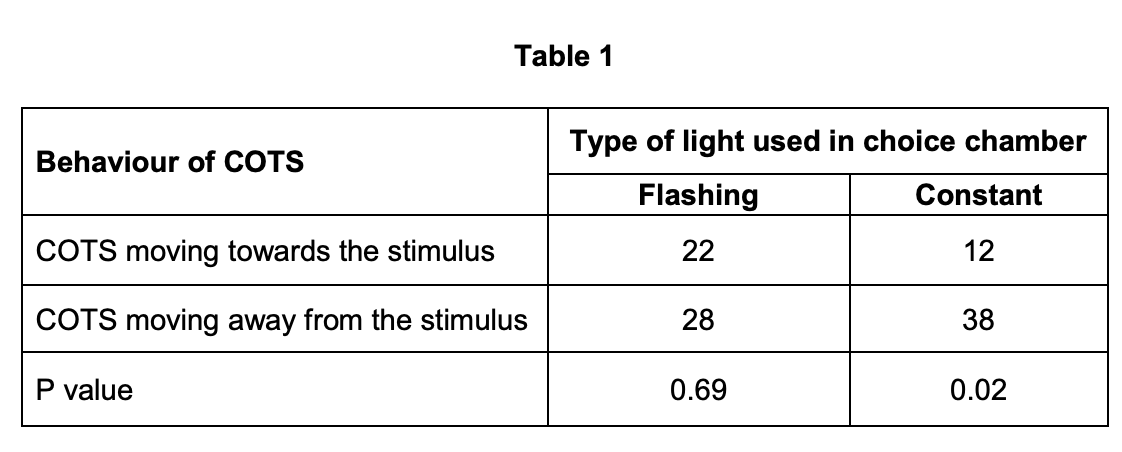
Answer
Mark Scheme
- Accept suitable null hypothesis that includes type of light and behaviour, eg The type of light has no effect on the behaviour/movement of COTS OR There is no difference in behaviour/movement with constant/flashing light (1 mark)
Comments from mark scheme
Ignore general null hypotheses, or example ‘there is no difference between observed and expected’
Tips from examiner reports
About 70% scored the mark. Give a SPECIFIC null hypothesis, not a generic ‘no significant difference between observed and expected’.
The natural habitat of COTS is coral reefs of tropical oceans.
Suggest two factors that should be kept constant in the choice chambers so that COTS display normal behaviour.
(1 marks)Answer
Mark Scheme
- Accept any two factors for one mark from the list below (1 mark)
- Salinity / salt concentration of the water Temperature (of the water) Amount / distribution of food pH (of the water) Oxygen/carbon dioxide concentration Intensity/wavelength of (constant and flashing) light (1 mark)
Comments from mark scheme
Ignore humidity Ignore type of coral Ignore depth of water
Tips from examiner reports
Just over 50% scored. Laboratory choice chambers can control ABIOTIC factors: pH, temperature, salinity. Biotic factors (type of coral, reef conditions) cannot be controlled in a lab and were not accepted.
A journalist studying Table 1 suggested that either type of light could be used to cause COTS to move away from coral reefs.
Evaluate the journalist’s suggestion.
(3 marks)Answer
Mark Scheme
- Yes (no mark) 1. Movement is away from either type/both types of light OR Negative (photo) taxis to both types/either types of light (1 mark)
-
- Significant movement away from constant light as p=0.02/<0.05/=2%/<5% OR Movement away from constant light is not due to chance as p=0.02/<0.05/=2%/<5% (1 mark)
- No (no mark) 3. Movement away from flashing light is not significant as p=0.69/>0.05/=69%/>5% OR Movement away from flashing light is due to chance as p=0.69/>0.05/=69%/>5% (1 mark)
Comments from mark scheme
- and 3. Ignore ‘results’ in the context of significance or chance
Tips from examiner reports
Only 6% scored all 3 marks. Evaluate using the statistical data — do not say ‘no critical values given’ when they are implied by the p values. ‘Results are significant’ was not accepted. Identify what the p values actually show about movement in each light regime.
One of the reasons COTS can destroy coral reefs in a short time is because COTS move quickly, allowing them to move from one reef to another.
Table 2 shows the maximum speeds recorded of COTS in constant light.
Calculate the shortest time one COTS would take to move up a coral reef from 66m under water to 18 m under water in hours of daylight.
Give your answer to the nearest hour.
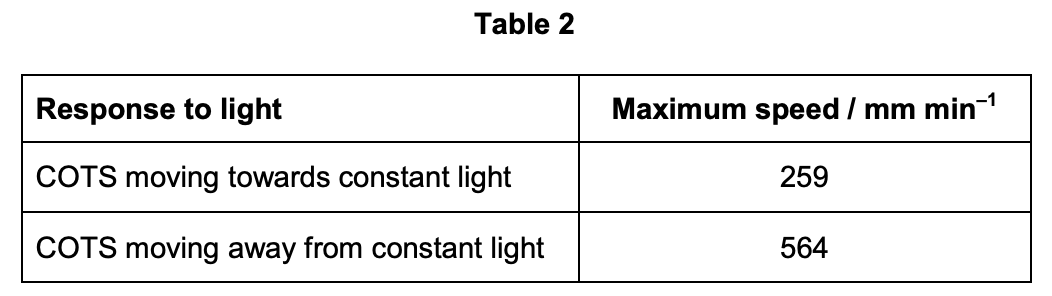
Answer
Mark Scheme
- Correct answer of 3 hours = 2 marks (1 mark)
- Allow 1 mark for distance of 48 000 mm in working 1 max for answer of 185 minutes/3 hours and 5 minutes/3.09 hours 1 max for answer of 1 hour (ie answers that use 564 in their calculation) (1 mark)
Tips from examiner reports
Just over a third scored 2 marks. Distance = 48 m = 48000 mm. Time = 48000 ÷ 259 = 185.3 min = 3 hours (to nearest hour). Common errors: converting 48 m to 4800 mm; not rounding to nearest hour.
Uncontrolled cell division can cause tumours to form. Figure 7 shows the growth pattern followed by a type of tumour.
Use Figure 7 to calculate the percentage of maximum growth this type of tumour reaches before it can be detected. You will need to use the 10x button on your calculator.
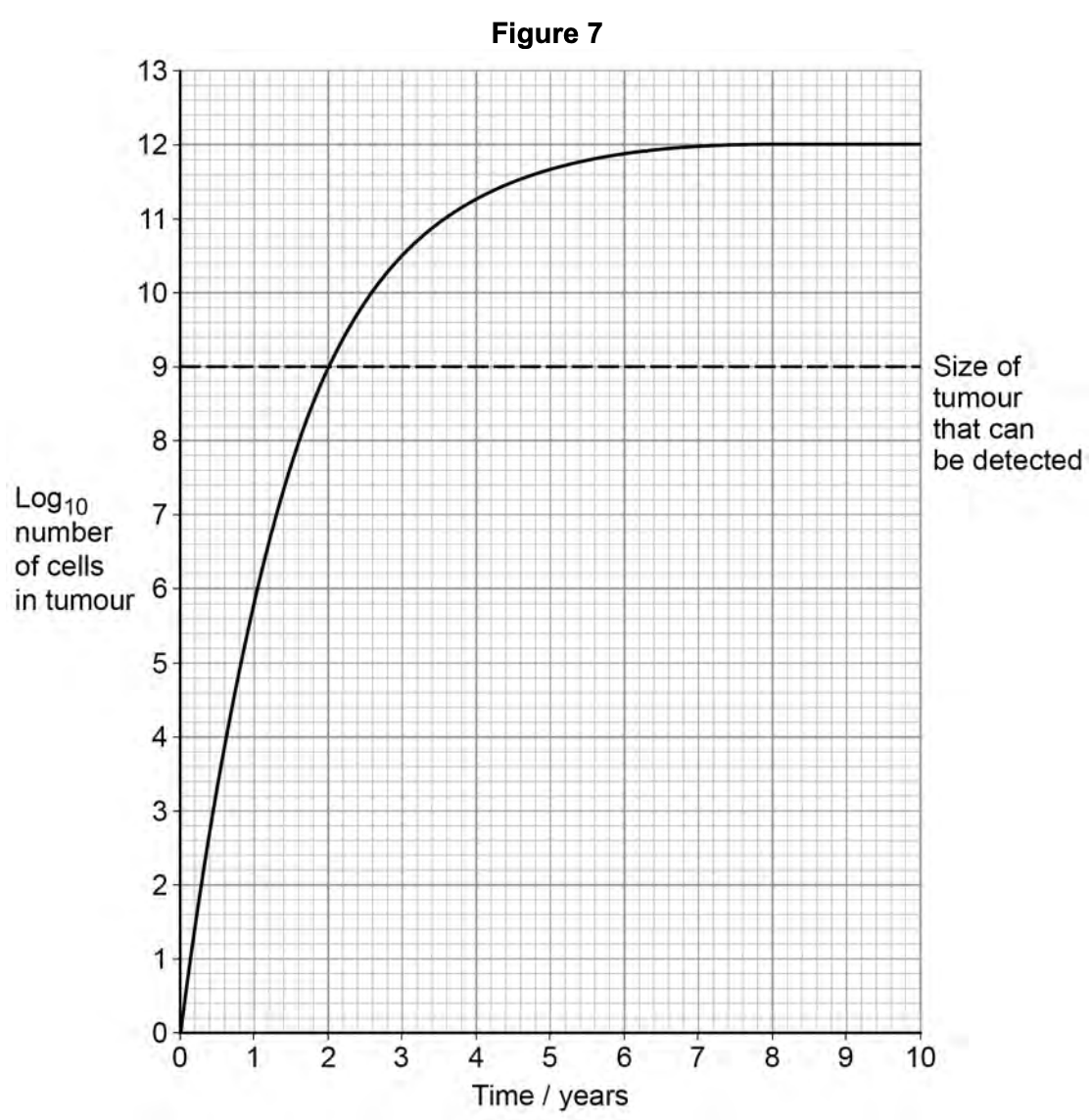
Answer
Mark Scheme
- 0.1 (1 mark)
Tips from examiner reports
About a third scored the mark. Read logarithmic scales carefully — use the log/antilog function on your calculator. A scientific calculator is a required material.
Figure 7 can also be used to calculate the age of this type of tumour. At diagnosis, a patient had a tumour of 3.98 × 10¹¹ cells.
Calculate the age of the tumour. You will need to use the log10 button on your calculator. (Answer years)
(1 marks)Answer
Mark Scheme
- Accept answer in the range of 4.7 to 4.9 (1 mark)
Trexall is a drug that can be used to slow the development of various forms of cancer. Trexall slows cell division by interacting with an enzyme called dihydrofolate reductase (DR). DR is involved in making nucleotides; the substrate for DR is folic acid. Figure 8 shows the chemical structure of Trexall. Figure 9 shows the chemical structure of folic acid.
Use the information provided to suggest how Trexall slows cell division.
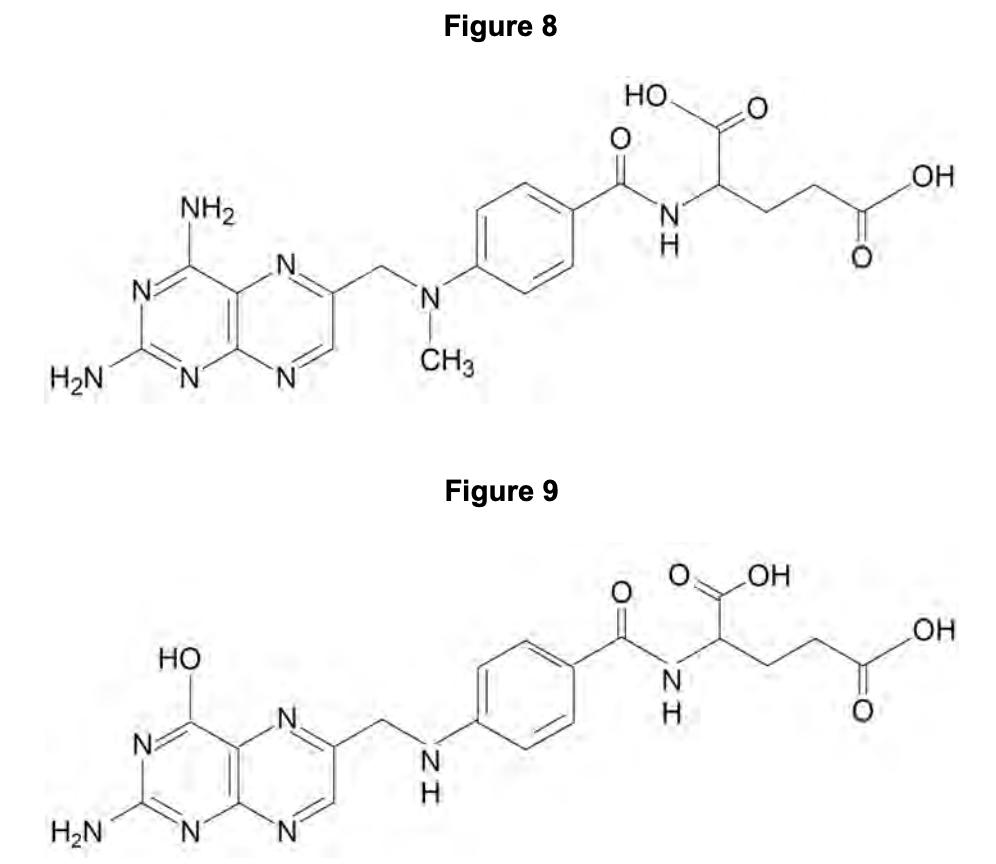
Answer
Mark Scheme
- (Trexall acts as a) competitive inhibitor OR (Trexall) competes (with folic acid/substrate) for/is able to fit into/binds at active site (on dihydrofolate reductase / enzyme) (1 mark)
- Less folic acid/substrate attaches OR Fewer enzyme-substrate complexes (1 mark)
- Fewer/not enough nucleotides available for DNA replication (1 mark)
Comments from mark scheme
- Reject Trexall and folic acid have the same shape
- Accept folic acid/substrate is prevented from binding
- Accept fewer/not enough nucleotides available during interphase/for semi-conservative replication/to add to (all) template strands/for transcription
Tips from examiner reports
Well attempted. Trexall (methotrexate) is a competitive inhibitor — similar shape to the substrate, blocks the active site. This prevents nucleotide synthesis → less DNA replication → reduced cancer cell division. MP3 (linking to DNA replication) was the discriminating mark.
Doctors investigated how the concentration of Trexall given to patients affected the box growth of lung tumours. The doctors measured the volume of tumours at the beginning of the study and after 8 months. Figure 10 shows the results of this investigation. The bars represent ± 2 standard deviations. A value of ± 2 standard deviations from the mean includes over 95% of the data.
The scientists measured the percentage change in tumour volume.
Suggest why they recorded both percentage change and tumour volume.
Percentage change = Tumour volume =
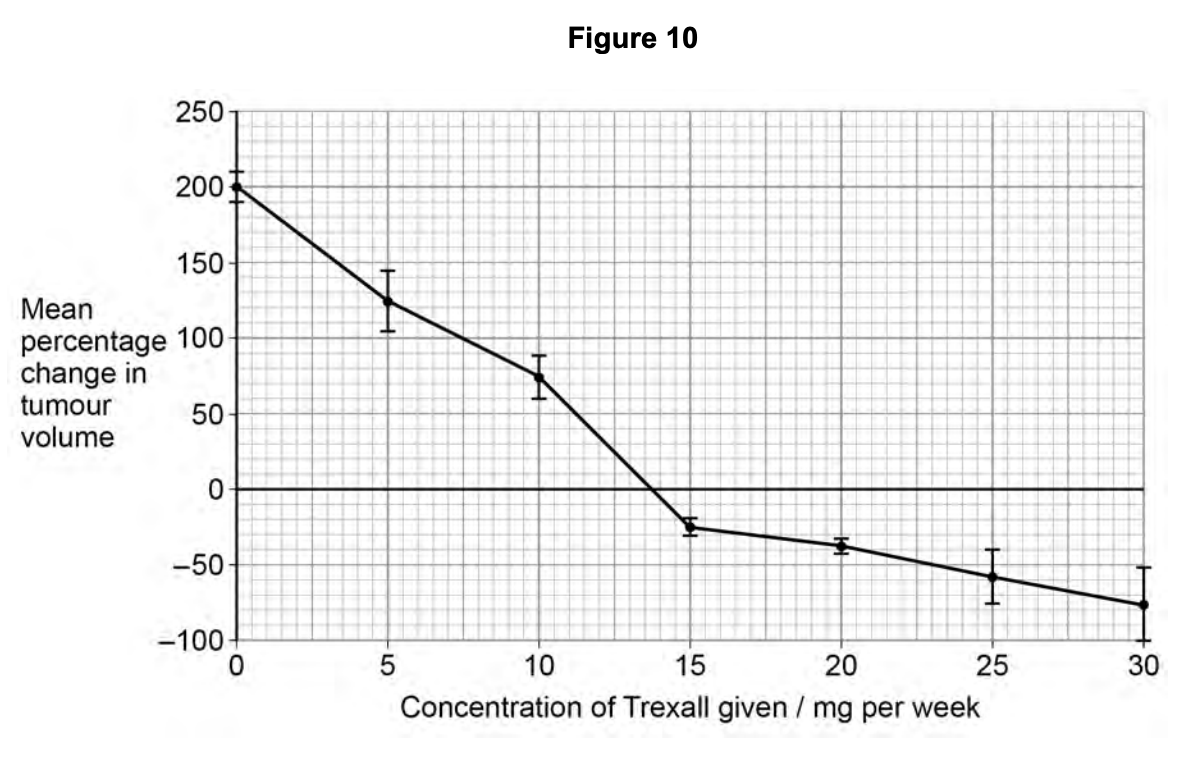
Answer
Mark Scheme
- Percentage change 1. To allow comparison as tumours may differ in volume/size (at the start of the investigation) (1 mark)
- Tumour volume 2. (As) tumours may differ in length/width/shape OR (As) volume is (best) indication of the number of cells in tumour (1 mark)
Comments from mark scheme
- Accept ‘as tumours are three dimensional’
- Ignore answers relating to density/thickness
Tips from examiner reports
Only 9% scored both marks. Calculate percentage change to allow comparison (tumours may start at different sizes). Measure tumour volume to quantify the change — not just whether it is present or absent.
A lung cancer patient received 15 mg of Trexall per week. After treatment, the diameter of his lung tumour was 35.8mm Assuming the tumour was spherical, use the mean percentage change in tumour volume shown in Figure 10 to calculate the volume of the patient’s tumour before treatment with Trexall. The formula for the volume of a sphere is 4/3πr3 where π = 3.14 **CHECK FORMATTING
(2 marks)Answer
Mark Scheme
Answer in the range 32 015.93682 to 32 045 = OR 3.20 x 104 = 2. Allow 1 mark for correct calculation of volume after treatment in range of 24 011.95261 to 24 034 /2.40 x 104 Allow 1 mark if student uses diameter throughout instead of radius, in range of 256 127 to 256 361/2.56 x 105 (1 mark)
To reduce the size of tumours, would it be better to use 30mg of Trexall per week, or 20 mg of Trexall per week?
Explain your answer.
(2 marks)Answer
Mark Scheme
- For (the use of 30 mg) 1. There is a significantly greater reduction (in tumour size with 30 mg), as SD (bars) do not overlap (1 mark)
-
- In some cases (with 30 mg) there was a 100% reduction in size/tumours would have been eradicated (1 mark)
- Against (the use of 30 mg) 3. There is too much/a lot of variation in effectiveness with 30 mg (in contrast with 20 mg) (1 mark)
-
- (No idea of) extra cost of providing 30 mg per week (1 mark)
-
- (Increased risk of) side effects with higher doses (1 mark)
Comments from mark scheme
Accept converse arguments for all mark points.
- Accept ‘significant difference’ for ‘significantly greater reduction’
- Ignore 30 mg has a lot of deviation/large standard deviation’ unqualified
Trexall can also be used to slow the development of rheumatoid arthritis (a pain-causing joint disease).
Scientists investigated the effectiveness of Trexall as a pain relief treatment in 12 rheumatoid arthritis patients.
All of the patients were female. They randomly divided the patients into two groups:
- Group R received Trexall tablets for 35 days
- Group S was a control group.
They asked both groups to rate their pain on a scale of 0–10 (0 being no pain and 10 being the worst pain possible) at the start and then every 7 days for 35 days. They calculated mean scores for each group.
Their results can be seen in Table 3.
Apart from age and general health, give two important factors when choosing patients for this investigation.
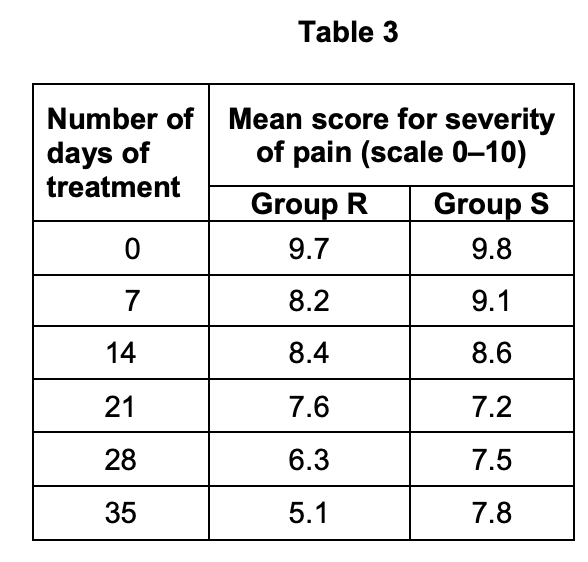
Answer
Mark Scheme
- Accept any two suitable suggestions for one mark, eg (1 mark)
- Severity/duration of arthritis Current/other medication Type of arthritis Weight/body mass Ethnicity (1 mark)
Comments from mark scheme
Reject age/health as they are directly in the stem Ignore gender/sex Ignore general answers such as diet/activity/lifestyle
A student analysed Table 3 and concluded that Trexall was effective in reducing pain in arthritis patients.
Evaluate the student’s conclusion.
(3 marks)Answer
Mark Scheme
- For 1. Pain decreases more with Trexall/Group R compared with the control group/Group S OR Pain decreases by 4.6 with Trexall/Group R and by 2 with the control group/Group S (1 mark)
- Against 2. Small sample size/only 12 people/only studied females / effects in males could be different (1 mark)
-
- (Mean score for severity of) pain in control group/Group S is (also) lower (1 mark)
-
- No statistical testing, so do not know if decrease/difference is significant (1 mark)
-
- Pain is (a) subjective (measurement) (1 mark)
Comments from mark scheme
2 max for answer only giving reasons against
- Ignore numbers stated from Table 3, eg 9.7 to 5.1 and 9.8 to 7.8
- Could be subsumed within MP1
- Ignore ‘do not know if results are significant’
- Accept ‘patients might lie about pain’
The importance of DNA as an information-carrying molecule and its use in gene technologies.
(25 marks)Answer
Mark Scheme
- No mark scheme available
The importance of bonds and bonding in organisms.
(25 marks)Answer
Mark Scheme
- No mark scheme available
Broken bones are repaired by cells called osteoclasts and osteoblasts. Osteoblasts secrete a hormone called osteocalcin in an inactive form. Osteocalcin is a protein. The active form of osteocalcin binds to a receptor on beta (β) cells in the pancreas, stimulating them to release insulin. Osteoblasts have receptors for insulin. Figure 1 shows how the production of osteocalcin by osteoblasts is controlled by positive feedback.
The secretion of osteocalcin (in an inactive form) by osteoblasts is controlled by positive feedback.
Use information from Figure 1 to explain why this is positive feedback.
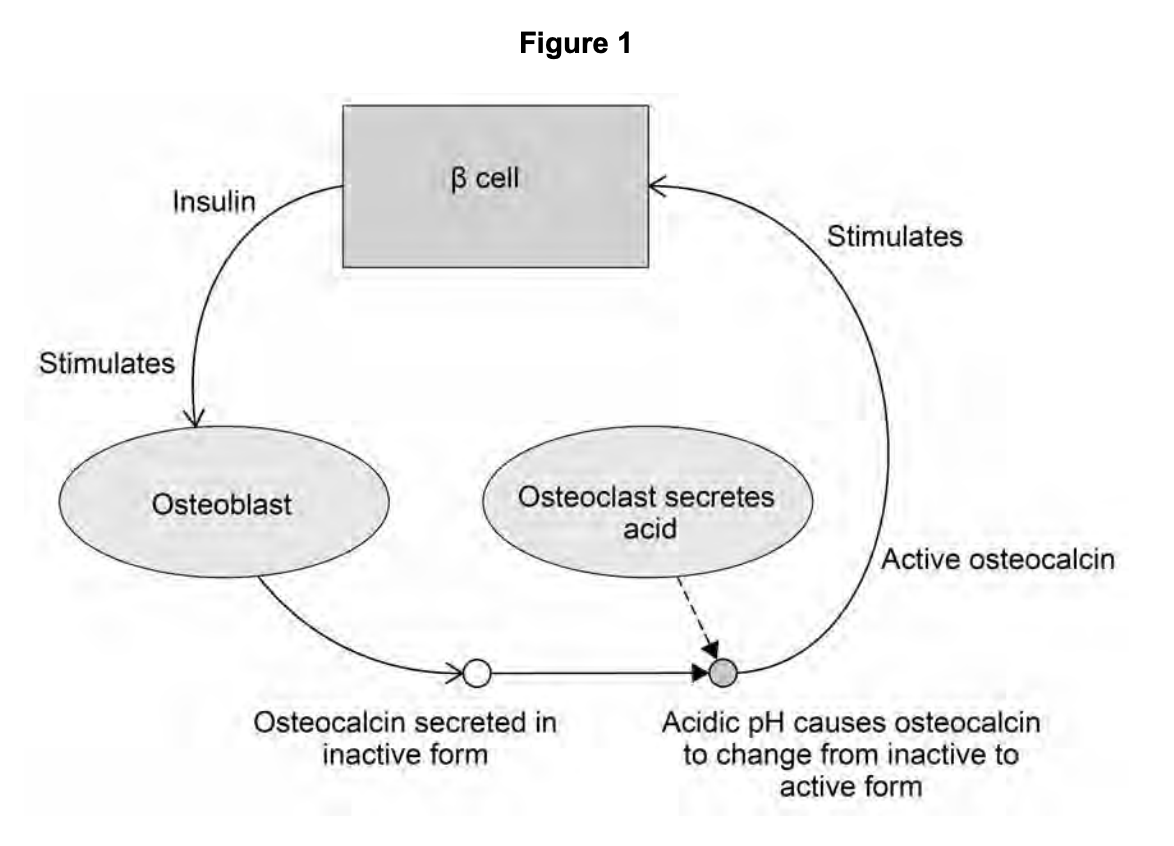
Answer
Mark Scheme
- (Insulin stimulates release of osteocalcin – no mark) 1. Osteocalcin causes more (release of) insulin (1 mark)
-
- (More) insulin causes more (inactive) osteocalcin (release) (1 mark)
Comments from mark scheme
- and 2. Idea of more required but other words can be used
- and 2. Ignore ref. to further
- and 2. Ignore ref. to more B cells / osteoblasts stimulated
The acidic pH conditions created by osteoclasts cause the inactive form of the protein osteocalcin to change into the active form of osteocalcin. Suggest how.
(2 marks)Answer
Mark Scheme
- (Change in pH) changes / breaks ionic / hydrogen bonds (1 mark)
- Changes tertiary structure (1 mark)
Comments from mark scheme
- Ignore ref. to peptide or sulfur-sulfur bonds
- Accept polar bonds
- Ignore changes to primary structure
- Reject ref. to active site / enzyme
- Accept forms binding site
- Ignore 3D
- Accept 3o
Binding of insulin leads to an increase in the rate of respiration in cells such as osteoblasts. Explain how.
(2 marks)Answer
Mark Scheme
- (Insulin) leads to more transport proteins / channel (proteins) / carrier (proteins) for glucose (1 mark)
- More glucose (for respiration / glycolysis) enters cell (1 mark)
Comments from mark scheme
Idea of more required once to cover both mark points
- Ignore references to opening channels
- Accept co-transport / GLUT 1 or 4 protein
- Ignore references to glycogen formation / fat metabolism / enzyme activation
Chronic lymphocytic leukaemia (CLL) is a cancer that affects some B cells of a person’s immune system.
Rituximab is a drug used to treat CLL. It binds to a protein called CD20 on the surface of B cells. If enough Rituximab binds to a B cell, it can kill the cell. Rituximab kills both healthy and cancerous B cells. The body then produces new B cells. The amount of CD20 on the surface of B cells varies from one person to another. Doctors investigated the relationship between the amount of CD20 on the B cells of a patient and the percentage of B cells destroyed by Rituximab. Figure 2 shows the doctors’ results. Each cross is the result for one patient
What statistical test could the scientists have used to determine whether there was a significant relationship between the amount of CD20 on the surface of B cells and the percentage of B cells destroyed by Rituximab?
Give a reason for your answer.
Name of test = Reason =
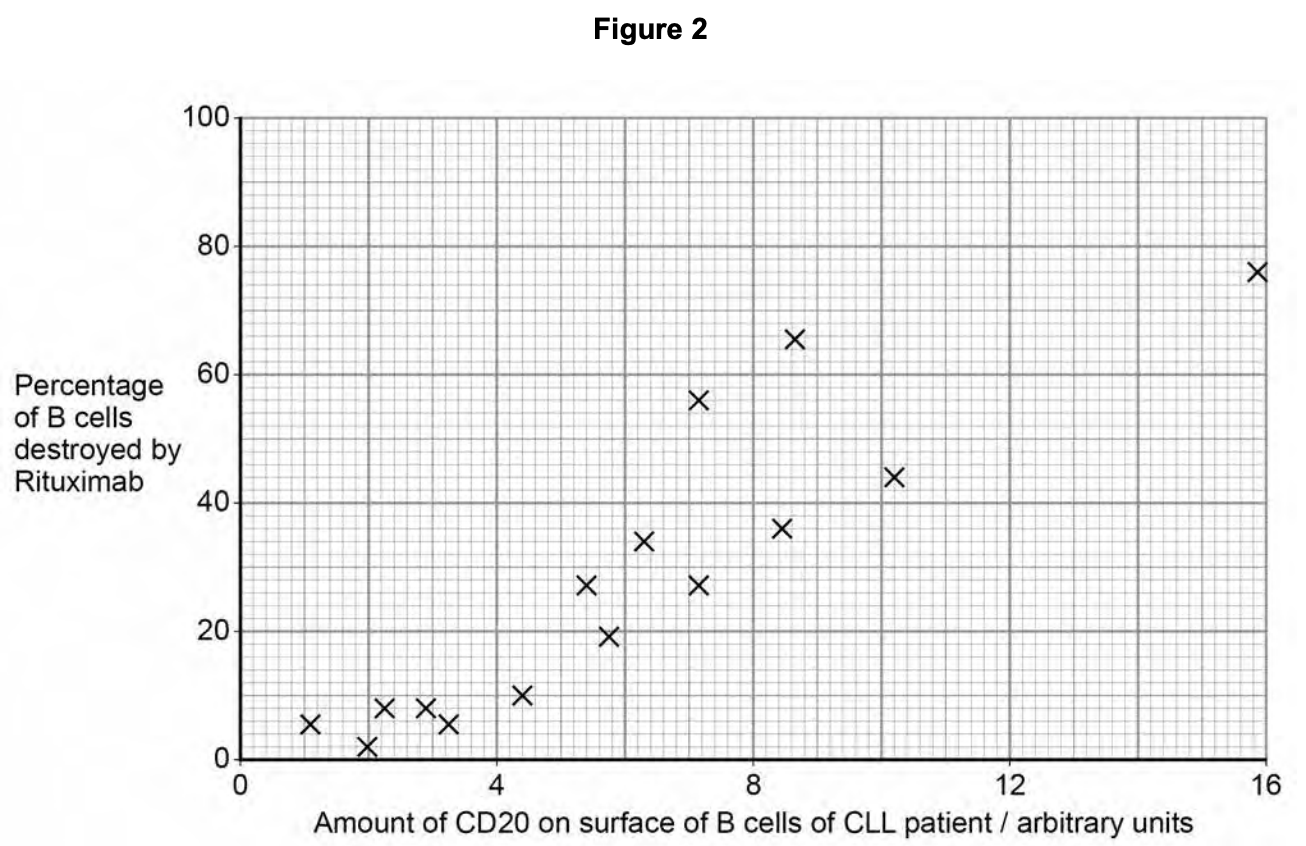
Answer
Mark Scheme
- Correlation coefficient and because looking for correlation / relationship / association between two variables / between B cells destroyed and CD20 (1 mark)
Comments from mark scheme
Accept Pearson and Spearman Accept factor for variable Wrong test or wrong reason = 0 marks
From these data, what can you conclude about the effectiveness of Rituximab in treating patients with CLL?
Do not include considerations of statistical analyses in your answer.
(3 marks)Answer
Mark Scheme
- The more CD20 (on B cells), higher the percentage of / more B cells destroyed / more effective it is (1 mark)
- (At best) only destroys (about) 80% of B cells OR In no cases are all B cells killed (1 mark)
- Don’t know % / proportion of cancer cells killed (1 mark)
- Won’t cure CLL / cancer / slows but doesn’t stop CLL / cancer (1 mark)
- Little effect below (about) 5 CD20 on cells (1 mark)
Comments from mark scheme
- Ignore ref. to ‘positive correlation’ unqualified Ignore ref. to correlation vs. causation Ignore ref. to effects on the immune system
- Ignore ref. to little effect where little CD20
Approximately 11 percent of people with CLL also have mutations of a gene called NOTCH1. This leads to production of a non-functional transcription factor associated with CD20 production.
The doctors determined the median percentage of B cells destroyed by Rituximab in people with CLL who had the NOTCH1 mutation and those who did not. The doctors’ results are shown in Table 1.
Human blood contains (approximately) 1.0 × 10⁹ B cells per dm³
Use the median values in Table 1 to calculate the difference between the number of B cells per dm³ in the blood of people treated with Rituximab with the NOTCH1 mutation and people without the NOTCH1 mutation. Express your answer in standard form. Show your working.
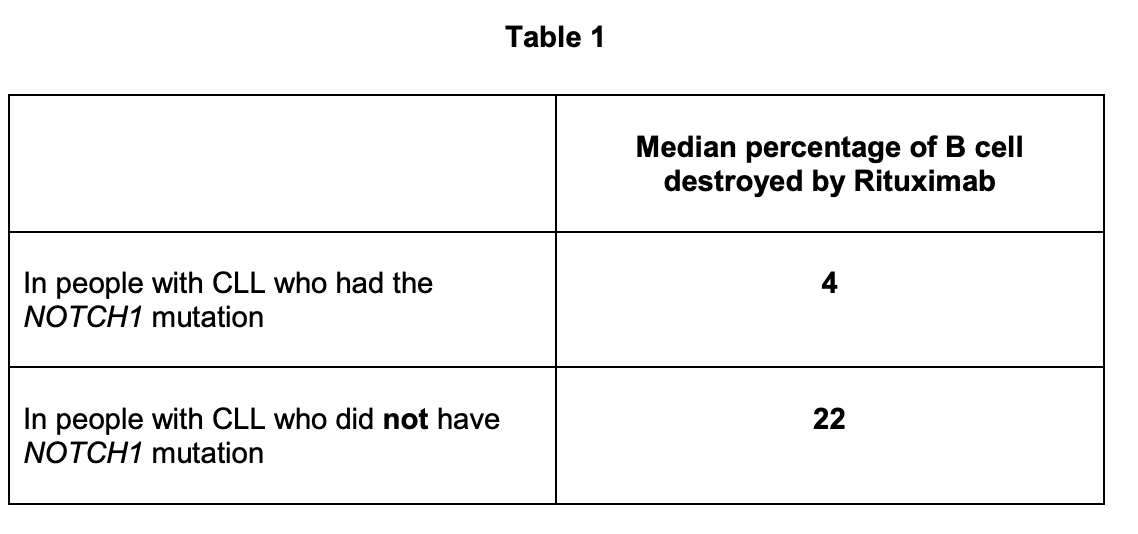
Answer
Mark Scheme
- 1.8 x 10⁸ (1 mark)
- If correct difference but expressed in non-standard form, award 1 mark (1 mark)
Comments from mark scheme
Award 1 mark if answer given as 1.8 x 10⁻⁸
Use all of the information to suggest how the mutation of NOTCH1 led to the difference in the percentage of B cells destroyed by Rituximab.
(3 marks)Answer
Mark Scheme
- Mutation changes the tertiary structure / amino acid sequence of transcription factor (1 mark)
- Transcription factor not complementary to / cannot bind to CD20 gene / CD20 DNA (1 mark)
- Little / less / not enough / no mRNA for CD20 produced OR Little / less / not enough / no (mRNA for) CD20 translated / produced (1 mark)
- (Not enough CD20 so) nothing / little for Rituximab to bind to, so few / no B cells destroyed (1 mark)
Comments from mark scheme
- and 2. Do not accept unqualified statements about nonfunctional transcription factor – this is in stem of question
- and 2. Answers must be in context of transcription factor, not CD20, or generic statements
- Accept TF cannot bind to promoter (on DNA)
- Accept converse for cells with a lot of CD20
- Accept lower median percentage for fewer cells destroyed
In women, the first division of meiosis produces one daughter cell that has almost all of the cytoplasm. The other daughter cell consists of a nucleus surrounded by a very small amount of cytoplasm and a cell-surface membrane. This very small daughter cell is called a polar body. Polar bodies do not usually divide. The same process occurs in the second division of meiosis, resulting in one egg cell and two polar bodies.
The diagram in Figure 3 shows the formation of an egg cell and two polar bodies during meiosis. It also shows what happens to one pair of homologous chromosomes. This pair carries two alleles of gene A.
Complete Figure 3 by putting A or a in the boxes. One box has been completed for you with A.
(1 marks)Answer
Mark Scheme
- Lowercase a in both boxes (1 mark)
Complete Figure 3 by putting A or a in the boxes. One box has been completed for you with A.
Put a tick ( ) in the box next to the name of the process that produced the combination of alleles on the chromosome in the first polar body in Figure 3. A) Anaphase B) Crossing over C) Independent assortment D) Semi-conservative replication
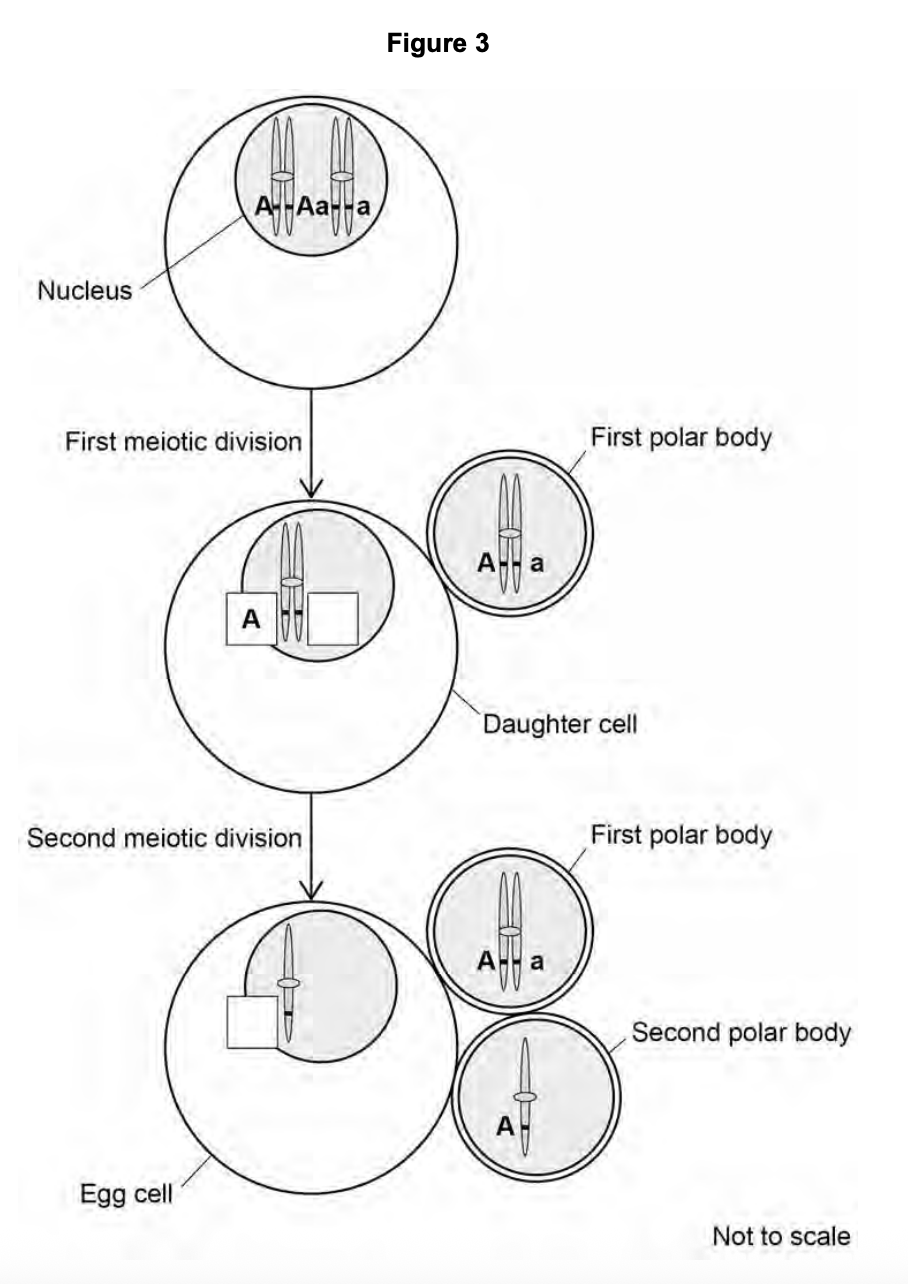
Answer
Mark Scheme
- B = ‘Crossing over’ (1 mark)
A scientist measured the diameter of a polar body and the diameter of the nucleus inside it. The diameter of the polar body was 10.4 µm and the diameter of the nucleus was 7.0 µm. The density of mitochondria in the cytoplasm of the polar body (outside of the nucleus) was 0.08 mitochondria per µm³ .
Calculate the number of mitochondria in the polar body. You should assume polar bodies and nuclei are spherical. The formula for the volume of a sphere is 4 3 πr3 where π = 3.14 Show your working.
(2 marks)Answer
Mark Scheme
- 32.73 / 32.7 / 32 / 33 (1 mark)
- Award 1 max for either 409 (409.2) for difference in volume (but incorrect number of mitochondria) (1 mark)
- OR Answer of 262 (261.9) (using diameter, rather than radius) (1 mark)
Mitochondrial diseases are caused by faulty mitochondria. All of a person’s mitochondria are inherited from their mother via the egg cell. An egg cell contains approximately 3 × 10⁵ mitochondria. One proposed treatment to prevent passing on faulty mitochondria involves
Suggest how this treatment prevents inheritance of mitochondrial diseases.
- removing the nucleus from an egg cell donated by a woman with healthy mitochondria
- replacing this nucleus with the contents of the polar body from a woman whose egg cells are affected by mitochondrial disease.
Answer
Mark Scheme
- Egg (created) has nucleus / DNA / genes of (affected) woman / mother (1 mark)
- It has mostly / many / lots of normal mitochondria (of unaffected woman) OR There are few faulty mitochondria (1 mark)
Comments from mark scheme
- Accept ref. to zygote / embryo / child for egg
- Accept genetic information
- Ignore references to alleles
- Reject if nucleus from wrong egg / woman
- Reject ref. to production of healthy mitochondria as result of treatment
If most of the mitochondria in a cell are faulty, this prevents many important enzyme-catalysed reactions taking place or slows them down.
Suggest and explain one reason why.
(2 marks)Answer
Mark Scheme
- Not enough / little ATP produced (1 mark)
- ATP provides energy for (enzyme) reactions OR ATP phosphorylates substrates / enzymes, so making them (more) reactive (1 mark)
Comments from mark scheme
One reason asked for, so list rule applies
- Ignore ref. to no ATP produced
- Accept (leads to) lower activation energy for reaction
- Reject if mention energy produced
Binding of one molecule of oxygen to haemoglobin makes it easier for a second oxygen molecule to bind.
Explain why.
(2 marks)Answer
Mark Scheme
- Binding of first oxygen changes tertiary / quaternary (structure) of haemoglobin (1 mark)
- Creates / leads to / uncovers second / another binding site OR Uncovers another iron / Fe / haem group to bind to (1 mark)
Comments from mark scheme
Ignore ref. to ‘positive cooperativity’ unqualified Ignore ref. to named bonds
- Accept conformational shift caused
- Reject ref. to active site
A haemocytometer is a special microscope slide which can be used to count the numbers of blood cells in a sample of blood.
The doctor counted the red blood cells in many small squares. The mean number of red blood cells per small square was 7 The original blood sample was diluted by a factor of 200 times.
Calculate the number of red blood cells per mm³ in the original blood sample.
- The surface of the slide has many small, equal-sized squares marked on it.
- The depth of the liquid under each square is 0.1 mm
- When counting, cells that touch top or left lines are counted but cells that touch right or bottom lines are not counted. A doctor used a haemocytometer to determine the number of red blood cells per mm³ in a blood sample. He diluted the original blood sample by a factor of 200 times before putting some on a haemocytometer. Figure 4 shows the distribution of cells in a typical small square.
Give your answer in standard form.
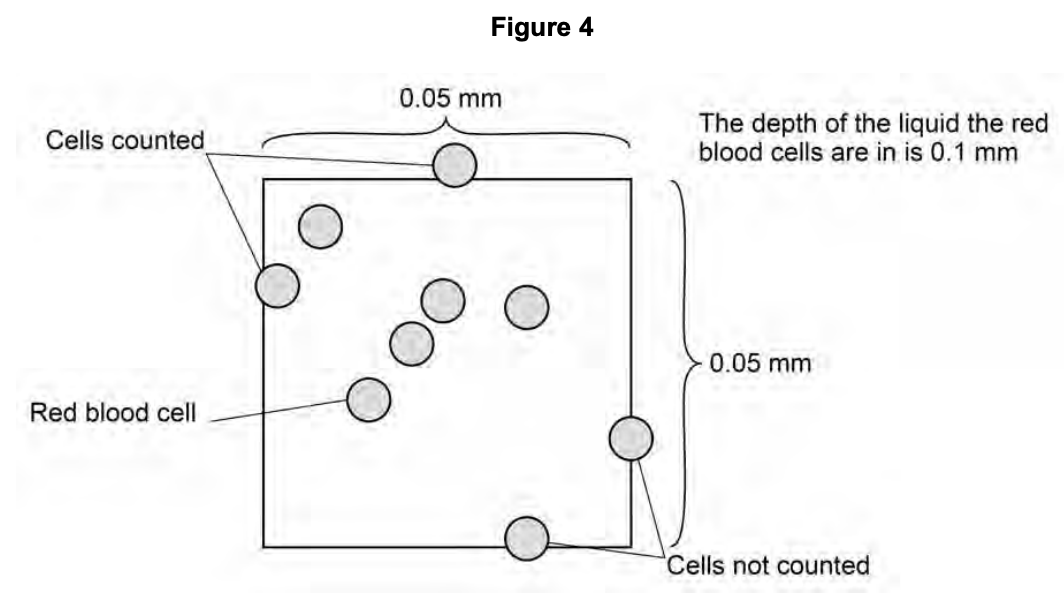
Answer
Mark Scheme
- 5.6 x 10⁶ (red blood cells per mm³ ) (1 mark)
- Award 1 max for one of 2.8 x 10⁴ (standard form but ignoring dilution) OR 5 600 000 (correct but not standard form) OR 5.6 x 10⁵ (failure to use depth of liquid on slide) (1 mark)
When counting, cells that touch top or left lines are counted but cells that touch right or bottom lines are not counted.
Suggest two reasons for this rule.
(2 marks)Answer
Mark Scheme
- To avoid dealing with parts of cells (1 mark)
- To avoid counting same cells twice / more than once (1 mark)
- To be consistent / get comparable results (1 mark)
Comments from mark scheme
- Accept more accuracy
- Ignore reliability / repeatability / reproducibility / precision / validity
The doctor also wanted to know how many white blood cells per mm³ there were in a different sample of blood. To do this he first diluted the sample by a factor of 20 times. He then made the white blood cells clearly visible by using a stain that makes nuclei appear dark blue.
When counting white blood cells, the doctor only diluted the blood sample by a factor of 20 times, instead of 200 times when counting red blood cells.
Suggest why he only diluted the sample by a factor of 20 times.
(1 marks)Answer
Mark Scheme
- There are fewer white cells, so no need to dilute (further to see enough (1 mark)
Comments from mark scheme
Accept converse of too few to see if greater dilution / at 200 times Do not accept ref. to numbers of red and white cells unqualified Ignore ref. to white cells larger
Explain how the stain allowed the doctor to count the white blood cells amongst all the red blood cells.
(1 marks)Answer
Mark Scheme
- White cells have a nucleus (that stains but red cells do not) (1 mark)
Comments from mark scheme
Accept converse for red cells
Scientists investigated the role of a protein called CENP-W in mitosis. Their method involved cell fractionation and ultracentrifugation.
The scientists began by lysing (breaking open) cells and organelles using a detergent that dissolves lipids in water.
Suggest how the detergent releases CENP-W from cells.
(2 marks)Answer
Mark Scheme
- Cell membranes made from phospholipid (1 mark)
- (Detergent) dissolves membranes / phospholipid (bilayer) (1 mark)
Comments from mark scheme
Note: candidates may make both mark points in once statement 2. Ignore breaks down 2. Reject hydrolysis
Explain how ultracentrifugation separates CENP-W from other molecules
(2 marks)Answer
Mark Scheme
- Spin (liquid / supernatant) at (very) high speed / high g (1 mark)
- Molecules / CENP-W separates depending on (molecular) mass / size / density (1 mark)
Comments from mark scheme
- Need context of high, not just ‘faster’, ‘higher’ in context of use of bench centrifuge
- Accept high centrifugal force Award 1 max if ref. to organelle separation
- Accept weight
CENP-W is involved in the formation of spindle fibres in mitosis. Spindle fibres are made of molecules of a protein called tubulin. The scientists treated cells in a culture with small interfering RNA (siRNA). This siRNA causes RNA interference of expression of the CENP-W gene. The scientists took samples of cells at 0, 48 and 72 hours after adding the siRNA. They then used gel electrophoresis to separate CENP-W and tubulin from these samples. Figure 5 shows the results of the electrophoresis. The size of each band is proportional to the amount of CENP-W or tubulin present.
Suggest how the siRNA produced these results.
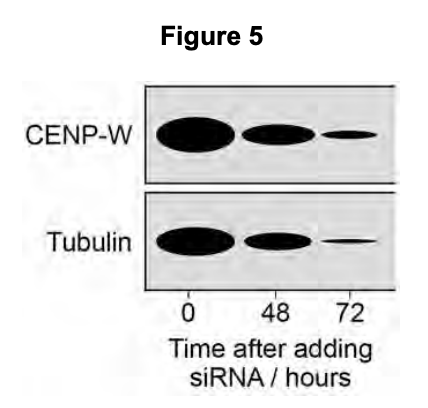
Answer
Mark Scheme
- siRNA binds to / destroys mRNA for CENP-W (1 mark)
- Prevents translation of CENP-W (1 mark)
- (After / as) CENP-W reduces so does tubulin production (1 mark)
Comments from mark scheme
- Reject if siRNA binds to gene / DNA
- and 2. Context is important, siRNA acts on mRNA for CENPW, not tubulin.
- and 2. Ref. to CENP-W required once for MP1 and MP2
- Accept reduces translation of CENP-W
Ammonia in soil is oxidised to nitrites and nitrates by species of nitrifying bacteria. Scientists investigated whether two soils with a different pH contained different communities of nitrifying bacteria. These communities consist of all the nitrifying bacteria of different species in each soil. They took samples of soil from two sites, A and B. They measured the pH of the samples and found that
The scientists used units of µg g−1 for the concentration of ammonia in soil.
- the soil from site A had a pH of 6.9
- the soil from site B had a pH of 4.3 The scientists measured the concentration of ammonia in soil samples over 20 days. Each sample contained the same concentration of ammonia at the start and had the same mass. They recorded the concentration of ammonia in
- soil A with a pH of 6.9
- soil B with a pH of 4.3
- a mixture of equal masses of soils A and B with its pH adjusted to 6.9 Their results are shown in Figure 6.
Suggest why, in this investigation, the scientists used these units.
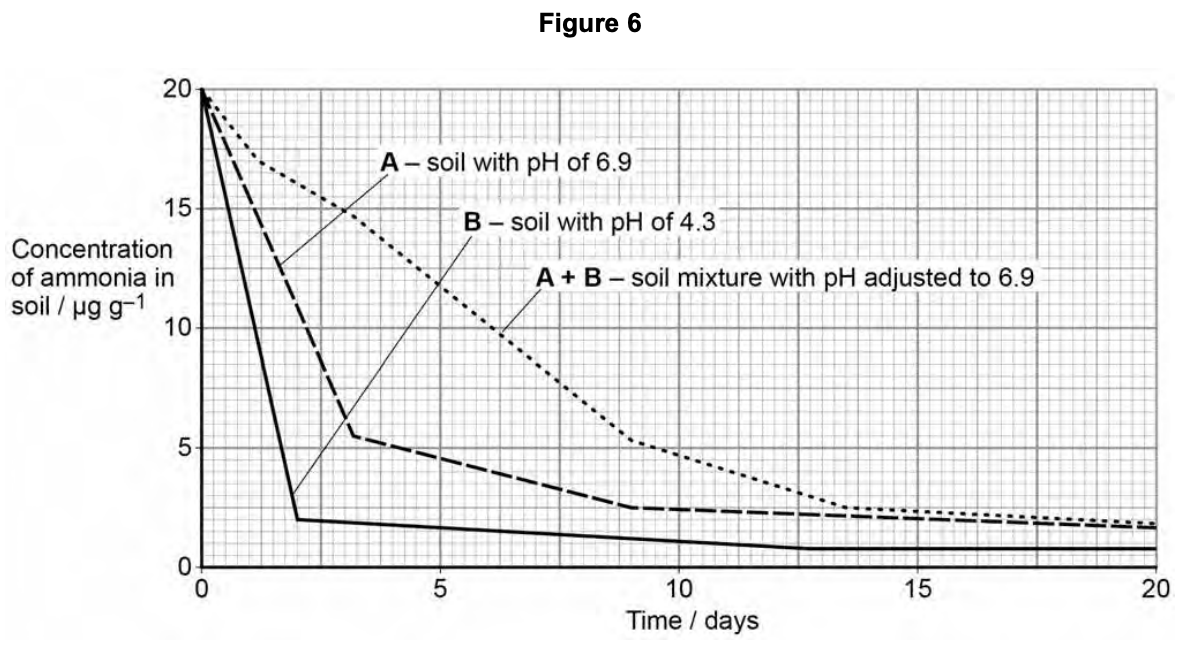
Answer
Mark Scheme
- (µg because) very little ammonia (in soil) (1 mark)
- (µg because) avoids use of (lots of) decimal places (in their results) / avoids the use of powers of 10 / avoids the use of standard form (1 mark)
- (g -1 ) to allow comparisons (between samples) (1 mark)
Comments from mark scheme
- Accept makes numbers more manageable
- Accept makes easier to plot graph
Calculate the difference in the rate of breakdown of ammonia per day between day 0 and day 2 in soil A and soil B.
Show your working and the units for your answer.
(2 marks)Answer
Mark Scheme
- Answer between 4.5 and 4.6 µg g⁻¹ day-1 (1 mark)
- Award 1 mark for correct number but wrong / no units (1 mark)
Comments from mark scheme
Ignore plus or minus signs Accept ‘per gram’ AND / OR ‘per day’
The scientists concluded that the soil mixture experiment showed there were different communities of bacteria in soils A and B.
What evidence from Figure 6 supports their conclusions?
Give reasons for your answer.
(3 marks)Answer
Mark Scheme
- pH 4.3 / B has fastest rate of breakdown (of ammonia) (1 mark)
- A + B / mixture at pH 6.9 slowest / slower (than A or B) (1 mark)
- Suggests (community / bacteria at) pH 4.3 / B doesn’t work (well) at pH 6.9 / pH of mixture (1 mark)
Comments from mark scheme
- Not just ref. to A and then B on their own
- Accept converse that only (community / bacteria at) pH 6.9 / A is working in the mixture
The oxidation of ammonia by nitrifying bacteria involves the enzyme ammonia monooxygenase. Each species of nitrifying bacteria has its own specific amoA gene that codes for production of ammonia monooxygenase.
In a second investigation, the scientists determined the expression of the amoA gene in two species of bacteria, S and T. Species S was from acid soil and species T was from soil with a neutral pH.
The scientists grew cultures of each species separately in soils of different pH. They determined the amount of mRNA from the amoA gene in each culture. Their results are shown in Figure 7.
In which species was the number of copies of mRNA more affected by changes in soil pH from 4.9 to 7.5?
Use a calculation to support your answer.
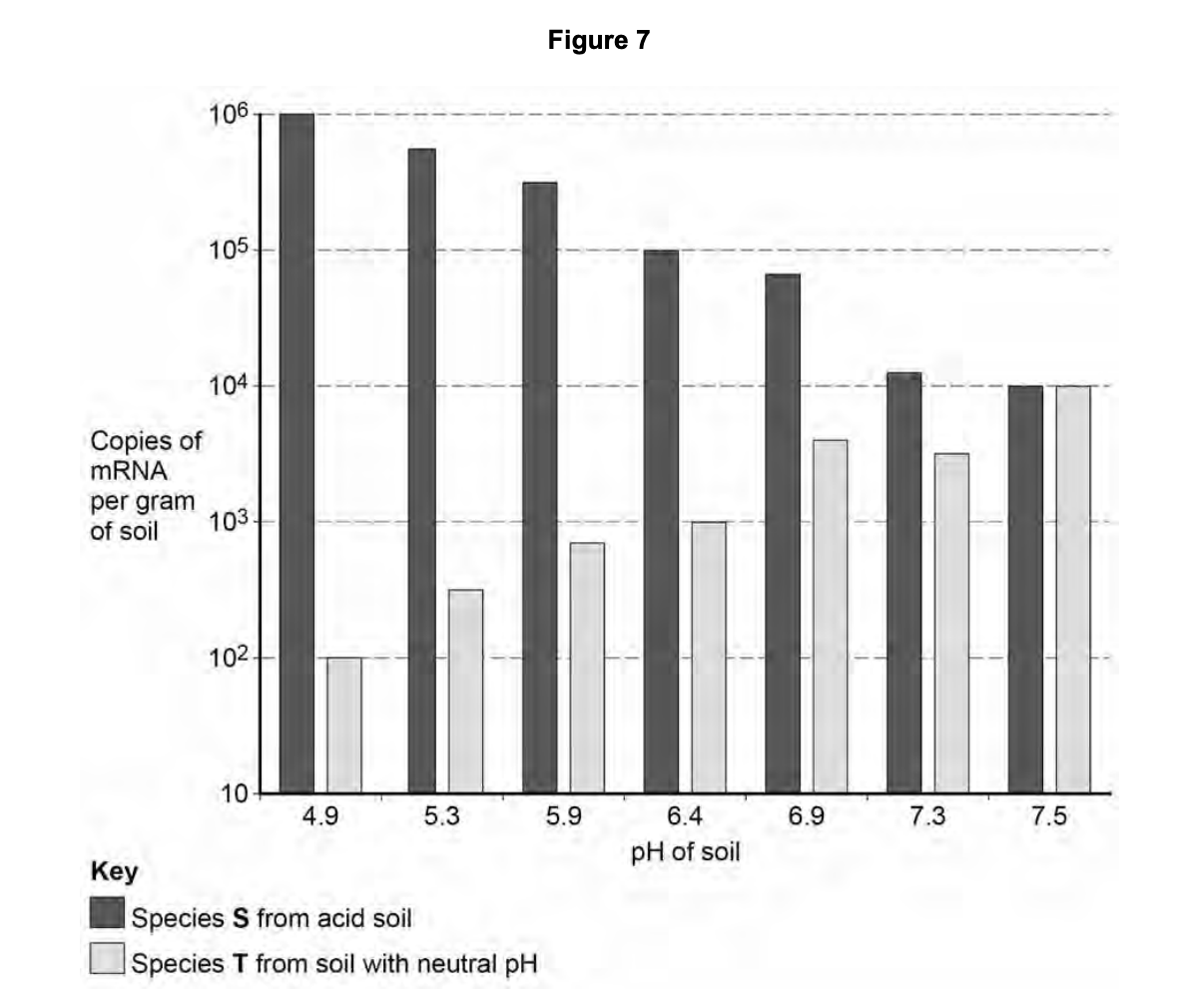
Answer
Mark Scheme
- (Species S because) no mark 1. Species S change of 990,000 (per gram of soil) (1 mark)
-
- Species T change of 9,900 (per gram of soil) (1 mark)
- OR (Species T because) no mark 3. Species S has 99% change (1 mark)
-
- Species T has 9900% change (1 mark)
Comments from mark scheme
Award MP1 and 2 OR MP3 and 4
- and 2. Accept standard forms 9.9 x 10⁵ and 9.9 x 10³ for either Accept for 1 mark for 100 times greater in correct context with no other calculations shown
This method allowed the scientists to estimate the expression of the amoA gene in each culture but not the growth of the bacterial population in each culture.
Explain why.
(4 marks)Answer
Mark Scheme
- They didn’t count bacteria / cells / population(s) (1 mark)
- Copies / number of mRNA related to amount of enzyme / amoA produced / translated (1 mark)
- Don’t know how much mRNA / amoA produced by each cell (1 mark)
- Don’t know if amoA (mRNA / enzyme) is linked to cell division / growth (of population) (1 mark)
Comments from mark scheme
Ignore ref to other factors / other named factors affecting growth 3. Accept some bacteria produce more mRNA / amoA than others 4. Amount of amoA does not show cell division / growth 4. Reject references to mitosis / meiosis
The scientists set up their cultures in sterile glass bottles.
Suggest one suitable method for sterilising the bottles and explain why it was necessary to sterilise them.
(2 marks)Answer
Mark Scheme
- Suitable method; eg in boiling water / steam / autoclave / wash in disinfectant / wash in alcohol (1 mark)
- (Reason) to remove / kill other bacteria / organisms that might break down ammonia (1 mark)
Comments from mark scheme
- Ignore heat unqualified
- Ignore flaming of bottle
- Accept radiation
- Ignore ref to removing bacteria that ‘affect the result’
- Accept other bacteria producing amoA
- Accept other bacteria compete with / kill bacteria that produce amoA
- Ignore contamination unqualified
The importance of the control of movement in cells and organisms.
(25 marks)Answer
Mark Scheme
- No mark scheme available
The importance of interactions between cells and between organisms.
(25 marks)Answer
Mark Scheme
- No mark scheme available
When a nerve impulse arrives at a synapse, it causes the release of neurotransmitter from vesicles in the presynaptic knob. Describe how.
(3 marks)Answer
Mark Scheme
- (Nerve impulse/depolarisation of membrane) causes Ca²⁺ channel (proteins) to open (1 mark)
- Ca²⁺ enter by (facilitated) diffusion (1 mark)
- Causes (synaptic) vesicles to fuse with (presynaptic) membrane (1 mark)
Comments from mark scheme
Accept single reference to ions to cover 1 and 2 Penalise once for no reference to ions
- Reject carrier proteins
- Reject ref to release of vesicles
- Ignore vesicles bind to membrane (but accept merge with)
The presynaptic knob contains actin filaments and myosin molecules. The myosin molecules can attach to mitochondria and move them towards the presynaptic membrane, as shown in Figure 1.
Use your knowledge of how myosin and actin interact to suggest how the myosin molecule moves the mitochondrion towards the presynaptic membrane. Do not include the roles of calcium ions and tropomyosin in your answer.
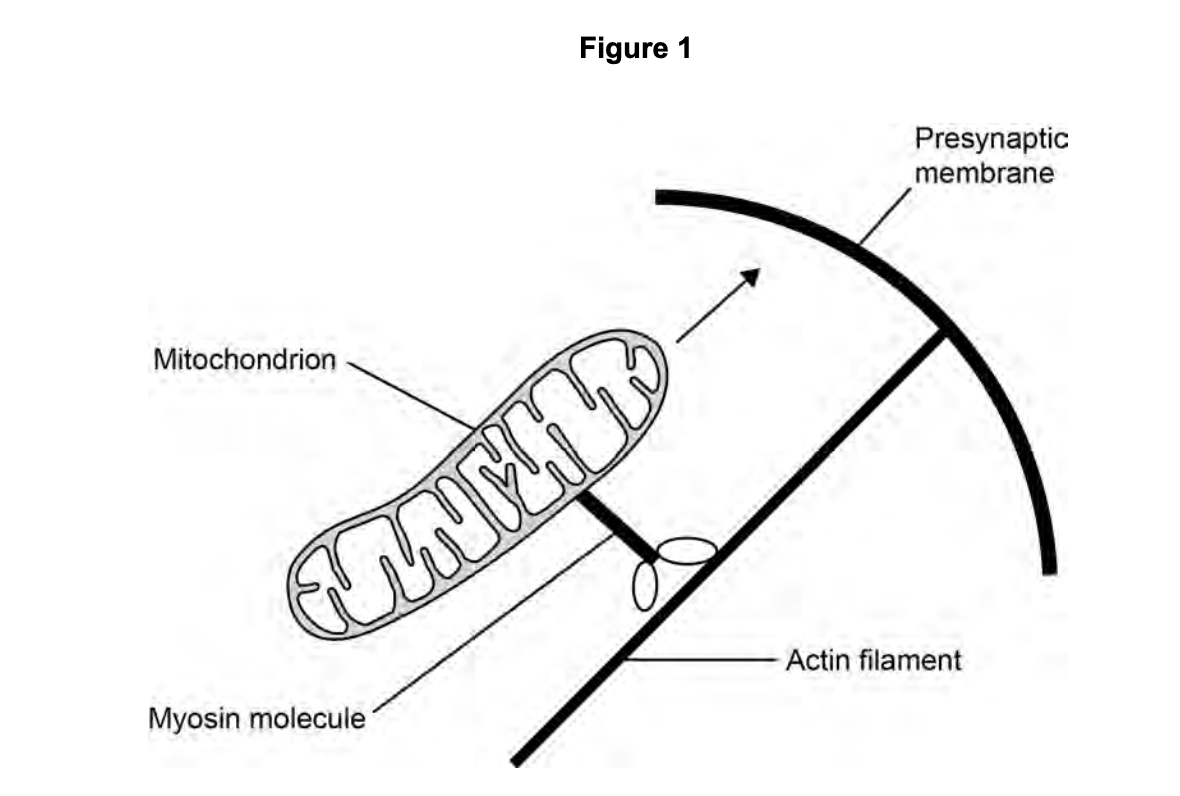
Answer
Mark Scheme
- Myosin head attaches to actin and bends/performs powerstroke (1 mark)
- (This) pulls mitochondria past/along the actin (1 mark)
- Other/next myosin head attaches to actin (and bends/performs powerstroke) (1 mark)
Comments from mark scheme
- Accept change shape/change angle
- Ignore pulls actin along
- Ignore refs to cytoskeleon Accept plural or singular statements
This movement of mitochondria happens when nerve impulses arrive at the synapse.
Suggest and explain one advantage of the movement of mitochondria towards the presynaptic membrane when nerve impulses arrive at the synapse.
(2 marks)Answer
Mark Scheme
- (Mitochondria) supply (additional) ATP/energy (1 mark)
- To move vesicles/for active transport of ions/for myosin to move past actin OR Re-synthesis/reabsorption of neurotransmitter/named neurotransmitter (1 mark)
Comments from mark scheme
- Reject produces energy
- Ignore ref. to ATP for opening calcium ion channels/making vesicles fuse with membrane
Bacteriophages are viruses that kill bacteria. Figure 2 shows drawings of a bacteriophage and a bacterium.
Using Figure 2 and your own knowledge, put a tick () in the box next to the only correct statement about the structures of the bacteriophage and the bacterium.
A) Both have ribosomes. B) Both have a cell-surface membrane. C) The bacteriophage has a capsid and the bacterium has a cell-surface membrane. D) The bacteriophage has a cell wall and the bacterium has a capsid.
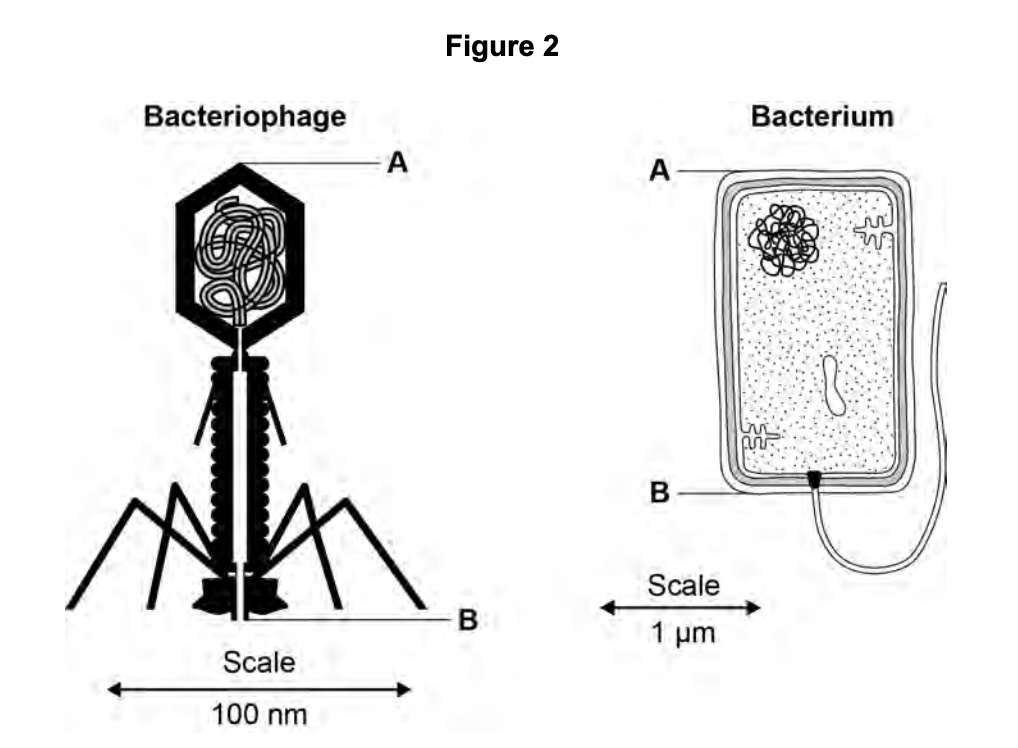
Answer
Mark Scheme
- C = The bacteriophage has a capsid and the bacterium has a cell-surface membrane (1 mark)
Using the scales in Figure 2, calculate how many times longer the bacterium is than the bacteriophage.
Use the distance between the points labelled A and B on each drawing in your calculations. Show your working.
(2 marks)Answer
Mark Scheme
- Correct number of times between 13.0/12.96 and 13.9/13.92 scores 2 marks (1 mark)
- One mark if correct sizes in ranges of 150.7nm to 154.4nm/ 0.151µm to 0.154µm and 1953.5nm to 2097.6nm/ 1.954µm to 2.098µm (1 mark)
Comments from mark scheme
Both lengths required for 1 mark credit Accept refs to150/0.15 and 2000/2 Ignore number of sig fig
Scientists investigated the use of bacteriophages to treat lung infections caused by bacteria. They infected the lungs of mice with a pathogenic species of bacterium. The mice were then divided into two groups, A and B.
Figure 3 shows the scientists’ results. Figure 3 shows the mean and the range of the data about the mean for each group. Standard deviations of the means are not shown.
What would the scientists’ null hypothesis be for this investigation?
- The mice in group A were not treated with bacteriophage.
- The mice in group B were treated by breathing in a spray containing bacteriophage particles. After 3 days, the scientists killed the mice and removed their lungs. They washed out each set of lungs with a set volume of liquid. The scientists determined the number of live bacteria in the liquid.
Answer
Mark Scheme
- The bacteriophage makes no difference to the number of (living) bacteria/there will be no difference in the number of (live) bacteria in treated and untreated mice/ there will be no difference in the number of (live) bacteria in A and B (1 mark)
Comments from mark scheme
Ignore no difference between mice
With some samples, the scientists decided they needed to carry out a series of dilutions of the sample before counting the bacteria.
Use evidence from Figure 3 to explain why dilutions were necessary for some samples but not for others.
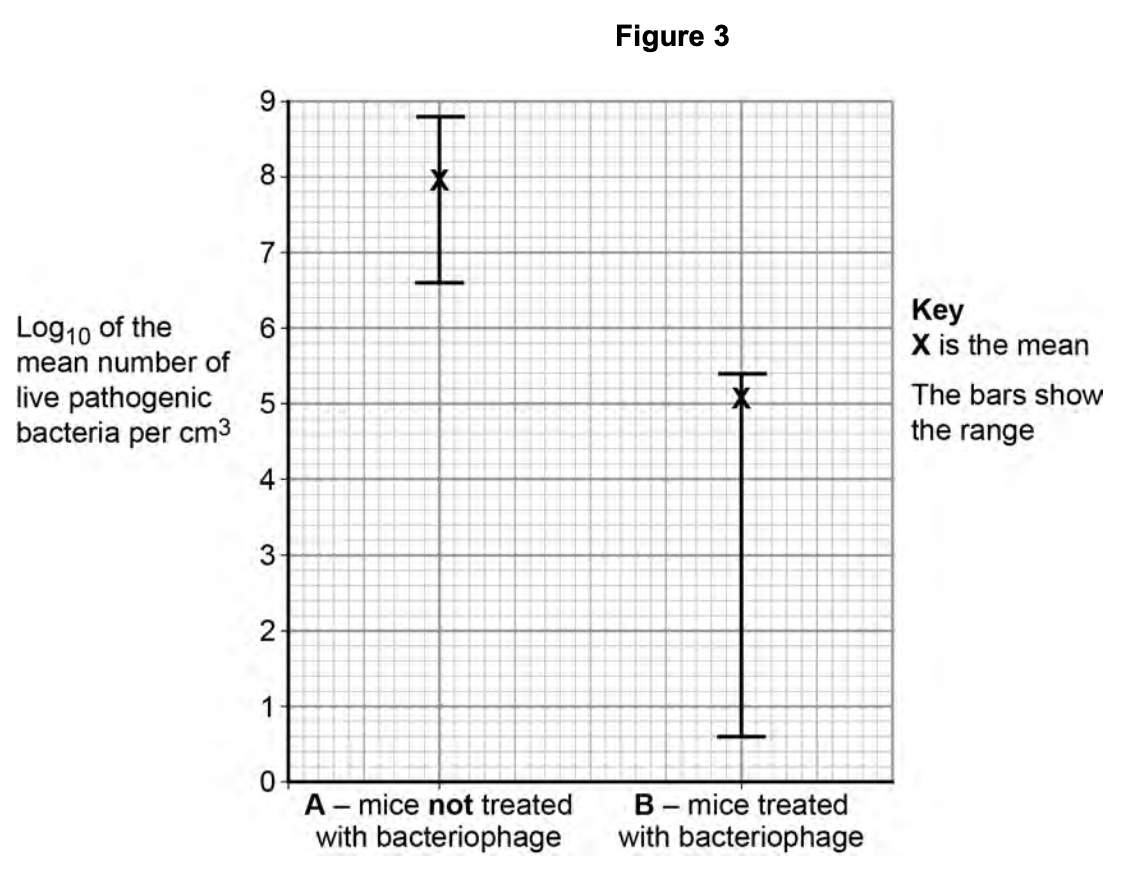
Answer
Mark Scheme
- Log scale (on graph) shows big range in number of bacteria OR Use of suitable data from log scale to give the range in number of bacteria (1 mark)
- Some samples too many to count (so dilute) but some countable (so don’t dilute) OR Use of figures from graph relating to ease (or otherwise) of counting Example. 631 000 000 bacteria would be too big to count (without serial dilution), 100 000 bacteria is small enough to count (1 mark)
Comments from mark scheme
1 and 2 Do not accept simple statements of log10 values from graph Look for answers in standard form Group A Mean between 79 million and 100 million Range 4 million to 631 million Group B Mean between 100 thousand and 126 thousand Range 3.98/4 up to 251 thousand
Using only Figure 3, what can you conclude from these data about the effectiveness of the bacteriophage in treating this lung infection in mice? Do not consider statistical analyses in your answer
(3 marks)Answer
Mark Scheme
- (Bacteriophage) reduces number of bacteria (1 mark)
- (In all cases/mice because) ranges don’t overlap (1 mark)
- But big range of effect/some mice a big reduction/a few mice with big falls in number OR Doesn’t bring bacteria down to 0 in any/works for some (mice) but not for all (1 mark)
Comments from mark scheme
Do not accept just quotes of log10 figures direct from graph Ignore refs to significance 2. Reject ref to SD / SE
Farmers use artificial fertilisers to maintain or increase yield from grain-producing crop plants such as wheat.
Artificial fertiliser is used to replace mineral ions removed from the land when crops are harvested. One of the mineral ions is nitrate.
Give two examples of biological molecules containing nitrogen that would be removed when a crop is harvested.
(2 marks)Answer
Mark Scheme
- Two suitable examples (1 mark)
- Examples 1. amino acid/protein/ polypeptide/peptide (1 mark)
-
- nucleic acid/nucleotide/base (1 mark)
-
- DNA (1 mark)
-
- RNA (1 mark)
-
- ATP/ADP (1 mark)
-
- NAD/NADP (reduced or not) (1 mark)
-
- Cyclic AMP/cAMP (1 mark)
-
- Chlorophyll (1 mark)
Comments from mark scheme
Reject for either point nitrates/nitrites/ammonia/ammonium/urea 4. Accept pre-mRNA/mRNA/rRNA/tRNA
Scientists investigated changes in the use of artificial fertiliser in India between 1970 and 2005. They also investigated changes in the fertiliser response ratio. This ratio shows how many kg of grain are produced for each kg of fertiliser used. Figure 4 shows their results in the form the scientists presented them. (A hectare is a unit of area commonly used in agriculture)
Use these data to calculate the difference in the mass of grain produced per hectare in 1970 compared with 2005. Show your working.
Difference in kg hectare–1 =
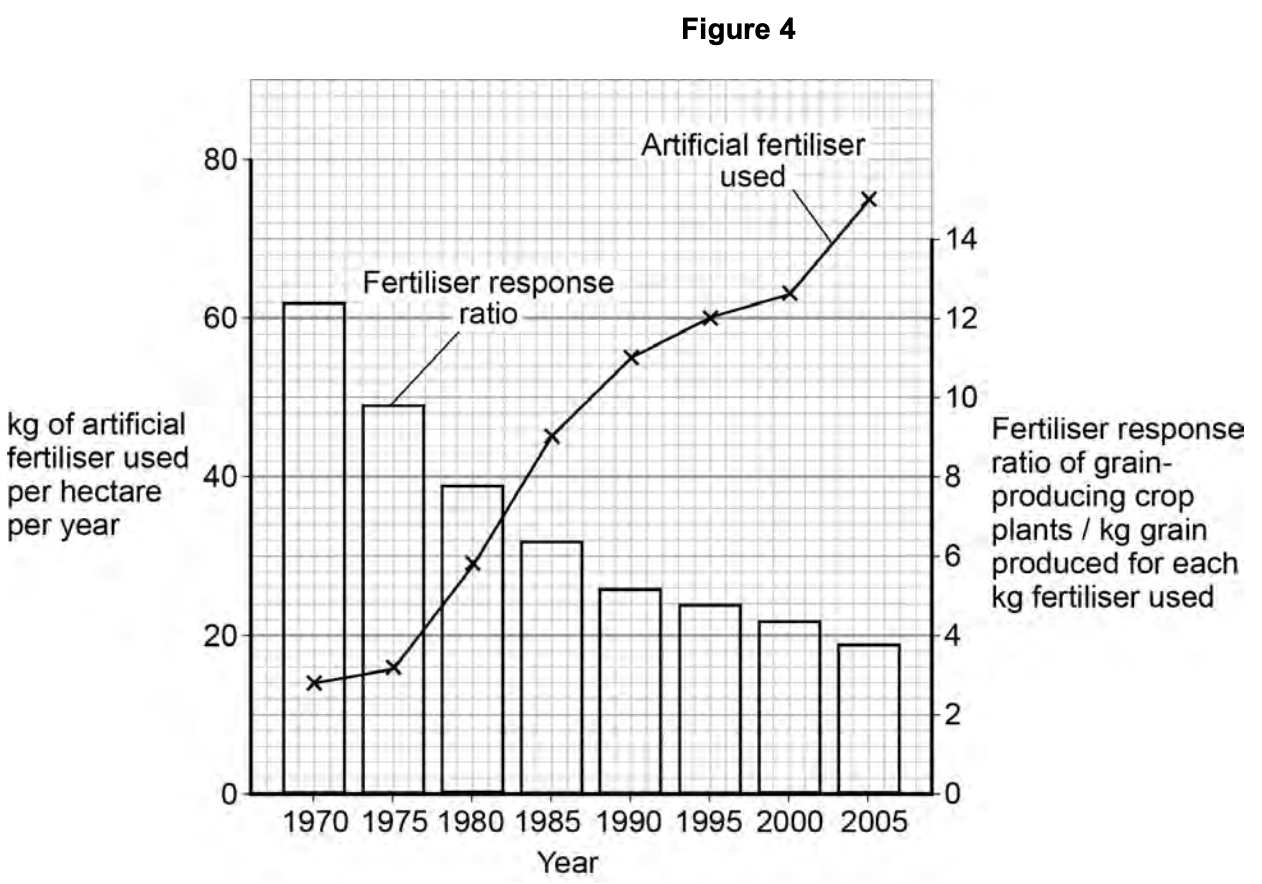
Answer
Mark Scheme
- Correct answer in the range 90 to 133.2 scores 2 marks (1 mark)
- 1 mark for answers where yield calculated correctly for 1970 OR 2005 (1 mark)
- (1970 in range) 170.8 to 176.4 OR (2005 in range) 266.4 to 304.0 (1 mark)
Comments from mark scheme
Accept positive or negative values
Use the data in Figure 4 to evaluate the use of artificial fertilisers on grain-producing crops in India.
(2 marks)Answer
Mark Scheme
- Using more but getting less response over time (1 mark)
- The graph shows correlation but doesn’t prove changes in yield due to fertiliser/but there could be other factors (1 mark)
- Becomes less cost effective with time (1 mark)
Comments from mark scheme
Idea of over time is important
- accept fertiliser becomes less effective over time
- Accept use of figures from graph
- Accept the idea of less grain/crop over time 2.Ignore whether correlation is positive or negative
Ecologists investigated changes in grassland communities on large islands off the coast of Scotland between 1975 and 2010. On each island, they used data from a number of sites to determine the change in mean species richness and the change in mean index of diversity. Table 1 shows plant species recorded at one site, on one island, in 1975.
Calculate the index of diversity for this site using the formula: d = N(N–1)/ Σn(n–1)
CHECK FORMULA ****
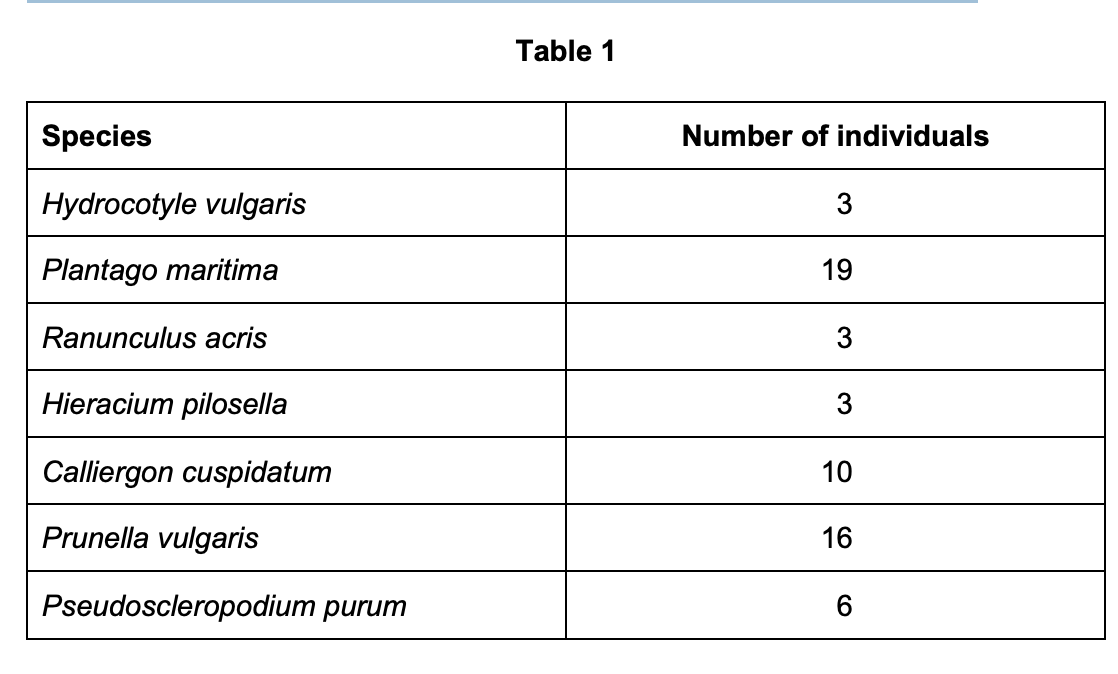
Answer
Mark Scheme
- Correct answer of 4.92, 2 marks (1 mark)
- If N(N-1) = 3540, OR ∑n(n-1) = 720, then award 1 mark (1 mark)
Comments from mark scheme
Accept 4.916/4.917/4.9
Outline a method the ecologists could have used to determine the plant species richness at one site.
(3 marks)Answer
Mark Scheme
- A method of selecting sampling sites at random (1 mark)
- Use of quadrat (1 mark)
- Identify (plant) species (at site/in each quadrat) OR Count number of (different plant) species (at site/in each quadrat) (1 mark)
Comments from mark scheme
- Eg grid with coordinates selected using random number table
- Frame or point
- Reject refs to % cover, or counting individuals
Some of the ecologists’ results are shown in Table 2. They carried out a statistical test to find out whether any differences between the 1975 and 2010 means were significant. The values for P that they obtained are also shown in Table 2.
Do these data show that there were any significant changes in the grassland communities on these islands?
Give reasons for your answer.
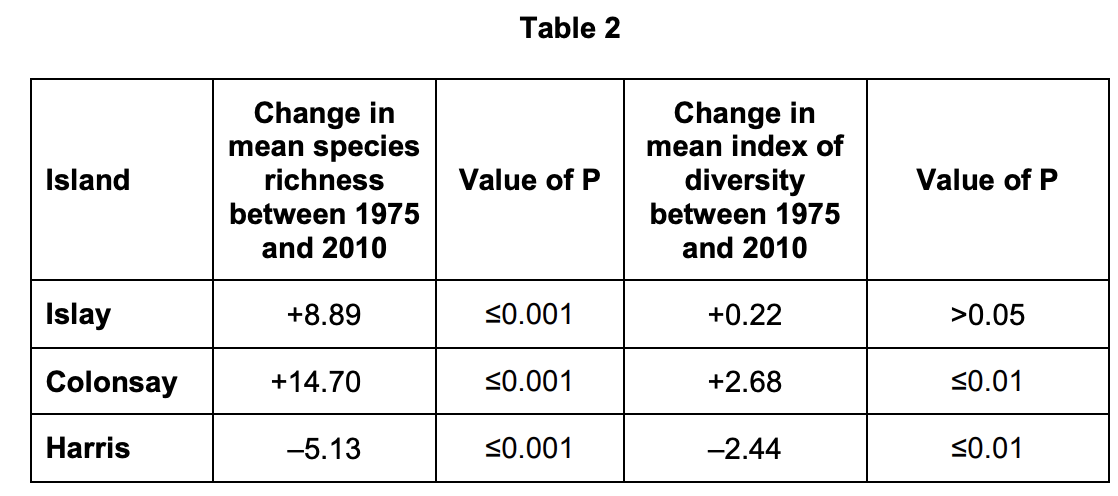
Answer
Mark Scheme
- Significant increase in species richness on Islay and Colonsay and (significant) fall on Harris (1 mark)
- Change in diversity on Islay not significant (1 mark)
- Greater than 0.05/5% probability of getting this change/difference by chance (on Islay) OR (For other differences) less than 0.001/0.1% probability of getting this change/difference by chance (for species richness on Colonsay, Harris, Islay) OR Less than 0.01/1% probability of getting this change/difference by chance (for diversity index on Colonsay, Harris) (1 mark)
Comments from mark scheme
- Accept converse about significance of differences in other cases
- Reject results are due/not due to chance
- Ignore refs to P unqualified
Name two enzymes involved in the semi-conservative replication of DNA.
(2 marks)Answer
Mark Scheme
- (DNA) helicase (1 mark)
- (DNA) polymerase (1 mark)
Comments from mark scheme
Accept (DNA) ligase/ Primase/telomerase/ Topoisomerase/DNA gyrase Reject RNA
Sometimes, damage occurs during DNA replication. One enzyme involved in repairing damage to DNA is called ATR. ATR works as follows.
Use your knowledge of enzyme structure to suggest why.
- ATR phosphorylates other enzymes involved in repairing DNA.
- ATR also phosphorylates substrates required to repair DNA. When ATR phosphorylates other enzymes, these enzymes become able to bind to their substrates.
Answer
Mark Scheme
- Changes tertiary structure of the enzyme (1 mark)
- (Enzyme) active site formed/able to be formed/active site becomes complementary (1 mark)
Comments from mark scheme
- Accept tertiary symbol 3 o
- Ignore 3D
- Reject refs to inhibition/inhibitors
- Ignore refs to E-S complexes form
- Ignore refs to substrate phosphorylation
The enzyme-catalysed reactions activated by ATR only occur if the substrates have been phosphorylated.
Use your knowledge of energy changes in enzyme-catalysed reactions to suggest why.
(1 marks)Answer
Mark Scheme
- (Phosphorylation/phosphate) makes substrates more reactive/raises their energy level(s)/lowers activation energy for the reaction (1 mark)
Comments from mark scheme
Ignore provides energy unqualified Ignore refs to kinetic energy unqualified
Sometimes, a mutagenic agent causes DNA to break. A different enzyme called ATM binds to the broken DNA. This leads to the activation of a protein coded for by a tumour suppressor gene. The effect of ATM binding is to stop cell division until DNA is repaired.
A mutation could result in a person having non-functional forms of the gene that produces ATM.
What can you predict about the possible effects of having a non-functional form of ATM?
(3 marks)Answer
Mark Scheme
- ATM will not bind to (broken) DNA (1 mark)
- DNA not repaired/ cell still has broken DNA (1 mark)
- Cell division continues/tumour forms (1 mark)
- Tumour suppressor (gene) not effective/ not activated (1 mark)
- May have no effect in diploid/heterozygous (organism) (1 mark)
- (Which) still has a functional ATM/ATM gene (1 mark)
A student used a potometer to measure the movement of water through the shoot of a plant. The potometer is shown in Figure 5. As water is lost from the shoot, it is replaced by water from the capillary tube.
In one experiment, the air bubble moved 7.5 mm in 15 minutes. The diameter of the capillary tube was 1.0 mm.
Calculate the rate of water uptake by the shoot in this experiment.
Give your answer in mm³ per hour. Show your working. (The area of a circle is found using the formula, area = πr²)
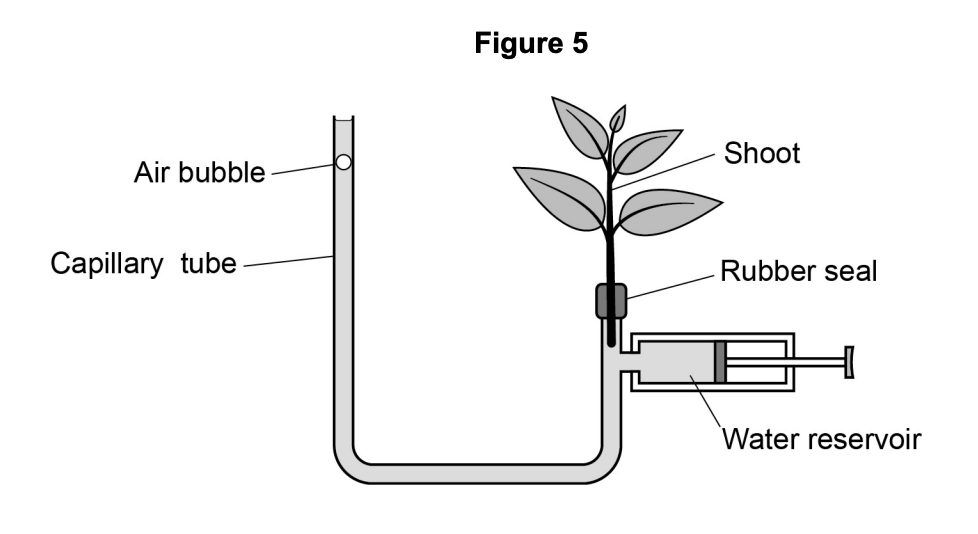
Answer
Mark Scheme
- Correct answer 23.55 – 24 two marks (1 mark)
- For one mark 5.9 OR 94.2 (1 mark)
The student wanted to determine the rate of water loss per mm² of surface area of the leaves of the shoot in Figure 5.
Outline a method she could have used to find this rate. You should assume that all water loss from the shoot is from the leaves.
(3 marks)Answer
Mark Scheme
- Method for measuring area; eg draw round (each) leaf on graph paper and count squares (1 mark)
- Of both sides of (each) leaf (1 mark)
- Divide rate (of water loss/uptake from potometer) by (total) surface area (of leaves) (1 mark)
Comments from mark scheme
Ignore references to air bubbles/mass flow/photosynthesis Accept xylem damaged when cut
The rate of water movement through a shoot in a potometer may not be the same as the rate of water movement through the shoot of a whole plant.
Suggest one reason why.
(1 marks)Answer
Mark Scheme
- Plant has roots OR xylem cells very narrow (1 mark)
Aquaporins are channel proteins that allow the diffusion of water across membranes. One type of aquaporin, called PIP1, can also transport carbon dioxide molecules across membranes.
Figure 6 shows the structure of a water molecule and of a carbon dioxide molecule. They are drawn to the same scale.
Suggest two reasons why water molecules and carbon dioxide molecules can both pass through PIP1.
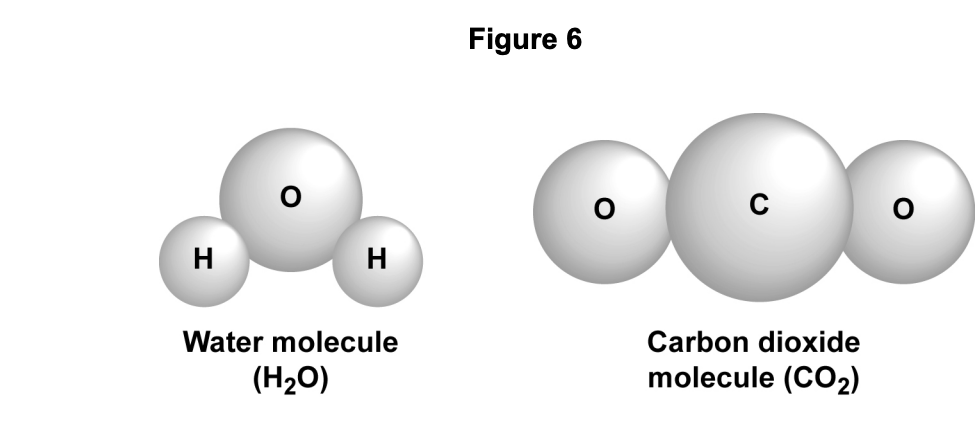
Answer
Mark Scheme
- Both small/similar size (so fit channel) (1 mark)
- Have a similar shape (so bind to/fit channel) (1 mark)
Comments from mark scheme
- Accept same height and width Ignore refs to polar/non-polar 2.Accept Aquaporin complementary to oxygen(s)
The scientists first produced transgenic poplar trees. These trees all had a length of foreign DNA inserted into them. This DNA led to the production of singlestranded RNA that specifically inhibited expression of the gene for PIP1. The scientists then measured the difference in the amount of PIP1 in leaves of transgenic poplars and in leaves of wild type poplars without the foreign DNA. The amount of PIP1 in the transgenic poplars was approximately 15% of that in the wild type poplars.
Using this information, what can you conclude about the effect of the foreign DNA in the transgenic poplar trees?
(3 marks)Answer
Mark Scheme
- Single-stranded RNA (has base sequence) complementary to PIP1 mRNA (1 mark)
- Binds to mRNA (of PIP1)/leads to destruction of mRNA (1 mark)
- Prevents/reduces translation (of PIP1) (1 mark)
- Reduces photosynthesis/named process that uses water (1 mark)
Comments from mark scheme
- Less made is insufficient
The transgenic poplars still produced some PIP1. Suggest why.
(1 marks)Answer
Mark Scheme
- Not all of mRNA bound to single-stranded RNA/there is more mRNA than interfering RNA OR Not all mRNA destroyed/disabled (1 mark)
Comments from mark scheme
Accept mutations in transgene, Accept not all cells with transgenes
The scientists investigated the importance of PIP1 in the movement of water and carbon dioxide through the tissues of leaves of poplar trees.
They measured the mean rates of movement of carbon dioxide and water through the tissues of leaves of transgenic poplars and through the tissues of leaves of wild type poplars.
Their results are shown in Figure 7
The scientists investigated the importance of PIP1 in the movement of water and carbon dioxide through the tissues of leaves of poplar trees.
Using only Figure 7, evaluate the importance of PIP1 in the movement of carbon dioxide and water through leaves of poplar trees.
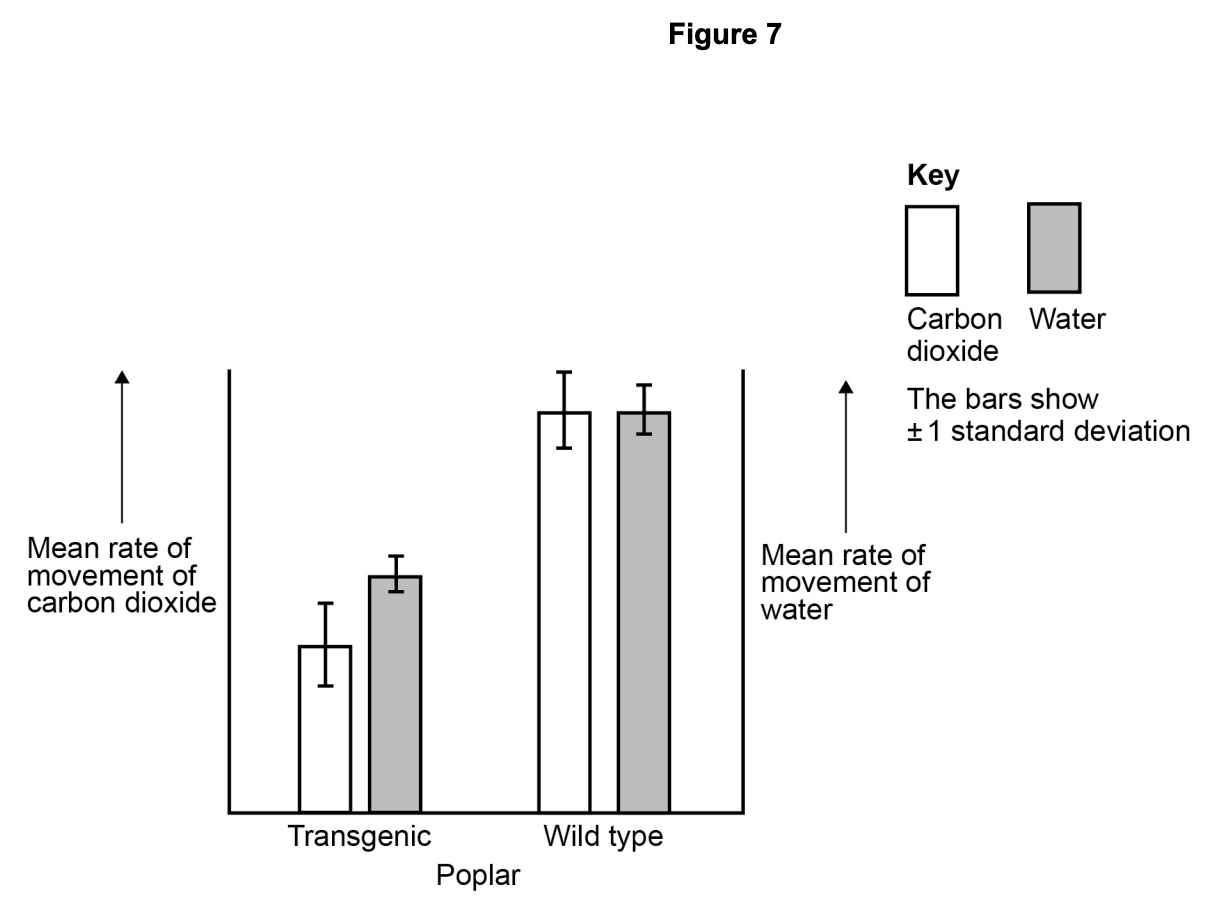
Answer
Mark Scheme
- Loss of PIP reduces water and carbon dioxide movement (1 mark)
- Differences significant because SDs don’t overlap OR Need stats test to see whether significant differences (or not) (1 mark)
- Greater (proportional) effect on carbon dioxide transport (1 mark)
- Not all movement through PIP (1 mark)
Comments from mark scheme
- Accept converse for wild type
- Reject references to results significant or not significant
- Accept error bars for SDs
The importance of nitrogen-containing substances in biological systems
(25 marks)Answer
Mark Scheme
- No mark scheme available
The importance of diffusion in organisms
(25 marks)Answer
Mark Scheme
- No mark scheme available
Accept converse Accept C=C for double bonds Accept as (number of) hydrogen/H (atoms) increases, melting point increases