Synapses allow signals to be transmitted between neurones, or between a neurone and an effector. The signal crosses the synaptic cleft as a chemical message: a neurotransmitter.
- A synapse between two neurones that uses acetylcholine (ACh) as the neurotransmitter is called a cholinergic synapse.
- A synapse between a motor neurone and a muscle fibre is called a neuromuscular junction.
Structure of a Synapse
What you need to know (based on the AQA specification)
What you need to know (based on the AQA specification)
The detailed structure of a synapse and of a neuromuscular junction.
A synapse is the junction between two neurones, or between a motor neurone and an effector.
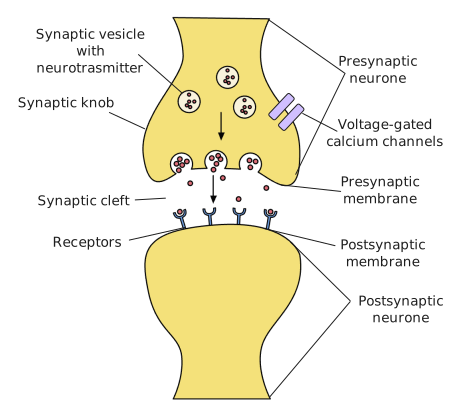
- Synaptic cleft — the tiny gap between the presynaptic and postsynaptic membranes.
- Presynaptic neurone — has a swollen ending called the synaptic knob, which contains synaptic vesicles filled with neurotransmitter. The synaptic knob also contains many mitochondria (to provide ATP for neurotransmitter synthesis and active transport).
- Postsynaptic membrane — has specific receptors that the neurotransmitter binds to.
- There are many different neurotransmitters. Synapses that use acetylcholine (ACh) are called cholinergic synapses.
Transmission Across a Cholinergic Synapse
What you need to know (based on the AQA specification)
What you need to know (based on the AQA specification)
The sequence of events involved in transmission across a cholinergic synapse in sufficient detail to explain:
- unidirectionality
- temporal and spatial summation
- inhibition by inhibitory synapses.
- An action potential arrives at the synaptic knob of the presynaptic neurone.
- This causes voltage-gated calcium ion (Ca²⁺) channels in the presynaptic membrane to open.
- Ca²⁺ ions diffuse into the synaptic knob down their concentration gradient.
- The influx of Ca²⁺ causes synaptic vesicles to move to the presynaptic membrane and fuse with it.
- The vesicles release ACh into the synaptic cleft by exocytosis.
- ACh diffuses across the synaptic cleft and binds to specific receptors on the postsynaptic membrane.
- This causes sodium ion (Na⁺) channels in the postsynaptic membrane to open (these open because ACh has bound to them).
- Na⁺ ions diffuse into the postsynaptic cell, causing depolarisation of the postsynaptic membrane.
- If the depolarisation reaches the threshold, an action potential is generated in the postsynaptic neurone.
- Acetylcholinesterase (AChE), an enzyme in the synaptic cleft, breaks down ACh (hydrolyses ACh). This stops the signal and prevents continuous stimulation.
- Ca²⁺ ions are actively transported back out of the synaptic knob.
Why is transmission unidirectional?
- Neurotransmitter vesicles are only found in the presynaptic neurone, so neurotransmitter can only be released from the presynaptic side.
- Receptors for the neurotransmitter are only on the postsynaptic membrane.
- So the signal can only travel in one direction across the synapse.
Excitatory and Inhibitory Synapses
- Excitatory synapses — the neurotransmitter causes depolarisation of the postsynaptic membrane, making it more likely to reach threshold and fire an action potential.
- Inhibitory synapses — the neurotransmitter causes hyperpolarisation of the postsynaptic membrane (the potential difference becomes more negative than the resting potential), making it less likely to fire an action potential.
Summation
Summation is the process by which the effects of multiple small depolarisations are added together to reach the threshold for an action potential. A single impulse may not release enough neurotransmitter to reach threshold on its own.
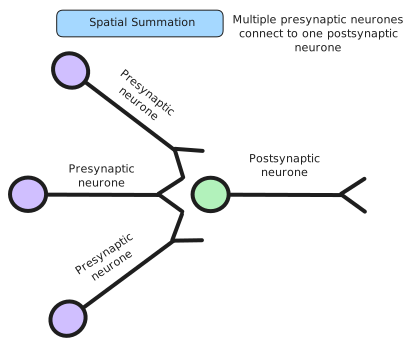
Spatial summation
- Multiple presynaptic neurones all connect to one postsynaptic neurone.
- They release neurotransmitter at the same time, and the combined depolarisation may be enough to reach the threshold.
- Some of these synapses may be inhibitory; if enough are inhibitory, the overall effect may not reach threshold, and no action potential is fired.
Temporal summation
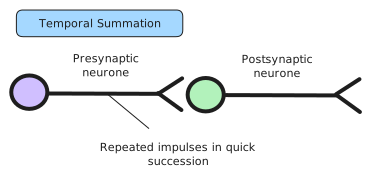
- One presynaptic neurone fires multiple impulses in quick succession.
- Neurotransmitter accumulates in the synaptic cleft faster than it can be broken down by AChE.
- The combined effect of repeated neurotransmitter release may be enough to reach the threshold and trigger an action potential.
Cholinergic Synapse vs Neuromuscular Junction
What you need to know (based on the AQA specification)
What you need to know (based on the AQA specification)
A comparison of transmission across a cholinergic synapse and across a neuromuscular junction.
A neuromuscular junction (NMJ) is the synapse between a motor neurone and a muscle fibre (effector). It uses the same basic mechanism as a cholinergic synapse, but with some key differences:
- The neurotransmitter is ACh (same as a cholinergic synapse).
- The postsynaptic membrane (called the motor end plate) has junctional folds; these increase the surface area for more ACh receptors and more AChE.
- An NMJ is always excitatory; it always triggers muscle contraction. A cholinergic synapse can be either excitatory or inhibitory.
The animation below shows the action at a neuromuscular junction (you should be able to notice a few differences from the cholinergic synapse, especially at the end).
Effects of Drugs on Synapses
What you need to know (based on the AQA specification)
What you need to know (based on the AQA specification)
Students should be able to use information provided to predict and explain the effects of specific drugs on a synapse. (Recall of the names and mode of action of individual drugs will not be required.)
You don’t need to memorise specific drugs, but you do need to predict and explain the effect of a drug from a description of how it works.
Types of drug action
-
Agonists — have a similar shape to the neurotransmitter, so they bind to and activate the postsynaptic receptors. Effect: the postsynaptic neurone is stimulated even without a nerve impulse, so the response is enhanced/continuous.
-
Antagonists — bind to the postsynaptic receptors but do not activate them, blocking the neurotransmitter from binding. Effect: the postsynaptic neurone is not stimulated, so transmission is blocked.
-
Inhibitors of neurotransmitter breakdown — prevent the enzyme (e.g. AChE) from breaking down the neurotransmitter. Effect: neurotransmitter remains in the synaptic cleft for longer, so the postsynaptic membrane is stimulated repeatedly/for longer.
-
Drugs that stimulate neurotransmitter release — cause more neurotransmitter to be released from the presynaptic neurone. Effect: more neurotransmitter in the synaptic cleft, so more receptors are activated and the response is enhanced.
Answering drug-effect questions
- Identify the step the drug affects (e.g. “inhibits voltage-gated Ca²⁺ channels”).
- Chain through the consequences — work through every downstream step, not just the final outcome. For example: less Ca²⁺ enters the synaptic knob → fewer vesicles fuse with the presynaptic membrane → less ACh released into the cleft → fewer receptors activated on the postsynaptic membrane → less Na⁺ influx / less depolarisation → fewer action potentials generated.
Try it: Drug Effect Simulator
Exam Questions
Following the release of acetylcholine into a neuromuscular junction, a muscle contraction occurs.
Describe the sequence of events, following the release of acetylcholine, that leads to stimulation of this contraction. Do not include in your answer the events following the release of calcium ions in the myofibril.
(4 marks)Hint
Follow the sequence: What crosses the cleft? Where does it bind? What ions enter? Where do calcium ions come from in muscle?
Mark Scheme
- Acetylcholine/neurotransmitter diffuses (across the synaptic cleft) (1 mark)
- (Acetylcholine) attaches to receptors on the sarcolemma (1 mark)
- Sodium ions enter, leading to depolarisation/action potential (1 mark)
- Calcium ions released by the (sarcoplasmic) endoplasmic reticulum (1 mark)
Tips from examiner reports
- Acetylcholine diffuses across the synaptic cleft (vesicles don’t move across)
- ACh binds to receptors on the sarcolemma/postsynaptic membrane — say “sarcolemma” not just “muscle”
- Binding opens sodium ion channels and Na⁺ enters — don’t skip the ion entry step
- Calcium ions are released from the sarcoplasmic reticulum (not into it)
- Only describe the events asked about — don’t go beyond what the question requires
Inhibitory synapses cause hyperpolarisation in postsynaptic neurones.
Explain how this inhibits synaptic transmission.
(2 marks)Hint
What happens to the charge inside a hyperpolarised neurone? How does this affect the amount of depolarisation needed to reach threshold?
Mark Scheme
- (Inside the postsynaptic neurone) is more negative OR the membrane potential is below resting potential OR the potential difference (across the membrane) is greater (1 mark)
- More sodium ions are required to enter for depolarisation/action potential OR prevents Na⁺ ions causing depolarisation (1 mark)
Comments from mark scheme
- For point 1: accept “decrease in the resting potential”, “reduces/lowers potential” (but not “reduces potential difference”)
- For point 1: accept “p.d.” for potential difference
- For point 2: accept “to reach threshold” or “generator potential” for “action potential”
Tips from examiner reports
- During hyperpolarisation, the inside of the neurone becomes more negative than resting potential
- This means more sodium ions are needed to reach the threshold for depolarisation, inhibiting transmission
- Say “sodium ions” not just “sodium” — the charge on the ion matters
- Chloride ion entry or potassium ion loss causes the increased negativity
Glutamate is a neurotransmitter involved in the transmission of nerve impulses from pain receptors to the brain. Ziconotide is a drug that can reduce severe, constant pain. Ziconotide blocks the calcium ion channels at some of the synapses which use glutamate.
The transmission of glutamate at synapses is similar to that of acetylcholine.
Explain how ziconotide reduces severe, constant pain.
(5 marks)Hint
Trace the pathway: Ca²⁺ entry → vesicle movement → neurotransmitter release → diffusion → receptor binding → ion channels. Be precise with locations.
Mark Scheme
- No/fewer calcium ions enter the synaptic knob (via calcium ion channels) (1 mark)
- No/fewer synaptic vesicles move to/fuse with the presynaptic membrane, so no/less glutamate is released (1 mark)
- No/less glutamate diffuses across the synaptic cleft (1 mark)
- No/less glutamate attaches to receptors on the postsynaptic membrane (1 mark)
- No/fewer sodium ions enter the postsynaptic neurone, so no/fewer impulses are sent to the brain (1 mark)
Comments from mark scheme
- For point 1: accept Ca²⁺/Ca²⁺; accept “presynaptic neurone/knob” for synaptic knob but not “presynaptic membrane” alone
- For points 2, 3 and 4: accept “acetylcholine” or “neurotransmitter” for glutamate
- For point 5: accept Na⁺
- For point 5: accept “no transmission”, “no depolarisation”, “no action/generator potentials” or “threshold not reached” for “fewer impulses” (reject “messages” and “signals”)
Tips from examiner reports
- Use precise terminology: calcium ions enter the synaptic knob (not “synapse” or “presynaptic membrane”)
- Calcium causes vesicles to fuse with the presynaptic membrane, releasing neurotransmitter
- Neurotransmitter diffuses across the synaptic cleft and binds to receptors on the postsynaptic membrane
- Include every key term: vesicles, neurotransmitter name, receptors, postsynaptic membrane
Give two reasons why transmission across a cholinergic synapse is unidirectional.
(2 marks)Mark Scheme
- (Only) the presynaptic neurone/knob releases neurotransmitter/acetylcholine (1 mark)
- (Only) the postsynaptic membrane has receptors OR no receptors in the presynaptic membrane (1 mark)
Comments from mark scheme
- For point 1: accept abbreviations for acetylcholine (e.g. ACh, Ach, AChol)
- For point 1: ignore “transmitter” alone
Tips from examiner reports
- Cholinergic synapse: action potential → Ca²⁺ enters → vesicles fuse with presynaptic membrane → ACh released into cleft → binds to receptors on postsynaptic membrane → Na⁺ channels open
- Sodium ion channels are present in both pre- and postsynaptic neurones — don’t say they’re only in one
Comments from mark scheme