What you need to know (based on the AQA specification)
What you need to know (based on the AQA specification)
In any ecosystem, plants synthesise organic compounds from atmospheric, or aquatic, carbon dioxide. Most of the sugars synthesised by plants are used by the plant as respiratory substrates. The rest are used to make other groups of biological molecules. These biological molecules form the biomass of the plants.
Plants are called producers because they make their own food through Photosynthesis.
In photosynthesis they use carbon dioxide, energy from sunlight and water to produce glucose and oxygen.
Some of this glucose can be used in respiration to produce ATP.
The remainder of this glucose can be used to make other biological molecules (e.g. cellulose). This is the biomass of plants. It’s referred to as the chemical energy store for the plant and can be transferred through the ecosystem, when one organism eats another.
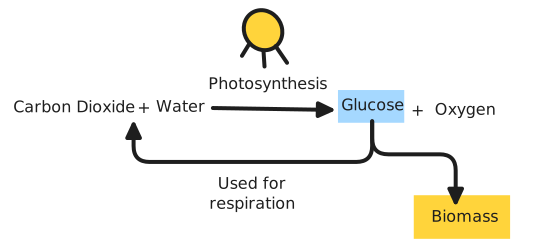
Biomass
What you need to know (based on the AQA specification)
What you need to know (based on the AQA specification)
Biomass can be measured in terms of mass of carbon or dry mass of tissue per given area. The chemical energy store in dry biomass can be estimated using calorimetry.
How do we measure biomass?
Biomass is the total mass of living material, i.e. all the remaining glucose which has been used to make other biological molecules.
Biomass
Total mass of living material. It can be measured as mass of carbon or dry mass per given area.
Calculating Dry Mass
It’s important to calculate biomass as:
- Dry mass due to the varying amount of water in organisms
- Per given area, not individual organisms, as a small sample may not be representative
You can calculate dry mass by measuring the mass of the organism with water removed. To do this you heat a sample of the organism to remove any water (note the organism must not be living), and weigh the mass. Once the mass of the sample remains constant (i.e. it doesn’t decrease anymore), this indicates that there is no more water to be lost.
This mass can then be scaled up to population or area and is usually measured in kg m⁻². For example, if you calculated the biomass of a small sample area (1 m²) was 100 kg, you could then scale this up to a larger area, e.g. 10 m² would be 1000 kg total, or 100 m² would be 10,000 kg total.
Calorimetry
Calorimetry can estimate the chemical energy store in dry mass.
It works by measuring the heat released during combustion.
A process known as bomb calorimetry involves burning a dry sample of biomass in a sealed container with oxygen. The resulting heat is transferred to a surrounding water bath (of a known volume). You can then measure the temperature change to determine the amount of chemical energy in the biomass.
It’s actually the same process you would use to measure calories in foods.
GPP & NPP
What you need to know (based on the AQA specification)
What you need to know (based on the AQA specification)
Gross primary production (GPP) is the chemical energy store in plant biomass, in a given area or volume. Net primary production (NPP) is the chemical energy store in plant biomass after respiratory losses to the environment have been taken into account, i.e. NPP = GPP – R, where GPP represents gross production and R represents respiratory losses to the environment. This net primary production is available for plant growth and reproduction. It is also available to other trophic levels in the ecosystem, such as herbivores and decomposers.
If you look at the image you should see that some of the energy that reaches producers (plants) as sunlight is never absorbed/not used for photosynthesis.
Why do you think this is? (3 mark exam question)
Why do you think this is? (3 mark exam question)
- (Light is) reflected;
- (Light is) wrong wavelength;
- (Light) misses chlorophyll/chloroplasts/photosynthetic tissue;
- CO2 concentration or temperature is a limiting factor.
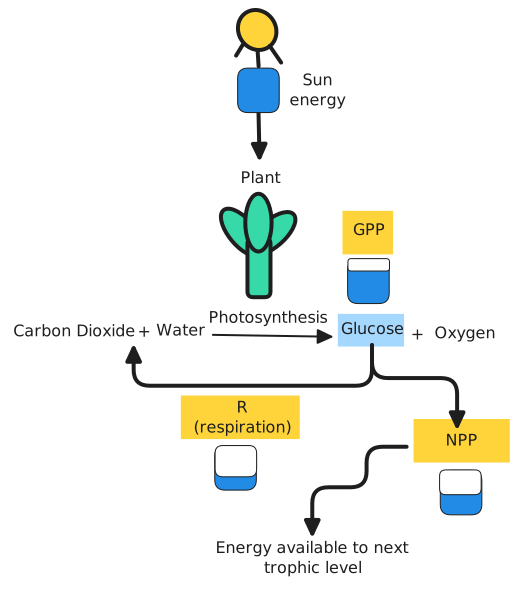
GPP
Gross Primary Production (GPP) is the total chemical energy store in plant biomass, in a given area or volume. Essentially it’s the total energy captured by the plants (producers) during photosynthesis.
Not all the GPP can be passed on to the next trophic level. The plants use some of the energy in respiration, so this has to be taken off (R for respiration).
NPP
Net Primary Production (NPP) is the chemical energy store in plant biomass, once respiration has been accounted for. NPP is available for plant growth, reproduction and can be passed on to other trophic levels, e.g. consumers and decomposers.
NPP
NPP = GPP - R
Net Production of Consumers
What you need to know (based on the AQA specification)
What you need to know (based on the AQA specification)
The net production of consumers ( N ), such as animals, can be calculated as: N =I –(F+R) where I represents the chemical energy store in ingested food, F represents the chemical energy lost to the environment in faeces and urine and R represents the respiratory losses to the environment.
Not all the chemical energy stored in the food consumers ingest can be transferred to the next trophic level. In fact, it’s really inefficient, with often only about 10% of the energy available to the next trophic level.
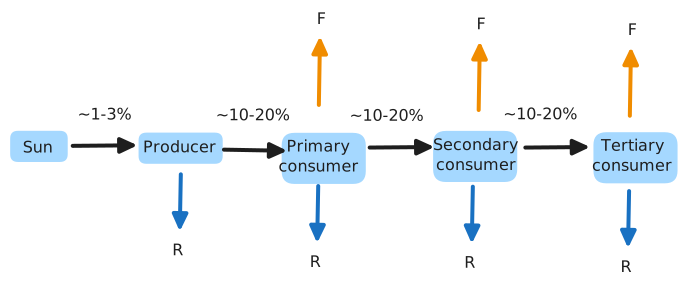
Give 3 reasons for the low efficiency of energy transfer from secondary consumers to tertiary consumers in an ecosystem. (3 marks from exam question)
Give 3 reasons for the low efficiency of energy transfer from secondary consumers to tertiary consumers in an ecosystem. (3 marks from exam question)
- Heat (loss) from respiration;
- Some of the food is not digested or not all eaten;
- Some excreted (lost as faeces).
The energy that is stored in the consumer’s biomass and available to the next trophic level is called ‘net production’, see equation below.
Net production of consumers
N = I − (F + R)
- N = Net production of consumers
- I = Chemical energy from ingested food
- F = Energy lost in faeces and urine
- R = Energy lost through respiration
Productivity (Rate)
What you need to know (based on the AQA specification)
What you need to know (based on the AQA specification)
Primary and secondary productivity is the rate of primary or secondary production, respectively. It is measured as biomass in a given area in a given time eg kJ ha–1 year–1 .
- Net production of consumers can also be called secondary productivity, when it’s expressed as a rate, in a given area in a given time, e.g. kJ ha⁻¹ year⁻¹.
- Similarly, primary production (GPP or NPP) can be expressed as productivity when it’s expressed as a rate in a given area in a given time, e.g. kJ ha⁻¹ year⁻¹.
Example: Calculating Net Production
Calculating net production
Question: A cow ingests 5500 kJ of chemical energy per day. It loses 3200 kJ in faeces and urine, and 1800 kJ through respiration. Calculate the net production of the cow.
Answer:
N = I − (F + R)
N = 5500 − (3200 + 1800)
N = 5500 − 5000
N = 500 kJ per day
Example: Calculating Efficiency of Energy Transfer
Calculating efficiency
Question: The net production of producers in an ecosystem is 40 000 kJ m⁻² year⁻¹. The net production of the primary consumers is 4400 kJ m⁻² year⁻¹. Calculate the percentage efficiency of energy transfer from the producers to the primary consumers.
Answer:
$$\text{Efficiency} = \frac{\text{Net production of the next trophic level}}{\text{Net production of the previous trophic level}} \times 100$$
$$\text{Efficiency} = \frac{4400}{40,000} \times 100$$
Efficiency = 11%
Farming Practices
What you need to know (based on the AQA specification)
What you need to know (based on the AQA specification)
Students should be able to appreciate the ways in which production is affected by farming practices designed to increase the efficiency of energy transfer by:
- simplifying food webs to reduce energy losses to non-human food chains
- reducing respiratory losses within a human food chain.
Farmers want to increase the efficiency of energy transfer to maximise the amount of energy (and therefore biomass) available for human consumption (in farming products). They can do this by:
Simplifying food webs
This is aimed at reducing the energy lost to other organisms (e.g. pests) in the food chain.
- Using pesticides/herbicides — to remove competing organisms (pests, weeds) that would otherwise consume energy from the food chain.
- Biological control — this involves introducing natural predators of pest species to reduce energy losses (e.g. ladybugs, parasitic wasps).
Reducing respiratory losses
This is aimed at controlling the conditions that livestock are in, to reduce the losses due to respiration.
- Restricting movement of livestock (e.g. battery farming, indoor housing) so less energy is used in muscle contraction.
- Controlling temperature of the environment for livestock — keeping animals warm reduces the energy they need to use to maintain body temperature, lowering respiratory losses.
Exam Questions
Put a tick in the box next to the equation that shows how the net production of consumers, N, can be calculated where I represents the chemical energy store in ingested food, F represents the chemical energy lost to the environment in faeces and urine, R represents the respiratory losses to the environment.
Give three reasons for the low efficiency of energy transfer from secondary consumers to tertiary consumers in an ecosystem.
(3 marks)Hint
Where does energy go that isn’t passed to the next trophic level? Think about respiration, faeces, and undigested material.
Mark Scheme
- Heat (loss) from respiration (1 mark)
- (Food) not digested
OR Not all eaten (1 mark) - Excretion (1 mark)
Tips from examiner reports
- Energy is lost between trophic levels through: heat from respiration, faeces (undigested food), and urine (excretory products)
- Faeces are not an excretory product — they contain undigested food that was never absorbed
- Link heat loss specifically to respiration
Freshwater marshes have one of the highest rates of gross primary production (GPP) and net primary production (NPP) of all ecosystems.
Carbon use efficiency (CUE) is the ratio of NPP:GPP. Freshwater marshes have a high CUE.
Use your knowledge of NPP to explain why freshwater marshes have a high CUE and the advantage of this. Do not refer to abiotic factors in your answer.
(2 marks)Hint
Remember: NPP = GPP − R. If CUE (NPP:GPP) is high, what does that tell you about how much energy the plants are losing to respiration?
Mark Scheme
- Low respiration — because NPP = GPP − R, a high CUE means a large proportion of GPP is retained as NPP, so relatively little energy is lost through plant respiration (1 mark)
- More energy available for growth/biomass/colonisation — the high NPP means more organic molecules (e.g. glucose) are available for building new plant tissue rather than being broken down in respiration (1 mark)
Tips from examiner reports
- GPP and NPP relate to plants (producers), not animals
- NPP = GPP − respiratory losses — this is the key formula
- A high CUE means plants keep more of the energy they fix, losing less to respiration