Structure of Prokaryotic Cells
What you need to know (based on the AQA specification)
What you need to know (based on the AQA specification)
Prokaryotic cells are much smaller than eukaryotic cells. They also differ from eukaryotic cells in having:
- cytoplasm that lacks membrane-bound organelles
- smaller ribosomes
- no nucleus; instead they have a single circular DNA molecule that is free in the cytoplasm and is not associated with proteins
- a cell wall that contains murein, a glycoprotein.
In addition, many prokaryotic cells have:
- one or more plasmids
- a capsule surrounding the cell
- one or more flagella.
Details of these structural differences are not required.
Now that we’ve looked at eukaryotic cells, let’s compare them to prokaryotic cells. Prokaryotes are much simpler — bacteria are an example. The key difference is that prokaryotes do not have membrane-bound organelles. No nucleus, no mitochondria, no ER — just a cell with its DNA floating freely in the cytoplasm.
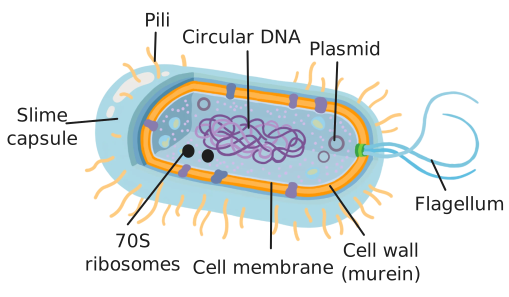
Structures Found in Prokaryotic Cells
Circular DNA (nucleoid)
A single, circular DNA molecule that is not associated with histone proteins. It is free in the cytoplasm (no nuclear envelope). This carries the main genetic information of the cell.
Plasmids
Small, extra circles of DNA — separate from the main circular DNA. They often carry genes for antibiotic resistance. Plasmids can be transferred between bacteria and are used in genetic engineering as vectors.
70S Ribosomes
Smaller than eukaryotic ribosomes (70S vs 80S). Still the site of protein synthesis (translation). This size difference is why some antibiotics can target bacterial ribosomes without affecting human cells.
Cell wall (murein)
Contains murein (peptidoglycan), a glycoprotein. Provides structural support and prevents the cell from bursting. Different from plant cell walls (cellulose) and fungal cell walls (chitin).
Capsule
A slimy layer outside the cell wall, found in some bacteria. Provides protection against the host’s immune system (e.g. prevents phagocytosis) and helps the bacterium adhere to surfaces.
Flagella
Long, whip-like projections that rotate to move the bacterium. Not all prokaryotes have them — some have one, others have several.
Compare prokaryotic and eukaryotic cells
Test yourself — click a button to reveal that column.
| Feature | Prokaryotic | Eukaryotic |
|---|---|---|
| Size | Smaller (1–5 μm) | Larger (10–100 μm) |
| Nucleus | No — DNA free in cytoplasm | Yes — DNA enclosed in nuclear envelope |
| DNA | Single, circular, not associated with proteins | Linear, associated with histone proteins |
| Ribosomes | 70S (smaller) | 80S (larger) |
| Membrane-bound organelles | None | Yes (mitochondria, ER, Golgi, etc.) |
| Cell wall | Yes — contains murein (a glycoprotein) | Plants/fungi have cell walls, but not made of murein |
Viruses
What you need to know (based on the AQA specification)
What you need to know (based on the AQA specification)
Viruses are acellular and non-living. The structure of virus particles to include genetic material, capsid and attachment protein.
Viruses are not cells — they are described as acellular (without cells) and are considered non-living. They cannot carry out metabolic processes on their own and can only replicate inside a host cell.
Why are viruses considered non-living?
Why are viruses considered non-living?
- They have no cell membrane, no cytoplasm, no ribosomes — so they cannot carry out metabolic reactions
- They cannot reproduce on their own — they must hijack a host cell’s machinery to replicate
- They do not grow or respond to stimuli
- They are essentially a piece of genetic material in a protein coat
Structure of a Virus
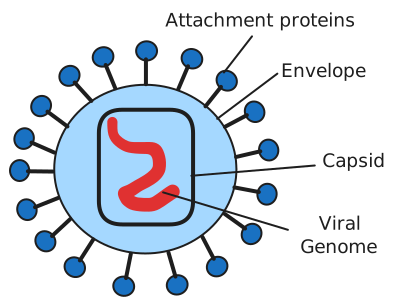
Genetic material
Can be DNA or RNA (not both). Can be single-stranded or double-stranded. This carries the instructions for making new virus particles. Different viruses have different types — e.g. HIV has RNA, while bacteriophages have DNA.
Capsid
A protein coat that surrounds and protects the genetic material. Made of protein subunits called capsomeres. The shape of the capsid varies between viruses (e.g. icosahedral, helical).
Attachment proteins
Proteins on the surface of the virus that bind to specific receptors on the host cell. This is what determines which cells a virus can infect — e.g. HIV has attachment proteins that bind to receptors on T helper cells.
Exam tip
Viruses are much smaller than bacteria. Don’t confuse them — bacteria are living prokaryotic cells, viruses are non-living acellular particles. Antibiotics work against bacteria but not against viruses (a very common exam question).
Want more on viruses?
The full structure and replication of HIV (including reverse transcriptase) is covered in the Immunity & Response topic — see Cell Recognition & the Immune System.
Exam Question Practice
Give two features of all prokaryotic cells that are not features of eukaryotic cells.
(1 marks)Mark Scheme
1 mark — give any TWO of the following:
- No membrane-bound organelles (or a correct example)
- Single, circular DNA (free in cytoplasm) OR DNA not associated with histones / proteins
- Murein / peptidoglycan in the cell wall
Below are four statements about the structure of prokaryotic cells.
- No prokaryotic cell has DNA that is associated with proteins.
- No prokaryotic cell has membrane-bound organelles.
- All prokaryotic cells have one or more flagella.
- All prokaryotic cells have smaller ribosomes than eukaryotic cells.
Which statements about the structure of prokaryotic cells are correct?
(1 marks)Mark Scheme
B — Statements 1, 2 and 4 are correct. (1 mark)
- Statement 1 ✓ — prokaryotic DNA is not associated with histone proteins
- Statement 2 ✓ — prokaryotes have no membrane-bound organelles
- Statement 3 ✗ — flagella are found in some prokaryotes, not all
- Statement 4 ✓ — prokaryotic ribosomes (70S) are smaller than eukaryotic (80S)
Comments from mark scheme