Structure of Eukaryotic Cells
What you need to know (based on the AQA specification)
What you need to know (based on the AQA specification)
The structure of eukaryotic cells, restricted to the structure and function of:
- cell-surface membrane
- nucleus (containing chromosomes, consisting of protein-bound, linear DNA, and one or more nucleoli)
- mitochondria
- chloroplasts (in plants and algae)
- Golgi apparatus and Golgi vesicles
- lysosomes (a membrane-bound organelle that releases hydrolytic enzymes)
- ribosomes
- rough endoplasmic reticulum and smooth endoplasmic reticulum
- cell wall (in plants, algae and fungi)
- cell vacuole (in plants)
Eukaryotic cells are more complex than prokaryotes and have membrane-bound organelles and other specialised structures. Common examples of eukaryotic organisms include: plants, animals, fungi and algae.
What does membrane-bound mean?
Surrounded by a membrane, separating the organelle’s contents from the cytoplasm. For example, the nucleus is surrounded by a double membrane (nuclear envelope) and mitochondria have their own double membrane. Ribosomes are not membrane-bound.
Explore
How to use this diagram
- Click on any organelle (or its label) to see its structure and function. The same info is also listed in the section below for reference.
- Click “Show Protein Pathway” above the diagram to follow how a protein is made and exported — from the nucleus, through the rough ER and Golgi, to release outside the cell.
Organelles — Structure and Function

Cell-Surface Membrane
Structure:
- Phospholipid bilayer with embedded proteins
- Contains glycoproteins, glycolipids and cholesterol
- Fluid-mosaic model — components can move within the bilayer
Function:
- Partially permeable — controls which substances enter and leave the cell
- Cell signalling via receptor proteins
- Cell recognition via antigens on the surface
Nucleus
Structure:
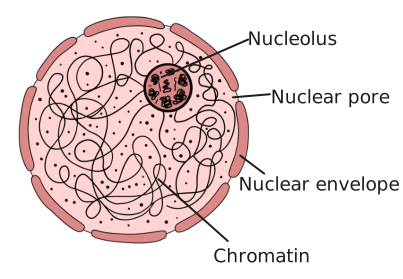
- Largest organelle, surrounded by a double membrane (nuclear envelope)
- Nuclear envelope has nuclear pores for transport of mRNA and ribosome subunits
- Contains chromatin (protein-bound, linear DNA) and one or more nucleoli
Function:
- Houses the genetic information (DNA) that controls cell activity
- Site of DNA replication and transcription (mRNA synthesis)
- Nuclear pores allow selective transport between nucleus and cytoplasm
- The nucleolus produces ribosomal RNA (rRNA) and assembles ribosome subunits

Mitochondria
Structure:
- Double-membrane organelle
- Inner membrane folded into cristae (increases surface area)
- Matrix contains enzymes and its own circular DNA and 70S ribosomes
Function:
- Site of aerobic respiration — produces ATP
- Krebs cycle occurs in the matrix
- Oxidative phosphorylation occurs on the inner membrane (cristae)

Chloroplasts
Structure:
- Double-membrane organelle (plants and algae only)
- Contains thylakoid membranes arranged into grana (stacks)
- Stroma is the fluid-filled matrix; contains own circular DNA and 70S ribosomes
Function:
- Site of photosynthesis
- Light-dependent reactions occur on the thylakoid membranes
- Light-independent reactions (Calvin cycle) occur in the stroma

Rough Endoplasmic Reticulum (RER)
Structure:
- System of flattened membrane-bound sacs (cisternae)
- Studded with 80S ribosomes on its outer surface
- Continuous with the nuclear envelope
Function:
- Ribosomes on the RER synthesise proteins
- Proteins are folded and processed inside the cisternae
- Proteins transported in vesicles to the Golgi apparatus
Smooth Endoplasmic Reticulum (SER)
Structure:
- System of membrane-bound tubules
- No ribosomes on its surface
- Connected to the rough ER
Function:
- Synthesises and processes lipids and carbohydrates

Golgi Apparatus
Structure:
- Stack of flattened, membrane-bound sacs (cisternae)
- Has a cis face (receiving side) and trans face (shipping side)
- Surrounded by Golgi vesicles
Function:
- Modifies proteins received from the RER (e.g. adds carbohydrates → glycoproteins)
- Packages proteins into vesicles
- Sorts proteins for secretion, delivery to lysosomes, or insertion into membranes
Golgi Vesicles
Structure:
- Small, spherical, membrane-bound sacs
- Bud off from the trans face of the Golgi apparatus
Function:
- Transport modified proteins and lipids to the cell-surface membrane
- Release contents by exocytosis (secretion)
- Some vesicles become lysosomes

Lysosomes
Structure:
- Membrane-bound vesicle formed from Golgi vesicles
- Contains powerful hydrolytic (digestive) enzymes
- Membrane keeps enzymes safely separated from the cytoplasm
Function:
- Breaks down worn-out organelles (autophagy)
- Digests pathogens engulfed by phagocytosis
- Involved in apoptosis (programmed cell death)

Ribosomes
Structure:
- Tiny organelles made of ribosomal RNA (rRNA) and protein
- Not membrane-bound
- Eukaryotic = 80S; prokaryotic = 70S
Function:
- Site of translation — mRNA is decoded to synthesise polypeptides
- Free ribosomes: make proteins for use inside the cell
- Bound ribosomes (on RER): make proteins for secretion
Cell Wall
Structure:
- Rigid layer surrounding the cell-surface membrane
- Made of cellulose (a polysaccharide of β-glucose) in plants and algae; chitin in fungi
- Freely permeable to water and dissolved substances
Function:
- Provides structural support and maintains cell shape
- Prevents the cell from bursting (lysis) when water enters by osmosis
- Found in plants, algae and fungi (not animal cells)

Cell Vacuole (Plants)
Structure:
- Large, permanent, membrane-bound organelle in plant cells
- Filled with cell sap (sugars, amino acids, mineral ions, pigments)
Function:
- Maintains turgor pressure by osmosis — keeps the cell rigid
- Stores substances and waste products
- May contain hydrolytic enzymes
Cell Specialisation Note
What you need to know (based on the AQA specification)
What you need to know (based on the AQA specification)
In complex multicellular organisms, eukaryotic cells become specialised for specific functions. Specialised cells are organised into tissues, tissues into organs and organs into systems.
Students should be able to apply their knowledge of these features in explaining adaptations of eukaryotic cells.
All cells in an organism contain the same genes. This means your muscle cell contains the same genes (DNA) as your skin cell. But why do they look and function so differently?
The answer is cell specialisation, whereby different genes are expressed (or not expressed) in different cell types — this is covered in Gene Expression.
So in multicellular organisms (organisms made of many cells, like us), different cells have specific structural features that make them better adapted for their function.
Why would a muscle cell have lots of mitochondria?
Why would a muscle cell have lots of mitochondria?
Muscle cells need to contract, which requires a lot of ATP. Mitochondria are the site of aerobic respiration, so having many mitochondria means the cell can produce ATP at a high rate to meet its energy demands.
Levels of Organisation
To work efficiently, specialised cells are often organised into a hierarchy:
- Cells — the basic unit of life
- Tissues — a group of similar cells working together to carry out a particular function (e.g. epithelial tissue)
- Organs — a group of different tissues working together (e.g. the stomach contains muscle tissue, epithelial tissue, glandular tissue)
- Organ systems — a group of organs working together (e.g. the digestive system)
Can you think of the different tissues found in the stomach?
Can you think of the different tissues found in the stomach?
- Muscle tissue — contracts to churn food (smooth muscle in the stomach wall)
- Epithelial tissue — lines the stomach, protecting it from acid
- Glandular tissue — secretes enzymes and hydrochloric acid
- Connective tissue — holds the other tissues together and provides blood supply
Exam Question Practice
Describe the role of organelles in the production and release of enzymes by animal cells. Do not include details of transcription in your answer.
(5 marks)Hint
Follow the pathway from gene to secreted enzyme. Which organelle is involved at each step? Don’t forget energy requirements.
Mark Scheme
- DNA in nucleus codes for the enzyme / protein (1 mark)
- Ribosomes / rough endoplasmic reticulum produce the enzyme OR translation occurs on ribosomes / rough ER (1 mark)
- Rough endoplasmic reticulum transports / modifies / processes the enzyme (1 mark)
- Mitochondria produce ATP (for the process) (1 mark)
- Golgi apparatus modifies / processes / packages / transports enzymes OR makes / transports glycoproteins OR forms / releases vesicles (1 mark)
- Vesicles move (the enzyme) to the cell-surface membrane and fuse with it (exocytosis) (1 mark)
Describe two functions of the Golgi apparatus in a eukaryotic cell.
(2 marks)Hint
Give two different functions. Processing and packaging are related — think about what else the Golgi does.
Mark Scheme
- Modifies / packages proteins or lipids (1 mark)
- Forms vesicles / lysosomes (1 mark)
Comments from mark scheme
- Must give two different functions, not two aspects of the same function
- Processing proteins and producing glycoproteins counts as one function
- Good alternative answers: packaging proteins into vesicles, producing lysosomes, forming glycoproteins / glycolipids
- Ribosomes are not made by the Golgi apparatus
Describe the structure and function of the nucleus.
(4 marks)Mark Scheme
Max 2 marks from structure, max 2 marks from function.
Structure:
- Nuclear envelope and pores OR double membrane and pores (1 mark)
- Chromosomes / chromatin OR DNA with histones (1 mark)
- Nucleolus / nucleoli (1 mark)
Function: 4. (Holds / stores) genetic information / code for polypeptides (1 mark) 5. DNA replication occurs (1 mark) 6. Production of mRNA / tRNA OR transcription occurs (1 mark) 7. Production of rRNA / ribosomes (1 mark)
Comments from mark scheme
- Maximum 2 marks each from structure and function
- Point 4: accept “protein / amino acid sequences / primary structure” for “polypeptides”
- Give more than one function — don’t stop at just one
- Say DNA codes for polypeptides / proteins — “controls cell activities” is too vague
- The nucleolus doesn’t contain all the cell’s DNA — it’s involved in ribosome production
Comments from mark scheme