Overview
What you need to know (based on the AQA specification)
What you need to know (based on the AQA specification)
Deoxyribonucleic acid (DNA) and ribonucleic acid (RNA) are important information-carrying molecules. In all living cells, DNA holds genetic information and RNA transfers genetic information from DNA to the ribosomes.
Nucleic acids are essential biomolecules and form the blueprint for life. They include:
- DNA (Deoxyribonucleic Acid)
- RNA (Ribonucleic Acid)
Nucleotide Structure
What you need to know (based on the AQA specification)
What you need to know (based on the AQA specification)
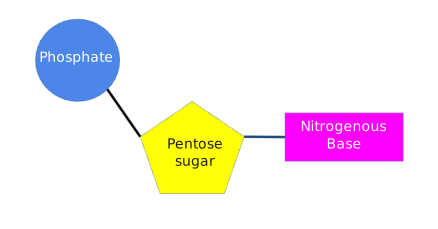
Both DNA and RNA are polymers of nucleotides. Each nucleotide is formed from a pentose, a nitrogen-containing organic base and a phosphate group.
As mentioned in the spec point, both DNA and RNA are composed of nucleotides.
Nucleotides are composed of 3 things:
- Pentose sugar:
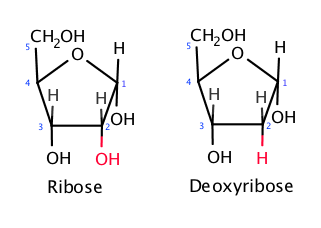
- RNA = Ribose (contains an OH group at the 2′ carbon)
- DNA = Deoxyribose (lacks OH group, has H instead)
- Phosphate group
- An organic base: adenine, cytosine, guanine or thymine in DNA/uracil in RNA.
Ribose vs Deoxyribose
Phosphodiester Bond
What you need to know (based on the AQA specification)
What you need to know (based on the AQA specification)
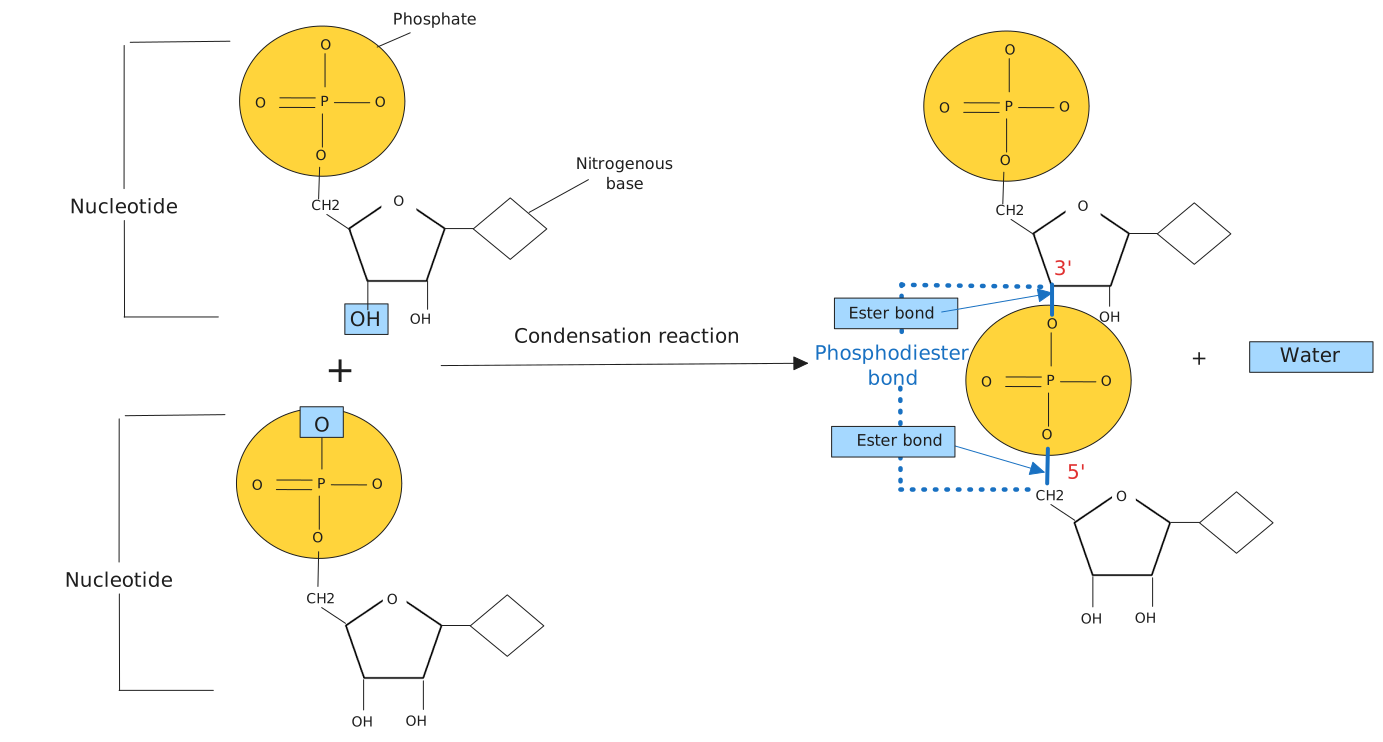
A condensation reaction between two nucleotides forms a phosphodiester bond.
A single nucleotide (mononucleotide) consists of 1 pentose sugar, 1 phosphate group and 1 organic base (as shown in the figure above)
Nucleotides can join together in a condensation reaction which forms a phosphodiester bond (a type of covalent bond) to form a polynucleotide.
As the name suggests, a phosphodiester bond contains 2 ester bonds linking adjacent sugars via a phosphate group.
This diagram below shows an example of 2 nucleotides joining as part of a condensation reaction. As this is a condensation reaction you can see that water is lost.
The bond formed is a 3′–5′ phosphodiester linkage, between the 3′ hydroxyl group of one nucleotide and the 5′ phosphate group of the next.
Why do we call them 3′ and 5′?
Why do we call them 3′ and 5′?
The carbons are numbered 1′ to 5′. This refers to the specific carbon atoms in the pentose sugar (ribose or deoxyribose) of a nucleotide.
DNA Structure & Function
What you need to know (based on the AQA specification)
What you need to know (based on the AQA specification)
The components of a DNA nucleotide are deoxyribose, a phosphate group and one of the organic bases adenine, cytosine, guanine or thymine. A DNA molecule is a double helix with two polynucleotide chains held together by hydrogen bonds between specific complementary base pairs.
-
DNA is made up of 2 long strands of polynucleotides arranged in a double helix
-
The two strands run antiparallel to each other
- One goes in the 5’ to 3’ direction, and the other runs in the opposite direction (3’ to 5’)
-
There is hydrogen bonding between these complementary bases:
- Adenine bonds with Thymine (2 hydrogen bonds)
- Cytosine bonds with Guanine (3 hydrogen bonds)
-
Phosphodiester bonds hold together the nucleotides and this forms the sugar-phosphate backbone. Think of it like a skeleton, holding together the DNA nucleotides.
-
The stability of the DNA structure is maintained by the bonding:
- Hydrogen bonding between bases
- DNA molecules with a higher proportion of C-G base pairs are more stable due to more hydrogen bonds (3 hydrogen bonds vs 2 hydrogen bonds, see image below)
- Phosphodiester backbone (commonly referred to as sugar-phosphate backbone) held together by phosphodiester bonds helps to protect the inner bases.
- Hydrogen bonding between bases
-
DNA is negatively charged due to the presence of phosphate groups
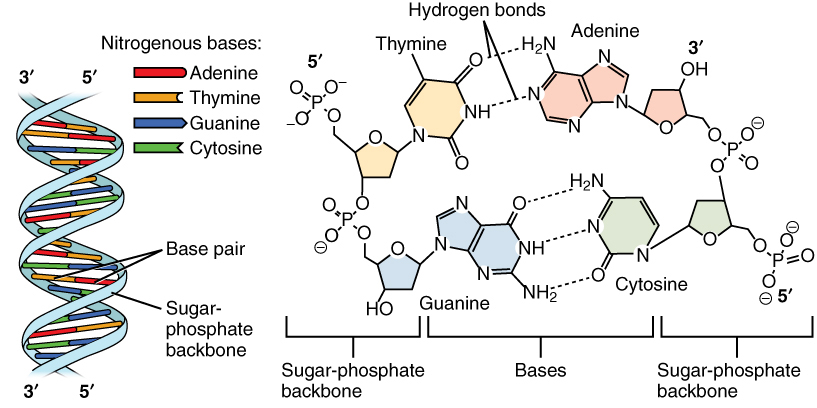 Image: DNA Nucleotides by OpenStax College, licensed under CC BY 3.0, via Wikimedia Commons.
RNA Structure & Function
What you need to know (based on the AQA specification)
What you need to know (based on the AQA specification)
The components of an RNA nucleotide are ribose, a phosphate group and one of the organic bases adenine, cytosine, guanine or uracil. Ribosomes are formed from RNA and proteins. An RNA molecule is a relatively short polynucleotide chain.
- RNA has ribose as its pentose sugar
- RNA is a single-stranded polynucleotide molecule.
- It’s shorter than a DNA molecule
- 3 types of RNA
- Messenger RNA (mRNA): Carries genetic instructions from DNA (transcription) to ribosomes
- Transfer RNA (tRNA): Involved in translation by bringing specific amino acids to the ribosome
- Ribosomal RNA (rRNA): A structural & functional component in ribosomes
- More about the different types of RNA and their role in protein synthesis is covered in DNA & Protein Synthesis
Differences between DNA & RNA
| Feature | DNA | RNA |
|---|---|---|
| Sugar | Deoxyribose | Ribose |
| Bases present | Adenine, Thymine, Cytosine, Guanine | Adenine, Uracil, Cytosine, Guanine |
| Number of strands | Double-stranded (double helix) | Single-stranded |
| Length | Very long | Shorter |
| Stability | More stable | Less stable |
| Function | Stores genetic information | Involved in protein synthesis |
| Types | One type | mRNA, tRNA, rRNA |
| Phosphodiester bonds | 3′–5′ phosphodiester bonds | 3′–5′ phosphodiester bonds |
Exam Question Practice
Describe the structure of DNA.
(5 marks)Hint
It’s a 5 mark question, so try to include 5 points about DNA structure. Think about the components that make DNA, and the two types of bonds that are present in DNA.
Mark Scheme
- DNA is a polymer of nucleotides — individual nucleotides are the monomers that link together to form the long chain (1 mark)
- Each nucleotide is made of three components: deoxyribose (a pentose sugar), a phosphate group and an organic/nitrogenous base (1 mark)
- Adjacent nucleotides are joined by phosphodiester bonds, forming the sugar-phosphate backbone (1 mark)
- DNA consists of two polynucleotide strands coiled into a double helix, held together by hydrogen bonds between the bases (1 mark)
- The hydrogen bonds form between specific complementary base pairs: adenine pairs with thymine, and cytosine pairs with guanine (1 mark)